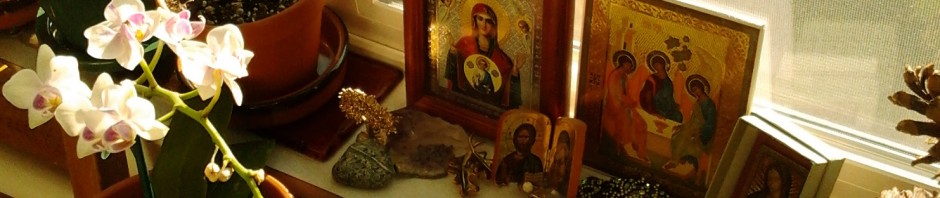
Moonrise in our courtyard, edging in over the buildings and trees, came along at 11:19 last night. In most of my phone camera photos, even the most dramatic moon just looks like a paper dot from a hole punch. And this is a waning little moon, not one with a special seasonal name even.
But this very moon shining in through the window might have crafted the latest in a lifetime of Connection Dreams.

In last night’s dream, there was a moon just like this one. I watched it rise from the imaginary back porch of a lovely old imaginary farmhouse, looking out on a grove of miniature trees covered with purple plums.
So far, there’s nothing moonstruck or mystical about a dream like that; plum season is in full swing right now. Neighbors have put out signs saying “Free Plums!” with boxes full outside their houses. Our very gracious Iranian neighbor even propped a ladder against his tree for the convenience of passing freeloaders. He and I met years ago when I paused on the street to admire one of his fruit trees. He immediately charged out of his house with a full shopping bag of apples and plums to insist that this perfect stranger, me, take it all home and then come back to pick more. (He has a hearty jolly sense of humor, so later on in my general enthusiasm for Persian language and good manners I told him “If you were a real Persian, you would dig up a tree or two and transplant them to my yard.”)
Anyway. In the dream a dear new companion (not a person from real life at all, but one who was, well, dreamed up) was waiting in back of me with quiet patient anticipation, giving me time to admire that lovely old farmhouse and farm that he’d been tending all his life. As I stepped ahead of him off the back porch I looked around at the yard, and saw that he’d restored the land and turned it into a food forest full of edible leaves, fruit, and nuts. The plum trees were bowed down with plums, so he’d even built a heavy wide semi-circular wood footstool with hand rails to fit right around the trunk of an especially short tree. That way even small children would feel safe climbing up to help themselves to plums.
The orchard was just beautiful, wisely planted with only very compact trees that were easy to care for and harvest. The stepping handrail bench was such nice woodwork, and such a thoughtful finishing touch for wee guests, that immediately I grasped my host’s vision behind it all: this was a yard and home where children would enjoy coming over to visit and play. That did it. I was completely won over. I’d found my person and my home and shared mission! Overjoyed, I cried out “Так дéти будут здесь игрáть!” or “So children will play here!” With this Russian outburst I actually woke myself up, and perhaps the neighbors? just as the alarm clock called me to real life: a day of customer service, helping people fill in and process a wide range of bureaucratic letters and forms.
That is a connection dream. They happen all the time. They appear with lifelike clarity and a profusion of fine details, often quite beautiful. They connect and continue for years on end, usually in one of three themes.
Theme 1: Family
This one is infinite variations of being at home with family, cooking and cleaning and feeding the chickens and bringing pie to the neighbors across the road and waiting for everyone to come home for dinner. Same plot, different imaginary companions.
In one family dream it was early dark morning in Minnesota in a howling snowstorm. In a Victorian house I was in the kitchen rotating a bunch of bread loaves in the gas oven. One of the kids was doing his math homework at the table, narrating word problems to me with some humorous commentary. Oliver nine years old with glasses and a mop of red hair, and he was a hilarious smart aleck wisenheimer with a snappy retort for every occasion. That was a very happy dream. But then I woke up with a start thinking “Are we late to school? How’s the driving, in all this snow? Oliver has to pack up and get to math class.” Then I burst into tears, figuring out that there is no Oliver with me, and there never was. [Later addition: I edited in a different name so the imaginary figure could have a pseudonym, out of a superabundance of caution in case someone in Minnesota has a kid by the other name and is taken aback by that. I’ve never been to Minnesota, but who knows?]
9/7: Last night’s connection dream was at home, home being a college sorority in another Victorian house, and on the evening of Graduation Day the girls were all wildly excited with dressing up and doing their hair and packing up to move out, with parents and boyfriends on the way to sweep them away for celebrations and on to their new homes. The dream was high-spirited fun and waves of chatter and laughter and some tears, and I was fixing their dresses and sorting out which pots and pans belonged to which girl and calulating everyone’s share of the utility bills and addressing packages for stuff that they wanted sent on ahead and also keeping watching out the window because one of the boyfriends was a star athlete bringing the rest of the sports team with him for a cheering sendoff. Finally the girls were on their way out the door, off to their weddings and grad school in Europe and jobs in New York City and all, and I was alone cleaning up the house putting everything to rights again. I woke up and could still feel them piling onto me for a last group hug.
Theme 2: Faith Community
Another connection dream is heading to an Orthodox Christian church for Vespers in a very close warm spiritual congregation. The little church looks ordinary, but a parish construction project uncovered something really wonderful inside the wall: an ancient work of art that was bricked up for safekeeping, dating from the earliest days of Christianity. It’s a miracle-working red icon that predates all the traditions of painted icons, and instead is a tile fresco of the Blessed Virgin made up of all shades of red crushed rubies and crystals and glass. Now, in real life I’ve never come across mention of a red ruby fresco icon. (Interesting: deep red is a typical color for Mary’s robe in Orthodox icons — unlike the white robe and sky-blue veil that she often wears in Catholic statues and paintings.) But this red icon quest dream has come back over and over for many years. Each time, the critical mission is to get to the icon for a special prayer and blessing that will really set me on the true path closer to God and salvation. And every time, travel to the church is full of darkness and hazards, and the church is locked and closed, and there is no spiritual community at all.
In a red icon dream just last week, the red icon was on display for one day only, being shown and protected by an order of Franciscan friar art restoration experts. The trip to the church meant forging through a crowd across a vast stone plaza in the burning sun and heat with a lot of pilgrim luggage, and getting there before the doors were locked. This time I was bringing my Mom, so that we could both view the icon and receive the blessing for our whole family. In the dream I knew that real-life Mom had passed away years ago — but here was dream-time Mom, looking very young and joyful and ethereally free of time and space. She found it delightfully amusing that I was concerned about plaza distance and viewing hours. As I tried to maneuver our way along she simply glimmered out of sight, and bells pealed closing time from the tower as the church disappeared.
Theme 3: The Heirloom
Another connection dream for years now is The Antique Shop that holds the missing heirloom keepsake — a small exquisite jewelry box. The lid of the box shows a precious inlaid miniature cameo portrait and name of my ultimate ancestor. Her portrait and name is the key to finding our ancestral origin, leading to a whole undiscovered family tree of living relatives waiting to be found. In every episode I’m there to search for the heirloom through an impossible trove of other objects.
In these dreams there are visits to the same antique shops over and over in various locations.
One dream shop is run by the Congregational Church in a specific white house in Vermont at the top of a hilly driveway planted in pumpkins and run by two delightful elderly sisters. They have a whole glass-topped counter display of colonial thimbles and other sewing notions.
One time, the dream shop was called The Bitter End Times, located in the Australian outback near a blue asbestos mine and run by a warm kind father and son, beefy guys with sleeveless undershirts and beers in hand. The shop is draped with a rabbit-proof fence made of spun sugar and set with precious jewels. In that dream I was searching through an endless mine tunnel piled with artifacts. At sight of the beribboned locks of baby hair and wedding rings and faded roses kept in memory of deceased loved ones, I started sobbing with grief. The father and son stood there with their beers and a good laugh. They finally pointed me to the punch line of the whole Bitter End cosmic joke: the jeweled fence was a portal to heaven, where all the babies and brides and everybody else were alive and united again.
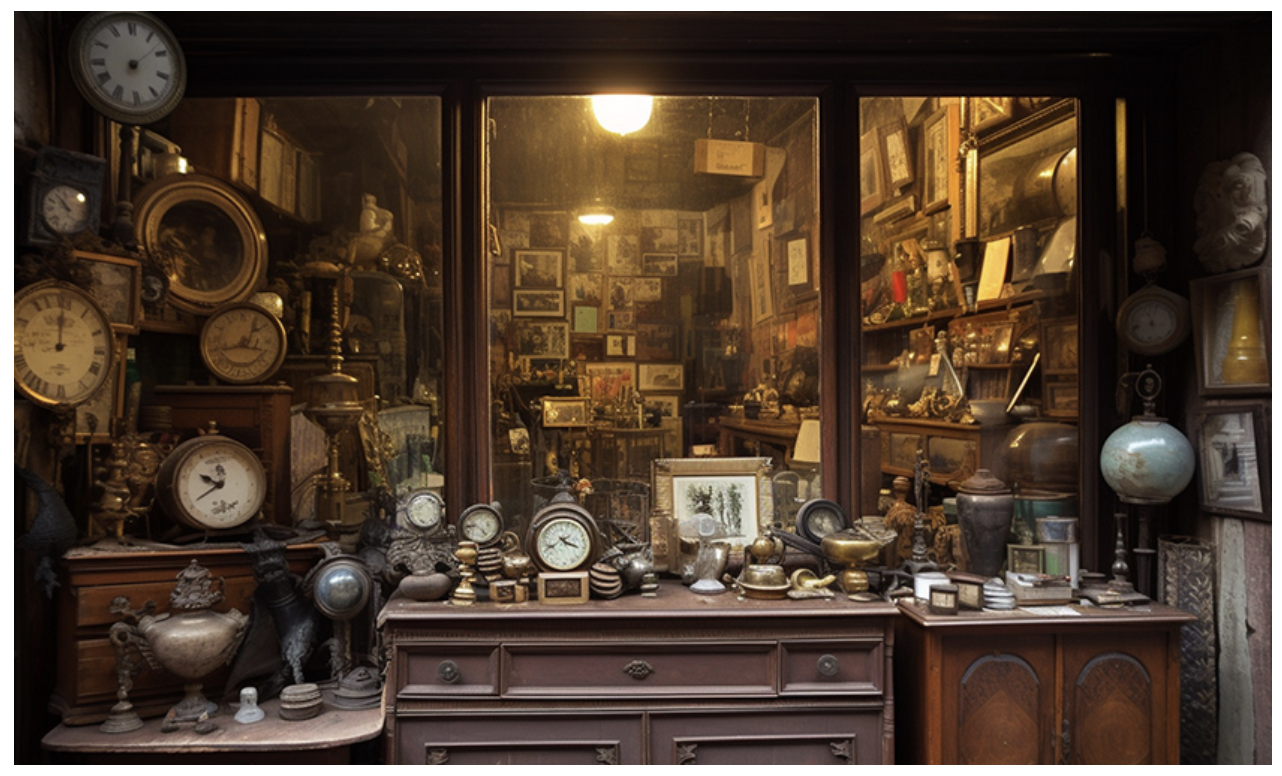
But the main dream shop is on Nevsky Prospect in St. Petersburg.
The St. Petersburg website pravmir.ru used to offer profound articles about Orthodox spirituality. Nowadays it’s news features about modern parenting and education, but I still glance at the headlines from time to time to pick up interesting new vocabulary. Last January there was a Christmas-y type fable that might (maybe?) have been composed by entering a query for “Christmas-y type fable” in a generative writing program. That would have been a forgettable instant.
But it was startling to come across the accompanying illustration, a photograph (wait — is that a real photograph?) described in the fable as an antique shop on Nevsky Prospect in St. Petersburg:
(Update 9/23/26) There are certainly disconnection dreams as well. In last night’s installment, after an epic journey I finally reached a mountain top looking out over an immense valley, the home country of the relatives that I’d come to find. It was a lush beautiful place, all tiny houses and terraced gardens and grapevines. But alas, the relatives had heard that I was coming, and they’d packed up their horses and wagons and vanished never to return. I woke up so upset that it took serious self-talk to remember: you’ve lived without these people all your life! You’ll survive without them. Now get up and go to work.)
In Orthodoxy the practice is to firmly dismiss and forget dreams as a pointless distraction and a likely sign of harmful прéлесть, or spiritual delusion. Any Orthodox priest-confessor, if I could find one, would reprimand me for dwelling at all on this sign of an overactive imagination. After all, I am not a clairvoyant prophet or ascetic gifted with special revelations. This is a sentimental single person who after 7:00 pm really needs to be closing the day with evening prayers rather than the chocolate covered peanuts that I ate tonight.
All this dream imagery and plot line was never my idea. At least thank goodness the dreams aren’t menacing, and the imaginary people are benevolent figures. But it does seem eccentric and draining to wake up in tears, missing people and places who don’t exist. It would be fine if it all disappeared, and that imagination went to productive problem resolution and community out in the real world.
We can write it off as just an everyday modern symptom of loneliness and disconnection, and then set out every day to build a better world, and leave plenty of grace for the dreams of those around us, awake and asleep.