Big Disclaimer: “Why is this writer reviewing this glorified bling nugget of candy-coated history? Does she have a dim clue about the seriousness of world events happening right now??” She does, and feels scared and immobilized on a daily basis. Typing up little musings is her escapist break at the end of the day.
This lavish sparkling period epic romance deserves credit for its acting, effort, and aesthetic taste. Maybe I’m the only viewer troubled by three thorns among those roses. Let’s take a look.
The His and the Handmaid refer to Matthew Lykov (Матвей Лыков) as Count Nikolai Sheremet’ev, and Milana Bru (Милана Бру) as Anna Averina and their romance under escalating duress and danger.
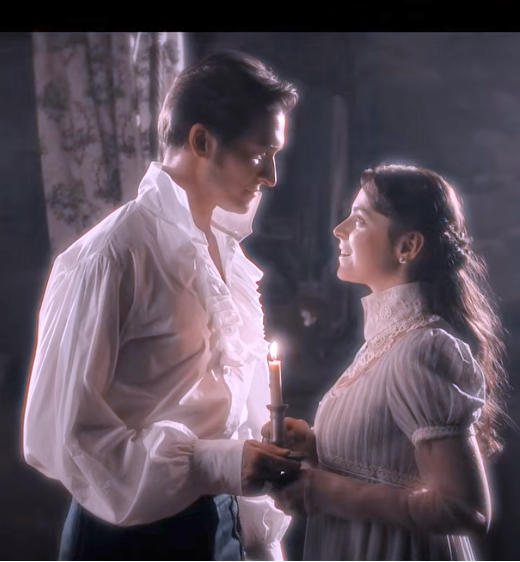
Russian streaming service subscribers can watch all 90 episodes. For the rest of us there are three-minute clips on You Tube. Watching them is like picking up sparkling confetti off the street and then assembling the pieces to guess what-all that parade was about.
How did this show appear on the radar? The Angel Studios production of “Seeking Persephone” [= upcoming post] won me over so much that while performing other computer tasks I play the episodes in the background, tilting the computer screen away from the windows so the neighbors don’t know I’m watching the same show over and over.
So some clever internet algorithm calculated this: Why not toss her another early 19th Century matchmaking epic about a beautiful innocent girl from a ruined noble family who must save herself and her relatives by embarking on unwilling exile at the castle of a handsome single aloof depressed self-isolating nobleman of unlimited wealth, and then must win him over with sweetness, light, and acute emotional sensitivity to his moods and needs and trauma to transform him into an ideal spouse? Only this time let’s send the viewer a show in Russian. Will that get her attention? It did. I fell right in, at least for a few episodes.
There is a whole bouquet of reasons why the courtship is so appealing. And, there are three reasons why I need to stop watching these clips and find a new hobby like tatting or scrimshaw instead.
Our Plot So Far:
Count Nikolai Sheremet’ev from Saint Petersburg is one of the richest men in the Russian Empire. He is a war hero back from fighting the French, sent home from the front on medical leave due to battle fatigue. For him, the medical furlough is a profound loss of face, and he intends to recover his nerves and get right back to active duty. Then Nikolai inherits his mother’s Moscow estate, on condition that he marry within one year — to a bride of high society and fortune and name approved by the Sheremet’ev clan. Nikolai arrives in Moscow with Potáp, his faithful manservant (or are we talking serfdom here?). He plans to settle Mother’s affairs, secure that advantageous wife, leave town, and get back to the army.
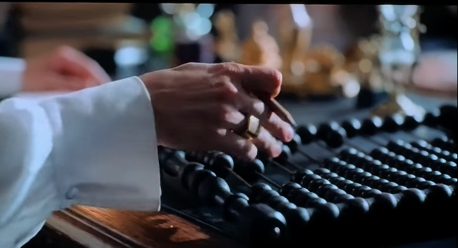
Nikolai likes to be left in peace from Moscow society and from domestic fuss. (“I care nothing for new acquaintances, and less for the old ones.”) He relies on an undisturbed breakfast alone with a copy of Moscow Véstnik newspaper. Then he adjourns to the study to manage the estate. (Here he calculates taxes on an abacus. It takes only nine columns to calculate 9,999,999.99 rubles and kopecks, but his abacus has twelve columns. This lad has some cash.)
And yet, for some reason Nikolai finds leisure for an evening of cards, where he wins away the family estate of a Mr. Averin. Now Nikolai is stuck with two superfluous Moscow estates instead of one, and the Averins are homeless and penniless because their Papa went and bet the ranch. Averin challenges Nikolai to a duel, having too little wit to realize that if he kills Nikolai then the gambled estate will go to the Sheremet’evs, not back to him. Daughter Anna Averina invades Nikolai’s house and demands that he cancel the debt. Nikolai proposes that to pay off the debt, Anna can work as his maidservant for one year. She slaps him in the face and storms right back out of the house, but soon returns to agree and sign a contract: for one year she will clean house, step and fetch at elegant dinners for potential wife candidates, and keep the estate peaceful from interruptions so that Nikolai can go back to the life he had before.
Questions. The whole Imperial Army probably had battle fatigue; why was only the wealthiest officer sent home for a lengthy rest? Why doesn’t Nikolai seek a bride in St. Petersburg instead, where he has a lifetime of relatives and associates? How can a large estate be paid back in one year with the amateur puttering of one young noblewoman with an ostrich feather duster? Why did the idle philandering Averins toss their daughter to the wolves of Moscow gossip, letting Anna perform manual labor and dwell unchaperoned in the home of a single man? Why didn’t Averin and his son volunteer to go work instead or in addition, as two more workers for the price of one, with no maidenly reputation to risk?
Anna arrives with Simka, her lifelong lady’s maid (or are we talking serfdom here?). (Update: Yes we are. The two women have lived together all their lives, and Simka is the one and only person who knows Anna well and who always stands by and comforts her. Nevertheless, one synopsis of later episodes informs us that when Simka and Potáp grow fond of one another, Anna considers legally selling Simka [even typing that sentence is reason to cringe] over to Nikolai, so that the two servants can get married.)
Meanwhile Anna is willful and spirited, putting up a fight at every opportunity to defend her pride and status while learning how not to burn toast. Anna’s hapless housekeeping gives us the innocent Lucy and Ricky Ricardo phase of their acquaintance. Nikolai is obliged to scoop up a fainting Anna in his arms and rush her upstairs out of kitchen smoke after she sets a pan on fire. He catches Anna as she falls off a bookshelf while dusting. He carries Anna to the house after she sprains her ankle. He carries Anna out of the study after she tries nips of his liquor and passes out cold after insulting him six ways from seven. He catches Anna after she playfully bounces on his bed on mattress springs that weren’t invented until decades later.
Anna eventually settles in, waltzing through the half dozen rooms with her feather duster, pouring tea or shelving books or arranging flowers. The bored depressed veteran cooped up in a strange estate far from home finds diversion in his new maidservant. In her light radiant presence, he becomes a warm protective presence himself and soon depends on her. There are tender lyrical scenes, as when Nikolai teaches Anna to play chess, or when he discovers that his PTSD recedes and he can fall asleep when Anna sits up beside the bed singing him a lullabye about the moon. Unaware of his own feelings, he begins toying with hers instead, reeling her in easily with many subtle overtures of affection. To paraphrase the Pet Shop Boys, he’s got the looks, she’s got the time; they’ll have lots of money. Why not? The gentry have written her off as a laughingstock no longer worth marrying, her philandering family doesn’t seem to know she’s gone, she already lives in his house, she falls under his spell right off, and she is learning to make toast. Nikolai impulsively gives Anna his mother’s ring, and they plan an engagement ceremony. Happy ending!
Maybe. The young lovers are supported only by servants Potáp and Simka, loyal people with a lick of sense who ply colorful banter and keep the house running in a pitch-perfect acting performance. But Anna is not a candidate approved by the family. Soon extraneous characters circle in like buzzards, with increasingly dangerous distractions, strategems, schemes, ruses, and maneuvers using gossip, lies, duels, extramarital betrayal, and character assassination. Nikolai’s aunt, powerful Princess Vorontsova, wants the estate for herself. She plans to move in and have Nikolai placed under “medical supervision” (= involuntary commitment?). After a good look at Anna, the Princess vows “I want her to disappear from his life forever. At ANY price.” Princess is a mouthpiece for a cruel social class, and Anna really ought to heed every word as an accurate early warning. For example, Princess warns Anna that Nikolai’s outbursts and gun collection might catch Anna in the crossfire one day. Is that even a possibility in a romantic relationship? Actually, yes. (Whatever her motives, here Princess plays the talking role of Rhett Butler. Throughout Gone With the Wind, Rhett kept reminding the other characters that their stated values did not at all match the hypocrisy of their actions; the only people that Rhett exempted from his sardonic sarcasm were the people of honor: Mammy, Melanie, Belle Watling, and Bonnie Blue.)
Princess Aunt and other persons of vested interest confront Anna with a dilemma: If Nikolai weds a woman of Anna’s lower class in an unconventional morganatic marriage, he will lose his entire fortune and will face prison in Siberia or a posting to a suicide squad at the front or both, and does she really want to destroy his life? If this is true then Nikolai is fully aware of that fact, and knew it before he started flirting with his new servant. He and Anna were born and bred and programmed to marry high and to keep to their own social class. Ideally, the two of them could have a serious talk about the future with their families present for good counsel, but there are no sensible relatives in sight.
Instead, Anna takes drastic measures. She sees that Nikolai is determined to defy convention and to marry her. To save his future, she resolves in secret to sacrifice her happiness; then Nikolai can marry someone else, collect the estate, and return to the front. She abruptly thrusts his mother’s engagement ring back at him. She announces that she does not love him and was only playing a “game of deception,” then slips away leaving him in tears. Cobbling together a display of contempt, she goes on serving eligible Moscow girls and their mothers while desperately eating her heart out pining for him.
Nikolai is blindsided by her rejection. Even on a 12-column abacus the man can not calculate why this sensitive girl would renounce her first love and start fleeing from him. He probably can foresee that without Anna’s constant devotion he is burning toast himself, subject to whatever future psychological implosion will put Princess Aunt in charge of him for good. In various confrontations he demands an explanation, towering over Anna and trying to restrain her while she yanks herself free from his grasp and flees all tearful to the servants’ quarters. He informs Potáp in few words that Anna has “no feelings” for him. (Potáp is unconvinced. He and Simka chalk this up to upstairs gentry acting like fools. Anna, without feelings? In what galaxy?)
Nikolai resorts to black-ice condescension toward Anna, and a show of being charmed by the rich females all around him. What else is a guy to do? Well, a lot. He can keep in mind that Anna puts up a fierce front when she is most afraid. He can secure Anna’s safety by blocking Aunt Princess and her minions from accessing and tormenting her. He can go talk to Simka and Potáp, and find out what kitchen investment will make Anna’s work easier. He can write a letter to that philandering family of hers, with a glowing report of the blessing that she is in his home and how highly he respects her fine character. He can write Anna a little thank you note with a line or two every day thanking her for something she’s done, maybe add a white rose from the garden outside. He can just give her a smile every time they pass by in the hall. And sure, he’s devastated, and it shows. But he also has 100% of the power here while Anna has no home, no money, no family honor, and nowhere to run.
Can this romance prevail? Who knows? There’s 90 episodes!
What’s To Like?
So much. After a workday of customer service and detail-driven problem resolution, any first moment in any scene in История его служанки lets my mirror neurons calm down and cheer up. Every three-minute confetti clip is an aesthetic treat. Every scene opens with floating drifting views inside a massive gorgeous estate house. True, from the outside it looks a bit AI-generated, and inside everyone keeps to only a few rooms: office with library, his bedroom, drawing room, and not much else but a wee kitchen downstairs. But these interior shots (and apparently it’s all interior, even the scenes staged to look outdoors) are just beautiful. This is a high-ticket production with interesting roles and wonderful camera work and many creative people working hard behind the scenes. In random how-it-was-made clips all the actors seem truly fond of one another and are apparently having a grand time.
The viewer comments are part of the experience, an interesting window on a contemporary audience. There is spirited discussion about details of history, speech styles, wardrobes, and the characters: I’m only here to watch Lykov’s acting or Anna girl, hold on! That is NOT a wedding ring! or Nikolai, just marry her! Quit dragging that cat by the tail! or Nikolasha, you have money to burn already. Give the estate to Auntie, grab Anna, and get back to St. Petersburg!
Anna is lovely with her dark remarkably expressive eyes, heart-shaped face, alabaster complexion, long wavy dark hair, willowy graceful figure, and refined gestures and silken voice. The one puzzlement, and this is in no way a criticism of the actress Ms. Bru, is her presentation in this role. She is assigned chalky pale makeup with a glossy-moist finish, a color filter of orange tones for her lips and the shadows around her eyes, and a tumbled unbrushed hairstyle with random hairpins and loose strands. She wears only fragile gauzy powder-blue dresses that would never hold up for butchering chickens or scrubbing the sheets. The production values are so high that this must be a way to emphasize her very youthful fresh delicate personality. It also raises anticipation that a major glowup makeover must be in the works for Anna, to be unveiled later in the series.
In masculine contrast, Nikolai with his luminous eyes and well-favored features and compelling physical grace and vocal timbre looks smashing in a seemingly endless wardrobe of bold intense blues and reds. Each garment and accessory is perfectly appointed to accentuate every social nuance and emotion. As a viewer with no fashion sense, I can not recall ever seeing a man who is so masterful at wearing lots of clothes and moving around in them. It turns out that the multilingual Mr. Lykov is internationally famous in the fashion and design world, with a list of credentials including the Russian term Top Módel.
So What Could Possibly Go Wrong?
Issue One: The cavalier handling of guns and weapons among even Napoleonic War military veteran characters who know better.
“Chekhov’s gun” (Чеховское ружьё) is a familiar literary device; as the author repeated in various ways, One mustn’t place a loaded gun in a scene if no one plans to fire it. (Нельзя ставить на сцене заряженное ружьё, если никто не имеет в виду выстрелить из него.) Well, this show gives us no chance to build up suspense around the guns in various scenes: in this household the firearms get tossed around like Pez dispensers loaded with popup candies.
At first, this review included screen shots with humorous captions, showing multiple howling gaffes in gun safety. But they’re deleted now. In real life, weapon accidents have caused too much loss of life and suffering to too many people.
This show could take the moral lead, and display gold-standard responsible gun ownership, especially for young viewers. It could include those standards in the dialogue. Is that too much to ask?
“No no, Mary; you don’t understand. The show is aiming (so to speak) for historical accuracy. These were folk of a simpler age, without our superior understanding of arms and ballistics.” Well, one scene shows Princess Auntie Vorontsova consulting with an expert about best ways to support her veteran nephew’s mental wellbeing. The expert warns her that all guns must be removed from Nikolai’s field of vision. Princess Auntie then buys Nikolai a gun.
In 1812, people knew what guns do when they are aimed and fired. Yet these characters violate every one of the following safety rules. One must always always assume that a gun is loaded. One must lock up guns in a safe, or put them in a castle gun room, not on one’s work desk within reach of the next temper tantrum or feather duster. One must not fling guns across the room. One should not hand a gun to a veteran with PTSD, pressuring him to fire it as homespun therapy. One must not come up behind said veteran as he is aiming the gun out the window, and passionately throw one’s arms around his neck as moral support. After firing said gun, the gun owner must not wave the gun all around one’s sweetheart while doing a happy dance of exuberance. One must not undermine the engagement of a depressed nephew by giving him yet another gun and then suggesting to the fianceé that the gun might be used on her. Most of all, a gun owner inside his study whose beloved is standing outside the door worrying about him must not petrify her into hysterics by blasting up a vase to let her think he’s shot himself.
Issue Two: Domestic violence, actual and implied, is packaged as a flavorful spice in the sugar of earliest acquaintance and attraction.
“What violence?? Nikolai doesn’t punch her out.” If that’s your low bar, sure; and at rough times he gives fair warning by barricading himself in his study and warning everyone to leave him in peace (they never do). But on day one of their acquaintance Nikolai waves a gun after Anna’s father, threatening to shoot him to dispense with the trouble of a duel, while Anna rushes her father out of harm’s way and Potáp pins Nikolai’s arm and holds him. Nikolai challenges Anna’s teatime suitor to a duel after grabbing him by the throat. Nikolai flings a pot of boiling milk across the kitchen. [Correction: My mistake. In a longer clip he doesn’t just pick up the milk and heave it; his hands start shaking and without meaning to he’s knocking stuff over and Anna runs over and talks him down.] Nikolai shouts at Anna to get away, and smashes a teacup at the wall so she will leave the room. Nikolai also uses alcohol to take the edge off his battle memories (At one point Anna keeps him sympathetic company by trying a dose herself, and passes out.).
In one conversation he confides to her that he can not always contain his rage, and that within him there dwells a monster. In another, she vows that she will fearlessly hold his hands when he is overwhelmed by wrath. In one tender scene she confesses that she is afraid of his gun and would like to hide it, but he smiles at her concern: “Let the gun be feared by my enemies. You are the complete opposite. I could never cause harm to you.” She gives him a brave smile and walks away hiding her tears. This early courtship features anguished apologies and forgiveness and reconciliation and his attempts to compensate with warmth and charm and white roses. It keeps Anna hyper-vigilantly tuned in, ready to intervene and distract and soothe and cheer Nikolai, in her pure faith that her love will heal him.
What’s the message? Is it teaching young men that domestic violence is kind of cool among good-looking heroes? Is it teaching young women that living with violence can be okay if the man is depressed and in need of sympathy and if he apologizes really well and is enchanting company most of the time?
Well, here’s a message from me that no one asked for: Bunny, you’ve got 90 days.
In my experience, that’s how long it will take your traumatized guy to figure out that you, with all the kindness in the lifeblood of your heart, are not the angel who takes away the pain of life. Inevitably he will conclude that you are to blame for all his troubles, including Napoleon. The next thing hitting the wall might not be the teacup.
Issue Three: If we’re trying for historical accuracy, then where is the immense and constant influence of 19th Century Russian Orthodox culture? Its foundation of humility, forgiveness, and discernment of God’s will, if the characters paid any heed, would clean this plot right up. In the clips I saw, faith is mentioned only three times, always by Potáp. His faith is shown as a humor device, part of his doggedly sincere servant class mentality.
The wealthy Muscovites portrayed here may or may not have cared about a personal relationship with God or living up to church standards. But if only for genteel veneer, or if only to suppress their sense of guilt for their scandalous shenanigans, the wealthy would likely have a private chapel or would support a local church. A couple becoming engaged would plan not just the type of party mentioned in the series, but first and foremost a crowning ceremony in church — an extremely serious milestone commitment in the eyes of the community. In the show we’d see some sign of everyday private devotions, icons, baptismal crosses included in everyone’s wardrobe, a social cycle influenced by fast and feast days and name-day celebrations, religious terms and sayings in everyday speech, possibly a pilgrimage if the household veteran needs to go find balance in his life, pilgrims and beggars showing up at the door for charity in the name of Christ, reflex gestures such as the sign of the cross at anxious moments, and most importantly a local priest to confess the family and counsel them on important life decisions. Instead, peripheral characters with their bounding lack of integrity seem unaware that Russian culture offers any precedent for emotional honesty and growth.
Other recent Russian shows (Father Matvei; Savior Beneath the Birches; on and on) found fond success incorporating truly devout spiritual principles. Why is there no aesthetic trace of Orthodox culture anywhere in evidence here? Why does this show portray zero characters of faith and wisdom?
I am a big fan girl for this production and its acting and dialogue and aesthetics and romantic sensibility. It has many loving lovely moments like this one below from the end of Season 2, episode 1. Hopefully the link works. (And if the link doesn’t work I’ll sing the song myself and try posting it here.) I’m in tears just typing about this scene, where a frightened Simka begs Anna to do or say anything to distract her from losing Nikolai. (Let’s do some needlework! Let’s go take a walk! Anything but this silence!) Finally Anna sings with Simka the moon lullabye that she once sang to Nikolai, while the camera pans over to him off in his study, brooding in misery.
Searchable title: “Душевное изнеможение историяегослужанки”
I want to invest my viewing time on portrayals of human nature striving to be its best under complicated circumstances. Without spending a single additional kopeck, this talented team could have shown characters being upstanding and kind and pulling together in times of crisis. Viewer comments for Season 1 were extremely positive, but with Season 2 episode 1 the general response was “Oh my goodness, that turned painful! I can’t look at these two poor confused children; I’m out of here.” There is solid literary precedent for Russian novels to be lengthy and dysthymic, but did the writers misread their audience this time?
So. Praise is due to the actors, and the crew of artists behind the scenes. There is likely to be a redemptive ending, and I’ll come back later to find out.
Fun spoiler alert, 189 years after the fact: The families mentioned in the show are actual figures from Russian history. In Holy Women of Russia by Brenda Meehan, page 30, it happens that in 1837 one benefactor of the women’s monastery at Borodino was Count D.N. Sheremetev (that N. would be Nikolaevich, or son of Nikolai). So a marriage of some kind worked in the end. I’ll tune back in at Episode 90 to check in on how these kids are doing.
Now about that tatting and scrimshaw….


Thanks for sparking my curiosity! I’m off to gather a few more pieces of confetti for myself.
Wendy D!
You should. And bring a tote bag: In your life the sparkly confetti is everywhere.
It’s really nice to see you.