11/23/25: Quince Fruit

Quince fruit (Cydonia oblonga) was a welcome new discovery, one that to more knowledgeable cooks is not new at all. This month two co-workers and one neighbor all shared their harvest supplies of quince, so it was time to study up and go test it out in the kitchen.

Apparently quince used to be common as a source of pectin in fruit canning, but with the rise of pectin powder people relied on the fruit less over time.

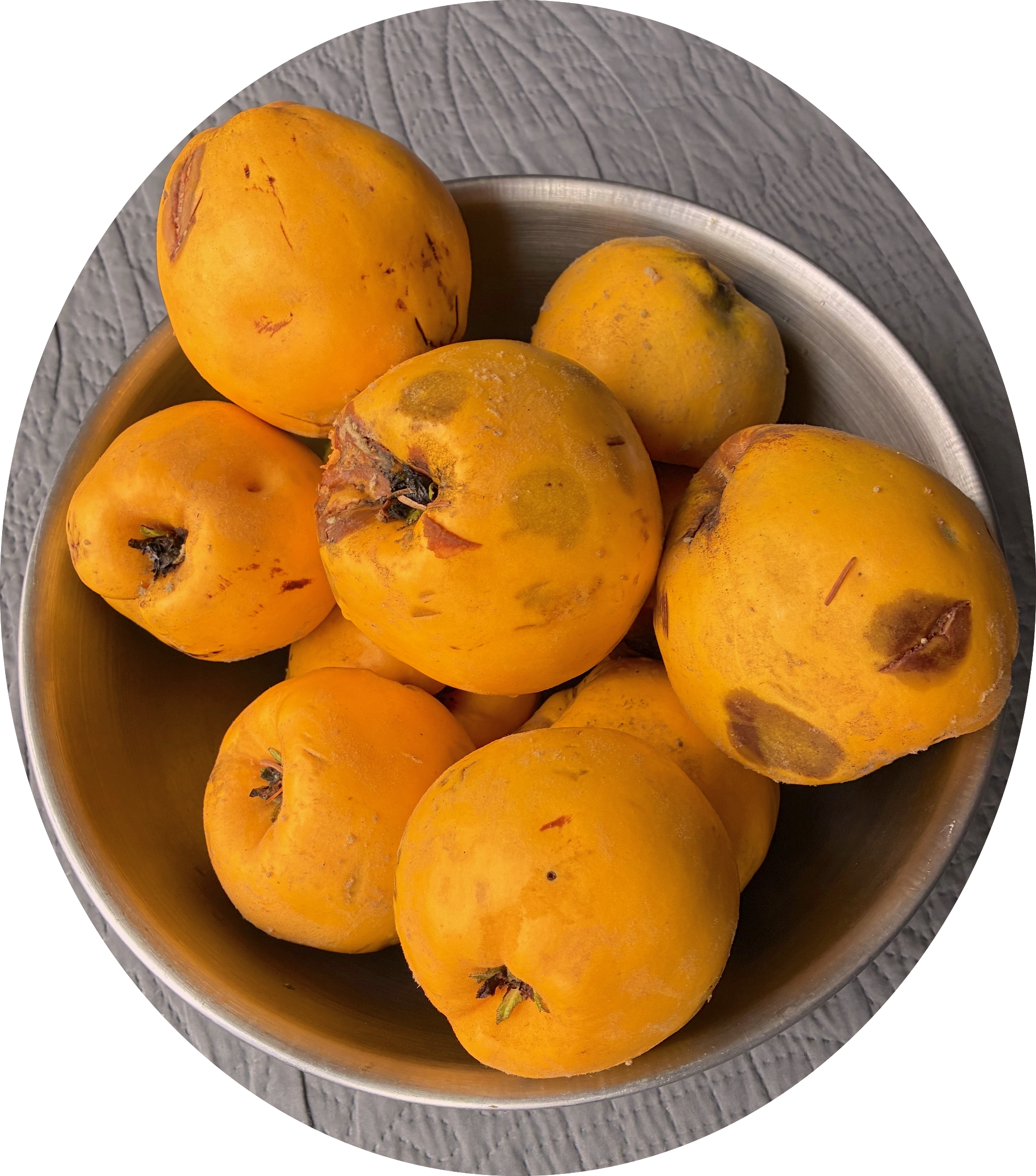
A quince fruit is like a giant heavy pear with a nice fragrance, tough skin, and woody flesh. They are not sweet as is. To peel and cut them takes some extra muscle and determination. Here are a few, staring me down:

Finally peeled, cored (don’t eat the seeds!), and chopped:

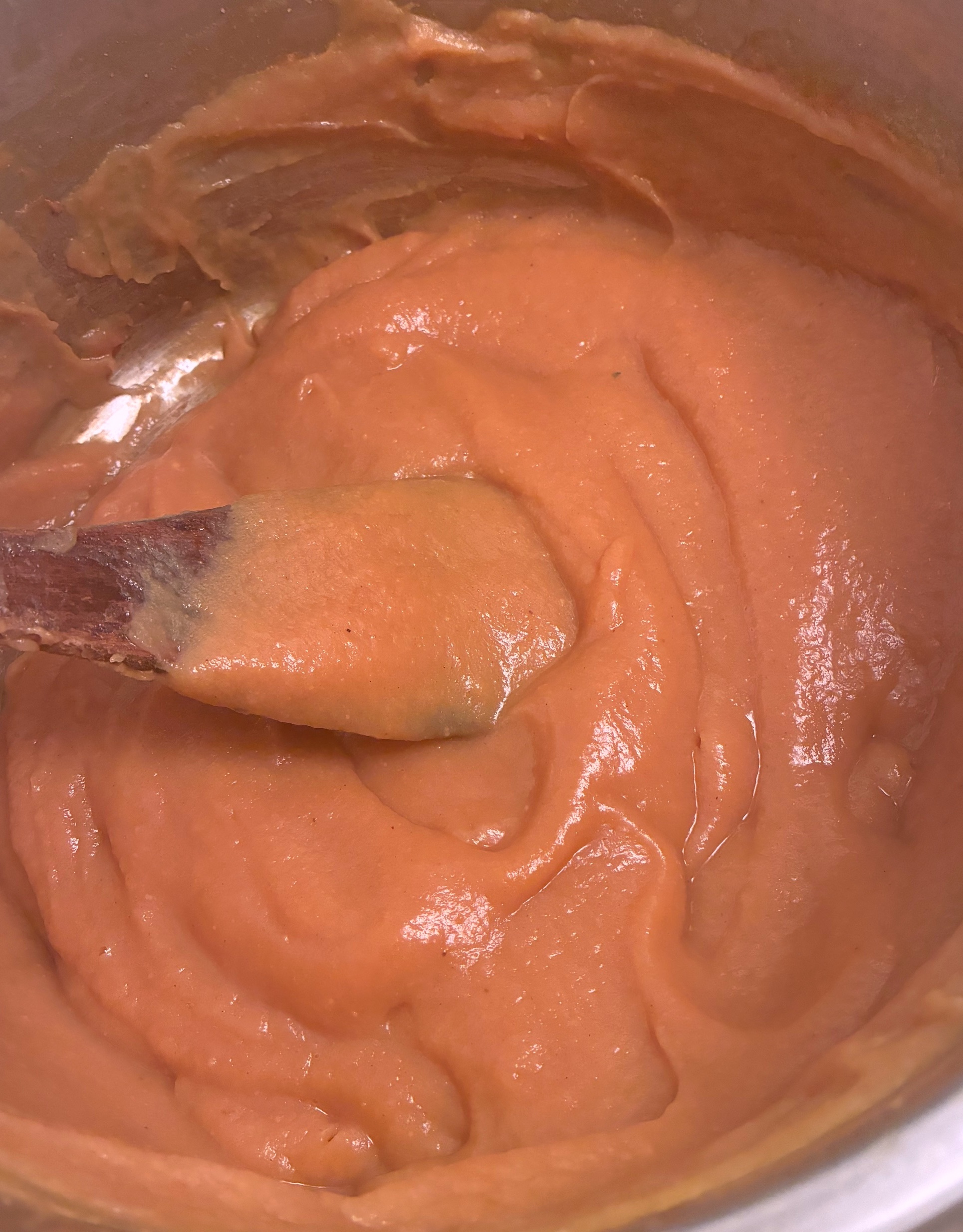
Quince simmered in water, then blended to a puree:

Quince pureed, simmered on low heat with regular stirring, for eight hours to half its volume:

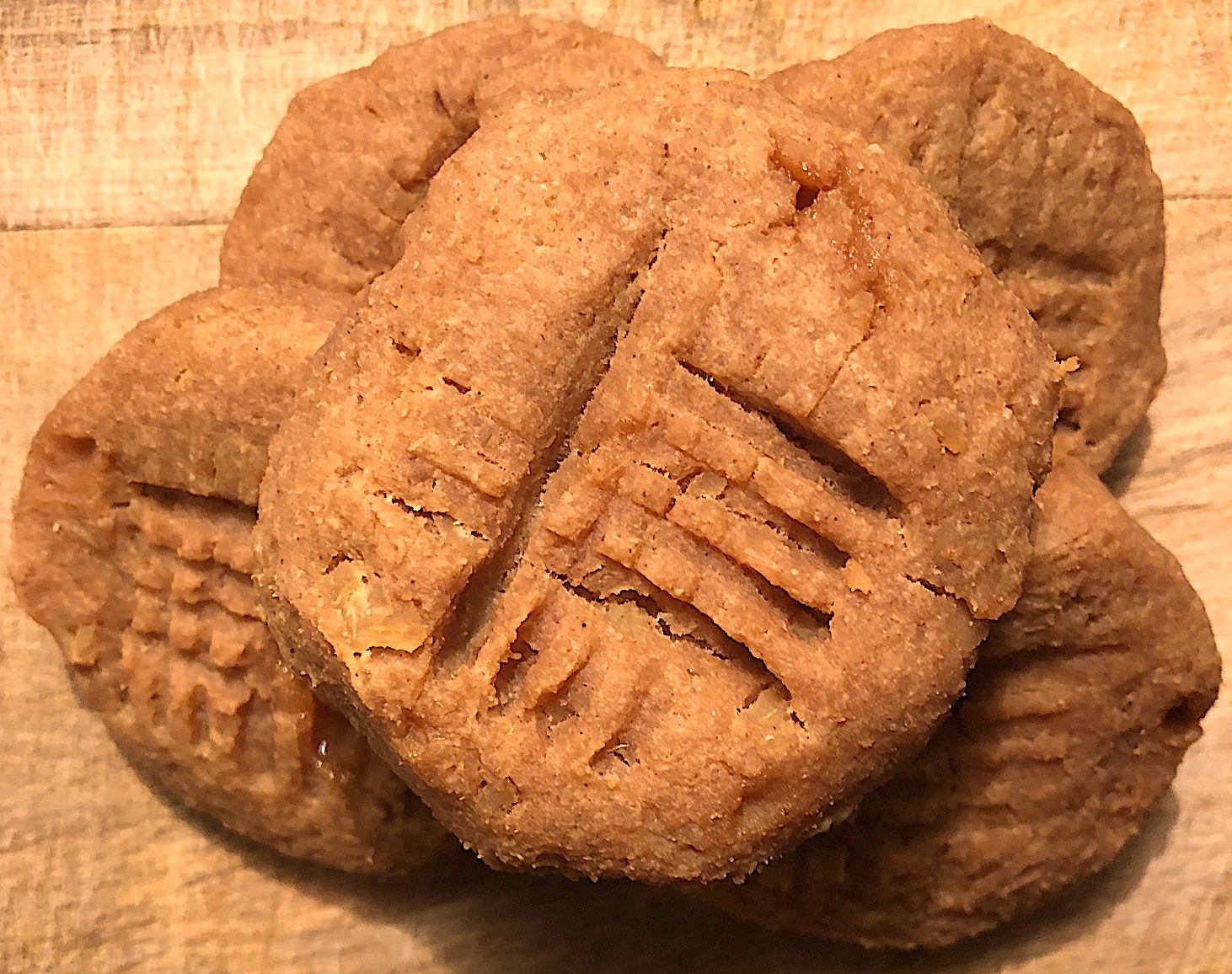
A popular recipe for quince is membrillo, a sliced gel eaten with Manchego sheep-milk cheese in Spain. The idea is to cook down the puree, add an equal volume of sugar and heat again to blend, then season with lemon and lemon zest and vanilla. The pantry is fresh out of lemon and vanilla. So I melted in some fair-trade crystal sugar (less than the 50% called for), and a dash of pumpkin pie spice.

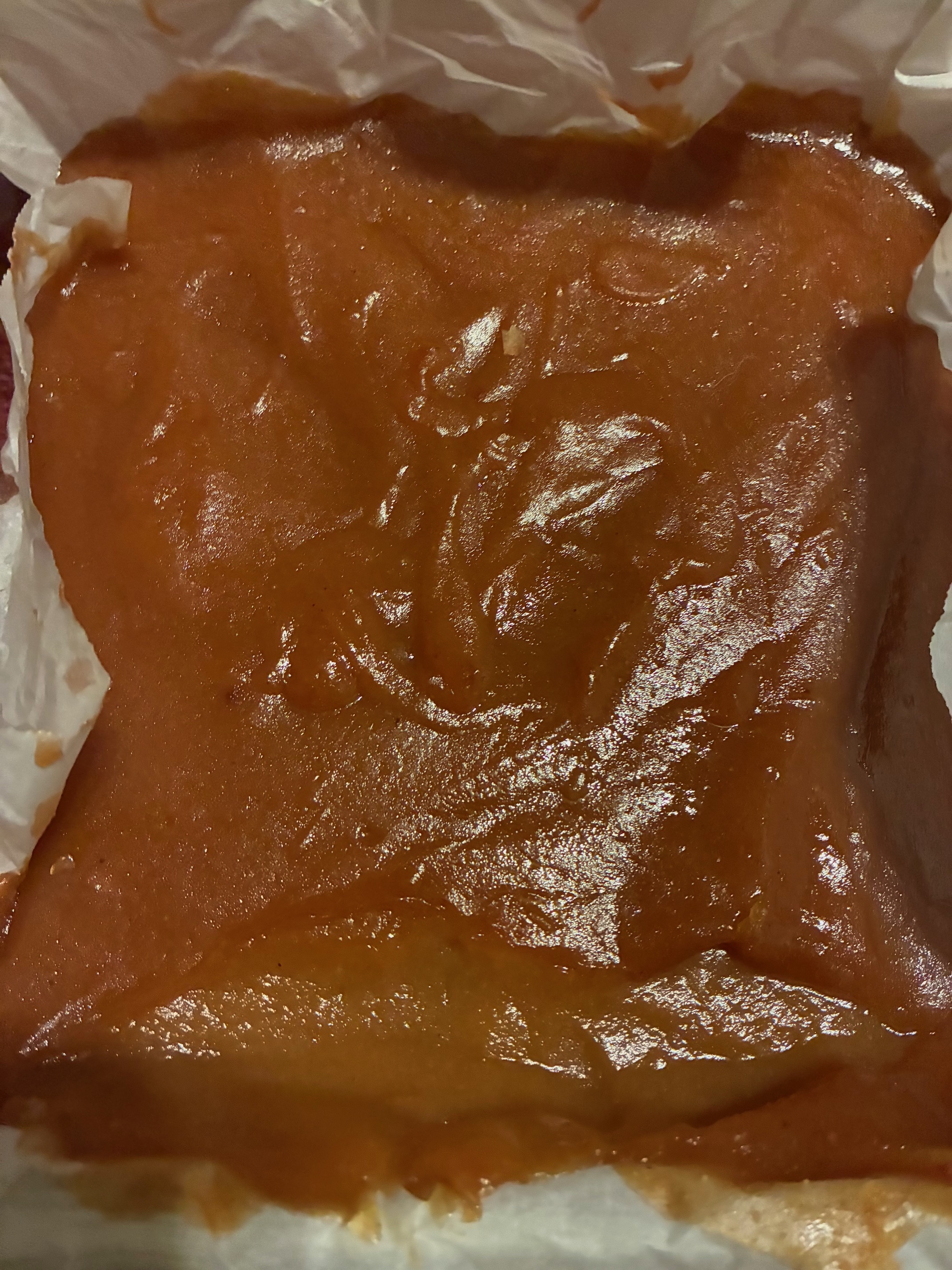
The purees goes in to a baking pan lined with parchment paper, and into the oven on low heat until the pectin forms a gel.

It’s been baking for several hours and Lo, it’s developing a fruit-leather skin on top.

Whether it sets and gels or not, at least it has a rich intense fruit flavor.

Here it is, after hours in the oven at 250 F. All those quince yielded 3 cups or so of halfway-gelled candied spread with fruit leather on top. Maybe it will thicken as it cools?

Would I ever try the membrillo venture again? Well, no. Last week’s set of quinces made an excellent stewed sauce blended half and half with pureed pears, and that’s plenty good enough. Still, this will make a novel holiday confection for the three people who shared their fruit with me, and at least this venture saved them 12 hours of kitchen fuss.

It was nice to experience a whole new legacy fruit, as a symbol of harvest generosity among our neighbors.

Posted in Uncategorized | Leave a comment

10/28/25: Medlars

The neighbors have a medlar tree. It’s not my tree, the neighbors don’t know me, and it’s too early in the year for harvest. But after days of hard wind and rain, some medlar fruits fell off the tree and were beaten into the mud. That made it feel ethically okay to pick up three weatherbeaten fruits and bring them home.

This would be the place to pile on details about how to “blet” and prepare the fruits. But looking up medlar history and recipes will be so enjoyable (well, for the people out there who enjoy looking up food history and recipes) that it’s only fair to let everyone have their own heritage plant fun.

These fruits have a long respectable colorful history that is worth learning. In colder climates the tree has been prized for its ability to lighten the winter by bearing us something sweet. Maybe our apartment complex will let me plant one here?

Posted in Uncategorized | 2 Comments

10/12/2025: Nanny Dogs of Eden

The Big Disclaimer: Knowing me, I’ll be polishing this post over and over for days. You might want to turn in a week from now for best results. Meanwhile, here it is.

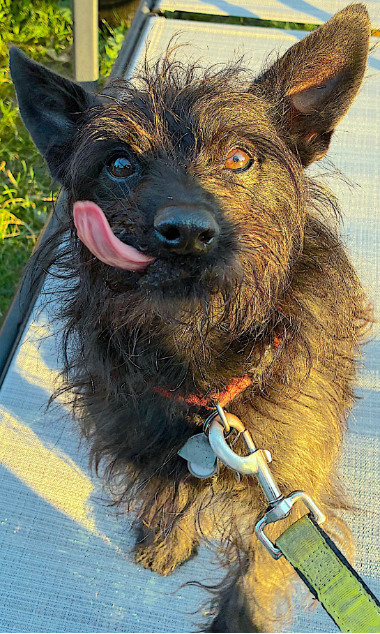
Here’s a friendly doodlecrumpet from our apartment complex.

He was wiggling right off his chair while offering me his left paw and licking his lips for the yum looking is that a protein bar? that is really my cell phone camera. An all-round good little egg.

Our neighborhood has lots of who’s-a-good boys and who’s-a-good girls. For example, Angelina’s beautifully cared-for dogs Super-Pup and Bingo have popped up in this blog. They’ve always been fun, friendly, sweet companions. Most dogs are amiable folk. They give me a passing sniff and wag; then they move on in search of stuff to chew, chase, or roll in. Every dog deserves safety, security, knowledgeable care, purpose, community, respect, affection, and a daily walk that actually goes out somewhere instead of roughhousing around and around. So this not to put down dogs, or the owners and their playtime right now outside this window.

What else is going on outside this window? A city with a lot of lonely people. Our Anglo-American tech-money culture keeps promising to fill in that loneliness with concocted substitutes. It seizes good healthy natural things and tampers with them, then markets and sells them to us.

About 60 years ago that image machine latched on to domestic animals who have been at our fireside for many centuries, and pitched their role as anthropomorphic action avatars promoted to be just as good as human companions, or maybe better. Social media and marketing have ascribed to dogs a whole range of human motives and emotions, handing down interpretations of canine behavior and inventing new social rituals to indulge our created tastes. Then it sells us products and services to maintain the avatar and keep it enshrined.

There are recipes for dog print cookies, made by pressing a dog’s paw into each circle of dough. There are keychains of dog figurines depicting a choice of breeds asleep wrapped in heavenly angel wings; in the photos it was unclear whether the dogs were sleeping angels, or were wrapped in wings while ascending to heaven. For those ascended pets, one zoo is organizing a new attraction for Día de los Muertos: an ofrenda, a commemoration altar, where visitors can come offer keepsakes and photos of deceased animal friends. A local school of psychic studies has classes in contacting deceased pets and channeling their messages to bereaved owners. A particular bank now has dog ATMs. While the owner withdraws cash, the dog can withdraw treats from a dispenser bowl. (That way he can share a food dish with who knows how many other dogs, and also learns that it’s fine to pick up food with undetermined ingredients from random sources on the street.) One clinic aims to tackle vaccine resistance by providing dogs to comfort little patients, cheerfully ignoring normal sanitary standard precautions, and the fact that some children are allergic to and terrified of dogs.

One news feature described a very successful new advertising strategy. Instead of visiting a shelter and sitting down with an actual dog, potential owners can browse AI-generated cartoons of adoptable pets. Each cartoon comes with a voice feature letting the character tell you all about its life and personality. The article explains that the animation advert brings joy by facilitating adoption, enables us to see into the dog’s soul (what?) humanizes the dog (they’re human now?), and lets it come alive (weren’t they alive to start with?). Where are we going as a culture now? Where are we dragging these dogs along with?

If we let this avatar idol take over our relationship to dogs as dogs, it can 1. block out nourishing social elements and customs that would do us humans a lot of good, 2. introduce non-nourishing elements that are not good for us humans at all, and 3. cause stress, anxiety, and ailments for the dogs themselves.

It wasn’t always like this. Back in our 1950s blue-collar neighborhood there were a lot of goldfish, turtles, two baby alligators, hamsters, canaries, parakeets, one Mynah bird, one cardinal (illegal, but he fell out of the nest and settled in on the family piano), one Dutch rabbit living in a truck bed, sea monkeys, and Mexican jumping beans. But very few families owned dogs. The Catholic housewives with eight kiddos were too busy boiling & ironing diapers and getting everyone out to Mass, with no time to fuss over some pet with fur. (And if people had suggested that she make plans to put the dog in the car and drive him out to a play date, she’d have chased them with a dust mop.) Back then, caring for a dog was seen as a pleasant laid-back juvenile pastime, like delivering newspapers or joining Girl Scouts or building orange crates into a go-cart. Breed selection was very limited, in modest sizes that were cheap to feed and easygoing in temper: cocker spaniels, fox terriers, mini-schnauzers, beagles, dachsunds, small poodles, and mixes in between. Nobody went for a Komondor or Kuvash or cattle dog. (I never saw a pit bull until graduate school. We only heard of them as a literary device in fight scenes by Jack London or Albert Payson Terhune.) People got a dog when some other family’s dog had muttlets. Then the other neighbors would notice and spread the word, maybe share an ad in the paper. Then we kids would go visit that family a bunch of times, meet the mother dog, play with the puppies for a few weeks, discuss their personalities, probably make a complete nuisance of ourselves. Then the new family would pick out the pup who clearly liked them and was nice to the kids. And nobody foisted off a sick or unstable dog, because that dog would get returned fast and the whole parish would hear about it. A dog’s job was to announce visitors, and mostly to follow the family’s kids all day long all over town. By night, they got a dinner plate of leftovers and slept in a little house in the yard or in the laundry room. They all wore a collar with name, phone number, and a rabies tag. (If that rabies tag was missing, Neighbor Vigilante down the street, our one-man Irish homeowners’ association, would threaten to call the dog catcher.) None of the dogs could tap out arithmetic answers or dial 911 or dance freestyle on stage. But they were amiable and chill, ready to be friendly with just whomever. As a wee one I used to knock on various doors asking for the dog to come out and play, and the lady of the house would just hand him over on a leash with a handful of biscuits. My best pal was the cocker spaniel across the street; he and I took naps together, and when he ate I would be on all fours next to his bowl fishing out kibble to munch on. To this day I can still remember and name every one of those playmates.

Nowadays, puppies don’t often come from friends of friends. We don’t often meet the mother dog or the original owners, or play with the puppy before it’s weaned. It’s easy to search idealized descriptions online of impressive-looking breeds, and decide before actually gaining experience with just what-all is entailed in owning one. Or, you can hear owners narrating their dogs’ backstory of mystery and drama, especially as a universal excuse if their dog has just acted out at someone. There is real social value placed on choosing an animal airlifted from this natural disaster or that hoarding misfortune. We even import dogs as novelties, even though this country already has far more strays than we can catch or care for. (One can only hope to heaven that Americans have more sense than to bring in the yellow Hwanggu / Nureongi Spitz dogs of South Korea; these powerful creatures were not bred to be pets, and they have zero reason to ever like or trust humans.)

Our local news website offers powerful breeds for adoption dressed in cute outfits with cute names, with discreet euphemistic code laying down the dog’s rules for the household: I will be happy with a woman only, a man only, no kids, no cats, no other dogs; my food dish and my toys belong to me. There are plenty of adoption videos where the new owner picks a dog on the internet or at a shelter because he has one floppy ear and looks cute, or has a brown eye patch over one eye like a pirate, or has a snaggle fang and “looks like he’s grinning.” (Sharks can do that for you too.) The ASPCA website explains that more rescue dogs nowadays have significant medical and behavioral problems. Their stated mission is to provide behavioral training, and to overcome adoption barriers by favoring more amenable municipal laws, and pet-friendly policies in housing. The stated ASPCA goal is to give these challenged / challenging dogs a better chance of finding a loving home. And here I figured shelters would prioritize responsibility to owners and their children first, their safety, and their right to the most adjusted emotionally stable pet!

And yes, there are good knowledgeable programs for people after military service or trauma or incarceration, to rehabilitate rescue dogs and forge strong therapeutic connections. But wouldn’t survivors do better with animals who were good-natured and healthy to start with? Millions of dogs are put down in this country every year. How about giving the first preference to dogs from gentler breeds, dogs who are reliable and friendly and have a lick of sense? All too often, well-meaning amateur pet “parents” are drawn to a dog with profound behavioral issues. Then they believe that hugging and treats and indulgence from the neighbors will impart the social skills that should have come from the dog’s real mother back in the nest.

For years that was my dream too. I was very touched by books and videos about rescued pit bulls, and the plight and resilience of these resourceful animals. It’s a brave meaningful dream overall: that in our broken fallen world we can venture out and rescue at least one hurt creature, and recreate Eden in our own home. So I did years of research on what these dogs need from us, how they should be socialized, how they should be put to hard work and mental stimulation for their fulfillment, and especially the lifelong safety precautions that they need for their wellbeing and harmony with other people and dogs.

And what’s the conclusion? Nope. We’re not in Eden any more.

These are not “nanny dogs” bred to protect babies in England. (See dogsbite.org for the origin of that legend; and do type the .org correctly, or you’ll get a mirror website with a different stance. And don’t view it before going to sleep.) Granted, like all animals pit bulls are innocent creatures of God. For centuries now, they do exactly what humans have bred, programmed, forced, and even tortured them to do. Gripping-breed dogs are crystal prisms magnifying and reflecting the bravest, the boldest, and also the most selfish hurtful facets of our humanity. They don’t belong with new or casual owners, or families with children.

That said, these dogs can put their personalities to work with experts like Joseph Carter the Mink Man, who provides meticulous care and training, full flat-out exertion, mental work, and warm encouragement for his dogs. Mr. Carter credits Bindi, his little American Pit Bull Terrier, for her unusually pleasant obedient temperament. Bindi dispatches rats all day, climbing and diving and running and digging and cooperating with other dogs and following complex commands.

One of Mr. Carter’s videos showed men in Florida night hunting feral hogs to donate the pork and save their farm crops. The hogs are described by the FDA as our most dangerous invasive animal, causing some 2.5 billion dollars of agricultural damage a year. First, valuable Blackmouth Curs with GPS collars tracked and held the hog in a solid cane brake, baying to cue the men. Then the men took a pit bull built like a cinder block, and strapped him in to padded armor. His mission was to grip the hog’s ear and hold the hog’s head still no matter what, and he did; that dog struck his prey like lightning. Clearly that was the moment he lived for, his closest view of heaven with his closest idea of a god. If they sent in that catch dog half a minute too soon, he could be slashed at by the hog. If they sent in the dog half minute too late, the one slashed at could be the knife man. It sounds like hunting a golf cart with razor bumpers, one that is agile and smart and ready to destroy anything in reach. It moved me to tears to see the extreme logistical thought and care of the men, and the absolute dedication of those dogs. We’re going in tonight, Partner. Let’s roll.

But vigorous exercise all day in all weather, breed-appropriate purpose, problem-solving, tangible accomplishment, and close companion teamwork — how many owners provide that? What happens when a powerful dog becomes his own pack leader, and chooses his own job?

And, what brought on this whole line of thought?

On two mornings last July, two different pit bulls on two days spotted me at different bus stops and launched a silent full attack at my head. My breathing and muscles locked in, and my mind and even my vision went completely blank, as if there were a blinding white wall in front of me. Both owners apparently yanked their dogs back just in time, leaning back on the harness like water skiiers, while shouting at me for triggering their animals. Both owners seemed to think that my frozen shock response showed a lack of respect, so both showed me who was boss by giving their dogs a second try at me, yanking back just in time before finally strolling off, satisfied that they had taught me a good lesson. That’s a total of five close calls from five pit bulls over the years who picked out my face on the street and thought “Today, Satan.” I didn’t even see them coming.

I’ve only told a couple of neighbors, and they didn’t, did not, believe for a second that these things can happen with no provocation or warning. And yes, pit bulls can be clowny keg-party funsters when they get what they want and get their own way, complete with the softest sofa and the food. But their primal need is to work off their immense physical energy every single day; that energy is a serious source of frustration and tension when it isn’t drained off, and a frustrated dog is an unstable dog. When a pit bull is staring or charging at me, is it really because he wants to play? Assessing that in the moment is just not my skill set or my job. Just last week at our apartment complex there were two new large pit bulls being walked about a hundred paces away from me. I monitored them out of the corner of my eye as I strolled smoothly around the corner and in the building door. Maybe there was no cause for concern. But pretty much any dog on grass will get busy sniffing around and rolling in dirt and marking shrubbery. In contrast, these dogs displayed dominance by carrying head and ears and tail high, both were dragging their owners around, both were leading with intense eyes instead of nose. Both owners had improper connection with the leash and were obliviously checking their phones. Owners were unaware that both dogs stopped on a dime at sight of me and stared me down for the couple of minutes that it took me to amble along out of sight. That’s the same casual default evasion I’d use when stared at by a bison at a national park.

I don’t go to national parks.

“Predatory drift” is a normal natural phenomenon, an orderly series of small links forming a chain reaction which activates a hunting reflex in a predatory animal. The trigger can be hearing a high-pitched or excited voice, or seeing erratic or unsteady motion. In a Cavalier King Charles Spaniel, the predatory drift has been pretty well damped down through breed selection. In other breeds, the reflex is a lot closer to the surface. Sometimes, all it takes to light the fuse is the sight of someone at a distance minding their business, heading the other way.

After the most recent near miss at the bus stop I came straight home, and opened my building door. Right inside, another dog on a leash leaped right at me. This dog has been trying to get at me for years, and I just ignore and block him, but this time my first reflex was a swift kick. Instead of that, to calm down I fled back out the door to my garden to lean down and look at the flowers. Right away, still another dog jumped up against my back. My hyper-startle reflex dismayed his owner, who said “But I thought you liked my dog! He’s such a lover, isn’t he?”

Then I gave up. For the rest of that Dog Day Afternoon I hid indoors, waiting for my stress hormones to settle down. Those nerves haven’t calmed down yet. (It’s interesting now to read accounts of women who were dog fans, but had a change of attitude after becoming pregnant, or experiencing some other hormonal event that re-set their reflexes and defenses. For one woman, it was retiring to a secluded area of a park to breastfeed her infant, and being charged by a dog who wanted the breast for himself.) All of a sudden this body just doesn’t sense random dogs the same way any more. Memories of past dog attacks and threats and dominance have been crawling out of the woodwork, even in my sleep.

When our trust is shaken up, part of the aftershock is difficulty trusting ourselves. Dr. John Delony makes that point on his podcasts. For that first pit bull attack, I didn’t see the approach because I was happily reading Dr. Delony’s book Building a Non-Anxious Life. In my now more anxious life, the first question was How was this my fault? What did I do, to trigger these dogs?

Because that is how female victims are programmed to think.

Until July I relied on Cesar Millan’s rule: “No touch, no talk, no eye contact” for safety around dogs. It hit pretty hard to find that Cesar’s rule doesn’t stop a dog who’s already left the ground. It would be nice to take a walk with Cesar at his ranch with his pack, and it’s good watching him work with aggressive dogs and patiently trying to demonstrate how to hold a leash short but not tense. So it helps to keep in mind that Cesar knows that he’s going to meet a dog that day. The owners are self-selected and willing to change their tactics, and they are grateful for his presence and they don’t say “I know, let’s really scare somebody with our dog.” They are screened in advance. Sometimes they are instructed to muzzle their animal. And Cesar gets to go in there with his crew standing behind the cameras, and he gets to hold up a tennis racket or wastebasket or whatever prop is at hand. And he can say “Red zone case. This calls for the power of my stable dog pack to back me up. Bring me Daddy and Junior.” Besides, what is the safety disclaimer on the show? Do not try these techniques at home by yourself without a professional!

I also trusted (and dream of living up to) the Orthodox Christian teaching that animals respond wonderfully to a person with a quiet demeanor and good intentions. In the 19th Century Russian memoir Way of a Pilgrim, an attacking wolf retreats at sight of the pilgrim’s knotted woolen rosary. In his book Our Thoughts Determine Our Lives, Elder Thaddeus of Vitovnica (1914-2003) tells of a priest who charmed an attacking German Shepherd just by opening his arms and saying “Let’s wrestle!” Elder Thaddeus taught that peaceful, well-meaning intentions will calm animals and plants around us, as they sense in us the grace of God; and that everything happening in our lives is either by God’s plan, or God’s permission. In The Scent of Holiness, the Greek monastery sisters reassure author Constantina Palmer that when she sees a poisonous snake in the garden or fields, “Just make the sign of the cross over it.” It was sad to realize that when faced with these dogs I was too frozen to pray, and there was no instant of time to make a sign of the cross. Well, faith is not a magic talisman anyway; as written out in the Morning Prayer of the Last Elders of Optina Pustyn,’ who knew they could be arrested any day and actually were, faith is a way to brace up no matter what harm the day may bring. It’s helpful to think of that, and to pray for those dog owners now whenever they come to mind.

Update: I just confided the incidents to an old friend, and he went right to work analyzing better strategies and precautions so I could stop acting like such a target. “Now, is there a way to avoid those two bus stops and just take a different stop?” (Those are closest on either side of my house. Dogs are faster than I am, and they can change bus stops too.) Are the stops in a deserted area? (No. They are on major thoroughfares.) What time of day was it? (Late morning.) Is there a way to go outside at a time when other people are on the street? (There were other people on the street.) Didn’t other people step in and help you? (No. They didn’t care, or were afraid of the dog themselves.) Then why exactly did the dogs single you out? There must have been some reason. Let’s go over these incidents again, moment by moment. What exactly were you doing? (Reading a library book.) How did you engage with the dogs before that? (Didn’t.) Are you saying that these dogs came at you out of nowhere? (Yes.) By then my adrenalin was spiking so much that I had to end the conversation.

Another thoughtful listener said “Do you think these dogs are aggressive because they sense that you just don’t like dogs?” Well, 1. I liked them just fine until July; 2. I couldn’t have been radiating much animosity by happily reading a library book not knowing that a dog was on its way; and 3. I’ve more often been blamed by owners for the opposite fault, liking dogs too much — that is, of owning one at home, and thereby triggering their own dog.

I actually get pretty far with animals just by giving them space, quiet, and respect. There are some nice examples of this. While it’s normal for dogs to alert their owner when I knock on a door, it’s pretty funny that when owners are away and I’m pet-sitting, the same dogs will sleep right through my arrival and departure until I clip on the leash and talk them awake. One summer evening a tenant’s guest brought his German Shepherd to a barbecue, and let him prowl the property unsupervised; the dog zoomed out of the shrubbery toward me, and I was somehow inspired to point behind him, whispering “Pst: Look! Squirrel!” The big guy stopped in his tracks and spun around, and we watched the squirrel; then he zoomed off again. One young couple had a big ol’ hound dog, a lanky manic adolescent, who adored playing fetch and would make the owners swing him off his feet snarling to wrestle the ball away. One day the hound brought the ball to me, and I tapped on a bench and said “Here.” Then I kept tapping the bench to show him where to put the ball. It took five minutes of repetition, but then all I had to do was tap gently on the bench, and he would just as gently put the ball down and sit down and wait; each time I made a big fuss praising him and threw the ball. The owners were surprised. “He’s being so sweet with you!” Another couple had a runaway Golden Retriever, an adorable bambino eight weeks old, and after they chased him around anxiously for a while he came frisking along and jumped up on me. I caught his gaze, pointed at him, then traced a path in the air pointing back toward his owners. He backed up, turned around, and trotted back to the couple. One night I stepped out of a brightly lit drugstore, and from the dark shrubbery outside a German Shepherd charged at me growling and lunging. In that scary moment I realized that in the shrubbery there were several people sitting on the ground. “Part Chow,” I called over to them. “Yes! That’s right, he is!” said a teenage girl. At the sound of her voice, the dog about-faced and lay down beside her. “That auburn touch in the fur, extra thick ruff, solid shoulders,” I said. “Handsome dog. Look how secure he is, taking his cues from you. He calmed right down.” She said politely “Yes he did, Ma’am. You didn’t come on like a total ass.”

To look on the bright side, only one dog has ever succeeded in biting me, and that was minor although sitting in the ER was not my plan for spending that Sunday. That was a Golden Retriever in a crosswalk. I’d already greeted the owner and passed by, when the dog spun around and got me in the back of the thigh. (The owner saw the bite, sprinted off into the traffic, and ran away.) But there have been many many incidents of snapping and lunging and unruly dominant behavior. So far, the standby has been to stand still and quiet, picturing a state of equanimity while blocking the dog with a duffle bag carried around for that specific purpose. But the more aggressive an incident is, the more strongly the owners reprimand me, to train me on how to not upset their dog.

1. “My dog is barking because you must have high blood pressure / high blood sugar / some undiagnosed disease, like cancer. My dog can sense it, and is warning you. He’s like a therapy dog.” This is the Mantacore Principle, inspired by the late Mr. Roy Horn of Siegfried & Roy, when his white tiger bit and dragged him across the stage during a show. Mr. Horn explained that Mantacore sensed an imminent medical issue in his owner, and was dragging him to safety. During recovery from the accident, this positive compassionate view seemed to bring meaning and comfort. Mr. Horn’s lifetime of devotion to these big cats gave him the hard-earned right to apply this theory to himself. It is less convincing when a dog owner applies it to me.

2. “You scared my dog by wearing a hat. You scared my dog by wearing a raincoat. You scared my dog by wearing a knapsack. You scared my dog by wearing a Covid mask. You scared my dog because you probably own a dog / cat at home, and he could smell it on you. (I don’t.) You scared my dog because you must have petted another dog. (I didn’t.) You scared my dog because you must have been traumatized by a dog as a child. (I wasn’t.) You scared my dog because you talk in a low voice like a man. (Maybe.) You scared my dog because you started to lean over, and he was kidnapped as a little baby. You scared my dog because you walk fast / you are tall / you are wearing all black / you are wearing green just like a camouflaged soldier.” (Dogs are red-green colorblind. They love working with soldiers.)

3. “Awww. Did you want her to play with you?” Spoken by a dentist to a shelter German Shepherd who charged me as I stepped into the waiting room. This foster dog was too destructive to be left alone at home. I found another dental office.

4. “Dogs bring JOY to the office.” Spoken by a former boss, when a shelter German Shepherd charged me as I stepped into the file room. This foster dog was too destructive to be left alone at home. (The boss didn’t remember to tell me she had locked him in there.) At another workplace a dog left a large deposit under my desk, discovered when I crawled under there to take a nap. That building and department had a no-dog rule, and as an asthmatic I asked my colleagues for years to not bring their pets. One day we had four of them at once; one dog lunged at me with aggressive barking when I stood up to present a talk in our auditorium, one lunged at me when I entered a conference room for a meeting, one kept dumping out my wastebasket looking for food, and one leaped on my desk trying to grab and eat an Orthodox icon.

5. “Is that your new GIRLfriend? Is that your new GIRLfriend?” Spoken in falsetto baby voice by a man to his dog who lunged at my shopping bag.

6. “Leave it! Leave it! Leave it! Leave it! Leave it!” This is how men greet women on our city streets. The “it” being our bodies.

7. “He has never reacted like this toward anyone, ever. YOU must be around other dogs.” Spoken by a man with a pleasant Polish accent as his Labrador Retriever lunged foaming on two legs. I responded cheerfully in Polish, at which the dog did a classic double take and lay down at my feet.

8. “My dog is a rescue. He was traumatized as a puppy.” Spoken by a frail little lady when her Rottweiler came at me. I was photographing flowers in a cul-de-sac alleyway, and could only stand there and wait for them to let me pass. She hugged the dog with treats and began to cry, saying “It’s okay, Baby. It’s okay. I’m right here.” I pointed out “Well, he’s not traumatized now. You raised a fine strappin’ dog. Look at that gleaming coat!” At those words the lady dried her eyes and smiled. The dog dropped me a play bow, leading with his nose and happy to come visit. Then he showed firm intentions of coming home with me.

9. “Just let him sit on your lap! He’ll learn to trust you.” Spoken by women in a book club when a dog leaped up to grab a pastry off my plate. When I blocked him with a cushion he leaped on the sofa behind my head. When his teeth closed in my hair I blocked him again onto the floor, explaining calmly to the guests that my lap is by invitation only. The hostess got the dog his own pastry, then tucked him in to her bed for a comforting nap. I was not invited back.

10. “She’s a great judge of character.” Said by a man behind me, entering the commuter train while I was reading a Bible while his Doberman Pinscher in a “Service Dog” harness leaped up with paws in my lap ready to romp. Flash: Your dog is a crap judge of character. There were plenty of spirited adoring dogs working for the Gestapo.

11. “Well, that is HIS car seat.” Spoken by a dear college friend who came through my town and picked me up for an outing. As we pulled away from the curb his new Siberian Husky began howling murder to a dog in the car ahead, then slammed over into the front seat so hard I figured he’d set off the air bags or yank the steering wheel and get us all killed. I got out and gave the dog back his seat. We said a cordial farewell to our friendship. I spent the next hour peeling fur off my pants with packing tape.

12. “But he’s friendly.” This is meant as universal currency, reassurance as solid as the Rock of Gibraltar. When unleashed dogs run up to my neighbor, she calls out “Please! Would you call back your dog? My little granddaughter is terribly allergic. Dog hair on my clothes could put her into anaphylactic shock!” Owners are uniformly oblivious to this line of logic. (It’s like the college acquaintance who used to ask restaurant waitstaff, “Is there ANY bell pepper in this food? If so, I will die.” The universal answer is “Pepper? No, that dish is not spicy.”) One Muslim family, from a country where dogs are not socialized as indoor pets, lived in my building for a semester. On Fridays I would walk them to prayer services at their másjid. Each week we crossed paths with a poodle off leash who ran around barking and jumping up on people. The poor dog’s wool was littered with debris and was badly stained; he needed a soap and water wash. My neighbors were all freshly bathed and all dressed up for worship, and would murmur “Nice doggie, nice doggie,” while ducking behind cars and trees to steer out of his way. Finally one week I explained gently to the owner that we had no personal grudge against dogs; it’s just that if the poodle jumped up with its wet paws on my neighbors’ clothes, then they would have to go home and wash over again and change their clothes before entering the worship space. “But my dog is friendly!” the owner seethed at me. “How can you hate a dog? Sick sick sick religion for sick people!” Each week from then on I encouraged the dog to jump all over me while the neighbors tiptoed away.

How about a #MeToo movement for this kind of violation of women? Does this society grant a woman enough bodily autonomy to go about her own business, free of unexpected nonconsensual physical encounters with dogs? Is she allowed to ask owners to restrain their animal? Can she do it without increasing risk, incurring their anger, or destroying a relationship? Maybe not.

The flip side of course is that my female acquaintances over the years were equally scrupulous about putting up with the behavior of their own dogs, sacrificing for them in a willing loving spirit. One couple buys ex-fight dogs considered too high-risk for any other home or shelter; the dogs live out their lives on separate floors and separate rooms to keep them safely apart, and they enjoy carefully scheduled exercise and affection, but the couple do not have guests, a dog sitter, or vacations. One dear friend paid for her shelter dog’s surgeries by placing a second mortgage on her house. Another had to return her large protection dog to a shelter after she gave him a good morning hug in bed, and he bit her face and sent her to the emergency room. One colleague spent her weekends driving to dog shows, groomers, veterinarians, and photo studios with her champion companions, and recorded tapes of her dogs’ snoring as a comfort soundtrack during time at her office. One customer had several 150 pound dogs who would jump up against her shoulders when greeting her at night; every day she took pride in showing the scars and ongoing grooved abrasions on her neck and arms, as tokens of “how much my babies love me.” I suggested that she head over to the urgent care clinic for topical antibiotics and bandaging. I also suggested that at night for her safety she should sidle in the door and refuse to acknowledge the quarter ton of babies piling on her until they calmed down. But she became tearful and said “I can’t do that. It would hurt me.”

These beautiful women deserved better for all their troubles and cares. It also concerns me that the social skills we girls were taught back in those 1950s (placating and appeasing boys and men, accepting needy disrespectful dominant dangerous behavior) transfer all too easily later on to indulgence with dominant pets.

And heavens yes, everyone has every right and plenty of reason to say enough of people and their hurtful relationships, and to retire to the wonderful company of an endearing dog. But the dog should not bring yet more trouble and care, or financial hardship, or medical harm, or damaged friendships.

Aren’t there many cases of companion dogs stepping in and providing crucial protection and help? Absolutely. For example, I know two women who were sexually abused as girls by multiple members of the family, and in both cases the family dog immediately stepped in and blocked the first incident of abuse. (Afterwards both dogs vanished from the home with no explanation offered from the parents.) One client lived in a remote area miles from town; her husband had threatened her and then went out to buy more liquor. As soon as the husband drove away, instantly the wife’s dog fetched the leash and with forcefulness and speed herded the wife out the door. The two of them ran away, the police brought them to the women’s shelter despite the no-pet rule, and that dog proved an outstanding source of calm and comfort with the children there that night. And what’s the common origin of stories when an animal was scrambling to help? The common origin was a history of human beings who failed these women in devastating ways, plus the human beings around them who didn’t know enough to intervene a lot sooner.

No wonder there are so many popular media views that our safety, emotional health, social adjustment, and even immunity and internal microbiome can be improved by dogs. There’s a socially cherished view that bringing dogs home has (quoting dear Cesar again) “made many packs complete” with the potential for “better humans, better planet.” For example, I’ve read that being raised with a dog can help a child to develop immunity to allergies and asthma; but I handled dogs at every chance, and was still basically grounded and home-schooled with my allergies and asthma.

What’s the rest of the health picture? In the US it’s not much on the radar any more, but those rabies inoculation tags are not a universal now, especially with harnesses replacing collars, and neither are rabies shots; some owners who oppose vaccines for themselves are starting to oppose shots for their dogs too. And with private equity medical specialty firms buying out primary-care vet practices, dogs no longer have the same vet for a lifetime; could that make it harder to keep track of preventive measures like rabies shots? (According to one news interview, an animal doesn’t even need to bite to carry the virus; rabies virus on the skin can infect us when we touch our eyes, nose, or mouth.) According to the US Centers for Disease Control and Prevention (CDC.gov) human alveolar echinococcus has been detected in rescue dogs imported from Europe. The CDC also notes that “in the United States alone, an estimated 4.5 million dog bites occur each year.” New owners now suffer from “puppy depression,” reporting significant stress from unexpected interrupted sleep, noise, cleanup, expenses, training responsibilities, and less social mobility; rehoming the dog can cause stress and guilt as well. Wikipedia quotes a 2009 citation from the Injury Prevention Bulletin that in the US, dogs and cats together “are a factor in more than 86,000 falls each year.” That’s pretty serious, considering our rate of osteoporosis. There are leash dragging and shoulder injuries, partly from the popular habit of juggling a leash with a full waste baggie, a cup of coffee, and a cell phone at the same time. There’s the carbon footprint of the factory-farm livestock slaughtered to make all that dog food. Dog waste is an increasing public health issue for people, plants, and ground water. Even when it is picked up, where are all those plastic twist-tie baggies going for the next thousand years? According to a hiker friend, baggies are piling up even on remote mountain trails hours away from the city, waiting for our defunded park rangers to come and clean them up.

How are the dogs doing? In daily observation around our building complex and on our streets, especially since pandemic lockdown, it seems as if dogs have plenty of snuggling and fun but more anxiety, more uncertainty, more scattered behavior, and more startle reflex. They are simply not using their noses quite as much, and so are easily freaked out by changes in their visual field. Almost no owners are attuned and actually guiding the dog with the leash. (In her 1877 novel Black Beauty, Anna Sewell described how crucial and calming it is for a horse to feel an owner’s sensitive steady hand on the reins guiding his head and balance. That doesn’t just apply to horses.) Many dogs have no idea how to greet even a calm stranger who wouldn’t mind being friendly. Nowadays when a dog is yanking its owner around and looking spaced out I just step off the curb and walk around them; with my lymphedema there’s no leeway for even the smallest bite or scratch.

Dogs look to us for stability and calm, not hyper elated baby talk. Cesar teaches that every dog wants a pack leader who will snap on a leash and say “1. Follow me. 2. Let’s go.” But our modern rituals don’t seem to be doing them much good. Hauling dogs into church on October 4th for the annual blessing on the Feast of St. Francis doesn’t sound meaningful or calming for the dogs. Besides, Francis was strenuously opposed to keeping pets. He respected wild animals exactly as they were, living their natural lives. It’s nice to laugh with dogs when they are in a happy-go-lucky mood and clearly want to obey a task or cheer us up to please us. But it doesn’t seem to fair to set them up in comical situations that they don’t understand. Jokes about their body parts and functions just seems jarring and disrespectful. Memes of breeds with extreme facial features that we’ve inbred into them, “ugliest dog” contests, Halloween costumes (I once lost a friend by not laughing when she dressed her dog as a Catholic priest) — we’re just displaying to the dog our own clueless incompetence at tuning in to them.

There’s a genre of dramatic videos of dogs put in extremely emotional reunions, with high-pitched cries like “Here comes Daddy!” Naturally the dog picks up on all this emotion and starts leaping and spinning. Humans think it’s from transports of happiness. In large part it’s because 1. the setting might be full of stimuli, such as an airport; 2. the narrator’s voice is over the top; and 3. there’s an intense encounter with everybody piling on to the new arrival. That’s about like filming a child on his first birthday as his eyes roll back at the very first taste of refined sugar frosting while everybody laughs at him. Goodness knows, people greeting a loved one deserve the happiness of whatever reunion they like. But if they want to include the dog in a harmonious way that the animal can comprehend, then here’s my fantasy: first, the dog is dropped off at a friend’s house to play, and then it’s off to the airport where the new arrival can have a reunion, come home with the family, shower off after the trip to get back their familiar smell, get a meal and a rest, then go over to the friend’s house and clip a leash on the dog and walk it home. That would establish a good attuned orderly bond again as a real kindness to the relationship.

In refreshing contrast, I knew an athletic outdoorsy couple who established their own new ritual. Each of them wanted a large powerful strong-willed dog — a German Shepherd, and an Akita. The two men chose puppies in advance by working with reputable breeders. They picked up their puppies on the same day. Instead of bringing the pups home for a bombardment of kisses and cuddles, they took them right out on a ten-day hike. The puppies had to scramble behind their leaders all day, anxious to keep up on rugged mountain trails, and they all ate and slept together at night. After ten days those dogs were walking close at heel as a stable bonded pack.

For all our obsession with dogs, owners seem to be missing vital cues in their dogs’ behavior. A dog whining and begging for food all through a holiday meal isn’t a deprived infant; he’s asserting dominance by insisting on his right to eat before everyone else. A dog dragging his poor rear end across the carpet with hind paws in air is not performing a circus trick for our amusement; he needs a vet. A dog wagging his tail has a whole range of reasons; it doesn’t guarantee that he’s happy to see us. When two Staffordshire terriers attacked a child stroller, trying to rip the wheels apart while their owner’s toddler was inside, that looked like possessive aggression to me. But to the trainer featured on the BBC, it was a cue that the dogs needed a reward of tasty treats to divert them. It’s a good way to teach dogs that attacking a carriage with child earns a treat reward, but what does it do for the toddler’s sense of security and trust in Mom? A compilation video of dogs with babies was supposed to show heartwarming evidence that “pitties” protect their baby “brother” or “sister.” It was an alarming display of resource guarding, where each dog warned the parents away as if the child were its food dish. (Cesar Millan has emphasized that dogs MUST be taught that the baby is not a littermate or toy, but the new pack leader of the entire house. At the sight and sound of that baby, at even the smell of a diaper in the garbage, the dog must be taught to back off and calm down. Later on he can be invited closer, but he must not be allowed to show a shred of excitement around an infant.) At the same time, it would be nice to teach children that dogs are not primates, and they don’t understand hugs; the family pet might put up with it, but any dog might see it in canine terms as a pose that dominates and pins him down. There are “puppy interview” shows where celebrities talk while squealing, howling, barking, and scooping up puppies as a cute photo opp, with no regard for a small animal’s body language, mood, or need to check out the human and to scope out its surroundings first. (One celebrity even egged on some pudgy wrestling pit bulls calling “Fight Fight!”) This trains the dog too, that humans expect him to enter a room with excitement and chaos, and to dominate the human’s lap and personal space. One new pit bull owner assured me that her dog was perfectly safe, because he keeps trying to suckle a cat who keeps whacking him out of her way. To humans this infantile neediness might seem cute, but it sounds like an adult male without proper weaning or age-appropriate socialization, one who can’t read boundaries and cues.

Learning those cues and interacting accordingly ought to be common knowledge by now; we’ve had enough millennia to practice getting along with these animals. Their potential is worth more attention and thoughtfulness. Dogs can be not only fine companions; they can be irreplaceable, whether going with Shackleton to the Antarctic or running the diphtheria serum to Nome in 1925 (and that wasn’t just Balto; it was a relay of 150 or so other dogs pitching in) or sniffing out bedbugs or smuggled narcotics or cancerous cells. There’s the Arizona ranch dog who guided a two year old home over seven miles of mountain-lion wilderness one night. There’s the loyal Great Pyrenees dog in Georgia who fought off 11 coyotes to defend his assigned flock of sheep. (I think they should put a pair of Great Pyrenees on our bridges, to buy time for anyone who thinks of jumping off. They’re bred to walk a patrol in all weather and keep watch, and to be good-natured pals who can also stand up for themselves. A person in crisis wandering a bridge at night, whether they like dogs or not, would certainly be distracted if a pair of Pyrenees loomed out of the dark to say hello.) It’s impressive to watch trainers like Joseph Carter patiently training his pit bull and hunting dogs to be versatile rat catchers. We all know about service dogs and personal companion dogs who have transformed lives. Just tonight I read a good news story about a small gentle dog whose warm comforting presence helped an owner recovering from a concussion. For another delightful example, check out Eric O’Grey’s seven-minute YouTube story “Eric & Peety, A Mutual Rescue Film.”

Still, I’ve been wondering what it could be like, to explore interactive spaces and relationships without The Social Avatar and its distractions and demands. Maybe then we humans can have a little more space and peace to interact with one another. How would that even look?

Well, maybe our gym. That’s a great place to not impose on a dog, full of canine triggers and overwhelm. It has crowding, sweat on exposed skin and minimal clothing, sudden boisterous movement, people staring at cell phones as they dart around and pop out of dressing rooms. There’s excited cheering and booing, bouncing balls, jump ropes, loud machines and equipment and loose weights falling, workout music, and a lively all-gender locker room with strong smells of chlorine and disinfectant as the staff work to keep surfaces cleaned and dried. Just the other day I was thinking with a sigh of relief how freeing it felt to walk the halls without being vigilant, without my duffle bag protection, without having to moderate my gestures or gait. Just then my elevator arrived at the weight room, where the doors opened on a good-sized dog. He’s probably a service dog, and yes, that’s absolutely understandable. Now what if there’s ever two dogs, and they don’t get along? What if the owner would like to use the pool, the shower room, the sauna? (Dogs don’t sweat. Don’t put them in a sauna.)

The closest I ever came to an avatar-free social structure was Leningrad in the 1970s. That summer I saw exactly one dog in town, a docile old English Mastiff wearing a muzzle on long daily walks. For companionship, Leningraders had one another. After supper the city went promenading on the long summer evenings. People of all ages strolled arm in arm with friends, singing and playing musical instruments in the parks, then sitting up at home over cups of tea and conversation.

I’ve seen Catholics and Episcopalians bringing in their companion pet to hug and share the pew. But at every másjid I’ve ever attended, the Muslim worshippers are fine praying without a dog around. Orthodox Christian churches are human-only spaces as well; in Russia even a home blessing requires that the dog be removed from the premises during the ceremony. Writers like St. Silouan of Mount Athos, a monastic with immense sensitivity to and compassion for the suffering of animals, warned against turning animals into playmates and possessions. In a Russian survey of priests in pravmir.ru, every one explained that at Liturgy, even guide dogs must remain leashed in the parish hall while the congregation pitches in to support and serve their fellow worshipper. That stands to reason; the churches have no pews that a dog could lie under. The congregation is half elderly people who could easily trip and fall. Worshippers are in constant motion to venerate icons or fill holy water bottles or receive Eucharist or go up for antidoron bread and a blessing or to ring bells. Churches are always packed. There are banks of candles everywhere and lighted candles in hand during processions. Yet, for many long hours of services and activities, these people seem to manage perfectly well just with the company of other people.

Single women like me hear plenty of say-so that without a dog our lives are just not as fulfilled in health and maturity and empathy. Just last month a very kind therapist in an introductory session advised that I really (really) need a dog. Long-term girlfriends going back many years still joke that my wrapping myself around a large furry male dog in bed at night would be better than any husband. My insistence on safe well-trained pets, and belief in dog-free beds and linens, really cut down the dating pool of some good eligible men who made it clear that their dog came with the nuptial package. To personal questions about why I don’t have a dog, my most tactful response is to defend the hypothetical pet, explaining that it’s not good for him or her to be alone all day in a studio room with white wall to wall carpet. It does no good at all to confide that for me, building a family starts with humans first.

This week a co-worker shared that when she gets home at night, “I just HAVE to have my dog there, waiting at the door to say ‘Where is my dinner?'” My own rose-cloud ideal would be getting home at night to the words “Dinner’s in the oven. How was your day?” It would be interesting to meet and observe owners who work with real working dogs. On the other hand, first and foremost my aspiration is close relationships with consensual humans who chose me as much as I chose them.

Here is one quiet vote to say that loneliness is healed first by communion with other people and connections with nature. For our closest and best inner-circle companions, we humans deserve the very best: the kindest and closest connections with other people. My dream is holding space, especially for single women, to share more of that kindness and peace for ourselves and one another.

Posted in Uncategorized | Leave a comment

8/24/25: Cooking for a Warm Day

“Extreme Heat Warning” is the headline for today, Monday. It’s been five days of Heat Advisory with a high alert for wildfires and no measurable rain since June. The rest of the world is soldiering on under far worse conditions than this, but for us it’s unusual. Some neighbors went out and invested in air conditioning; they are running their units right round the clock. (Our normally silent nights, enhanced by the calls of barred owls and flying waterfowl, are now all humming windows, angular auditory cubes of white noise.) Saturday night after sunset the temperature dipped by a few degrees, so I made two trips to the food co-op to refill my filtered water jars, almost a mile each way, and then got out the hose and watered the vegetable patch. Then with all windows open I ironed clothes, soaked beans and grains, cleaned the kitchen and bathroom, and washed floors until 2:30 am.

In the morning I woke up at 7:00 am. Here on the top floor facing east, the studio was already too warm. The sun was already uncomfortably bright even with the shades down. So I draped some fabric over the curtain rods to block more sun, resisted the false promise of sleeping later on a Sunday, and got to work improving the situation. Safety first: As an older person I stayed well out of the sun, did not go out and walk anywhere, and sipped plenty of water all day. That left an ideal day for housework.

Some chores had gone by the wayside these past few weeks, with the new habit of hitting the gym every day after work and getting home at 8:00. So today it was good to catch up.

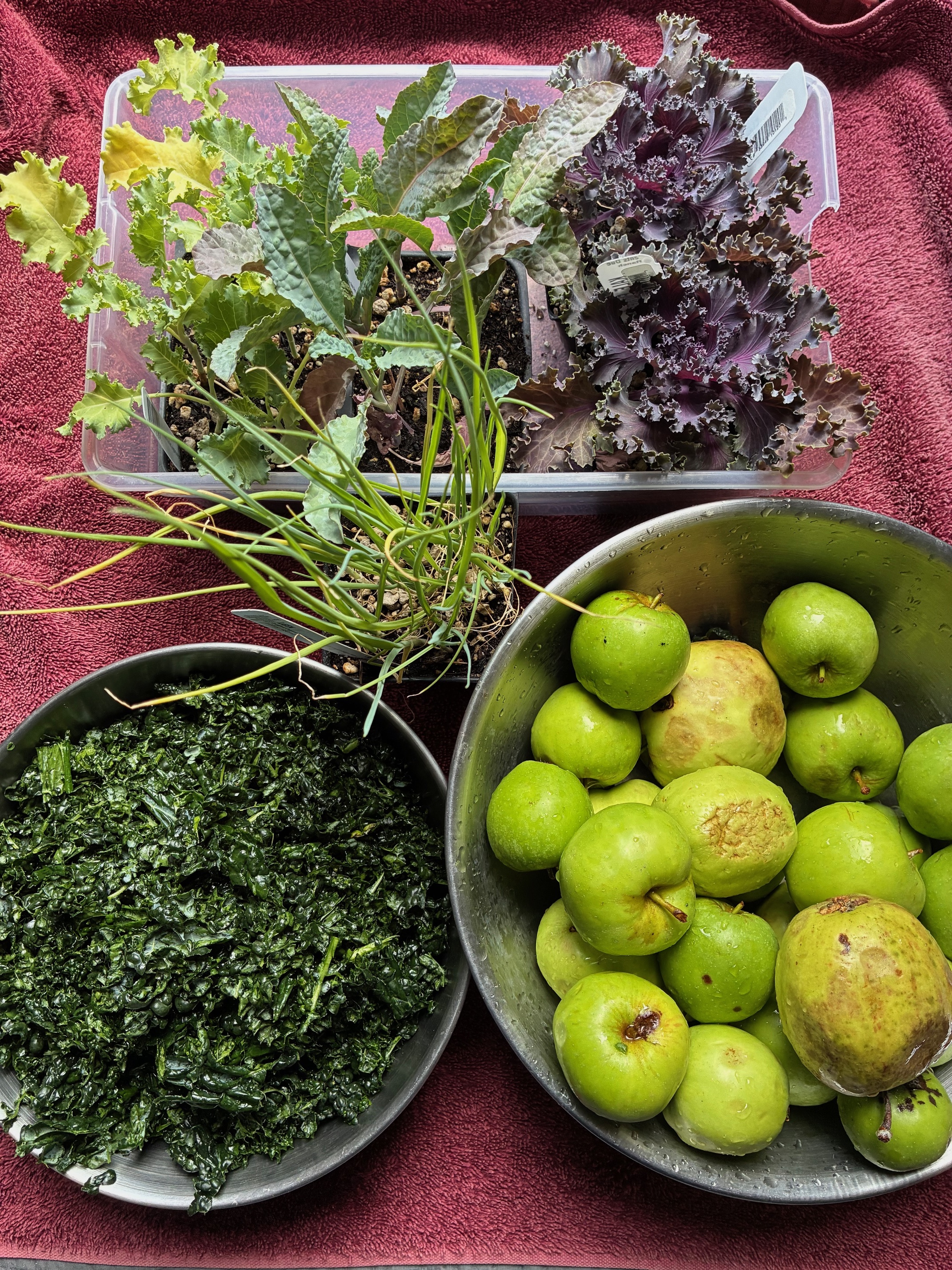
The big venture was cooking. The fridge was packed full of paper bags of foraged and bargain foods. Down at the Fruit & Folks open air market the hot weather interfered with the refrigeration, so the dear proprietors offered fantastic bargains on vegetables to carry home. Our bike trail is lined with invasive Himalayan blackberries and cutleaf blackberries, and other very local wild fruits. Abandoned houses have public alleyways with unclaimed apples and plums. My own vegetable patch has kale, onion flowers, herbs, and horseradish leaves in need of picking, plus edible weeds like purslane, lambs’ quarters, and dandelion. At the food co-op, there is a last markdown sale with 6-packs of plants for only 99 cents each! Those hardy greens will grow all winter, so I carried home the box of little flats shown in the picture above.

It took eight hours to get it all cooked up and tucked away. Why so long? Partly because on such an ideal laundry day I got to wash the linens and towels in the bathtub and boil them on the stove, then hang them on the balcony to bake in the sun. Mainly because foraged / bargain / garden produce needs extra washing and trimming. Besides, the raised garden patch downstairs really needs water. So, all day I’ve carried buckets of vegetable wash water and dish water down 42 steps and around the corner to the garden, with a quick jog back up the stairs. This produce needs lots of trimming too, so batches of trimmings went down the same 42 steps all day to the compost collection bin, about 20 round trips.

Here tonight is half the contents of the fridge. (Where is the other half of the fridge? It’s labeled now and tucked away in the freezer.)

The trimmings and leftovers from the fridge cooked down for a vegetable stock to sip on. The dinosaur / lacinato/ Tuscan kale (shown above with the apples) needed a whole LOT of washing and trimming, then it was all shredded in the Cuisinart to break down the cell walls and enhance the nutrients. The stems were very tough, so I trimmed those away and shredded them separately and spread them in the garden as a green mulch. The kale cooked up into small jars for lunches, seasoned with tomato sauce or apple sauce, balsamic vinegar, garlic granules, and Ethiopian berbere spice mix.

The different wild berries needed a careful picking through on a white tray, then a gentle wash in baking soda water. Then they’re lifted out and splashed in white vinegar, then rinsed and placed in a glass pot to cook gently in their own juices and brought to a boil and strained. The first pressing of juice makes a good berry syrup for the freezer. The rinsed strained pulp makes a good sour berryade.

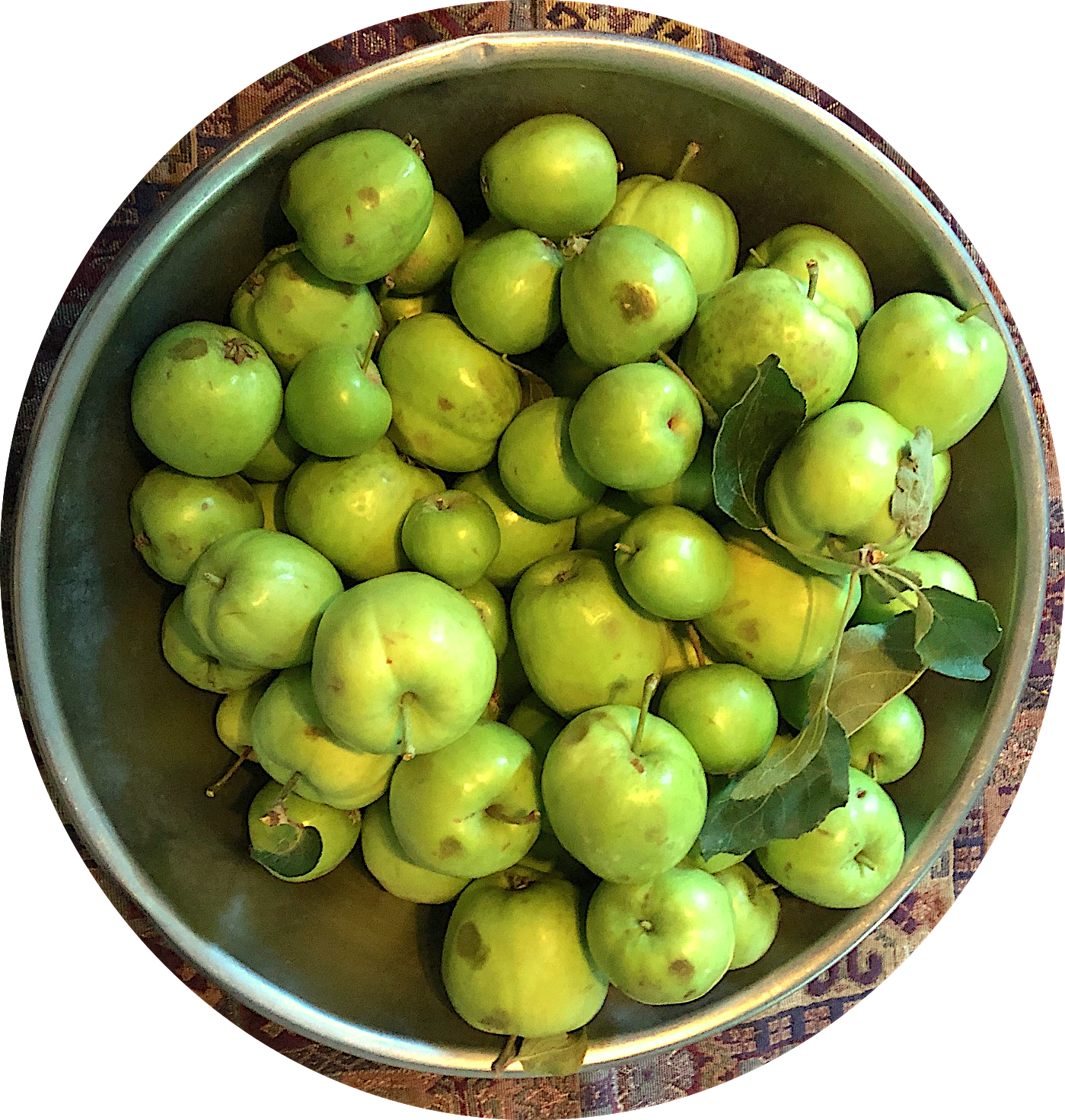
Wild apples like the ones shown above are a 33% proposition. Cutting them in quarters will reveal that a third of the apple is fit only for compost — bug-eaten or spoiled by a core of residue like dark shredded plywood. One third is fit for the stock pot, and then the other third can be stewed and blended for sauce with peel and all. Trimming these blemished little fruits is tedious, but the flavor of that 33% is much more lively than the taste of clean shining uniform store apples. Even when fruits are completely sour, they make a valuable dressing for strong tasting greens. One batch of apples was so sour that I blended them with some overripe bananas, water, soymilk, a spoonful of cocoa powder, and vanilla extract; that will be a dessert shake to drink after getting home from the gym.

The rhubarb was sliced up and cooked in the glass pot in water. After it’s cooked and in a jar, it’s sweetened with raisins; they plump up in the hot rhubarb juice. (It’s not a good idea to add sweetener while the rhubarb is cooking. The sugars can burn easily, and that’s a great way to destroy a glass pot.) Purple plums were blanched and peeled by hand, then pitted and stewed for a beautiful red-gold compote.

The other items could be washed and just boiled or steamed — millet, chickpeas, beets, tiny new potatoes from the neighbor’s garden, odds & ends of fridge greens for a cole slaw, mushrooms that dried out in the bargain bin but still make good stock, a red onion to chop up & pickle, and shake over salads as a condiment.

On one trip downstairs I was throwing water on some poor wilted berry bushes in back of our building. “Hey you! What are you doing trespassing here?” a voice shouted behind me. And “Why are you watering that bush?” said another. Two of my favorite neighbors, a bright young couple with a delightful sense of humor, came charging out their door waving their arms. “Well somebody had to, and you weren’t doing it yourselves, ya deadbeats,” I told them. Lively banter was had by all.

The whole day was just stove and pots and pans and freezer containers and wet linens and sloshing around with buckets and compost up and down the stairs. But having a fridge stocked up for the week is a massive privilege. All I could wish for is someone here who would like to share with me the choicest bargains that money or scrounging can acquire. It was a real gift to have this day at home and to wake up with the chores put to rest.

At every annual physical, my remarkably youthful primary care doctor looks at my chart and asks me in a concerned and caring voice, “And are you still able to do your own housework?” I tell him Sure, so far God willing. Next time I should bring him some plum compote.

Posted in Uncategorized | Leave a comment

8/3/25: Happy Esther Day!

Miss Esther Earl (1994-2010) dreamed up this wonderful holiday, and she left it as a legacy for us who are still here forging along. August 3 is an invitation every year to say “I love you,” to family and friends and people in our lives, especially if we’ve never said it to them before, and especially if saying it seems like going out on a limb in a vulnerable new way.

How did Esther Day become famous? That’s the work of John Green, author of Everything is Tuberculosis. Esther was an online follower of his, and John learned about Esther and the Earl family organization This Star Won’t Go Out, benefiting families of children with cancer. John offered to make Esther’s birthday on August 3 become any kind of holiday that Esther would like, in her memory and honor. Esther decided to make her day an annual occasion to reach out in love to all the people who are not our special valentine, or who are not anybody’s valentine at all.

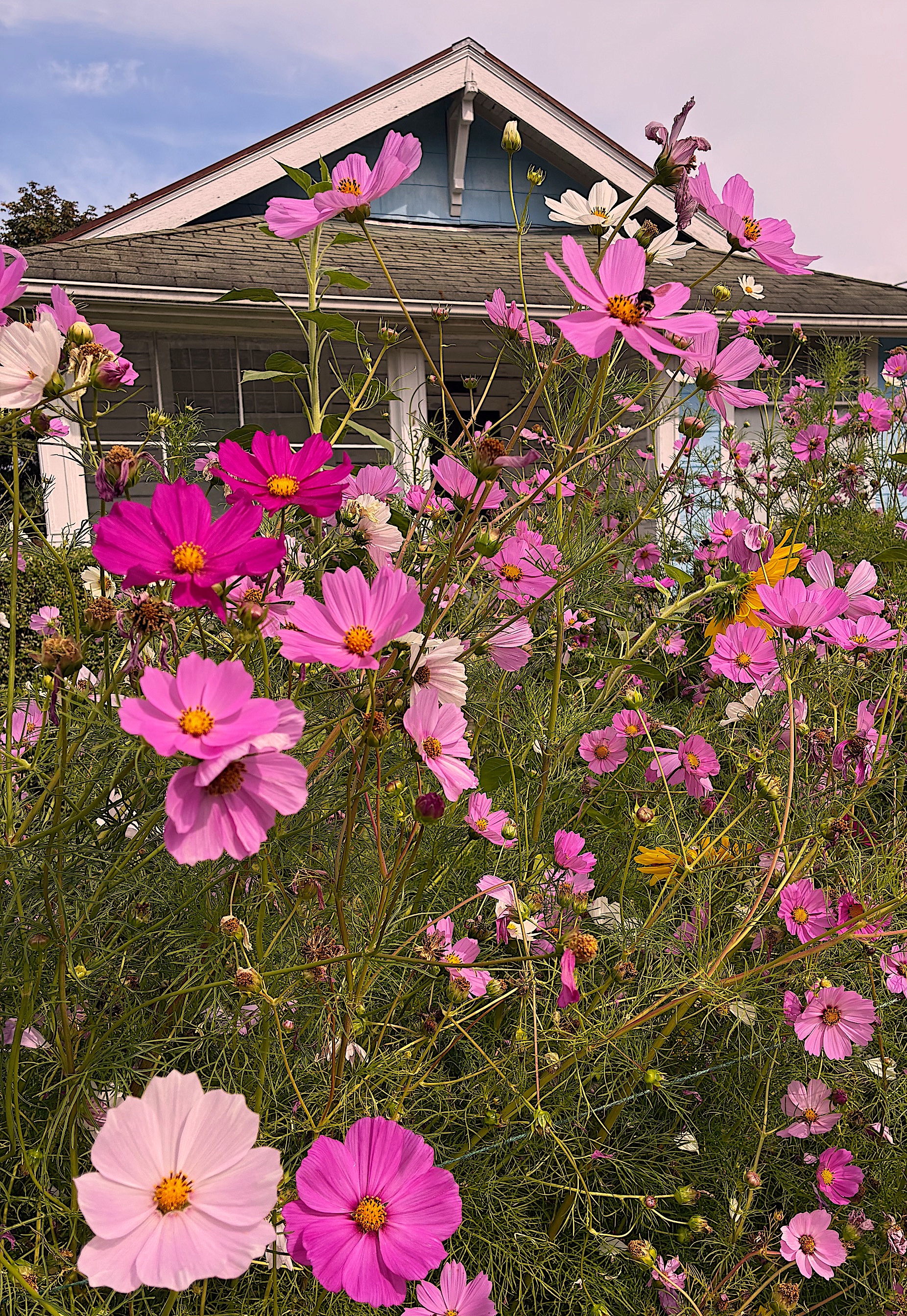
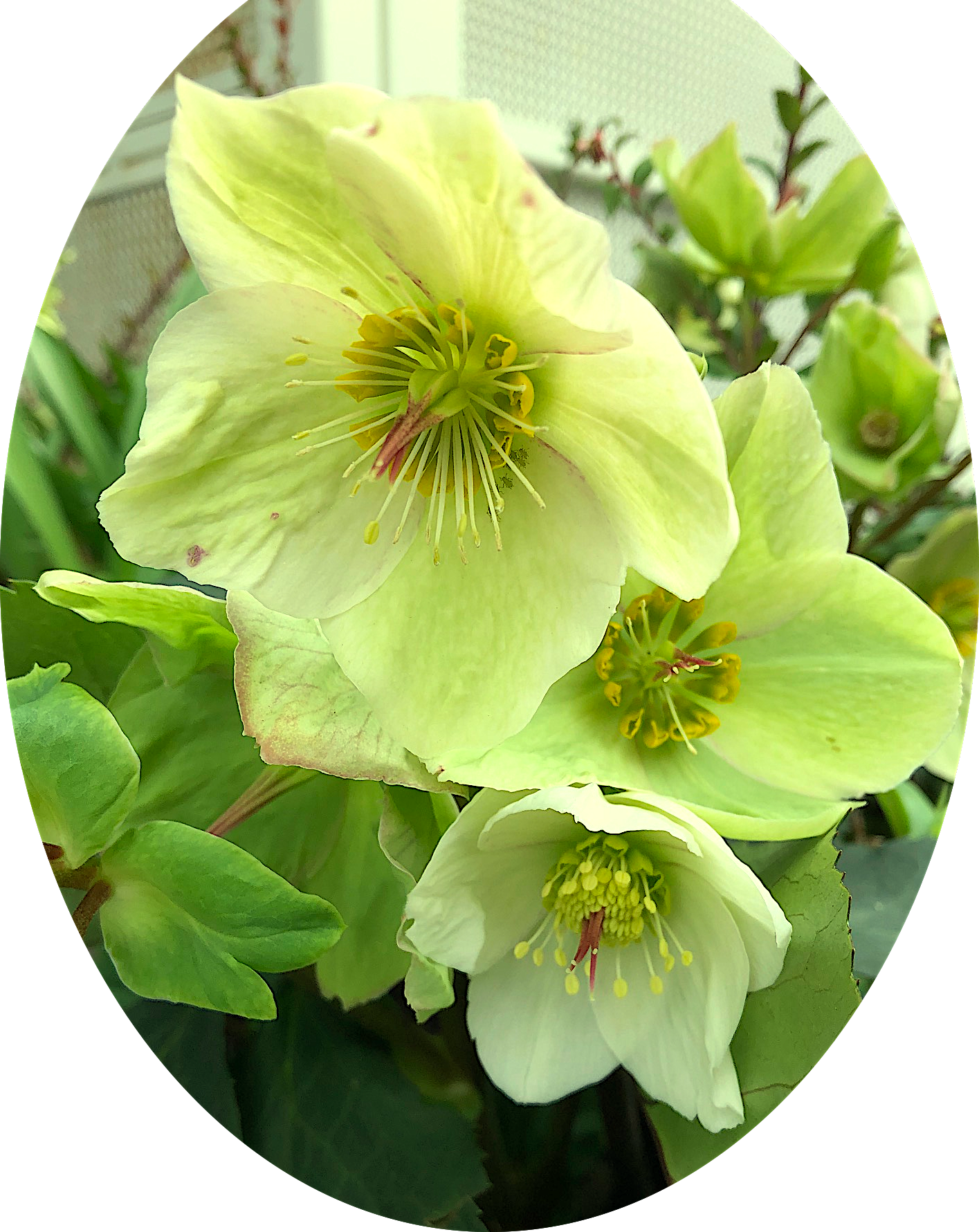
Here is a picture from today’s walk, a happy free-for-all of cosmo flowers in pink and in white, colored like Good & Plenty candies.

Cosmo flowers remind me of a cherished friend of mine from years ago. She was kind and brilliant and funny and beautiful, and she loved to cook up feasts for all us neighbors. She was finishing her PhD dissertation, and also bought herself an old farmhouse and restored it from forlorn to a treasure box. She moved into her home and planted the yard with all kinds of flowers. Then she started to tire easily, with little dizzy fainting spells. The doctors told her to quit working so hard.

One lovely August day she and I sat in her parlor with its polished old wood floors and beveled glass window seat with a whole riot of cosmos crowding up against the panes in the sunshine. There she told me that somebody at the local hospital had just totalled up her symptoms and imaging scans and prognosis, figured out what-all was going on, and referred her to a facility with hospice care. I said “I love you, and I’ll do anything to help care for you.” She said “I love you too. Don’t ever come back. I can’t die if you’re with me.” She meant it. In her care facility she ordered her relatives to offer no updates about her condition, until an envelope showed up at my post office box one day with an obituary inside, cut out of the local paper.

So today on this lovely August afternoon, admiring this little house garden made me think all about her. Then I remembered: it’s just in time for Esther Day.

Happy Birthday on your own star, Esther! Thank you, John.

Posted in Uncategorized | Tagged , | Leave a comment

7/6/25. Colonoscopy: A Journey of Discovery

(Blanket Flowers down the street, a random picture irrelevant to this whole junket.)

Concluding idea: Maybe that scope procedure showed my doctor some things about part of me. But writing down this experience was like a different scope into my own thought process start to finish, and that’s a journey too.

The Big Disclaimer: My day at the clinic was a sea breeze compared to the medical experiences of other patients. In my own case the procedure carried the lowest level of risk. Preparations and results will vary widely depending on a person’s own circumstances (diabetes? anti-coagulant medications? sleep apnea? on and on). For someone else there may be lots of other safety instructions, so this is not medical advice for anybody else.

The Second Big Disclaimer: A colonoscopy, like a flight on a commercial airplane, feels like an insane amount of privilege. Both experiences are carried by the intelligence and dedication and skill of an army of people behind the scenes. To write about it here, when the option isn’t available to the people who may need it most, feels like taking unearned good luck and flaunting it around. At the same time, what if someone needs the same procedure but is worried and wonders what it’s like? Well, maybe these thoughts will help.

A friendly patient representative called in March. Their hospital clinic had re-opened their calendar for new appointments, and they could book me in for June. This is a routine scheduled preventive diagnostic for people of senior age. The last colonoscopy was in mid-winter, and that is not a comfy time for a water fast and cleanse. June sounded ideal. Over the phone there was a long list of questions about medical conditions and history and lifestyle, assessing my risk level for the patient chart. Right after the call, my phone and email lit up with notifications: the update to my patient chart showing the phone interview, prep prescription, instructions, driving directions and maps to the parking lots. 

Step 1. Booked three days off work, to include a day for the prep, then the day after. (Another extreme privilege: a job with leave time, and a studio room to rest in.) My grab-&-go hospital binder got some updates for the occasion: the clinic’s assessment of my risk (low), medically relevant history including a POLST / DNR forms, and contact info for me, my doctor, my responsible adult driving me home after, and my relatives.

Step 2. Called my friend Sandy, to be my friendly grownup to drive with me to the clinic, check in with me at the front desk, give them her phone number, and promise to wait and drive me home and see me safely in the door. Luckily Sandy did all of that. I also called a second friend as backup standby, because on the day what if something came up for Sandy, or her car didn’t start? (It started up fine. Sandy had just bought it.)

Step 3. Ten days beforehand, cleared out any food that might linger in the digestive system and clutter up the doctor’s view through that scope. The chia seeds, flax, hemp, nuts, raisins went in the closet with the air-pop popcorn maker. I finished off any groceries with seeds like tomatoes, zucchini, cucumbers, even bananas (they have seeds too). For the last few days before the prep, directions say to cut out beans, and items with vivid colors, especially red ones — so no beets, no red cabbage, no pomegranates, no dulse, no dark chocolate. To be on the super safe side I cut out vivid greens and high fiber too.

Step 4. One week in advance, picked up the prescription. The supermarket pharmacy texted when it was ready. At the counter a young pharm tech handed me a gallon-plus sized jug with just some white powder at the bottom. Before handing it over, he had me electronically sign a release form stating that I had received complete counseling on how to take the prescription. I signed, then asked “What counseling would you like to give me?” He said “The counseling is ‘Talk to your doctor.'” But the empty jug with powder puzzled me. In the last two procedures in years past I seem to remember receiving pre-mixed prep, and some additional flavor packets. “Is there anything else I’m supposed to pick up?” I asked him. “Anything else to do while I’m here?” The young man gave me a stricken look. “No no — the prep is at home. You do it at home!”

As opposed to, say, prepping in Aisle 4. That was adorable. And so was the scene a minute later at the cash register, for Step 5.

Step 5. Stocked up on white low-texture food for the three days before the prep: light-colored low-sodium broth, tofu, rice milk, pasta, white baking potatoes (to eat without the peel), plain puffed cereal, a bar of white chocolate, distilled water, and a 12-pack of toilet paper. Our young Christian cashier rang up the items and said “Nice to see you, Mary. Have an amazing blessed day! Any big plans for the weekend?” I said “Yes!” and held up the jug. To the cashier’s bewilderment, on that checkout line everyone over the age of 50 started laughing, saying “Yup, we’ve had those weekends.” One super-fit trim young man with a radiant laugh said “Me too. Go proud! Go proud!”

Step 6: White Food. The standard meal around here is leafy greens with beans, stewed tomatoes, seeds, and red Berbere spice. So a couple days of bland white food was a novel change, like being a little kid in the 1950s again. But even one meal of refined stuff can really tank one’s blood sugar and wellbeing. A person can fill up and still stay hungry. It became harder to concentrate, to prioritize projects, to make sequential-step decisions. One night I felt so gnawing and anxious after supper that I bought a jumbo box of Life cereal and wolfed down the whole thing. That’s a good reminder of how most people feel every day the world over! That includes the millions with little or no food, and some fellow Americans with a higher budget. It gave me more understanding too of the many attention-deficit issues that people can face, for a whole range of reasons.

Step 7: Fasting. After two days of plain carbs, the next two days of fasting on just water was much more comfortable. The trick was remembering to not eat — another good reason to keep those cabinets cleared out. While batch cooking for the week ahead I had to remember not to taste-test anything, and not to lick the spatula.

Step 8, a day in advance: Parking. I took the maps and instructions for both hospital parking lots, tiptoed down the ramps, and interviewed staff at the ticket booths on their procedures. Which ramp was likely to fill up first at 2:00 pm? Did they take cash? The staff were all very nice. I walked through the garages to explore the location of elevators and exits and emergency call boxes, then went home.

Step 9, the night before: Doses and Flavorings

Surprise: YouTube had a prep video, filmed by my own medical team at my own clinic! The presenter insisted that every patient has to ask the pharmacist for the flavor packets that go with the prescription; the tech is supposed to tape them to the jug. Hm. I called the pharmacy. “That formula doesn’t come with flavoring, Hon,” said a strong good-humored reassuring bass voice, clearly someone who had helped many patients through this same rodeo. “Just go buy ya some lemonade powder; you’ll be better off. Or, save ya money: I been there myself. After the first quart of that stuff I don’t taste nothin. Could be gasoline for all I care. Just get it down and over with.” That sounded reasonable at the time.

The prescription called for 4 liters of formula mixed with plain water, 12 cups taken the evening before and 4 cups or so taken early on the day, drunk as 8 oz. every quarter hour. I drew up a spreadsheet with ruled lines and clock times, to checkmark each dose taken. I took some sticky labels, numbered them 1 to 16, and on each one I wrote the clock time for each dose. That night I set my phone alarm to signal every 15 minutes for the 12 evening doses. I applied the labels to the lids of 16 Mason pint jars, and measured out the doses in each jar. There was a stressful moment when the measurements didn’t quite add up. But that makes sense; the doses are in metric, and my kitchen measuring cup and the markings on the jars are in English measurements. That tracking system was a real help for accuracy and peace of mind.

One video suggested drinking this stuff ice cold to dull the taste, but I never drink cold things and was afraid it would upset my stomach. So I just set the doses in a row on the counter. Thinking How hard can this be? Here goes! I slugged down a cup of bitter salty water. But looking ahead to the next 15 doses gave me pause. At some point the body is going to react, as it’s designed to do, and say “Don’t be an idiot. Stop drinking salty water.” Drinking formula is one thing. Keeping it down is another; some folks can’t, and then they have to cancel the whole procedure.

Back to the supermarket. There were many powdered drink brands on the shelf, but they contained daunting innovative sweeteners. Finally, here was this one exception — TRUE lemon original Lemonade Naturally Flavored drink mix, shown below. This 1.06 oz. box came with 10 little packets. Each packet is sweetened with 1 gram of plain cane sugar, with some stevia. Friends, this lemonade powder was a great investment. It helped me drink all those doses in comfort.

Side note: for this experience, it helped to wear comfy surgical scrub trousers with an easy to unfasten drawstring, and to stock the bathroom with edifying and inspirational books.

After all the doses, and in between, we’re instructed to drink water and clear liquids. Gatorade is recommended, but at our supermarket it comes only in large shrink-wrapped plastic lots in vivid blue and green colors. Luckily I was able to find a bottle of untinted no-flavor unsweetened Gatorade sold as individual bottles. (Thank you, dear Mom & Pop Korean grocery!) Unflavored Gatorade is a little odd, with a faint quality like the scent of fabric softener at a laundromat, but my body found it very heartening. The white grape juice and coconut water were a real help too.

For the next procedure, a few years from now, as soon as it’s scheduled I’ll run right out and buy all of these right away.

Step 10: The Big Day

Early in the morning I drank the final doses and lots of water. I shined up the kitchen and bathroom. I prepared a small simple light supper for after the procedure, to avoid knives and stoves while recovering from anesthesia. I made up my bed roll, and laid out sleepwear ready for immediate bedtime. I put away my cell phone and wallet and office keys. I showered and dressed in comfortable clothes.

I took my apartment keys, the empty prep jug, the bin of empty containers from all the clear liquids, an exact food journal from the pre-prep days, and the dosage schedule with all the times checkmarked. That’s in case the medical team asked anything like “So what have you been eating? What is your idea of a ‘clear liquid’? Did you drink your formula?” I added a printout of the parking instructions, plenty of cash and a quarter roll, my hospital binder of medical history, and a heavy blanket.

Dear Sandy showed up early, right as rain. “Blanket??” she asked. I folded up the blanket as a seat cushion, explaining that even when a person is all wrung out by this process, they don’t want to risk an old friendship and a new car. Sandy raised her hands in surrender. She is familiar with my mode of operations by now. She eyed all my gear and data without comment, and listened respectfully to my reassurance that I had interviewed the parking attendants in advance. As we pulled away I said “Oh no! I was going to give you a book by Timothy Snyder at Yale University. Please remind me after the procedure, and I’ll give it to you then.”

Parking was easy, and I was proud of knowing the exact location of the elevator to the clinic. We checked in at the reception desk. As always, I’d stored up maximum anxiety in advance, prepared and fretted at every stage, then was astonished and overjoyed when the day didn’t leave me sitting in hell in a handbasket. That made it a special pleasure to meet the team.

The colonoscopy team is a very high-morale outfit. Unlike the ER, this is not a place where anyone is rushed in with a crisis. Patients are vetted and instructed and scheduled well in advance, and this is not in general an emergency high-risk procedure. (It probably also earns the hospital a fair income; according to the chart notes, from start to finish my colonoscopy took 18 minutes.) The medical team whisked me in, saw no need to inspect my empty juice containers or checklists, and settled me in bed. One kindly medical assistant helped me stow my stuff and to robe up, one started an IV for the fentanyl and midazolam, and the doctor came in for a final final check. (I showed her my hospital binder, and pointed out my POLST form.) The team seemed to sense that this patient appreciates good humor, and they were ready to comply.

A truly wonderful anesthesia nurse came in to explain the program for the day, and they wheeled me to the procedure room. There, the sound system played a 1983 hit by Sting and the Police. “Oh, so is that the Anesthesia Nurse theme song?” I asked her. “‘Every breath you take, I’ll be watching you.’?” She laughed “Yes it is, and yes I will! And what is your favorite music?” I figured she was asking out of courtesy to put at me at ease, so I said “Russian Orthodox chant.” She said “Great! So… like Fleetwood Mac?” I said “Yes, exactly.”

So while they adjusted the equipment and my IV and draping, in the half minute of down time waiting for the doctor, they team broke into an impromptu happy dance while we all sang along with Fleetwood Mac’s “Seven Wonders,” which given the context was a pretty amusing song choice.

The doctor came in all enthusiastic about getting started, and said “Now first I’ll make an initial exam before we insert the camera.” Sure. I was about to give her consent to do just that. But then somehow this was the parking garage again, and there was only a warm instant of memory of the doctor saying with a cheering smile that everything looked normal and fine, and we were done.

   “It’ll be ten dollars,” said Sandy, replying to something I must have said.

I handed her the money and thanked the attendant for our parking experience. “Sandy?” I asked. “Am I stoned right now?”

   “Yes,” she assured me, and we headed home.

Back at home I snipped off my patient ID bracelet, and set the prescription jug in the pantry. (In the event of an adverse reaction the batch number on the jug has to be reported to the pharmacy. There was no reaction, so three days later I peeled off my medical ID label and threw the jug in the recycling.) I settled into bed with my sweet potato and miso soup, and slept deeply for four hours. Waking up, I packed my wallet and office keys and then remembered the Timothy Snyder book that was supposed to go to Sandy. Oh no! I looked at the shelf. The book was gone, leaving a little gap in its place. I must have given it to her, meaning that she must have walked me upstairs, which was very thoughtful of her.

A couple of lessons remain.

One, the days of refined foods and fasting (and then a day or two of medications wearing off) made it more difficult to plan and execute the sequencing of steps in a task. For example, I set up hot soapy water and my scrubbing board in the kitchen, but really should have fetched the handwashing first to save steps. Sequence makes meaning and carries consequences for the result of a project. Well, at times in my life there have been people making choices without thinking ahead to the results, eliciting the question “What were they thinking?” Sometimes people caught those moments in time and/or noticed and repaired the result to do it differently next time, but not always. Well, it was humbling to realize how little it takes for my own sense of sequence and consequence to be thrown off track.

Two, remembrance can be a tremendous gift. We have the potential to commit events to memory, to store and retrieve the memory, then to articulate and create meaning with it and share that meaning with others as part of deep human connection. When people remember important events in my life, it makes me feel connected. When life-altering events are forgotten or unnoticed by people who matter to me, it can feel as if my life either didn’t matter, or just didn’t happen. Well, perhaps there are moments when that knack is out of their hands. After leaving the clinic I didn’t even remember putting my pants back on. But the someone doing it must have been me, because when I got home my lymphedema bandages were all perfectly wrapped and fastened in place. I did thank Sandy later for her company that day, but did I ever say “Thank you” when she dropped me off? No idea. (I did text her that night feeling anxious about the parking. What did I owe her? How much was it? “Ten dollars,” she texted back. “You paid the attendant.”) Remembering is a high-level ability, and is more fragile than it seems. I feel committed now to preserving that ability as much as possible.

There was a lot to be thankful for too, to Sandy and everybody on the team. Later that week I typed up thank you notes for the doctor and the anesthesia nurse, telling them what was especially helpful about their care. I taped the notes to cards, and dropped them at the clinic in observance of our day of Seven Wonders.

Posted in Uncategorized | Leave a comment

6/9/25: Toxic Weed Alert: Cow “Parsnip”

Not a real parsnip, and not something to touch or burn or compost. If the plant oil gets on the skin, and if the skin is exposed to natural daylight, the oil causes phytodermatitis — a skin burn. The weed is 5 feet tall or so, with flowers almost the size of a dinner plate.

From our commuter bus a flash of a view was visible out the window every morning for days. It finally concerned me enough that I got off the bus and took a good look.

At first I was afraid it was Giant Hogweed. Hogweed is larger, and hazardously toxic. (While looking up images of Hogweed, I inadvertently populated my viewing screen with a gallery of Hogweed injuries. The burns in those images were very serious.)

But no, my scattershot amateurish citizen-science online research suggested that this was Cow “Parsnip,” a smaller less dangerous cousin. Cow Parsnip is still a burn issue though, and this patch of it was thriving wildly.

Problem is, it was growing outside a school building. It took some tracking down & around, but I found the landscaping team in charge of the grounds, and emailed them pictures and a statement of the problem, and my concern that some student might go outside and start picking jumbo flowers. The facilities office responded right away! Their coordinator emailed that a work order report was now on record. What’s more, later the coordinator emailed again, to say that the grounds crew were going to add this to their day’s inspection.

Professionals were on the case, and could decide what to do. It was reassuring to leave this issue in their hands and gloves.

Posted in Uncategorized | Leave a comment

6/6/25: Walking Out for Water

Every evening before sunset it’s time to head out for purified water, toting a jug and coins and a rosary or my Orthodox prayer book in liturgical Greek, to memorize and chant a few new words along the way. It’s an hour a day for one mile there and back, stopping to meet neighbors and admire plants and sky.

In the bright setting sun, here are some miniature Columbines.

At the little Bible church the pastor’s family comes out to greet me. Their splendid purebred hunting dog warns me loud and clear to stay away from her humans. But then we all chat about neighborhood news and of course liturgical Greek. At that their faithful guardian quiets down and drops back to all fours and resumes following her nose toward bushes and birds. They unclip her leash. She trots peacefully into the house.

Calla Lilies in the shade. In the background those tall vivid popsicle blooms are Kniphofia.

Everything but the tail: a lucky shot of a little ginger lightning streak. Kitty comes zooming out each time to give me a good nuzzle and to roll around for his daily reminder of how beautiful and clever he is, then runs off to look for bunnies and squirrels.

Here’s an Orange Ball tree, full of fragrance and bees.

Common Evening Primrose, among Woolly Yarrow. Thanks, Google Search!

At the store, I fill my jug at the purified water machine. The cashiers are on the lookout for the same customer every day at the same time to buy the same item. Some days I pay for the 59 cent refill with exact change including four pennies. Other days I pay 60 cents and get a penny change. Since pennies are now no longer being made by the US Treasury, our daily running joke is that either their side or mine is going home with a collector’s item coin, which will change hands back again on the next trip tomorrow.

Behind this picket fence there is a lush old-fashioned garden. For weeks, there were fragrant little pale-pink Cécil Brüner roses spilling over both sides of the gate. Now there are yellow loosestrife plants and balloon flowers in blue and white. As I stop to take a picture, the gardener comes running outside with greetings and a chat, filling my water bag with flowers to take home.  

Near our street, a delightful young neighbor of faith stops me with good news. She is moving — in to the vacant studio next to mine! It’s reassuring that such a friendly presence is going to live right on the other side of the wall. We’re going to visit as soon as she moves in. We share some balloon flowers to celebrate.

At twilight the robins are singing all along the way. These days the waxing moon is up, on its way to full, with a few early stars. More stars form a line, rising one by one in a jewel trail from the airport south of town.

In the darkness, those Calla Lilies are sleeping.

Bellflowers, hydrangea, and roses from the gracious and giving new over-the-fence acquaintance. Night night!

Posted in Uncategorized | 5 Comments

5/17/25: Jeffrey Circus on Keyboards

Mr. Circus was hard at work or play, smithereening piano keys at Pike Place Market.

I was strolling the waterfront after flying in as a tourist to the city of Seattle. On that day years ago in the bustling market, all these notes came shimmering downwind, all ignition and drive with high light tones of sweetness and speed. Whoa, was that music live?? The sound towed me in through the crowd to gape agog.

This performer abounded with gratitude and cheer. There he was in tossing hair and rain boots and mismatched gloves and old-timey suspenders, laughing outright just to be here now. He readily looked around, exchanging bright-eyed glances and smiles with people passing by. “Thank you!” he called out to every single person who dropped change in the hat. Then between each piece he leaped in the air to wave his arms and introduce himself and the names of his original compositions, urging us all to enjoy a wonderful day. I got to chat with him a bit, asking him whether he ever sang along to his playing. “Oh no,” he quipped. “The consensus of my fans is that I do not.” (It was especially heartwarming that he attributed his good spirits and inspiration to Mrs. Circus, who kept a steady supportive presence in the crowd nearby.)

It was puzzling to see sightseers just stroll on past him as if none of it were happening. How is that even possible? As a tourist I’d have to chalk that up to the folks of Seattle being refreshingly calm and accepting. They float about in a peaceable manner without plowing each other out of the way, and would actually apologize when they crossed my line of vision! They won’t ask you through a bullhorn whether you’ve accepted Jesus, they are unruffled by special public events where clothing is optional, and there’s not a car horn or hollered insult to be heard. (Unfortunately this makes it easy for 1 driver in 20 to cruise around without headlights at night, and even to take short cuts up one-way streets.)

But all this open-minded tolerance might just be adding cotton wool to their perception of extreme talent when they see it. I wish we could move this piano setup to a safe venue in Manhattan, where people would be very quick to notice him. He’d be perfect as a regular on Seinfeld; as the show’s cast members flail around on their hapless adventures, Jeffrey Circus could be the tireless musician on the sidewalk or their favorite tavern, calling out bright philosophical sparks of wisdom. Just last night I clicked through all the songs of a hit show on Broadway getting rave reviews. None of them held a candle to this.

Over the years since that vacation there have been plenty of street musicians to hear and see. But the memory of that music still shimmers along. Was that radiant young fella still playing piano, with his heartening sense of cheer?

Then just last night it dawned on me: there might be a YouTube channel. Eureka! There he is. It turns out that tourists from all over the world were of one mind about Jeffrey’s talent, and had the film gear to prove it. Here are just a few clips with searchable titles and links.

Title: “Ghost Town” This is my favorite one of his pieces.

https://www.youtube.com/watch?v=Cx8K6Upa4bo&list=RDMM&index=3

Title: “Jeffrey Circus Seattle Busker”

https://www.youtube.com/watch?v=R5Ahxtw0S7E

It’s especially endearing to see this resolution to the question: To sing or not to sing?

Title: “Jeffrey Circus – How Could That Get Old (Official Music Video)” https://www.youtube.com/watch?v=h5AcwDUUmbI&list=RDMM&index=3

What a gift it is, to witness someone with a talent used so beautifully, for the good of so many people. Thank you, Jeffrey Circus. Wishing the Circus Family many wonderful days.

Posted in Uncategorized | Tagged , | Leave a comment

4/28/25: Kombucha, The Theatre, and the Cable Guy

  1. A young man with long hair had staked out a busy corner. He had many layers of clothing and luggage and a sleeping bag, trying with eager anxiety to catch the eye of people walking by. Making the snap assumption that he was selling our street empowerment newspaper, I took out a couple of dollars. But at closer range it turned out that he was holding up not a sample issue and ID badge, but a cardboard sign that he needed to raise $20 to buy lunch. I gave him the $2 anyway. As is often the case, what he wanted was not just lunch but a conversation. He had a bright-eyed avid look, ready to ask advice and counsel from anyone who decided to stop.

“Thank you!” he greeted me joyfully. “Say, I’m from Florida. I just arrived in town. Tell me — how come people in this city are so unfriendly to the homeless?”

“They probably don’t mean to be,” I told him. “They are just concerned with their obligations and tasks. Head down, powering through the day the best they can. So, Florida? Are folks more friendly there?”

“For living on the street? Whoa!” He raised his hands in a protective gesture. “Florida’s downright dangerous. But say, why is the food here so expensive? Can you guess how much I just paid for a bottle of Kombucha?”

“Ah, no. Can’t afford Kombucha.”

“Oh. I’m sorry! I have to. I can eat only certified organic foods — dairy-free, gluten-free, soy-free.”

“Gosh. That makes it complicated for you, for sure.”

“It does. How do you get by, living here? What do you eat?”

“Well, at Christmas the store had a sale shelf of mixed dry beans, 99 cents a pound. I made a couple trips and bought 20 pounds for $19.80. Still eating on them, a big potful every week. And bargain shelf from the B-Grade produce stand, whatever is left on Saturday nights and needs cooking right away; they always have organic greens. And grain from bulk bins.”

“I’d love to buy rice,” he said. “But I can only buy those little instant plastic rice packages from [Local Zen Spendy Store], because they let me use the microwave. See other stores don’t let you do that.”

At that point other older neighbors saw his sign and stopped to chat with him and share dollar bills, so I headed off to mail a birthday card. It made me think. The absolutely harrowing difficulty of living on the street is well beyond my ability to imagine anyway, but it dawned as a new idea that buying food for life outdoors without a kitchen has to be way more costly. One more way that our food supply is all cattywampus.

He was such an eager young man, really hanging on every word that anybody said to him; clearly he wanted lots of company. Five years ago he could have gone to our public kitchen for young people like him, ages 18 to 25. They could come indoors for a hot breakfast and a hot supper and socializing with the staff. Whenever our workplace had catered events, I’d call their kitchen and then we’d drop off trays of food. I volunteered for their kitchen one time, putting supper together and eating with the guests. That night I woke up good & sick with Covid, and then the whole city locked down. That kitchen valiantly stayed in operation, but since the pandemic they have to refuse all fresh or cooked food (at our last visit the kitchen staff apologized profusely, and helped me take our trays of wrapped assorted sandwiches and pitch them in the compost). Now they’re only authorized to hand out sealed packaged snacks and beverage bottles with no more in-house hot meals or shared community. It’s one more thread of social fabric that has unraveled and disappeared.

2. I was kneeling on the ground looking for just the right angle to photograph a glorious rose-red camellia tree growing right through a wooden picket fence, against a pleasantly weathered little house in the old style — high pitched roof, deep set windows and doors, wraparound porch, little gables peering out from dormers and eaves.

To my chagrin, the door popped open. A man strolled out to light a cigarette, looking serene and composed, pondering the sunlight. I jumped up from the other side of the shrubbery and hastily complimented the tree, then asked his permission to take its picture. He gave me a friendly nod and a shrug of assent. Then he told me the history of this century-old house. His family had lived here and worked in the grand old theater downtown, producing musicals, operas, and ballets. He grew up backstage, learning the business from taking tickets and coats to working the popcorn machine, and kept up the whole family legacy — handmade costumes, lighting, backdrops, sound, musicians, staging.

For the next hour it was like a show right there, standing on a carpet of camellia petals in that dooryard, listening to him weave a whole spell of those grand theatrical productions.

I burst out with a lot of ideas to throw at him, things I’ve always wondered or marveled over, the backstories of movies and plays and their technical effects. Like, at one point I said “Now that backdrop you described sounds like…” I named an Orthodox church that I’d seen once, and told him all about its magnificent interior.

He laughed. “When the pandemic cancelled our whole season, for the subscribers we picked that church. I did the staging for the company to film a short feature film there.”

Unlike so many experts, he didn’t just roll his eyes and brush off my ideas. Naturally he’d heard all the stories, lived with those special effects, created many of them himself, made it all happen. But he just smiled in recognition, and added details I’d never dreamed of about just how much work goes in to the kind of production that true fans will remember for the rest of their lives. “For [classical world-famous epic] we had 220 stage hands and 78 tractor trailers of props for the scene changes, all made for that production. And at the end, where do you store 78 trailers? There’s no warehouse here large enough. We had to destroy it all.” He thought it over. “I’ve been very very fortunate. Raised in a career that I truly love, with the chance to work in it for a lifetime. By the way, that necklace you’re wearing is gorgeous.”

“This?” It’s beads on a little leatherette string. “Got it yesterday for a dollar. Church thrift shop.”

He shook his head. “Every bead of that is worth more than a dollar.”

“Oh. Are they glass?”

“Stones. Semi-precious, some of them.”

We wrapped it up when it occurred to me that “With all you have to keep in mind, you must have things to do. And here you just stepped outside for a quiet cigarette! Thank you for talking to me about the bigger plot unfolding back behind the curtain. I’ll bet the hardest part is working with all those personalities — performers, orchestra members, cast and crew, audience. So much. No wonder for his crew’s backstage snacks, David Lee Roth specified the color of the M&Ms.”

“Right,” he laughed.

“Creating those 78 tractor trailers, and letting it all go? That’s like a mandala.”

“Exactly.” We waved goodbye.

3. The Cable Guy was due at 2:00. The day before I moved my bookshelves and everything else well out of the way of the entire cable wire, dusted the baseboard radiator, worked the carpet sweeper, cleared off the computer table and the entry hall, had the new gateway router ready for him and a plastic bag so he could carry off the old router conveniently. I made sure everything was ready an hour early, at 1:00.

He called me at 1:07, a young man with an Arabic name. He’d reached my street, and was it okay to show up early for this call to the fourth floor?

Sure. I met him downstairs. He was just jumping out of his truck with the company name all over it and a tall ladder folded on top.

“Oh, you don’t need to use the ladder,” I assured him. “Let’s just take the stairs.”

He gave me a concerned look, and then had a good laugh.

We exchanged the usual pleasantries on the way upstairs. Taking a guess that he was Muslim I left my door propped open for his comfort. He immediately took off his shoes and left them outside. In about two minutes flat he swapped out the routers. Then he stood in silence at my side for twenty minutes, tapping a whole series of functions on his phone. “Diagnostics. Testing the connection,” he said. “Sorry. Takes a few minutes. So, are you from here?”

“No, New York.”

“What is your heart for New York?”

“My heart?”

“Yes! Like, think ‘New York,’ and what is your childhood thought that your heart is for New York life?”

“My heart remembers people being very religious. Every day at noon it was time for the Angelus prayer, to think about Angel Gabriel appearing to Hezrat Miriam. You’re driving in your car? Pull over and say the prayer. You’re a man wearing a hat? Take it off and say the prayer. The church bells ring for noon? Stop on the street and say the prayer.”

“Really? Unbelievable.” Tactful hesitation. “You know… New York? Not like that any more. Ok, your connection is all good.” He picked up the old router.

“It’s 1:28 now. Well that was fast. And what is your nice accent?”

“My what? Oh! It’s uh…” Pause. “Well, it’s… well, I’m from Africa. North Africa that is.”

“Oh, sure. Okay.”

Pause. “Country called ‘Libya.'”

“So you know Mohamed Bzeek?”

“I do. Do you???”

“Only through the news. I looked him up this morning to check on his health, since he’s had cancer. And no family to care for him.”

“No! Cancer? He brought home and cared for so many of the dying children! So many.”

“Yes, like 80. He takes babies in hospice care. At one point, people started a fund for him and sent him money. What did he do with it? He bought an air conditioner for the babies, so they can rest in comfort. That man will enter Paradise ahead of us all. Our favorite Libyan.”

Downstairs at the front door, we exchanged a handshake.

Shúkran djídan, thank you for your call. Ma’a salaam.

Ma’a salaam. You know… Mohamed Bzeek. It’s kindness like him,” he concluded. “It is our only hope for the life.”

Posted in Uncategorized | 2 Comments

4/27/25: St. Sophrony the Athonite: a Paskha thought

(Still life at dusk, with apple blossoms and tiny moon.)

Cashier Zia is a bright and upbeat young woman, wielding competence and cheer on a seriously multi-tasking job. On Easter Sunday during a break in the action she waves hello from the next aisle, calling “Mary Mary! Happy Easter. How is your holiday going today?”

In America this worthwhile social ritual is all planned out for us. Just color in the lines. All I have to do is wave back and say “Fine! You?” and by then Zia will be whipping through the transaction for the next customer. Simple.

So at self-checkout, pausing while typing in the bar code for my organic Tuscan kale, I smile right back. Then I just stand there speechless.

The real answer is that St. Sophrony the Athonite, later of Essex England, before his repose in 1993 (Bright Memory to him!) recorded ‘Why Some People Feel Empty During Easter (Even Though Christ is Risen.’ It’s on YouTube with English subtitles. (For some reason they use “Easter” in the title, even though the Orthodox are particular about correcting me to call it Paskha instead.) Anyway, in his frail warm little voice and old-school Russian, Father explains that there are Christians who do not feel joy at Paskha. Rather, they experience the feast as a “time of trials, of existential collapse.” These are the people who have still not conquered their fleshly passions. They may even feel “Paskha has come! Christ has risen from the grave. And here am I, still lying in the death of the passions.”

At that point, feeling many notches more discouraged than before, I turned off the computer and did the next constructive thing, heading for the store for leafy greens.

Zia: (smile turns to empathic concern) OH — What, did all your People die? My Gramma said life is just hell when all your People die. She always told me “Zia Dear, enjoy your golden years while you still can. Because ya don’t get many. And they ain’t that golden!”

Me: Thank you, Zia. She sounds like a wise and caring Gramma. Does she live nearby?

Zia: Oh, she died. (With a wave she sprints off to respond to an alert in the overhead paging system, calling for customer service in the frozen food aisle. Yes, they now have to keep the ice cream under lock and key.)

I finished entering bar codes for the greens, paid and packed, and walked home. Things felt better after the kale run. So I braved the rest of St. Sophrony’s talk, and it’s a good thing. He tells these other souls, the rest of us, “Do not give in to the temptation of these thoughts. You must believe that we shall truly rise. Say this, with fervor: “I do not only believe in the resurrection of the dead; No! I also await it.” Let us AWAIT the resurrection of ourselves and our loved ones, as the Holy Fathers expressed so wonderfully in the Creed. Remember that nothing else exists except Christ. Lean on Him and say in the meantime ‘Into your hands I commend my spirit.'”

It was a good thought to keep in mind for the end of the feast day. The kale cooked up nicely with tomato sauce and garlic flakes and crushed almonds and a shot of balsamic vinegar. Sweet potato on the side.

Posted in Uncategorized | Leave a comment

4/8/2025: Angels

Angel of the Resurrection window, installed in 1898. Artist John La Farge, known for working with superimposed panes of layered glass in opalescent hues. Those peacock feathers in the wings are a glorious sight when the sun rises outside.

The book Angels: God’s Secret Agents by Billy Graham turned up at our Little Free Library. The title did not inspire immediate confidence. And for a staunch Baptist author, isn’t angel talk a bit on the fluffy side? But no, the book was a solid summary of angels throughout Scripture, with citations nicely annotated and organized. What’s more, Dr. Graham patiently defused the various homespun notions such as “Your child died because God needed another angel,” since people do not turn into angels even after they crochet us a doily or bake us a pie, not to mention that no one should ever say that to anyone ever anyway.

As the book points out, angels are not here to be endearing or cute. In the Bible, a “cherub” is not really a plump white boylet, but something intimidating and enigmatic. Angels as a rule dismiss any personal overtures toward themselves. They deliver messages in the fewest words, they get their job done, like changing your flat tire on Thanksgiving, and then vanish without dawdling around to be befriended or thanked. (True, two exceptions come to mind. One unnamed angel spends all night wrestling with Jacob (Genesis 32:26), who says “I will not let you go until you bless me.” In the Book of Tobit there is Azarias, or Angel Raphael in disguise. He stays on for over two weeks as an incognito fellow traveler, fisherman’s friend, matchmaker, marital counselor, diplomat, pursuer of demons into Egypt, collector of inherited silver, healer, and all-round helpmeet and comfort to Tobias and his family and dog. Incidentally, the Billy Graham book mentions other named angels, but not Raphael. Perhaps it’s because Tobit is included in the Bible for only some denominations, but not in others.) So to sum up, angels flash in, say their piece, and are gone before anybody figures out what-all just happened or who that was.

You never know when reminders of angels might come along. One time a whole crowd of fans flowed toward a stadium for a major-league ball game. A mother had her teenage boys and one quiet little fella all jostling at an intersection waiting for the WALK sign. Then, the little guy clutched his collar and cried out “My St. Michael medal! I left it home! Can we go get it? St. Michael protects me from EVIL.” (He pronounced both syllables at full value, é + víl, like the announcer for some thrilling show on old-time radio.) The teenagers hollered with laughter, clutching their collars and wailing in mock lamentation. (We have to be late for the game because Baby Whiny lost his medal, and because ball games are é + víl!) The WALK sign flashed on, the crowds shoved off the curb. But the little one stood weeping, bereft of his medal and now stung by the jeering of the bigger kids. We all missed the WALK sign.

I caught the mother’s eye, giving her a sympathetic nod, then turned to the youngster and said “Medals are important. They remind us that St. Michael is out there to watch and guide us. But YOU thought past that and remembered and had faith in him anyway! And that is all it takes. Go open an atlas of Ireland some time. Not just any map, but a good large atlas at the library. It shows you Irish names like Skellig Michael, Kilmichael, Kirk Michael, on and on. When people there thought about St. Michael and found his comfort and help, or experienced a real miracle, then they marked the place by giving it a Michael name.” Even the older teens got all quiet, listening. “But don’t believe me,” I told them. “The atlas has centuries of proof!” The young’un dried his eyes and raised his head high. Mom flashed me a smile; the light flashed a WALK.

If we-all were acquaintances, I could have entertained him with a factoid that small Catholic children can find it interesting: that there is one saint whose name is a question and a battle cry (Mi-ka-el, Hebrew = “Who Is Like God?” Answer: God alone), a saint who is not even a human being! It’s nice to think that his canonization did not bog down in the Vatican red tape gauntlet with its scrutiny of his personal life, medical documentation of miracles, and the legalistic assaults of the Advocatus Diaboli. He just flew right in, no questions asked.

According to Russian Wikipedia, Michael’s Orthodox title of Arkhistratig means leader of the heavenly hosts of angels. In Orthodox icons he is shown as a beardless youth with wings. The wings represent motion at the speed of thought, to act and perform the will of God. The gold background behind him is a symbol of heavenly radiance. The gem diadem symbolizes all-seeing wisdom. In his left hand, the slender lance symbolizes his role wielding spiritual combat over the forces of malice — fighting not flesh and blood, but the powers of spiritual darkness.

Citation: 13th Century, Monastery of St. Catherine, Mount Sinai.

Catholic depictions take the military angle, showing Michael full length with an athletic body in a Roman short tunic and armor. He’s braced on his right foot, pinning down the head of some massive serpent with his left foot, with right arm about to deliver a death sword blow. Often in his left hand he is holding the scales of the Last Judgment, measuring sins and virtues in an individual’s life and advocating for his soul; this is why there are cemetery chapels dedicated to him.

But those conventional portraits have changed quite a bit since Billy Graham wrote his book. The author might be surprised by results of my internet check just today, and its alterniverse of images generated by artificial intelligence. A modern twist is Michael with bare chest and washboard abs, and hair like young David Lee Roth. This result is definitely one of the most tasteful, though the sword looks about twice as long as a genuinely functional weapon.

Does each of us have our own guardian angel? Not everybody wants one, but I do. His silent wordless inner prompting conveys either one of two possible messages:

1. Go go go! Move! Act! Do it now!

2. Halt! You do not understand the bigger picture. Calm down. Let it go.

Does this prompting care at all what I feel or I prefer? No. Is it always right? Yes.

Have I ever seen an angel? Once. I was young and house-sitting alone in a bitter cold late winter in a small town where I knew absolutely no one, and for three days was too cold and despairing to get out of bed. The third night, I was swept under by an attack of sheer panic. Then, a luminous presence flashed into consciousness for a tenth of a second, and I recognized that this very presence had been interceding for my soul since before time began, a realization which brings me to tears to this day. With a single gesture the presence commanded me to get up on my knees and pray for myself with all my might, and to get out of that house and town and go find people, and do it right now. What came to mind next was the memory of a poster from a bookstore, a flyer for a Gender-Role Free Folk Dance club meeting for a potluck in the city. I rocketed out of bed, washed up and dressed warm, packed a bag, and ran out the door.

I walked out to the road through the wetlands in the wind and waving reeds, caught the town bus, then a commuter train, then another train, then another bus, then more walking, and within two hours I was at Gender-Role Free Folk Dance. The folks there gave me a warm welcome and a plate for their potluck. After a brief business meeting we sat huddled all cozy on the floor with guitars. Everyone had a song to share. I started singing “For the Birds” by Bruce Cockburn: Hummm Hummm Hummm, oh every day / flashes like a spray of blue jays. Oh, a golden crown upon each one / Like an eagle seen against the sun. Every single person at that potluck knew the words. They sang it over and over as a round, in harmonies, sounding just beautiful.

After a walk and two trains and missing the last town bus, I walked back to the house praying through the waving reeds along the water with jets flying right overhead toward the airport runway, all turbulence and scream and flashing lights and wings, and went back to bed for a blessed sleep.

When the folk dancers hugged me and thanked me for coming, they said “It’s great that you found us tonight. Who sent you??”

Posted in Uncategorized | 4 Comments

3/31/25: Delivery Driver

Bedtime. Take out the compost, or leave it for morning? I ran out to the bin with my bucket, stopped for a night shot of Mrs. Wing’s daffodils, and came back inside.

In the downstairs lobby I gave a courteous nod to a delivery driver in uniform examining a little bubble-wrappy package. He gave a courteous nod back, and punched the elevator button without knowing that our venerable elevator was not working. He had quite a wait ahead of him before Maintenance gets the parts they need and a tech to come fix it.

Decision time: Tell him, or not? When I interfere in other people’s lives by offering unsolicited good-natured commiseration, or factoids about stuff that they can figure out on their own, it is surprising how many can be annoyed by it. (Once I was visiting Boston, and a departing shopper became quite surly when I said “Sir, whoa — your wallet is still here on the counter.”)

Well, what’s to lose? I retraced my steps and went back to talk to the driver. “Out of order,” I sympathized.

But at least with that small overture, he somehow felt encouraged to show me the address label on the package. Let’s call it Apartment 800. “Ziss name for namber eight zeera zeera — is in this building?”

“Sure. I’ll show you. Stairs are right here. Ili ya samá voz’mú. Or I’ll take it myself.”

Double take. “Vy sámi? You will???”

Hey now. He surrendered the package with a smile (“And how did this happen? You are not a Slav!”) and we chatted up a storm. He whipped out his phone to show me his little village on Google maps. He talked about his Ukrainian relatives and his Russian relatives. They had of course a compelling story which does not belong here, so I expressed fragile best wishes for everybody’s safety. He expressed fragile best wishes that some day I can travel there and see the place for myself. I made a point of expressing admiration for that village’s centuries of expertise with artisanal apple tree husbandry and church architecture, and for one priest there doing wonderful charitable work. The driver just lit up. “Yes! I know him!!”

Then he headed out to his truck while we hollered blessings back and forth.

Dropping off the package upstairs, I felt so happy. I asked God to place me in more good connection chances like that one. It took all of seven minutes of time, between a truck and a compost bin. But in a troubling world it felt like a shining wee gossamer strand of peace thrown across a very wide bridge.

Posted in Uncategorized | 6 Comments

2/15/2025: Their Valentine Heart

Every Possible Disclaimer: This incident is true, and the dispatchers and patient are real. The details are a composite hash of the five (5) sites where I’ve served as a medical interpreter. As always, the characters have pseudonyms. The fictitious name “Nikolai Petrov” is something like a Russian “John Doe”; the world has countless real Nikolai Petrovs, and this character is none of them.

Life as an interpreter was blissfully easy compared to the jobs of so many healthcare workers who face disrespect and harassment at work, some of it dangerous. My wartime-era former-Soviet seniors were the least stressful clientele in the hospital. The interpreter setting has evolved far from the quaint setting described here. Now the service employs telephonic remote personnel, with instant access to many languages. That leaves the question: What about the companionship of the in-person interpreter, someone who might know the whole family for years, someone to accompany the patient from clinic to clinic all day or stay at the bedside all night on what might be the hardest day of their lives? That was a human connection that many hospitals can no longer afford.

This story is not in any way a criticism of our patients, or of any culture group. It is about holding off on judgment until I know a person’s back story, and why he might behave the way he does. This piece was prepared for last Valentine’s Day, and took one year to finish. Chances are, in the next few days other improvements will come to mind. The story might read better a week from now. -mary

7:25 am. I got to Base, dropped my bags, and got my schedule from the mailbox.
Dispatcher Delia hit Pause on the voicemail cassette recorder. She lowered her headset microphone, and tapped Speak/Listen on the telephone console. “Interpreting, what language?” She waved at me to stop. “For Pre-Surgery, and Creole as in…? Well no, Creole is not a language, it’s — No Dr. Marsden, I am not trying to insult anyone’s culture, I only – Look. Your patient arrived from…? Haiti. Haitian then. Not one of our languages. But call…” She checked a Rolodex card “555-1234. Ask for André Etienne in Engineering. Why Engineering? Mr. Etienne is an engineer. Loop him in with the patient and the OR. Best we can do welcome bye.”

   “Mary!” Delia hit Disconnect on the console, and raised her microphone. “Change for your 3:00 Radiology.” She opened the appointment book, an atlas-sized hourly calendar with two foldout double pages for each day. She erased and rewrote a note, then flipped the page to check and make sure the eraser didn’t wear through to notes on the other side. “It’s now Cardiology.”

   “Okay.” I handed her my schedule. “Who’s on for Radiology then? Rodion is off at 1:00.”

   “Zoya’s got it.” Delia hit Speak/Listen and lowered her microphone. “Interpreting, what lang — Oliver? Yes you are marked right here in the book. 7:40 for PT. Didn’t expect you? Lemme call Trixie bye…. Hello Interpreting what language? No Trixie, Oliver is not late. He is waiting for your patient, in your exam room, signed in by your staff. Right.” Disconnect. “Jeez…”

She raised her microphone, corrected my schedule, and handed it to me. “Ah! First day back…”

   “We missed you.” I took back my printout. “Nice vacation? You so deserved it.”

   “Heavenly. Had to take the time. Use it or lose it.” She winked. “Ya know how that goes.”

   “Oh Sure.” I gave her an upbeat smile. “Sure.”

She hit Speak/Listen. “Interpreting, what lang– STOP WHAT LANGUAGE? YES PLEASE WAIT.” She hit Hold and raised her microphone and her voice. “Hannah! Line 3 urgent.”

   “What am I now?” Hannah called from the next room. “Vietnamese again?”

   “Vietnamese was on Line 4; Line 3 incoming is Chinese. Thanks Hon. Transferring.”

   “Guys!” Fernanda from Admissions burst in. “Answer your phones! Everybody’s dialing us instead.” She slapped down a stack of pink memo slips on our message spike.

   “I owe you, Fernanda.” Delia opened the first aid kit for a small bottle. “Cassette tape ran out.”

   “Ran out?” I asked. “That’s a 90 minute tape.”

   “Cody didn’t erase the voicemails. No one told her to delete once they’re done.”

   “Oh dear.” Cody was our smart cheerful high school volunteer. She came to our rescue covering two days of Delia’s vacation. Now the dispatchers had 90 minutes of messages that were either returned or not, confirmations called in or not, appointment requests booked or not, and six phone lines of Monday calls incoming.

   “Interpreting, what — Sí, lo sabemos.” Delia popped open the small bottle and shook out two pills. “Su intérprete será Nina Elena. En cinco minutos. De nada adiós.

   “Mr. Wang died!!” Hannah looked in. “And due in Surgery followup, 10:00 Tuesday.”

   “Which Wang please?” Delia flipped up the mike and opened the book to Tuesday.

   “Wang Shan. Scotty,” said Hannah. “That was his wife on Line 3.”

   “Not Scotty? Oh Hannah. I’m sorry. Call May Li. Gimme her schedule a sec.” Delia erased Mr. Wang’s Tuesday for Surgery, crossed him out on May Li ‘s timesheet, and gave the printout back to Hannah. “Interpreting, what language? Labor & Delivery? Right. How far along is she? Which dialect? Okay paging Jenna bye.” Delia typed a pager message.

Pleasant chime sounds floated from the ceiling. “Code Red,” said a soothing male voice. “Facilities Level 4. Code Red. Facilities Level 4.”

Delia read through Fernanda’s stack of pink slips, and rearranged their order on the spike. “So Mary. Your 3:00 Cardio is Nikolai Petrov. Have you worked with him before?”

   “No.” I put on my hospital lanyard and ID badge. “What’s he in for?”

   “Routine monthly pacemaker check. Hold on. Interpreting, what language? Hey Cokie. The patient told you what? Well you tell him that Yes Renala is a female, she is our only speaker, she will keep it confidential, and his male provider will keep him safe, chaperoned, and draped behind a curtain.” Delia pointed an imaginary finger gun to her head. “You’re a trooper, Cokie.”

   “Coffee cart.” Hannah popped in. “Here’s your Earl Grey. With milk, right?”

   “Or vodka.” Delia took the two pills with her tea. “Whattaya want, Ross?”

   “Yo!” Ross from Transport waved an envelope at us. “Mindy’s pizza sendoff, 1:00. You in?”

   “Interpreting, what — Jenna! L & D stat! Thanks luv.” Delia handed Ross five dollars and glanced over at me. “So Mary. Your Cardio…”

   “Something about Petrov?” I asked her.

   “Right. Lovely man. Interesting life story, and he’ll tell you all about it. Watch for him at the side door. He and his wife Lilya come from Pineview Manor. They walk uphill from the bus stop hand in hand. When she’s up for it, she comes with him to check on their heart. As they call it.”

   “‘Their’ heart?” I looked up from the schedule. “Joint appointment?”

   “No. Lilya’s not our patient. We don’t follow her care.” Delia gestured a confidentiality zipper at her lips. “‘Their’ heart because they’re inseparable lovebirds. Cardio is their big monthly date. He’ll buy her a red rose in the Gift Shop after. Especially today.”

   “Today.” I checked the date on the schedule. “Fourteenth?”

   “‘Fourteenth,’ she says. It’s Valentine’s Day, hello. Lane’s taking me to the same cafe where we had our first date!” Delia beamed at me. “How ’bout you? Big romantic plans for the holiday?”

   “You bet!” I added more oxygen to my smile, with a little fist sideswipe to convey a can-do spirit. “The big plan is Petrovs in Cardio, and their valentine heart.”

   “Code Red resolved.” More chimes from the ceiling. “Code Red all clear.”

   “They really are the dearest lil’ lovebirds. Nikolai adores his Lilya. And, he will still flirt outrageously with every female on staff. Including you. Enjoy!”

   “Right.” I took a deep breath, squared my shoulders, and picked up my bags.

_______

2:30 pm. After one audio check, one orthotic fitting, one sed rate blood test, one ultrasound, and one colonoscopy, I signed out with the staff in GI Diseases and dashed through the parking garage, sprinting around the campus to the side drive. At 2:40 (Interpreter Rule: be prompt) I was at my post on the hilltop in good time. I caught my breath, and set down my bags.

Those bags were packed with care. Interpreter Rule: carry proper items for professional readiness in any situation. The large duffle held a tissue box, hand sanitizer, distance eyeglasses, a Russian-Russian medical dictionary, an English-Russian encyclopedia of medical phrases, laminated anatomical charts, bilingual Patient Q&As with drawings for inpatient staff, spiral notebook and pen, clinic phone directory, business cards for the various language voicemail lines back at Base, and my proud new interpreting certificate from the state Department of Health in an acetate page protector. The knapsack had winter boots, a sweatshirt, scarf, high-visibility vest and flashlight for the two-mile walk home, and a rain tarp for an ice storm on the way. The lunch bag was packed with a water jar, lentil patties, apple, banana, and almonds for a lunch that didn’t happen.

2:45. Hm. No couples strolling hand in hand; I ran two blocks downhill to check the bus stop.

2:50. My pager buzzed with a text alert from Base: Pt @ Reception. U? GO! The Petrovs? At Reception? I ran two blocks back up the hill and around to the main drive.

At the entrance, Mr. Levitskii was arriving at the kidney infusion center with his sit-down walker and oxygen tank. He whistled at me, slapping his knee. “Polkán! Idí, Polkán! Fido! C’mere, Fido!” He greeted all of us Russian interpreters that way. That was his light-hearted tribute for how he saw us tossed around with every phone call and pager alert.

   “K vashim uslúgam! At your service,” I called back, giving him a snappy salute. In the hospital lobby I charged up to Reception Dotty at Visitor Information.

   “Interpreter, you’re late!” said Dotty. “Pineview Manor sent your patient in their shuttle. He’s been waiting over a quarter of an hour for you.”

   “A Vy guliát’ poshlí? Gone strolling?” Mr. Nikolai Petrov was eyeing my arrival. He was a distinguished Greatest Generation figure, standing tall and straight in a dress shirt, suit slacks, and a tweed jacket. His vigorous stance, thick silver hair, and blazing blue eyes called to mind Paul Bragg, a health enthusiast born in 1895, whose books had fans in both Russia and America.  

   “Zdrávstvuyte, Hello, Mr. Petrov. Interpreter Mary, for your 3:00 Cardiology.”

   “So I heard. We have been waiting for you.” He looked me up and down.

   “Yes, I’m sorry.” Keenly aware of the contrast between his dapper alert appearance and my perspiring breathless state, I looked around anxiously for Mrs. Lilya Petrova. Was she in the rest room? At the Gift Shop, buying a rose? “Are we waiting for –”

   “Dlia Vas.” He cut me off. “I tól’ko dlia Vas. You, and only for you. It is now 3 minutes before the hour. Shall we adjourn already?” He flicked a hand to whisk me toward the Cardio suite. There Patient Coordinator Stella signed my schedule. “This way, Interpreter.” She rushed us to a room at the very end of the hall, closing the door as she left.

Squeezing past Mr. Petrov’s knees, ducking my head in apology for crowding him, I tiptoed to the door and eased it open again by six inches. Interpreter Rule: keep door open by a hands’ breadth. The open door policy was a standard best practice, a discreet signal that the patient was still in the room; otherwise, overworked staff had been known to forget that my elderly Medicaid patients on routine checkups were waiting, and we could be overlooked entirely.

Mr. Petrov hung a leather shoulder bag behind the door, and reaching in pulled out a plastic box.

   “How are you today, Mr. Petrov?” I sat down.

   “Fine. Never better.”

   “Are we here for your pacemaker check?”

   “Today is the fourteenth. Pacemaker checks are the first of the month.” He smiled. “You could learn that yourself if you looked at the patient chart before showing up.”

   “Well, it’s a good thing we’re in the right place.” Interpreter Rule: Never access patient charts unless ordered to do so. “So we can tell the team all about it right now.”

Medical Assistant Cassie knocked and entered. “Name and date of birth?”

   “Imia, famíliya?” I repeated for Mr. Petrov. “Dáta rozhdéniia?

   “Ia sam! I myself.” He waved my words away, and in English gave his name and birth date.

   “And how are you feeling today?” Cassie logged in to the computer.

   “Kák vy sebiá…?” I began.

   “FINE!” Our patient sat tall, striking his chest with his fist. Opening the plastic box he took out his pill bottles, lining them up across the desk.

Cassie checked each prescription against his computer medication list. She applied a blood pressure cuff, pumped the bulb, watched the dial, and entered the reading. She locked the screen, left the room, and closed the door behind her. I got up and opened it again.

   “Clogs?” Mr. Petrov put the prescriptions in their box. “For a medical setting?”

   “Clog shoes are useful.” I was loyal to my rubber-grip footwear for running in the rain between clinics and for race-walking over polished floors. “Not the style in Russia, are they?”

   “Oh, they are,” he assured me. “For slopping hogs.”

He sprang up and strode across the room, put the pill case back in its leather bag, and hung the bag back on the door. “Zhal,’ Such a pity. That you had to travel so far to work with me.”

   “Far? Nichevó. No, no trouble,” I assured him. “I live close by.”

   “Not likely.” He sat down again. “In this neighborhood there are no residential homes.”

   “It’s campus housing. Studio room with shared kitchen.” I rather liked letting the patients know that not all Americans were drowning in wealth. My economy housing often led our Russians to reminiscences of life back in their Soviet communal apartments.

Nurse Keller charged into the room and logged in. She measured his blood pressure, measured it again, listened to his heart, then paged through the screens of his chart. “Mr. Petrov.” She swiveled to face him. “Merenice called this morning from Pineview Manor. She said they were sending you in on their shuttle, and that you woke up anxious and agitated. Any reason?”

   “No. I am good,” Mr. Petrov quipped in English. From across the room his keen eyes monitored the green blinking cursor as she checked his record. “I am always good.”

She logged out, left, and firmly closed the door.

   “One studio room.” Mr. Petrov gave me an appraising glance. “For you and your parents?”

   ” No, my parents live on their own. Out of state.”

   “Why not live in their house, and care for them?”

   “Oh, they don’t want or need care. They’re doing quite well.”

   “Buy a house for them here. To live with you.” His bright blue eyes narrowed.

   “They are fond of their own home and town, among their friends and activities.” Behind my smile I wilted a little. The mortgage officer at our bank had already let me know: with an interpreter salary and an on-call job, a mortgage was not in the cards. My lifelong dream of a family and home and a bit of land was receding farther every year. I sidled past Mr. Petrov again to open the door.

   “Interpreting must have called you at short notice,” he commented.

   “No, Delia is very efficient. She told me early, when I arrived at 7:30.”

   “Yet you still showed up late and in a rush. You had trouble finding your own patient.”

   “Thanks to Dotty in Reception,” I said brightly, “It all worked out. And here we are.”

This was a fairly typical first-acquaintance conversation. Interpreters for all the language groups faced personal questions and commentary. After all, most of our patients had lost their homeland, livelihood, professional identity, relatives and friends, social connections and familiar customs. Almost all of my Russian elder patients had depression, anxiety, memory issues, and several metabolic illnesses. They talked with nostalgia about their young days in Soviet times, when their fitness and knowledge were always in demand in war and peace. My patients did not choose America; they were uprooted and brought along by children and grandchildren. For them, exam rooms were a social gathering place. The interpreter was their American cultural informant, one who spoke their language. No wonder our personal appearance, ethnic and religious background, housing, income, relationships, and lifestyles were all a source of interest, entertainment, and gossip with countrymen.

Interpreter Rule: when a conversation takes an awkward turn, excuse yourself and explain that you need to answer a pager message. Fortunately, at that moment my pager buzzed again. Update? Needed ENT.

   “Mr. Petrov, please excuse me a moment. I need to telephone my dispatcher.” I stepped into the hallway. Interpreter Rule: Never discuss an appointment in the patient’s presence. Besides, our small room had no desk phone, and clinics had no flip-phone reception. I headed up the empty hall to the clinic house phone and called Base.

   “Interpreting, what language?” said Delia.

   “Hello, Mary in Cardio.”

   “Still??? Why are you just sitting around there? It’s a routine pacemaker check!”

   “Yes, I was just going to call you.” Interpreter Rule: In any minutes of down time, always call Base; chances are they will send you to a filler appointment at another clinic.

   “Olga and her daughter Sveta just showed up at Ear Nose & Throat. ENT expected them yesterday for Olga’s surgery followup, but they’re here now. How fast will you wrap up there?”

   “They haven’t told me anything.” Olga and Sveta needed double interpreting; we used Russian-English for Sveta, who repeated everything to Olga in Russian Sign Language.

   “Ok, I’ll send Polina. Get over to ENT and spell her as soon as you’re done.”

   “Will do.” With double interpreting taking twice the visit time, ENT would not be happy waiting for me. At the same time, in Cardiology and other high-caliber clinics it was hard to coordinate provider teams and unexpected events. Wait times were much harder to predict. I glanced around the hall, and lowered my voice to almost a whisper. “This doesn’t look like a routine check so far.”

   “Interpreter!” Nurse Keller appeared. “No medical discussion in the hall. Off the phone.”

   “Yes, Ma’am.” I headed back to the room, leaving the door cracked open.

Mr. Petrov sat with folded arms, tapping his foot. “I thought you wandered off and left me.”

   “Oh no,” I smiled at him. “Just talking to the dispatcher. I’m staying right here with you.”

   “You must be new here. You haven’t had time to get a proper badge.”

   “Badge?” Interpreter Rule: ID must always be worn in clinic. Startled, I checked my lanyard. “Why, here is my badge.”

   “That’s not a proper badge with your real name.”

   “The Security office issued this badge. Here is my real name.”

   “It is not,” he insisted. “In English, suffix “-y” forms the diminutive: Micky, Bobby, Betty. Names for schoolchildren and movie gangsters. ‘Mary’ is not your real name.”

   “But… Mary is a traditional Catholic name.” My devout mother often reminisced fondly of her love for the Blessed Mother, and her wish to give the name to me. “For the mother of Jesus.”

   “Really now.” He rolled his eyes. “Her real name was Maria. And so is yours.”

   “Her real name was Mariam.” No one had ever questioned my Mother’s baptismal name for me before My voice came out with the hint of an edge, breaking the Interpreter Rule: Never engage in disputes with a patient. A contractor who answers back will not be called to work again.

   “My my.” His eyes gleamed. “Whatever you say.”

Two new providers hurried in with an EKG equipment cart. There was no curtain in the room, and not enough space for the furniture and equipment and four people. So to Mr. Petrov’s obvious amusement as he unbuttoned his shirt I averted my eyes and finally stood up with my face to the corner, ready to interpret the procedure. But the exam was administered in silence. One provider whisked the cart away while the other entered some chart notes and closed the door behind her. Mr. Petrov straightened out his jacket and shirt.

I stood up and eased the door open. “Mr. Petrov, I’ll be working right here in the doorway,” I explained, opening my vocabulary binder. Interpreter Rule: During down time, check translations of English-Russian patient education materials to make use of billable minutes.

   “Interpreter.” Patient Coordinator Stella stepped in. “We’ll need you here tomorrow, 8:00 to noon for testing.”

   “Tomorrow morning is Rodion,” I told her, “Rodion has seniority for morning slots.” Rodion was permanent, on salary. He had first choice of morning appointments, so he could pick up his wife and children in the afternoons.

   “I asked you, Interpreter! For Mr. Petrov’s continuity of care.”

   “You’re welcome to call Base. They determine the assignments.”

   “Then call Base now and tell them we booked you for tomorrow.”

   “Base won’t accept that second-hand. For billing, Maura needs to hear directly from the clinic.”

   “I’ll tell them you refused, while I’m at it.” She closed the door.

   “Well now.” Mr. Petrov turned to me. “You must have read great works of literature by our many stellar writers — Dostoevsky, Tolstoy, Chekhov. Which literary work is your favorite?”

   “Rákovyi Kórpus.” I didn’t have to think twice. “Cancer Ward. Aleksandr Sol’zhenitsyn.”

   Rákovyi Kórpus.” Mr. Petrov raised a brow. “I said ‘literature.’ By an actual writer.”

   “Yes. Rákovyi Kórpus is my very favorite Russian novel.”

   “A story about a ward of hospital patients? Whining about their symptoms! That’s your idea of a literary book?”

   “It’s my idea of a profound book.” I blushed. “One which is personally meaningful to me.”

   “Ha.” He tossed his head. “Na vkus i tsvet továrishchei net. There’s no accounting for taste.”

   Kázhetsia.” I gave him a placating laugh. “Seems so.”

My pager buzzed: Stay after 5?

   “Mr. Petrov, I’ll need to answer this message,” I apologized. Checking both ways for Nurse Keller, I headed back down to the hall phone.

   “Interpreting what language.” This was now the cool no-nonsense voice of Dispatcher Maura.

   “Mary, Cardio. Yes, can stay after 5:00. Did they tell you how long I’ll be here?”

   “They’ve paged the attending; Schmidt is on his way. Something’s shaking at Cardiology. Some chain of command issue. Charge nurse wants Petrov admitted; but they don’t have the data to back that up. Sit tight there.” Click.

I went back to the little room, leaving the door open. “Mr. Petrov, I hear you have an interesting life story. Perhaps there will be time for you to tell me some of it?”

And at that, we were finally on safe ground. Mr. Petrov needed no further encouragement. He launched into his very own exciting history, well-polished with retelling and rich with long-term memory. After the War he’d been selected for special training that demanded technical expertise, extreme physical endurance, reflexes, and bravery. Now he expanded upon the successes of his team of men on missions that promised glory, patriotic pride, excitement, and inevitable injury or death. Somehow, Mr. Petrov and his close circle of comrades had all survived unharmed.

A gray-haired provider in a suit strode in with no badge, no introduction, and not a glance at us. His distinguished appearance and cut-to-chase manner suggested that this was attending Cardiologist Schmidt himself. He logged in to the computer and reviewed the chart. “A well-appearing white male, X years of age,” he announced. Speaking in a clear projected voice he adjusted a wired attachment clipped to his front pocket. “Referred by care home for uncharacteristic anxious and irritated behavior. Initial workup indicates…” He expounded upon technical details of the patient’s vital statistics and EKG, reached in the pocket to click settings on a recording device, and walked out closing the door.

Mr. Petrov turned to me for an explanation. I didn’t have one.

Despite my training, Schmidt’s rapid-fire narrative was technically incomprehensible; perhaps it was meant to be. At least for this situation we were covered by our Interpreter Rule: interpret only what the provider says directly to the patient, and what the patient says directly to the provider. In this case, there was nothing for me to say.

   “Well. About your story.” I turned the subject back. “It really is remarkable.”

   “I’m the only one of the team left alive. Last time we met was at Leningrad State University.”

   “LSU?” I exclaimed. “I studied there. Summer, 1978.”

   “1978 was the 35th anniversary of our mission.” Mr. Petrov’s eyes flashed brighter. “Our team leader was an LSU administrator.” With fond reminiscence he mentioned the team leader’s name.

   “Administrator??” The name was striking and distinctive, drawn from several Orthodox early desert fathers. “But — he worked with us students! We respected and liked him very much. What a hardworking, quiet, kind, modest man. That whole glorious background! And to think he never told a word of it to us.”

   “To you?” He laughed. “We didn’t breathe a word to anyone at the time. But in ’78 I flew to Leningrad from Moscow to see him in July, and take him to dinner. Little did he guess that I’d called on our whole collective for a reunion; they came in from all over. We surprised him with a festive ambush. He was lecturing that day, and we all burst in to the auditorium and ushered him away.”

   “In the last week of July ’78,” I sat up in my chair. “On our last day of summer term, a whole group of men came in to the lecture hall and swept our administrator out the door. We students just thought it was his birthday. He looked very touched and happy to see his friends. It was an important occasion; one of the men even brought in a splendid tall bouquet.”

   “With 35 flowers.” He smacked his hands together. “One for each year.”

   “Roses in red, white, and gold.”

   “Red, white and gold! The banner colors of our mission!” He beamed at me. “You can’t imagine how much work it was to obtain all those roses and carry them around town.”

   “The one with the roses was you?”

   “Naturally, I was younger then. My hair was red, not gray.”

   “Mine was redder instead of gray too,” I laughed. “And all of us were younger.” Amazing; my companion’s presence in this room was the only remnant of a treasured memory from that week. He and his roses were the incidental backdrop, like black velvet for a gem under glass.

In July 1978, after that last lecture on that last day of class before our return to America I left campus for a social invitation to the historic district of Nevsky Prospekt. There a remarkable Old Petersburg family welcomed me in and talked to me over tea. The young man of the family was off in the corner behind the grand piano, ostensibly studying a Rachmaninoff score. But all during my teatime interactions with the family he watched me in silent wide-eyed intensity, as if he were upset by my visit. As it turned out, he was not upset at all.

   “So what do you say?” Mr. Petrov leaned close. “How about it?”

   “Sorry?” I was still rapt by that lovely reverie. The thought of that young pianist resurrected a long-buried fresh green tendril blooming in my heart, all hope and warmth and remembered kindness.  

   “There are things a woman can do. Your hair, for starters. What age did it turn gray?”

   “My hair?” What in the world…? “Early. Age 17 or so.”

   “High time to do something about it. And some cosmetics while you’re at it. Lipstick at least.”

   “Mm.” My spirits had a long way to fall, back to reality and cramped yellow walls and this man who like many other patients harped about my hair, my shoes, my makeup, my clothes, and the bags that I carried. I stood up and headed to the door. “Would you excuse me a moment? I need to report in.”

   “Interpreting,” said Maura. “What language?”

   “Maura? Mary,” I whispered. “Has Cardio called you with any updates? No one’s around.”

   “Schmidt’s deciding what tests to run. Keller’s behind the scenes saving everybody’s bacon.”

   “Interpreter!” Nurse Keller came up behind me. “Stop discussing cases in the hall.”

   “That’s her now,” said Maura. “When that nurse says Jump, do not stop to ask how high.”

   “Get back to your post.” said Nurse Keller.

   “Yes, Ma’am.” I hung up.

   “And I am not your Ma’am,” she blazed up. “My title is Nurse!”

   “Yes, Nurse Keller.” I headed back to the room, leaving the door open.

Mr. Petrov sat examining my appearance. “Yes, it’s time to do something about that hair. You’re not exactly 17 any more. At your age now, you must be a full Professor.”

   “Full professor?” Anyone in the American work force would find it strange to think that a contract interpreter would have full professor rank. But the question was truly odd coming from the educated elite of the Soviet Union, a system where professors had such prestige that their apartment buildings even bore engraved bronze plaques, to inform passersby that an academic had lived there! “Full professor? Why, no.”

   “You’re not a full professor? But you did complete your doctorate, didn’t you?” he persisted.

   “Doctorate?” This was another offbeat question. A Soviet doctorate meant much more than completion of a course of study and research. The title indicated exceptional innovative achievement in a specialty field. “But the interpreting career is not an academic track,” I explained. “For hospital work, I am fully qualified. We pass written and oral state exams and hiring interviews; we take continuing education courses with constant training and observation on the job, regular assessments, and shadowing opportunities. Our training never ends.”

   “But for Russian language — don’t you have an academic background?”

   “I do, in Russian language and pedagogy. All the coursework needed for a doctorate.”

   “But did you finish?” Mr. Petrov didn’t miss a beat. “The doctoral degree?”

   “Mr. Petrov.” I resorted to a courteous fallback phrase. “Interpreter is here to focus on you and on your health. If you have any questions for the team, or –“

   “Did you finish your doctorate?”

   “I don’t know of any doctorate in medical interpreting. I’m certified with the department of health.”

   “Did you finish your doctorate?”

   “Do you have concerns about our training process? You are welcome to contact my supervisor. Dispatcher Maura, our lead Russian interpreter, can describe the process for you, so that –“

   “Did you finish your doctorate?”

   “No, Mr. Petrov.” That was certainly not a secret. But that academic ordeal in graduate school was still a source of deep regret. It ended the dream of an academic career, and work and research opportunities here and in Russia. “It’s a different path,” I assured him. “I earned a second Masters in teaching English to speakers of other languages. I taught vocational English to newly arrived Russian speakers. It was good meaningful work.”

   “So you’re a letún,” he concluded. The root is letát,’ meaning to fly here and there. To the wartime generation, anyone who changed careers was seen as unfocused, unreliable, lacking in integrity. “And now you’re trying out yet another career! Practicing on us patients.”

   “Mr. Petrov.” I took a deep breath. Interpreter Rule: Focus the patient on the visit. “The team will be here soon. Let’s turn our attention to anything you might like to say to them.”

Cardiologist Schmidt and the EKG technician hurried in for a second EKG exam. Again I squeezed into the corner with my nose to the wall. As they examined the results and left, Dr. closed the door a little harder than necessary.

   “Not a full professor.” Mr. Petrov gripped the arms of his chair. ” No dissertation. Yet you take human lives in your hands and on your conscience every day!”

   “Whatever concerns you would like to report to the team or to anyone else, let me know how I can assist. I’m right here.” I cracked open the door and stood there. Interpreter Rule: When a conversation becomes emotional and off topic, do not remain unchaperoned with the door closed. During an extended wait, part of an interpreter’s job was to moderate the conversational dynamics, to keep the patient calm and in place, ready when the provider showed up.

   “Interpreter.” Nurse Keller summoned me out to the hall. “For HIPAA confidentiality, you are to keep that door closed at all times. You are to stay inside that room and with your patient. If you open the door and wander out here one more time I swear I will write you up.”

I stepped back inside. She closed the door.

Mr. Petrov paced the room. “How many CHILDREN do you have?” he fired off.

   “Excuse me?” Now I was uneasy. There was a real change in his manner and mood.

   “It’s not a complex question.” He sounded anxious and irritable. “Think.”

   “I don’t have any.”

   “Who knows how you arranged that?” He looked me over. “So. If you haven’t raised a child, what makes you think that you can take care of patients?”

To be fair, that was the standard get-acquainted question. Patients across many culture groups believed that female interpreters were better at patient care if they were also wives and mothers. Interpreter Rule: As with any hazing ritual, the key was to remain serene and well-intentioned, letting the comments drift past. If we interpreters showed the slightest sign that we felt hurt or taken aback, our questioners would conclude that they had hit upon some interesting secret. They would probe even harder, then spread their speculations to the other patients.

Now I steeled myself for the central question: marital status. Patients got around to that one sooner or later, usually sooner. Next they would warn me that single women have unbalanced hormones and become emotionally unstable. (Popular stereotypes about this abound. At minute 1 hour 36 of the 1980 rom-com Moskvá slezám ne vérit, or “Moscow Does Not Believe in Tears,” the hero’s very first come-on overture line to the heroine is that she has the glance of an unmarried woman — “Otsénivaiushchii, kak smótriat militsionéry,” searching and appraising, like that of the police.) At one of my other hospitals, a Russian supervisor tried nagging me to go out on the weekends for drinking and a sex life: “If you dry out, you’ll be no use to our patients.” (This Russian vysókhshaia, or out + dried, is the ultimate criticism of a woman perceived as an old maid.) Back at that same hospital, a member of leadership would test the freshness of the female interpreters by lining up the women every Monday to collect from each one “a kiss for Papa.” As the new employee I offered him a handshake instead. The look he gave me signalled that my days in that department were already numbered.

As if on cue Mr. Petrov asked “Are you at least married with a husband?”

   “No.” My eyes tuned out the room, gazing far into the distance past the yellow walls.

   “And why is that, tell me?”

    “Bózh’ia vólia. God’s will.”

   “God’s WILL.” It was a crooning simper, treacle and brimstone. “So you failed at that too.”

Everything went blank. The meaning of everything was suspended: time, space, the little green tendril of hope, the yellow walls, English, Russian. It dawned on me: being alone was not a dark valley to walk through with patience and courage to the other side, not a process of more personal growth and social skills, not just a vocation to marriage ready and waiting if only I prayed long enough and let go and let God, not just some one ingredient lacking in whatever I’d done so far in life. No, being alone came from my own deep identity. The fault was not what I did, but who I was. It was not that life had failed me, but that I had failed God Himself and failed the lifetime population of available solid single men that He created. And I wasn’t good enough for any of them.

Somewhere deep in me a finely tuned mechanism, a biological clock held in perfect readiness and fueled by a lifetime force of faith and hope, snapped its mainspring and died for good. I had no idea how much that clock had kept me going through the years until now when it was gone.

In self-defense, I almost told Mr. Petrov everything: about the Old Petersburg family with their delight in my visit, their ancient monogrammed silver and remaining teacups and their stories of the past, about the Conservatory student behind his grand piano who gazed at me the whole time, simply because he thought I was beautiful and gentle and good, how that young man then spent my last week in town showing me his city, and how at every greeting and goodbye he bowed low and kissed my hand. But my words to Mr. Petrov were stopped by some deep intuition. Tell him nothing; not a word it seemed to say, as if my own guardian angel with a double-edged sword were shielding the silence of my little Eden.

Interpreter Rule: Keep your mind on the job. The summer of ’78 was gone, and no man was going to bow to me and kiss my hand like that again. I sat up straight, gripping to my chest my vocabulary collection binder, with fingers marking tabbed section 7 (Cardiology: anatomy, physiology, testing, medical conditions). The door flew open. The team filed in: Medical Assistant Cassie, the EKG technician, Nurse Keller, Cardiologist Schmidt, and with them a matronly woman with a calming tuneful voice. Their interpreting appointment began in earnest. But the cosmic clockwork that powered the meaning of life had just died. There was no human left sitting in my chair, gripping a binder of vocabulary and packed bags and a head full of rules. The Interpreter had left the room.

Everyone stared at me as I sat stunned and gaping at the yellow walls.

Then, from the depths of auditory recollection, another personality stepped in took over. She was the voice of Radio Leningrad, the Díktor at the microphone, switching on at 6:00 am right after the national anthem, taking charge of airwaves on each radio all over the city. She was poise and style and even-keeled clear diction, declaiming the news from a government that handed down all the answers. She took me over like a fist in a puppet, commanding Russian conjugations, declensions, perfective and imperfective aspect, determinate and indeterminate verbs of motion, the dictionary terms pored over for those state exams, and years of interpreting for everybody else. Every time the care team began an English sentence, The Voice saw the end of that sentence coming. She formulated the Russian simultaneous reply, and muscled it right back.

Hello! Can you tell us your name?
And how are you feeling today, Mr. Petrov?
Can you tell us where you are, and why? What is today’s date?
You had a pacemaker check the first of the month, two weeks ago? How have you felt since then?
Who is the President? (“Yours or mine?” Mr. Petrov sassed them back, and named them both.)
Can you count backwards from 100 by sevens? Well. That was fast.
Would you show us all your medications again? Can you tell us what each one is for? Have you taken each one as directed? Has the dosage changed? Let’s compare each one with the medication list on your patient chart. Is your pharmacy still the same, for refills?
Has your insurance changed?
In the past two weeks, have you changed your diet, sleep, exercise?
In the past two weeks, has your vision changed?
In the past two weeks, has your breathing changed? What about bowel or bladder habits?
Do you smoke?
Any family history of cardiovascular ailments?
Can you cross the room along that straight line, please?
Can you count many fingers I am holding up?
Can you hold your arm out, and then sweep your hand in and touch your nose?
Are you left-handed, or right-handed? (Interpreter Rule: raise hand, and ask permission to speak. “Interpreter would like to mention that in the Soviet Union all children were trained to use only their right hand for penmanship. The hand used for writing may not be the dominant hand.”)
Are you allergic to any medications?
Are you allergic to any medications, or substances including latex?
Do you have difficulties with general anesthesia? Do you have any chipped or broken teeth?
Do you feel safe at home?
Are you afraid of falling? (Mr. Petrov laughed outright. Men on The Mission were not, to put it mildly, afraid of falling.)
Is your son still your emergency contact?
Do you ever think of harming yourself?
Are you concerned about your level of drinking?
Do you ever feel that someone is listening in on your phone calls, or your private conversations in your home? (“Interpreter requests permission to speak. In some cultural settings, it is routine for phone calls and home conversations to be monitored by a third party.”)
Have you lost interest in any favorite activities including sex?

The action then proceeded from room to room, starting with the Blood Draw lab. Mr. Petrov refused a wheelchair with a head toss of contempt until Nurse Keller looked up at him. He sat down then.  

   “Nurse Keller? At some point I will need to call Base,” I ventured, on one of our transfers.

   “I called,” she said, taking a turn with the wheelchair.

   “For Rodion at 8:00 tomorrow?”

   “Maura’s got it,” she said.

   “And Pineview Manor? Reserving their shuttle for tonight and tomorrow –“

   “Told ’em.” She gave me a collegial nod.

The energy of the team was attentive and non-committal. Mr. Petrov’s interest had long worn off; he was like a cultured talk show host grown weary of the guests: the schoolboy with trite magic tricks, or the zoo visitor displaying a contrary animal, or in this case the smiling tuneful-voiced woman who introduced herself as a social worker and asked gently whether Mr. Petrov had an Advance Directive on file?

No, Mr. Petrov did not. Granted, in a perfect world, advance directives were supposed to be handled sooner, during routine visits with a trusted primary care provider, long before they were needed. They were not meant to be an afterthought during a health crisis or en route to the OR. But that is exactly when they usually come up in conversation. The topic was never popular. Patients assumed that we were questioning God’s will, tempting fate, securing permission to turn off life support, or trying to frighten the chronic Medicaid patients into an earlier death.

The social worker then asked with special gentleness whether in his culture Mr. Petrov had any special Spiritual Needs.

Mr. Petrov looked to me. “Shto? What?”

I interpreted and paraphrased the question three times.

   “Spiritual needs? No.” He flashed his teeth in a defiant laugh, reminding me of Beethoven shaking his dying fist at the thundering sky.

For the next couple of hours, my Radio Voice continued to speak for me and to animate energy in my steps and steel in my spine. There were only three strange side effects. One, my hands trembled with adrenalin and the ambient electricity of the medical drama around us. Two, my eyes absolutely refused to look at Mr. Petrov, to reveal to him any more of the mirror of my soul. Three, these eyes overflowed with tears. Despite the calm dispatch and demeanor of the best interpreting work of my entire life, the tears flowed on their own. The effect called to mind accounts of the Orthodox Christian experience of the Chudotvórnaia Ikóna, documented wonder-working icons, where a depicted saint mysteriously sheds myrrh-bearing tears of fragrant chrism, gathered by the faithful to heal the sick and the broken of heart.

And all the while, Mr. Petrov kept up his sotto voce comments in my direction. “It’s obvious you’ve never been married,” he hissed at me. “Why would you care for a husband? When you met a patient late, without checking his chart? No lipstick, no makeup. No proper name on your badge. Squatting in one room like a bohemian, not at home caring for your parents. Didn’t bother to finish school. Thinks that literature is tales about a cancer ward by some muck-raking literary hack! Rákovyi Kórpus indeed.”

Because the patient addressed none of this to the providers, and because the providers had nothing further to say to the patient, there was at last nothing more to interpret. The team agreed to reconvene at 8:00 am with Mr. Petrov and Interpreter Rodion for more testing. They dispersed for the night. I ran back to the exam room and fetched the leather satchel from the hook on the door, then ran to catch up with the group as they headed out of Cardiology. “In only fourteen days!” Schmidt’s voice faded down the hall. “…the hell could have happened?”

Mr. Petrov packed up his patient visit summary printout. “American success. Career before love and family. You aren’t here for the patients. You’re here for the pay.”

   “Here is your bag, Mr. Petrov. Reception is this way.” Still drying my eyes I handed Mr. Petrov his leather satchel, and pointed him back in the right direction.

   “You don’t know what it is,” he shook his head. “To love a man. With all your heart.”

Through my tears a haze of red and glitter swam into view, from a display window of flowers and balloons. The Gift Shop was closed. Valentine’s Day was over.

   “Vot smotríte. Just look at yourself,” Mr. Petrov marched past the shop. “You are acting like a child! You deliberately chose to misunderstand my intentions.”

   “Evening, Dotty,” I greeted the night Receptionist. “One for Pineview Manor.”

   “Driver’s right there.” She slid the transport book across the counter.

   “Great.” I checked off Mr. Petrov’s name from the list of patients expecting rides, wrote in the departure time, and dried my eyes. “Good evening!” I hailed the driver.

   “How are ya,” the driver greeted me. “Hiya, Nick!” He led us to the green and white shuttle.

   “Sovétoval kak drúg.” Our passenger fastened his seat belt. “I advised you as a friend. For your own good. You don’t have the constitutional fortitude to face the truth about yourself.”

   “All set?” I checked that Mr. Petrov’s leather satchel was on his lap, and his hands and feet safely out of the way.

   “Well ‘MARY.’ Or whatever your real name is,” Mr. Petrov concluded, “You can take off that badge now; you’re a professional disgrace. And the worst is, you can’t be bothered to care.”

   “We’re ready!” I closed the door, waved to the driver, and stepped back.

I turned away with a deep yawning sigh of relief. But then in the darkness someone behind me seized my wrist. I gasped and spun around. A man bowed and kissed my hand, and sprinted back to a green and white van. The van pulled out. Its taillights splintered in red rays through the first raindrops in my eyes.

Perevódchitsa — Vy opozdáli! Interpreter — You were late!” Mrs. Nina Melnik was part of the crowd heading home. “I expected you to show up for Radiology at 3:00. You kept us all waiting!”

“Your 3:00 interpreter was Zoya, she had to drive to get here,” I called over to her. “For 3:00 they dispatched me to a different clinic. I had to stay with the patient.”

“Well, it still delayed everyone. I wish you’d all organize yourselves and show up on time.” (Small Epilogue: Two years later, an email from Management notified me that on the contractor list my place had to be reassigned to a new interpreter for our many new speakers of Iraqi Arabic. I was hired instead by that same Radiology department. Mrs. Melnik was one of the patients who praised me once I was gone. “I’ll have you know,” she told Interpreter Zoya, “That Mary? She was a nachítannaia dévushka, a well-read girl. She knew not only her own literature, but she’d read ours as well.”)

   “Polkáaan — domói!” Mr. Levitskii with his seat walker and his oxygen tank was boarding his Medicaid shuttle with his swollen legs and labored breaths and eager grin. “Fido — Go home!” he hollered as the driver fastened his belt. I gave him a snappy salute.

Before the two-mile walk home, in an alcove between two brick walls and the smokers’ bench, I sat down to put on my sweatshirt and scarf and boots and rain tarp slicker. Then I pulled the hood of the tarp low and rested against a warm heating grate to eat a banana. The bricks formed a little grotto all around, lined with wintering ivy. “Vysókhshaia,” I whispered in sympathy, reaching out to touch its leathery leaves. Its suction disk rootlets wrapped around my fingers.

A young woman with a cigarette came and sat down, hunching over in the chill. She wore a red knitted stocking cap and a fluffy sweater with red hearts.

   “Oh.” I took a closer look. “Nurse Keller. Good evening.”

   “Jesus! You scared me to death.” She nearly dropped her lighter. “Who is that?”

   “Interpreter.” I pulled back my hood. “Thank you for all your help in Cardiology today.”

   She sat, taking a long drag of her cigarette. “Why didn’t you go to nursing school?”

   “Me?” My imagination took wing for a moment, then came back to earth. “Can’t handle stress.”

   “Huh. So much for that then,” she laughed, standing up with car keys in hand. “Night, Hon.”

Pinpoints of precipitation whispered along my tarp hood. My eyes closed. A long-ago letter floated to mind, fountain pen ink in beautiful shaded Cyrillic letters.

Since you left here I’ve learned a number of pieces for piano, and progressed a great deal in technical execution; but the playing has gone dry, with a “touch of chill.” For my professor I played Rachmaninoff’s preludes in D Minor and B Minor. He was not pleased. “No lyricism,” he shouted. “Go fall in love with a girl!” In response I had only a hapless smile. And what lay behind that smile, only I knew. Well, and you. Yes?

He practiced so hard. He cared so much. And already his Rákovyi Kórpus was waiting for him.

My eyes blinked open in a soft glow of light. Someone at the hospital must have switched on a Gobo, a go-between optic light display, against the opposite brick wall. I’d only seen them outside city taverns, but now to my amazement the lighting cast a life-size image of the Vladimir Icon of the Mother of God. The wind rippled through her veil, setting the gems in her diadem to sparkle and gleam. Cradling the infant Jesus in her arms she gazed at me in sorrow and sympathy, with her eyes brimming with tears. Chudotvórnaia Ikóna! I sprang to my feet for a closer look. But the tears of Our Lady were only crystals of sleet; her gown and veil were the wind on rippling ivy. The apparition disappeared. My own tears calmed down and stopped.

________

7:15. At Base I checked the mailbox. Schedules were ready, but none was printed for me. In the staff room, at the Chinese language station, the interpreters kept a little memorial temple, a wooden model with a tiny ceramic bud vase with a single flower. Tonight in the temple window there was a new light from a battery candle. Inside the temple door there was a new rice paper scroll with some Chinese calligraphy. “Good bye, Mr. Scotty,” I whispered. “Sleep in peace.”

In the dispatchers’ office, the lights were on. Lead Interpreter Maura always started in at 6:00 am, an hour before her shift, to walk the wards and check on our patients who needed care most. Now she was still here, after hours. She was keying numbers on an adding machine, leafing through a tall stack of crumpled appointment schedules.

“You’re still here!” I greeted her, hanging my slicker outside the office door. “Mr. Levitskii was outside just now; still in rare form, whistling for us dogs.”

“He’s on his last legs,” Maura said softly. “Your schedule’s late. Short month. They’re due the 14th. I’ve already totaled up the batch.”

   “Oh. Sorry.” I unfolded my schedule on her desk. “We ran way past 5:00.”

   “You know the rules. You tell the clinic to fax it to us by 6:00!”

   “Stella was long gone. And there was a lot going on.”

   “Look here: They didn’t sign you out! How am I supposed to submit this? Accounting won’t pay. Take that schedule right back to Cardio tomorrow. See if you can talk them into signing for next pay period. I’d sign myself, but when a timesheet’s overdue, Payroll might audit us.”

   “Anesthesiologist to NICU, stat!” A woman’s voice broke in on the overhead, broadcasting full volume. “Anesthesiologist to NICU, stat! Anesthesiologist to NICU stat.”

   “Okay,” I said. “Oh, Cardio for 8:00 tomorrow morning. Did Cassie call? Petrov has tests.”

   “Keller called. And he doesn’t.”

   “Ya he does. They want him back in the morning.”

   “They’ve got him now.”

   “Petrov? He’s gone home. I just saw him on the Pineview shuttle myself.”

   “He passed out in the van. Shuttle driver brought him to the ER.” Maura hit the print key.

   “He was fine not an hour ago! Will he be okay? Was it his heart?”

   “Stroke.” Maura tore off the adding machine tape roll.

I squared my shoulders. “So… do you need me to stay tonight? Interpret for him?”

   “Cancel anesthesiologist to NICU,” said the woman in the ceiling. She sounded tired. “Cancel NICU.”

   “Not much point interpreting. Not if he’s unconscious.” She stapled the roll to the timesheets.

   “For his wife Lilya, though. Whatever she has to say.”

   “Oh very funny,” she seethed at me. “Is that your idea of a joke? What is that supposed to mean?”

I noticed her bloodshot eyes and the catch in her voice. “Nothing. I don’t mean a thing. Night.” I collected my slicker and turned to go.

   “Wait.” Maura stood up. In her eyes the flash of indignation faded to dismay. “But you’re the last person he spoke to! Didn’t you — He must have — All that time, what did he talk about?”

   “Talk? About 1943, what else.” I took off my lanyard and photo ID. “Being a hero.”

Maura sank back to her chair and took off her glasses. “She’s dead.”

“KELLER?” I put down my bags.

“No. One of those missed voicemails was Pineview Manor. Lilya died last week. She had leukemia for years. Nikolai took care of her.” Maura put her glasses back on. “Look, just gimme the timesheet. I’m signing you out myself for 7:30. That’s walking Petrov to the shuttle, and to make up for the lunch break you didn’t get.” Maura knew the rules: on-call interpreters don’t get a paid lunch. But she made the change anyway.

“Thank you, Maura. I’m very sorry to hear this. Inseparable, weren’t they?”

Maura signed my timesheet, stapled it to the batch, edited the paper tape, and bundled it all in a string-cord envelope. “Your schedule’s in the printer. Surgery Prep is at 6:45 tomorrow morning. Check in there at 6:30.” She turned back to the answering machine, and hit Play.

I picked up my bags.

Posted in Uncategorized | 2 Comments

2/14/2025 Valentine’s Day

A holiday theme story is in progress, almost ready to post here. And meanwhile,

Here is a wee corner of the Valentine’s Day display at our corner Big Chain Grocery. This is only 25% of the fanfare; I cropped out the background of customers, juice coolers, carts, and other sundries. But even this small slice shows that the staff have outdone themselves. They set out flowers, giant balloons, cookies and cakes from the bakery in back, even strawberries hand-dipped by the Produce team in stripes of dark chocolate and white chocolate. Yesterday before 8:00 am the store had a rush of young men hurrying to buy bouquets! That seemed a hopeful sign. And so many bouquets to choose from! (In the center of these bouquets, the sharp spiky blue flower below is Sea Holly. It’s an interesting touch, and one more sign that the staff really care about their handiwork.)

Posted in Uncategorized | Leave a comment

1/11/25: Ring-Necked Ducks

Down at the pond, we had a rare calm sunny day of winter.

On today’s visit there was a new kind of waterfowl. My phone camera doesn’t capture bird pictures. But of course the Cornell Bird Lab comes through instead. Here is their page with video and photos of Ring-Necked Ducks ready to be admired.

https://www.allaboutbirds.org/guide/Ring-necked_Duck/id

Today there were several Ring-Necked males, striking and glam in their sharp dark & white suits, blue and white striped bills, and rich violet plumage tones.

A gentleman with a large old-fashioned camera was patiently standing and angling about for just the right shot of this or that bird. He identified the species, and could see that these ducks were a new wonder for me. So he surprised me by bringing them up close! He made a clear chirping call, and swung his forearm up and down. In a flash every duck in the pond headed straight toward him as if they knew who he was. They all assembled at the base of our footbridge, looking up with interest.

“My goodness!” I exclaimed. “Do they think that we are going to feed them?”

“No,” he said. “They have their own food. They are only curious and bored.”

Then I asked him “Is that a blue heron up in that nest already? How wonderful!” In this picture above, in the very tippy-top left corner, there is a tousled heron nest with tousled heron, and a crow sitting just to the left.

“Yes, that is a heron.” He tactfully let me know that the heron family didn’t stand a chance. “In a successful rookery you’ll have a hundred nests, not only one; then the whole flock will stand watch and defend the others. See that crow just to the left? He’ll get any eggs as soon as the parents leave the nests. Every year that same pair nest right there, but there’s no next generation to build beside them next year. They haven’t figured out that safety comes in numbers.”

A good lesson to remember. Not only for birds.

Posted in Uncategorized | 2 Comments

12/31/24: Mingling in Good Faith

1/5/25, wee update: Our same Catholic church-which-does-all-things-brilliantly emailed me a month ago about a welcome social brunch scheduled for today. It was their first social since pandemic lockdown. They wanted to welcome all the people who had registered with the church since 2020. The brunch followed the largest Sunday Mass, so that the most people could walk right over after the service to the large hall across the street. The program sounded really nice! Something hopeful and shy in me responded right away to the email. Then every day for weeks I gazed at the event on my calendar and looked forward to going.

So good, the brunch was today at 10:30. At 10:33 I was just walking down the steps to the hall, and crossed paths with a woman who was already leaving. She was very attractive and well dressed with a pleasant manner, younger than me, in her 40s or so. We greeted each other. We introduced ourselves as Catherine, and Mary. Catherine very graciously welcomed me to the event and pointed out the exact entrance. I thanked her, confiding that I’d never been to one of these parish welcomes before. She confided right back that she hadn’t either. In fact she’d stepped in, took one look around, and headed right back out the exit.

“I guess I am just not any good at being sociable,” she confessed.

“I’m plenty sociable,” I told her, “and really want close people in my life. I’m just not any good at finding them at church socials.”

“Oh, I want close people too,” she hastened to add. “But at this event I lasted about three minutes.” She wished me a good time, and went her way.

It turns out that in the last four years, some 425 people plus their kids had registered with this church. The tables were packed with young couples and proportionally way more babies and kidlets than one would see anywhere else in town. I floated around nodding and smiling at everyone, looking for a place to sit. Finally I perched on the edge of the stage and pulled out my lentil soup and spoon, tuning in to the atmosphere and listening to the conversations all around while the children ran shrieking with joy around and around and around me and the hall. The couples looked on happily, cuddling babies and pointing out their kids and sharing conversations about parenting.

Now, I should have gone to the kitchen at the back and volunteered. I should have asked “Is this seat free?” and plunked myself down to meet some young families. I should have invited Catherine out for tea. But this grip of sadness came over me, as if my heart were bleeding light. The light turned to tears pouring out of my eyes, so I put the soup away and left for the bus home.

(Christmas at our Catholic church: Poinsettias at the altar rail.)

There’s a human experience out there called building a Faith Community. According to wise and spiritually attuned people, we can not be saved for eternity except within the safe ark of the Church. According to these wise people, faith community leads to the deepest most powerful intimacy possible: being members of the literal Body of Christ, the mystical transformative union of people who share in sacraments and ritual week after week for life.

The formula is that this begins with showing up at the services and becoming a member, so people can see us as familiar and dependable. Next it means titheing and teaming up to administer the church and also serve those less fortunate. Next it means carrying each other’s burdens and interacting with vulnerability to know and be known in our deepest selves. Next we open ourselves up and bathe in the love of the Holy Spirit shed abroad in the hearts of the faithful around us. We become true brothers and sisters in Christ in unconditional love and honesty and trust and sterling accountability, forged into true stable lasting family who show up for one another no matter what, and that’s the true solution to the loneliness of being human. As a kindly Orthodox priest said to me, “This congregation is here so that YOU won’t ever be alone.”

And according to the wise people, that starts with coffee hour. As one Catholic wife & mom urged me, “If you are single, then show up after Mass, take a seat with us, share a beverage and doughnut. And then this coffee hour will become the true family life that you are longing for.” Even Dr. John Delony on his podcast made the point that statistically, people who make it a point to join in a worship community do much much better in every area of their lives. Certainly people in churches look infinitely happier and more socially integrated than I am. So I keep going back.

The initial step in belonging is that all-important first conversation, where the community forms an impression of who you are, and your place in the congregation. It’s vital to put one’s best foot forward, and to say the right things. That starts with giving good answers to friendly get-acquainted questions. For some of us, that’s a delicate art.

At an Orthodox church some 20 years ago I sat down at coffee hour and was greeted by Olga and Irina, two Russian ladies born before the First World War. “You are not Orthodox, are you my dear? What is your background?” Olga asked.

“I’m an Irish Catholic who loves the Orthodox faith as well,” I told her.

The two exchanged looks. “What you are?” they asked again.

“I’m Irish,” I said.

“What?”

I switched to Russian. “Ia irlándka.”

Chtó oná govorít? What is she saying?” the two of them asked one another.

I tried the country name. “Irrr-LAN-di-a.”

“Ah!” They beamed and nodded. “Wonderful. Welcome.”

The next week, the ladies had an amazing surprise for me. First, they tracked down the right parishioners, who tracked down the right relatives, who tracked down the right care home staff, who arranged the right access van, and synchronized a whole successful operation to bring a special guest to church. That Sunday after Liturgy, in the parish hall, the ladies eagerly introduced me to a very frail looking but dapperly dressed gentleman. The Russians all around us gathered to watch the excitement as he and I were introduced. Our venerable guest kissed my hand and greeted me. My smile froze; his Russian was incomprehensible to me. As onlookers watched for my delighted reaction, I struggled to figure out what dialect this was, but to no avail. Well, he was probably saying something along the lines of “Hyvää huomenta. Miten voit? Mikä sinun nimesi on?

“See?” the ladies beamed. “Like you: he is from Finlándia!” But soon my dumb look and inability to respond sensibly to this dear man made for a great disappointment to everyone at the table.

It took a week or two for everyone to establish that my heritage was Irish. Then Olga said “This then you will know: V Amérike, Któ sámy velíkii irlándets? In America, who is the very greatest Irishman? We admire him very much.”

I looked around at the group. “Uh. John Fitzgerald Kennedy?”

“What? No no no no no,” Olga said. “AH re li. AH re li.”

Hm. Well, that li was the Russian past plural ending. The word sounded rather like the Russian verb “they howled.” But… Who? “Któ?” I asked them. Who was doing the howling??

Olga prodded my arm, giving me a triumphant knowing hint. “Bil!”

Bil?” Well, that was easy: bil is the singular masculine past tense of “to beat.” So some man beat people until they howled. That was their idea of the greatest Irishman?

Olga repeated everything again. “Bil! Bil! AH re li. AH re li.

Finally Irina turned to Olga. “I think Americans call him Bill O’Reilly.”

Olga just shook her head, waving away the whole sorry conversation. After that day, after their two attempts to make me feel at home, the two women gave up and stopped speaking to me altogether. “Imagine,” Olga said to Irina as they stood up and put on their coats. “An Irish, and does not know Bil Areli!”

_________________________________________

My latest foray at finding community was this year on Christmas Eve, at our Catholic church of some 1,000 households. There was an absolutely beautiful holiday reception in the decorated parish hall. Here is only one of four tables loaded with homemade treats. (Those two round pastries in the front are baked Brie cheese pies, one with apple and one with fig.)

This 6:30 event had to be a short visit for me; I planned to leave the building at 7:00. The church neighborhood experiences armed robberies and attacks every single week, at all hours. Last week, one bus stop away from this very church, a city worker minding his own business carrying out his city job was murdered by a random stranger. It made all the local headlines, and people left flowers and candles on that corner:

(Leaving early turned out to be a good idea on that Christmas Eve. At 7:00 pm every single business was closed, and my bus home was completely empty. So were the dark foggy streets, with not a car or pedestrian anywhere the whole way. It was a great relief to get back home and in the door again.)

Meanwhile, the church greeters welcomed me right in. “You’re joining us for Midnight Mass, right?”

“I would love to,” I told them. “But I only stopped by for a prayer upstairs and to meet you all down here and thank you for creating this beautiful event. Then I need to get back on the bus home for safety’s sake.”

Their faces fell. “But can’t you stay with us for Mass and the reception?” Judging by the full parking lot, it’s likely that these early arrivals had cars right outside the door, and families to ride home with.

“Well, I’d better go earlier,” I said. Then I felt anxious to explain that this was not a reflection on their beautiful event. “What with the murder up the street this past week.”

The friendly folks around me were left at a total loss for words.

That cast a pensive shadow over the greeting committee. So I thanked them all again and moved on in to the reception, and took an empty seat next to a friendly married couple. They invited me to help myself to the festive treats, and eagerly asked me the standard Catholic question: “What is your usual Mass?” Orthodox people don’t ask this. Their churches have one Liturgy on Sunday, and with the readings before and after that’s over two hours. Their churches are smaller and there are no pews, so everyone is in full view as they file up to venerate the icons; you were there and they all know that, or you weren’t and they know that too. But Catholics ask you this to glimpse which parish social set you run with, and who at the church will know you. It’s a friendly interest question. The deep true answer is, “Mass attendance depends upon my level of existential anguish on any given day.” Instead I say “Oh, depends. The Masses all have their own appeal, and I really like those different experiences. I visit other Catholic churches too. And Orthodox churches as well.” I handed them my Orthodox daily prayer book. The husband looked at the book cover, written in liturgical Greek letters. He turned away from me and began murmuring at his wife about a work project he was planning at their home. I waited a few minutes, and then got up and tiptoed away.

Upstairs at the church I knelt down for a quiet prayer. Early Mass was just ending. The manger crèche had been put up that very evening.

Apparently, in this parish the manger scene is the setting for a joyful tradition: Dozens of families were lining up to exclaim over the Baby Jesus and to have their pictures taken on their small pilgrimage to the stable. During my half hour visit, wave after wave of excited little ones took turns rushing up to the altar rail to stand for pictures, and young couples posed with infants in arms. The church rafters echoed with laughter and excitement and greetings. It was nice to watch these family portraits in the making, keepsakes to share in future years. I caught my breath trying to envision how wonderful it would be, to have a person of my own alongside me for pictures and Mass.

Finally one woman pointed me out and whispered “I think we’re disturbing that lady there.” Her family turned to look at me.

I gave her my warmest smile, standing up to greet them all. “YOU are re-creating the true spirit of Christmas. The Holy Family has been here just waiting for your visit.”

They beamed back at me, and started arranging each other in rows for their Christmas portrait.

I picked up my coat, and caught the bus.

Posted in Uncategorized | 8 Comments

11/28/24: Thanksgiving Ramble

Usual Big Disclaimer: These notes mention a couple of potentially edible plants. But as always, don’t put anything in your mouth on my say-so. Why would you go to a foreign-language major for your foraging or nutritional advice?

After the usual morning cold-water bathe and some lymphatic drainage massage and foot bandaging, and a big bowl of kale with tomato & onion, it was time to hit the road with rosary in hand for a holiday walk in a whole new different residential neighborhood.

One all-winter neighbor is our wealth of mosses and lichens, taking over any wooden surface they can find. Here below was a branching twig all grown over with little passengers.

On the upper right, that flat lichen of soft sea/sage green curling at the edges might be Cetrelia cetrarioides. On the very lower right, the branching sea-green tendrils could be Evernia prunastri. And on the left, those two puffy-soft tumbleweedy blobs might be Sphaerophorus tukermanii.

At least, that is a best initial guess based on pictures from the handy lichen fan site https://lichens.twinferntech.net/pnw/ , where photographer B. McCune has clearly been hard at work. And, these name guesses may be totally wrong, because even the lichenologists are busy trying to keep track of our “580 species of macrolichens and over 1400 species of microlichens.” Here below was an irresistible sample from Photographer McCune, who for size comparison thoughtfully put in a 1997 coin (“Bank of Russia. One Ruble”).

This could be stinging nettle.

At one of our public libraries, the bushes had a second harvest of salal berries.

This homeowner put up a choice of birdhouses, and even made sure that bird dwellers could pay social calls on one another using little walkways. The angle is awkward, and it included just one birdhouse. That was to avoid aiming directly at the human house in the background.

In the nearby woods, this small birdhouse fell in the underbrush. The open plan was a puzzle. Who lived in here? (Not bats; for a bat house the bats hang in upside down, and there’s no floor.)

At this point in the walk the morning fog lifted, and the sun came out for a beautiful clear day.

The leaves are fallen from this fig tree, but it seems to be sprouting for next spring and is still bursting with fruit. I’ve heard that the figs have a chance to ripen, if the tree is planted in a sheltered black plastic pot directly against a south-facing brick wall.

One harvest that hasn’t made an appearance is from our Strawberry Trees. Other years the fruits are everywhere, and go to waste falling all over the streets. Last Thanksgiving on our jogging trail I gathered quarts of fruit and made boiled strained nectar, but this year hadn’t seen the fruits at all. On this walk though there was finally a very small tree with just a few fruits. The tree was right in someone’s private yard, so I gathered nothing but this picture.

It’s heartening that even in affluent neighborhoods, residents resist the urge to put in flat green lawns. Instead they plant tall trees or rock gardens with succulents, and many have vegetables right in the front yard and even a chicken house. Sometimes they are in no hurry to harvest the vegetables, especially the cold-sturdy items like this curb strip of leeks.

And this triumphant cabbage, easily four feet wide.

The holly trees have their showy berries ready for Christmas.

These delicate blossoms invite pollinators with the vigorous smell of rotting meat.

These winter-blooming Camellias flourished high up on a trellis in full sun.

That brought the walk back to familiar ground, six miles in all. After all that exploring it was a real relief to sit down with some lentil soup and think about the many reasons to be grateful, before making holiday visits and calls.

Happy Thanksgiving wishes to everyone!

Posted in Uncategorized | Tagged , , | 2 Comments

11/15/24: Cashiers

On our street at National Grocery Chain, a cashier is leaving.

His presence has been one more important seamless stitch holding together the social fabric of our everyday lives. When the stitches of presence work together, the fabric runs like silk and it’s too easy to overlook the fine job done by the staff.

National Grocery Chain is selling our store. The new mega-corporation might keep the store going, or might shut it down to consolidate sites. We don’t know. Meanwhile, that grocery is the heart of the neighborhood, not only for shopping but as a gathering place and for safety. Unlike most Americans, we have the great comfort of knowing there is food and a pharmacy right across the street, open 20 hours every day. After work, especially now on our dark rainy evenings, it’s a Godsend just to hop off the bus and to pass by those lighted windows with shoppers coming and going on the street and vigilant staff patrolling and maintaining the premises. Stopping by there for an item or two nearly every day, greeting the regular staff and hearing the news on the street, is always a source of uplift and cheer.

Our cashier is working night shift right now for the entire front end — a half dozen checkout aisles, and another dozen self-serve checkout machines that are constantly beeping and flashing for his immediate help. It’s managing machines, stocking the checkout areas, coordinating the customer service desk and locked cabinets of batteries and liquor, monitoring customers who sometimes behave in distraught or impaired or hostile ways and even run out the door with their coats stuffed with merchandise. On my shopping trip there tonight, our cashier was holding down the fort alone with no backup in sight. When I first walked in, busy as he was he gave me an enthusiastic hello wave from the other side of the store. It’s like I was the Cavalry showing up, when in fact it was the same older lady who comes in every night to buy kale and refill a gallon jug from the filtered water machine.

It was especially special to be recognized that way because he and I have never had an actual conversation. All this time I’ve just cruised through the self check, punching in item numbers for leafy foliage, and on the way out always gave him a smile. Until today I didn’t know his name. On the street I wouldn’t know him because at work he is always dutifully masked up. All this time I’ve kept my distance because he is busy and young and quiet and ultra-sensitive and fine-tuned in some higher indigo chakra manner. Our total interaction time was my noticing his lunch snack — some 100% sugar-free baking chocolate — and saying “Whoa. 100%. You’re the Man!”

Well tonight I punched in the numbers for my mustard greens and two potatoes and was heading out. He flagged me down and said “I just wanted you to know. Today is my last day. I’m only here until 10:00.” He is going to a nearby town, where National Grocery Chain is promoting him to management at a much larger busier store.

So I ran home and rummaged in the pantry and wrapped up all of my 100% sugar-free chocolate chips. Then I emptied all the cards out of my special card box of Catholic Saints for All Occasions, chose a saint card, and wrote him a little message. I put the card back in the box with the chocolate and ran back to the store. During a fleeting break in the customer action I handed him the card box. When I did he asked: Would I come and see his new store? He gave me directions on how to drive there. He clearly meant it. Think of that. Dealing with hundreds of people every day, and here he sounded serious about having one more person buying her kale at his new place. What an honor! Just then, some customers needed his help at their flashing blinking self-check stands, so we waved goodbye and I beelined out to the parking lot. That was just as well. I was getting too choked up to speak, just thinking about the staff at our store.

See, that card box was a treasured keepsake from a young cashier who worked the same shift at the same register a few years ago. She had a rapid-fire straight-faced sense of dry humor, and worked like lightning to get us through the line and out the door. She wasn’t one for chat, and never mentioned her personal life to me, except one brief detail before moving on to the next customer: “I’m your downstairs neighbor.”

She never told me her medical history, or how she was soldiering on just to stand at that register all day. Only later did we shoppers compare notes and piece together parts of her story — at her memorial service, held outside our apartment complex. National Grocery donated and delivered all the beverages and food. Over 60 neighbors got together and shared stories about her. Two of the women with a beautiful garden put in tribute ornaments and plants that still grow in her honor.

I should have done more to get to know her. She led a quiet life; it didn’t seem right to interrupt her leisure time off work. But one time she walked upstairs and knocked on my door, all busy and brisk on errands. Dropping a wrapped bundle in my arms she said “Here ya go. You should have these,” and off she went. I never saw her again. In that bundle there was the box of Catholic cards, and an armful of beautiful long jumper dresses, and an icon of the Virgin Theotokos. As it turned out, her beloved Orthodox Christian Grandma had left her that icon, and she left it to me. In fact, she went all around the building and neighborhood with arms full of gifts. She was one of many fine cashiers, one who for her end of life planning gave away all her nice things to the customers.

There’s a city bus to the nearby town of the new store of our cashier, now a manager; I just looked up the route. It’s a trip worth taking whether they have kale or not.

People who serve are simply everywhere, all the time. Cashiers, truck drivers, librarians, the phone operator who helped me today with a medical insurance question — there is no way to show enough appreciation, for all they do to hold together the lives that bless us.

Posted in Uncategorized | 1 Comment

11/1/2024: Someone Left the Pizza in the Rain

Well, not really in the rain. It was tucked back under the eaves out of the path of the rain, on a bench under the call box of our building, where clearly someone didn’t pick up the phone in time to buzz in the pizza delivery driver.

Halloween Night. The wind blasted squalls of rain, leaves, and costumed folk of all ages darting through the traffic all in stylish black. At the front door, the two hot boxed mystery pizzas smell wonderful. A bevy of neighbors from the building, coming and going with their candy bags and baby strollers, gather around the pizzas. Is there a name on the box? Sales slip? We text various usual suspects from various apartments. Finally we all vote to move the boxes indoors to the donation table, where at least they’ll be safe from the raccoons and cold wind. I’m just adding a note to the boxes when another tenant pops out of the elevator and claims his nearly hot prize. Everybody laughs and heads out for their festivities. I walk upstairs humming, while my brain happily rewrites Jimmy Webb’s “MacArthur Park.”*

Here’s a bill for $35 from the dental clinic. Fine. Take health account payment card, call clinic, pay by phone. Of course, there’s a pretty healthy wait time. Then the kind patient rep has to take down my data and pore through their records for my account. Then their computer freezes and has to reboot. Then the bill isn’t showing as due? For some reason? Is it ok if she puts me on hold? “Take your time,” I tell her. “I needed a Muzak break.” La la la, la la la. Okay, she’s back. What’s the card number? Oh wait, it’s a health payment card? Yes indeedy! (The card is issued by the state with pre-tax dollars that we state employees can use at this state-sponsored clinic, but I refrain from pointing that out.) Hm. She is not able to process that kind of card in that program just now. Is it ok if she transfers me to another desk? “Sure thing!” I tell her. She transfers me to another number. There’s an extended silence without the Muzak. La la la, la la la. She’s back again. That line does not seem to be answering. Would I like her to text me when that line is free? Would I prefer to call them back? “Sure, whatever. That’s fine. So long as the clinic knows I tried to pay my $35. Sounds like you are WAY busy there.” She explains that yes, they are way busy. “I get it,” I say. “I used to work there at the hospital too.” She sounds more cheerful. I did? At the hospital? What was my job? “Russian interpreter. Lively times.” We wish each other a good day, and somehow it turns into a very heartening call.

At same dental clinic I’ve been trying to reschedule a cancelled checkup, and tried calling for a few days now but just got the voicemail. So I hop on the bus, show up at the dental billing office, and hand them my insurance card. Their scanner can’t read it (?). Luckily as Plan B I also brought my checkbook, so I write them a $35 check. Now everybody is happy, and we all wave goodbye. I head upstairs to my clinic, and reschedule the appointment. The receptionist is happy to help. I happen to know that this clinic’s mission is not only training new specialty dental residents, but also helping patients with grave dental-related illnesses including procedures in the OR under general anesthesia with a code cart team at the ready. These people are high above all my admiration for their amazing work. But “Say, you’re minding the store by yourself?” I tell the receptionist, fielding patient arrivals and phone calls. “Sure am,” she says, “for the past three weeks my partner’s been out. There’s 300 voicemails waiting for me.” I hand her my annual treat for their break room: Trader Joe 100% sugar-free all-cocoa chips. “Recommended by 11 out of 10 dentists,” I tell her. “Trick or Treat!! Your leopard costume is adorable.” We exchange lavish goodbyes, and I head out the door. Suddenly there are footsteps behind me. She’s left the phone desk for a minute to give me a huge leopard-plushy hug. I hug her back.

At work I get a mystery text. “Mary, I have to ask a humble errand. Please don’t think badly of us 🙂 !” Who is this? Is this yet another unsolicited election donation request? I don’t keep any names in my phone, and I know the familiar numbers by heart, but don’t recognize this one. My address book indicates that Aha, it’s the Dad from a young couple in the next apartment building. Here’s another text. “Could you please get the kids’ clothes out of the end dryer at the laundry room near Captain Wing’s place? We have a net bag on the machine. We can’t get back home in time.” I text back. “Sure, leaving office at 5:00. Will head right over there.” At 6:00 I’m at the cottage-garden building laundry room. Oops: Of course! I’m not a tenant at this building, and don’t have a key. I’ll have to go to my place, write a note, then tape it to the door explaining whose laundry is in the end dryer. Wait, what’s happening in the window? The dryers are all stopped, and all the dryer doors are open. In the closest one, there’s a load of children’s clothes safely tucked in a tall net bag hamper on top of the machine. Good deal. I text Papa the update: some good Samaritan beat us both to it.

Back at my place, there’s a gift on the mat: a downstairs neighbor left me a 5 pound bag of organic rolled sprouted oats, and let me know that she doesn’t want payment for it. She and I have a tradition that on the weekends when I sprout and boil lentils or chickpeas, she gets a share too; why should two of us bother cooking the same thing? Then I pack up some Trader Joe pumpkin biscotti and carry them over to leave at Angelina’s door. Her downstairs neighbor pops out to flag me down: “Would you like my queen size mattress? It’s practically new.” I explain to her that in my studio room I just sleep on a yoga mat. That’s about all I have room for, but it’s really kind of her to offer.

Almond-Prune Bites: Two ingredients, pretty much

  • Raw almonds, soaked in cold water overnight and then peeled. (The skins slip right off. No blanching needed.)
  • Prunes with no additives, pitted. I still slice each one in quarters to make super sure there are no pit fragments. These can go in the Cuisinart with the almonds for a good spin with unsweetened powdered cocoa, vanilla, cinnamon, and lemon oil. When the mix clumps up, roll into balls and keep in the fridge. These don’t have the dopamine hit of regular candy, but they are plenty sweet if chewed well, and have a nice steady quality.

* Just listened to “MacArthur Park” again for the first time since, like, 1968. Then to shake off the sensation of melting auditory cake icing I recalibrate my ears by turning on “Moonlight and Gold” by Gerry Rafferty.

Posted in Uncategorized | 4 Comments

10/27/24: Around the Neighborhood

It’s a bright sunny afternoon. High school is letting out, and teenagers are everywhere. Outside our building the local bus stops to swap some students off and on. Then in a flash, something goes haywire — and not with the teens. One woman is screaming at another outside the bus. They’re on the ground grappling so hard that one falls right under the bus while the other screams Get the !@#$%^ back up. I sprint toward the bus to tell the driver not to pull out, and so does every adult within a block around along with some of the teens. But the driver isn’t going anywhere. He’s already on his phone relaying information, and in a couple of minutes the bus company inspector drives up and speaks to the women, or tries to over the screaming. I’m not a witness to what happened, and qualified help has arrived. So I cross the street on my way to the grocery store, up a steep driveway making a natural lookout point at the top. The sheriff arrives and tries to intervene. Then a police car shows up with two officers. But a woman’s voice goes right on roaring obscenities. At last in the milling crowd we see a young woman sitting in the very middle of the sidewalk wrapped in her arms, slumped over quiet with a police office on either side of her. Up in the parking lot lookout with me, there’s a family gathered and still watching. They’re a mom with an infant and a flock of small children all about kindergarten age or younger. Their family is often out walking on our block single file, all modest signature clothing and earnest manners, but they’ve always respectfully kept to themselves. Today though the mom speaks to me for the first time. “What do they do in a case like this? Will they arrest her?” My vote is that it depends on what the police find out as they patiently sort through what on earth is going on. The small children take an interest in me, and several ask questions about the various law enforcement cars, the role of the driver and the officials. I make the point to the kids that it is impressive to see a family like theirs, such young people who can use such good situational awareness, keep a level head, stay gathered together, tune in to Mom for cues, and ask insightful questions. “This is why emotional self-regulation is so important,” I tell them, indicating the altercation. “Knowing how to calm ourselves down.” Mom makes a good-humored joke. “I’m not feeling very self-regulated at the moment.” I counter with the possibility that at the moment she is regulating the balance of not only the family, but the woman across the street. We all say goodbye; she gathers the troops and heads on home.

At my clinic I was down at heart and discouraged, waiting to discuss the low bone mineral density results in my DEXA scan, and didn’t notice a button-cute little girl chatting eagerly with her Dad. After a while her Mom came out and the parents switched places, Dad heading in to the doctor’s office while Mom sat in the waiting room with their little girl. In an effortless way the little girl switched from English with Dad to Spanish with Mom, eagerly whispering something with a cupped hand to Mom’s ear and pointing at me. As I glanced up at them, Mom apologized. “She was just saying that you look like a Grandmother.” The little girl gave me a shy friendly look. “Es verdad,” I told her. “Yo soy la abuela de todo el mundo.” She sprang up with a look of joy, and rushed to bring me a little rock from a decorative planter, and drop it in my hand. In English and Spanish I admired the rock, pointing out its good points. She took the rock back, then rushed to bring me another. I pointed out the excellent qualities of that rock too, so she hurried to exchange it for another to see my reaction. What is more fun than to cue the behavior of an adult, and to test the same reaction dozens of times? When Dad came out and the family prepared to leave, the parents got a smile out of watching their daughter, a busy bee still choosing and swapping rocks with everybody’s grandma.

Across the street at the grocery store, Jordan in Produce always has something new to tell me about vegetables, how to grow and cook them. So when my horseradish plant put out its last leaves of summer, I wrapped them up to carry over to Jordan. Along the way there’s a house with raised bed boxes right on the curb, planted with good dirt and double-sized thriving vegetables and flowers. I stopped to admire the dahlias. The neighbor opened the front door and called to me. “Take some cucumbers! We have too many.” As she stepped outside to pick me some I said “Would you like some horseradish leaves? They’re a tender salad green with a bit of a wasabi bite.” She took the packet with a curious look, and said “Just now? I was in the kitchen blending our tomatoes. They all ripened at once, so I was making a Bloody Mary mix. The recipe called for horseradish. I thought ‘What is that? Where do I even get any?’ and there you were.”

The Wing Family took a “vacation.” This is their name for a cross-planetary trip with kiddoes to spend an intensive month or two working hard and caring for older relatives in rural areas. It’s tiring just to type all that, let alone imagine it. But then they came back. They brought me a package of beautiful historic church postcards, and they brought me fresh green kû guā, or Bitter Melons. Somewhere along the way, with all their packing, toting, caring, and travel, they remembered those are Things That Mary Likes. I don’t know how they do that.

Tonight at the food coop I paid for my oats, quinoa, and emmer faro, and headed for the door. There a young teenager flagged me down, bouncing on her toes in eagerness to talk to me. She was an instantly appealing little soul with her expansive hands and excited voice and studious eyeglasses. “Are those YOUR three dogs in the parking lot?” I said “Well, I have no dogs. Are they in trouble?” But no, she only wanted to show me three splendid white husky dogs seated in a row in the pouring rain, watching the door with laser focused attention. “You LOOK like their owner! You look like a person with three dogs! They should be yours!” Well, that made sense. “Sure, I’m dressed like a dog walker, in all this raingear and fluorescent vest.” She said “No no, I mean you look like a Witch. In a good way.” I thanked her for the compliment, and confided that yes, I would love to have three dogs. “You NEED them! Three dogs!” she cried. “Some day. Maybe four,” I called back, as we waved goodbye.

Grocery manager Morrison often has a philosophical question about the meaning of life. While I was buying collard greens he asked “When you were in your twenties, what was the most trouble you ever got into?” I said “Being pulled over by the Moscow police for writing a postcard with my left instead of right hand. That wasn’t done in those days.” He threw his hands up. “Never mind. Can’t top that.”

Today Maizie my old office mate from 1989-1993 rang me up to ask “Where can I find a weasel for my summer house? Not for a pet, but to go after the chipmunks and mice. They’re in the basement. My friend has a weasel who like weaseled his way into her farm cellar, and she leaves him alone and he clears out all the varmints.” I said “That would be Joseph Carter the Mink Man. He has trained minks, and he makes house calls. Here, let me look him up… Oh. No sorry, he’s in Utah. Maybe there’s a franchise near you?” She said “You just pulled ‘Call Joseph Carter’ at random right out of a hat. That’s impressive, in an unsettling way.” I said “I’m just the random person that you thought to call.”

So much of everybody else’s business to mind, so little time.

Posted in Uncategorized | Leave a comment

10/27/2024: Apple Chutney

Chop up this stuff and drop it in the Cuisinart, in proportions to taste.

Apples

Fennel bulb & fronds

Lime juice

Dates

Ginger powder

Mustard powder

It’s one option if you’re cooking for folks who want to cut out oil & salt. This sweet sour spicy raw relish is good on just about whatever. I’m eating some now on hot Yukon potatoes & cabbage.

Posted in Uncategorized | Leave a comment

10/8/24: A Taste of Home

   “Why would you say a crazy thing like that to me?” My host flashed his lovely sweet smile.

   “I’m sorry!” I apologized. “Nat King Cole –“

   “I have no idea who that is.”

   “Oh. Right.” My mistake. How could I expect him to know Nat King Cole??    

He put down his cigarette and picked up the wine bottle, still smiling. “What an insane thing to say.”

I smiled back. Truce! “I just thought –“

   “Well don’t.” He poured our wine. “I made that dish just for you!”

   “Yes, it’s very good.” I got back to work with my steak knife, and finally resorted to my fingernails. With my ham-handed cutlery skills, dinner might as well have been a plate of bite-sized Rubik’s cubes.

   “Look at you. Acting like a child.” He couldn’t help laughing.

I laughed at myself too. Laughter seemed like a good sign for a first dinner date. Right?

My host was not to blame, that when anyone watched and pointed out my dining manners, I always wanted to shrink under the table. Even now, restaurants don’t feel like a happy place. For companionable eating I just want to buy my own hand-held food at a counter. Then we can find a quiet place to listen and talk and stroll side by side, and watch seagulls or squirrels instead of one another.

He filled my wine glass. “So you don’t like my cooking. Here I really looked forward to your visit tonight. I wanted it to be a nice evening. To make you feel welcome.”

   “Yes yes, I appreciate that.” I wrestled a bite and started chewing.

   “So I served your own food from YOUR tradition, not mine. But that comment you made to me just now? Don’t tell that to anyone. Everybody in the world will think you’re nuts.”

I crunched and chewed some more, and managed to swallow. Everybody in the world? Well, he knew better than I did. He’d seen a lot of that world, speaking five languages including mine, and I spoke not a word of his. He’d sampled fine food and wine all over the planet. And in most cultures, including his, refusing to eat a home-prepared meal was a hurtful insult.

He looked hurt now, but tried to laugh it off. “Look, never mind. Let’s forget the whole thing. What you don’t finish tonight, you can finish next time you come over.”

   “Oh, good,” I agreed. He was inviting me back for another date. “That will be very nice, thank you.” Next time I was going to figure this out and do a better job.

He put after-dinner mints on the table, took my plate to the kitchen, and drove me home.

Here is what I didn’t get to tell him. Instead I’ll say it here to you.

Nat King Cole sang “Chestnuts Roasting on an Open Fire.” His song was on the radio and in shops and on record players all over the neighborhood between Thanksgiving and Christmas when I was small. All of us knew it (well, we knew the first 12 words). The song was always right where it belonged, as the winter backdrop for festivities to share and remember.

We even heard the song right on the streets in The City, when Dad took the whole carful of us for the big holiday trip each year. There we could walk through FAO Schwarz and look at plush stuffed animals, a whole Noah’s Ark, lifesize and lifelike enough to breathe. We could go to the Museum of Natural History to stare up at the great blue whale soaring along under the roof. We could go to Hayden Planetarium and hear a talk and watch a little green arrow trace out animal pictures out of twinkling lights on the ceiling, and tell us all about the Star of Bethlehem. We could go to the Christmas floor show at Radio City Music Hall. We could peek in at the German decorations and violinists at Lüchow’s. We could look in at the jewelry window at Tiffany’s. We could see skaters at Lincoln Center. We could see Central Park, and the carriage horses with bells on, and they let me reach up and pet their noses.

The weather was cold for those hours of walking on short solstice days, all wind tunnel around buildings so tall they cut out the sun. We could get warm standing on the street grates when the subway went rushing underfoot. We could stand near the warm pushcarts in the street too, with their hot charcoal fires baking up great big soft pretzels with kosher salt, and honey-roasted peanuts, and buttery popcorn tumbling inside a window.

But the best warmth was the little bags of chestnuts. Dad was a hero for being our tour guide and for buying a bag for us before the car ride home. In the bag there was heat and smoke and scorched shells to warm our hands. The shells cracked right off along with the fuzzy inside skin. The wrinkly pale little nut brain inside had a creamy soft mouth feel, and a heavenly taste between the best cashews and the best baked sweet potato ever.

At home for the couple of weeks when chestnuts were in the market, it was something special when Mom & Dad brought home a bagful for the kitchen. They looked pretty on the table as a centerpiece, in a pewter bowl with gourds and autumn leaves and chrysanthemum flowers.

A raw chestnut has a hard tough leather hull. If you hack and wrestle off the hull and try to eat a raw one it’s just fuzzy and astringent and bitter skin, and crunchy starch. If you put them in the oven as is, the steam will burst the kernels. Then you’ll just get an oven with shell bits and fluff.

So Mom taught me how to cut a deep cross in the dome-shaped side. That was my girl homemaker job. I loved blessing the chestnuts by carving the sign of the cross in every one. Then when they came hot from the gas stove we had a platter of chewy sugary comfort. We ate our chestnuts with buttered popcorn and hot apple cider and homemade Toll House cookies and Mom’s blended cream & egg & sugar & vanilla & nutmeg nog, and all of us piled in on the sofa watching Nat King Cole.

Then I went off to college, and had an invitation to a real dinner date, and got all dressed up, and found myself facing off with a whole plate of chestnuts served raw. I just figured this was the cosmopolitan sophisticated way to eat them, like sushi-grade raw tuna instead of tuna from a can. Maybe it hurt his feelings and his pride when I apologized for my table manners by confessing that I was only familiar with chestnuts in roasted form. Now, what if I were clever and brave? What if I said “Say, let’s try something fun. I can roast some of these for you right now, and we can have a taste test, and you can see what you think.” But instead, during that short relationship, every time I came to visit, that same plateful was served with no sign of the cross in any of them. I chipped away at several more nuts each time.

In my new town the mature chestnut trees were killed off long ago by The Great Blight. But in older neighborhoods and back alleys maybe there are ancient stumps underground, because you still find little saplings springing up to make a brave fresh start for a short doomed life. Their green burrs are falling on the ground this very week. Sometimes the burrs are crushed open by cars, and then in gingerly fashion (those spines are sharp) I ease them apart to get the nuts inside. So far the nuts are just empty shells. But I always stop and admire them anyway as an American treasure, and think about winters long ago, back when gaslight was a noun and a power that stayed in the oven making itself useful, when Mom & Dad were alive and just wanted the family to be happy.

That night my host put out his cigarette and poured himself a second glass, still laughing. “You’re positively mad. Chestnuts roasted? Who does that? Nobody.” He headed down the hall to get our coats and his car keys.

I helped myself to a couple of dinner mints, eased open his door, poured my wine out under some shrubs, and to cheer up hummed to myself a catchy little holiday song from years ago.

That was a sleepless night, wondering how another date with another suitor went off the rails. Maybe I got it all wrong about Nat King Cole after all? Maybe that song was a deeper allegory about something else entirely that went right over my head? Only years later, typing these words, did a dawning realization make me smile: The Host didn’t have to be attend to my words, not when a whole battalion could have backed me up and set him straight: the no-nonsense pushcart vendors who rule the holiday streets of a city that does not mistake its recipes or mince its words.

Posted in Uncategorized | 3 Comments

8/6/24: Crashing the Party

It’s National Night Out!

On the first Tuesday in August, Americans have permission to turn off the telly and go step outside and see who lives on their street and wave at them. It’s a chance too, to stop and be very thankful for a street where one can step outside for a stroll even at night.

In school neighborhoods, or for families with kiddos, people take it serious. They register their street in July with the local police, and the city puts that street on a map of goings-on, and then those neighbors can block off their street and put up sawhorse tables and signs and food and music and games and amusements.

Here at our apartment complex, we villagers figure any summer evening is a good reason for a night out. But things here were uncommonly peaceful tonight, so I headed out to the main street to see what-all the action was.

Action was only three blocks away. A circle of people were out in lawn chairs, looking cultured and wholesome. They sure have a nice garden too.

I crossed the street and strolled closer, tuning in to the energetic bubble around them. Fortunately there was a conversation piece right on the sidewalk — a stepladder, dressed in a frilly folk-dancey skirt. “Giant chrysanthemum?” I called over to them. “And does all this constitute a Night Out?”

For an under-imaginative intrusion like that, a default unmarked response could be a flick of handwave, if that. But not this bunch. No, they hollered at me to come right on over and get some refreshments, calling out the various menu options. Then we settled in and got all acquainted. They were quite a crack team at sociability, in both sharing and eliciting interesting questions and answers. In no time we worked out who lived where, who belonged with whom. We swapped household shopping tips about my fluorescent getup (state surplus warehouse $1 on clearance), and our hostess’s party lamp (a luminAID solar lantern. There is supposed to be a tiny superscript R in a circle after the brand name, but I couldn’t get the symbol to transfer in to WordPress).

Here’s a picture of another uninvited guest who came crashing in. “He’s clearly heading straight over to my garden to eat flowers, though he is moving real slow,” one neighbor observed. “Actually for a snail, he’s in a vast hurry,” I had to tell her. “Word is out, you’re growing tasty stuff.”

Pictured here for Angelina’s son Jaeger, who is all about nature denizens of this sort and might have taken the little guy home.

We settled in to a good talk about neighborhoods and community. I marveled at everyone’s very thoughtful planning and shopping for their social; they’d even printed up invitations and delivered them to houses all up and down our main road!

Then it was time to start packing up goodies for everyone to take home.

Wee sampler from a groaning board of tasties. I didn’t have the audacity to accept more.

Not pictured: ice chest of refreshments, hummus, a watermelon cubed in big tempting chunks, and more luscious vittles that people offered to hand over.

These are good neighbors to keep in touch with. They gave me thanks and hugs, just for being there! I promised to not write any personal details about them “except for the snail,” I called as they waved goodbye.

Posted in Uncategorized | 1 Comment

8/4/24: Sweets in Sharp Spaces

This beautifully tended local flower strip is nothing like the bushwhacking terrain described below. No berries are pictured in this story, lest some reader feel encouraged to go nibble on unfamiliar flora.

After early Mass today I took the long way home, through back alleys and hedgerows and office parking lots and other overlooked shrubbery. In the drought-dried foliage there was a fine harvest of the healthiest fruit — wild berries, five different kinds.

Before a-berrying it’s good to tidy the kitchen and clear some space. (One hour of forage adventure means three or four hours of schlepping around the kitchen later. Will those purple anthocyanin pigments ever scrub out of the surface of my tiny countertop? Maybe; maybe not.) At this time of year, here’s what I bring for the trip.

Safety goggles! Put them on before messing with those bushes.

Two one-quart containers with lids that fit tightly. That way any earwigs or spiderlings won’t pop out of the berries and run around one’s duffle bag.

Well-wrapped feet, as padding from underbrush (and maybe ticks). Every day I wear trousers and two pairs of socks and thick felt wraparound lymphedema bandages anyway, so that’s all to the good.

Stick or rod, preferably hooked, to hold thorny canes safely in place. Tongs could work.

Long sleeves and cuffs. Fingerless gloves could be nice.

Small scissors to cut stems when needed. (One of the berry types will slip its skin if pulled, so one has to twist and roll the berry. That didn’t loosen the fruit for me, so I snipped each berry at the stem base.)

Double folded paper grocery bag, for any unexpected bonanza of wild apples. When they rain, they pour.

Finally, a water jar and paper towels, to rinse dried juice off one’s hands.

Then each separate berry type at a time goes right in a punchbowl of salt water, gently agitated to shake debris loose. (Berries are filthy. We’re not back to Eden.) Then they’re lifted out gently with a spoon and laid on a white tray for inspection. Then back in another fresh salt bath. Then lifted out for a fresh bath with white vinegar. Then a thorough rinsing, and into a glass saucepan to stew in their own juices to a boil. Then one can eat them as is, or strain and crush to make juice. It’s a lot of fuss and mess, but next winter there will be berries ready in the freezer.

The city fruit around here goes to waste, drying on the vine or falling on the pavement. No wonder. Who has idle time to spend, to mess up the kitchen or to stand in the sun sticking their hands into thorny canes, or prickle-edged leaves? Pretty much nobody. It takes a while to stand with a soft gaze and wait for one ripe berry to materialize, pick that one, then watch and wait for the next berry to show up in plain sight. One variety ripens in a counter-intuitive manner: the really ripe delicious ones are not at the top closest to the sun, but at the very bottom. That discovery called to mind St. John of the Cross, who wrote that by stooping low one can aspire high to reach the goal.

It’s a very slow martial art, edging around and peering and stooping and crouching and bending. It’s also a good way to meditate; today, it was thoughts about heavy-value milestones.

“Value-heavy milestone” is a made-up term (made up just now, in fact). These are not the rites of passage intended to forge resilient character and conform an individual to society. Instead, these are occasions crafted over generations, to not only support and welcome people through their life experiences, but meant to feel enjoyable in the moment. These milestones come wrapped in stories assuring us that other people found happiness or pleasure in these moments, and therefore (if we play our roles right) we can make them happy times too.

There’s a small complexity here. The same milestone could be all glowing nostalgia and joy and mirth for a majority, and a miserable let-down for someone else, who is then left wondering “What’s wrong with me?” Some folks reminisce with elation all their life long on their own value-heavy triumphs, while the same experiences make other folks want to go rest up behind bales in the hay barn to recover. It would be interesting and potentially beneficial to gather some deeply safe friends to exchange impressions and sympathy around “summer camp,” “birthday party,” “dance recital,” “altar call,” “Christmas,” “graduation day,” and “first kiss.” (The show-stopper is “wedding night”; laden with expectations and demands, it’s a mother-lode of poignant confidential stories from cherished women acquaintances.)

Thoughts of positive occasions that capsized, and their accompanying sad baffled memories, led to a downcast day or two. A very wise friend advised, “Not every occasion needs to be a peak experience. Sometimes pretty good is pretty good.” I said “Sure, but inherently joyful events should not be a vehicle for causing intentional or gratuitous psychic harm.”

Then, the perspective brightened up with a whole new idea. Sure, we’ve all had anticipated occasions that people insisted would be happy, yet turned out all a-glay. But even if we are poor in value-heavy goodness, what if we go seek out and create our own value-light incidents that promise nothing, and then we alchemize them into something good? For instance, a sudden all-night stay in the emergency room two years ago, walking in circles for 12 hours reading the Psalms, attracting all sorts of patients and their stories, turned out to be a beautiful experience of kindness and warmth. So were two cataract surgeries with delightful surgical staff and the care of Captain Wing and Angelina. So was half a day’s layover homeward bound at Dallas-Fort Worth airport in 2014, coughing and feverish and chilled and disoriented and cared for by kindly church ladies and security guards and men in cowboy hats and the Somali cashier at the gift shop.

Some of us have missed out on, or were bowled over by, the normal range of positive milestones. But even for us, life offers a limitless array of new rituals that we can craft for ourselves. They’re waiting in alleys and hedgerows and office parking lots and other overlooked shrubbery, with cane thorns and sharp-prickled leaves, with earwigs and spiderlings. That’s where the healthiest fruit is, if one looks long and stoops low enough.

Posted in Uncategorized | 6 Comments

7/71/24: Foraging Surprises

There’s an apple tree by the interstate highway near several small parks and bridges and abandoned houses where people are trying to eke out shelter and rest. On one side is a community urban garden, not one of the lush neighborhood patches with heirloom produce but one with like zucchini growing up salvaged car fenders. Outside that patch there is a small green-apple tree. Every year it carpets the street with hard green apples piled up gathering wasps. No wonder: the apples are pure cringe-sour instead of sweet. So those apples carpeting the ground are generally missing one human bite apiece from disappointed fruit seekers.

This year instead of tiptoeing around the mess I decided to pre-empt the issue, and started snipping apples from the heaviest branches, the ones bowed down fit to break. In 5 minutes I gathered 14 pounds. (“I guess it’s like petty theft?” I said to my neighbor. She said “Why? What’s the ‘petty’ part?”) I washed and quartered them up and stewed them soft, peel & all; these are hard instead of juicy, so they needed a little water added for cooking. But first, in a small pot I cut the cores and discarded the seeds (the seeds contain some amount of cyanide), then simmered the cores in water and strained them out to make a very sour clear fruit stock. To blend the apples into sauce I used the fruit stock as blender liquid. The purée has a nice smooth texture, but is truly sour even with some coconut sugar added. It’s still valuable in salad dressings or to flavor other stewed fruits. They’re labeled and in the freezer now.

Yesterday evening I was strolling home and nearly slipped and fell on some slick uneven pavement. Fruit! Overripe fruit was trampled and slopped around all over the street, sidewalk, and the grass strip in between. At 5:30 this morning I took two quart containers and went back for a good look. A real prune plum tree! A couple dozen plums were still sound, but so ripe they were swollen with juice and splitting open. I gathered those from the grass, gave them a bath of salt water and another bath with vinegar, and stewed them right away.

Today after work I felt like visiting Mother N.’s old church and garden. There was no sensible reason and nothing to see; it’s doubtful that her soul is still lingering around there. Still, I felt like paying a visit to a place that was once hers. Nothing was blooming but some valiant lavender-colored phlox, now fading out. I stood there sending up some prayers for her, and then turned to go. Crossing the side alley to the building I glanced to the far end of the parking lot. The fence was buried in shrubbery. What kind? Sometimes weeds are the most interesting thing around, so I took that walk to the far end. And there was a whole thicket of the largest ripest Himalayan blackberries I’ve ever seen, jet black and brimming with juice. These rascally spiny-caned invasives invite themselves into fencerows and lots all over the city; virtually no one even notices or bothers to pick the berries. But these fell right off the canes into my spare jar. After careful washing and drying I spread them apart on little baking trays; they’re in the freezer now, and when they’re frozen they can go into sealed labeled bags. It was a marvel to find such large sweet berries. What accounted for that? Maybe that patch was nourished by Mother N. Maybe she stepped out the church kitchen door after suppers in the parish hall, and threw out coffee grounds or leftover borscht. We can eat them in good health to her memory.

Thank you, Mother!

Posted in Uncategorized | Leave a comment

7/10/24: Roses of Reconciliation

Father Jerome’s roses are all in bloom right now. They’re a lovely memorial to Father’s many years of toil and care for his garden in honor of the Blessed Virgin. Even more important, to me they’re an annual reminder of how those roses brought us together after our big fight.

Some 18 years ago I slipped in to a Catholic church in my new city for a first visit. There in the vestibule was a stack of handsome little ornate cards as ceremony souvenirs, announcing the ordination of a certain Father Ambrose, with what might be his life verse: Paul’s Letter to the Romans, 10:14

How then shall they call on Him in whom they have not believed? and how shall they believe in Him of whom they have not heard? and how shall they hear without a preacher?

The cards are a nice custom, a keepsake for the family and friends at an ordination, and an invitation to us parishioners to pray for the new priest. I smiled, took a card, and stepped into a pew.

At that early weekday Mass, attended by only a few parishioners, the celebrant was the stately venerable semi-retired Father Jerome, then 77 years old. In his brief sermon he offered an observation that flattened me right back in my pew. It was an artifact of an old Catholic conventional notion dating right back to Pope Pius XII. What was it doing in a sermon, in this day and age? Smothering the urge to leap and up say “Wait! That’s not a Catholic teaching!” I walked out of the service.

Outside, there was a garden of thriving well-tended roses in shades from black to silver-blue to all kinds of extraordinarily vivid colors and shadings; some even had buds in one bright color, then bloomed showing other contrasting nuances of tone. When Father Jerome finally came out of the building I approached with some trepidation to ask about his sermon comment.

“I don’t have time for this,” he informed me with curt formality, adjusting the sprinkler. “I’m going back in to pray the rosary with the people.” He walked up the steps to the side door, and let it close behind him. I stood there feeling even more troubled, ready to quit the premises in discouragement.

Then, an inner guidance intervened, commanding me “Do NOT set foot from this church. If you do, you will never come back. Walk right back in there now and find Father Ambrose.”

Father Ambrose, newly ordained? But he was nowhere in sight at Mass that day. The young priests didn’t spend peaceful weekday mornings with the retired faithful, lingering to pray the Rosary. The young priests were sent off to the four winds at a run all day, to serve and assist at multiple Masses, to give theology and philosophy lectures on campus, to visit hospitals, to hear confessions, and much more.

But out of obedience to that inner intuition I walked around to the far side of the church, away from Father Jerome, and pulled open a door to the back dark corner under the old choir loft. There was a young priest, waiting with folded hands. “Hello, good morning,” he greeted me. “I am Father Ambrose. Can I help you?” He held the door for me, we stepped outside, and we took a turn along the rose garden.

First, Father Ambrose sympathized warmly with my dismay. After I was all done venting, he set out for me in broad generous terms the history of Father Jerome’s post-war seminary training, the European influence of his elders, the language in which they couched certain sincere yet obsolete world views. He confirmed with care that this particular viewpoint artifact was never Church dogma. Finally he hinted at Father Jerome’s hidden virtues and good works, inviting and encouraging me to take a closer look at the life of his elder priest. As my next step, Father Ambrose urged me to call up Father Pastor right away for a chat, and to return to Mass on Sunday.

In some fear and trembling I called Father Pastor and left voicemail, expressing appreciation for Father N. and also confiding some hurt over the sermon. After signing off from the call, I regretted making it at all. I dreaded the return call from Father Pastor, who might well give me a good scold-out for questioning his priest.

Just then, an old friend from back home called with happy news: he was in my new town on a layover, and was taking me to lunch. On that afternoon we had a sudden record-breaking heat wave, so I changed to a light summer dress before heading out to meet him. I had just acquired my first cell phone, and was afraid that by placing the phone in my knapsack I would miss any return phone call. Where to put it? There was no time for a satisfactory solution; my friend had arrived.

During our lunch, my friend noticed that I seemed anxious and downcast. I told him about the sermon. Then I blurted out, within earshot of other patrons and waitstaff, “If my bra starts buzzing, I have to answer it. It’s my new pastor.”

My friend and I said our goodbyes. Then the call came. Father Pastor introduced himself, and said “Is this Mary? I’ve just left the hospital from visiting a patient. Pulling out of my parking space I checked your voicemail and nearly ran the car off the road. I am beyond sorry that you heard that sermon in our church. It will, believe me, not happen again. Please come back — and next time, come to Sunday Mass at 9:00. I will deliver that homily myself. Come up after the service and introduce yourself. I hope to see you in church soon.”

For the next two years, Father Jerome could be seen working hard, being greeted by staunch-looking long-term parishioners, or working in his garden. And at sight of me, he would level a glare in my general direction, and march away. During that time, I got to hear testimonials about the petals of vivid virtues that grew from his thorny façade. Years before, he had noticed that a number of men lived nearby at a highway overpass; over time he began striking up conversations and getting to know them, and when men knocked on the door in hopes of a chat and perhaps a snack, Father would hurry to fix a sandwich and coffee and then share the time of day with his visitor. Once I was walking through the snow to early Mass; struggling up the hill there were several elderly men with clearly difficult lives and precarious health, and one of them began cheering on his companions by chanting out “I smell FOOD. I smell FOOD.” Another petal of virtue was his legendary courage in military medical service, then his years nursing wounded veterans, and his many years of work as a hospital chaplain — especially to patients with no tolerance for priests, but who had no other visitors than this old salt who kept stopping by to keep them company. Yes, Father Jerome’s crusty exterior hid a soft sweet heart for the poor, the elderly, old soldiers, young children — everyone, apparently, but me.

One day, an inspiration came to mind. I sat down in the rose garden one day after work with paper and colored pencils. It took six weeks of visits and several false starts and failures, then more weeks of finishing touches at home. But finally when the roses were all gone for the year, their images were blooming again in my picture just in time for the Feast of the Immaculate Conception of Our Lady. I made a dozen color copies, put them in an envelope, and waited after Sunday Mass. When Father Jerome stepped outside in a whole group of parishioners I darted up and handed him the envelope before he had a chance to realize who I was.

“What is this?” he demanded sternly. Then he saw his own name on the envelope. He gave a cautious look inside, and pulled out an image of his rose garden. “Oh! Beautiful, beautiful,” he marveled softly. Then he walked me around, pointing out the different bushes all neatly trimmed and mulched for winter, telling me all about what each one needed, and how he planned to care for and expand the garden come spring. During our talk, Father Pastor stepped out of church. Seeing Father Jerome and I joined in earnest companionable discussion side by side, Pastor did a classic double take. “HI Guys,” he exclaimed in astonishment. “And Girl.”

Father Jerome lived to be 91 years of age. He had more productive years to befriend the men who so enjoyed his soup kitchen, years to visit the sick who didn’t know how much they wanted a visit, years to nurture the roses that to this day form a riot of color all along the church grounds.

Toward the end of his life, one day I stopped by the church to take some flower photographs. At first I didn’t notice Father Jerome, stooped behind some shrubbery in his plain black work clothes. Intent on clearing some weeds, he didn’t recognize me. But he did take notice of my interest. “Do you like flowers?” he asked me. Then he gave me a thorough tour of the entire grounds, introducing the roses by name like old friends. We had a peaceful stroll that day, sharing our wonder at these beautiful blooms.

“It’s hard to choose a favorite,” I told him. “The colors are beautiful on their own, but even more beautiful as they highlight the contrasting colors all around them. Each color shows the beauty of all the others.”

“All of these roses grow in honor of Our Lady,” he assured me. “Their beauty is from her, and for her.”

He headed for the faucet, to start watering them all.

Posted in Uncategorized | Tagged | Leave a comment

6/28/24: Bean Dip

The neighbors just sent a group text that we’re meeting outside in the garden this evening. Nice! But what to bring? Well, there was a double-size pot of pinto beans hot on the stove, just cooked. Hm…

So while they cooled off, I put a can of no-salt stewed tomatoes in the Cuisinart, and spun then around with some red onions pickled in balsamic vinegar, raw walnuts, dried garlic granules, teaspoon of coconut sugar, lemon oil, paprika, and a bit o’ cumin. There was also a little handful of Trader Joe vegan mozzarella shredded cheese, so that went in too. The beans pureed nicely, half and half with the tomato mixture.

We’ll just have to keep it away from the dogs; garlic and onions are poisonous to them. But I can serve it in a jar with a lid, instead of putting it in a bowl.

A dish of black olives can go as a side dish, and a plate of celery sticks for dipping.

Oh, that plant is a horseradish. The greens are good raw as a bite or two of spicy cruciferous vegetable. Weeks ago I put the cut root top in a dish of water and kept it fresh for a few weeks while the sprouts got started. One cut root grows a lot of leaves.

Now to pack up everything and take it to the garden.

Posted in Uncategorized | Leave a comment

Missed Signals

(Jerusalem Sage. Not a missed signal; just something nice to look at.)

Here from the past week are examples of small near-misses in messaging. If only our human communications were a little more fine-tuned, it would be a safer and warmer world.

Incident 1.

This week before wakeup time, group texts were pinging to my phone. The phone number of the sender and group member numbers were all unfamiliar; so were the area codes. In the distant past I might have reached out in friendly fashion to let everyone know that I’m me, and not someone else. But I’m more cautious now, and simply deleted them. There’s a history of incorrect group emails from mysterious social clubs, and from online retail advertisers. What’s more, for the 18 years that I’ve had this phone, the former subscriber to this number (we’ll call him Morris) has received texts in Spanish, urging him to vote or fill in a survey or enter a contest or open a link promising alluring photos of ladies wanting to meet & greet.

To this soundly sleeping person, the group texts (probably meant for Morris) bypassed the thin veneer of good nature, and seemed like a nuisance. The texts had an official now-hear-this tone, commanding us all to await orders on where to go, and when. The texts kept coming in, this time in Spanish, insisting that we all had to be patient and wait to be escorted out. It sounded like instructions for people picked for jury duty, but they named landmarks that were nowhere near here.

What?

In no cheerful mood, and wondering why people can’t proofread the phone numbers in their subscriber lists, I hauled out of my blanket roll and logged in to the computer to look up the phone numbers. There was no online information on any of them. But some of the area codes were in Dade County, Florida. That called to mind news of the week, reporting heavy rains in the Southeast. Huh. Sure enough, a quick check of weather alerts showed a flash flood warning at “Catastrophic Threat” level, with many Florida area people stranded and waiting for orders and the safest route to evacuate.

Oh Goodness! That put-upon feeling can vanish instantly, once one knows the back story. Perhaps some sheriff or county agent was trying to contact as many residents as possible? I considered texting back to let them know the error, but decided that emergency services had enough to worry about without being corrected by some former grammar teacher.

Instead I prayed about it, hoping that Morris and all of them got out okay.

Incident 2.

On the back of the bus I sat enjoying my book and the evening commute. Idly I glanced out the opposite window up front, and noticed a man resting on a street bench who looked to be no older than in his forties. He was very pale and thin, stooping over with his back bent at an angle of over 45 degrees. As passengers filed on to the bus, the man stood up in an unsteady manner. It took a moment for it to dawn on me, that he was trying to walk to the bus stop. It took another moment to realize with concern that he wanted this bus, and actually thought he might make it. I couldn’t fathom why he was out without a walker or even a cane. It was alarming to watch him shamble off balance, trying to pick up speed.

“HEY!” I called to the driver. “Somebody here is trying to –” But the driver had already closed the door and pulled out. At that point drivers are not allowed to stop the bus and swerve back to the curb, because injuries occur when passengers fall off the curb or run into traffic after the bus.

Another bus was due in 15 minutes. But it was sad to see this man left behind. The college students all around him looked up from their phones, registering the problem as we drove away. Hopefully they were able to step up and intervene to flag the next driver, and perhaps lend the man an arm.

Incident 3.

One of our neighbors has never spoken to or looked at me. That’s fine; everybody has the perfect right to privacy and to be left in peace. I still give him a nod and a smile in case he looks up, but so far he hasn’t. The other day I smiled again, and he passed by looking distant and unaware. I dropped off my recycling, and passed his door on the way back.

Behind the door there was the sound of a man sobbing bitterly.

I stood there frozen, wondering what to do. If this were any other neighbor I would have knocked to call through the door, asking whether they were all right. At least I’d have slipped a note under the door. They would do the same for me. In this case, a strong inner intuition ordered me to back off, leave him alone, and walk away. I did, but it troubles me. What if he just needed somebody to talk to?

He passed by me yesterday. I said hello.

Incident 4.

About twenty steps from the bus stop, on a recent warm sunny morning, a young man stood swaying and stumbling about on the sidewalk. Despite the unseasonably high temperature, he stood in the sun overdressed in a ski hat and puffy coat. Judging by his gestures and speech he was unaware of his surroundings and was in a labile emotional state.

That’s normal. Every day on our streets there are people who seem unaware of their surroundings, and/or in a labile emotional state, and/or saying things which seem unconnected to situational awareness. They have every right to stand on the street and talk to themselves as they wish. Still, to watch for the bus I preferred to step out of sight around a corner to the front door of a restaurant. It felt more comfortable to be in sight and sound of the restaurant staff and other shopkeepers right nearby.

A little girl came along, no more than 10 or 11, with long fair hair and skinny jeans and a cute little summer top. To me she seemed a bit young for traveling by herself. She was dragging an awkwardly made and inadequate child’s luggage cart in bright colors. The cart kept tipping over and dragging on the pavement, hampering her progress. Every few steps she had to turn around and bend over to right the cart. That made it impossible for her to stand straight, to walk at a normal pace, to keep balanced, to keep her hands free, to watch where she was going, or to take in the scene on the street. My first impression was annoyance that her responsible adults didn’t give her a usable cart or better still a knapsack.

She dragged the cart around my corner, spotted me, and instantly shied away to go wait at the bus stop.

Reluctantly I left my hiding place to keep an eye on the girl. The man nearby seemed unaware of us, and went on talking and waving his arms. But soon his speech grew louder; there were general random threats with profanity.

At that, I spoke to the girl. The goal was to get us both out of view in a respectful discreet manner without provoking attention. “Let’s stand behind this corner,” I said to her quietly. “We will see the bus from there.”

Now mind you, I was not inviting her into my car, into a phone booth, or behind a shrub. I was inviting her to an open populated parking lot with shops and pedestrians and drivers. But she gave me only a blank look, clearly uncomfortable with I had approached her. Perhaps she had been trained to never speak to strangers under any circumstances. “Huh?”

The man turned and noticed us.

“We. Can. Wait. Over here.” Shifting into mom bear mode I beckoned, and pointed. Let’s GO!

That gesture works quite well even on dogs; dogs are good with hand signals, they understand pointing, and they know real fast when you mean business and want them to move. But apparently to the girl, given a choice between two strangers the suspicious one was me. (In his books, my hero Gavin de Becker teaches parents how to teach their children to assess strangers on the street, and to pick out likely people (= women) who are likely to help when needed. Any kid of mine would get a bazillion hours of field work on checking out people around them.) But this girl turned her back to the man, and ignored me. She stood gripping her little cart, aiming for an air of sophisticated nonchalance while the man stood looking at her. I stayed nearby, but felt it unwise to speak again to an underage girl who wanted no contact with me.

A neighbor from our building spotted this drama from the supermarket far across the street. He charged right through the traffic to stand and watch over both of us. He kept up an outspoken friendly assertive presence until the bus finally arrived.

The girl got on, and sat in a side-facing seat. I got on, and beelined to the back. The bus was nearly empty, but the man with the puffy coat sat down right next to her. In response, she shrank down in her seat, pulled up her cute summer top, and used it to cover her nose and mouth. What a startling sight in this day and age, to see a modern child strive for safety by looking smaller and covering her ability to breathe and use her voice!

At last she did get up and move to the back near me. I wanted very much to seize that chance to talk to her, to say that we women on the street need to watch out for one another. But she was back there only to ring the bell. She hopped off, yanking her cart as it caught on the door.

But here’s a happy ending: I got to tell it all to Angelina and the women tonight, as they sat outside with their dogs; it was very satisfactory to hear them all talk at once, about how outrageous it was and how we-all as a culture need to empower our girls.

And, Mrs. Wing gave me red and gold raspberries, just picked from her bushes, along with a glass of some kind of delectable health-giving transfusion of juice, made from a blend of berries and other fruits.

Here’s to good neighbors, and people everywhere who look out for one another!

(There were lots more berries, but I wolfed them down on the way upstairs.)

Posted in Uncategorized | Leave a comment

Plants: who is welcome, who belongs

Every day, walking down the street or waiting at the bus stop or passing a weedy lot that at first glance seems unattractive and dull, I feel so fortunate that they all feature some kind of plant right nearby. Whenever there is a moment or a bit of ground, it’s good to look at plants and to learn them one face and name at a time, and to marvel at them all.

A special interest is, how do people recognize or decide which plants are welcome? Which ones belong where they bloom?

Nature and plant devotees have a social image of being peaceable folks. One might think that fondness for plants would always draw people together. It came as a surprise, to read and hear that plant people can differ about which plants belong in our local habitat, and which ones do not. There are good collegial and neighborly relationships which have frayed apart over this issue. One native plant advocacy group were called “purist Nazis” because they wanted to preserve a restoration site for only those plants which flourished before the city was founded. Another example of the complexity of these debates came from a bulletin courtesy of our dedicated and sincere local extension service. They advised that from now on, the Syrian Bean Caper Zygophyllum fabago should be called just Bean Caper; it reasoned that former names like that one had a nationalist and exclusionary origin, and could stoke xenophobia. But it gave me a chuckle to see that the same extension service cautions about the invasive nature of Russian thistle, Canada thistle, and those pesky English holly and English ivy.

Our food coop, an upscale place with very conscientious product sourcing and social awareness, has a lovely display of Chameleon plant for shoppers to take home for their gardens. They probably don’t know that the dear little thing happens to be classified as an “extreme invasive”:

Pretty, though…

Chameleon plant is a variegated cultivar of plain green fish mint (Houttuynia cordata), which has cheerfully spread all through our little vegetable patch. (Our fish mint makes a sturdy ground cover, and Mrs. Wing will harvest the roots in the fall for traditional Chinese medicine remedies, so for us it’s all good.) But both have a habit of taking up all the space they can.

That’s a complication in deciding which plants belong here: our nurseries can make a good profit stocking plants which easily jump the garden wall and take over whole landscapes, because many are attractive and reasonably priced and easy to grow.

It’s surprising to discover that some plants which strike delight and awe should be grubbed out and dumped in a garbage can. A neighbor’s yard holds this treasure, with its hooded flowers and showy stalks. Until today I thought it was some rare woodland Jack-in-the-Pulpit. But yikes! no, it’s poisonous toxic Italian Arum (Arum italicum) or orange candleflower, classified as a noxious weed. Don’t even touch without gloves! Keep the kids and dog away!

Adding to more confusion, some other invasives were introduced deliberately as food plants which then got out of hand. There is one local that I’d like to find but will not name or picture here; apparently it’s a healthy cruciferous with good flavor. It would be nice if we could just harvest it into extinction. But I won’t forage any until I can go with an expert. It’s not safe to pick stuff and taste it without solid knowledge.

This morning for the last day of spring, I took an early walk at a favorite small pond. It used to be a weekly year-round destination to a neat clean little body of water. But today I didn’t recognize the place. It was so choked with brown algae and green scum that the herons and usual water birds were nowhere; a few Mallards hung around, but instead of swimming they were huddled on a bit of mud flat. Along much of the walkway, the water wasn’t even visible; there was a massive amount of invasive thorny Himalayan Blackberry about fifteen feet high, along with invasive hedge bindweed, spotted jewelweed, butterfly bush, knotweed, and unfamiliar new plants like the ones below.

The hardwood forest side of the pond is muffled up with masses of this white-flowered overgrowth. Silver lace vine? Goat beard? Old man’s beard (wild clematis)? Some kind of knotweed? None of the on-line images quite fit. There certainly is a lot of it.

Update: This might be Ocean Spray (Holodiscus discolor), a native shrub. The wood has been put to many uses, carved into utensils and tools.

Scruffy little yellow-flowering trees have taken over one bank. It looks like a member of the legume family, some of which are poisonous, so I didn’t touch it.

My guess on this is Hardhack or Spiraea douglasii, in its fluffy cotton candy season. It’s crowding around on the shore. The county extension calls it “aggressive” when grown under moist conditions.

What could have happened? At our local pond, there was an army of retired folks who really knew their animals and plants. Their houses adjoined the pond, and one of them even donated the land. They were out there every day at all hours with their cameras and dogs, checking on the system; I once saw a group of them with butterfly nets, patiently scooping up algae and bagging it up for the trash. But those neighbors were in their eighties and nineties; perhaps they don’t have opportunities to cut down these out-of-balance plants any more? Now I’d like to find out whether anybody is still keeping an eye on the property, and whether there are cleanout days planned.

A lot of nature seems off kilter at the moment: cropland coping with feral hogs, songbirds coping with pet cats, the Everglades coping with pythons dumped out of aquariums, on and on. One python hunter made an excellent point: “The pythons didn’t ask to be here.” And when it comes to invasives, a compassionate co-worker reasoned that when a plant is thriving in its very own habitat, then it co-exists peacefully with a whole range of other plant types, and the necessary insects and animal predators that keep the whole ecosystem in check. When the plant is part of a supportive network, everyone can thrive. But when a plant is torn up and dragged in to unfamiliar turf, it has lost its original connections. Then its survival is more precarious; to grow at all, it has to grab up all the space it can.

Her view is very compassionate. I don’t feel that compassion yet for the Poison Hemlock taking over our main walking trail, but she has a good point. It also makes me wish for some picture of what our lovely landscape looked like in former times, in all its lush variety and balance, before just a small handful of species were dumped here and started rampaging around.

Here is the delicate social balancing act: in order to honor and protect our unique indigenous native plants, perhaps we really do have to make some firm decisions about which plants belong in one defined area, and which do not? After all, we know that for good health our inner microbiome needs a rich assortment of bacteria so that disease-causing strains don’t take over. I used to be delighted at the sight of a uniform carpet of Yellow Archangel or Herb Robert or Shiny Geranium blooming in a whole colorful patch. But now I know: that kind of uniform thriving prettiness probably means that some other plants got crowded out.

That pond walk was food for thought. It inspires me to learn more about our changing ecosystem. Hopefully I can help with good plant stewardship to cultivate balance, for the sake of the plants themselves and the creatures around us.

Posted in Uncategorized | Leave a comment

5/26/24: Memory of Mother N.: The Old Garden

Ten days ago I took a different walk home from work. I felt like a nostalgia visit to the 2012 site of the Orthodox church, at its rented room upstairs in the community building. I wanted a look at Mother N.’s old garden too. Back then, Mother had it planned out so that the plants stood in height order like children in a class picture. The tallest (giant sunflowers) were against the south wall. Next were tall hollyhocks. Then, the flowers bloomed in layers and stages, drawing the eye in and upwards, with different colors every season to give us something beautiful to see all year.

Well, I should have known better than to take that scenic detour. At the old site, nothing was in bloom. There was shrubbery and undergrowth crowding around the community building, but even in mid May there were no flowers. After a little hunting around I found just this brave little volunteer:

What can it be? My search terms didn’t turn up anything similar. It looks like a yellow version of Platycodon, or blue balloon flower.

Update: Just figured it out — it’s Lysimachia punctata, Large Yellow-Loosestrife. Live & Learn! -m

The overcast drizzly day got a warm ray of setting sun as I turned away for the walk home. And right there was a great field of dandelions, the biggest and healthiest that I’ve ever seen. This was no wan fading garden, but acres of edible greens knee high and thriving between the bus station, the bridge underpass, and the interstate highway — enough nourishing food for the whole summer! I sure was tempted to pick them. But I didn’t pick any dandelions, because the field is home base for men living in tents and in cars parked all around. That is why this photo is so narrow and cropped; it wouldn’t do, to bother the men by taking pictures of them or their setup. I photographed only a discreet little snippet aiming away from them, and then I hit the road.

If Mother were around, and just maybe she was, she would tease me and make fun about my looking for signs of life in an old garden left behind. Then she would have been delighted by Life being Life at its medicinal best right across the street. Yes, the visit to the old garden felt like a wee bit of a letdown. But that walk was just one of the rituals that we create, to fill in the empty space and make meaning out of losing someone dear.

As a consolation prize, at home I searched for and looked through a couple of views of the old church. Mother made every possible effort to deck that little upstairs sanctuary with flowers, often from her garden at home or the garden right outside. This first view is from a warm day, when the woodwork in candle light enhanced her peach-toned lilies.

The other view is a cold day, when the very last ray of sun shot in against a white chrysanthemum.

Mother’s church has moved away. Her garden is gone, and so is she. What comes next? It’s up to me to honor her by tending our own little patch outside with the neighbors, and by appreciating flowers all around us, wherever they grow and whatever they are.

Posted in Uncategorized | 2 Comments

5/12/24: Memory of Mother N.: Blooming Where They’re Planted

After Mother N. passed away, I dreamed about her in a new life restoring an ancient church in the mountains. There was a sequel dream the very next night.

In the sequel dream, the whole congregation was moving away to Mother’s new church. The women brought colorful flowering plants from their gardens, potted in shiny cans of rich soil for the trip. The men took the cans and loaded them on an open-bed truck. For this final load everyone worked fast, so the flowers would arrive still fresh and healthy. Mother would be happy to see them and to have a garden again.

I stood there feeling sad to watch everyone go. The truck looked like a lovely float in some feast day processional. But how would this lush blooming rainbow take to the high windswept altitude, the steep terrain of large stones under the sun?

   “Hurry!” a dreamtime intuition told me. “Speak up! Tell them the names of the right flowers and trees to bring. Things that can bloom where they are planted.”

But how? I didn’t know landscaping. I’ve never experienced a climate like that.

   “It’s in Cancer Ward!” the intuition nudged me. “The ‘j’ word. Tell them!”

Oh! Plants from Cancer Ward might just work. Sol’zhenitsyn’s novel takes place in Kazakhstan. The book’s hero, Kostoglotov, is a cancer patient released from the Gulag and exiled to Kazakhstan “in perpetuity,” meaning that even after his imminent death not even his body can be brought back to Russia. In the days he has left after his hospital treatment, he resolves to appreciate whatever good thing he can find in exile, including its people and its plants.

Does Cancer Ward have a plant starting with “j”? For the rest of the dream, in fitful sleep, my brain went spinning through its memory banks of the text of the novel for any possible “j” words. My memory did recall the almond tree right at the end, flowering like a glorious pink cloud. But the “j” word?

Finally my dream intuition lost patience with me. “Then tell them to plant Camelthorns!” it said.

Camelthorn? That’s not a “j” word, and it doesn’t appear in Cancer Ward. Is that even a plant name? It can’t be. There’s no such word anywhere. The term sounded like some earthy irreverent joke. I certainly couldn’t say it to a flock of devoted Orthodox Christians setting out on a mission!

The congregation finished loading the truck. I stood waving my arms and tried to call out after them, but in the dream I was invisible. They couldn’t see me or hear my voice, because I didn’t know the “j” word to catch their attention. As I stood there trying to speak, they drove away for good. That was the end of the dream.

I woke up anxious and tired, an hour before the alarm set for a day at the office. To fading stars and a single robin stirring from sleep to song, I lay there thinking through the dream. “Camelthorn”? What a strange figment of imagination!

I hopped out of my blanket roll and went to the bookshelf for the English translation of Cancer Ward. First I opened the book toward the end, and found that my dream memory was wrong: the wondrous pink cloud tree is not an almond, but a Central Asian flowering apricot, or uriuk. In the book it’s a touching scene. Kostoglotov somehow survives his long siege of hospitalization. At dawn he sets foot on the streets of the free world outside, and is astonished by the tree’s beauty, a globe of pure rose in the early rays of sun.

Here is an uriuk tree at the Ile-Alatauskii National Park, Almatinskii region. https://ru.wikipedia.org/wiki

Иле-Алатауский национальный парк: Алматинская область

So there was one solution. Mother would be delighted to have her own apricots, and a lavish tree blooming right around Paskha.

But the “j” word? The table of contents showed a Chapter 20, “Memories of Beauty.” Here Kostoglotov, still in the city hospital, is reminiscing about the wild plants in his village of exile. And look: the passage has not one “j” word, but four of them!

[He remembered] …the jusan of the steppe…. the jantak with its prickly thorns, and the jingil, even pricklier, that ran along the hedges, with violet flowers in May that were as sweet-smelling as the lilac, and the stupefying scented blossoms of the jidu tree….

Here are the plants, one by one.

1. Jusan. In English that’s “bitter ” or “grand” wormwood, or Artemisia absinthium. The plant is one ingredient used in absinthe. Absinthe has a reputation as a strong high-alcohol spirit; in some countries it has been banned at various times as a hazardous beverage. Our local county extension service in our mild rain-rich climate calls it an invasive species. But on the steppes, in its right place with other plant life, it’s just a naturallly occurring hardy survivor.

A different kind of Artemisia appears in Revelation 8:10-11:

[T]here fell a great star from heaven, burning as it were a lamp, and it fell upon the third part of the rivers, and upon the fountains of waters;and the name of the star is called Wormwood: and the third part of the waters became wormwood; and many men died of the waters, because they were made bitter.

Wormwood is Чорнобиль in Ukrainian, Чернобыль in Russian, transcribed in English as Chernobyl.’ In the 1980s, over and over I heard devout Christians from Ukraine and Russia quote these Revelation verses. It was heartbreaking to hear them confide their fear that God sent nuclear disaster as punishment to their people for their sins. Perhaps that was one way for them to face tragedy and reach for meaning and connection.

2. Jingil

This search term defaults to “Jingil Bells” as a jolly holiday tune. So I switched alphabets and searched in Cyrillic, trying жингил, or zhingil. Aha! Russian Wikipedia came through. Its additional language options include Kazaksha, or Kazakh, which luckily uses Cyrillic spelling for a helpful cross reference showing original plant names — in this case жынгыл or zhyngyl, a spelling combination not admitted in Russian orthography but fine in Kazakh.

Zhyngyl is a Tamarisk, a tree with dozens of varieties. One is in Genesis 21:33.

Abraham planted a tamarisk in Beersheba, and called there on the name of the Lord, the everlasting God.

The tamarisk has an affectionate mention in Willa Cather’s Death Comes for the Archbishop. Missionary Father Joseph on his long treks through the deserts of New Mexico welcomes the sight of every tamarisk as a sign that nearby there will be water, and a welcoming Mexican household:

[T]he tamarisk waved its feathery plumes of bluish green…. and its fibrous trunk is full of gold and lavender tints.

The whole passage sounds romantic in the novel. But don’t plant it in your yard or anywhere else. The tree can suck up and evaporate 200 gallons of precious ground water every day, to grow into a highly flammable flame starter. But again, in its native arid desert it might stay manageable and appealing, as in this Getty Image:

3. Jidu

This search went nowhere. After typing in various tricks and turns, I wondered: could that final “u” possibly represent the feminine accusative of a hypothetical nominative feminine final “a”? I wasn’t out to correct Sol’zhenitsyn’s Russian, but wouldn’t mind questioning the English translation. I went back to the bookshelf for the Russian text. Eureka! The hero’s reminiscences go on for several independent sentence phrases. But all are governed by the initial verb “to remember.” So yes, in Russian that would place all the “j” word plants in subsequent sentences right into the accusative case. The root noun is Jida. Cyrillic doesn’t have a letter “j,” so one would need to search for either zhida or else dzhida.

Zhida worked, turning up the Elaeagnus tree:

They’re cultivated for their silvery foliage, the edible fruit (at least in some varieties), and their resistance to wide temperature extremes and drought.

4. Jantak

A search for zhantak turned up Alhagi maurorum. In our county extension registry that’s an invasive weed. But in its native desert, the tree’s sweet sap sustained pilgrims traveling for Al-Hajj to Mecca, hence the name Alhagi. https://en.wikipedia.org/wiki/Alhagi_maurorum

Honey derived from the tree makes Alhagi “a promising medicinal plant” according to this PubMed article: https://www.ncbi.nlm.nih.gov/pmc/articles/PMC4739472/

That concluded the search for proper trees to fit with Mother N.’s church in my dreams. All four “j” words from Cancer Ward are searchable in Library of Congress transcription as zhusan, zhingil, zhida, and zhantak. All describe plants which properly belong in arid sunscapes. All four have potential usefulness, and even their own kind of beauty. Mother was an accomplished practical gardener and herbalist, and would have welcomed them all. For someone still grieving her death, it was a comfort to work through this dream and learn new appreciation for the plants of Kazakhstan — the world’s largest landlocked country, origin of the apple and the tulip!

Oh, this last tree, the Alhagi maurorum: According to our county extension guide, the English name is Camelthorn.

Posted in Uncategorized | Tagged , , | 4 Comments

4/29/24: Memory of Mother N: The New Life

Yesterday I was searching for and admiring the art of Ivan Yakovlevich Bilibin. Here is “Batiliman” (1940), from his Crimea travel landscape series. That was two years before the artist died of hunger, back in Leningrad during the Siege. His paintings give me the hope that in his final days the memory of those beautiful distant scenes were a great comfort to him.

That night in a dream, a Bilibin-style landscape appeared again, as a high summit under a clear sunny sky. But this scene was a pilgrimage site with an ancient whitewashed stone church. A church on level ground would have its rooms spread out side by side. On these rock cliffs the chambers and cells were stacked at facet angles instead, fashioned over many years and braced into the mountain.

Far uphill, there was one lone pilgrim carrying large parcels. Even at a distance there was no mistaking this sturdy vigorous woman with her braided crown of silver hair. It was our loved departed Mother N., by some miracle alive and well in a new country. She was striding along in her Sunday best, a sky-blue flowing silk dress and head scarf. In the dream it was clear that she was heading to the mountaintop ahead of the rest of us to clean and restore that church in honor of Saint Seraphim of Sarov, a place for our Orthodox congregation to gather for Liturgy.

It took an effort to catch up and keep up with her, and then I was too breathless to ask questions. But at least I helped carry the parcels for a while. One was a large planter of blooming red carnation plants for the church door. There were two large earthen jugs from the Holy Land. One held wine for Liturgy, and one held light sweet almond oil and attar of roses, for chrismations.

Following Mother was a tall snow-white long-haired llama, coming along to stay and guard the church. At first the llama made me feel afraid; those are powerful animals, dangerous when they want to be. But I reached out and touched his reins, and he fell in right beside me looking peaceable and content. 

   “Mother!” I asked her. “How is this possible, that you’re back here with us again?”

Mother was never one for chitchat when there was some place to go and work to be done. She and the llama forged ahead, and I was left on the path watching them go. As an answer to her wayward random Roman Catholic she only nodded toward the church with a word of good-humored reproof and a bright twinkling side glance: “Just come Home.” 

Posted in Uncategorized | Tagged | 2 Comments

4/20/24: Memory of Mother N.: A Day of Rest

For one life topic, Mother N. had no mechanical aptitude or herbal remedy to share. It came up during one of our car junkets. As we talked I shared with her that despite my best efforts at attitude and actions, life alone was a lonely place. Mother thought that over during a long reflective silence. After all, her life was teeming with people day and night, all of them needing her for everything. Her answer illuminated my perspective. “I’ve never in my life had a whole day off of rest.”

Book Cover of Mother by Kathleen Norris, 1911

For other life contingencies, Mother was flat-out in charge with a workaround in hand. She was everywhere, a strong deft limber woman in sensible shoes, always neat and tasteful in long colorful dresses and long light head scarves, with keen bright eyes and cameo skin and a thick crown of pure silver braided hair. She moved with endless energy and endless equanimity and precise soft speech and self-effacing humor. She had earlier careers in agriculture and textiles, and still created installations of fine artisan metalwork on commission. After raising her own children she welcomed other young ones into the home as well. She kept chickens, knitted sturdy winter hats and gloves in rich colors, farmed and preserved a family garden, taught evenings at a local college (her students posted sparkling online reviews), foraged for herbs, and crafted herbal tinctures and essential oils.

At their Orthodox Christian church, Father was the head — and Mother was heart and hands and feet. The two served a devoted united congregation, speakers of Russian, Ukrainian, Serbian, Armenian, and Georgian, with new American converts coming in. Mother trained and rehearsed and directed the choir. She supervised the renovations and cleaning of their little rented sanctuary. She managed donations and expenses. She coordinated the sumptuous potluck dinners cooked on the premises after every Liturgy, vestments for all the men serving on the altar, the flower beds outside, altar breads and beeswax candles and icons and chrism and holy water, baptisms and weddings and funerals, lists of prayer intentions, counseling for new converts, emotional support and car rides and home nursing and hospital visits and child care for members in need.

Their sanctuary and altar and iconostasis were in a lavishly reconverted rented room, upstairs in a nondescript community building; for years I’d peered out the bus windows of my evening commute, pondering the enigmatic little plaque on the door. In 2012 I was in their neighborhood searching for an office holiday party. Hopelessly lost, I finally gave up on the party and tried their door. The chanted candlelight Vespers service was so beautiful that I came right back for Sunday Liturgy. There the women brought bags of groceries and cooked a whole feast. Then the men washed the dishes and watched the babies while Mother and the women walked in pairs out in the park, arm in arm, singing Russian folk songs. I fell in love with these people and their faith. It was a sad loss when the church moved to a larger space farther away. That meant three bus rides with a stopover early Sunday mornings in the riskiest part of town, away from home for up to 10 wearying hours every Sunday. Considering the history of Orthodoxy, and how the faithful faced tribulations unto death to practice their religion, it is humbling to confess that when pandemic lockdown made the downtown more openly dangerous I gave up altogether on the intention of regular attendance.
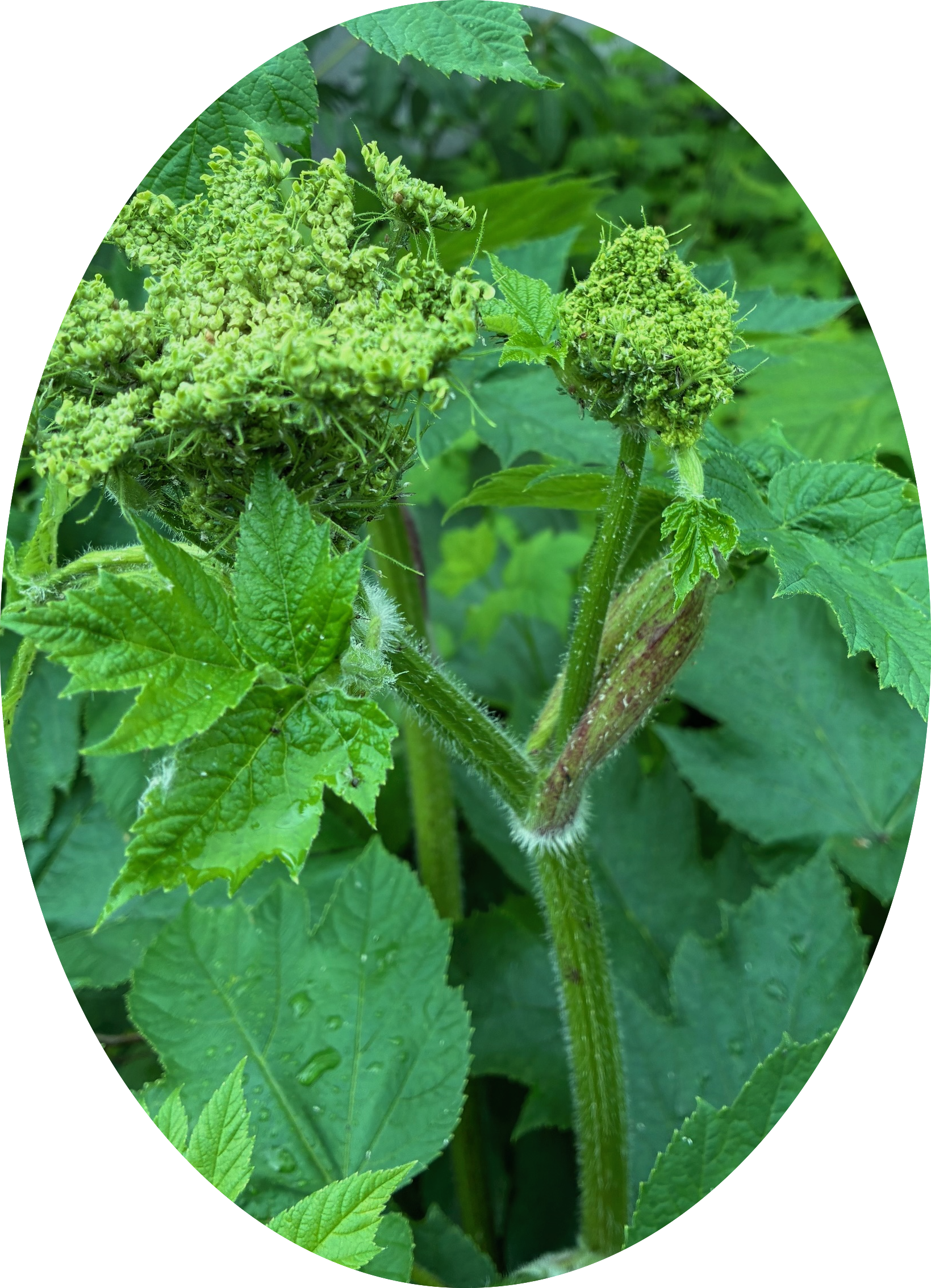
But Mother never gave up on me. On special feast days she would call and offer me a ride to church. Every few months she would pick me up for a shopping trip to the produce markets for vegetables. I loved her conversation about the Desert Fathers, the wonderful Orthodox monastics and families she’d met in other countries, her personal witness of miraculous answers to prayer, her gifts of home grown greenery and herbs and knitted gloves and natural remedies. Any free hour that she set aside for me over the years was a privilege and a blessing.
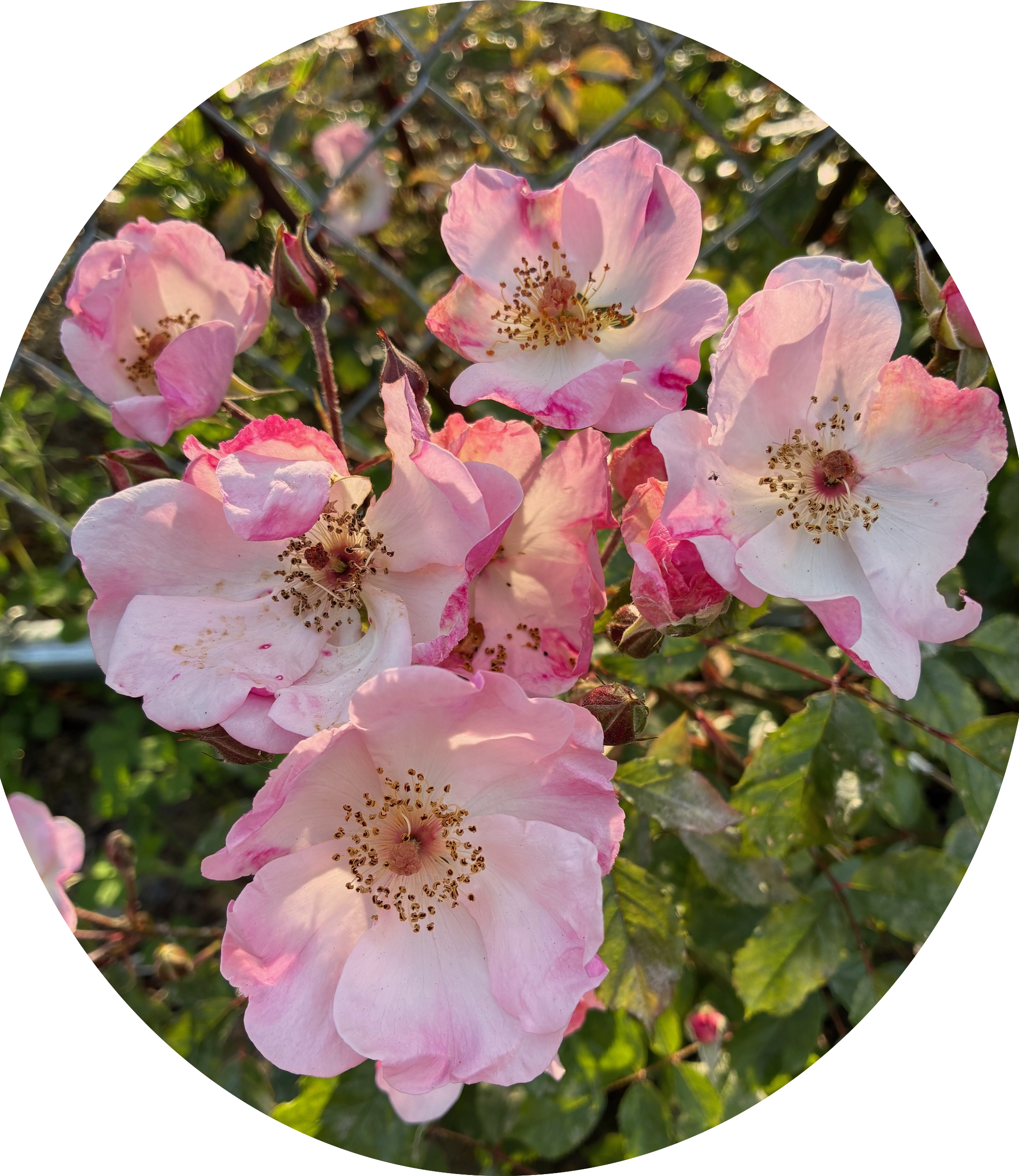
Mother’s emails were always sent at wee hours when the household was asleep. They were missives warmed with reflections on faith, housekeeping, and wry humor, signing off as “your unworthy, MN.” In one of them she let me know that she and Father were leaving for another summer pilgrimage, and that she would contact me for a visit upon their return. It was a pleasure to see the lovely trip photos on the church website, and to anticipate her stories. I emailed her back that I greatly missed our church, but was not leading a totally unflocked life: for the time being I was walking to a friendly little Bible-teaching church right up the street. While Mother was away I prepared a packet to give her at our next meeting. It held readings for her to enjoy in case she ever had time to sit down and open a book. One was The Kitchen Madonna by Rumer Godden. Another was by Kathleen Norris (not the author of Cloister Walk, but an earlier author of the same name), the 1911 novel Mother written as a tribute to motherhood.

Summer ended, with no word about the pilgrimage. There were no more email replies. Messages on her cell phone went unanswered. As time passed the realization dawned: many Orthodox Christians would feel concerned and hurt to hear that I was attending services at another denomination. Mother must have given up on me after all.

Then, a cryptic text email appeared from an unknown phone number account. It arrived by chance; the sender had inadvertently used an outdated church contact list from years before. The message was one sentence announcing the funeral for the departed servant of God Mother N____.

I stared at the message, then tracked down the phone number to a member of the congregation, and called her. During our conversation she told me that after the pilgrimage, Mother had made rueful jokes about the sin of sloth, accusing herself of chronic laziness. But she kept soldiering along for months. Finally her family compelled her into the car and took her to a doctor. By then, it was too late for treatment. The women of the church cared for Mother through a long ordeal of immense suffering. (One Orthodox tradition cautions believers to never be scandalized or disillusioned, if a patient has an especially difficult death. It can be one way for God to truly perfect an especially pure soul, and a means of atonement and relief for the sins and sufferings of others.) Holding the phone, I thought what a grace it would have been, to be on hand to perform any service of care for her. Apparently during that illness Mother mentioned my name to the women, in the certain and hopeful faith that they would all see Mary in church again very soon. She was right.

The funeral was profoundly heartbreaking and beautiful. In a bank of candles and bouquets Mother was laid out in her coffin facing a white wreath at the Golgotha, the large Crucifixion icon before the altar. The customary Trisagion band of white embroidered cloth crowned her shining silver hair. The customary icon of Christ and the Harrowing of Hell was clasped in her hands. Father sat straight and still on a chair beside her. Every man woman and child, gracefully suited and gowned and veiled all in black, stood at attention with candles in hand, rapt in absolute reverence. Our choir director was gone, but the service was chanted by her grown children standing at her feet. The celebrant priest serving the funeral concluded with a solemn ritual prayer for the forgiveness of every possible type of sin that any deceased person might ever have committed over a lifetime. But after the service he added a personal word of his own: what a profound honor it had been for him, to serve as confessor to a soul like hers.

Each member of the congregation venerated the icon of Mother’s body. Each one took turns handing over their babies and their candles, then approached her for three full floor prostrations. Then they leaned close to kiss the image of Christ, then her forehead, then her hands; they lifted their children, who reached out to her with eager warmth and trust. Then family by family they picked up their bouquets and slipped away to prepare for the drive to the cemetery. As an outsider, I spent the service out of sight off in the farthest corner. Later I left by the back door, passing through the dark parish hall filled with boxes and bags of groceries, casseroles, and baked goods. The congregation had prepared it all, to return from the burial and share a funeral meal and final prayers.

I waited and tiptoed last to the foot of the coffin. Too timid to attempt those three floor prostrations, I only made the Orthodox sign of the cross. With one arthritic trembling hand I touched her fingers, and rested the other arthritic trembling hand to touch her crown. I stood staring in dumbfounded wonder and warmth before backing away.

Do I remember all that? No, not in the emotions of the moment. But there must have been a tiny movie camera tucked in at Mother’s feet. My YouTube recommended algorithm presented a startling display of me to me: clown-sized bunion boots and velcro felted lymphedema leggings, a dumpy bowing torso, a head scarf slipping all agley, arthritic hands looming in front and center, and finally an awestruck final gaze. Now it’s a public spectacle for the internet: a meeting between two faiths, from two sides of the veil, of two loving women. One of them at rest.

“…Do Thou, the same Lord, give rest to the souls of Thy departed servants in a place of brightness, a place of refreshment, a place of repose, where all sickness, sighing, and sorrow have fled away.”

Posted in Uncategorized | 2 Comments

4/14/24: A Dog’s Breakfast

Back in the day, one of the elder relatives in our Irish extended family had the hope of inspiring me toward more ladylike and classy behavior, and used to tell me in sorrowful tones that my room / homework / hair / playtime outfit after playtime / looked “like a dog’s breakfast.” As a kid, my reaction was to be equally crestfallen and puzzled: What does a dog eat for breakfast? Today at the stove I made up one proposed option.

This is for the dog downstairs. If the whole family would like some too they are welcome — there’s a whole potful. This dish is red beans, organic white rice, minced steamed organic kale, parsley, raw shredded carrot, garlic (one clove, removed from the rice after cooking), coconut oil, nutritional yeast, Bragg’s Aminos, and a pinch of turmeric.

Dogs must not eat onions (nor raisins nor grapes nor chocolate nor alcohol), so there are no onions in this recipe. Bragg’s Aminos ought to be ok for them, because it’s listed in reputable whole-food plant-based dog recipes on the internet. My inspiration for this spontaneous concoction was Eric O’Grey, who collaborates with the Physicians Committee on Responsible Medicine. He has posted several creative recipes for dogs on line and in his book Walking With Peety, a warm-hearted memoir about health recovery and the benefits of adopting a shelter dog.

At a time when world news is so grave, isn’t it a fiddling baroque pastime to be devising dog dishes, and to be toting around carrot sticks and other dog treats on the street? Well, unlike cats (who are obligatory carnivores), dogs are opportunistic omnivores. If we cooked them more vegetables and beans and whole grain for at least part of their diets, there would be less packaging to throw away, and it could save money. Besides, this is the stuff I eat every day. (This was my breakfast too, straight out of the pot.) Another reason is pet diplomacy; I used to give a wide berth to two dogs who had a dominant manner and were not about to share the sidewalk at all. Their owners used to drag them away, saying “Leave it!” Now those dogs swoon at a whiff of me and my treat bag, and the owners and I are all smiles. But the most important pretext is the same reason why I bother gardening: it makes friends with more neighbors. At a time when world news is so grave, it seems to cheer up folks to pause and socialize and see their companions munch on something good for them.

Today I set aside some of those soft-boiled red beans. In the cast-iron skillet, rubbed with just a touch of coconut oil, I dried and roasted them at medium-low heat. After they were done I put them in a separate bowl and tossed them with a little dash of Bragg’s Aminos and nutritional yeast, then slow-roasted them dry over again. They were good, with a good umami flavor. Boiled red beans open inside out and turn crispy, making a nice crunchy topping for salad or rice. Angelina’s dogs really go for my boiled roasted chickpeas, so I took the roasted red beans down to their play space for a taste test. The bean crunch was a big hit with Super-Pup and Bingo. Then Caboodle, their high-spirited pal from next door, liked it too. Granted, Caboodle’s owner pointed out that her dog gets excited if somebody hands her a rock. The taste test was still a good conversation piece, and that was the whole point. It’s in the fridge now. I’ll carry the crunchies in my treat bag on evening walks this week around the neighborhood.

Posted in Uncategorized | Tagged , | Leave a comment

4/11/24: Bingo’s Bedtime Walk

Mary: Whenever I take Bingo on walks myself, he really gravitates to that phone pole there.

Angelina. Yes he does. And there he goes. Who’s a good boy?… So! Mare! Back to you. Just read your latest blog page. I’m intrigued! It describes a whole new side of you. One that only people in churches get to see. But I do not, because I don’t even know anyone else who is more inclined to the heart of Christ.

Mary: Bingo is.

Angelina: That’s a given; Bingo is a pure soul. But please walk me through the steps of how these church encounters happen.

Mary: It’s every church. They all have a different path which has always worked beautifully for that community: baptism as an adult vs. baptism as an infant, baptism as triple immersion vs. 1950s forehead dab, fasting on Wednesdays and Fridays and other fasts year round. I fall short at all of them.

Angelina: So first, people meet you being there all quiet and polite, and they underestimate you in a wildly drastic manner or find you threatening for some reason. Second, they walk up to you and just say this stuff, while you sit there listening patiently.

Mary: It really hurts. I mean, how hard can it be to just blend in and be normal and abide as a good church member? Maybe God only put me here as some hapless anthropologist unawares.

Angelina: Now before you step in to churches, do you first put on a pair of Dumb Eyes?

Mary: Yes, the eyes are very large with rolling googly beads. Like on Planarian flatworms, when you view them under a microscope in science club.

Angelina: Then, you stand there looking like a raving idiot?

Mary: Uh. I guess?

Angelina: Thus prompting people to diagnose you with lust, and fleshly desires. Do they even know that you handwash your socks in the sink?

Mary: I did go buy that Mexican scrubby washboard. That counts as a labor saving device.

Angelina: No. That still counts as self-flagellation.

Mary: And I do have a fleshly desire for an Excalibur food dehydrator. Then I can make my own apple rings.

Angelina: Well meanwhile, you’re getting pasta. Here’s some Tupperware; I made lots. You can eat it tomorrow for lunch. Night, Mare! Bingo, we’re not gonna chase that bunny now; let’s go home.
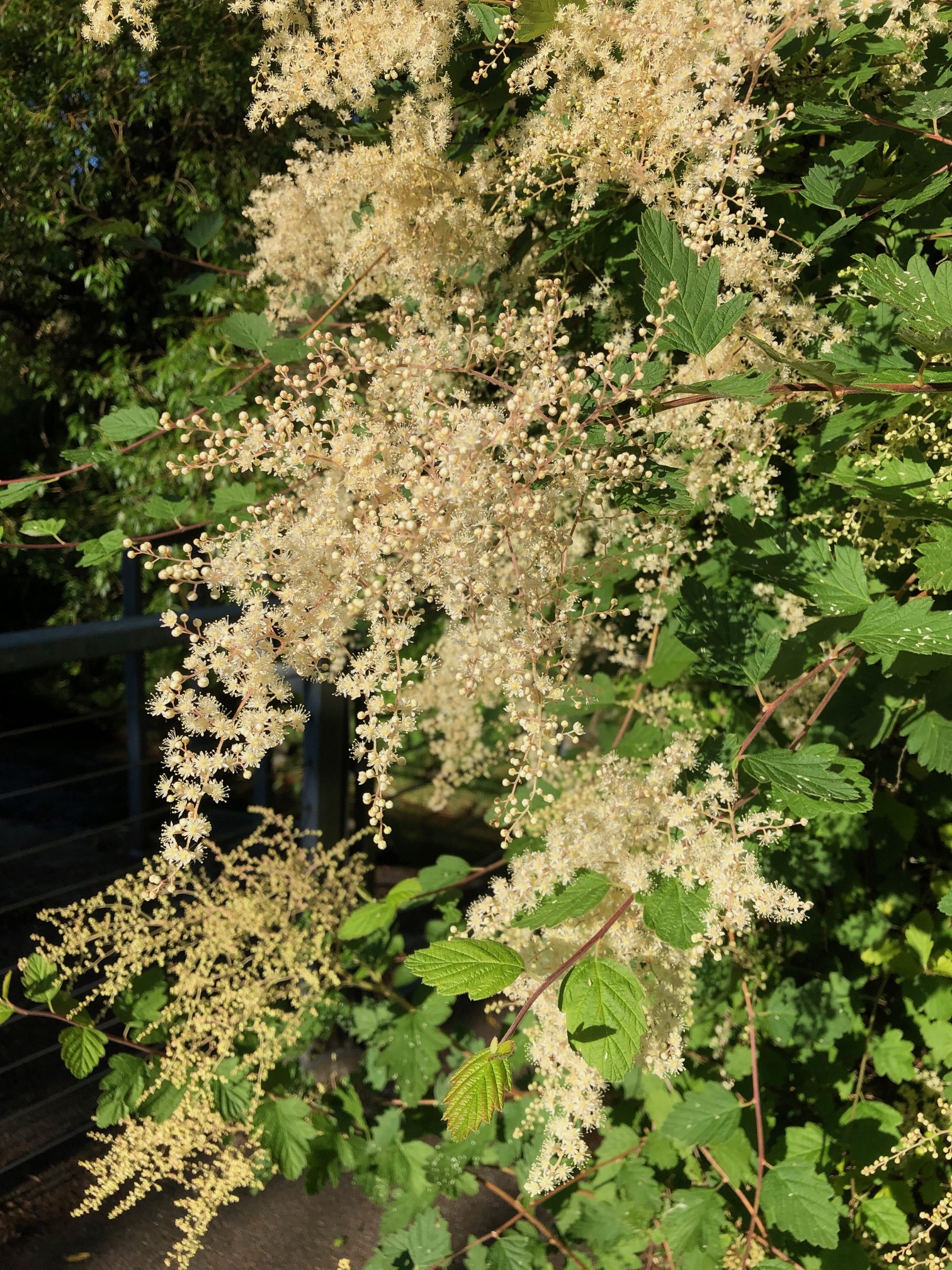
Posted in Uncategorized | Leave a comment

4/7/24: Losing Your Religion

Another Thought, 4/8: Just reading Supercommunicators by Charles Duhigg. One of the points is that to engage in a negotiation (and many personal conversations are exactly that), we have to settle What are we talking about? Who are we? How do we feel? Well, in the conversations described here, let’s suppose that the other people were peacefully tending the home base of their faith, and I was crashing into the china shop with these big sandbags of unresolved grief and then expecting all sorts of understanding and approval? It would be good in the long run to circle back with all these good people and explore how they are, and how they felt. Maybe some day when my plumage grows back in.

The Big Disclaimer: This is not the path of “God must grant me the ideal life that I imagined, or I will not believe!” Nothing in this post is cause for complaint compared to the immense suffering in the world. Religious faith is an immeasurable blessing, and I am very happy for my friends whose faith is flourishing right now. This is only the rumination of a melancholic sort who is alone too much and would benefit from having someone at home to set her straight and help process these experiences the day they come up.

A friendly neighbor, young enough to be my grandson, called “Hi Mary! Heading to work again? Why not just retire?” For this common question I usually have a cheerful joke all ready to hand back. This time to our mutual dismay I just said “Because I’m really tired of being alone.”

“Whoa,” he cautioned. “You know, there is such a thing as being TOO desperate. When women hit up on me I show them this wedding ring and say ‘Thank you Lord Jesus, for giving me such a beautiful reason to say No.'”

In other news on the Christian front, a sweet warm-hearted acquaintance with a delightful family saw me when I stopped in at her church for some quiet time. I confided my bewilderment with the Gospel message, and how I’d tried to live up to it all my life. She kindly sat down for a heartfelt pep talk with me about my spiritual walk. She mentioned the salvation verses of the Romans Road, and our hope of heaven. She gently questioned whether my salvation years ago was really certain, whether my own faith in my salvation was secure, whether at the time I had really been aware of my inherent sinfulness and need of Jesus’s sacrifice on the Cross, whether I fully accepted the church as God’s chosen family for me, and finally the barrier in the way: my fleshly desires. Of course, the fleshly desire she meant was the wish for a family of my own at home, but at first I just stood there with a dumb look, thinking of my bed = yoga mat, and breakfast that day = split peas, with weeds foraged from the tree farm near the post office. I am sad to say that my response was to finally take my leave and blunder off waving my hands in disconcerted surrender; later on I’ll go back and thank this gentle sweet soul for her kindness and concern. (Culture note: the Romans Road to Salvation topic is long long familiar from my years in the Bible Belt, where it came up as a caring everyday pleasantry everywhere — at gas stations, at the Jesus Laundromat, in line at the bakery to buy doughnuts. The town phone book even had little fish symbols to designate businesses owned by Christians. I was sincerely whole-heartedly saved there in 1980. The problem is that no one since then witnessed my conversion, so how can they be sure it was genuine?)

Last year I was attending a beautiful church. After two wise and welcoming interactions with a member of the clergy and his hospitable family, I booked a counseling appointment to discuss membership. He and his staff welcomed me to their office. There I openly confessed the greatest impediment in my spiritual life: exhaustion and despair caused by utter loneliness. “I expect to die alone and to be forgotten right away, and that’s just life for many people. But I’ve always wanted to know what it’s like, to love someone who would actually like to be loved by me. Someone that I have the right to talk to about anything, and the right to touch, in a relationship where no one is assaulted or humiliated or screamed at. I want to go home to my husband, and to lie down and be at rest.”

“Let’s just call it what it is: Lust,” he smiled. “You’ve chosen to feel lonely. You make sadness your comfortable choice, with fantasies about the pleasures of the married state. Our society believes celebrities like Dr. Ruth [Westheimer] — that to be happy, we need to be having sex!”

“No, it’s that… to be human, we need other humans,” I told him. “We need to know and be known as our whole selves. I experienced that one time long ago, with a deeply serious young man in Russia. Right before I left the country he and I became acquainted and spent several days with his family, taking walks and talking about life, and he asked whether I would ever consider a future with him. I took that very much to heart, and I think of him every day. But we never saw each other again.”

“You could have married him, yet ended up right where you are today,” he laughed. “He could have died in a year or two.”

[Momentarily speechless.] “He did.”

“Well, see? There ya go!”

He compared me with my adamant family-life wish to a little kid with his fist stuck because he’s trying to get a pebble out of a precious antique vase; or to an elephant chained up as a calf, who grows up and doesn’t understand that she can just break the chain and walk away.

Then for two hours he encouraged my path forward: renunciation of earthly desire, and union with the true Bridegroom of my soul. He told story after story about martyrs of the flesh, centuries ago in other countries. One young man was so enamored with prayer that he had himself walled in, standing up until he died; his remains are still there, and people come to his grave to pray for special intentions. Another woman in her devotion to God became a pilgrim, and spent the rest of her short life walking. Passersby discovered that she gave clairvoyant answers to their questions, though she lost all awareness of her past and her own name as her clothes fell into rags and her body wore away. “And YOU can have this same divine Eros, this same joy in the Lord! You can have the same trust in God that my children have in me.” He concluded with suggestions about texts to read, and ways to incorporate weekly fasting.

He’s a radiant generous person in general with a warm manner, someone I would ordinarily be happy to see again in his church. Still, as he talked I sat twisting my mind into a Mobius strip, pretzeling out the logic for that cosmic step of renunciation into ultimate fulfillment. I’d walked in looking forward to a meeting of the minds about deep spirituality. I walked out feeling like a naughty little girl harboring carnal thoughts, and haven’t had the heart to return to that church since. Being too dissociated to even remember saying goodbye, I left the church whimpering and groping along in a strange inner darkness to the bus stop. The bus was empty. I huddled up in a seat. The driver checked on me in the rearview mirror. Before starting the bus he turned and nodded to me and smiled with remarkable kindness. Getting off the bus later, still whimpering, I smiled back at him.

I arrived home and packed up all my Bibles and religious books, and boxed them in the closet. “I’m sorry,” I told the icons on the wall with their sad eyes, as I took them all down. “Something is wrong with me. Some day I’ll be ok, and we can all live together again.” That night, and every night for weeks after, I woke up in the dark gripped by fear: for the first time in my life, the night sky was an empty shell. Outer space held no heaven any more. Time was empty too; history had lost its meaning. There was no sense or plan for the full circle of eternal redemption or heaven, not for me.

The day after the session, my dear former dental hygienist passed me on the street. I watched myself cracking jokes about a real estate poster on a phone pole, making hilarious fun of the stylized commercial euphemisms and prices. That night she contacted me to follow up. “How are you doing?” she asked. “Something was wrong today. You didn’t look or sound like yourself.”

She had a point. The counseling encounter had hit like a concussion, a head injury that still hasn’t gone away. Now church services that mesmerized with their beauty seem like a nicely decked out puppet show. Decades of memorized chants from Liturgies and Mass and feast days and akathists and hymns (in Slavonic, Old Russian, Latin, Greek) have disappeared from memory. Those cherished daily prayer books are just obsolete words on a page. The favorite luminous promises and prayers of Scripture sound like trampled dust. God’s whole historic united body-of-Christ plan has marched off without me; he’s in some other part of the cosmos, a pleasant well-meaning guy with good ideas and care for better people.

Maybe the real fleshly desire, other than Trader Joe 72% chocolate, has been the lifelong desperation to belong to a church, to follow all the advice, to feel saved enough, to feel included like everybody else. Along the way of trying so hard, I lost my faith and want it back. I miss the words in print and hearing, the eyes on the wall. Most important I miss myself, and the way God used to lead me — a prompting of intuition that cut cross-wise right through my ordinary thoughts and showed the way, and was always always right. It’s time to find that again.

In fact, after my neighbor had the gentle word with me about salvation, she urged me to try prayer, asking Jesus for guidance. That night I did, and right away there was an inner flash of intuition. “You can be lonely, you can be sad,” that awareness seemed to say. “That does not interfere at all with the work I gave you, of sitting with souls in pain. But do not ever, EVER, speak to them the way those people spoke to you.” Maybe I needed to hear everybody’s advice, to feel exactly which words do not help.

Meanwhile, back to that driver on the empty bus. His silent nod and smile were holy, the sacrament I’d been looking for. He inspired me to carry that kindness forward, to kindle sacramental meetings ever since, all day every day, one human being at a time.

Posted in Uncategorized | Leave a comment

3/30/24: Dr. Michael Greger, MD: Groatnola

Usual disclaimer: If your teeth are delicate, and if any of them are porcelain, they might need a more consistent tender texture in the finished product — even if you bake it extra soft and moist. My groatnola came out with a few random tiny harder bits after baking. The fault might be in my cooking technique. I would need to soften this by cooking it in with oatmeal, which kind-o defeats the purpose of granola.

Update: I made this again, this time with peeled grated organic apple mixed in. I also added some extra Ceylon cinnamon. But I left out the little pinch of clove powder. That way on the street I can pass out samples to not only the neighbors, but their dogs. (Dogs can eat Ceylon cinnamon, but in theory they can get sick eating cloves or clove essential oil. Better safe than sorry.) But honestly, I don’t plan on making this again for just me. Raw soaked buckwheat groats and rolled oats cook up in just a couple of minutes, and it’s no trouble to steam sweet potatoes, so I really won’t need granola in general.

Still, for cereal fans, it’s a nice recipe — ready to eat with no salt, no sweetener, and no oil. It’s wholesome and filling with pleasant-tasting groatiness, and a good unique use of the ingredients. And if kids can enjoy kneading up a batch and can still believe that this is what we mean by “cereal,” that’s all to the good. Now, since it has no salt or sugar or preservatives, then unlike the cereals on grocery shelves this does not have a long shelf life. But a batch could stay in the freezer, as something to throw into porridge during cooking. As it cooled it softened a bit, making it a nice trail snack to chew while hiking the neighborhood.

It’s 4 ingredients: sweet potato, buckwheat groats, rolled oats, flavoring (spices & vanilla). That’s it!

For the YouTube video, search for “Dr. Greger in the Kitchen: Groatnola.” He is way more entertaining as a performer than I am as a recipe reporter, and his presentation is fun to watch. While following along, check out the vertical column of subtitles and cute commentary. (The burpee joke referred to his other clip “Dr. Greger in the Kitchen: My New Favorite Beverage.” In that clip while waiting for the blender to puree the ingredients, he powers through 10 burpees on the kitchen floor.)

I soaked the raw buckwheat groats for a few hours, then rinsed and drained and cooked them soft; that takes just a few minutes, so stay close and keep an eye on them. I steamed, mashed, and peeled the sweet potatoes. Then I mashed the two together with a good dose of vanilla and (my own notion) a little teaspoon of coconut oil for two quarts of cereal. I used a smaller amount of rolled oats than the ratio shown in the video, mixing it first with cinnamon and cloves. Then I mixed and kneaded all the ingredients together and spread it on parchment paper on cookie sheets. In the oven that baked at 250 F for two hours plus the half hour it took for the oven to cool. Dr. Greger’s mixture looked flaky and crisp, but mine was more chewy and tender.

You could stir in a dash of bitter cocoa powder with the spices, and some ground unsweetened coconut toward the end of baking.

Dogs: As Dr. Greger points out, you can feed this to dogs first, and then add the spices after. It’s easy to see that dogs would like this. Of course, dogs are a good sport about putting all sorts of items in their mouths. Still, Angelina is getting a sample for her own snack and a taste test for Super Pup and Bingo. They prolly won’t mind a little spice. (Last week, the doggos were very enthusiastic about my soaked & sprouted & boiled & roasted chickpeas. Maybe that’s just because there was Bragg’s Aminos sauce on them. Maybe the dogs were crawling all over me not for my cooking but only to get at the salt.)

I’m eating a bowlful of groatnola right now with rice milk and blueberries. This has a pleasant gently subtle sweetness, and makes a nice cereal.

Posted in Uncategorized | Tagged , , | Leave a comment

3/29/24: Watching for Bunnies

(No bunnies here. Just a nice view this week, on the walk home after work.)

Each morning, the alarm in their bedroom rang Ding! then with a polite pause Ding Ding! then with another polite pause really warming up with jazzy bright chimes in a doot-doot-de-doo rhythm. A fast online search turned up a picture that looks like theirs — a Westclox Big Ben Chime Alarm. Memory is a curious thing; I had no visual recall of that clock, but spotted it right away just now in a whole page of vintage models.

Every morning, when they turned off the alarm, Grandma’s voice would say to Grandpa “4:30 already! Goodness. After you retire, I’m going to sleep late until 6:00 every morning of the week. What a shame to wake up the little one in there.”

The little one though was up & at ’em, wildly excited to be visiting Gram & Grandpa, with the amazing novelty of being awake in the pitch dark and cold. Soon Grandpa and I were down at the table in the chilly kitchen by the warm gas stove, me on my foot stool for extra height, bundled up warm with an extra pair Gram’s woolly knee socks. Gram whipped up sausage patties, perfect round poached eggs, toast, and sometimes (my favorite) mashed potatoes fried crisp in butter, and delicious oatmeal cooked in milk. I got to eat it all up with a special tiny child spoon of real silver, and drink out of a special glass with a beautiful red Kentucky Cardinal painted on the outside. Every morning I looked at its red and black colors and jaunty crest, wishing I could go to Kentucky and see a real Cardinal, because we all knew New York is too cold to ever have any. (The first time I saw a bird outside that matched the bird on the glass, I burst hollering into the house to tell Gram to come running and see.)

Grandpa was silent at breakfast, and silent in general. He worked every day except Sunday from 6:00 in the morning to 6:00 at night at the family business, generally in the bitter cold. For the coldest days and snow, as outdoor clothes he put on just a quilted vest and a black and white hunting hat with ear flaps, made of hounds’-tooth pattern wool. I never once saw him wear a coat or scarf or gloves. Mornings we left the house at 5:30 or so, crunching through snow under the moon to the car. Grandma put me in the back seat and always said “Where’s your HANDS?” and I had to hold them straight up where she could see them so she knew it was safe to close the back door without hurting me. Then she drove very slowly all the way down the hill to town, to drop off Grandpa for the workday, and he got out of the car with a roast-beef sandwich in brown paper to tide him over until supper.

After work we picked him up. In careful stiff stages he eased in to the car after his long day. If my cousins were in the car, and if it wasn’t too close to supper to spoil our appetites, sometimes Gram opened the glove compartment up front and took out her supply of Black Jack gum for us to chew on. (In Wikipedia I just looked up Black Jack gum. By golly, that was really a thing — a licorice formula confection since 1884, the first flavored gum in the US and the first gum available in sticks. The licorice (pronounced lick-rish) flavor was completely strange to us, but we chewed it anyway. Then while Gram drove the car we kids took the gum wrappers and very carefully speared them on the long pearl pin that Gram always wore with her hairbun. We thought she might enjoy the fun of having gum wrappers falling all over when she walked into the grocery store or took off her hat.)

Back at home, Grandpa sat down on the foot stool while Grandma unfastened his high boots, working the laces free of the metal hooks from toe to top. His hands couldn’t handle small things like bootlace knots, after getting frostbit in World War I. I didn’t understand then how come if the War was more than 40 years ago, why didn’t the frostbite melt away by now? But Grandma said that’s how it goes with frostbite, and that’s why girls have to put on mittens and warm socks for outdoors. After easing his feet into fresh wool socks and slippers, Gran gave him a cup of hot tea to hold and then opened the freezer and took out a package of pure white goose-grease from the butcher, and she rubbed it on his hands to help them warm up for the night. Then he would sharpen his straight razor on a long leather strop, shave with a little mirror on the wall, watch a few minutes of TV news over a very light supper (small patty of round steak chopped, three spoonfuls of cooked spinach, three prunes for dessert). Then he said “Nacht Nacht” to all and climbed the stairs to bed.

But before work, in their half hour of pre-dawn free time, my grandparents went searching for bunnies.

Bunny watching was for short days and long winter nights, before the sun came up, when roads were empty and creatures were still out and prowling. Gram went a little bit out of their way, on the beach road looking out over Long Island Sound. At that hour there was not a car in sight; we had the woods and shore to ourselves. The car cruised at a gentle little pace, avoiding any signs of ice, taking its time. In the dark forest the stars trailed right along, hiding and seeking through the tops of the trees and over the horizon with its twinkling lights from the city.

We watched out both sides of the car with close attention. Gram always managed to spot them first. Bunnies! They dashed along the road with white cotton tails high, and sometimes right across, lucky to be seen by the slowest careful driver. Sometimes it was squirrels. Or mallard ducks. Or a cat with shining eyes. One time a real raccoon! Climbing out of a storm drain! And once it was a ringneck pheasant, with a great flapping soar of surprise and flashes of color and elegant tail. I kept breathing on the windows and rubbing off the frost with my mitten to see everything, and trying to trace the animals on the window so I could have a lifelike shape on the frosty glass to look at later. But the animals were all too fast for me, so mainly I did a lot of bouncing in the back seat trying not to yell and scare the creatures. It was just so amazing and great to see real nature animals that weren’t on TV.

Tonight for Catholic Holy Week, looking for an Easter memory to capture here, what came to mind somehow was bunnies. After growing up, and growing older now than those grandparents were then, it’s easy to see: the point of looking for bunnies was not scoring bunnies. It’s about two greatest-generation Germans born in the 1800s, weathering hardships and heartaches that they were not about to mention to us and that we can never fathom, saving string in a ball and bacon drippings in a jar and keeping a scrubbed warm well-fed home for the grandkiddos to visit and mess up and holler in.

Bunny watching was their one light enjoyable tradition of leisure; traveling in silence, side by side down the years, watching for the frozen dark to yield some sweet surprise along the road.

Posted in Uncategorized | Leave a comment

3/18/24: Wedding Pictures

On Saturday somebody dropped their recycling in shopping bags next to (but not in) the recycling dumpster, the way folks do. One bag held two crumbling pasteboard folders. So I grabbed the bag to toss it to the bottom of the full bin, and then with a yip of surprise saw what was inside. I left the bags and hurried my discovery upstairs.

There I set it on the bathroom counter and fetched a sharp knife and scissors. It took about ninety minutes of chipping in little careful bits to remove crumbling pasteboard and layers of very hard mucilage. Then I cleaned up the bathroom, wrapped up the board and glue debris and ran that straight back to the dumpster, washed hands and tools, then took my find into daylight for a good view.

It was two photographs. There were no names and no date. Both came from Roberts Studio, Brooklyn New York, and were printed on Eastman Kodak film. I turned them face down on the balcony laundry rack for an airing in the sun. Then I opened the internet and started some research.

Roberts Studio was at 683 Fresh Pond Rd., Ridgewood, New York. The Ridgewood Times had a little article about the Fresh Pond neighborhood.

A NY neighborhood that still has its own newspaper!

The newspaper invites readers to share any pictures or memories. I may just make prints of these, and send them to the paper. Meanwhile I photographed them, then showed my cell phone images to people around me. One neighbor made a little fun of my all-out rescue. “You do realize,” he said, “that one day all of your stuff is going in a dumpster too?” I said “Yes it will, but their stuff won’t if it depends on me. The hope and beauty in these faces does not belong in the trash.”

How old are these pictures? Kodak film was invented in 1889. Roberts Studio had a second shop as well, at 1230 Fulton St., Brooklyn. That was originally a family house built in 1910; it still stands today. My sentiment, and it may be wrong, is that the wedding fashions are from before the Roaring Twenties, perhaps even before World War I.

Both pictures have the same faint painted arch background. Both grooms are dressed alike, down to the little flower ornament in their lapels. The brides seem to be dressed alike too. Perhaps instead of buying wedding clothes, they rented them from the studio? If so, that would suggest that they were not wealthy people. Judging by everything I heard from my relatives, and from Brooklyn scenes I saw as a kid, life there 100+ years ago might have had its spirited occasions but was in no way easy or serene. There is something appealing and heartfelt about two people facing the future side by side in the best clothes they could manage.

For right now the wedding pictures are in page protectors at the front of my address book binder, protected from light. At first it was only basic respect, to pounce on ancestor pictures put out with the garbage. Then, the work of freeing these pictures from their old folder frames, and doing the research, made me care about these people. Now I want to find out how to preserve them well. Unless of course a reader at the Ridgewood Times says “Holy Smoke — that’s Grandma and Grandpa!” If so, they’re getting sent back home to be with their relatives.

I like to go open the binder to look at these young people, to hope that they got through the Great War and the 1918 flu, to wish them a good and long life together.

Posted in Uncategorized | 2 Comments

3/17/24: Potato Cookies

Big Disclaimers: 1. Warn the guests that these have peanut butter. 2. Don’t lick the batter off the spoon. The label on my oat flour warns that the flour must NOT be eaten raw. There are warnings about wheat flour nowadays too, that we can’t let the kiddos lick the spoon any more. Apparently, wheat fields are now contaminated by the deer population, as deer have proliferated so much and bring diseases along with.

Recipes for these cookies are all over YouTube, posted by better cooks.

This recipe might work with any kind of potato. At a St. Patrick’s Day party at college 45 years ago, one of our generous warm-hearted fellow students brought rolled “Irish Potato” bites including peeled white potato mashed with condensed milk and coconut cream and a whale of sugar and cinnamon. At the time I didn’t understand, and was too polite to ask, why these delicious treats had a biting astringent metallic aftertaste. Since then I learned that it means the potatoes had developed solanine (boiling doesn’t remove it), and they should have been thrown away. Potatoes can solanize even before they sprout or turn green. If the flavor bites, don’t eat them.

Back to our recipe. Sweet potatoes are sweeter to begin with and apparently they have a gentler glycemic index than white potatoes, so we use those.

Bake the sweet potato, mash it with peanut butter and oat flour, form into cookies, press with a fork, and bake. The cookies don’t rise, so you need not space them apart in the pan.

I used leftover steamed potatoes, peeling off the very outer papery skin. Then I inspected the potatoes carefully, cutting out anything that looked like a potato eye; the eyes are very bitter and not healthy to eat. Then I mashed the potato in the Cuisinart with cinnamon and vanilla first, and turned it into a bowl before adding unsalted creamy peanut butter and just a little dash of honey. I kneaded that well, then mashed in enough oat flour to form a soft dough. You can roll these into flattened balls, place them in a baking pan on parchment paper, use a fork to press in cross-hatch patterns to make them look more like regular peanut butter cookies, and bake.

They came out fine, but at first bite the flavor was a little cloying. Next time I’ll add a pinch of salt to the oat flour, and perhaps use chunky peanut butter. The starch-rich potatoes can carry more flavoring than I thought; a good dash of pumpkin spice would work.

After 25 minutes of baking at 350 F the cookies were still quite soft, so I let them sit in the oven while it cooled down. That improved the texture. My guess is that frozen they will taste even better.

They have a nice dense moist marzipan quality. It would be interesting to try almond butter, almond flour, and almond extract next time. Tahini and some ground sesame seeds with a dash of orange would be worth a try too.

Posted in Uncategorized | 2 Comments

How Green Was My Valley: The Potch Recipe

Update: Well, after trying this in the Consolationland test kitchen, my admiration for Mrs. Morgan’s cooking knows no bounds. She must have been a great alchemist as a cook, with better vegetables. Mine after all that simmering had the texture and taste of sink sponges and were a mess to peel. Long cooking can be convenient when one has a stove fired up all day, powered up by a mountain of coal. But it can bring out a rank flavor, especially for folks with a gene that makes them sensitive to the bitterness in brassica vegetables. The starch really clogged up the Cuisinart too.

Well, it was an interesting craft to try, and it’s good to learn by doing. Next time I’ll peel the vegetables first, dice them small, and roast crisp with oil and salt, or flash-boil in a little water until fork-tender one vegetable at a time before mashing.

In Richard Llewellyn’s book, narrator Huw Morgan describes two recipes. Here is the simple one, a dish called Potch.

The book explains that one should simmer winter vegetables gently, whole in their peels. Then

… skin them clean, and put them in a dish and mash with a heavy fork, with melted butter and the bruising of mint, potatoes, swedes, carrots, parsnips, turnips and their tops, then chop purple onions very fine, with a little head of parsley, and pick the leaves of small watercress from the stems, and mix together. The potch will be a creamy colour with something of pink, having a smell to tempt you to eat there and then, but wait until it has been in the hot oven for five minutes with a cover, so that the vegetables can mix in warm comfort together and become friendly, and the mint can go about his work, and for the cress to show his cunning, and for the goodness all about….

Here it was at our local chain grocery, US dollars and English vs metric weights.

$1.94 $3.00/lb. Parsnips (2 smallish)

$1.40 $2.29/lb. Turnip purple top

$2.12 $2.49/lb. Rutabaga, or Swede.

$1.37 $1.49/lb. Potato Irish russet

$0.60 $1.49/lb. Carrot

$7.43 total

“Say, you should add in the cost of those greens. You didn’t buy them.” Yes, in the dark and rain I went out and snipped off a handful of leek, daikon, and turnip greens that grew in the garden all winter, and threw in some dried peppermint. So the garnish was free. Except for hauling home topsoil last summer plus toting about 100 buckets of vegetable rinse water down 42 steps and around the corner to water the patch.

“You forgot to count the butter pat.” Okay, butter pat or two. Dash of rice milk. Salt & paprika. So, close to $8.00 for the whole batch of potch.

“What! I could sell you a whole bushel of that stuff for the same price,” someone with farmland in Montana might be saying. I wish you would.

On the internet a search for Potch gets you many conflicting accounts and etymologies, a whole hotch-potch, from all over Northern Europe. One confusion was the names for vegetables. When I was a kidlet in the 50s, I’d never seen a purple top turnip. To us, “turnips” meant the rutabagas in my German grandmother’s kitchen. They were much larger and darker orange and sweet than any I can find today. Gramma peeled, cooked, and mashed them through a metal ricer, and added heavy cream, butter, and salt. Mm.

This looks like a proper Potch recipe below, though 3 hours seems long for simmering vegetables.

https://americymru.net/americymru/blog/4199/welsh-soul-food-potch

By today’s grocery standards, this is pricey for a coal mining family staple. But the $8 should make two solid noon meals. To go with the menu I also picked up a pound of lentils and a pound of green split peas, for $2.79 apiece. They will expand a good bit when soaked. The lentils triple in size when sprouted to the tiny leaf stage. Either item cooked up will make at least 4 servings apiece, making the meal more budget-friendly.

Posted in Uncategorized | Tagged , | Leave a comment

How Green Was My Valley

These Hellebores didn’t come from the green valley. They’re at the local garden center.

Last Friday at our beloved surviving store of venerable books, the dollar cart turned up a real gem: a mint new Richard Llewellyn in the prettiest jacket with a picture of a village in the mountains. Of course I carried my find to the sensitive sweet cashier, and gave her my dollar and a story: “Once upon a younger time, a man ended our dating association with a dire prediction: ‘Some rainy Friday night you’ll think of me, when you’re in bed all alone. Probably reading How Green Was My Valley.‘”

The cashier’s look of eager friendliness slacked down to dismay.

   “And — I can hardly wait!” I confided to her, waving my new copy.

She was all smiles again. “Oh, what a lovely cover! Well, we can say he was giving you a helpful book recommendation.”

That night the rain and wind were in great form, a comforting racket for being all tucked in with this nice edition. It’s a good size copy, easy to hold and read. It fell open to Chapter 40: “I had splendid minutes in a bookshop…. O, there is lovely to feel a book, a good book, firm in the hand, for its fatness holds rich promise, and you are hot inside to think of good hours to come.”

After joining narrator Huw Morgan from cover to cover this week, I watched the lyrical warm-hearted 1941 film, made in California, and enjoyed the many viewer comments full of nostalgic memories and praise and movie lore and wit:

“This film stole the best picture award from the amazingly brilliant Citizen Kane and it is considered a shocking lapse of Hollywood’s taste. But you know what? I have watched this a dozen times and haven’t had the slightest desire to see Citizen Kane again.”

“Some weird accents to anyone who’s ever heard a real Welsh voice. Are the adult sons played by German POWs?”

It was a pleasant surprise that the plot faithfully followed the book and its dialogues. The choral soundtrack brings us “Cwm Rhondda” (we English-speaking Catholics call it “Bread of Heaven”), “Calon Lân,” and other fine songs. The black and white sets and scenes were beautifully composed. Young Roddy McDowall as Huw was a luminous hardworking presence all throughout. In the climactic scene shown below, Huw finds and brings Dada’s body up to the surface of the shaft with Chaplain Gryffud just before the mine collapses.

Why isn’t this book popular??? Maybe Americans want a plot that builds up something successful. Maybe they don’t want a lengthy plaintive remembrance about family and friends cherished and loved who all die under a mountain of coal or fire or starvation or exile, about a village and valley abandoned under creeping black slag as the narrator ties his last belongings into Mother’s head shawl, and walks away from his crumbling house never to return. There’s graphic violence and heartbreak too, hair-trigger tempers and fisticuffs and bloodshed and suffering at childbirth and drunkenness and madness and social shunning and English cruelty to children who use Welsh at school.

But through it all, there are lilting passages of intricate ecstatic praise of family and hearth and home and singing and the valley and animals and flowers. There is even tenderness for the little beasts of burden who power the mines underground their whole lives. Before the final cave-in that destroys all the life they know and Huw’s father at the bottom of it all, Huw rushes into the dark to get them out:

“Well, if you had seen the little horses when they saw us. Like children, they were, ready to sit down at a party, and with just as much noise…. the ponies were so full of joy that they pushed against us with their noses, and rubbed their necks…. all shouting to be going on top to grass.

Eh, dear.

If you had seen those ponies running when we let them loose. Blind they were, but they knew that mountain had only kindness for them and nothing for them to trip on or trap to bring them low.

If only we could all have been as happy.”

An improving read, something to be grateful for on a rainy Friday.

Posted in Uncategorized | 4 Comments

1/6/24: Being Real

One week of rare forays in unvarnished emotional honesty.

  1. Virtual seminar at work: medical research all about loneliness in society. Takeaway points: Loneliness means a subjective perception that one is isolated. Loneliness has become an epidemic. It’s big! Feeling lonely is a health hazard equivalent to smoking 15 cigarettes a day, according to the Surgeon General. [The same Surgeon General, in an interview I heard about loneliness, gave two suggestions. One, spend quality time with your spouse, children, and family. Two, look confident. This will encourage people to want to socialize with you.] Statistics, figures, pie charts, all show negative health outcomes of loneliness. Fortunately, elderly people report less loneliness as they age. Recommendation: treat young people with cognitive behavioral therapy in virtual video sessions. Train them to replace their negative thoughts with positive ones, and to learn behaviors which enable them to socialize with peers and become more self-reliant and resilient. Thank you.

Presenter: Discussion?

Me: Loneliness as a subjective perception really isn’t mentioned in this culture. Many susceptible people are too distracted with their drugs, junk food, guns, pornography, and pets to articulate it even to themselves. Elderly people can quietly faint from dehydration because they lose touch with their own sense of thirst; caregivers know to just hand them a glass of water instead of asking them whether they want it. In the same way, the loneliest senior citizens may not know how to verbalize to researchers that they are lonely. They may have lost touch with the sense of or need for close connection.
Participant: Actually, the research does show that older people report less loneliness.
Me: [They may not sit around reporting anything to YOU if they are busy planning to do something about it. Check your suicide stats in PubMed, especially for older men.] Sure. And, older people have been trained to not admit that they’re lonely. At least if they would like people to visit them.

2. Zoom meeting with friendly caring remote offsite co-worker who I’ve never seen: So, all set for Christmas?
Me: Well, Christmas is more for families. So actually no, I don’t celebrate it any more.
Colleague: Mary!! I am your family. All of us are! Your family is our whole department.
Me. Thank you! I hope your family have a wonderful holiday.
Colleague. We’ll be skiing — this time with the dog. Should be interesting!

3. Very intelligent science colleague: It’s been pretty rainy lately, but the days are getting longer now. Your problem is just seasonal affective disorder. 
Me: You know, it’s actually not. Summer is much harder. Rain is comforting and calming, but sunshine hurts.
SC: You could wear sunscreen.
Me: No, it’s the light itself. Sunshine fires off way too many neurons in my brain. That’s why rainy weather really helps.
SC: What really helps me is my full-spectrum light, timed to reflect just the right balance of blue/orange light throughout the day to aid in a healthy melatonin cycle. You can buy [brand name] on Amazon. It wakes me up every morning, and makes all the difference in my mood.
Me: That’s great. I’m happy you found something so helpful.

4. My oldest girlfriend: When in the WORLD are you going to retire?
Me: To whom?
OG: What?
Me: Retirement is our chance to devote our lives to our families. Who is that?
OG [?????]: Well if that’s how you feel, why not invite a co-worker out for coffee?
Me: My co-workers work remote at home. With their families. And their coffee.
OG: I sure wish I had some alone time away from our full house here. Your life sounds so peaceful.

5. Favorite bus driver: Jeez, Mary. Back on the bus again. When are you going to retire? What are you gonna, go to work and ride the bus back and forth until you just keel over and die?
Me: That’s the plan, Bernie. This seat will do fine.

6. Celeste, grandmother with a close growing dynasty: You need to gather your women friends together, and once a month go out and treat yourselves to lunch at a nice place. Then as the years go by, you will have more in common with them as they become widows too.
Me: Thank you. [Uh. Widow?]

7. A Favorite Neighbor since 2010: Hi, Mary! Happy New Year! How was your Christmas? What did you do?
Me: Uh, I didn’t get up. Mostly over the years I’ve worked really really hard to make it meaningful. But maybe for me it’s just a black flatline and that’s how it is? So I just stayed put until it was over. Then I started calling and checking on people in the building and in my life. Some of them are really struggling.
FN: Oh gosh, I was really sick! I’m fine now, but it was like… flu or something. Poor Gary had to keep helping me to the bathroom. He had to bring me hot fluids and hot water bottles and keep tucking me in. And then my sons drove to town, and they pitched in and did all the shopping.
Me: That sounds awful! I’m really sorry to hear that. Thank goodness Gary was there and you got to see your sons too.

8. After Church: [This conversation may be the most kind, caring attempt by a Christian congregation member to even listen. See how much nicer this is, than the Christian woman who once clapped her hands directly in front of my nose, shouting in the parish hall “You must have an unconfessed sin OR lack of forgiveness toward others. Forgive now! Just do it!”]
Very warmhearted church member: Mary! How are you? Doing okay?
Me: Hi! Working on it.
VWCM: Wait — working on what?
Me: Working on doing okay. Last week the sermon was about the Prodigal Son being left lonely and forsaken, and how loneliness is a sign that we have to repent and turn back to the Lord. I really worried about that all week. How do you turn back to the Lord if you didn’t turn away? Does loneliness mean that the greatest prodigal sinners are people in Medicaid nursing homes?
VWCM: The sermon didn’t say that!
Me: Well, and tonight’s sermon was about joy in suffering. What’s joy? My friend is red/green colorblind. He says God is the color green: something people tell him about, but he doesn’t know how colors feel. Maybe joy is just another color.
VWCM: But don’t you have joy in your life?
Me: Doesn’t feel that way. People talk about it at church all the time.
VWCM: It’s the joy of the LORD. The joy of the Lord is our strength!
Me: Okay. And what is that?
VWCM: Why, joy is different for everybody. Everybody has different things that bring them joy.
Me: Where is it in our chest? Is it red? Green? Like, here’s this lovely photo card you gave me of your whole family at Christmas. Every year people mail me these group photographs. The family members look like they feel a lot of joy being together. Then I open the envelopes and look at the photos and they just make me cry.
VWCM: Well our family also has concerns as well.
Me: Yes. It’s been very inspiring to watch you relatives care for each other. Families like yours face your concerns united, not alone.
VWCM: But single women can still have joy!
Me: Okay. And what is that? What does that feel like?
VWCM: [Hug] Well, at church we love you!

[Typed up thanks to the moral support of listening to many reps of “Cloud Nine” by Nik Kershaw.]

Posted in Uncategorized | 2 Comments

12/27/23: Angelina’s Island Adventure

Big Disclaimer: Angelina is back. I would never mention anybody’s travel plans until they are safe at home again. Nobody needs to worry that their whereabouts will be blurted about under their pseudonym on an anonymous virtually unread blog written by another pseudonym in a city far away.

Bedtime for Bingo — a very, very good boy.

Angelina: Was that a knock? WHO’S AT THE DOOR? Let’s see who it is. Look, Guys! IT’S MARE!

Me: Hi Sweetie! Hey Super Pup. Hey Bingo. I didn’t bring treats, but you can come sniff and lick me anyway.

Angelina: This week while I’m away, Vickie is staying with the dogs. You don’t know her yet. Lovely woman. I think she is a Genius. Like, literally. You know how with some people, you can just SENSE that they’re a Genius?

Me: I wouldn’t know.

A: You’ve got to meet her.

M: I’ll watch for a stranger stealing your dogs, and go introduce myself. What time is your Uber pickup?

A: At 4:30 am.

M: So in seven hours.

A: Say a prayer for me, that I’m downstairs in time.

M: Okay. Have you packed yet?

A: No.

M: I’ll say two prayers. So, you’re off to Island X___ ! Exciting times.

A: Swimming with wild pigs.

M: Huh. So, like Chincoteague, but…?

A: Pigs. Look: Here are pictures on my phone. People swim with them.

M: Did they run out of dolphins?

A: Dolphins don’t live there. Pigs do. Careful, Bingo: I don’t want to trip on you. There, there; you go lie down. Good boy. Bingo’s joints are hurting him. Want some tea?

M: Not if you’re waking up in five hours. Aren’t pigs, like, large, heavy, faster than we are, and wicked smart with teeth?

A: A few injuries here and there apparently. But my friend wants to go.

M: Hence, she invited Nurse Angelina, R.N. Good plan.

A: Do you need extra tomato sauce? Here’s a jar. Here’s two. And, a scarf for you. It’s warm.

M: Thank you, it’s very pretty. You could stay home and swim with Bingo in a hot tub of Epsom salts.

A: Poor old fella. It’s time for his pain meds. Take this waterproof jacket. Let me hold it up to you. Good, it’s long enough. Eddie Bauer. Put it on. It’s just a shell.

M: Shells are what most people tell me to come out of, not put on. Gosh, nice jacket. Thank you!

A: So tell me ALL of your news!

M: My friend Gabrielle, the art appraiser and historian, is coming to visit next year.

A: That’s great! The one who was your boss.

M: Right, like that movie “I Heard the Mermaids Singing”? She’s the gorgeous cultured Curator, and I’m Polly, her organizationally challenged Girl Friday. I told her she can have my apartment and I can stay in your spare room. I guess I could have asked your permission first.

A: What about THE BED?

M: In your spare room? If your spare room doesn’t have a bed, that’s fine. I’ll sleep on the floor, like at home.

A: No no no. I meant the bed at YOUR place. As in, you don’t OWN one.

M: Oh. You’re right. I can’t put Gabrielle on a floor, because she has a stiff back.

A: Mare. Get a grip. You can’t put Gabrielle on a floor because she is A HUMAN BEING. That settles it. We are buying her an air mattress!

M: Tonight???

A: As soon as I am back. Or no — you take MY bedroom. She’ll take my spare room. You girls can stay up all night and talk. That’s half the fun. I’ll go to your place and sleep on the floor.

M: Well, we’ve got a year to argue about it. Better let you pack.

A: Take this carry bag for the tomato sauce. I put in some pasta to go with. And here: keto granola bars; Costco had a sale. Jacket looks good on you. But it’s just a shell, with no warmth.

M: Just like me. Bye Bunny! I’ll miss you!

Posted in Uncategorized | Leave a comment

12/24/23: Home Companion, rewrite

(Eye of the Beholder: A sense of wonder stopped me in my tracks, at sight of these beautiful frost crystals on black ice. But on closer inspection it was a car part busted up in the gutter.)

I’ve always wished for 1. a companion, and 2. life-building occupations shared 3. in home space.

What is that like? Well, it’s two people who can spend an interlude in the same room, where for now their presence feels like enough, and is just right. Neither one has to feel shut down or afraid or left out or hurt. They like times of peace and rest. They can feel safe and at ease with how they feel and think and look.

The two can take care of each other when they are sick or having a hard day. They can listen and pay attention and talk their hearts out. Or, they are so comfortable that they can attend to their own chores. They can do the dishes. Or, they can take out the garbage. Or, they can plan on their schedule or budget for the week. Or, they can wash and iron and mend the laundry or do needlework. Or, they can cook and eat a meal. Or, they can sing. Or, they can play musical instruments. Or, they can read the Bible out loud. Or, they can pray. Or, they can practice a foreign language. Or, they can read and discuss each another’s writing. Or, they can take a nap. Or, they can play with the dog. Or, they can sit at the window looking out at rain and listen to the killdeers flying overhead. Day by day they can do small things to make every day better and more secure in a shared present, and a secure shared future.

My whole life was spent working hard on skills and character and wisdom to be the best companion for a loved one. Whenever heart-breaking things happened, or there were new lessons to learn, I tried to use this opportunity to become a better partner one day. God willing, good companionship is my biggest dream and meaning and ideal of life. I imagine it every morning waking up, and every evening falling asleep. I wish it for other people too.

Especially every holiday, and especially Christmas Eve.

Posted in Uncategorized | Leave a comment

12/16/23: Frontier Town, NY: Yippee Ky Yay!

The man with the bandana over his face pointed a gun at me. “Do you have any gold teeth?”

I recognized him as an arch-villain like the kind on TV, where cowboys in big hats ran around shooting each other. I had no idea when adults were only play-acting in a costume, or what “gold teeth” were, but was pretty sure I’d never noticed any while brushing in the mirror before bedtime. I shook my head.

   “Open your mouth!” he demanded.

That was a familiar command from trips to the dentist, so I did. Then I held very very still, staring up at him. Is he going to kill me? The grownups here are insane. I’m all on my own here.

   “Aright then.” He holstered the gun, jumped off the stage coach, and waved the driver to start the horses again. The passengers gave him a round of applause. Another day of family fun at Frontier Town. Now for a preschooler, the perfect punch line would have been seeing this arch-villain take off the bandana and say “Surprise! I was only kidding! I’m a local high school kid at a tiring summertime resort job. The gun’s not loaded. It’s made of licorice.” I would have really laughed and then dogged his footsteps for the rest of the day, peppering him with questions.

The Great Stage Robbery came to mind today in a waking moment before dawn, just one more vignette in a warm loving childhood set in the utter cirque-du-bizarro called the 1950s. I lay in my blankie roll thinking “Wait, what? Did that happen? Did some historic re-enacter really point a gun at a little girl? Was it called ‘Frontier Town’? Was that a real place?”

By golly yes it was. Who knew? I just looked it up. The park opened in 1952 at Schroon Lake in the Adirondacks, upstate New York. According to the website Atlas Obscura, it had “trick riders, bucking broncos, horses and buggies and stagecoach bandits…. Founded by Arthur Bensen, an enterprising phone technician from Staten Island, the park had a Pioneer Village (with lots of calico dresses and butter churning), Prairie Junction (modeled after a Wild West main street), an Indian Village, a rodeo arena, and even a narrow gauge railroad.”

And according to this article by Michael Maciag,

https://www.governing.com/archive/gov-north-hudson-new-york-frontier-town.html

“Frontier Town, a Wild West theme park, once attracted families from all across the country. In its heyday, more than 3,000 cars may have filled the parking lot on a weekend. Patrons filled up the town’s motel rooms. When the day ended, they dined at one of several restaurants or taverns. If thrillseekers wanted to make their own food, the town even had a grocery store — a luxury not many other places in the Adirondacks enjoyed.” Article photographs include this appealing abandoned church, looking like some Volga German construction in a Russian village.

I was too young to remember any of those attractions, or the rest of our trip. But it’s heartwarming to think of my thrifty serious overworked parents driving all day for a cultural holiday. I wish I could thank them for it, especially for the chance to meet a live horse that wasn’t just in a movie or a book. That is my main memory of Frontier Town. It happened at our cute little overnight motel, white with yellow shutters and a covered porch, run by a friendly motherly innkeeper. She had a small fenced pen outside with a pony. I think their names were Betty and Tony. Someone picked me up and put me on Tony, and led him around the pen. He was very gentle and very soft to the touch, with a shining black & white pinto coat. Up on his back, I was over the moon with astonishment and happiness. That made it a little sad to click through various websites and read about a family resort shuttered down with only a few animatronic cowboys looming around. But now that story might have a new ending, according to this website:

https://www.frontiertowngateway.com/our_story

Apparently new American Mr. Mohammad Ahmad and his family have made an enthusiastic home here, and have been hard at work setting up a gas station and a local restaurant as a rest stop for tourists. The website advertises cuisine from Pakistan at “Taste of Lahore at Frontier Town (Halal).” If I were near the Adirondacks, I’d hurry on down to say Salaam aleykum and have lunch and talk to the family.

Frontier Halal. That says it all. God bless America!

Posted in Uncategorized | Leave a comment

12/9/2023: Chicken Livers

(Update to original story: Oh well, back to the drawing board. Next time I’ll just cook and eat these plain as a meal apart with ginger and other pro-digestive seasonings. Liver is a wholesome food, but my system wasn’t accustomed to the novelty, and didn’t really know what to make of it. Besides, I couldn’t serve this to Angelina even at the end of a ten-foot pole; she’s way too fast for me to catch. -m)

Angelina will not want to be surprised by a photograph of this culinary adventure.

Out of consideration for her sensibilities, here instead (with full permission) is a picture of SuperPup, crawling into my lap to show me her new chew snack. SuperPup was fine with having the picture appear on the blog, stipulating only that every penny of royalties goes to her.

Last night and today it rained hard with local flooding. To shop for food I pulled on my tarp slicker and fluorescent vest, and was just hauling on my OSHA-compliant high rubber boots (a $2.00 bonanza at the state surplus sale). Then the phone rang. It was Angelina, looking out her window and thinking “Rain = Must drive Mary to store.” That is how first responders think. They just spring into action. It’s amazing. They are not one of us. Would I like a ride? Yes, Ma’am!

Soon she and I set out, with SuperPup and Bingo in the back seat. They happily licked the side of my head but whimpered in heartbreaking woe when we left them in the car. It is touching to see that when Angelina issues a training command, the dogs may have their sassy moments, as in “Ha! Are you going to make me? You and how many papal Swiss Guards?” But they are existentially distraught when Angelina is out of their sight for even a moment. She is the sun of their entire solar system. They need their alpha figure and pack configuration in order to feel safe and comfortable.

First we stopped at Fruit & Folks, where I loaded up on the Saturday bargain bin produce specials. Then we headed over to a whole new destination: the uptown butcher shop, so I could branch out and explore food products derived from (as my plant-based peeps will say) animals that had a mother and a face.

That first trip may be my last. Beef, $69.99 a pound? $40 for salmon? Where’s the decimal point? Holy smoke. Clearly, all those times that colleague Gunnar served salmon to his guests from the office, I should have been nicer to the guy.

Me: You know, at the Dollar Store there are jumbo cans of mackerel with only mildly scuffed labels. Oh wait — look at this. (Holds up clear plastic container of organ meat and blood.) $3.82 a pound. I’ve found my price range!

Angelina: (Discreetly averts eyes with random throttly noise, and walks away.) Enjoy! I’ll be in Housewares.

Out in the car, I gripped the chicken livers to keep them tightly lidded and level all the way home. (On the next offal outing, I’ll bring a lidded tupperware canister to hold the meat and avoid any chance of spillage on the upholstery.)

SuperPup and Bingo were luminous with joy to see that Angelina had decided to return instead of farming them out to a new forever home. Their great mood might have been even better if they’d had a few licks of my purchase too.

Chicken Liver Hash

Blended in Cuisinart: Celery leaves, mushrooms, zucchini, apple. (Chives or scallions would have been nice too.)

Seasonings, added to the Cuisinart hash: Parsley, dill, paprika, ginger, Bragg’s aminos. (Honey mustard and rubbed sage and black pepper could be good too.)

Last night I boiled down bones and bone broth in my heavy stew pot. Instead of scrubbing out the pot, I put the whole pot in the fridge for the night to reuse the flavorful residue at the bottom. In the pot I sauteed some minced garlic in a bit of bone broth and a dash of apple cider vinegar. I stirred in the vegetable/seasoning blend. Then I poured the livers and handy liver blood directly from container into pot without getting raw meat near cutting surfaces or utensils. Since I don’t put meat in my Cuisinart, I chopped and mashed the livers right in the pot after they were well cooked through.

Half the liver went in the freezer. The other half was mixed with one whole cauliflower, steamed and mashed. The idea was to make the dish about 90% cooked vegetables.

This tasted good. The recipe was a keeper, worth making again.

Posted in Uncategorized | 2 Comments

11/28/23: Potluck at our Network Village

There was a potluck tonight at our Village To Village Network office.

Local chapters of the VTVN are growing nationwide, and that’s good news for all of us. Here is their home page. Maybe there is one in your town. https://www.vtvnetwork.org/

The Network is for folks who wish to spend their older years aging right in place, in their own homes. They would like to postpone the transition from independent to assisted living. In some cases, all these elders need is some car rides to the doctor, some light housework help, or some friendly visits. Members pay the Network a yearly fee, and are matched with vetted screened volunteers who serve for free. That can let people stay at home for months or years longer, and be healthier and happier along the way.

How did I hear about it? Years ago, my super-hearty super-sharp enterprising Mom made a difficult decision to surrender a piece of her fierce independence. She gave up driving, and sold her car. Her scenic small mountain-foothill town had zero public transportation, no grocery store, no sidewalks mostly (and even those were uneven slabs of pre-Revolutionary puddingstone over tree roots), and massive snowfall during long winters. For years I dreamed that she would move to my building in my new town or at least spend the winters here, with our mild climate, buses everywhere, and free shuttles to the medical centers. And why didn’t I move to her town and help out? Her town doesn’t have steady employment, I don’t drive, and groceries are miles away. As a senior citizen myself, it frightened me to slip and slide around in four feet of snow on frozen puddingstone, and to walk on icy interstate roads — once falling headlong off a tall snowdrift as an 18-wheeler truck sped right past me.

But Mom, being super-sharp, knew that the VTVN had been fixing to start a chapter in her town. Mom showed up at the planning meeting with a donation check for $100, four pans of fresh hot homemade brownies, and vocal enthusiasm. When the chapter opened she signed right up, attended all meetings, networked like a champion, and gave up the car. Mom was pragmatic and upbeat about asking for help. For me, living far away, it was poignant to see her tackle this milestone in her life journey.

For her first experience with a Network volunteer — someone who was, after all, a perfect stranger — I waited anxious by the phone. What a relief to get her phone call saying that she was safe at home again. “We chatted like old friends!” she exclaimed about her new volunteer. He was an earnest distinguished gentleman in his 80s with exquisite courtly manners. He and Mom shared the confidence that both were hard of hearing — and that both were big Cole Porter fans. It happened that her new road companion had a whole library of Cole Porter CDs in the car. He cranked up the volume, and the two new friends sang their hearts out all the way to the doctor and back.

With her membership, Mom met people who were eager to drive her to the doctor and the food store. She baked her luscious desserts and shared them at Network events. She had new stories to share with us, and all the news was good. For years, her wonderful volunteer (may he rest in well-earned peace) showed up faithfully for all her appointments. At his very last excursion for Mom, he signed in at the funeral home and stood quiet vigil at her wake. I spotted his name in the guest book and charged at him with a huge hug, hollering “You brought so much sunshine and song to my mother’s life!”

After Mom’s funeral I was walking down the little Main Street, and saw a woman unloading bouquets from her car. I helped her carry them up to her church door. We got talking about the town, and I mentioned the local VTVN. “I’m a brand new member,” she said gladly. “I just joined and attended my first Network party. But what an unusual party — everyone was crying! They couldn’t stop talking about someone named N___.” I explained to her that that was my Mom. She and I had a lovely chat. The two of us exchange holiday cards to this day.

The Network eased and brightened my mother’s life so much, I had to explore it further. That’s how I joined our own chapter (to her delight) over eight years ago as a volunteer. The office interviewed me, found out my interests and skills, and conducted a criminal background check. (“How did the background check go?” I asked their administrator later. “Rap sheet a mile long,” she replied.) My first assignment was helping my neighbor Miss Rose. She was perfectly independent, and needed only help with her laundry each week. Once we placed the loads in the dryer, Miss Rose would serve me tea and a fresh-baked scone, and we would play Cribbage for an hour and then fold the laundry and put it away. That was our cozy Thursday ritual each week for the next three years. And when Mom passed away, Miss Rose and her sympathetic ear and tea were a great comfort.

Tonight our Network had a holiday singalong and potluck. I brought my bowed psaltery and a batch of dark-cocoa dessert crumble (coconut spun with dates, raisins, some 72% chocolate chips, and spices), and headed over.

As an icebreaker, the flock of us gathered and pitched in to set the table and set out the food. We talked about and admired the different dishes while I sat in the corner with the psaltery and played winter-themed songs. Then everybody settled down around the table.

At first, the conversation was a bit unsettling for me as a newcomer. The fabric of words was like a slightly scratchy loose burlap cloth, floating aimlessly overhead. Sometimes people talked over each other, or talked at once, or asked one person several questions at the same time. I caught myself retrieving people’s words for them without being asked, and calling out the ends of their sentences for the benefit of people at the table who didn’t catch all of the stuff being said at the other end of the table. Finally I realized that my nervous habit of moderating the group chat came from large family dinners in the old days, where frequently the quiet people got left out or there were misunderstandings that led to someone feeling hurt.

But at this potluck, nobody got upset at all. Clearly my worry was only an extra mind-casserole that was all in my head, not on the table. So I sat on my hands and hushed up while everybody talked past each other. And sure, sometimes they interrupted. They repeated stuff. They were asked to repeat stuff again. They left trains of thought on the side of the tracks. Then they circled around and eventually finished those trains of thought. They tried new trains of thought and set out together happily to explore them. And they all agreed on one thing: Eating together was good for us. I agreed too.

One Board member had a great idea. She started us off by suggesting that everyone share their story: How and when did we learn about and come to join the VTVN? Then, she gently made sure that the conversation got around the table so that everyone got to share. Every member had a starting point (loss of a spouse; son or daughter moving away; medical troubles), then a moment when they heard about the Network, then a moment of Hope, when they pictured that maybe now their lives could be better, and maybe this group could be just right for them, and they made that very brave phone call and found themselves a new bit of home and connection. Members talked about how much they enjoyed the Group’s social clubs. It was very touching when they all chimed in and encouraged each other to sign up for exercise outings, life-planning skills, transition support, music and drama and poetry groups, and more.

At the end, another member had a great idea too. “Let’s close with a song.” We struck up a heartfelt chorus of “White Christmas.”

At the end, a member who brought appealing paper holiday ornaments gathered them up, mentioning softly that we were welcome to take some home. I asked her “May I have a few? Our building has a giveaway table, and we have small children who will be delighted to have their own ornaments.” She beamed and handed them right over, and I made a big grateful fuss of appreciation.

Walking out the door with my psaltery and cocoa crumble jar, I stepped out into the frosty starry night. Then, it struck me. That whole conversation over dinner? That was our Scottish waulking-work. Waulking was a group handicraft for women, who would beat fabric while singing to keep the rhythm. That’s what we were doing with our conversation at the potluck. It was taking the floaty loose-knit scratchy burlap and talking the words until finally the fabric was smooth and a good fit, as a new little piece of shared history. Our conversation turned out great. Working out shared talk is good for our minds and spirits. I look forward to the next potluck, and to more events.

At home I set out the ornaments on our house donation table downstairs with a little greeting note. They looked merry and bright for that evening, but were snapped right up and gone by morning.

Posted in Uncategorized | Tagged , | 2 Comments

11/23/23: Thanksgiving Confection, No Sugar

Dates, 6 large, pits removed, soaked in a bit of water for half an hour, then diced up.

Oranges, 4, tiny mandarinees or tangeritas or whatever the word is, peeled and chopped.

Flavoring mix: bitter cocoa powder, 1/2 tsp or so. Cinnamon. Vanilla, alcohol-free. Teaspoon of coconut cream (optional, for softer fluffier texture).

Coconut, unsweetened flaked. The package is 8 ounces, but this was more like 7 ounces because I put some on my oatmeal last week.

Spin coconut in Cuisinart until it’s all powdered down and just starting to stick together. Add flavoring and spin some more. Add orange and date pieces. Spin until mixture sticks together in a clump.

On a sheet of wax paper, pat dough into a firm ball. Wrap it in the wax paper. Press down into a small bowl. Pop into the freezer for an hour. Then unroll and slice it, or roll into little balls. Put it back in the freezer, and serve at dessert time. It’s handy that for upcoming social events you can freeze this in advance.

This is for anyone at the party who is cutting out refined sugar. The coconut is the central ingredient. (But spinning raw almonds, soaked and peeled, should work too.) Overall, a very versatile recipe. Substitute anything for anything. This doesn’t give the usual spike hit of sugar because there isn’t any. But when it’s chewed a while it tastes sweet, and the healthy fat and fiber give it a satisfying feel. I brought this to Angelina’s tonight, and the guests were fine with it.

Posted in Uncategorized | 2 Comments