One New Year’s Eve

The new apartment had four cozy wee rooms: kitchenette, bathroom, central room, walk-in closet alcove. Each had a window with oil-heat radiator facing west, looking up at a six-story brick wall of windows and a little slice of sky.

In a multi-college city, getting an apartment was a long shot. How was I one of the lucky ones? Three reasons.

Reason 1. That morning, Maintenance Master Frank discovered a unit left open and abandoned, filled with spoiled food and cockroaches, where the tenants had vanished leaving dented walls and cigarette-burned floors and thousands of dollars in unpaid utility bills and rent. He reported the news to Property Manager George.

Reason 2. In the office of Manager George, rental applications came pouring in through the fax machine and piling up on the floor. George busily typed the names in to a database, and found that all hopeful applicants had credit scores which dashed his hopes.

Reason 3. Enter Mary, walking in just then with checkbook in hand to cover first + last + security, and the greeting “Hello, Mr. N___. Why — YOUR last name comes from Byzantine royalty!”

Judging by George’s happily astonished reaction, no one at this hassle of a job had ever shown the slightest interest in his royal heritage. Leaping from his chair, he grabbed the keys to show me — if not the challenged unit itself, at least the building outside it. We finished an enjoyable chat about Byzantium and the Orthodox Church, shook hands, and clinched the deal.

Moving Day! Faithful friends Bill and Sarah moved my stuff in their van. Their plan was to carry my things in, then take me shopping for a full selection of winter groceries and new household goods. But on our way, it began to rain. Then the rain roared down and turned to sleet. So with curbside hugs and a promise to return next day, they dropped my boxes at the door and leaped in the van for what proved a dramatic and strenuous trek over the bridges and down the shore to their seaside home. 

I took the boxes in. It was 3:00 pm. In the winter courtyard the daylight had disappeared, to return at 10:00 next day. In the early darkness, high-intensity timed floodlights switched on. They gave our courtyard an evocative Stalag Newsreel look. This was enhanced by a loud radio in a window across the way bouncing echoes of distortion off the brick walls, with an assertive news broadcast in the Russian language.

Closing the door, I said a few prayers to dedicate the apartment as a refuge of prayer and introspection, naming it Little Beje after Corrie ten Boom’s family home. I opened a special housewarming present from Bill & Sarah, and laughed. They’d given me a mascot of theirs, an inflatable nine-foot boa constrictor from the Museum of Science nicknamed Mr. Snakey. When coiled in the closet alcove, Mr. Snakey looked impressively lifelike and vigilant.

Next I plugged in the refrigerator, and flicked on the light switches. Nothing happened. I plugged the landline phone into its jack. There was no dial tone. But thanks to Frank, the gas stove pilot light was on and the floors gleamed with fresh polyurethane varnish. The walls were slathered with fresh paint. So were the windows; they were sealed shut. The oil radiators had no off valve. They poured out dry heat and the roasted rancid-blood essence of dry-roasted cockroaches in the pipes. The whole floor was crunchy with grout bits or paint chips. I grabbed a box lid as a broom and cleared the central room at a walking squat, moving each box at a time. Opening the hall door for light and air showed that the bits and chips were in fact a layer of fumigated cockroaches, lying on their backs with folded multiple arms. That was great incentive to sweep the place corner to corner. Wrapping my hands with sleet-soaked advertising circulars from the lobby, I scooped the whole rout into a garbage bag, grabbed the keys, then slipped and skidded across the courtyard to the dumpster. 

The gas stove worked like a charm. So did the water faucets. But the water smelled like paradichlorobenzene, the active ingredient in mothballs. After running the kitchen taps for twenty minutes I made tea, took a sip, and gagged it into the sink. Then I grabbed the keys and my coat and slipped and skidded to the Store 24 on Beacon Street. The men in the long line snapped up soda, cigarettes, chewing tobacco, scratch tickets, and magazines discreetly wrapped in brown paper and stored behind the counter. Unlike me, they had tuned in to the weather and spent their day not packing, but shopping the goods off the store shelves.

On the short return walk I was hit by a hissing whiteout snowfall. At home I stored the grapefruit on the cold bathroom windowsill. In the baking heat I locked the door and dropped all my clothes on a chair. To protect the pipes from freezing I turned on all the taps to a trickle. I washed up, and fixed distilled-water oatmeal and tea in the dark while snow hurtled past the Stalag lights. Then for a breath of air and to vent the stove gas and polyurethane I put some clothes on, opened the hallway door, and set up for the night in the doorway with sleeping bag and Bible.

We had three blizzards in five days. The streets were silent. There were no people afoot, no traffic noise but sirens, no trolleys on the Green Line. The nearest pay phone was a 25 minute walk each away up and over snowdrifts. I called my family, Bill & Sarah, and our office. The boss answered, but the company was closed for the week. He ordered me to stay home until after New Year’s. Other businesses were closed too. The drifts were 5 feet high. On side streets the plows could clear only one central lane both ways for cars and pedestrians to share, with blackening snow walls that lingered until April. Maintenance Master Frank worked all hours on the roof chopping ice, or fixing burst pipes for tenants with no heat, or plowing snow from the doors. He promised to get my windows open soon.  

Every morning it was time to break camp, roll up the sleeping bag, and lock the door. Then I dropped all my clothes. (Naturism was soon a necessary automatic reflex, that is if naturists vacation all alone in small dark rooms.) With the cardboard lid I’d sweep up the cockroaches, re-robe, drop the garbage in the dumpster, and gather some pine twigs on the way back. The pine twigs went into a stock pot of tap water boiling all day with grapefruit peels and cinnamon to improve and moisten the atmosphere. There was always pease porridge to tend on the stove too, with legumes and seaweeds and grain from my boxes. Then after a dip in the trickling bathtub I’d wash the laundry and dry it on the radiator in minutes. With a pickle crock weight as a hammer I’d tap a wooden spoon all around the window frames, in hopes of a paint gap for fresh air. When the fumes and heat made my head spin, I’d get dressed and stroll a bit on the snow drifts. Then with the Bible and Mr. Snakey for company, and a bath towel over my head for the draft, I sat in my doorway on the sleeping bag to study, read, and write, in hopes of meeting some neighbors. 

But where was everybody? There was plenty of bustle in the building across the courtyard, but our floor had no one. Perhaps the other renters were students, at home for winter break. Only a couple of men traipsed through now and then, kicking the advertising circulars into a junkmail-mâché across the floor. I always said hello. They took one look at my setup and kept walking. 

Before Christmas the dizziness from the fumes was getting worse, even when I stepped outdoors. The trip over drifts to the dumpster was extra tiring. The cold in the hall felt shivery even with extra bundling up. The heat with the radiators felt feverish even with bathtub dips and clothing-optional living. A sore throat set in with laryngitis, a cough, and shortness of breath. One night I was resting in the doorway with head wrapped in towels, with a fold tucked down to cover my eyes; the fluorescents had a painful glare, and my stomach queased up at sight of the mâché slush on the floor. It was stained by melted rock salt from the snowplows in two city-issue colors (cotton-candy pink, and inauspicious pea green). 

At about 3:00 am a rustling noise shook me out of a fitful reverie. Peeling back the bath towels I looked around blinking, and caught sight of Mr. Snakey. He was across the hall in the opposite doorway. Oh no! While stumbling around feeling sick, I must have fallen asleep in the open door of the wrong apartment! In a panic I flailed around to an upright position against the door frame, trying to stand up.

To my further dismay, Mr. Snakey seemed to come alive. He yanked back his head at sight of me and the feel of the cold hallway. Then a young man appeared in the open doorway. With a whispered epithet or two he grabbed the moving snake, glared at me, and slammed the door with his pet in hands — another nine-foot python that looked a lot like the inflatable one right behind me. I wobbled up to my hands and feet, crawled into my apartment, and locked up. Then, a good idea dawned: because the bathroom was all tiled walls and floor, Frank hadn’t painted or varnished in there. So that night I pulled my sleeping bag into the bathroom, closed the door, and had caught some rest beside the trickling tub under a reassuring view of sky slice with star.

That day or next, a cheerful cricket noise rang out in the alcove. The telephone! The first call was from Bill and Sarah. All during the blizzards they’d been telephoning my new but inactive phone line, wishing they could pick me up to stay with them, or at least drop off some fresh produce; but by the sea the roads were still hazardous, and they’d had flu themselves. 

The phone line felt like a gift from heaven. People called every day for long insightful conversations. “You are SUCH a wonderful listener,” said one girlfriend. “Nobody pays attention as well as you.”   
“Conditions are perfect,” I explained. “You’ve reached a snowed in person sitting in the dark with no clothes.”  

The phone gave me a new daily ritual: calling the electric company.
   “This is Mrs. Washington,” a customer service associate snapped. “Name and address?”
   “Hello Mrs. Washington.” My throat was still husky and sore. “It’s Mary —”
   “Speak UP!” she barked. “How do you spell that?”
   “It’s M –“
   “Is that M as in ‘Mary’?”
   “Why… yes. Here is my address and unit number.”
   “What is the nature of this call?”
   “I paid Management on December 1 for the first month, but…”
   “EXCUSE me! We are under a SNOW EMERGENCY!”
   “Yes Ma’am, I see it out the windows. Just wondering, in a case like this —-”
   “Hold the line.”
After 25 minutes of Muzak, the call disconnected.

So did the other calls. I kept on dialing, night and day.
Mrs. Lincoln, Mrs. Jefferson, Mrs. Monroe, Mrs. Madison, Mrs. Buchanan all looked up my address and unit, then simply put me on hold for 25 minutes of Muzak until the call cut off. 

Finally, Mrs. Roosevelt explained. The former tenant had finagled thousands of dollars out of the electric company, and now they were in no scramble to light up my life. I would have to prove to them that he was not me, that I was not him, that were not in cahoots, that I was hereby renouncing all his vain pomps and works. “Only a supervisor makes exceptions. And they are all out with the repair trucks. To speak with one, you’ll have to call back.”

Mrs. Coolidge wanted a letter faxed to her with my previous addresses, signature, date of birth, and social security number.
Mrs. Eisenhower said I’d have to fax her a postmarked envelope showing my new name and address. (I didn’t have any. All my mail went to my post office box downtown. I would have to mail a letter from myself to myself, but I was too sick to walk to the mailbox and mail it. Besides, they preferred that the envelope be from a utility such as the electric company.)
Mrs. Cleveland said that the fax needed to show a copy of the cancelled deposit check. (I didn’t have the copy. The month wasn’t over, so the bank statement with cancelled check wasn’t issued yet. Besides, the statement was going downtown to the same post office box which I was too sick to get to.)
Mrs. Wilson wanted the fax to show a money order with a future deposit of $500. (I couldn’t get one. The bank was probably closed, and I was too sick to get there on the trolley that was not running.)
Mrs. Harding wanted a past bill from some other utility company. (I didn’t have one. For years I’d lived in group houses.)
Mrs. Garfield wanted a copy of my lease.
Mrs. Truman wanted a government-issue ID with photograph, and my birth certificate.

At least waiting on hold for all those calls made a good meditation and stretching practice. Soon I could hum along to the different classical Muzak pieces while eating dinner or napping with the receiver tucked nearby.

On New Year’s Eve day I called again.
   “Ms. Jackson. State your name & address.”
   “Lo, Ms. Jackson.” I recited the address for her.
   “What do you want?”
   “Not a thing, Ms. Jackson. I’ve been calling about this account for a couple of weeks. This is just to say that any day now it will stop snowing and I won’t always be sick, and then I’ll go out and find an open business with a fax machine and send you all the documents that you would like.”
   “What is the nature of your emergency?”
   “To say thank you. You have a high-stress job, and you’re saving lives in this terrible weather. And your Muzak! It’s all I have to listen here at home in the dark, and it’s LOVELY.” I started getting tearful. “So thank you. Happy New Year.”
   “Unh.” Pause. “Right. Bye.”

For dinner that day I had the usual split pea soup and the last two figs. An empty potato chip bag turned up in one of my boxes; the crumbs gave a delicious seasoning accent to the meal. Eating dinner, I was longing for a church, a place with electric lights and people.

So I wrapped up warm with a bath towel around my neck and ventured out for the first time in days, down Beacon Street. Eureka! A large community church was open. In an upper floor all the lights were on. I hurried over snow drifts and up to the parish hall. About a hundred people were gathered for the service.

   “You’re here!” The organizers rushed to greet me at the door. “Thank goodness! Oh, you’re our invited speaker, right? Well, it’s time to start. Can you lead the meeting anyway?”
   “Meeting?” I looked around and saw the 12-Step slogan banners all over the walls. “Oh sure.” I was expecting a prayer service, but this was fine; I’d led many Anonymous group meetings before, including the mixed-program share-a-thons on holidays. “No problem.” Walking up to the microphone I greeted everyone, and suggested a moment of silence followed by the Serenity Prayer.
   “We welcome you, to this meeting of –” I opened the speakers’ binder. “Sex and Love Addicts Anonymous.” I stopped and looked up at the audience.
They looked back at me.
These hundred people came through snow and ice, who knows how far, for my story of experience, strength, and hope in recovery from this addiction. I was the keynote speaker for the evening.

First, in keeping with Program standards of complete honesty, I let them know precisely how qualified I was to serve as their speaker.
Well now. That led to a moment of silence for sure.
Then, they laughed. Soon laughter rolled through the hall in waves.
People would start to calm down, take another look at me, and start laughing all over again. They laughed until they were weeping, slapping their sides or waving their hands in surrender.
   “So were you gonna walk into just ANY meeting?” one man called out in friendly fashion.
   “Meeting???” I said. “I thought this was Vespers!”

Everybody just howled, laughing all over again. While they did, I looked out over the hall and thought: Come Holy Spirit; this would be a fine time to give me an idea of what to tell these good folk. Finally I said “But aren’t we all here for the same reason? Isn’t it just human, to want to find safety and comfort, and also connection with other people? Isn’t that how we got here? Isn’t that how we can come together right now, this evening? We’re not alone; we made it here. We are in good company. We have wisdom and stories to share, and that starts now. The floor is open for sharing.”

So people shared their stories and treatment plans and recovery. There was a lot of adversity and courage and wisdom and cooperation in that room. It was a great meeting. And then people joined hands and said the Serenity Prayer, and gathered around with coffee and cookies and punch before saying goodbye. Hearing from these people did my heart a world of good.

That week, my flu got better.
Frank fixed the radiator valves and got the windows open.
Bill and Sarah took me to my favorite thrift stores and then to the Food Coop.
As the snow began to melt, neighbors showed up out of nowhere.
Here I’d been feeling down, thinking everybody else was off on vacation. But no. Some were hiding in their units all scared and waiting to venture out to stores. They needed their checks to arrive from Social Security. They needed pain meds, baby formula, diapers. There must have been some way to help them. If only I’d put up posters in the hallways, or asked Frank in Maintenance to give out my phone number!
After that big snow, one lovely frail couple had to be taken to a nursing home. They’d survived World War II together in Belarus, and were so overjoyed to find that I was a Russian speaker that they begged me to come for a goodbye visit, to have tea and view their photo albums.
What a life lesson for me! There is always more that one can do, to get out and meet and check on our neighbors.

But meanwhile, on New Year’s Eve, the walk home from that SLAA meeting was beautiful. The air was cold and clear. In some places the snow still had some glitter to it. At Store 24, they had bananas!

Back at home I locked the door, took off my boots, put the groceries on the frozen windowsill, fixed some mint tea, dropped my clothes in the heat, and sat on the floor watching neighbors with lights on celebrating together, enjoying their TV shows and parties.

The sound of early fireworks had me leaping up in the dark to stretch up against the glass, peering at the scrap of sky in hopes of color and flash. 

And at midnight, the electric company made a judgment call. The First Ladies — Martha, Dolly, Mamie, Lady Bird — turned on my lights. All of the lights, with me in full view of six floors of neighbors.

With a yelp of chagrin I hit the floor out of sight. I slid across to my sleeping bag, rolled in, zipped it decently up to my neck, teetered upright against the wall, and hopped around in the bag long enough to turn off all the light switches with my chin. Then back in the dark and popping out of the bag again I moved my bananas from the windowsill to the humming refrigerator. Then I raised the tea cup and drank a toast to the Electric Company, humming my favorite piece from their Muzak ensemble.

You can hum it too. It’s the Intermezzo instrumental interlude from “Cavalleria Rusticana” by Pietro Mascagni.

Happy and Blessed New Year to Everybody!

Mary

Posted in Uncategorized | 4 Comments

New Year’s Eve, 12/31/21

This picture shows a snow scene on water with a clear sky, and tall evergreen trees.

Here was the Eastern sky today at sunset. When choosing one song out of many to fit this scenery on a reflective New Year’s Eve, I gave up and chose two instead. Here they are.

Song 1: “ИНОК” духовный стих

Artists: Лазурно-золотой Берег Запредельного “Azure-Gold Shore of Beyond”

“ИНОК” (Inok, the Monk) is an Old Believer folk song from the Altai region. My Russian isn’t good enough to catch most of the words. But apparently a monk is walking through a green field of flax, weeping and sobbing over his fate. In the refrain, “Cherno-Rizyi” means “O Monk (literally, O Black-Cassock).” The song ends with a prayer to the Theotokos, Queen of Heaven.

The Siberian music group Azure-Gold Shore of Beyond are proficient in many traditional instruments and songs. They also study the teachings of Sri Chinmoy.

Song 2: “Wintergatan Soundtrack 01 – MUSIC BOX, HARP & HACKBRETT”

Artist: Martin Molin

Martin Molin invents his own music boxes and other instruments, then composes music to fit. He and the Wintergatan music collaborative then post the music on their channel.

Off to work on a New Year’s story to post here…

Best wishes and blessings to all of you in 2022! – Mary

Posted in Uncategorized | 4 Comments

12/19/21: Ferns

It just may be that every character, like every opal, has unique and complex facets.

The unique facet for me just might be the lifelong drive and everyday efforts toward optimal human connections at every level, combined with astonishing social clumsiness. Sure, there is a solid track record as a good grocery customer, model dental patient, friendly neighbor, and great customer service representative. But at anything closer and more significant, things veer right off into hilarity or heartbreak. Interactions that were made in heaven to be the most warm and close and loving and affectionate — well, they turn out more like flotsam that fractures into jagged splinters. It happened tonight, in a simple family phone call that went so cattywampus so fast that maybe it’s time to just quit talking.

And why? Well, the causative shortfalls and flaws abound. It all comes down to being way too naive, too eager, too religious, too literal, too huggy, too shy, too impressionable, too overwhelmed, too klutzy, too bursting with factoids about which nobody else gives the slightest hoot, and too deeply and permanently affected by words or tones of voice that were never meant to be noticed in the first place.

These everyday efforts make for some pretty good stories way after the fact. But meanwhile they add up to a general cloud of melancholic loneliness to carry around. If some little cartoon character (hedgehog, trilobite, whatever) were trudging through life feeling downcast to that degree, he would be followed by a big floating balloon, colored in with just a dark pencil scribble and a trail of bubbles pointing at his head.

But today for a couple of hours the floating thought balloon lightened up wondrously, and the pencil scribble inside it turned rosy and sparkling when I made another visit to the Greek Orthodox church. The service was just beautiful, and it was fascinating to see those familiar words written out in a whole new language. The church is very large and very busy with preparations for Nativity. Nevertheless, after service one priest hurried right over and offered to introduce me to the main priest, just in case I needed to talk! Then in the bookstore there was a big welcome and good books and icons and household things to admire and a lovely display for Nativity. (I bought a nice book on the Jesus Prayer, and little Nativity icon cards, and some jasmine incense to keep on the desk at work.)

After that I walked over to the park across the street with an amazing feeling of genuine happiness.

The clouds parted to a bright blue sky, the sun came out, and all the foliage sparkled. The air was perfectly fresh and clean and fragrant. The tall tall pines whispered and swayed. A Hairy Woodpecker (they don’t really have hair, but they really do peck wood) flew right up to me and started tapping around and around a snag tree, piping cute notes and fluttering a little dance and looking all spruce in his tidy black and white suit and red spot. A Labradoodle came rushing to greet me. “He really wants to show you that old tennis ball he’s got in his mouth,” the owner apologized; “he just found it now in the woods.” I gave the dog a good petting and told him “Did you? I love when that happens! I chew on mine too! Who’s a good boy?” and the three of us had a nice visit.

Then came the ferns. Now, it’s easy to find ferns. They are common enough growing in pots in houses. But as indoor plants go, the fern adventure doesn’t end well for the fern. In that close human relationship (owner + ornamental) they just pine away. But out here in the woods they were packed in all over the place.

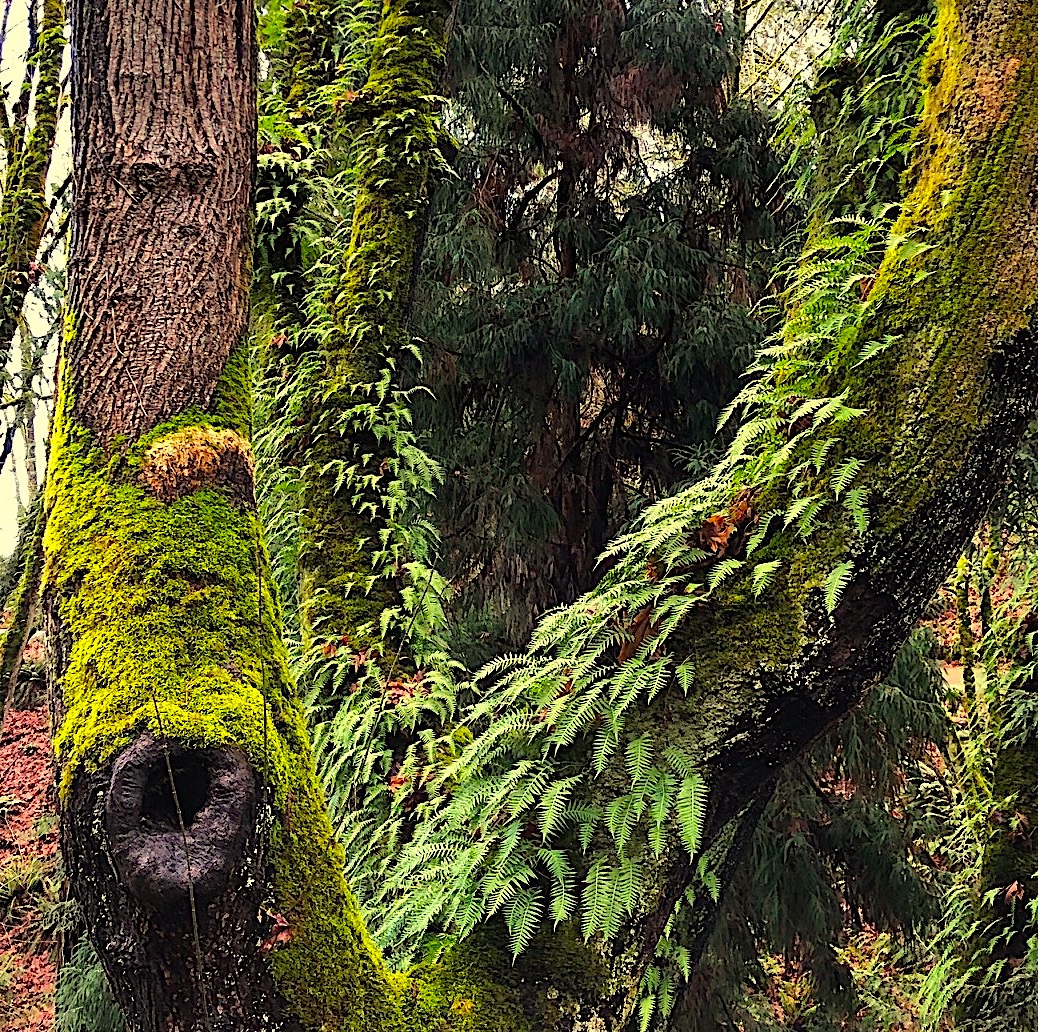
Here is a mossy tree trunk. These feathery plants growing out of the moss might be licorice ferns.

There were all shapes and sizes, all kinds.

Here’s another fern. I have no idea what kind it is.

They marched along the ground, on rocks, in moss, growing right out of tree trunks.

Here is a fallen tree in pieces covered with thick moss, and more ferns.

In the winter woods, the textures and types of ferns were just a wonder. Here were these beautiful creatures with their unique facets, all faces and fingers, transforming decaying trees into soft luxurious pieces of art. Some of them might even be licorice ferns; I’ve heard that we can dry and pulverize their roots, and the starch is many times sweeter than sucrose. Imagine that.

What a revelation. If ferns can be this healthy and happy in the place that is right for them, then what if God has a place planned out where I can grow in a community too?

Maybe between here today and the Kingdom of Heaven, He has some little place even for me. One where it’s possible to feel safe and happy and close to other creatures who thrive in cold and rain; who take even the splintered jagged flotsam of circumstance, and then spin it into sugar.

Posted in Uncategorized | 3 Comments

Advent Memory: A Crib for the Baby

Advent for the Catholics is the four Sundays before Christmas. (If you’re a Catholic, this year it’s November 28th through December 25th.) Back at our school with the Sisters of St. Dominic, the four weeks of Advent started off with the most important tradition of all: getting the crib ready for the Baby Jesus.

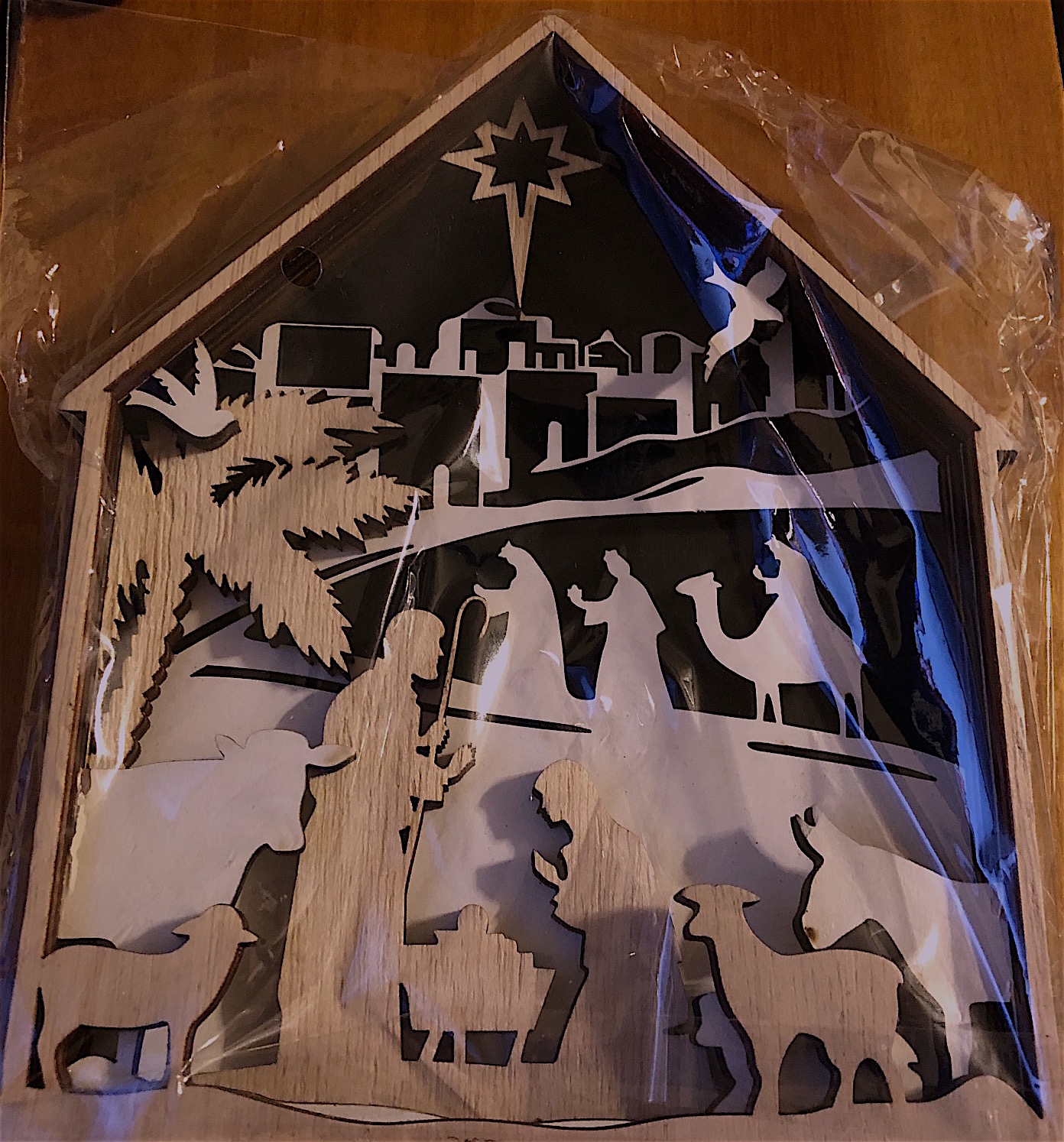
Here is a closeup view of an appealing little Nativity scene. It is filled with all the figures from a regular Nativity scene, but carved from thin slices of wood. I can’t imagine how they made something this delicate and pretty.

First, we needed to get a cardboard shoe box.

Shoe boxes were special at any time of year. We didn’t buy new shoes too often, not when there was always some kid on the street with bigger feet and we could wait for him to outgrow his shoes and then we could wear them. When we did have a shoe box in the house, our mothers used them to sort S&H Green Stamp booklets or recipe cards or nuts & bolts, and they tied up the boxes with red and white bakery cake box string and made neat labels and stacked them in the cabinet. Even when we did have extra boxes, we kids used them up for crafts right away. For example, you can turn a shoe box on its side so that the top long side makes a ceiling and roof. Then paint the inside blue, glue in some stones, cut out and color paper fishes and plants, hang them on strings to the ceiling side of the box, then tape a sheet of clear plastic wrap over the front. That turns the box into an aquarium, only these fish won’t die after you bring them home.

But shoe boxes were extra handy in Advent, an important time for an important project.

Step 1. The first day of Advent, get in line and follow Sister across the parking lot to church to examine our conscience. It’s always nice to sit there being perfectly silent so we can hear what God might say to us and gives Sister a minute to rest her feet in some peace and quiet.

Step 2. On the way home from school, go to Mr. C.’s shoe store and ask him for any empty boxes. Irving’s Pharmacy next door, with the big glass jars of color dye water in the window, they have boxes too. But we’re not allowed to go into Irving’s Pharmacy because it has one of those modern heavy glass doors, and our moms say we can get our fingers stuck in the door when it closes. But Mr. C. has the right boxes and he has just the screen door, so we’re allowed in there. If he’s not busy with a customer we can put a penny in the gumball machine while we are at it.

Step 3. Think up ideas for new good deeds to add to our life ever day. Like, the very first time Mom calls, run right home for supper or get up for school. Then set the table or make the bed. Carry your plate to the sink and say thank you. If you notice that the wash is dry, take it off the clothesline and fold it up and pick up the clothespins out of the grass. Finish your bread crusts. Say a decade of the rosary every night. Let Dad read the funny papers first because you make Silly Putty prints out of the faces in the comics.

Step 4. After dinner, sit at the kitchen table with a notepad and ruler and pencil. Draw 12 boxes. Then, fill each box by writing in one of your good intentions. Next, cut up the paper to make 12 squares. Put them in an envelope. Use another page or so to write and cut out one square or more for every day of Advent.

Step 5. Decorate your box with crayons or a little colored paper. But don’t be all showy about it. Like, don’t go paint a lot of macaroni shells gold and then glue them on, because Jesus was very poor as a baby and did not have a wealthy bed. And besides, the outside of the box doesn’t matter. What matters is the inside later at the end of your four weeks.

Step 6. Now the real project starts. Every day, pick a good intention paper slip out of the envelope and then work on your good intention. At the end of each day, if you finished your good deed, take that slip of paper and put it inside the shoe box crib. Don’t show or talk about your good deed; it should be a secret between you and God.

Step 7. Every day, carry out another good deed, and put each paper slip in the box. At the end of Advent, if you counted right, the envelope is empty and the box is full of good deed paper slips.

Step 8. At the end of Advent, put the lid on the box and fasten it down with rubber bands from the rubber band ball in the kitchen drawer. Take it to school on the bus.

Step 9. At school, take off the lid and everybody put their boxes under the little fake tree next to the Nativity scene that has all the figures looking at the empty manger. At the end of Advent all of the children’s boxes are full of paper slips! That means each box and all 4 Sundays of Advent were full of good deeds for our families and homes and neighborhood and school. They make the boxes into a soft warm manger bed for Baby Jesus. Then even in wintertime the Baby knows He is welcome in this world.

But most of all, the real welcome and the real soft warm place for Him is the change inside our hearts.

*************************************************************

About the photo above: This is a very sweet and very thoughtful Nativity present. (The picture does not show how pretty it really is.) I’ve been sad for days, missing the Advent traditions from long ago. But then out of the blue my lovely neighbor gave me this woodcut picture! It is so much better than any shoe-box aquarium I ever made, and such a kind cheering gift, that I want to keep it on my windowsill to look at all year long. Thank you dear! Joyous Feast!

Posted in Uncategorized | Leave a comment

11.29.21: View from the Bridge

Here is a bridge over water during tonight’s sunset, against a tangerine sky. It’s a different bridge from the one in this post.

On the day after Thanksgiving I stopped to change buses at our little student neighborhood right on the water. It has quaint old houses and gardens and charming unique family businesses and shops and open cafes and fanciful public art. At holiday season the stores put up lights, and play holiday music. Young shoppers flock around with cinnamon rolls and cocoa. Musicians play in costume. Dogs wear reindeer hats and sleigh bells and blinky-light collars. Our magical music store keeps an open door with live or recorded music playing, and a lobby stocked with flyers for upcoming events — like their public open house the first Sunday in December every year where everybody brings a plate of cookies and has fun in jam sessions and playing the different instruments. (I once spent a happy afternoon there in the back classroom, playing all the hammer dulcimers.)

To recover from Thanksgiving I had my heart set on a cheering little stroll on the waterfront street to take in the people and the sights. This year, my hopeful idea did not work as planned. At 4:45 pm, on American peak-retail “Black Friday” and the kickoff to the winter holidays, our delightful mini-downtown was empty. The businesses were closed up. The streets were not full of shoppers or tourists. Even the music store was silent; their bulletin board had no upcoming event flyers, and they’ve called off this year’s open house.

The scene called to mind “It’s a Wonderful Life,” with George Bailey’s daymare vision of the Georgeless wasteland in Potterville. Darkness fell. It was starting to rain. Crossing the footbridge I was all alone. There were only three men around; they were conversing quietly beside the bridge, sitting on the ground outside a makeshift tent. A teenager crossed by on the other side, weighed down by a black trash bag on his shoulder. I forged ahead at a brisk clip, without even stopping to pull out the phone for photographs. I took only a glance overshoulder at the downtown lights, gold and silver on black velvet water.

Then, right in the middle of the bridge, there was a new sign:

No Jumping From The Bridge! Consequences are fatal and tragic.

Wait. What? The logic and sentiment of that public service message stopped me in my tracks. Not only the “fatal” part, but the appeal to reason pointing out that the outcome would be considered tragic to those left behind. It is rare for anyone (outside the world of advertising) to give urgent heartfelt personal counsel to anybody. In this pensive setting, the warning sign struck a caring philosophical tone, like a bedtime story moral read out loud by the little plush animals at Pooh Corner. It was heartening to marvel at the people who designed that municipal sign, processed the metal work, and set it on the bridge in anticipation that someone would need that very message, standing right on this very spot, and that the sign might help. Because you just never know.

That reverie led to four realizations.

Realization 1 of 4: It’s time to give up popular-culture holidays, or at least to give up the appearance that I can transform them into something fun. Secular society in general (and the world of advertising in particular) lays out the expectation that we should all have the supplies and organizational management and social skills to make these days a time of consumption and entertainment. For too many people that’s a heavy yoke to carry, one that leaves too many behind.

This cavalcade of assumptions gives single people a special task: please make being alone look like a great time, so that the rest of us don’t have to feel uneasy around you. The idea is that if single people are mature self-actualized adults, we should not have time to be lonely; we should be too busy on the El Camino de Santiago, whale watch, Vipassana retreat, and of course lots of volunteering. Well, I’ve worked a whole array of meaningful solo activities over the years (including the natural history museum feeding venomous snakes, but that’s another story.) Yet still, the hardest part of any holiday is the crash of sadness afterwards and when eager people ask “How was your holiday? Do anything fun?” And still my default answer is to burst into tears. Then people usually laugh in bewilderment and walk away, and that’s the end of the conversation and/or the relationship.

Well, it’s time to admit it. I have no idea how to be single, and no idea how to thrive at secular celebrations. Because to me, the essence of celebration is coming home at last to the person or people who I’m allowed to love, and who love me. That’s the holiday I’ve always yearned for, because celebrations outside the context of family don’t make any sense.

However, that said — no matter how one feels about holidays, it is still right and good and essential to support other people who celebrate theirs. (In fact, I just baked cookies and want to bring some to Neighbor Livie. Talk amongst yourselves for a minute.) Okay, I’m back. Livie liked her cookie sample. Anyway, it is important to write out and mail cards to those who like cards, bring them flowers, bake them treats, make snow angels and chalk drawings with the neighborhood kids, visit the nursing home, check in on folks who live alone, and whatever else one can do to lighten this time of year for other people. But it’s high time to put to rest the charade that holidays are in any way about me, or about having fun. My dream of love and family may happen only in heaven. So from now on when people ask the holiday fun question I can just say “Thank you, my holiday will be in heaven.” That ought to work just as well as standing there dumbfounded and tearful. All this led to Realization Two.

Realization 2 of 4: Celebrate real holidays from now on instead. That idea led to Realization Three.

Realization 3 of 4: If the most endearing moment in days came from gazing fondly at a Don’t You Even! placard in the rain, then that’s not good. It was time to get off the bridge and get to church.

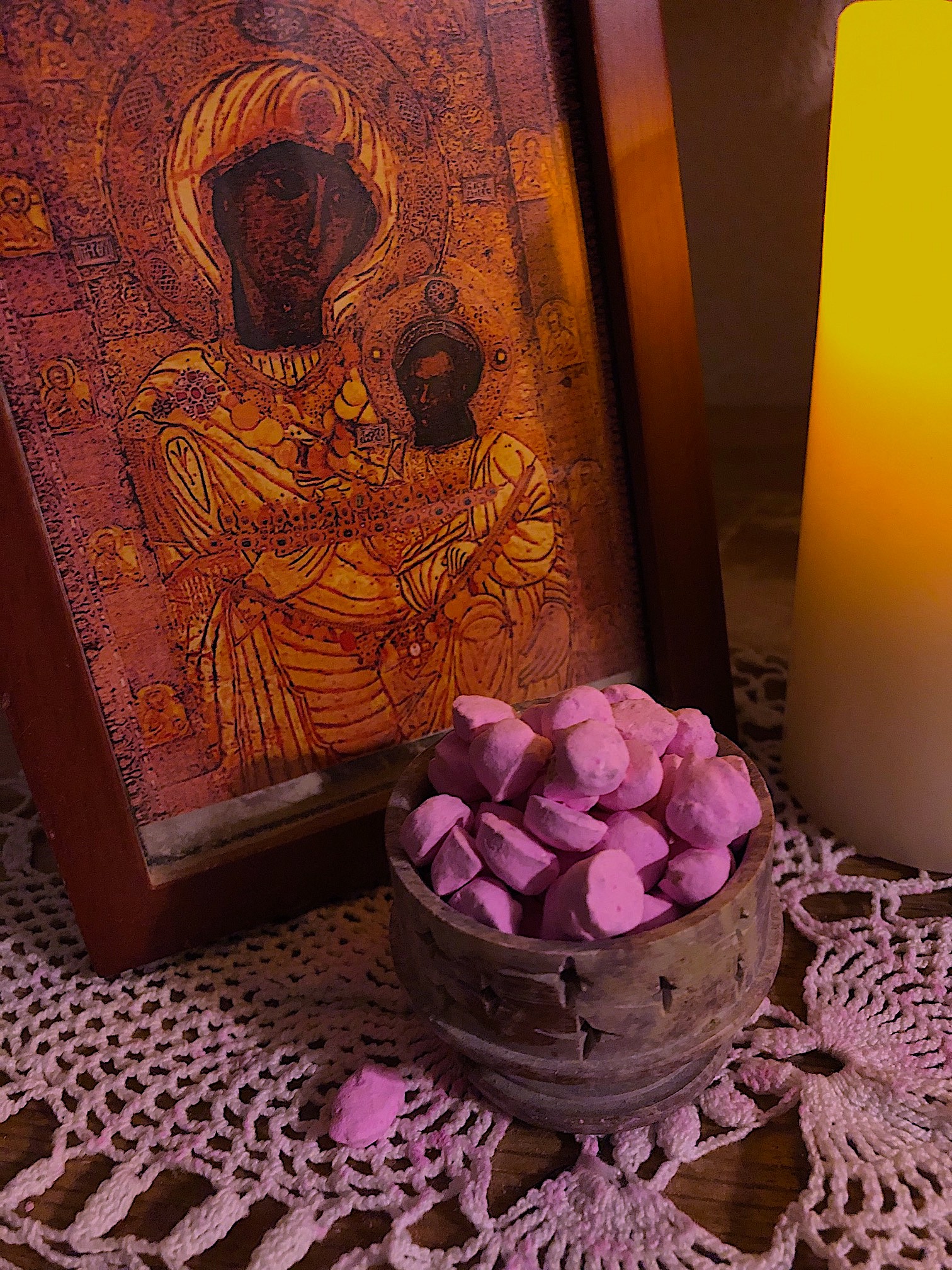
This is a small picture of the Panagia Portaitissa icon of the Blessed Virgin Mary. The original is kept at the Georgian Iveron Monastery on Mount Athos. There is also a battery candle, and a bowl of pink incense tablets scented with rose oil.

Since then I’ve been studying articles in pravmir.ru, all about Orthodox Advent. Their calendar year round is a cornucopia of fasts and feasts and Scripture readings and lessons and prayers and hymns and saints to inspire, with something uplifting and beneficial to commemorate every day.

On Sunday, at the Greek church two buses away, the bookstore ladies gave me a warm joyful welcome. I hope that they forget my last visit two years ago, when they inquired kindly about my Christmas and I broke down and wept while blocking the icon aisle. Among the many works of art, household items, and reading materials there were two excellent new books to buy and take home. The store also had incense, all different scents. I gravitated right over to the rose oil, not to burn but just to keep in the prayer corner. It comes in pink nuggets with the sweetest fragrance.

Realization 4 of 4: Now that flower season is about over for the winter, why not start photographing and even drawing pictures of bridges? Bridges are good transition symbols for leaving one place in life and entering another. Maybe these pictures can be nice enough to cheer up someone else.

Because, you just never know.

Posted in Uncategorized | 2 Comments

11/10/21: Параскева Пятница (Paraskeva Piatnitsa, or Paraskeva Friday)

New neighbor T. would like a little help with a simple sewing alteration. She asked whether I knew someone in our complex with a sewing machine. Sure, we have lots of handy-crafty people here, so I made some inquiries. I was eager to help Neighbor T., introduce her to some other wonderful neighbor, and so set another good stitch seam in our network of residents. But, my inquiries led nowhere. The fruitless search was a disappointment, and was puzzling until I opened a favorite website pravmir.ru and found an article about the saint of the day. Aha! No wonder our sewing effort came to naught on November 10th, today of all days.

This is a picture of an icon of Saint Paraskeva Friday. The icon background says “Saint Paraskeva” on the left, and on the right the title “Great Martyr.” In her hand she is holding a cross, and the Creed written in Church Slavonic: “I believe in one God, the Father Almighty, Creator of Heaven and Earth…”

The Feast of Saint-Martyr Paraskeva Friday is November 10th. What a great name for a courageous girl hero. There she is fighting for the cause of justice, while her mom calls from the window: “O Paraskeva Friday! Dinner!” Well, Paraskeva Friday really was a genuine girl hero. Here is her tradition, taken mostly from these two articles:

  1. Pravmir.ru, “Почему не Параскева Пятница, или Как святые становятся нам близкими

2. Alla Mekhontseva in Argumenty i Fakty, St. Petersburg, November 9, 2021

https://spb.aif.ru/society/paraskeva_pyatnica_smysl_prazdnika_chto_mozhno_i_nelzya_delat_v_etot_den

Here is an icon of Paraskeva Friday as a beautiful girl looking brave and stern. The scroll in her hand begins with the words “O Lord God…” in Church Slavonic. She is dressed in red as a symbol of martyrdom. The background of the icon is black, representing prison.

This year, the feast day of Paraskeva Friday falls on a Wednesday. But “Paraskeva” is Greek for Friday, to honor the day of the Passion of Our Lord. Legend has it that this saint lived in the 3rd century in Iconium, Asia Minor. Her devout Christian parents spent their Fridays in fasting and prayer and almsgiving. After many childless years, they joyfully greeted the birth of their daughter on a Friday, and named her accordingly. The child was raised as a devout Christian. Orphaned early in life, she kept to her childhood faith and gave away her considerable fortune by feeding and clothing the poor. She was martyred under the Diocletian persecution, adamantly refusing the offers and threats of men in power who demanded that she renounce her heavenly spouse and marry one of them. Even in prison awaiting death, she showed such unearthly radiance that her captors were unnerved by her presence. As a well-born girl of striking beauty, she inspired many people toward the Christian faith through her life of devotion to Jesus Christ, her courage, and her charity to the poor.

This picture shows a Paraskeva depiction on oak wood. She is holding a scroll with the Creed, “I believe in one God…” Honored as the patroness of agricultural fields, she is shown here with woods and fields in the background.

Paraskeva Friday is honored as the patron saint of happy courtship and marriages, healing from illnesses, comfort from frightening dreams, and blessings upon cattle and fields. To this day, in the Russian countryside one can find little roadside chapels known as “Fridays” in fond memory of this saint — prayer point landmarks for friends to meet and to part on their journeys, and for young couples to socialize.

To observe Paraskeva Friday’s feast, everyone was to pay special heed to the commandments, to give alms, to assist the poor, and to refrain from harsh speech — arguments, scandal, and gossip, as well as idle or derisive laughter. As on Fridays year round, this was also a fast day with all-vegan fare. Men had to give the land a rest from agricultural labor, and they could not do any work with iron tools. Women were required to refrain from all womanly household chores. This meant that young girls were not to dress or style or ornament their hair. It also meant a day of no sewing, no knitting, no embroidery, and no washing clothes. (Interesting: canonical icon depictions show Paraskeva as a grave ascetic in red with unbound hair, sometimes with a black background to represent prison. But an image search also turns up many delightful stuffed Paraskeva dolls with flowing hair, beautifully dressed with fine stitching, knitting, and embroidery, and with no facial features — like the dolls one can find among the Amish.) And her icons with their frames show a full range of metalsmithing and tool work as well, probably done on the other 364 days of the year.

This Paraskeva icon has an elaborate metal frame. She is holding a scroll with the opening words of the Creed in Slavonic. In this icon she is not shown with flowing hair; instead, two angels are giving her a crown, possibly a crown of martyrdom.

According to Ms. Mekhontseva’s article, the only feminine craft permitted on this day was a Russian term new to me. According to Google Translate, to “trepat’” means fluttering or rattling, in this case for rendering flax into linen. Now with Paraskeva’s blessing I want to go find out how to rattle flax, to prepare for next November 10th.

But the main way to observe the feast was by visiting church with the congregation, and at home praying with petitions like these:

O saintly blessed Martyr Paraskeva, O beauty of virginity, O wisdom: Send down blessings upon our womanly lot in life. May the chalice run full in this house. May the family be happy and strong. May the ones in love find good sturdy husbands. Amen.

Amen indeed!

Posted in Uncategorized | Leave a comment

11.4.2021: Leaf Quest

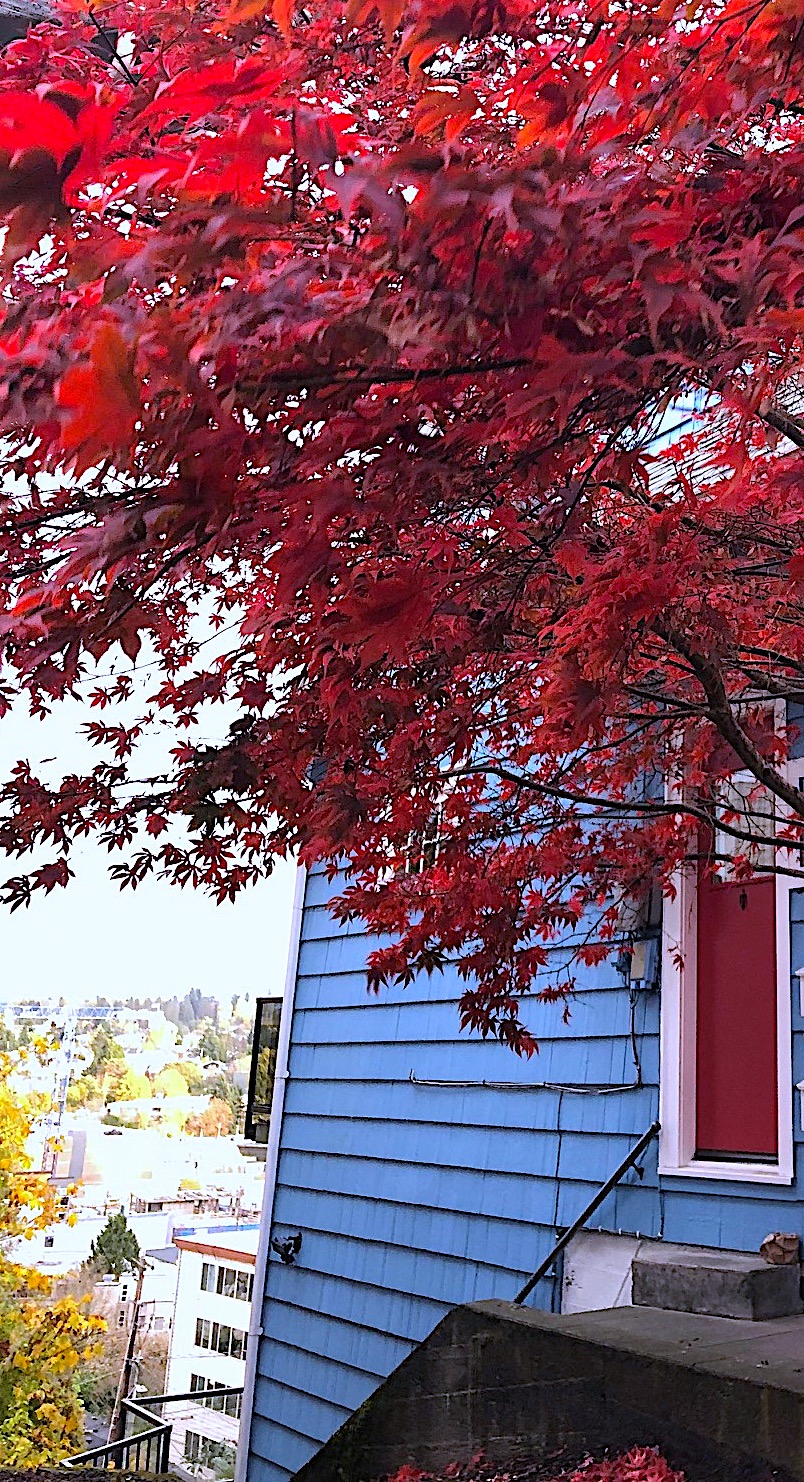
A cozy blue house has a red door and red Japanese Maple tree. There is a wonderful hilltop view, with very steep stairs.

4:02 Text from Captain Wing, at Wing Family Central: Are you at work?

4:05 Text from Mary: Yes. Do you need something photocopied or filed?

4:07 CWWFC: No. When you are near home, please text me. We have Swiss Chard for you and Neighbor S. Don’t rush.

ETA 5:30. Leaving the office.

But… outside on the wall, the creeper vine was losing all its leaves. A wind storm was stripping our colorful trees bare. Say! Miss Rose would love those leaves. She decorates her room at any excuse for a holiday. For years, I’ve brought her installments of colorful autumn leaves for her centerpieces. Now an intuition was prompting me: “Go now! It’s on your way home. In a year you might be living somewhere else, and she is thinking of a transfer to another neighborhood. Bring her lots. Hurry up.”

Well, one leaf led to another. Look at that tree up that street! And that one there!

(By the way, behold the ergonomic setup of that truly charming campus cottage above, on a steep hilltop with a back staircase. The staircase has no external barrier. The doorway has no connecting handrail or steps. Sure, if I were stepping outside I could grab the inner handrail against the house wall, but I’d have to lie on my face to reach around for it. Wow. Who lives there — Cirque du Soleil?)

Leaves flew everywhere. I chased them through the gusts, forsaking the main streets for the brilliant fall foliage behind stately old fraternity houses with immense trees and dramatic hilltop lake mountain views. I took the old shortcuts too from street to street all the way down: flight after flight of steep old stone stairs weaving past orchards and gardens and inviting little kitchen windows and porches. The steps were thick with wet leaves like slippery cornflakes; I had to pick my way gripping low makeshift pipe rails. On lower flights there was no way to tell what was leafy muck, and what was level ground. There really was cause to be thankful that I’d left work a little early, before the dark and rain set in.

One of a series of stone stairs down the hillside, covered with wet leaves.

That back way cost an extra half hour, but made the walk a glorious ramble. At the bottom the wind was left behind, blustering overhead, as the trees opened out on the park. As I walked through the field, a last sunbeam turned a distant tree (maple?) bright gold.

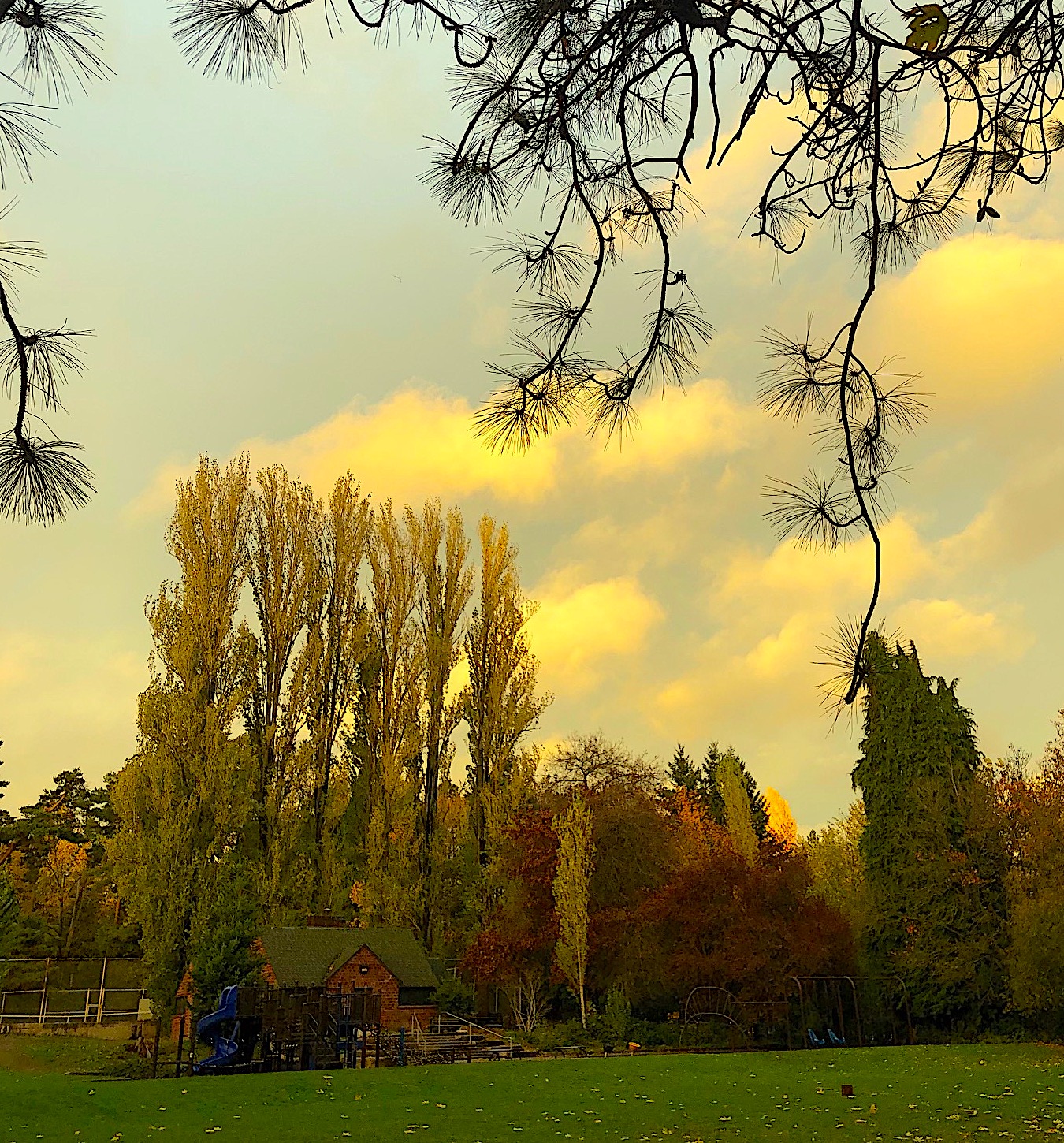
Here are six cottonwood trees above a park building. In the background there is a flash of gold maple.

Hold on to your hats!

In the wind and gathering dusk, storm clouds massed together. With steep altitudes and high wind and cloud cover, there was real drama in the passing changes in lighting and mood. Sometimes within minutes the landscape advanced deeper into darkness toward winter, then sprang back toward daylight and autumn. These rocking pines stood at the edge of darkening woods. This park service men’s room looked like an appealing port in a storm with its little light and green door. (My favorite art is landscapes by Maxfield Parrish, and Ivan Bilibin. This picture looks a bit like both.)

Here in pine trees is a public men’s room with a little light over a green door.

It was tricky finding the path out of the woods; it was buried under fallen leaves. I hurried as carefully as possible. There was a huge fallen log, with the stump so wide its width came up higher than my waist. I stopped to admire its deep carpet of moss and ferns before realizing that this log was once a ponderous tree toppled — by wind! At that thought I got a move on, grateful for the good counsel in the Gospel of John, 12:35: Yet a little while is the light with you. Walk while ye have the light, lest darkness come upon you: for he that walketh in darkness knoweth not whither he goeth.

That’s for sure. What a relief to see the woods end with the footbridge over the ravine. The sun came out! That elevation over the creek far below allowed a free view of the open sky. That drop is a whole lot deeper than the picture shows; I always stay well back from that railing.

Here is a little footbridge with low rail, over a ravine of trees.

From there the way was easy going — level pavement and familiar map grid and streetlights switching on.

At The House I sanitized my hands, took my temperature, took a pen from the Clean cup, filled in the visitors’ intake form and Covid attestation, dropped the pen in the Used cup, and sanitized my hands again. The wonderful front-line staff behind the clear plastic barrier have been running interference for 21 months now, delivering messages and packages and meals 24/7 to and from residents who last year were on lockdown confined to their bedrooms. The staff greeted me warmly while disinfecting everything in sight. They made pleasant jokes about my weekly delivery of fresh foliage — which, now that I think of it, are steeped in Mother Nature’s microbes and germs. “After today,” I told them, “autumn leaves will be one more household commodity affected by shortages in our national supply distribution system.”

Miss Rose was just folding her laundry, so I texted Captain Wing with an ETA update. (“If you are outside, look up,” he texted back. “The cloud is beautiful.” Alas, the laundry room had no windows or clouds.) Then, Miss Rose maneuvered her shiny ultra-modern firetruck-red electric wheelchair into the elevator with the laundry, me, my knapsack, and my rainwear and fluorescent jacket and duffle bag of leaves. Back at her room she protested mildly at my extravagance; Miss Rose is a thrifty sort, even with free stuff picked up in an alley. “So many! I won’t have space to display them all! You ought to take some of these for yourself.”

I pointed out that there were still oodle-googles of leaves whirling around outdoors, and that now she could pick and choose the ones she liked best for her decor.

We sat and visited for just a breath-catch, and then I was on my way. Only 20 blocks to go, but now the wind was strong again and it was really dark, and half the way was straight uphill. Fortunately, I chased and caught a bus east for 10 blocks. Then I chased and caught another for the 10 blocks north, texting Captain along the way, and hopped off at our corner.

He was waiting in the dark garden with a picnic basket. We walked next door to visit Neighbor S. There she and I marveled at Mrs. Wing’s harvest gift, picked that afternoon for the two of us to share: several plants of vivid magenta-red Swiss Chard, a dozen Jerusalem Artichokes apiece, and two bowls of more ‘chokes sautéed and seasoned, still warm and fragrant. While S. and I divided the bounty, Captain headed straight for the balcony, saying “Now to fix that drainage problem.” Neighbor S’s outdoor herbs are getting too much rain. So, Captain picked up every single potted plant, placed coins to surround and prop up the drainage holes, set them back in their planters, and then for each plant he took heavy foil and molded little coverlets for the stem base as a canopy. “Less water in, more drainage out,” he explained. “And here is a supply of foil in case you need more.” Now S. can enjoy her outdoor herbs well into the winter.

As Captain and I headed downstairs I told him about Miss Rose’s red firetruck. “The scooter chair is so large and so heavy that it can’t be lifted into a passenger car. That means she can’t visit children, grandchildren, or great-grandchildren for the holidays.”

“No visit from Grandma?!” he exclaimed. “No way. What make and model of wheelchair?”

“Ooh, sorry. I wouldn’t know from one wheelchair to another if it ran over my foot.”

“Could the chair be folded up?”

“No, that’s the problem. It’s powered with little stick controls and weighs hundreds of pounds.”

“If I were her child, I would just buy an old schoolbus and fix it up with a lift.”

(He means it. His buddy salvaged a vintage ambulance, and the two men turned it into a dream of a recreational vehicle for the friend’s whole family.)

“If you were all of our children,” I told him, “this would be a different world.”

“I didn’t know you were visiting The House today! Next time, introduce me to your friend. I want to meet her and see this chair for myself.”

He took the empty chard basket and adjusted his glasses with a headshake and determined look, probably contemplating another engineering adventure.

The chard was fantastic cooked, then tossed with a puree of sardines, tomato paste, lime juice, and ginger. The sunchokes were perfect over brown rice. (Hm… maybe this weekend I can bake some kale chips with anchovy sauce and Chinese five-spice powder. The family might like those.)

A few scarlet oak leaves ended up at the bottom of my bag. They’re pressing now thanks to Neighbor S’s leaf-pressing kit. In a day or so they will look pretty downstairs on our lobby table.

Posted in Uncategorized | 3 Comments

10/11/2021: A Fellowship Call

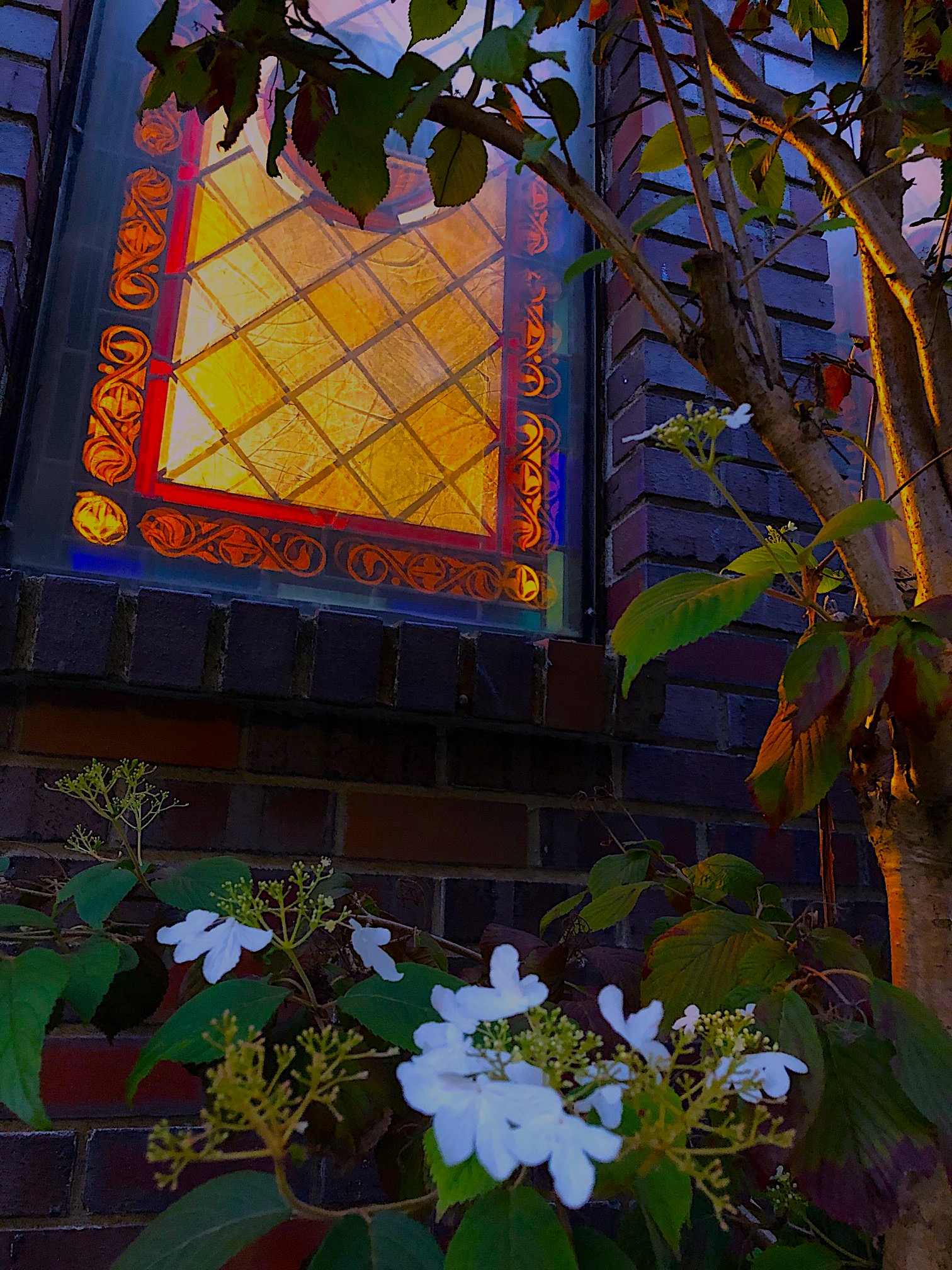
This picture shows white hydrangea flowers outside a church window of red and yellow stained glass shining out into dusk.

“Good Morning!” said the hearty warm voice of Colleague T. when I answered the phone. “In a few minutes I’ll be at Friends Bench. Can’t wait to see you!”

I sat with phone in hand, blinking stupidly at my computer screen, where a cascading chain of misunderstandings at work called for immediate attention and assistance. Of course, the logical Yankee Anglo etiquette would be to cancel our lunch and explain to T. that something came up at the office.

Friends Bench is a garden seat at the Society of Friends Meeting House. For years, Colleague T. and I have met there to lunch and chat. Colleague T. is a resilient, generous, caring, upbeat woman of faith committed to family, church, and charities. In retirement she is busier than ever with worthwhile well-organized activities. Her aura is radiant and poised, with fabulous taste in earrings and accessories. She has faced life’s adversities with a positive outlook of charity and hope, and always has good energy and uplifting words to share.

One week in advance, Colleague T. texted me suggesting a Friends Lunchfest for October 11th. Great! I happily added her to my calendar for November 11th. In anticipation, I thought how nice it would be to meet on Veterans’ Day, so we could spend our work holiday in good fellowship without either of us hurrying back to the office.

But at that moment, on the right day wrong month, the truth was that I felt shy about seeing anyone at all. And Colleague T. was especially discerning and insightful. It would be hard to keep up appearances for a whole hour, and to hide from her how discouraged I was feeling about life.

On the phone, with a heavy heart, I confessed to her that I was held up working at home, and was not actually near our meeting place. To my surprise, she said “Well, would you like to meet somewhere else? I’ll drive right over!”

I suggested meeting outside my apartment to begin with. That idea came with some real trepidation; what if T. thought my hospitality was disrespectfully slapdash and half-hearted? After all, I had no refreshments prepared, my studio was in no shape for guests and neither was I, and the clouds were about to pour rain. But she cheerfully agreed to come right over. Fortunately, that gave me exactly enough time to tackle the email chain and set the communication issues to rest. Then T. and I met downstairs, I found a couple of lawn chairs near the garden, and we carried them under the trees.

And then, somehow the whole picture changed.

In a flash, Captain Wing materialized out of thin air with plushy towel in hand, and wiped down the chairs before vanishing back in the house. In another flash, Mrs. Wing sprinted outside to hand me a big bag of her fresh picked garden vegetables. As if on cue, one endearing neighbor after another and a cat or two headed past on their errands, and every one stopped with friendly greetings in a community-wide demonstration of good will. It was better than watching a Sunday promenade from a café in Paris. The storm clouds parted in dramatic manner, and tremulous autumn sunshine burst out on the nasturtiums, calendula, marigolds, geraniums, and Mrs. Wing’s fuchsias and flowering ginger. Goldfinches gathered in the pines overhead in a sweet warbly chorus, and hummingbirds zizzed around.

In this magically charming setting I confessed my calendaring mistake. Because our jobs depended upon accurate calendar scheduling for ourselves and others, we had a good laugh. Then somehow I went right on confessing, about how discouraged and useless I felt, as a person with not much function or meaning in anybody else’s life. Colleague T. caught my drift right away. After listening and hearing me out she responded with honesty and clarity. She talked about her own search for meaning after her hardworking career, and now that her grandchildren were virtually grown up with busy accomplished lives of their own. She was pursuing and exploring plenty of service opportunities, but was still searching for God’s calling for this stage of her life now. In particular, how could she really live the Gospel to witness to others who needed it most?

It was such an all-absorbing talk that I braved a suggestion that she come upstairs to my place — as the first guest to set foot in the door since the Age of Covid. We went upstairs. “This studio is clean enough and tidy,” I pointed out. “But — time was, I always had soup on the stove and bread in the oven ready for anyone to stop by. Now look. Half of it’s file boxes and a laundry rack and cartons of pandemic canned goods. It’s not a home; it’s a room with someone who has given up on her own life. Sure, there’s customer service work all day long, and church, and always neighbors with errands and chores and messages to share. But after a whole day of interaction I come up to this room and think ‘Is that it? I don’t really belong to anybody. What’s the point of my life?'”

Well, T. must have been inspired then. She shared the best and soundest Bible teaching for anyone who feels isolated and alone. All of it reminded me that here from the earthly view we can’t grasp what a difference we make in the lives of others, or how much meaning our lives really have, or what treasures are stored up in heaven. “And as for the room,” she added at one point, “arrange it for your self. It matters!”

That simple idea was hard to grasp. The room? For myself?

But one thing was clear. “God sent you a month early,” I told her. “And you certainly brought Bible teaching to me. This was a real fellowship call on someone who needs it.”

As we said goodbye and she drove away, I realized I’d forgotten to give T. some of Mrs. Wing’s vegetables to take home!

Ever since that talk with T., life has felt different in a good way. It’s still grief every day. But praying, working, falling asleep, waking up, all of it is 10% better. These dear neighbors and community members look even more dear. Friendship with T. is even deeper and warmer for the future. There are even new little changes in this living space, but that’s a story for a later day.

That night, it was heartening to discover this verse. It went right in my Bible notebook as a memento of our visit:

Exhort one another daily, while it is still called Today; lest any of you be hardened through the deceitfulness of sin. For we are made partakers of Christ, if we hold the beginning of our confidence steadfast unto the end. — Hebrews 3:13-14

Looks as if Colleague T. has that new ministry she was praying about. She certainly ministered to me.

Posted in Uncategorized | Leave a comment

10/10/2021: Adventure with Acorns

Big disclaimer again: There are plenty of ways to safely and efficiently process acorns. Consult the experts. Don’t imitate somebody who is just bumbling around. 

In our earlier episode, I gathered about 2 cups of perfectly fresh sound fallen acorns from a white-oak tree. They dried in the sunshine while I studied up on library books and websites about acorn foraging and preparation.

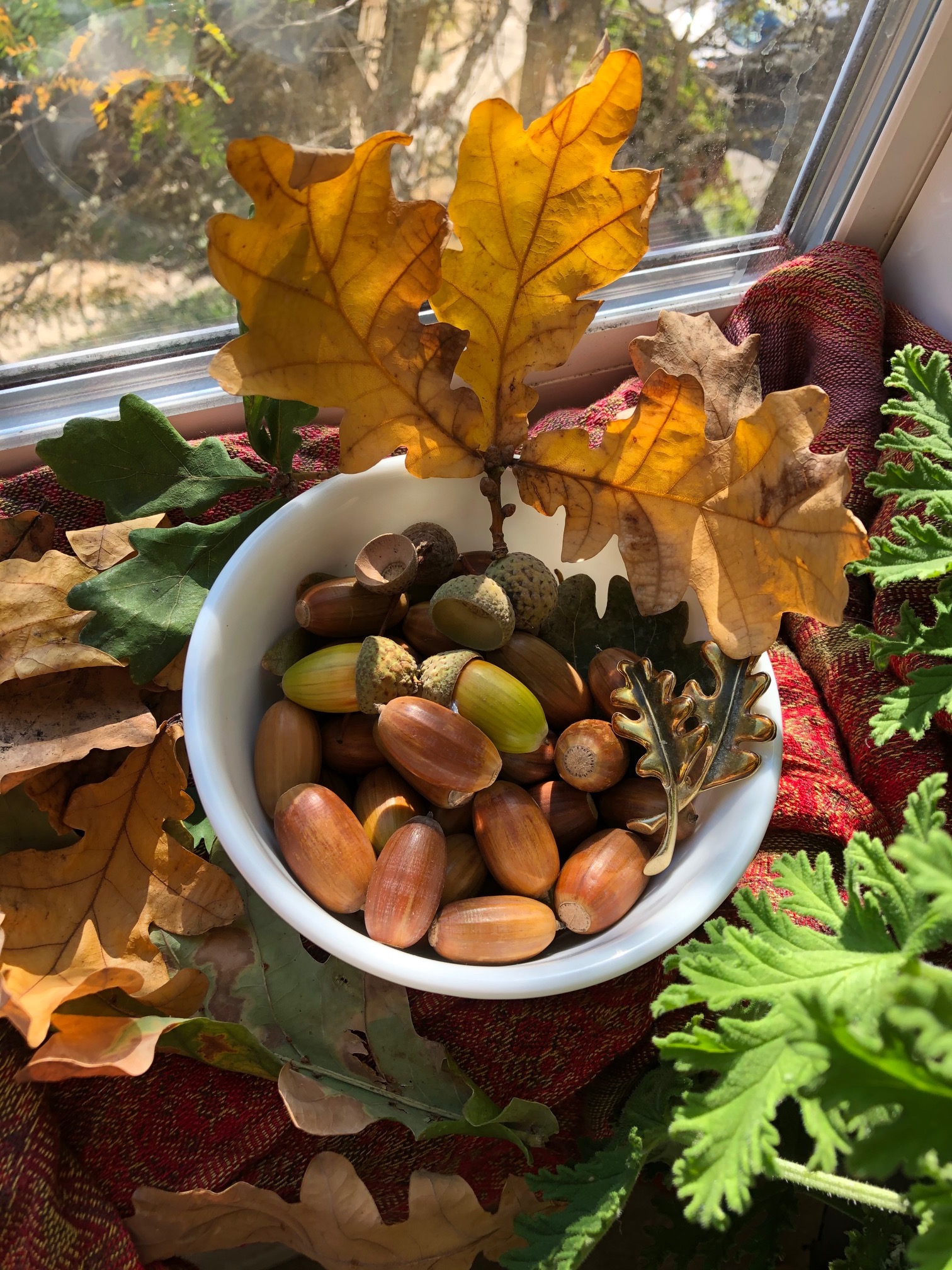
Exhibit A: Whole shells

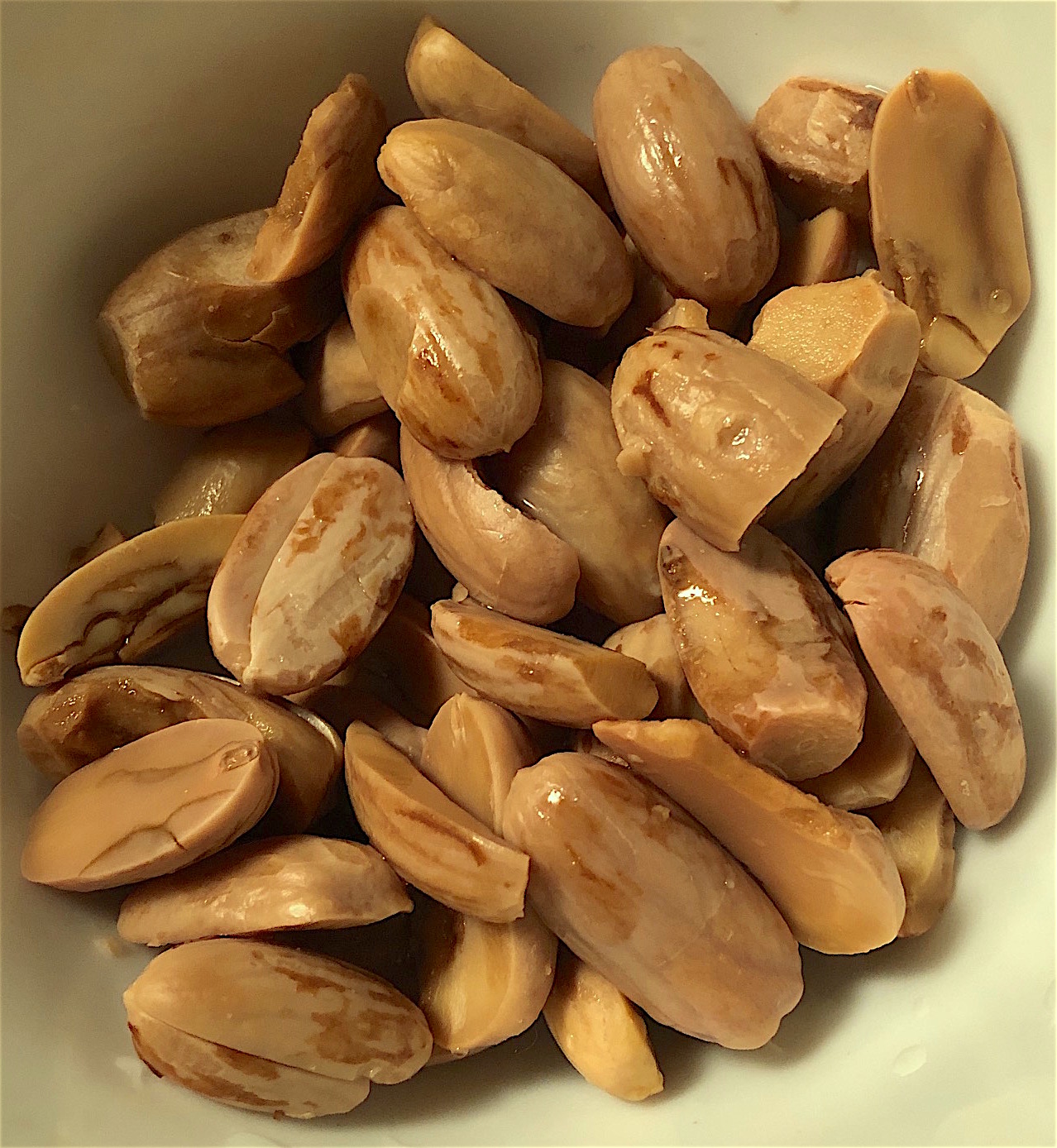
This picture shows acorns from a white oak tree, still whole in their shells, in a bowl on the windowsill.

One source said that putting acorns in a dehydrator will help the kernels shrink in from the shells for easier removal. Ten days in the sun on the windowsill might have helped with that. I placed them in a plastic bag three at a time. I figured out how hard to tap each one with a Russian kettle bell weight: not enough to shatter the acorn, but just enough to get one clear dry splitting sound. That creates a crack in the shell. Then one can pry apart two shell halves with a half kernel in each, gently bending the flexible shell to pry out the kernels with a thumbnail. The shells went into the compost pail.

Exhibit B: Kernels and inner skin

This photo shows white-oak acorns, shelled but with their papery inner skin remaining.

That left these shelled kernels still with the “testa,” the papery brown inner skin, still attached. The kernels need to be peeled and have the testa removed. Testa has extra tannin, and a papery mouth feel. With chestnuts, it’s simpler; one can oven-roast the nuts, and generally the testa cracks right off with the shell. Or, with raw almonds, just dunk them in simmering water for a minute, then into icy water, and the inner skins should slip right off. (Even easier, I just soak the raw almonds overnight, then slip the skins off next day. No cooking needed.)

Blanching these acorns was more of a challenge. Even after blanching and cold water, the testa did not just slip off. So I simmered them for several minutes, then used cold water again. Even after several blanchings, I still had to chip away with fingernails to scrape the testa away from each kernel. Many kernels needed additional carving with a sharp knife to remove blemishes; I wanted only completely sound kernels.

Even after multiple simmerings in several changes of water, a taste test kernel had a crunchy texture. The flavor was pleasantly nutlike for about 10 seconds until the tannin taste kicked in. I had to throw away the kernel and brush my teeth to get rid of the bitterness. That double handful of kernels cost 90 minutes of slopping around with pots and bowls and strainer, a sore back, and two split fingernails. I felt like an inept loser up past her bedtime.

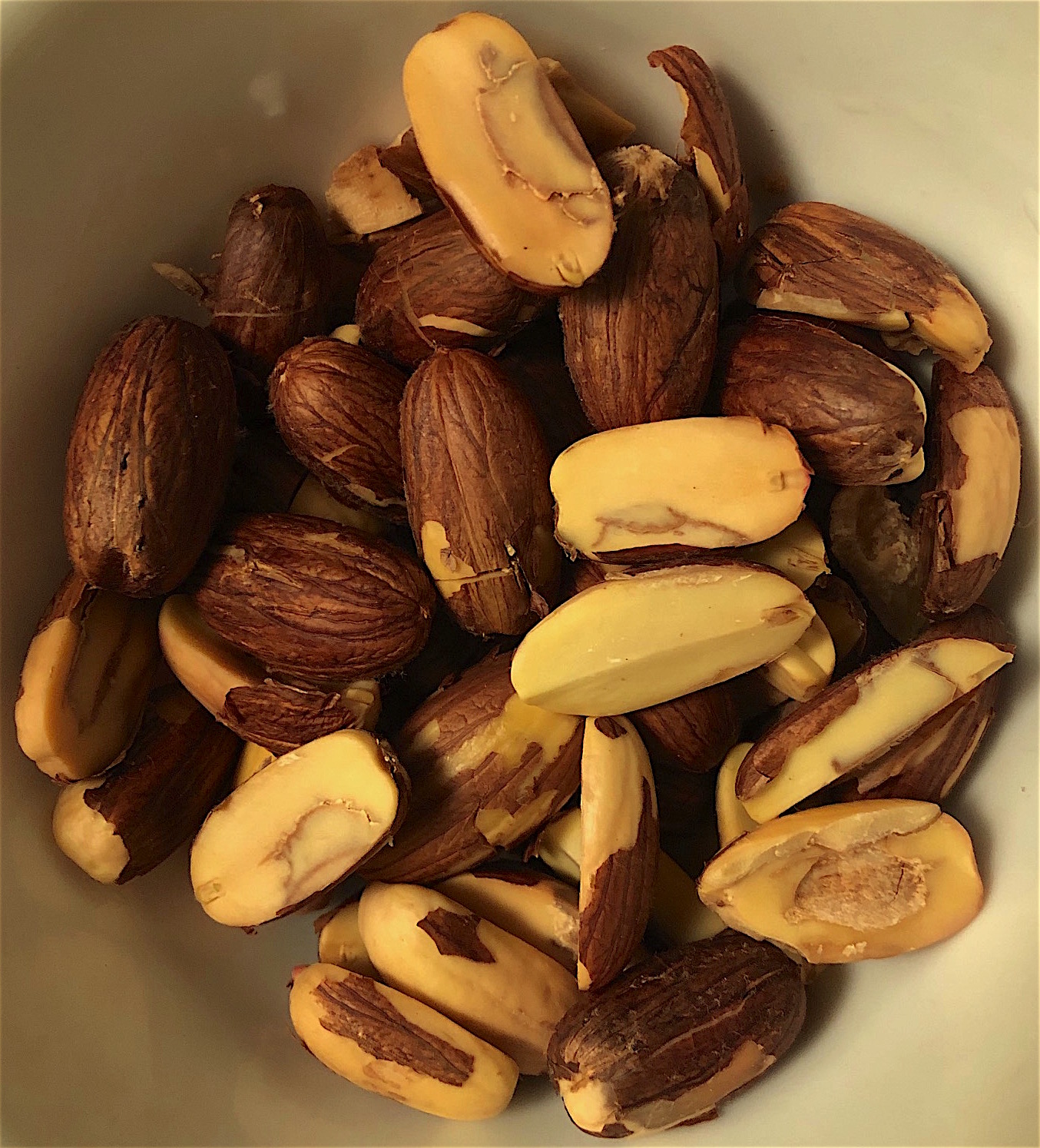
Exhibit C: Peeled kernels

This photograph shows white-oak acorns. These were shelled, blanched, and then peeled.

Next I pureed the kernels with lots of water in the Vita Mix blender. This made a murky liquid with floating particles of sediment. Before putting the jar in the refrigerator, I took one very cautious lick. The solution tasted like runoff from a storm sewer. That discouraging moment brought to a close an evening of bother and fuss.

Exhibit D: Flour-water solution

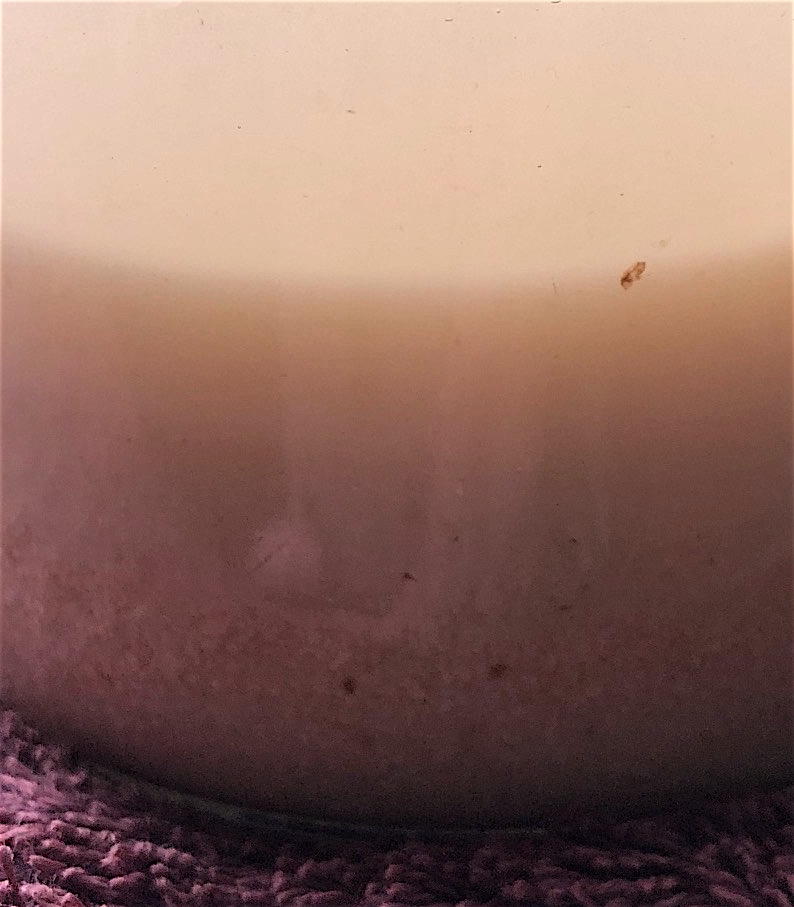
This photograph shows acorns blended with water to form a murky tan solution in a jar.

Next day the acorn flour had settled to the bottom of the jar, leaving the water with a murky color and very bitter taste. I poured off and refilled the water, then shook up the jar and put it back in the fridge. After five days and dozens of rinses & refills, the solution looked clear with a well defined layer of flour at the bottom. The water and the flour had a neutral taste with no bitterness, and no astringent mouth feel. I poured off and discarded the water, drained the flour, and heated it a bit to make a soft more cohesive dough. It had a plain starch taste, like eating plain millet or white corn grits.

It’s impressive to imagine our ancestors devising and sharing tasks like this as part of their social bonding rituals. A project like this must have been much more efficient and enjoyable when a whole group worked on the harvest together.

Exhibit E: Starch dough

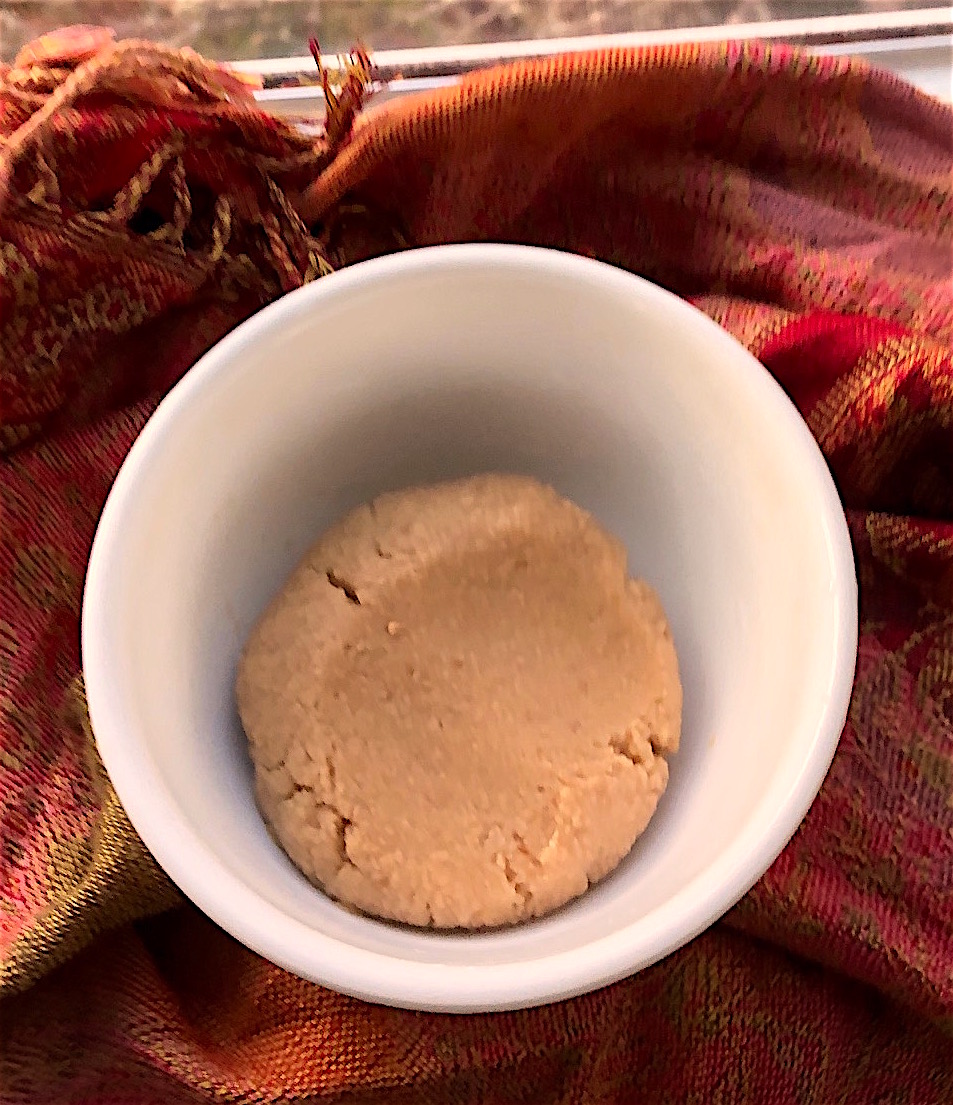
This photograph shows a ball of acorn starch dough in a white bowl.

It seemed that this starch dough with its plain taste might lend itself as an ingredient in a highly spiced sweet like German pfefferneusse or Russian prianik cookies. So I mixed the acorn dough in the Cuisinart with dates, tahini, coconut, bitter cocoa, allspice, and a dash of xylitol. That made a soft halvah candy, rolled into small balls for the freezer. 

Exhibit F: Voilá

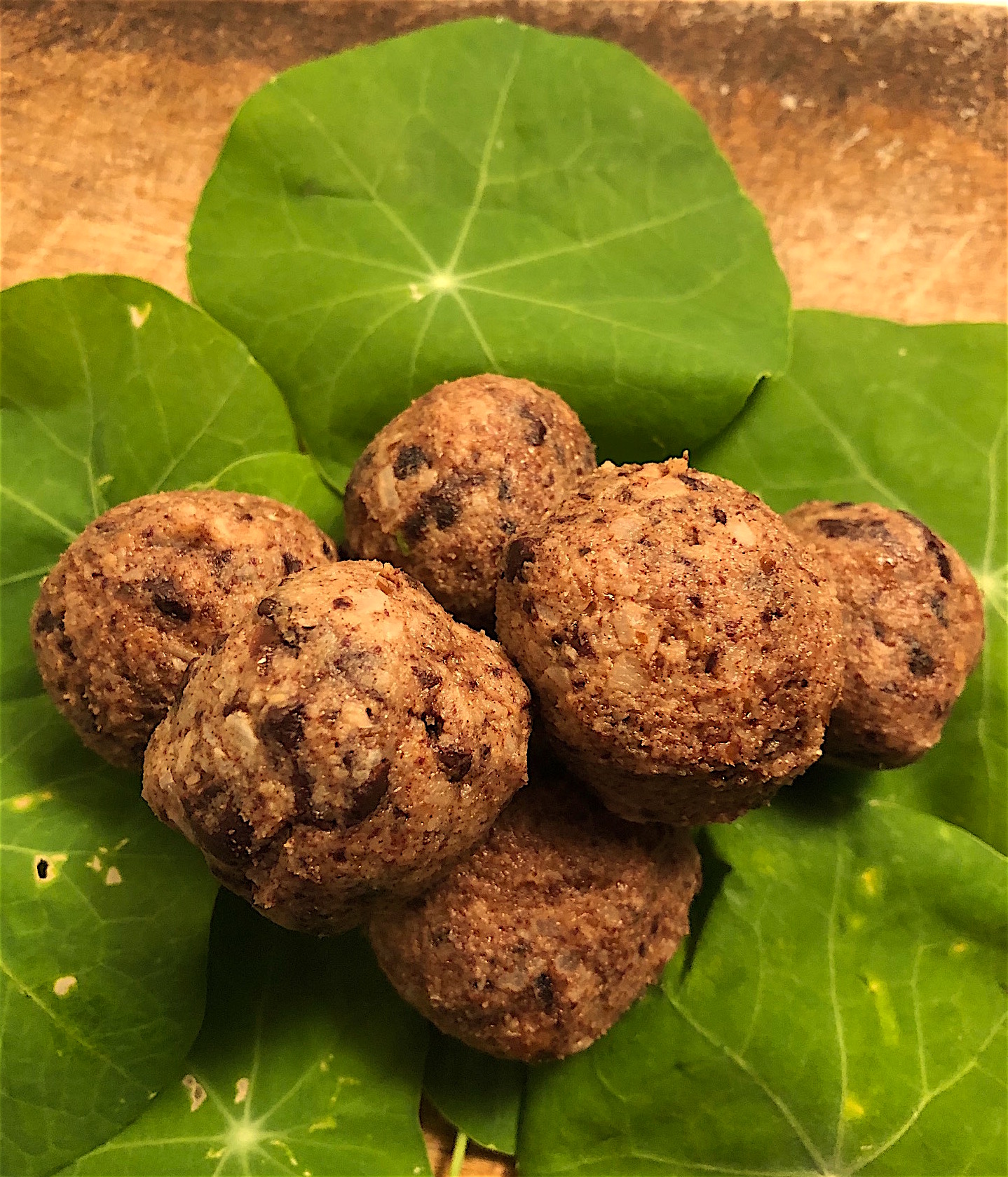
Straight from the freezer, this made a delicious candy. Here is a sample below, on fresh edible nasturtium leaves from the garden. This confection would benefit from some ginger, and more festive flavorings such as cinnamon and cloves and orange zest. To me the acorns gave a very subtle note of centered calming autumn-woodsy flavor, like the smell of rain on freshly fallen leaves.  

When more fresh sound acorns come along, I will try this venture again.

This photograph shows rolled candy balls on a bed of edible nasturtium leaves.


Posted in Uncategorized | Tagged | 2 Comments

10/9/20: Fennel. Or, Keeping Up With the Wings

Big safety warning here, about fennel and everything else: This is an entertainment blog by a writer who rarely leaves the sidewalk and can only identify two kinds of lettuce. There are plenty of competent plant books out there. Study as many as you can, and go on plant walks with a competent guide whenever possible, before you pick anything. For example, one book warned that people might see life-threatening poison hemlock seeds and think they are fennel when they are not! What’s more, even plain edible fennel from the grocery store comes with medical warnings from the Mayo Clinic. So again, study up all you can and don’t take it from me.

There is a very popular Keeping Up With show on the television set nowadays, about a family with a lot of home businesses who are very good looking and wear nice clothes. I haven’t seen the show, but can guess that any family would have an interesting time keeping up with the Wings. Judging by the daily activities in our courtyard, the Family Wing (which must come from an ancient Chinese character meaning “Cavalcade of ingenuity and friendly helpfulness”) needs a reality show of their own. Which is pretty funny, since Captain Wing has been editing and making copies of Neighbor G’s memorial service video, the real reality show from last Sunday.

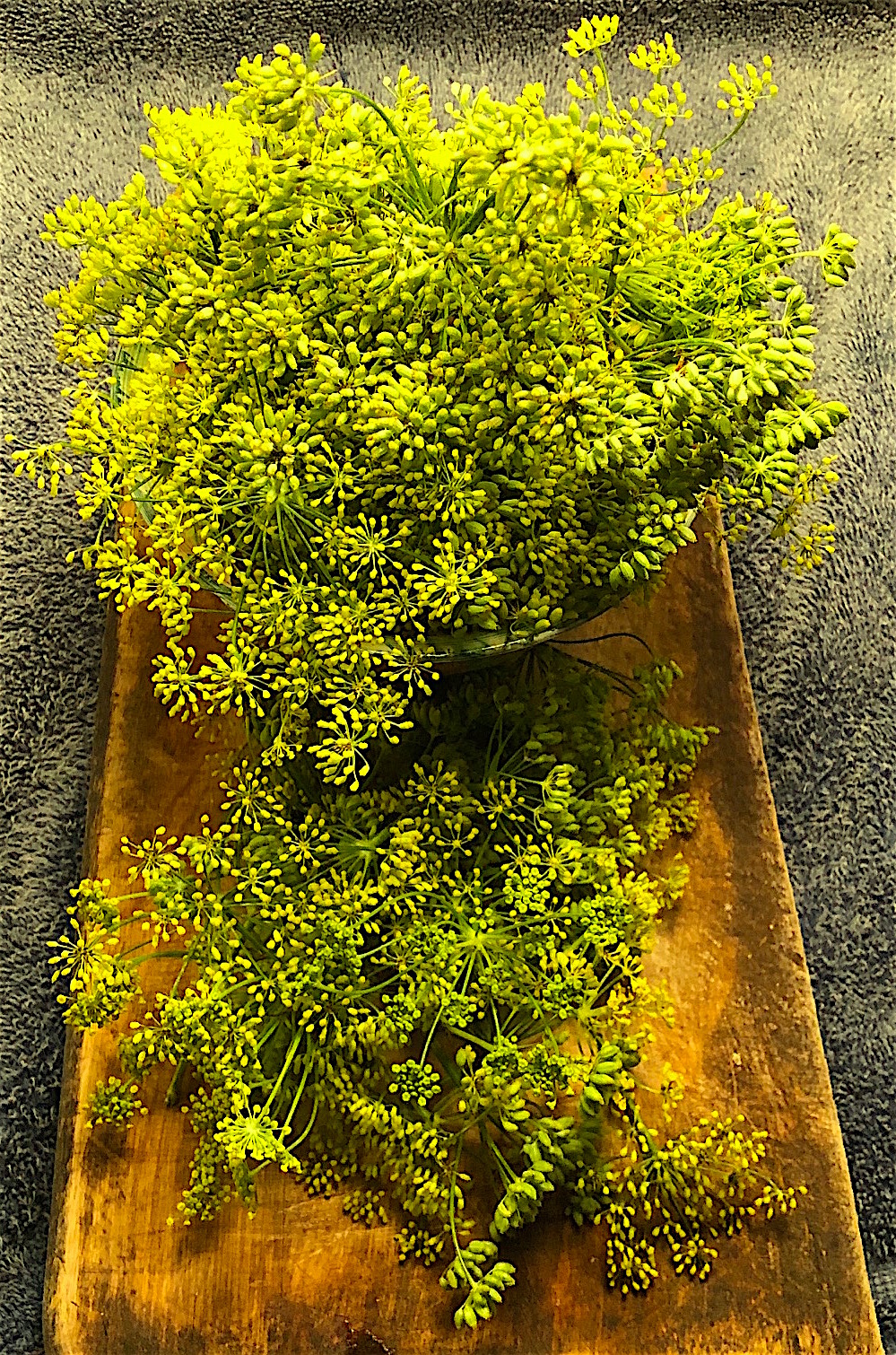
In this exciting episode of our neighborhood saga, I found a tall thick plant of feral fennel (Foeniculum vulgare) with a broken main stem. The flower heads had already bloomed, and were full of tender green seeds. The whole plant had toppled over and onto the sidewalk, but looked completely fresh and untrampled. The strong licorice scent from the broken bruised stems was heavenly.

Exhibit A

This picture shows a fennel plant broken on the ground, showing the flower heads with seeds.

There’s nursery fennel in my garden, and I’ve often snapped off and chewed on the green seeds. Unlike the hard pointy fennel seeds purchased as a seasoning, the fresh seeds are tender and sweet. But with this plant, uncultivated and close to the road, I didn’t eat anything without washing. (There is research proposing connections between microbes, and illnesses including gum disease and Alzheimer’s. It pays to be careful.)

Still, I took out a bag and filled it with dozens of flower heads.

Passersby and drivers paid me no mind. Anyone in that building could have pounded on the window and said “What’s the big idea? That plant was standing in the front yard of this apartment complex!” And if they did, I would hand over the bag right away with some recipe tips. But in general, people hurry past my foraging activities looking embarrassed for me. Once in a rare while, some older person might flash me a smile. Perhaps they are picturing the earwigs that will soon be running up my kitchen wall? Maybe all of them know that fennel is classified as a noxious weed by the extension service, and that getting rid of it is just being patriotic.

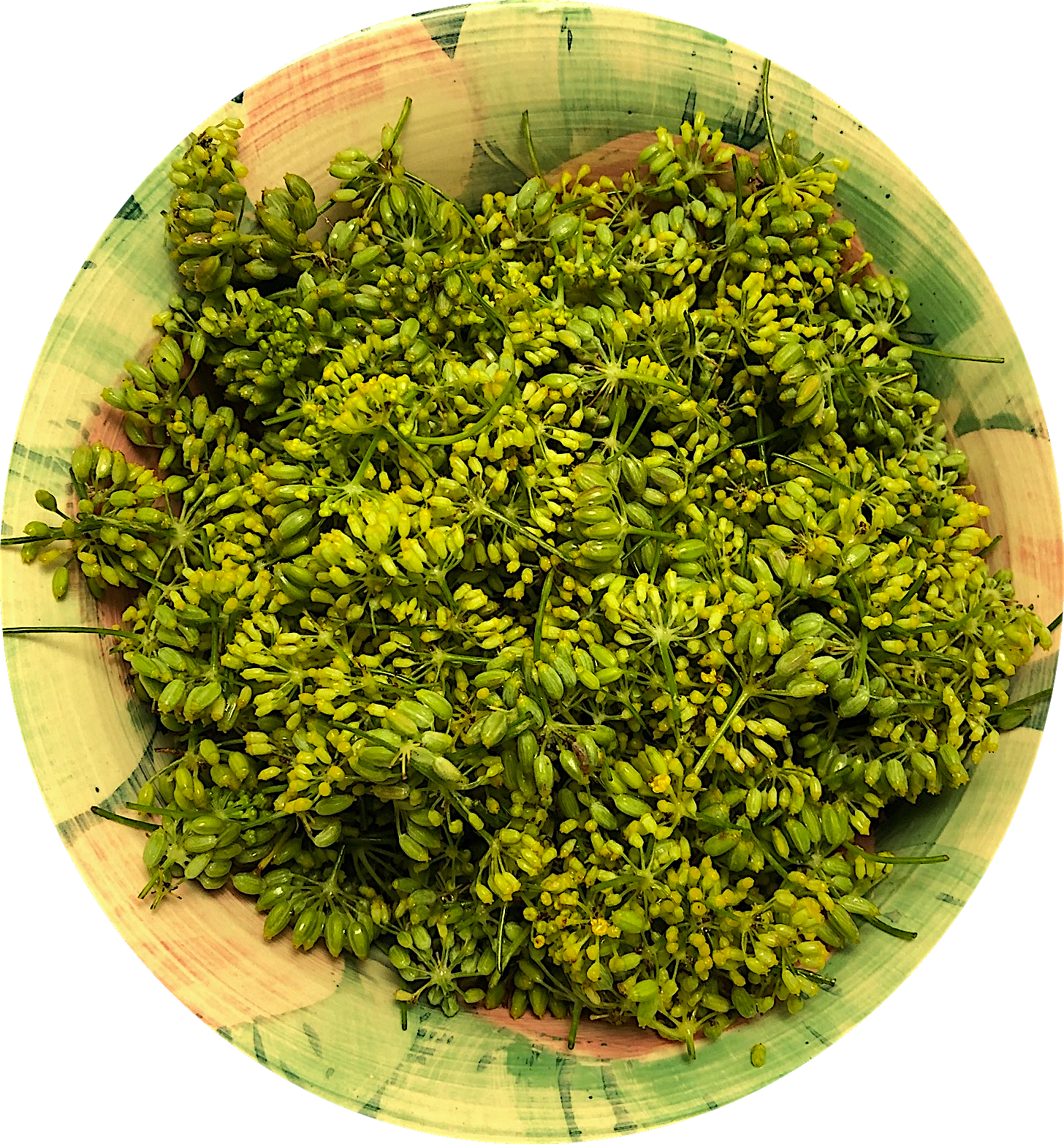
At home I swished and rinsed the flower heads very well in three changes of baking soda water with a final rinse, pouring all the rinse water into the garden bucket to throw outdoors; it would not be a good idea to start fennel growing from raw seeds down in the kitchen plumbing. Flower arrangers might enjoy working with these fragrant nest-like flower heads; they are curved up like an upside down umbrella, and cling together so well that by dropping flowers on top of each other you can easily build a whole pyramid of them in a tall stack.

Exhibit B

This picture shows a stack of washed fennel flower heads with green seeds.

Maybe if the seeds were mature and dry, they would have rubbed right off the stems. But these green seeds did not. I trimmed them off, then simmered the stems to make soup stock and set aside the stems for compost. The seeds stayed in clusters with tiny spidery stem bases. Some people might have the patience to pick off each seed, but they don’t live here. Because the seeds grew right on the street and not in my garden, I simmered them in the stock for about five minutes. While waiting, I rearranged some counter items to form a comfy hiding place to a panicking earwig. Then I drained and spread the seeds on a tray to dry. Their texture was fun to work with, fluffy and light, like a woolly green fennel fleece. The seed flavor was excellent; sweet and fragrant at first, then a hint of saltiness.

This raw seed idea appeals to me, and might appeal to others. I knew a woman who couldn’t stand any food made with fennel, but it turned out that she was fine with the taste. What she couldn’t stand was the mouth feel of unexpected tiny sharp points. Well, chewy tender raw seeds might be a better option. In Indian restaurants, it’s nice when after a meal the waiter brings a little dish of fennel seeds to chew on; they help ease digestion. But raw seeds would be even nicer to chew on if one can get them.

Exhibit C

This picture shows green fennel seeds, separated from their main stems.

Finally the seed fleece went in a container in the freezer. It will be easy to pinch off fluffy pieces and add them to cooking. Today for lunch I prepared a spoonful of kimchi with almond flour and nutritional yeast in a bowl. Then I blended several stalks of celery, drank the celery juice, then mixed the celery pulp with two beaten eggs and some rice milk and paprika and a drop of Red Boat anchovy sauce. When the cooking eggs had set solid, I sprinkled on some fresh fennel seeds. The omelette finished cooking until it puffed up, then went in with the kimchi. The fresh seeds were a nice contrasting touch.

But, we were trying to keep up with the Wings.

Arriving home after foraging, I found the Captain inspecting his tomato patch. He was already strategizing improvements in his tomato seedling cultivation techniques for next year, having selected the five (5) varieties that he will raise, planning which neighbors will receive which seedling type based upon their garden spaces, and arranging his south wall and black pots for optimal heating units of sunshine. That’s just how he thinks about things all day long.

I showed him my batch of fresh green seeds. This time, thought I, this will be something nice and novel for him to see. But, what did I know.

“I’m ahead of you,” he said.

“We all know that,” I told him.

“No, I meant my fennel seeds. I have a whole batch in my dehydrator now. They’re almost ready. See, before harvesting these you should have waited until the seeds turned black, on a dried plant; then they’ll fall right off.”

Well, when it comes to stuff lying on a public sidewalk, for the sake of cleanliness I wanted to harvest immediately. But his harvest method certainly sounds more efficient.

Later today when I return a bunch of kitchen dishes from Mrs. Wing’s cooking triumphs, we’re all going to have a fennel showdown, a taste test of the two batches to see which method has the best flavor and fragrance. I like my tender chewable seeds. But it’s easy to predict that for long-term pantry storage, his dried method will yield a superior professional result.

So as it turns out, the family had their whole winter supply of fennel seeds almost ready before I even went out foraging. There is just no keeping up with these folks. But as the old saying goes, “If you can’t beat ’em — join ’em.” On our street their work ethic, industrious ingenuity, lovely tended garden, and eagerness to share information and goodies with everyone else is the best entertainment value around.

Posted in Uncategorized | Tagged | Leave a comment