10/11/2021: A Fellowship Call

This picture shows white hydrangea flowers outside a church window of red and yellow stained glass shining out into dusk.

“Good Morning!” said the hearty warm voice of Colleague T. when I answered the phone. “In a few minutes I’ll be at Friends Bench. Can’t wait to see you!”

I sat with phone in hand, blinking stupidly at my computer screen, where a cascading chain of misunderstandings at work called for immediate attention and assistance. Of course, the logical Yankee Anglo etiquette would be to cancel our lunch and explain to T. that something came up at the office.

Friends Bench is a garden seat at the Society of Friends Meeting House. For years, Colleague T. and I have met there to lunch and chat. Colleague T. is a resilient, generous, caring, upbeat woman of faith committed to family, church, and charities. In retirement she is busier than ever with worthwhile well-organized activities. Her aura is radiant and poised, with fabulous taste in earrings and accessories. She has faced life’s adversities with a positive outlook of charity and hope, and always has good energy and uplifting words to share.

One week in advance, Colleague T. texted me suggesting a Friends Lunchfest for October 11th. Great! I happily added her to my calendar for November 11th. In anticipation, I thought how nice it would be to meet on Veterans’ Day, so we could spend our work holiday in good fellowship without either of us hurrying back to the office.

But at that moment, on the right day wrong month, the truth was that I felt shy about seeing anyone at all. And Colleague T. was especially discerning and insightful. It would be hard to keep up appearances for a whole hour, and to hide from her how discouraged I was feeling about life.

On the phone, with a heavy heart, I confessed to her that I was held up working at home, and was not actually near our meeting place. To my surprise, she said “Well, would you like to meet somewhere else? I’ll drive right over!”

I suggested meeting outside my apartment to begin with. That idea came with some real trepidation; what if T. thought my hospitality was disrespectfully slapdash and half-hearted? After all, I had no refreshments prepared, my studio was in no shape for guests and neither was I, and the clouds were about to pour rain. But she cheerfully agreed to come right over. Fortunately, that gave me exactly enough time to tackle the email chain and set the communication issues to rest. Then T. and I met downstairs, I found a couple of lawn chairs near the garden, and we carried them under the trees.

And then, somehow the whole picture changed.

In a flash, Captain Wing materialized out of thin air with plushy towel in hand, and wiped down the chairs before vanishing back in the house. In another flash, Mrs. Wing sprinted outside to hand me a big bag of her fresh picked garden vegetables. As if on cue, one endearing neighbor after another and a cat or two headed past on their errands, and every one stopped with friendly greetings in a community-wide demonstration of good will. It was better than watching a Sunday promenade from a café in Paris. The storm clouds parted in dramatic manner, and tremulous autumn sunshine burst out on the nasturtiums, calendula, marigolds, geraniums, and Mrs. Wing’s fuchsias and flowering ginger. Goldfinches gathered in the pines overhead in a sweet warbly chorus, and hummingbirds zizzed around.

In this magically charming setting I confessed my calendaring mistake. Because our jobs depended upon accurate calendar scheduling for ourselves and others, we had a good laugh. Then somehow I went right on confessing, about how discouraged and useless I felt, as a person with not much function or meaning in anybody else’s life. Colleague T. caught my drift right away. After listening and hearing me out she responded with honesty and clarity. She talked about her own search for meaning after her hardworking career, and now that her grandchildren were virtually grown up with busy accomplished lives of their own. She was pursuing and exploring plenty of service opportunities, but was still searching for God’s calling for this stage of her life now. In particular, how could she really live the Gospel to witness to others who needed it most?

It was such an all-absorbing talk that I braved a suggestion that she come upstairs to my place — as the first guest to set foot in the door since the Age of Covid. We went upstairs. “This studio is clean enough and tidy,” I pointed out. “But — time was, I always had soup on the stove and bread in the oven ready for anyone to stop by. Now look. Half of it’s file boxes and a laundry rack and cartons of pandemic canned goods. It’s not a home; it’s a room with someone who has given up on her own life. Sure, there’s customer service work all day long, and church, and always neighbors with errands and chores and messages to share. But after a whole day of interaction I come up to this room and think ‘Is that it? I don’t really belong to anybody. What’s the point of my life?'”

Well, T. must have been inspired then. She shared the best and soundest Bible teaching for anyone who feels isolated and alone. All of it reminded me that here from the earthly view we can’t grasp what a difference we make in the lives of others, or how much meaning our lives really have, or what treasures are stored up in heaven. “And as for the room,” she added at one point, “arrange it for your self. It matters!”

That simple idea was hard to grasp. The room? For myself?

But one thing was clear. “God sent you a month early,” I told her. “And you certainly brought Bible teaching to me. This was a real fellowship call on someone who needs it.”

As we said goodbye and she drove away, I realized I’d forgotten to give T. some of Mrs. Wing’s vegetables to take home!

Ever since that talk with T., life has felt different in a good way. It’s still grief every day. But praying, working, falling asleep, waking up, all of it is 10% better. These dear neighbors and community members look even more dear. Friendship with T. is even deeper and warmer for the future. There are even new little changes in this living space, but that’s a story for a later day.

That night, it was heartening to discover this verse. It went right in my Bible notebook as a memento of our visit:

Exhort one another daily, while it is still called Today; lest any of you be hardened through the deceitfulness of sin. For we are made partakers of Christ, if we hold the beginning of our confidence steadfast unto the end. — Hebrews 3:13-14

Looks as if Colleague T. has that new ministry she was praying about. She certainly ministered to me.

Posted in Uncategorized | Leave a comment

10/10/2021: Adventure with Acorns

Big disclaimer again: There are plenty of ways to safely and efficiently process acorns. Consult the experts. Don’t imitate somebody who is just bumbling around. 

In our earlier episode, I gathered about 2 cups of perfectly fresh sound fallen acorns from a white-oak tree. They dried in the sunshine while I studied up on library books and websites about acorn foraging and preparation.

Exhibit A: Whole shells

This picture shows acorns from a white oak tree, still whole in their shells, in a bowl on the windowsill.

One source said that putting acorns in a dehydrator will help the kernels shrink in from the shells for easier removal. Ten days in the sun on the windowsill might have helped with that. I placed them in a plastic bag three at a time. I figured out how hard to tap each one with a Russian kettle bell weight: not enough to shatter the acorn, but just enough to get one clear dry splitting sound. That creates a crack in the shell. Then one can pry apart two shell halves with a half kernel in each, gently bending the flexible shell to pry out the kernels with a thumbnail. The shells went into the compost pail.

Exhibit B: Kernels and inner skin

This photo shows white-oak acorns, shelled but with their papery inner skin remaining.

That left these shelled kernels still with the “testa,” the papery brown inner skin, still attached. The kernels need to be peeled and have the testa removed. Testa has extra tannin, and a papery mouth feel. With chestnuts, it’s simpler; one can oven-roast the nuts, and generally the testa cracks right off with the shell. Or, with raw almonds, just dunk them in simmering water for a minute, then into icy water, and the inner skins should slip right off. (Even easier, I just soak the raw almonds overnight, then slip the skins off next day. No cooking needed.)

Blanching these acorns was more of a challenge. Even after blanching and cold water, the testa did not just slip off. So I simmered them for several minutes, then used cold water again. Even after several blanchings, I still had to chip away with fingernails to scrape the testa away from each kernel. Many kernels needed additional carving with a sharp knife to remove blemishes; I wanted only completely sound kernels.

Even after multiple simmerings in several changes of water, a taste test kernel had a crunchy texture. The flavor was pleasantly nutlike for about 10 seconds until the tannin taste kicked in. I had to throw away the kernel and brush my teeth to get rid of the bitterness. That double handful of kernels cost 90 minutes of slopping around with pots and bowls and strainer, a sore back, and two split fingernails. I felt like an inept loser up past her bedtime.

Exhibit C: Peeled kernels

This photograph shows white-oak acorns. These were shelled, blanched, and then peeled.

Next I pureed the kernels with lots of water in the Vita Mix blender. This made a murky liquid with floating particles of sediment. Before putting the jar in the refrigerator, I took one very cautious lick. The solution tasted like runoff from a storm sewer. That discouraging moment brought to a close an evening of bother and fuss.

Exhibit D: Flour-water solution

This photograph shows acorns blended with water to form a murky tan solution in a jar.

Next day the acorn flour had settled to the bottom of the jar, leaving the water with a murky color and very bitter taste. I poured off and refilled the water, then shook up the jar and put it back in the fridge. After five days and dozens of rinses & refills, the solution looked clear with a well defined layer of flour at the bottom. The water and the flour had a neutral taste with no bitterness, and no astringent mouth feel. I poured off and discarded the water, drained the flour, and heated it a bit to make a soft more cohesive dough. It had a plain starch taste, like eating plain millet or white corn grits.

It’s impressive to imagine our ancestors devising and sharing tasks like this as part of their social bonding rituals. A project like this must have been much more efficient and enjoyable when a whole group worked on the harvest together.

Exhibit E: Starch dough

This photograph shows a ball of acorn starch dough in a white bowl.

It seemed that this starch dough with its plain taste might lend itself as an ingredient in a highly spiced sweet like German pfefferneusse or Russian prianik cookies. So I mixed the acorn dough in the Cuisinart with dates, tahini, coconut, bitter cocoa, allspice, and a dash of xylitol. That made a soft halvah candy, rolled into small balls for the freezer. 

Exhibit F: Voilá

Straight from the freezer, this made a delicious candy. Here is a sample below, on fresh edible nasturtium leaves from the garden. This confection would benefit from some ginger, and more festive flavorings such as cinnamon and cloves and orange zest. To me the acorns gave a very subtle note of centered calming autumn-woodsy flavor, like the smell of rain on freshly fallen leaves.  

When more fresh sound acorns come along, I will try this venture again.

This photograph shows rolled candy balls on a bed of edible nasturtium leaves.


Posted in Uncategorized | Tagged | 2 Comments

10/9/20: Fennel. Or, Keeping Up With the Wings

Big safety warning here, about fennel and everything else: This is an entertainment blog by a writer who rarely leaves the sidewalk and can only identify two kinds of lettuce. There are plenty of competent plant books out there. Study as many as you can, and go on plant walks with a competent guide whenever possible, before you pick anything. For example, one book warned that people might see life-threatening poison hemlock seeds and think they are fennel when they are not! What’s more, even plain edible fennel from the grocery store comes with medical warnings from the Mayo Clinic. So again, study up all you can and don’t take it from me.

There is a very popular Keeping Up With show on the television set nowadays, about a family with a lot of home businesses who are very good looking and wear nice clothes. I haven’t seen the show, but can guess that any family would have an interesting time keeping up with the Wings. Judging by the daily activities in our courtyard, the Family Wing (which must come from an ancient Chinese character meaning “Cavalcade of ingenuity and friendly helpfulness”) needs a reality show of their own. Which is pretty funny, since Captain Wing has been editing and making copies of Neighbor G’s memorial service video, the real reality show from last Sunday.

In this exciting episode of our neighborhood saga, I found a tall thick plant of feral fennel (Foeniculum vulgare) with a broken main stem. The flower heads had already bloomed, and were full of tender green seeds. The whole plant had toppled over and onto the sidewalk, but looked completely fresh and untrampled. The strong licorice scent from the broken bruised stems was heavenly.

Exhibit A

This picture shows a fennel plant broken on the ground, showing the flower heads with seeds.

There’s nursery fennel in my garden, and I’ve often snapped off and chewed on the green seeds. Unlike the hard pointy fennel seeds purchased as a seasoning, the fresh seeds are tender and sweet. But with this plant, uncultivated and close to the road, I didn’t eat anything without washing. (There is research proposing connections between microbes, and illnesses including gum disease and Alzheimer’s. It pays to be careful.)

Still, I took out a bag and filled it with dozens of flower heads.

Passersby and drivers paid me no mind. Anyone in that building could have pounded on the window and said “What’s the big idea? That plant was standing in the front yard of this apartment complex!” And if they did, I would hand over the bag right away with some recipe tips. But in general, people hurry past my foraging activities looking embarrassed for me. Once in a rare while, some older person might flash me a smile. Perhaps they are picturing the earwigs that will soon be running up my kitchen wall? Maybe all of them know that fennel is classified as a noxious weed by the extension service, and that getting rid of it is just being patriotic.

At home I swished and rinsed the flower heads very well in three changes of baking soda water with a final rinse, pouring all the rinse water into the garden bucket to throw outdoors; it would not be a good idea to start fennel growing from raw seeds down in the kitchen plumbing. Flower arrangers might enjoy working with these fragrant nest-like flower heads; they are curved up like an upside down umbrella, and cling together so well that by dropping flowers on top of each other you can easily build a whole pyramid of them in a tall stack.

Exhibit B

This picture shows a stack of washed fennel flower heads with green seeds.

Maybe if the seeds were mature and dry, they would have rubbed right off the stems. But these green seeds did not. I trimmed them off, then simmered the stems to make soup stock and set aside the stems for compost. The seeds stayed in clusters with tiny spidery stem bases. Some people might have the patience to pick off each seed, but they don’t live here. Because the seeds grew right on the street and not in my garden, I simmered them in the stock for about five minutes. While waiting, I rearranged some counter items to form a comfy hiding place to a panicking earwig. Then I drained and spread the seeds on a tray to dry. Their texture was fun to work with, fluffy and light, like a woolly green fennel fleece. The seed flavor was excellent; sweet and fragrant at first, then a hint of saltiness.

This raw seed idea appeals to me, and might appeal to others. I knew a woman who couldn’t stand any food made with fennel, but it turned out that she was fine with the taste. What she couldn’t stand was the mouth feel of unexpected tiny sharp points. Well, chewy tender raw seeds might be a better option. In Indian restaurants, it’s nice when after a meal the waiter brings a little dish of fennel seeds to chew on; they help ease digestion. But raw seeds would be even nicer to chew on if one can get them.

Exhibit C

This picture shows green fennel seeds, separated from their main stems.

Finally the seed fleece went in a container in the freezer. It will be easy to pinch off fluffy pieces and add them to cooking. Today for lunch I prepared a spoonful of kimchi with almond flour and nutritional yeast in a bowl. Then I blended several stalks of celery, drank the celery juice, then mixed the celery pulp with two beaten eggs and some rice milk and paprika and a drop of Red Boat anchovy sauce. When the cooking eggs had set solid, I sprinkled on some fresh fennel seeds. The omelette finished cooking until it puffed up, then went in with the kimchi. The fresh seeds were a nice contrasting touch.

But, we were trying to keep up with the Wings.

Arriving home after foraging, I found the Captain inspecting his tomato patch. He was already strategizing improvements in his tomato seedling cultivation techniques for next year, having selected the five (5) varieties that he will raise, planning which neighbors will receive which seedling type based upon their garden spaces, and arranging his south wall and black pots for optimal heating units of sunshine. That’s just how he thinks about things all day long.

I showed him my batch of fresh green seeds. This time, thought I, this will be something nice and novel for him to see. But, what did I know.

“I’m ahead of you,” he said.

“We all know that,” I told him.

“No, I meant my fennel seeds. I have a whole batch in my dehydrator now. They’re almost ready. See, before harvesting these you should have waited until the seeds turned black, on a dried plant; then they’ll fall right off.”

Well, when it comes to stuff lying on a public sidewalk, for the sake of cleanliness I wanted to harvest immediately. But his harvest method certainly sounds more efficient.

Later today when I return a bunch of kitchen dishes from Mrs. Wing’s cooking triumphs, we’re all going to have a fennel showdown, a taste test of the two batches to see which method has the best flavor and fragrance. I like my tender chewable seeds. But it’s easy to predict that for long-term pantry storage, his dried method will yield a superior professional result.

So as it turns out, the family had their whole winter supply of fennel seeds almost ready before I even went out foraging. There is just no keeping up with these folks. But as the old saying goes, “If you can’t beat ’em — join ’em.” On our street their work ethic, industrious ingenuity, lovely tended garden, and eagerness to share information and goodies with everyone else is the best entertainment value around.

Posted in Uncategorized | Tagged | Leave a comment

10/3/2021: Memorial Service, Neighborhood Style

This picture shows our local cemetery just today with sunshine, clouds, and tall trees.

The Memorial Service for Neighbor G. was on Sunday.

At the local grocery I bought the universally popular party pack of choco-chip cookies, then put on Neighbor D’s sleek black classic dress and headed uphill to the barbecue area. It was a worry wondering whether people would turn up, since it looked about to pour down rain. Would a few people show up and just dawdle around a bit for the sake of appearances, looking depressed and ill at ease? Was anybody else bringing food? If not, it would be conspicuous to show up with a party pack of cookies. But I decided that in case of questions, knowing the faith-based inclinations of our loved one of honor, I could claim that as citizen clergy I’d brought communion.

Well, no worry needed. The affair was a smash.

The men got there early and set up picnic tables. Captain Wing brought about 30 chairs and then served as video historian with two cameras at once. There was a true feast of home cooked potluck dishes. The women laid out tablecloths and decorated everything beautifully. They’d cleaned Neighbor G’s apartment and set up a big display of his favorite personal belongings to give away. There was his hat collection, his decorated walking sticks, stuffed animals, many small framed pictures (he was a talented photographer) and his famed red feather boa. There were even party costume accessories. Everyone was invited to take home (and/or dress up with) a keepsake of their choice.

Then everybody stood up and shared a funny or heartwarming story of the larger than life personality who was Neighbor G, alternating with lovely poetic readings and inspirational quotes. It was a revelation to witness that during his many years in the building, G. had reached out to so very many neighbors and local business people and employees, and picked out a great many as permanent friends. Over the years, they had teamed up on his health care, finances, living situation, social connections, and wellbeing. In this day and age, and in a city known for its courteous reluctance to talk to strangers, it was amazing to see such a large heartfelt turnout and hear the stories. There were some shared tears, but a steady wave of shared happy laughter.

Finally everyone converged on the tables, piled high with delicious things to eat.

At that point I slipped out through a back patio and went home and changed into regular clothes. As a memorial practice I listened to a recording of the Akathist to St. Nicholas read by Sergei Merkur’ev, praying along with it in my Slavonic prayer book. I also curled up with my current bedtime devotional, which happens to be Facing Death — and the Life After by Billy Graham. I am enjoying this book very much. It came from the Little Free Library located right by Neighbor G’s daily powder-blue smoking bench, where he held court for many years. Every time I came home from work, passing by the Little Free Library on the way, Neighbor G would call me over eagerly to his smoking bench and ask “Whatcha reading now? Anything new and good?” Well, he sure would have had some quotable bon mot to offer over this particular LFL choice, and he would have swapped out the photo on this post with something more scintillating. But he would have liked the cookies and the black dress.

Captain Wing saved for me a lion’s share of Neighbor R’s homemade molasses-bacony-spiced baked beans, the best I’ve ever tasted.

The men are going to re-paint the smoking bench in fresh powder blue. They’ll add a little G. plaque too while they are at it.

Posted in Uncategorized | 2 Comments

Neighbors, 9.27.21

Yesterday I ironed a clean shirt for Neighbor D. She saw me wearing it recently and said “Ooh, nice shirt. Can I have it?” She was joking, but I washed and ironed and wrapped it with a note on her porch. Soon after that she called me over, delighted and dismayed. “I was kidding! You don’t have to do this!” But then she had an idea: with my encouragement, she’ll keep the shirt on condition that I take a gift in return. She ran indoors and brought out a very long sleek knitted black turtleneck dress that she wasn’t wearing; it’s the basic black classy number that ladies are supposed to have on hand for unexpected award ceremonies and the like. “It comes with cat hair,” she apologized. I asked whether if I assemble the hair, that would create a whole new cat? “No, but that little feral calico living over in those bushes? She needs a good home, and I intend to catch her for you.”

Then Mr. Wing flagged me down and presented me with a new hand crank food mill strainer for my future adventures with windfall fruit. Next Mrs. Wing insisted that Mr. Wing deliver to my door a hot plate of Chinese noodles with special sauce, scrambled eggs, grated cucumber, and some of her candylike homegrown cherry tomatoes. Both of them offered abject apologies that the tomatoes detracted from the pure Beijing-style authenticity of this dish. I had to promise not to expect or add tomatoes when visiting Beijing.

Then I slopped around, pitting and blanching the skin from three quarts of windfall Italian prune plums. Thanks to the food mill, this finally yielded a batch of sweet rose-gold puree. So I ladled out a jarful for the Wings, and popped the jar into the fridge in an empty oatmeal container for easier delivery.

Today between drenching downpours and before sunset we had a sunny break, with a fresh wind and towering rain clouds chasing brilliant blue patches across the sky.

That was a good time to leave the plum sauce at the Wings’ door. Then I planted some flowering kale and some rooting scallions, and picked a few young leaves of collards, kale, and purslane, and also some scented geranium for the icon altar. A tiny gold potato turned up in the dirt (it’s in the soup pot now). The storm knocked down a zucchini blossom, and a couple of late windfall yellow apples on the street.

That made today’s memorial picture for Neighbor G.

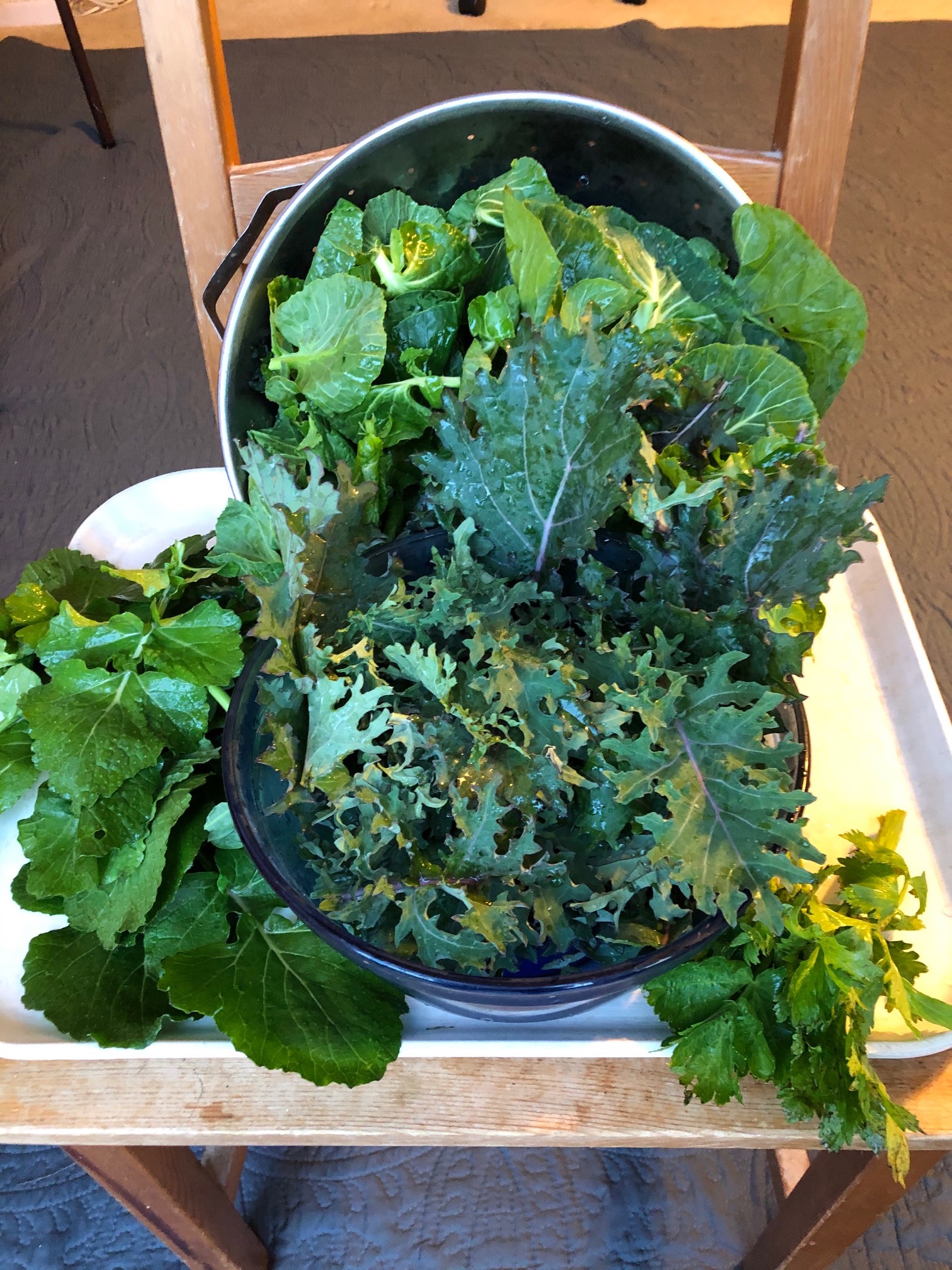
This picture shows a bowl of garden greens on a wooden chair with a lighted battery candle, a yellow zucchini flower, and two yellow apples.

For many years Neighbor G. presided over the smokers’ bench out on the street. He wore knitted hats and looked very thin and seemed to store up energy by soaking in the sun on even the hottest days. He and his cigarette and his little talk radio and earpiece braved all weather at all hours. He stuck with that bench, reflecting moment to moment upon the meaning of the cosmos and saying philosophical or witty things to any person or dog passing by.

Judging by his pithy observations about organized religion, his path was as much Buddhist as anything. It seemed not sensitive at all to put the St. Nicholas icon or other Christian pieces in his memorial picture. But somehow it seemed okay to set out these leaves and fruit instead.

The neighbors report that G’s stay in the hospital was short and peaceful. When he was admitted, two young women neighbors went to his apartment and made some accommodations and purchases for his comfort, in hopes that he would come back home. Meanwhile a whole group of the men took turns driving over to the hospital to take turns at his bedside. One of our dear maintenance engineers, who doesn’t even work here any more, kept vigil like everybody else.

The memorial service will be held Sunday, behind the smokers’ bench. A neighbor from G’s building gave me the news in the garden.

My first thought seemed inappropriate, but I said it anyway: “For a service, he would probably prefer something highly irreverent.”

Luckily the neighbor took this in stride. “He’ll want us all in drag.”

Huh. Well, there’s that sleek black dress…

Posted in Uncategorized | 5 Comments

White Oak Acorns 9.25.21

This photograph shows brown acorns from a White Oak tree. They’re in a white bowl with some yellow oak leaves, in morning sunshine. In the bowl there is also an oak-leaf pin from the thrift shop.

Warning: this post is for entertainment purposes only. There are plenty of published experts out there if you want to read up on working with acorns. Do not stake your health or pantry on the adventures of a foreign language major.

Along the way home from work there is an old green grass median strip between two main roads busy with traffic. It’s an untended space with a few very mature trees. I was crossing the strip lost in thought and suddenly felt crunchy but slippery traction underfoot. What a discovery: three tall old White Oak trees, and acorns underfoot in a solid carpet inches thick. There’s a truckload of fresh acorns in perfect condition. This must be what the farmers would call a “mast year,” when the fruiting trees of a species team up and all produce nuts at once.

Back at home, in the last warm amber rays of sunset I hurried to take a picture of the acorns and leaves. The last light beam was just hitting the window sill. The timing was perfect, the last beam came and went, the picture was a success. But it revealed a line of soot inside the track of the double window pane. I’d never even noticed that before.

Fortunately, the sun this morning hit the window too. This time a scarf made a nice drape for the window track. Only trouble was that during the night, the attractive green-gold acorns had slipped out of their little hats. It took some Elmer’s Glue and a bit of patience to fit them back in. Then we were good to go. This acorn picture is about the upper limit of my cell phone photo taking skills. There are sure to be more artistic ways to portray flotsam that piles up and crunches underfoot, but it is beyond me.

For weeks I’ve been looking around for White Oak trees. For years I’ve wondered about exploring homemade acorn flour. The trick is that acorns have so much mouth-puckering tannic acid that they aren’t edible or healthy until the tannins are leached out. Tannin is after all what manufacturers have used to turn soft skin into leather. Not a target nutrient.Way back in Russian language major days I gathered Red Oak acorns and patiently leached (vs. leeched) them in many changes of water for weeks. One tiny tongue lick of the result was enough to end that science junket and incur plenty of hilarity from the roommates and their suitors.

Later, a library book pointed out that White Oak acorns are a better starting point; they’re lower in tannic acid. Another library book specified that you have to crack open the acorns. The goal isn’t to try leaching tannin out of whole shells. The goal is to get those shells open and harvest the little kernels, and that is your real square one for the leaching process.

Well, how hard can it be to crack open an acorn? Talk amongst yourselves while I go find out.

Back again. It took 3 minutes to split open one acorn using a 5 pound weightlifting Russian kettle bell. The acorn was so smooth and polished that any blow sent it ricocheting off the kitchen walls. So this took several rounds of searching for the acorn under the Bible table and stove and then putting it back on the cutting board. Placing the acorn in a wide jar lid helped to keep it in one place. At last, the acorn split in half, sending pieces everywhere. A quick crawl around recovered the two main pieces. It took a minute to pry out the kernels, tender white nut fragments. These tasted surprisingly pleasant, chewy and starchy and nutlike-ish. Then, the bitterness kicked in for real. Gah! It took another three minutes of tooth brushing with Bronner’s lavender soap to get rid of the taste. So. One acorn, seven minutes.

Next I’ll try putting an acorn in a bag and cracking it that way. Give me a second here.

Ok, progress. Putting five acorns in a clear plastic bag was a step forward. Three good kettle bell whacks apiece made ten acorn halves. The shells are thin and somewhat pliable, and the kernels are soft and waxy-crumbly, so working with an acorn is much easier than dealing with a walnut. But this really calls for a nut pick instead of thumbnails. At least the kernel halves are out, soaking under cold water in a Mason jar in the fridge.

Next question is the inner brown paperlike covering wrapping the kernel pieces. Are we supposed to remove that? Blanching might loosen it, but that would still mean buffing it away from a lot of fragments and halves. The optimistic view would be that when the kernels are ground into silt and soaking in their leaching water bath, the brown paper material will precipitate out.

Update: that brown papery stuff inside the shell is called “testa,” according to Alan Bergo at his https://foragerchef.com blog. He reports that testa is high in tannin; it needs to come off the kernels. For White Oak, once the acorns have dried one can rub the kernels and brush off that layer.

As usual, Captain Wing had a better idea. “No need to stand out there picking up each acorn off the ground. I have just the right short-handled rake. You can rake up all the acorns you want, and we’ll sort them in the garden on trays. And don’t try peeling off each shell. Twelve hours in the dehydrator, and the kernels will shrink down and shells will become brittle and breakable. Put down that kettle bell. Don’t be tasting that water; we have litmus paper. That what it’s for.” Alan Bergo’s blog agreed that dehydrating makes the shells easier and safer to open. The rake idea sounds good, but I still want to inspect each acorn for pinholes first before bringing it home; no point in surprising the neighbors with a knapsack full of emerging grubs.

Will go gather some more acorns and give this a try.

Posted in Uncategorized | Tagged , , , | 2 Comments

9.12.21: Grapes

Red table grapes, sweet as honey and shining with health, grow ten blocks away.

They’re growing up the garage fence at my favorite house. It’s a little bungalow built in 1925. The owner died many years ago. The house is deserted ever since, with the lights on 24/7 and security cameras over the doors. It’s a poignantly appealing whitewashed cottage like a villa in Tuscany, fifteen paces by fifteen paces in size, with a crumbling chimney and porch with rounded arches and charming tiny medieval windows. In my dreams I want to buy and restore it. But the entire structure, roof to windows to steps, needs replacement and probably a wrecking ball. According to the internet it’s appraised at $840,000 (up $90,000 over last year). Restoring it would cost a fortune. Besides, it’s not for sale. In this affluent all-white residential neighborhood these old houses fall every day, replaced by tall personal castles of artificial stone or cubist condominium blocks. It seems possible that the house is somebody’s good investment and nobody’s home.

Anyway. The grapes have been growing over the sidewalk for weeks.

I stop to look at them every day. Surprisingly, nobody else walking past looks twice. Finally this morning I put on a nice Sunday dress and bonnet for a more respectable air, brought scissors and paper bags, and spent half an hour very openly and conspicuously snipping grape bunches in everyone’s full view. Families with baby carriages and cell phones and dogs kept walking past. For each one I nodded and smiled, waiting for them to stop and say “Who the hell are you? Are those grapes yours?” Where I’m from, any neighbor would have marched right out and challenged me, as they should. So I was all ready to say “Take some grapes!” and to explain that autumn rainy season is forecast for this week, these grapes are perfectly ripe and about to fall, grapes on pavement create mold and a slippery fall hazard, and they attract coyotes, raccoons, rats, and wasps. I was hoping that some kiddo would be excited to learn that grapes come from vines, and that some lifelong resident would enjoy telling me stories about the house and taking some grapes home for jam. Maybe I could find out the late owner’s relatives, and could drop off a thank you note and some grape juice and offer to prune and feed the vines for next year.

For 45 minutes I stood there in plain sight, cutting down the entire 2021 bounty hanging over the property line. Not one person glanced at the lady with scissors standing in shrubbery in the drizzle. Finally I took my triple-layered paper shopping bag full of grapes and leaves and vines, and headed home.

Here is just one half of the harvest. The other half wouldn’t fit on this chair.

Home is when the real work begins. Always plan for a much bigger mess and bigger time expenditure than expected.

I put the bunches in a baking soda water bath, then swished and lifted them into plain water baths several times. I set aside five of the most attractive compact small bunches to give to a neighbor. He doesn’t even know me, but on Friday he saw me admiring his plum tree, and he rushed out to hand me a whole shopping bag of gorgeous blue-black silver-bloom Italian prune plums, perfectly ripe and sweet. 

For the loose grapes I picked off and inspected every one, checking for any traces of mold or bugs or bird droppings. Fortunately, the grapes were perfectly clean and just at the peak of ripeness. One bucketful of the wash water will go on the garden (maybe the seeds will sprout!).

Next I poured the loose grapes in a pot and began to heat them. Fruit sugars will scorch in a jiffy and ruin a pot, so I watched carefully in case they needed water. But the grapes sweated juice right away and melted down to half pulp, half juice. With reluctance I brought them to a boil, and simmered for five minutes. It would have been nice to consume them raw, but who knows what critters (and their parasites) might have been in those vines. Here are the six cups of cooked pulp with seeds and juice.

6 cups of pulp, seeds, and juice

Then the pulp went into a strainer. Here was a source of unexpected fuss. Grape skins completely block the strainer, so I had to both press with a potato masher, and at each stroke also scrape the skins away with a wooden ladle. (A Foley hand-crank food mill sieve would have been the perfect help.) I set the pulp aside, and strained the strained juice several times. Even that was extra bother; the strained juice is hard to strain. It’s high in… pulp? gel? pectin? and doesn’t go through mesh easily at all. To strain it several times, I had to massage it through with my fingertips. The pulp, leaves, and vines went into the garden compost, but first I simmered them to make sour soup stock for Russian borscht.

The six cups of pulp strained down to this three cups of juice below. The juice has a wonderful taste. It’s clearly very high in sugar, but it’s nothing like commercial juice; it has a strong kick and complex chimes of flavor.

Two cups of juice will go to Mr. and Mrs. Wing; they both take fruit juices and Chinese herbs, and make craft tinctures and liqueurs. One cup of juice will make a good flavoring for my windfall apples and plums and Oregon grapes. Those fruit sauces will stock the freezer this winter. More important, they’re a good gift and point of connection with neighbors who take an interest in raising and cooking with plants.

One harvest = 3 cups of grape juice

This certainly gives a new appreciation for our ancestors and how hard they worked, to put a little taste of sweetness in their lives.

Update, 2 hours later:

The neighbor who gave me the plums was at home just now. I knocked on his door and handed him a bag of grapes. He seemed fine with the discovery of a fruit-bearing total stranger alighting on his doorstep, and he gave me a whole tour of his little garden. He then sent me home with a shopping bag of plums, and he even climbed a ladder to shake down some gorgeous jumbo apples. Now on the counter I have his shopping bag of apples, plus six quarts of his plums from Friday and today. We’re going to keep visiting and swapping our grown and forage fruit, and he’s going to walk over and tour our garden strip.

Then on the way home with my apples and plums I met still another neighbor, who was planting and harvesting a rotating crop of what turned out to be buckwheat to improve the woebegone soil at our apartment complex. Naturally I gave him some apples and plums, and asked permission to come back and photograph the buckwheat, a handsome plant with pretty white flowers.

Then Mrs. Wing came outside and sent me home with more plums (just in time for the next batch of fruit stewing), cherry tomatoes, and two giant zucchini. It would serve them right if I baked some zucchini into bread and left it at their door. Hm…

Posted in Uncategorized | Tagged , , | 2 Comments

8.11.21: The Great Dracaena Caper

Mrs. Wing is a wonderful cook. She brought out a plateful of paper-thin, super-crisp hot seasoned fried potatoes when I was hoeing the garden. I ate up the rest before taking the picture.

Scene 1. Internal morning monologue, Mary’s mind:

Off to work. 

It’s a hot and sunny day. We’re in for a three day heat wave, clear sky and soaring temperatures. Better get to the office and settle in good and early.

Here’s the garden, with the raised bed and the row of potted…

Say, what’s this here? It’s a whole new houseplant. 

This wasn’t here late last night when I did the watering.

Did somebody drop it off for the garden? 

People drop off stuff all of the time — plants dead & alive, planters all sizes, birdbaths, tools, statues, planks, on and on. It’s really generous, but… I wish they’d talk to us first. Usually they’re moving out and they just dump things and leave. Often I need to scrub the stuff and then tote it to the thrift shop on the bus or out to the recycle or dumpster bin.

But this, wow. A supersize gorgeous Dracaena.

Elegant pot too. Right up on a display pedestal where the full sun will hit it all day long.

Except Dracaenas are understory tropical plants. They can not stand direct sun.

And this is one very expensive decorator statement. In New York City this would cost a couple hundred dollars.

What to do, what to do… must catch bus… 

Whose plant is this? Is it really for us? It’s way early. Who’s around to ask?

Well, somebody has to rescue this plant right now, and find the owner later.

Neighbor D. is great with plants, and she has a deep shade covered porch 30 steps away. I’ll bring it there.

Gak, this thing is heavy. Struggle struggle struggle. 

There! Now it’s safe at Neighbor D’s, tucked way back behind her prize-worthy wall of potted Hosta plants.

Now to text her and explain that… Oh… I don’t have her number in my cell phone.

Well ok, texting Captain Wing instead. Captain! If anybody asks you — the Dracaena is at Neighbor D’s! I’ll bring it back later!

Anybody who’s anybody, if they want to know the neighborhood news they’ll go ask Captain. He’ll let them know.

_______________________________________________________________________________

Scene 2. Internal morning monologue, Neighbor P:

Nice news — my family brought me a beautiful Dracaena last night as a gift.

Spent the evening clearing and arranging the perfect space for it in my room.

I can’t wait to see how nice it looks.

Dracaenas can’t stand direct sun. But they brought the plant late last night. We knew that for those few hours in the dark, the plant would be safe and well. But itt’s sunup now. So I’ll go out and —  

Hey!

Where is my gift? It was right here just hours ago. Now it’s gone!

Who was it? Who was lurking around at midnight watching our house and running off with a Dracaena?

Who could have done such a thing? In our neighborhood! This is so sad!

____________________________________________________________________________________

Scene 3. After work.

Mary is cadoodling home from work for a pleasant evening of garden putter.

Wait, what are these handwritten signs?

“PLEASE bring back my Fortune Plant!”

Oh no. So it wasn’t a donation for sure.

Gosh — what if somebody sees it at Neighbor D.’s? They’ll think she took it!

Hurry hurry. Here’s her porch.

Thank goodness. The Dracaena is still right here!

Gak, this thing is heavy. Struggle struggle struggle. 

Ok, it’s back on its pedestal.

Text from Captain Wing: Mary? I have no information about this plant. Will have to find out and get back to you later. 

Text back to Captain Wing: Not to worry! Situation under control.

______________________________________________________________________________________________

Scene 4: All Together Now

Neighbor P, appearing outdoors: My plant! It’s back! 

Mary: Yes! This morning I saw it in the sun and didn’t want it to bake. I figured the relationships could be mended, but the plant would be Dracaena jerky if it stayed where it was.

Neighbor P: No, I was going to come out and get it super early! 

Mary: I am so sorry! This caused you a day of needless distress.

Captain Wing: Hello! What’s this about a plant? Was it missing?

P: Yes! I said to my family “How could this happen? It was only outside for a few hours!” They said “Please don’t be sad. We can always buy you another.” But I said “No no, it’s not just the plant. What kind of person could have done such a thing?”

Captain Wing: Mary could.

Neighbor P: Then I said a prayer about it at my altar to the saints, that the person who took it would decide to bring it back.

Mary: You have an altar? I have an altar too! 

P: Yes, I’m a Catholic.

Mary: So am I!

P: I’m an usher at St. Mary’s.

Mary: St. Mary’s? Father N. used to visit our building here to visit dear Mr. and Mrs. H. every single Sunday those last years to bring them Communion, when they couldn’t get out to church any more. 

P: Wow, Father N. did all that??

Captain: Who’s Father N.?

P: Father is home in Ireland for vacation right now.

Mary: With his 11 siblings. Or wait, maybe it’s 11 kids and only 10 siblings.

Captain: 11 kids??

Mary: Which saint did you pray to? It must have been Anthony, patron of lost things. Except — you didn’t lose it. More like it was swiped. You could have prayed to St. Dismas the Thief.

Neighbor D: Mary! Here you are. I figured you would know how that plant ended up on my porch and where it came from.

Captain: Mary took it for her altar to St. Anthony. Or something. But she gave it back.

Mary: Yes, when St. Anthony says jump, I say how high.

Neighbor L, arriving from work: Hey guys? There are signs posted around: Somebody stole a plant last night! Right from the garden! We should report this to Management. 

Everybody: It’s ok. That’s just Mary.

Neighbor D: She was looking out for people. And their plants.

Neighbor S: You know Mary, all this confusion wouldn’t happen if… Have you ever tried minding your own business? Except then I guess your life wouldn’t be very interesting.

Mary: No, it’s a pretty nowhere place. By interfering in the lives of others, you get to meet the nicest people.

Posted in Uncategorized | 4 Comments

8/5/21: A Distinguished Guest from Moscow (Почётный гость из Москвы), 1998

The ladies were coming to tea.

My new neighbors were highly educated cultured women 70 years of age or so, with eventful lives and wonderful stories to tell. Lydia was from New England. Aliona came from Moscow. Both were staunch parishioners at my new church, both residents at Senior Home across the alley, and both eager to view and housewarm my new studio room.

The new studio was ready, scrubbed to a minimalist gleam. In the clutter and ruckus of the city, I desperately needed this sensory refuge, calming and clear with the fewest possible belongings, and everything in its place. I loved the Shaker simplicity of the wood floor, bare windows open to every ray of winter light, tiny bathroom with its buckled floor of six-sided black and white tiles, kitchenette alcove with its neat clear counter and the little open shelves (two bowls, two spoons, cooking knives, matching Mason jars). From the dumpster there were sturdy wood apple crates, well scrubbed in boiling water and Bronner’s soap. One upended crate was set for our tea. The other was a little corner altar with pine boughs and icons.

Over in the kitchenette, supper was ready. There was hearty Russian borscht, deep ruby with beets and studded with root vegetables, fresh parsley and green onions and dill. There was potato salad with mushrooms, and savory corn muffins. There was stewed fruit kompót, roasted nuts and seeds with cheese and black olives, and homemade halvah to go with our tea.

The ladies arrived to a fanfare of welcome. It was a joyful occasion to see these devout loving womenfolk in my pretty room. I sat them down on the bed with apple crates, paper towel napkins, and spoons. In a row of Mason jars I dished up borscht, tea bags and hot water, honey, lemon, and stewed fruit. It was a beautiful meal with the afternoon sunshine glowing on the clean windows, plain plaster walls, and wood floor. Setting sunlight illuminated the glass jars, kindling the gem tones of borscht and fruit.

Aliona had a lifetime of experience administering art museums, curating exhibits of traditional art, and creating painted and textile handicrafts. She was a deeply astute observer with a keen eye and heart for beauty. She stood still, taking in windows, walls, floor, and tea things.

   “It was quite a surprise for Aliona,” Lydia explained, “to find an American apartment building four stories tall — with no elevator.”

   “Ah, izviníte — zdánie stároe. Sorry! Building’s old,” I apologized ruefully. 

Aliona was busy catching her breath and eyeing the Mason jars. She glanced down at the bed, delicately probed the heft of the mattress and yarnwork of the afghan. Then she stepped into the open bathroom door and sat down on top of the closed toilet seat, bolt upright with gracefully folded hands and a tactful neutral expression, staring straight ahead. I rushed to bring a jar of tea to her bathroom perch. But she graciously declined tea, borscht, dinner, and conversation. For twenty minutes, Lydia and I tried to lighten the moment by making pleasant small talk while I included Aliona by paraphrasing from English to Russian and back. Lydia and I exchanged our favorable impressions of the clear weather, Sunday’s Liturgy, and an upcoming winter social at Senior Home.

Aliona stood up and walked with restrained dignity straight to the door. She thanked me for my hospitality. She adamantly refused my Russian-style insistence on accompanying her to the street. Lydia hastily cleared her barely-tasted tea to the kitchen before rushing after Aliona, calling a hurried goodbye to me before closing the door behind them.

I sank to the bed, dismayed. Why did my guests run away in 20 minutes flat? Aliona was upset, but why? What could have done it?

Hm. Was it the borscht? Perhaps one glance told her that there was something amateurish and inauthentic about my staple soup recipe.

Maybe it was the tea. Tea played a crucial role in Russian socializing. The ladies at church prized their various Chinese blends, poured piping hot and super strong (with real twigs swirling at the bottom) from a real tea pot to real tea glasses with silver handled holders. They certainly didn’t use cardboard boxes of tea bags with this and that herb thrown in.

Maybe the muffins? Mine were made with corn. And say — in Russia, corn was traditionally a rock-hard toothlike forage kernel fed only to pigs. Hm.

Or the icons! According to some sincere outspoken members of our own congregation, Catholics as heretics were not even authorized to own icons. A devout believer was supposed to hang up icons in a permanent prayer corner, icons blessed by an Orthodox priest who had dedicated the room in a special house ceremony. My paper printout icons with little dumpster frames must have struck Aliona as a flagrant cultural appropriation. Perhaps I should have wrapped them reverently in towels and hidden them for her visit? And oh goodness — my Virgin of the bathroom! I always kept a little Mary over the sink in there for company. Would that strike Aliona as disrespectful and irreverent?

Too late, I remembered that cultured Russians of Aliona’s age (she confirmed this for me later) do not sit on beds! I thought back on the hotel staff member in the Soviet Union who reacted with horror when we Americans sat down right on our bedspreads and beds. She rushed into the room with shouted warnings that sitting on a bed caused uneven wear and tear on the State-issued mattresses and box springs entrusted to her care. And to make everything worse, what if Aliona thought this seating arrangement gave even the appearance of some improper exotic American tryst?

At that thought I burst into tears.

It took a good cry before I could hoist my heavy discouraged heart to the kitchen and clear away the untouched women’s fellowship feast. It looked as if I’d have to find a new church, if my new friends were so upset that they couldn’t even stay in the same room with me.

In the long term, Lydia and I visited back and forth for years. She finally moved to a lovely little town to be with her relatives and a wonderful new church family. (First she joined the Peace Corps at age 88 and had the time of her life on the other side of the world.)

Aliona did not visit me again, and resolved never to climb four floors for me or anybody else. But at least when I apologized for scandalizing her with my bedsitter seating, she only rolled her eyes and waved away my baroque American scruples. And until Aliona passed away years later, may her bright memory be eternal, she invited me to her apartment instead. There at least once a week she shared real tea and real china, prayer, art books, classical music on Russian radio, and wonderful stories. Her thrifty room was perfectly appointed. Before moving or adding any piece of furniture, she would sit with floor plans drawn on graph paper and labeled to scale; she would move paper furniture models like chess pieces to preview and choose the most harmonious final arrangement. She knitted matching slipcovers and pillow covers for her own sofa. She unraveled old cashmere sweaters to crochet soft wall hangings. She embroidered linen towel frames for her lovely old icons. She fished wooden spoons and cutting boards and scraps from the trash, painted them with Palekh-style fairytale motifs, and hung them on the walls. She braided area rugs, and crocheted lacy window treatments. And soon we were close enough that she could give me a piece of her mind, since my mind was clearly lacking in pieces of its own. “What were you thinking, living in that kennel? You’re an educated American, for the love of God! Buy a chair! Buy cups! Get some curtains and floor rugs! Hang up a painting!”

But that night, Aliona struggled down those four floors to the street. As Lydia told me later, Aliona sank to a low wall and doubled over, wailing in dismay. “So sad,” she wept. “I did not see such poor even in village! I think, Americans have the money, all goods and best style. But no, NO! Mary’s is nothing. Not chair, plate, lamp. Nothing for window and floor. Nothing for LIFE!” She made a twisting lid motion to indicate my Mason jars. (In the American South, a Mason jar is considered a charming homelike touch for serving tea. But Aliona explained that drinking out of a pickling jar goes along with drinking pickle brine straight up, a hangover remedy among alcoholics.) Sitting on that wall, Aliona gripped her aching heart and wept. “No wonder she is single! What man wants to come home to that?” (To be fair, I had not set up my room to serve as home for a man. I believed that a man was out there preparing a home for me and our future kids instead, and would marry and bring me there.)

But even as she sat on that low wall, Aliona was making plans for me.

Next day, small white-haired dignified Aliona buttonholed dozens of good folk at the church and Senior Home. She called in a battalion of Russian elders within a radius of twenty miles. They ransacked their homes, their children’s homes, garage sales, and rummage basements (Russian word tolkúchka, from “to push,” as in jabbing through a crowd with one’s elbows). 

Two weeks later, after Liturgy, the women in the parish hall unveiled a surprise for me: a carload of merchandise, ready for delivery to my home. Someone’s strapping taciturn grandsons drove it around the corner, and unloaded cartons and bundles outside my walkup room. Once it was locked inside, they hurried me back to church for supper.

Later that afternoon, I got to go home and peek at the cartons and unpack. The Russians had rustled up metal chairs, a folding card table, and six sturdy boxes of utensils and decorations. There were floor mats, place mats, potholders, tablecloths, vases, a macrame wall hanging, doorstop dachshunds stuffed with sand to keep out drafts, dishes and glasses galore, more galores of cutlery, a melon ball scooper, Bambi salt and pepper shakers, a boiled-egg slicer, toucan wall clock, shish-kebab skewers, corncob grippy holders, a Carmen Miranda cookie jar with fruit hat lid, and a knitted clown tea cosie.

I spent one year in that studio. It took all that time to gently smuggle all that loot out the door. Obviously it wouldn’t do, to tote it on the subway to the various thrift stores. Chances were 11 out of 10 that some member of the bargain battalion would feel hurt by the reappearance of Carmen or Cosie the Clown, and word would get out all over the grapevine. Whenever my American friends planned a car trip out of town, I would plead with them to take a box along and drop it off at some good cause. Otherwise, my daily household chores meant moving cartons out of my way and then back again, shoving and stacking them along the wall and shelves, stowing them in the bathroom and kitchenette. All year, people at the church would ask “How are those lobster tongs working for you? I may need to borrow them some time.” All year, things with smiley faces or sharp edges fell on my head from upper shelves or tripped me at night. All year I carried this dark secret from the church, not inviting anyone to visit, afraid someone would show up to see the new furnishings. That’s what a caring community can be: people to shower you with support and help, and also to say (as so many guests have said over the years) “What a dump! Do you call this living? Let us show you how to fill your space like a real grownup.”

But on Trousseau Day, back in the parish hall, the women demanded that I pay Aliona on the spot: seventy five cents in exact change for a large carload of goods. “Because of the silverware,” they explained. “Three knives, three quarters.” The women supported their argument and enlightened my bewilderment by citing President Putin as an example on his visit to an artisan foundry. As broadcast on Russian TV, the artists gifted the President with a commemorative knife. He dutifully fished out and handed over his coin. That’s where I learned that when a Russian gives you a knife as a gift, you have to fork over the equivalent legal tender of twenty five cents. Otherwise the energy of the knife might cut the energy of the friendship, resulting in a quarrel. The token payment will even that out and keep the peace. 

Of course I paid right up, three quarters for Aliona. 

Aliona pocketed the offering. Then she passed me a civilized dinner plate, and a broad smile.

Father led the prayers. The church sat down to eat.

Posted in Uncategorized | Leave a comment

7/29: Carry a Tune for Us

Oral surgeons know all about these things, and before letting me out of the chair last Thursday mine really laid down an extra rule for me: “NO singing! For two weeks at LEAST.”

Oh gee.

It’s been discouraging. But times like this we have to let other people carry a tune for us.

Shouldering that burden here is Mrs. Lindsay Kirkland with music ensemble Sounds Like Reign, where all the musicians look alike. Maybe it’s because they’re all Mr. Brackin Kirkland. Anyway, here they are in their home studio in the mountains with two songs.

Posted in Uncategorized | Tagged | 2 Comments