8/22/22: Dr. Joel Fuhrman’s Nice Cream: Fan Tribute

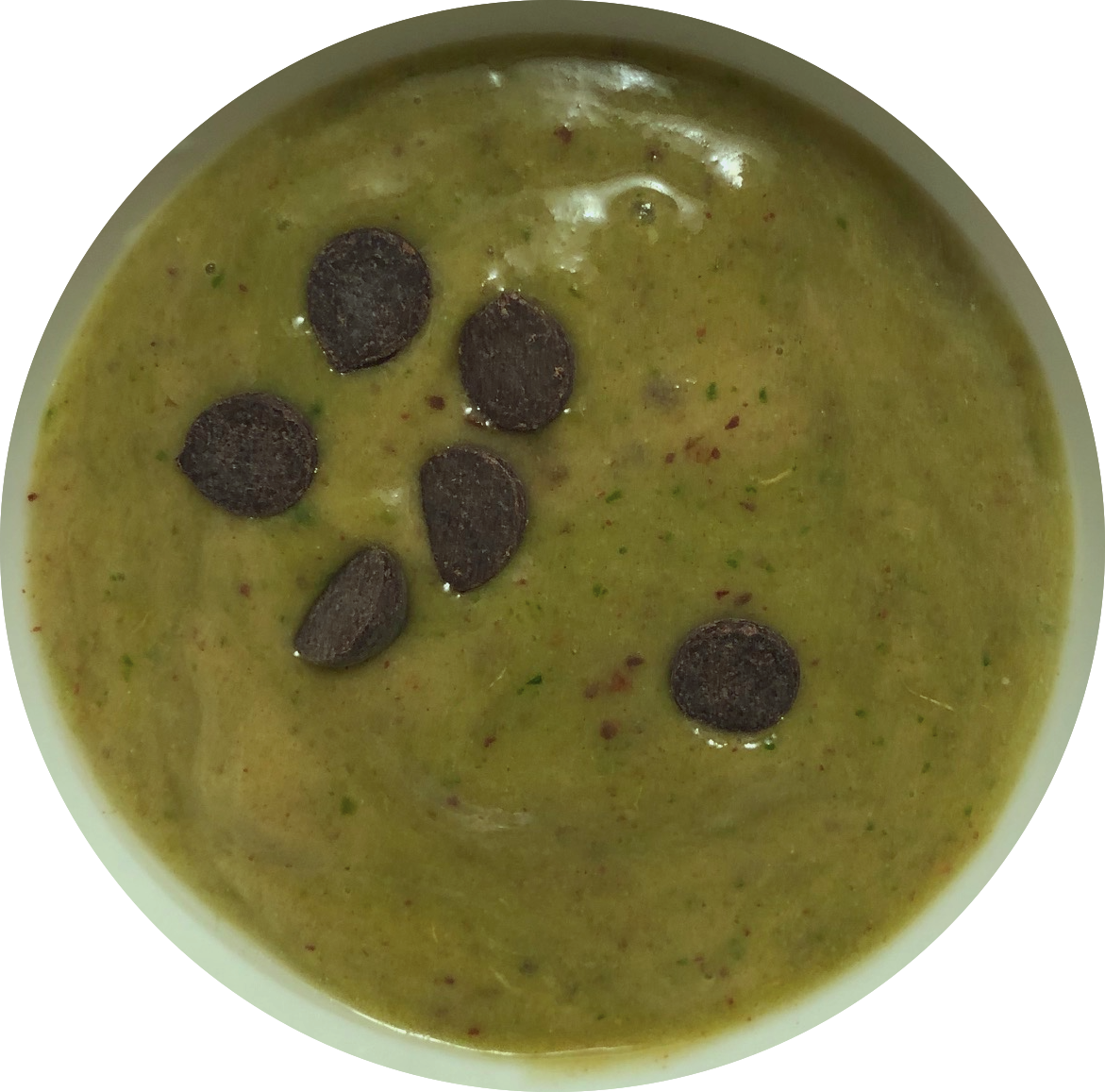
The way it is supposed to look, elegantly crafted by a medical doctor and his team of culinary artisans.

“Mint Nice Cream” was the recent Featured Recipe at the website drfuhrman.com (Check it out. His books are good too.) It blends frozen bananas, raw spinach, pitted dates, nut butter, a dash of almond milk, mint leaves, and a sprinkle of 100% dark chocolate chips. Uploading the recipe here seems forward and possibly unethical. But maybe it is ok to use this little slice of screen shot above, because it certainly looks more tempting than the fan version turned out by me.

It’s the thought that counts.

When bananas on the countertop are fully ripe, I peel them and wrap in waxed paper and old bread bags, pressing out the air and sealing them up for the freezer. Then they’re ready to slice as needed. 

Spinach: For my third practice run with this recipe I hand-picked only the freshest driest leaves. The rest of the spinach was getting wilty and a little dark around the edges, so I cooked that up for tomorrow’s egg scramble. This bag of spinach was a very kind gift from the neighbor downstairs. A more practical less perishable substitute would be… maybe blending in celery juice pulp, or fennel greens, or baby kale, or jicama, or raw zucchini, or pureed sweet potato? Food for thought.

In the Vitamix I blended the spinach with just enough almond milk first, then added the pitted date pieces. Then in the Cuisinart, the hard-frozen banana slices spun around for a minute or so. They clumped up and had to be mashed with a fork. When they were well whipped and frosty, I dropped in some fresh peeled peach chunks, then a drizzle of coconut oil instead of the nut butter, then added the spinach mixture. (Our garden mint has a very strong taste, so I didn’t add any.)

Doesn’t it sound more sensible to put the spinach mixture in the Cuisinart first and swirl it around, then add frozen banana slices?

Yes it does. But in the Cuisinart the spinach mixture by itself (even with my hand pressed down firmly on the spout) went all over the kitchen wall and my hair. So just start by pureeing the bananas first.

I packaged up tonight’s batch and walked it outside to Dog Play Hour at the neighbors’ patio. Because it was too dark to actually see the dessert, two brave neighbors agreed to taste it. Angelina pronounced it “Totally edible. A kid would eat this!” I left her some for tomorrow, and she sent me home with some vegetarian enchiladas, a pretty good deal all round.

This dessert needs to be eaten as fresh-frozen as possible so the bananas don’t get melty. When frozen overnight, the texture is more scrap-y like an Italian ice than it is creamy. This opens the possibility of freezing in advance, then walking it over to the church freezer until fellowship time in the parish hall. The point after all is fellowshipping, not toting in equipment and making a racket and then washing spinach off the walls.

To me this is just as good as ice cream from the store, and no, you can’t taste the spinach. But even without the refined white sugar, this is still a whole hit of fructose. Next time I’ll omit the dates and chocolate chips and add healthy fat like avocado or nut butter.

Posted in Uncategorized | Tagged | Leave a comment

8/15/22: Things to Do in August

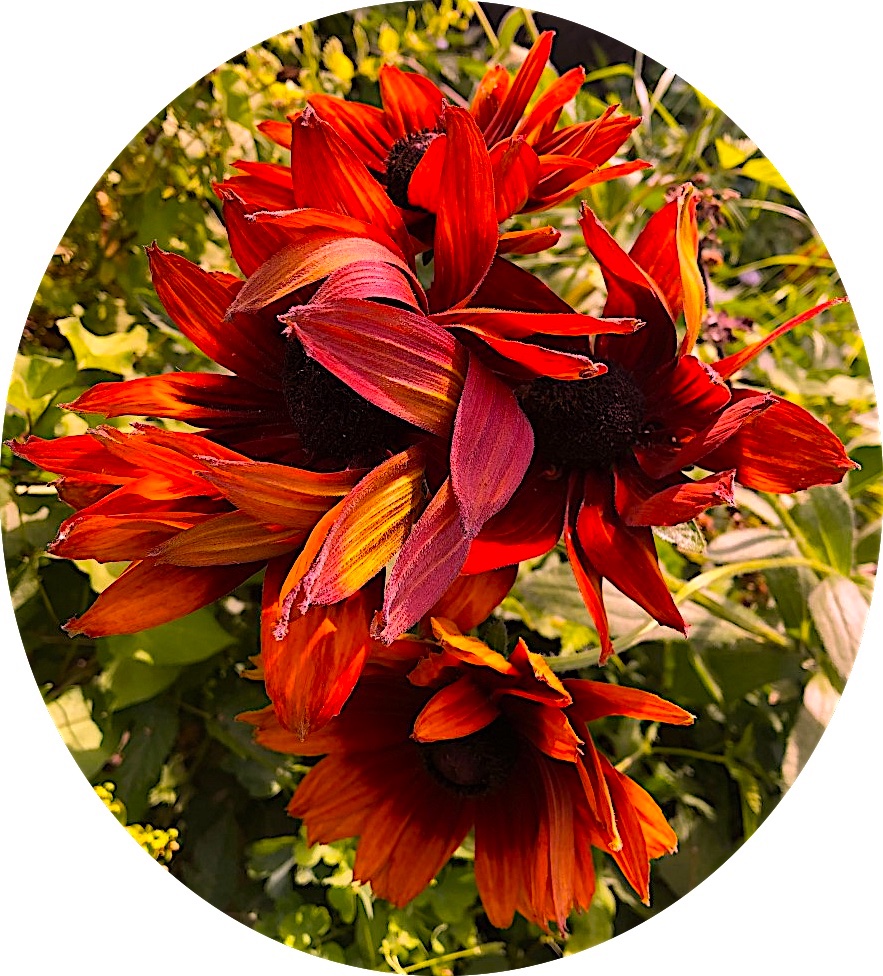
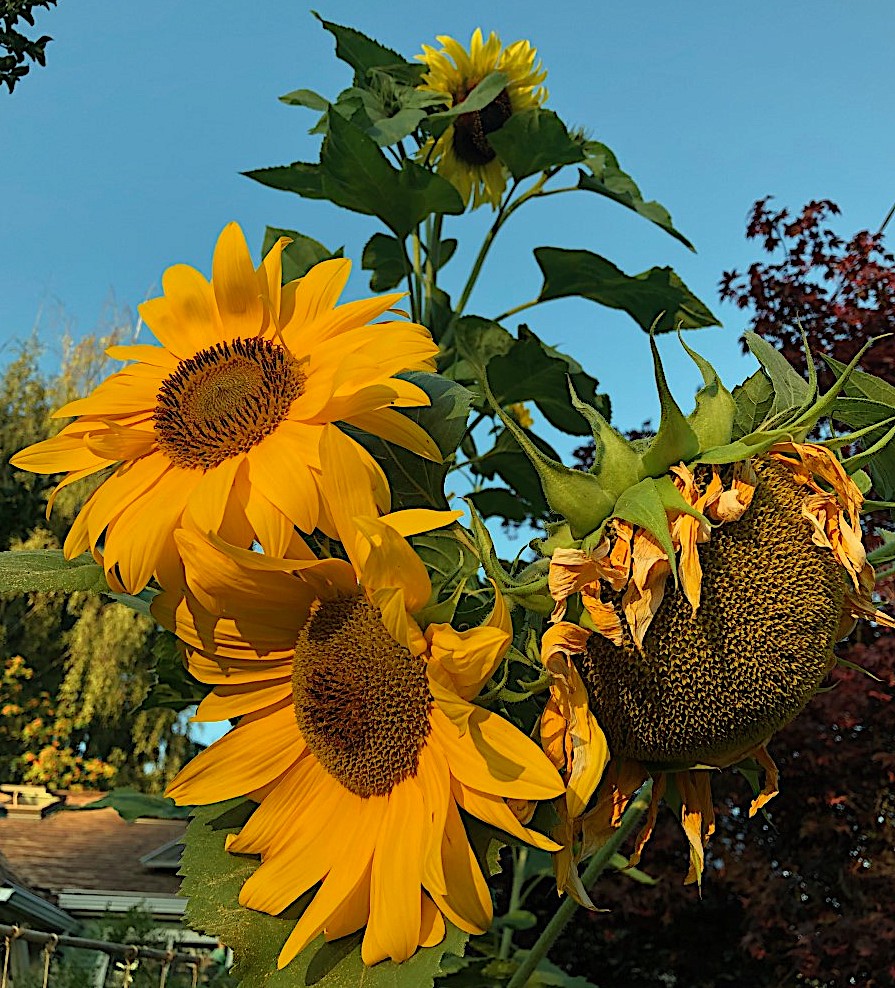
A mess of sunflowers

On Friday night after supper we stopped by church for 40 Hours Devotion. Then Dad drove us to buy groceries at Food Fair and let me ride the machine horse there for 25 cents. Then he drove us to Carvel for frozen custard. I got a Brown Bonnet flat cone, tall swirly vanilla ice cream dipped in melted milk chocolate and frozen again so the chocolate is crunchy.

On Saturday morning Dad went to Tony the Barber for a haircut and to hear all the news. Tony patted my head and said “Why Hello Sweetheart, are you here for a haircut too?” and all the men laughed and thought it was cute, a girl at a barber shop. Tony let me get on a chair and he pumped it higher and let me spin it around. He gave me a bubble gum with a Bazooka Joe carton wrapped inside and comics to read with ads for x-ray spectacles and sea monkeys.

On Sunday we went to earliest Mass before Church heated up through the windows. The candles had ripply heat over the flames. The Sisters had red lines on their foreheads where their wimples and veils were too hot and our mantilla veils and stockings felt scratchy and we fanned ourselves with the bulletin. Bees wandered in for the flowers on the altar. At the door the sponge in the font got dry and ran out of holy water. After Mass we went to Mondello’s bakery for Italian bread shaped like a crown. Dad picked out a peach pie too, and then Mr. Mondello packed it in a white box with red and white string in a bow. I looked at the display case of different bread shapes and licked my finger and picked up sesame seeds from under the racks to crunch on.   

On Monday Mom took us to Jones Beach. The night before, she set out our bathing suits and towels and suntanning lotion and sunglasses and beach hats and shovels and pails and thongs. In the morning other families on our street left the house at like 9:00. Not Mom. No, she just had to get up way early to squeeze lemons and fill the big yellow jug with lemonade, and boil eggs and make baloney sandwiches in wax paper and cut up carrots and wash grapes. She loaded the car with the big wicker picnic hamper. She woke us up while it was still shiver cold out and the sun wasn’t even over the trees. We put on our bathing suits with clothes over them. She got us in the car, and drove the 30 miles. At 8:00 or so we were in our favorite spot by the Pen & Pencil Tower and the lifeguard chair, covered with suntanning lotion and eating breakfast with the whole beach to ourselves. I was always scared of the ocean but she picked me up and said “Look, a big wave! Let’s catch it before it breaks,” and swam us out fast so the wave picked us high up and carried us right in and then we did it again. The lifeguards had white zinc cream on their noses because they were outside all day, and they let me climb the chair for a look around. We looked at sand crabs and sandpipers and planes dragging banners or writing on the sky. We picked up stones and shells and made castles and popped the bubbles in the seaweed. Then at 11:00 Mom made us shake out everything and pack up and get going. Then the whole parkway to the beach was bumper to bumper traffic on the other side. But we cruised along going the the other way past sea gulls on the wooden street poles. The hot asphalt was melty in spots and smelled like Necco Wafers and had mirages way up ahead like ripply water until we got up close and then the water disappeared. At home Mom made us go take cold showers and change clothes and put on cocoa butter so our skin didn’t sunburn. She washed our beach things and hung them on the line and unpacked everything and washed off the seashells and aired out the lemonade jug and the hamper. Then they were ready for next time.

On Tuesday we helped Mom hang laundry out on the lines. It whipped around in the wind, and to get cool we ran our faces right into the sheets. Mom hung one line low and let us make a tent out of the wet sheets and lie in the shade. She even brought us Hawaiian Punch popsicles in Dixie cups out of the freezer.

On Wednesday we kids on the block all put on our bathing suits and ran in the sprinkler. That’s ok on Wednesday except not on Sundays, because Sunday is too holy for girls to walk around in a bathing suit right on the street. Then we went to Ridder’s Pond to slide down the sliding pond and go on the swings and feed ducks.

On Thursday it was too hot to cook in the kitchen. So Dad put a lot of charcoal on the barbecue and made a fire. He made hamburgers and hot dogs and corn on the cob and onions and potatoes and toasted buns, and Mom opened some Schweppe’s Bitter Lemon seltzer and made hot tea with ice cubes and spearmint leaves. She peeled and sliced up cucumbers and salted them and then squeezed out all the salt and mixed them with sour cream and dill. She picked tomatoes and basil. She cut up watermelon into cubes and we spit the pits into the grass. We cut up Navel Oranges with no pits at all, except girls can’t call them Navel because it’s not polite so we have to call them seedless oranges. Mom made butter sugar flour crust in a big pan and cut up peaches and plums in pretty designs and baked them on top for sheet cake. After supper Mom toasted marshmallows on the fire and ate them all black and crunchy. When the charcoal got cool we took pieces and drew black pictures on the driveway.

Then there were things to do for every day. We helped water the garden and pull the weeds. We checked all the tomato bushes to take off the tomato hornworms, and checked the roses to chase away beetles. When vegetables look ripe or big enough we picked them and brought them in.

We had steel roller skates with leather straps but we weren’t allowed to skate in the street. The boys drew circles on the ground and set out glass marbles and then flicked their marbles with their fingers to knock the other marbles away. We had Mexican Jumping Bean races. We had paddles with red balls on an elastic string. We had puzzles with number pieces to move around inside a little frame. We had waxy cardboard drawing boards that you could draw on a clear top sheet with a plastic stick and then lift the clear sheet and the gray sheet underneath, and the drawing disappears. We had boards full of metal powder with a dog face picture under a plastic cover, and we could take a magnet stick and move the powder through the cover to give the dog long ears or long fur. We had Etch-a-Sketch boards to draw pictures by wiggling the round knobs and then erase it by shaking it upside down. We took wire coat hangers and twisted one half into a loop, and stretched an old stocking over it to make a net for catching bugs. We had soap bottles with wands to blow bubbles. We carved bar soap into shapes, and then our mothers took the scraps and saved them in crocheted bags for washing the clothes. We drew hopscotch squares on the sidewalk with chalk and tossed rocks to use as the potsy piece, and hopped around yelling “Butterfingers!” We took Mom’s wash line for jump rope games. We tied a lot of rubber bands together and made a Chinese jump rope too, a big loop that two girls held open with their shoes and the rest of us jumped in and jumped with one line crossed over the other with our feet in between and then jumped and turned and jumped out again. Dad showed us how to play tinikling with mop sticks that you tap on the ground and then tap together, and you jump in between them like the girls over in Philippines. Mom showed us how to play ball & jacks. She took Hawaiian Punch cans and punched triangle holes in the top and ran rope through the holes and tied the ends to make a loop. Then we could stand on the cans and lift the loops and have stilts to walk on.

We played checkers and Parcheesi and Scrabble and Old Maid and Go Fish. We made houses out of cards and blew them down. We played dominoes, and pickup sticks. Somebody at work gave Dad a fancy roulette wheel and board and poker chips all in a leather briefcase, and Mom said we do not gamble in this house but it’s fine to play with poker chips and build towers with them. One time our cousin brought a really big jigsaw puzzle with like 1000 pieces and a picture of just flat sand and far away a tiny little runner. So we took turns all week putting together one piece of runner and 999 pieces of sand. We played Monopoly with house and hotel pieces getting in and out of jail and Boardwalk and Park Place. Mom and I played together as one player with her helping me against the others; she planned a lot of real estate deals in her head and won a lot, but I just liked to play with the Scotty dog piece and match the colors on the cards and look hard at the pattern on the dollar until it looked like lines were spinning around. 

After supper it was ok to go back outside because in summer it’s not a school night. We caught lightning bugs in a jar and watched them flash around a while. The boys took a pinkie rubber ball and played stick ball against the stoop. The girls picked white clover flowers and we tied them into ropes and crowns. We used Dad’s flashlight making animal shapes with our hands. We climbed on the car and lay there looking for the first star. Then when the street lights came on we ran races. But then Dad told me to quit with the racing because I was getting too big and beating some of the boys and that isn’t polite. So I rode my bicycle instead. It’s really a bike but girls can’t say that word because if they do it’s not polite at all. Girl bicycles don’t have a bar in front for in case we wear dresses, and girls can’t ride a boy’s bicycle because everybody will laugh at her. I rode mine all through the streets in the dark and raced all over Park Circle, jumping the curbs. The boys called their bicycles just bikes. Some boys had extras like a banana seat or high handlebars or tag with their name or a tiger tail on the back. They took wood clothespins and clipped baseball cards to the wheels so the spokes ticked like a clock. When it got later Mom called us in and put rubbing alcohol on our bug bites, and we washed up and went to bed.

Sometimes it was way too hot to sleep upstairs. Then Mom and Dad let us stay up later. Some nights for our TV snack Mom got the iron fry pan and made a lot of popcorn with butter and salt. Or Dad made leftover fried pizza. Or we had blender malteds with ice cream and Bosco milk and eggs. Dad rigged the TV cord out the Dutch door to the sun porch and we watched with the breeze through the screens. Sometimes there were crickets chirping in the corner, and we let them stay inside because they are good luck. One time Mom let us stay up for the Alan Burke Show. A father and son came on the show to talk about their adventure with Martians. They showed a film as proof. In the film they were running away all scared, looking over their shoulders in a panic. But Alan Burke waved his big cigar and said “Who’s holding the camera — the Martians?” Then the guests explained that the film was a dramatic re-enactment. Then Alan Burke said “Cut their mike!” and “Get off my show and don’t waste my time.” After that Dad had this joke. All he had to do was hold on to his glasses and look over his shoulder and pretend to run away in panic, and then we yelled “Hey who’s holding the CAMERA?”

Nights always got cool again. Then it was time to go upstairs. Mom sat with me to hear my prayers. Then she tucked me in with my glow in the dark rosary and turned on the angel night light and said “Good night, sleep tight. Don’t let the bedbugs bite!” 

Outside the older high school boys stood under the street light listening to the transistor or working on a car or maybe smoking a cigarette if their parents were in bed and didn’t see them. Next door the TV was turned down low, with a high pitch signal and blue flicker light. All along the street, Norway Maple leaves flickered and shushed in the breeze. Click bugs ticked back and forth in the branches. Every little while a propellor plane flew over. With all the windows open, the little thrummy noise went from curtain and screen to curtain and screen all across the attic, over the house and away to Idlewild. 

Posted in Uncategorized | Leave a comment

8/8: Neighborhood Update: Real Furniture, Fruit Treats, and Causing Confusion

On Saturday the grapevine on our street sent word that my neighbor’s son Jaeger was looking for me. Jaeger had been out driving in his car, and saw a table in the trash. Jaeger recalled hearing (on said grapevine) that Neighbor Mary was looking for a bookshelf. Would this table fill the bill?

Mary was in fact looking for a bookshelf. This room holds a collection of Orthodox and Catholic textbooks inside various mismatched plastic drawers swiped and scrubbed from furniture thrown in the dumpster. It would be nice to have a steady piece of furniture so the books don’t spill and hit my toes. I contacted Jaeger right away, asking him where I could go find the table. But in the 90-something degree heat, he devised his own strategy: he would drive me to the table, see whether it passed muster, and if so he would drive it back.

In the hot sun, Jaeger opened the car hatchback, rearranged a few items, then inspected the table with me. “Does it seem to you,” he asked, “that this glass pane is detachable, or is it all in one piece?” I tapped on the glass top and attempted to jiggle it around, but found that it remained firmly in place. With confidence I assured him that the glass pane was attached, and could be moved easily as one piece with the table.

Jaeger contemplated the table from several angles. Gently and carefully he lifted the glass pane right out of its niche, and set it far forward in the hatchback on some soft material. This is why the glass ended up nested comfortably in his car and then in my home instead of in a zillion fragments all over the street. Then he hoisted and turned the table just so, to fit. He drove it to my building, and took it out of the trunk. I prepared to lift and swing it by one corner after another to inch it up the walk and all the way down the hall. But Jaeger parked, took out the table, replaced the glass, and carried it all the way up to my studio. That’s a whole lot of upstanding behavior, and I was very grateful for his help. As at least a token of thanks I sent him home with a jarful of red beans and brown rice. Then on the off chance of bedbug activity I set the glass in the sink, got the table right into the bathtub, scrubbed it down, doused every inch and crevice on all sides with pot after pot of scalding water, buffed it dry, set it out to bake hard in the sun, and then brought it in. I soaped and rinsed the glass top, gave it a good polishing, and set it into place.

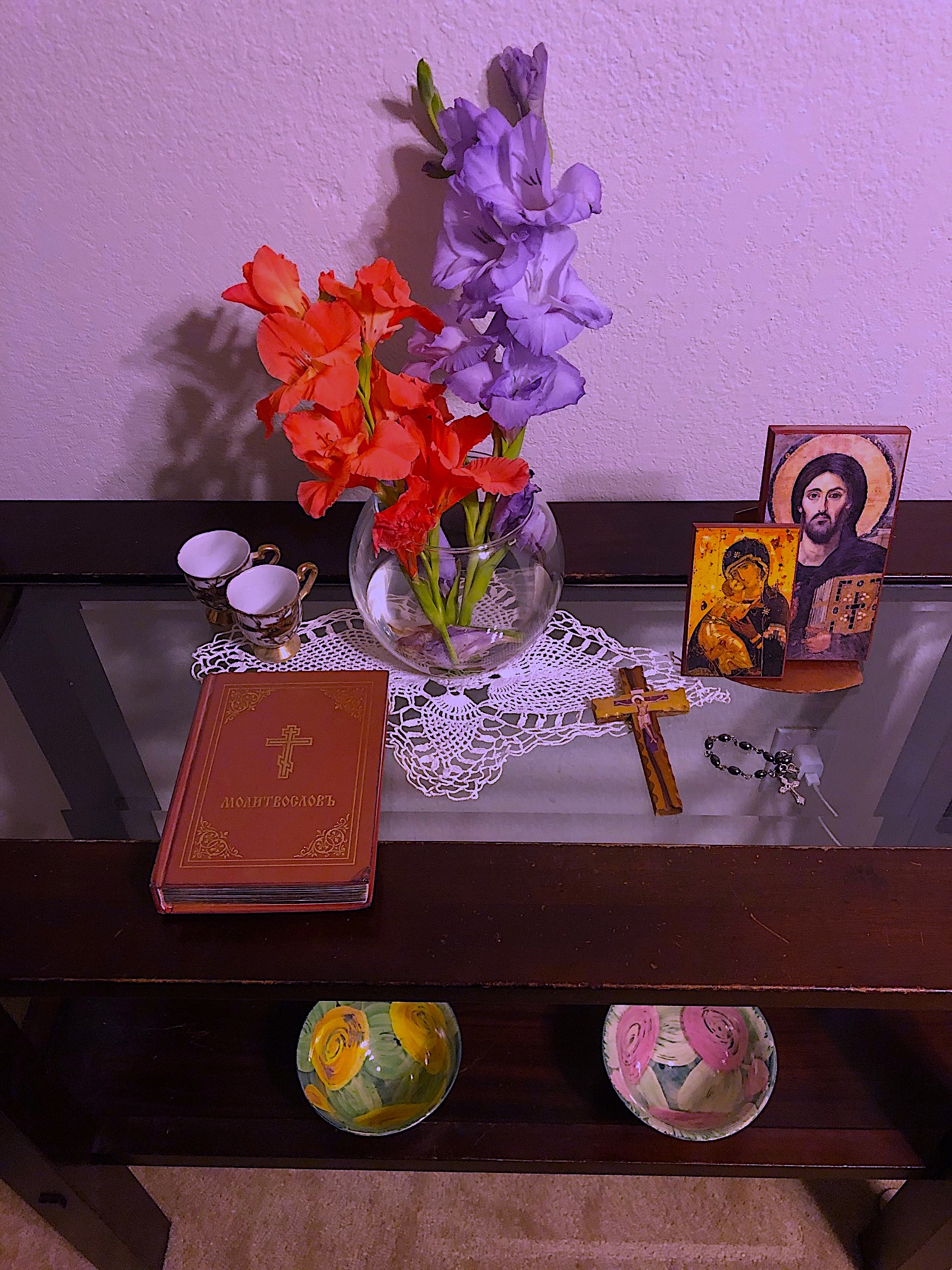
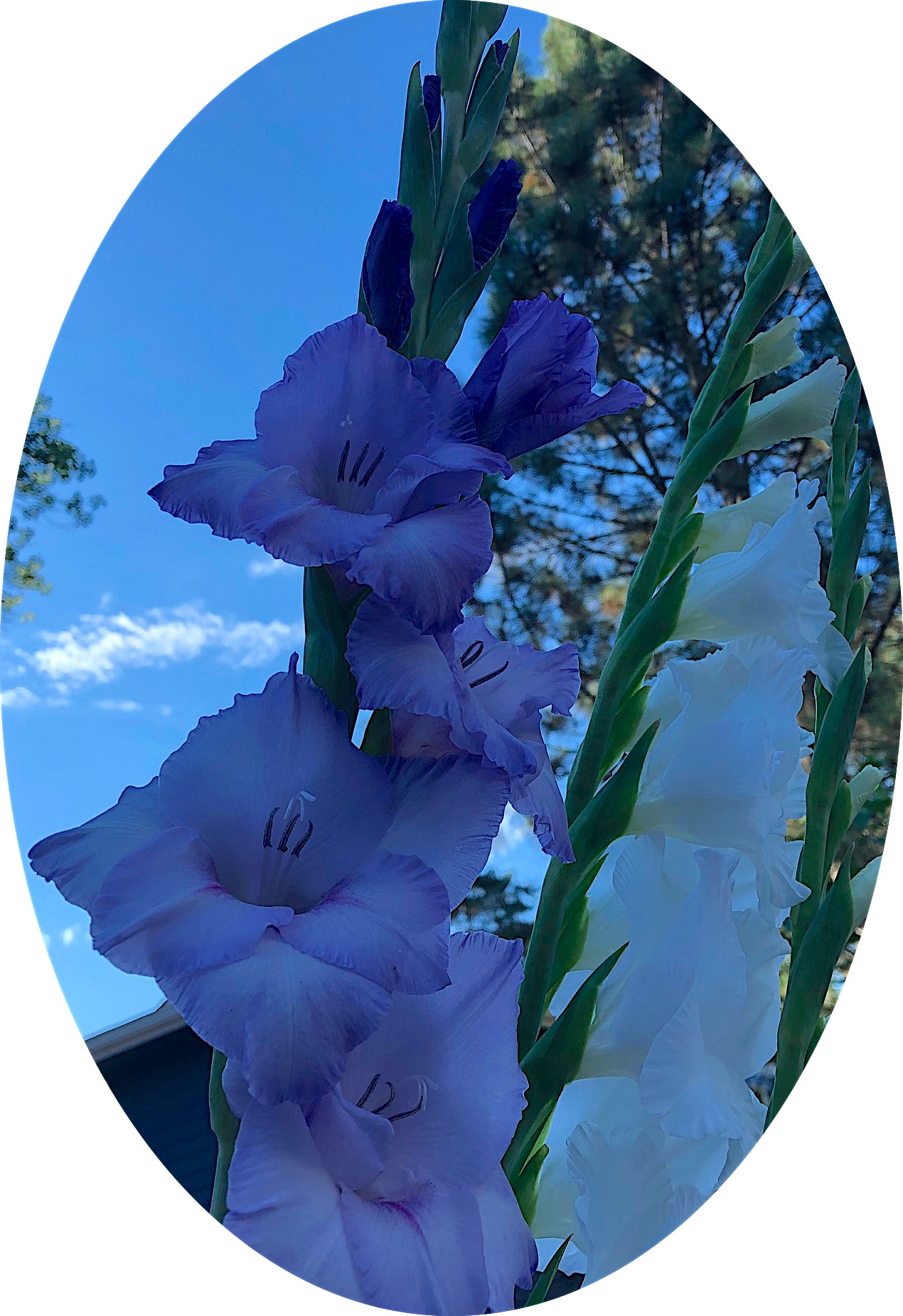
Here’s the table tonight, looking all elegant like an instant heirloom. Maybe it’s too nice to be loaded with books? That’s a 25-cent crocheted doily from the needle exchange thrift shop, a glass bowl from the garbage cage, and Captain Wing’s last two gladiolas of the year, which of course he cut off and gave away. That table really lights up the whole studio. Thanks to Jaeger!

A new piece of actual nice furniture

In other news, yesterday a lovely gracious young woman wearing an N-95 mask met me on our street and thanked me for the donation of daehwong, the Chinese medicinal preparation in a jar. I stood there with a friendly but clueless smile listening to her very warm thanks and appreciation. After our conversation I stood there, hand on forehead. That’s life with prosopagnosia! Who was this lovely lady? What kind of food was I passing out around the neighborhood? What was daehwong again?

This is why I don’t drink.

Walking home, I remembered what daehwong was. Eureka! Of course. I’d made a big batch of rhubarb, carried some to a co-worker and some to an old friend, and went to share some with Angelina. But Angelina was leaving on a trip. So I slapped a note on the jar with its English name and Chinese botanical name and the note “Add SUGAR!” and gave it to Angelina’s neighbors instead. That family and I were on a hello-wave basis as we met in passing now and then while I took out my compost. Yesterday was the first time I’d seen the mom out of context, away from her family, and wearing an N-95 mask. So the mystery gift was stewed rhubarb!

“So that Chinese medicine,” I told Captain Wing, “was what we Anglo Americans just call an ingredient for pie.”

“Mary!” Captain Wing adjusted his glasses and gave me a serious look. “Rhubarb IS Chinese medicine.” He explained how to compound the roots, and how they are used.

Captain talked to me while inspecting the plants with a flashlight, watering in the dark and checking for slugs. I was out there to bring a treat for the Wing family. That day at our open air market, there were fresh apricots just over the hill of ripeness for 50 cents a pound. I blanched them, and blended them with tahini, rice milk, banana, and a dash of organic sugar. It really tasted good, an attractive orange creamy fruit sauce with a light bright taste. I explained to Captain that the fruit sauce was to celebrate the eighth day of the eighth month. My impression was that in China the number eight is good luck, two eights are better, and that their double-eight holiday called for a treat.

Then I brought it to their kitchen entrance and knocked. Mrs. Wing opened and lit up with a happy smile. I handed over the fruit treat. “Bā Bā Kuài Le!” I hollered at her, waving my arms in enthusiasm. “Happy Eight Eight!”

Mrs. Wing looked at the apricot puree, gazed at me, blinked, and called a soft question over to Captain. In a short conversation, he apparently explained to her my line of reasoning. She thanked me kindly, and wished me a good night.

As I headed back to my building, Captain Wing took the flashlight and followed behind me, lighting up every step as I walked up the garden path. “Psalm 119 says that God’s word is a lamp unto my feet,” I told him. “That is why I appreciate your flashlight help.”

I came upstairs to check the internet and learn more about August 8 and its significance. As it turns out, I was a tiny bit right. In China, August 8 really is a big important family holiday. The phrase “Eight Eight” (Bā Bā) sounds a little like “Dad” (Bà Bā), so when it came to assigning a holiday to that date the choice was simple:

I had just wished Mrs. Wing “Happy Father’s Day!”

Posted in Uncategorized | 2 Comments

8/6: Awake Stick

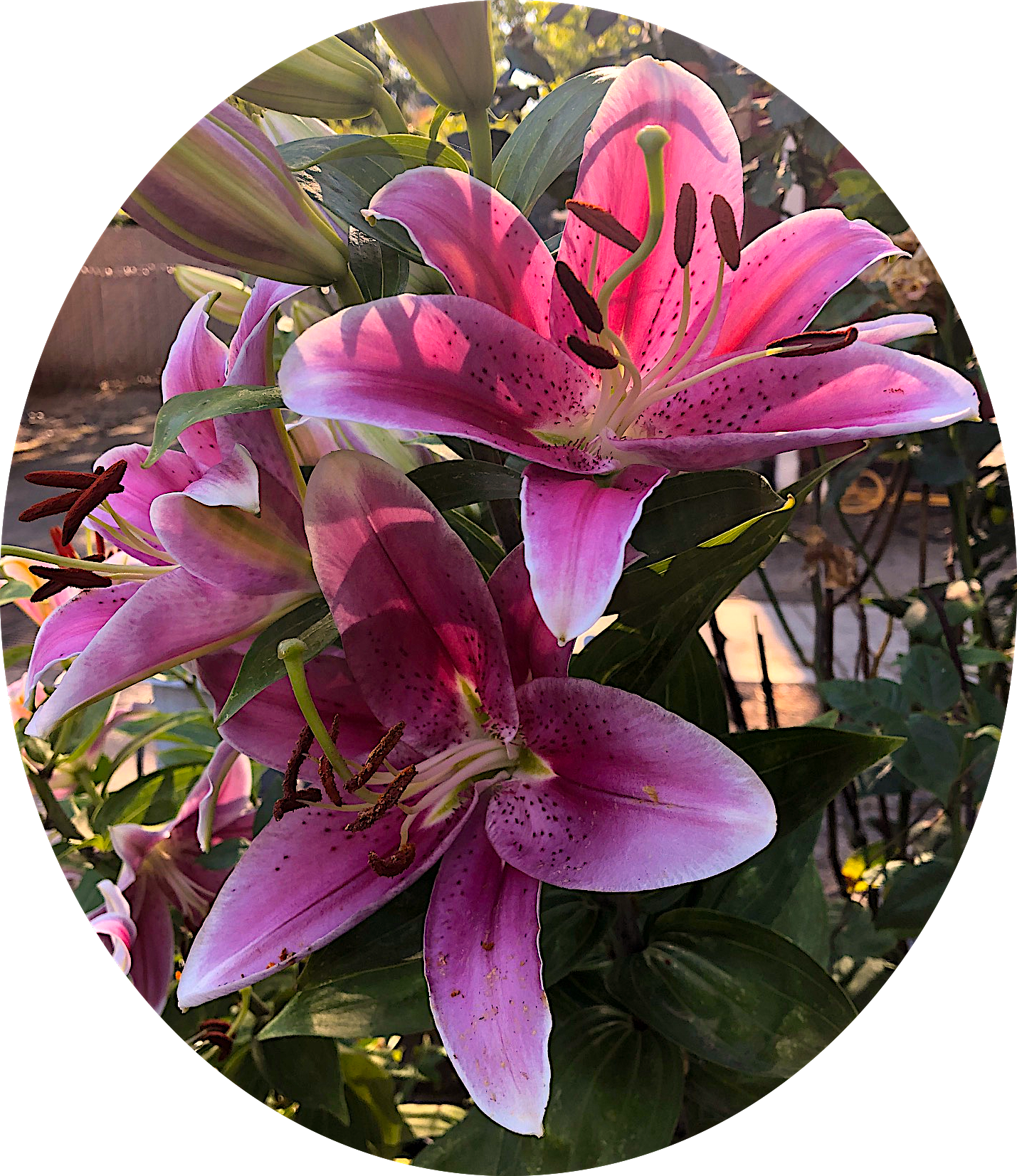
Sunset through our neighbor’s lilies

On Sundays at 1:00 am, the monks hit the highway.

Each week they’d drive around town and beyond, to pick up anyone who called by 1:00 to ask for a ride to Sunday morning services. On one occasion their truck pulled up in my alley too, through the trumpet vines and towering pokeweed. I had some serious church burn going on then, and was much too discouraged to venture out and find another church. While pining away for some spiritual practice and fellowship, I went and spent a quiet night meditating with the monks. It was good to see them pull up with a friendly greeting in their denim jackets and farming feed caps. In companionable quiet we headed out past starlit fields of wheat and corn, in the summer breeze with the nighthawks buzzing overhead. After picking up a last passenger the monks drove us back to town, to their little rented house. There our hosts put on graceful gray robes and brown aprons while we visitors took off our shoes and picked out hand-sewn black sitting cushions. We tiptoed across the polished wood floor, and settled down in the soft dim light. 

Sunday service began at 3:00. There were long long chants in Korean, with written translations in English. One was probably the Heart Sutra, about release and freedom from one’s Self-centered sensations and perceptions. Here is an excerpt from the Center’s website. “No eyes, no ears, no nose, no tongue, no body, no mind; no color, no sound, no smell, no taste, no touch, no object of mind; no realm of eyes and so forth until no realm of mind consciousness.”

(Editorial opinion here. Yes, these words have been beloved worldwide for centuries. They have proved a great comfort for people gripped and driven by suffering. Some of those people tell me how much it’s helped. But those words might not be a remedy for people dissociated from their own bodies, who don’t know what hurts, don’t know how to talk about it, don’t sense that they even have a Self, or were taught that their thoughts and feelings don’t matter and their perceptions of reality are wrong. End of digression.)

With the chanting that night, there was also bowing with prostrations. That means standing with hands folded palm to palm. Then it’s a deep knee bend with straight posture, sinking down to kneel with forehead and tops of feet against the floor, and then sitting back and tucking the toes up under, and then springing straight up as lightly as a heron. The monks led 108 of these floor prostrations, in a very fleet manner. I can not imagine how they kept count. Typing this just now, for the sake of interest, let me go find out whether my ankles and toes are still limber enough to manage a knee bend all the way down to the floor. 

No. 

During the session, there were intervals when we sat in silence. I seem to recall that at times we turned around and knelt facing the white wall, that sitting up straight was hard, and that several times the silence was so absolute and lengthy that I was sure the monks had forgotten all about us and taken themselves off to bed. During those vast expanses of stillness, the meditation leader floated from corner to corner, tuning in to the energy of the room, balancing a stick which might have been bamboo. As the wee hours wore on, waves of drowsiness would roll in and drag the marrow in my bones straight toward the center of the earth. We’d been told that at those times, any one of us could place hands palm together and give the leader a nod. Several times I did just that. Then he would come over with the stick and carefully rest a hand on me to feel and shield my spine. Then on the soft part of the back inside the shoulder blades he would give me two hearty glancing thwacks on the left, and two thwacks on the right. This Awake Stick treatment was voluntary and reviving, like dunking one’s face in ice water. It certainly helped with remaining focused and wakeful.

Apparently, in traditional mentorship the Awake Stick was also applied when a Zen teacher sensed that a student was about to reach some next step of spiritual advancement. Then the teacher would give a few spontaneous thwacks to help the student snap out of everyday thinking and into the higher level of experience. (It sounds like Cesar Millan guiding a dog with a tap from the top of his shoe Tch! — but to snap the brain into a state of being, not out of it.) That night, the possibility dawned on me: What if one of the monks with Awake Stick at the ready discerned that I was about to reach some epiphany? Wouldn’t it be an amazing experience to feel an unexpected thwack to push me over the right edge? Of course, at a Zen Center, the great goal is not the thought “How am I doing here? Am I advancing toward spiritual insight? Is anyone important noticing my progress?” Still, as night crawled on (and on), that thought did captivate my imagination. So did thousands and thousands of other thoughts, including the complete jingle to the Bonomo Turkish Taffy theme from childhood TV.

Between silent sessions, there were also rounds of walking meditation. We would all slip our shoes on and step outdoors in silent single file, walking with palms together. The idea was to meditate while taking one small soft mindful step at a time, keeping the focus on the breath while letting the body be gently grounded point to point through space. 

That was a tiring and laborious night. Still, this despondent temperament found benefit with silence in a household of minimal deliberate actions, thoughtfully arranged consistent ritual, meaningful well-intentioned speech, social synchronicity, and plain aesthetically uplifting surroundings. 

By 6:00, Sunday morning service concluded with a short reading and lesson. The monks hung up their gray robes. Two put on their feed caps and drove us home. But first, they even treated us to breakfast and tea at the diner. These were industrious enterprising young men. They worked long hard hours in construction and farming and baking and industrial sewing by day, then by night devoted themselves to meditation practice and receiving visitors to the Center. They operated with open hospitality, humility, philosophical conversation, and gentle straight-faced self-effacing humor. In their kind company we all enjoyed a good sunrise conversation with our meal. One of the men gave me his tasseled prayer beads, unvarnished golden wood with a wonderful sandalwood fragrance.

Just today, 35 years later, I looked up their community back in that modest-sized town. At a time when the news holds so much polarized bombardment, when social connections are fraying at the seams, I expected that the group was broken up and the Center long gone. To my surprise, those sittings caught on and grew. Two of the original founding members are still right there leading the Center. (A third one now leads his own center back East.) The community has bought and renovated a house on the quiet edge of town out toward those corn and wheat fields. On their website, the premises show meticulous cleanliness and care. There are services in person and over Zoom, with open drop-in meditation hours, and frequent day retreats. It would be wonderful if more Christian denominations had a house and community of this kind, open for public worship and day events. (Over the years as congregations have discussed strategies for community outreach, I’ve told them to hold services at 3:00 am.)

Back to our story. That night we circled around the block in three walking meditation breaks, palms together, in unison, step by step. We eased our footfalls over brick sidewalks and tree roots and lacy leaf-shapes under the streetlights and once a strolling daddy-long-legs with a huge shadow. We walked to the sound of a questioning dog bark somewhere in the dark houses, a distant siren down Main Street, lawn sprinklers and the rustling walnut trees and katydids and crickets and a mockingbird and freight trains and the summer breeze over the river and one slow cruising car with a radio playing “In My Dreams” by REO Speedwagon.

KABONG!

A hearty bracing blow hit me square on the back. I looked up from the ground, catching my breath. Gee! Did one of the monks bring along the Awake Stick, and decide that I was on the brink of deeper awareness? Oh, but… wait, the monks were at the head of the line. I was last. The street behind me was dark and empty; just crickets and me. As I stopped and looked back my foot hit something softish but firm like a sandbag, a wrapped bundle weighing a pound or two. I leaned over for a closer look.

And we climb, and climb, and at the top we fly / Let the world go on without us! We are lost in time…

The appealing lyrics and tune trailed off down the street. All along his route, the driver of that cruising car tossed thick hefty Sunday newspapers. Most hit the doorsteps. One hit me, for my closest brush with Zen enlightenment.

Posted in Uncategorized | 2 Comments

8/4/22: 3 Summers Long Ago

Not the same lilies.

Market Day

In Novgorod the sun was rising on an ancient village square, all onion-dome silhouettes and ravens. A woman in a black head scarf and black work dress was opening her kiosk. She was a strong fierce-looking elder, like some wise warrior from a folk tale. Arranging cut flowers in shining metal pails of water, she looked me over with an adversarial glance. It was normal for shopkeepers to think “Oh, a Kapstránka, a capitalist-country-female. She came to look down at us, to scoff at our consumer goods.” But I just stood there spellbound, staring at the lilies. “That — those — they’re — the most beautiful lilies I’ve ever seen,” I stammered. Each one was perfect, the size of a soup bowl, blood red. Her eyes narrowed, sizing me up again. Then she raised a branch of three flowers, and handed them to me. I caught my breath, turning them over and over, and reached for my purse. But with a proud toss of her head, she waved me away from her stall. “Run along,” she said, with a trace of a smile.

Mild-Mannered Reference Guy

Back at the graduate school, the reference desk librarian spoke English English. I don’t know from English accents, but it sounded high class to me. Still, judging by his conversations in the back room or on the phone he was a lot more at ease speaking French. He was very handsome and scholarly looking with his sleek longish black hair and silver glasses and very calm thoughtful dark-lashed eyes. He was impeccably courteous and helpful about tracking down and handing over books, then would head straight back to his office. Over time though, when I stood around at the front desk thinking it too pushy to ring the bell for assistance, it made him smile. We developed an in-joke where I’d loiter at the counter, and when he finally looked up from his window in the back room I’d hold the bell up and point to it, and he’d laugh behind the glass and then come help. He finally made an observation about how many books I needed for my research, and then we talked about books in general. One day he suggested that we meet for tea at the coffee shop by the park downtown, and then he’d drive me home. I was absolutely thrilled.

That evening over baklava and tea we talked books and film and poetry for hours, and a little bit about ourselves, gazing out the picture window at the pocket park and passing traffic lights. He paid for our tea, and held the door. Then I held the door for three young men from the next table, and gave them a friendly nod. They did not smile or nod back.

My companion led me to a strikingly small silver car, all streamlining and gleam. As I took my seat, one of the three young men came up to my side and said “You sleeping with this Arab here? Well unlike him we served our country. And Jeez, Girl, you’re ugly; you must be bisexual or something. I oughta punch your face in.” I offered him our regrets. “Oh, Sir. Please excuse us; but we need to be going now.” This break in sequential logic left him completely taken aback for a moment. Finally he said “You smartassing me?” I said “No, Sir! Not at all; just telling you the truth. We do need to leave.” He grabbed the door handle, but the small car spun around and shot out into traffic. The three young men revved up their pickup truck. Our librarian leaned back at ease, maneuvering the wheel with his fingertips, skimming through four lanes and right over a concrete median in a hairpin turn that left the pickup stuck in traffic going the other way, lost from view. The silver bullet purred along in some Harry Potter space continuum, gliding gently lane to lane as the other cars melted away behind us. After a circuitous series of loops, still with all clear in the rearview mirror, he finally downshifted for our trip across campus.

Behind my house, in the moonlit alley under the trumpet vines, it took my shaking hands several tries to unhook the seat belt. I felt heartsick at the thought that by accepting his invitation to tea I could have endangered his life. And what if those troubled men were on the lookout now for a silver sports car?

“Are you still thinking about the other guys back there?” my companion asked, adjusting his glasses to scan my subdued and crestfallen aura. He seemed embarrassed for me, disappointed in my performance under pressure, unlike this little gem with its underfoot purr. He shook his head and shifted gears, and drove away.

After that day, there was a change in Reference Reserves. Two new friendly work-study students took over the front and brought me my books. The librarian stayed behind the window cataloguing acquisitions, leaning back at ease and clicking typewriter keys at blazing speed. It took many visits to clue me in that he wasn’t going to speak to me again. They promoted him upstairs. He probably had a successful fine career.

I wouldn’t assume such a bright future for those three young men. It would be good to talk to them today, to hear what-all was going on for them. Probably a lot. Over our chat, I could tell them that despite their first umbraged assumption about public decency I was not sleeping with anyone from anywhere. Despite their second assumption, my companion was a veteran too. It dawns on me just now that at one point, before coming to the States to library school, he might have fought the same army they did. That brings us to their last jumped conclusion: he was in fact a poet from Iran. As a teenager back at home his other keen affinity was rigging up and racing cars.

Wee Hour Surprise

I was fast asleep when Dad sat me up in bed. Mom was grabbing her coat to put on me. “It’s a surprise. Hurry and come look,” they said.

We heard a low hum droning along in the dark, and then Wow — right over the porch roof there were bright lights and letters running through the sky all by themselves! Like a lit up ribbon of wiggly bulbs running back and forth on a movie theater, but in bright colors. “What IS that?” I yelled. Dad explained it all. The Wikipedia version goes like this:

“Skytacular: In the mid-1960s, the GZ-19 Mayflower (N4A) was fitted with over 3,000 incandescent lamps of red, yellow, blue and green on both sides that for the first time featured animation. Usually moving stick figures, ticker messages or colorful patterns. A small gas turbine had to be attached to the car in order to power the Skytacular night sign.

“That is the GOODYEAR BLIMP,” Dad said. “It’s going off to visit the New York World’s Fair. And guess what? Next week, WE are going to visit the Fair too!”

Well that was a lot of amazement for the middle of a night. “Like skywriting, but from God,” I told them, as they tucked me back in bed. But I sat up for a last look out through the screen of the open window.

Colors and flashes hummed along and headed west, spelling beautiful news across the sky.

Posted in Uncategorized | 4 Comments

8/2/22: “I Tell You My Joy”

Captain Wing’s gladiolas, at dusk on this lovely August evening

Mayday, or Not

That’s a Killdeer in distress, a plaintive note of discord on a lovely August evening. The setting is a Little Free Library, generously stocked with donations by a “retired” superstar librarian. (She is so well loved that there is an Action Figure with her name, so that little girls can have a superhero doll who fights for library budgets.) The library is set across from the Catholic church right at a sidewalk cafe, with chalkboard art full of appealing specials of the day and little tables with bowls of water set out for dogs. Some nights the cafe walls even open out for a live ensemble playing smooth jazz. At sunset the baked goods are half price, so during their strolls in the cool of the evening, people stop in for little bags of bagels and crumpetry to take home.

But back to that Killdeer. In danger. She’s not kidding.

I stop browsing library books and snap to attention, looking around. (I’m fond of Killdeers. They’re so cute with their pretty markings, on their teetery legs. It’s sweet to wake up at night as they fly over with their timid pure notes lilting down through the darkness.) Now, it’s natural for a Killdeer mom to cry all kinds of woe while dragging a wing along the ground, and as interlopers chase after and get ready to pounce she’ll rocket into the air and head back to the ground nest that she just tricked us away from. Still, some critter must be really bothering her. So I go running up the street to intervene, tracking down the sound just as the poor thing seems to choke and fall silent. This time, she lost the game and her little ones are doomed.

The sound led me to a traffic circle planted with orange lilies. All along this pleasant street of tall trees, little wooden family houses and gardens on one side were bulldozed out to make room for new multi-story luxury townhouses, all professionally landscaped with boxed bushes and mulch.

The street is dead stillness for the next three minutes. Then, right around the corner, it’s a Flicker crying out for help help help help HELP Arrrrrgh! and then strangling to death. I dash around the corner to the alley, but too late. It’s over. Not a bird call anywhere.

Now it’s a Stellar Jay up in the trees, for a minute of outrage and panic coughing into quiet. Three minutes later the mysterious super-predator is taking out a Robin, to an S.O.S.! S.O.S! retching into silence again. Three minutes after that, it’s a Goldfinch. I’m circling hither and yon, craning my neck, checking the rooftops and trees and phone wires, following one distress call after another.

Finally, after enough scampering and gaping, reality dawns on Bumpkin. The bird calls are recordings. They come from those luxury townhouses, from black transmitters placed among the rooftop corners. They’re on a timer, so that different types of birds cry out from different locations all along the block. (Now it’s one thing to play distress recordings of, say, seagulls or geese at an airport. That’s a safety measure to clear the way for the planes. But even a phone app of random birdcalls during a nature walk drives the local birds nuts. How can the neighbors possibly stand the sound of animals being throttled? Do they even notice?) Somebody paid tip-top dollar to live in these new dwellings. Apparently the structures will stay in pristine shape so long as they are kept safe from the pesky little toes and nests of those darn fluffy colorful songbirds. I’ve always enjoyed walking down this street. It must be time to pick a different way to go. Judging by the eerie silence, the birds already have.

Pain Relief

The medical bill came in for that night in the ER in May. The exams, observation, blood tests, and the ultrasound came to about $5,000. (Separate charges are still drifting in for lab fees and more.) To my extreme good fortune, insurance paid for 90%, and I paid the $500 and thanked my luckiest stars. But the bill showed that $700 was doses of anesthesia, administered throughout the night. What? No one gave me opioids or other painkillers that night; I wasn’t in pain. I called the insurance company. While sitting on hold with merry Muzak playing along, I breathed deeply and pictured my blood pressure lowering by about 20 points. Then an extraordinarily calm dulcet voice came on the line. I greeted her and pointed out the issue with the bill. The operator explained that on that night, all provider consultation minutes were described as ANESTHESIA by the software. “The charges are all correct; the medical codes are correct in the permanent record, but the description for all was “Anesthesia” on the printout mailed to you.” How about that. “That’s very good to know! I was worried that someone else had accessed my account,” I told her. “Yes, that is an understandable concern. That is what every caller today has been wondering.” We ended up having a good laugh about it. “This medical insurance call has been more fun than I expected,” I told her. “In fact, this is hilarious. Would you kindly connect me to your supervisor? I’d like to report that you’ve been very helpful today.” The supervisor and I had a nice talk. “At a time when people’s lives are falling apart, that upset is going to carry over to their medical insurance phone calls. You must hear plenty of that. You’re helping to hold the whole system together out there. Thank you for your presence and help.” We had a nice talk before signing off.

National Night Out

Today, the first Tuesday in August, is National Night Out. That used to be when neighbors on the different streets registered their blocks for outdoor gatherings. They put their street on a precinct map, got special permits and barricades, closed off the road to traffic, set out tables, and had food and music and friendly milling around. Then from the local precinct the police would stop by and introduce themselves.

Several years ago I downloaded and printed out the city notices in the Mandarin version, and knocked on the doors of all our neighbors from the People’s Republic of China. I was taking a Mandarin class that year, and even got our teacher to come to the event with her family. (At first the Night Out concept of having fun with police didn’t make a lot of sense to them. Finally I just explained that it’s the American Moon Festival, and that answer made them happy.) To prepare, I studied hard to learn useful Chinese phrases, like “Come over! We’ll have snacks!” and “Does your child have food allergies?” and learned how to sing a beautiful Chinese TV show theme song for their entertainment. I scrubbed the picnic table and bought treats, and the Chinese families brought food, and they all started talking and exchanged Weibo and social media coordinates so they could all keep in touch, and then like magic a real moon rose. That was a wonderful evening.

But life changed a lot. The pandemic happened, and people weren’t gathering, not even outdoors. They lost the habit of in-person communication. (Many still mask up outdoors, and cross the street away from one another to keep up that social distance.) The Chinese students and faculty went home and stayed there. The Chinese language program was discontinued; I loved our class, and was sad to see our teacher leave. The police were defunded; some were discouraged and quit. The others are far too stressed by rising crime to walk around and chat with folks on the beat. This year I was too late to register our block, but I went out in search of other parties to thank and encourage people. There was only one little party, a few blocks away. I stopped by, but people were too hunkered in with their own spouses and kids to talk to anyone new. So I just circled slowly around the event looking for a way to strike up a conversation, and then slowly drifted away again.

But just then, several houses down, a tiny little girl in a tiny little sundress and sandals burst out of a house and came sprinting down the sidewalk. Being a total stranger, I didn’t want to frighten anyone so small; so I stepped aside out of her way. “I’M GOING TO THAT PARTY!” she cried, beaming up at me. “Yay!” I cried back, giving her a round of applause. “It’s a GREAT party. You are gonna love it! Good for you!” A busy looking mom ran outside, maneuvering a casserole and house keys. “That was one fast-moving enthusiastic party-goer,” I told her. The mom laughed, heading up the street in hot pursuit.

Not Just The Sorrow

One of our local entrepreneurs called and waved from across the street. Clearly he had exciting news. What’s up? “My SON,” he cried. “Arrived to America last night.” Our businessman arrived in the States years ago. He started with a job sorting garbage on a fast-moving outdoor factory chute in all weather, then signed on for dangerous winter work on a fishing vessel, then began cleaning office buildings while also working nights at a gas station and also fixing used cars for resale. He’s done the work of three men in one for years, sending every spare dollar home to support his relatives. Ten years ago he applied for visas for his son and daughter. (He brought his daughter here five years ago. On her way from the airport, she had him drive her to our community college, to enroll in nursing school prerequisites.) Two years ago, on the very day of his son’s interview with the American Embassy overseas, pandemic lockdown began all over the country. The Embassy closed its doors. Since then, news of natural disasters and drought and famine and civil war have burdened the heart of this kind father in America, who just kept soldiering on. But last night, Father and Son met at the airport. They posed as someone in the crowd took their picture. They looked radiant, arm in arm. (At a time when generations can easily feel misunderstood and disillusioned with one another, it must be amazing for two young adults to know that their Old Man crossed the world alone without a word of English, and wielded all his physical strength and character and wits to make this whole dramatic epic come true.) My eyes misted over at sight of the flowers that Dad brought to the airport for his son. It was so like him, to think of that little bouquet. He and I stood shoulder to shoulder marveling at that picture, and gave each other a big hug. “Over years,” he explained. “Many times I tell you about sorrows in my country. Today, I come to tell you my joy.”

Posted in Uncategorized | 2 Comments

7/30/22: Dog Days

According to almanac.com, “the phrase ‘Dog Days’ conjures up the hottest, most sultry days of summer. The Old Farmer’s Almanac lists the traditional timing of the Dog Days: the 40 days beginning July 3 and ending August 11, coinciding with the heliacal (at sunrise) rising of the Dog Star, Sirius.”

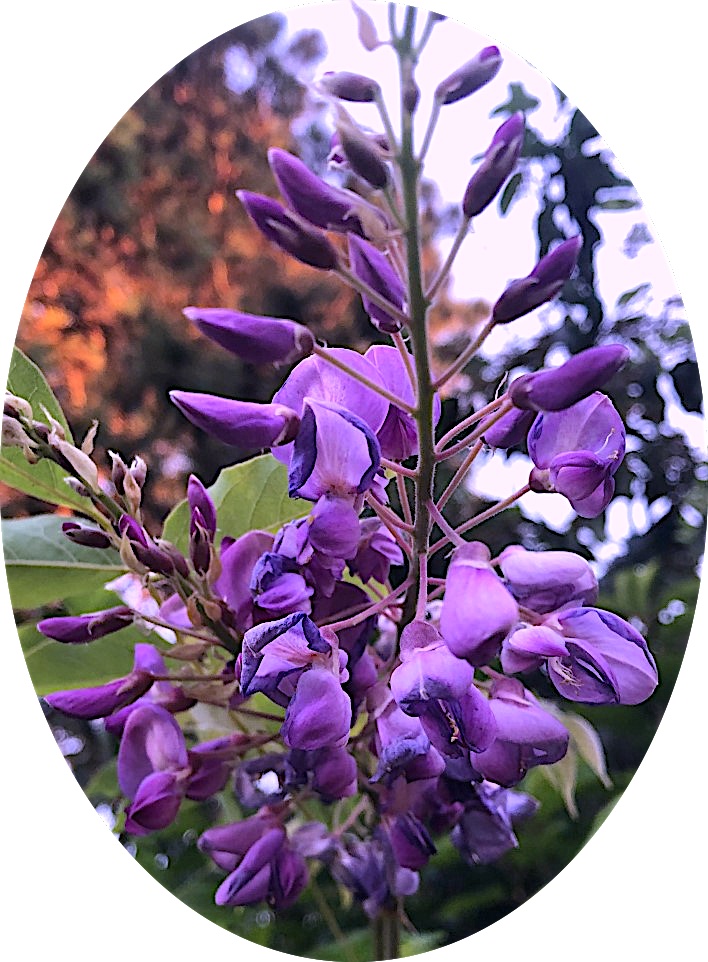
Here’s a wisteria vine, in a second hot-weather blooming season

We have a heat wave this week. Compared with the suffering all around the globe our experience isn’t bad, but for us it breaks all the records and already at least six people have died. I have no right in the world to complain ever, what with a roof and running water and an excellent system of public transportation and an indoor desk job. But this does take extra safety planning and responsibility, and some checking up on our senior citizens, especially if they live alone.

At Baptist church up the street, on days like this the men and boys (always looking handsome and poised in their dark suits with jacket and tie) set up enormous industrial fans in the invitingly dark cool basement and carry all the hymn books and Bibles downstairs for evening services. During the sermon they turn off all but the small cooler fan. After the service this Wednesday, Pastor announced “We have the usual cold drinks in the fridge. But on this circuit we can run either the main wind-tunnel fan, or the coffee machine. Take your pick. Those of you who wish for coffee tonight, you can enjoy your hot beverage while watching the rest of us swelter.” (They’ll spend all day today like every Saturday, setting out in the church van to neighboring towns to hand out surprisingly thoughtful Gospel leaflets and strike up conversations with anyone they can find. An intrepid lot in all seasons.)

The computer can’t take the heat up here at the top of the building, so remote work is out. For commuting this week it’s wise to be out at the bus stop by 6:30 and at work by 7:00. Then I can leave after 3:00 to shower and nap at home. This week though there was a terrible Hazmat truck fire on the highway at 1:00; it’s a real wonder that no one was injured. The interstate was closed in both lanes for about six hours. At 4:00, knowing nothing, I stepped out of the office and was baffled to find bumper to bumper traffic gridlocked in all directions. One trucker was sitting in lotus position on the sidewalk, meditating in the shadow of his rig. The streets were silent. Because we’re not back East, there was not a car horn or inventive invective to be heard. I wove along between cars for block after block, past stalled buses on my bus route. Finally I walked 45 blocks homeward in easy stages, from one spot of shade to the next. The route was straight west, and I had my Solumbra/Sun Precautions UV-blocking sombrero, the next best thing to walking around with a manhole cover on your head. Otherwise I would never have ventured it; I would have gone back and spent the evening at the office. In the end the side streets away from the highway were starting to ease up, and I caught an air conditioned bus for the last 20 blocks. During the wait at the stop in the shade the atmosphere felt light-headed and queasy; since the walk was unexpected I didn’t pack water, but will pack it from now on.

Naps in hot weather are important, at least three a day. Lying on any floor will work in about two minutes for instant deep sleep. I need to tape a big sign to the bottom of my desk saying Hey Mary, it’s okay. You just woke up with no idea where you are, but this is the office. You crawled under here half an hour ago and were out like a light. Some day my boss can find it there after I retire.

It’s helpful to stay active during the cool hours; this morning at 6:00 I walked down the street to photograph the sun rising over a dewy field of grass under the tall trees. Then before sunrise and after sundown, there’s drinking water to buy 2.5 blocks away at the triple-filtering machine in the grocery parking lot. It’s the best water available for only 40 cents a gallon, five trips a week at 22 minutes per trip. Then I’ve been hauling every bucket of wash water down 42 steps from the fourth floor and around the corner to the garden, about 16 pounds for two gallons at 8 minutes per trip. The leafy greens and sweet potatoes are in peak good health and good looks; watering them takes at least 10 buckets, a total of 80 minutes or one hour 20 minutes of stairs in a day. Food prep is at 5:00 am or 11:00 pm, so that means toting wash water downstairs at all hours. (Even at midnight it’s a lively neighborhood. Teenagers hang out at the picnic table, dogs need walking, the smokers are on night watch in a companionable klatch, and there is always some Wing Family paragon out gardening with a flashlight.)

This week’s menu has been green juice from the leaves in the garden, raw beets and jicama and carrots and cabbage, pickled daikon radish, mobile-pasture egg, brown rice with coconut oil, kimchi, banana for potassium, bread (Ezekiel 4:9, made with no flour or oil or sugar), and dark chocolate with roasted peanuts and raisins. Also quarts of water with stuff added to it, not listed here because nobody needs dietary tips from some teacher of Russian language. That’s a really privileged diet, not that anyone I know would want to share it.

After rolling straight out of bed in my surgical scrubs, I run right out to get the water hauling done early. Neighbors and their dogs have the same idea, starting off their dog days early for any breath of coolness. Gentle agreeable sensitive women gravitate to high-energy alpha male working breed dogs. These muscle-bound buckos belong at West Point, hauling carts of provisions to the cadets and walking the perimeter on night duty. Instead they are losing their minds at sight of a squirrel, barking in random meaningless ways, dragging their owners all over, and blocking the sidewalk. All these familiar animals mean no harm, so I always straighten up, shoulders back, hands on hips, feet planted solid, engage the owners in friendly fashion, and obey Cesar Millan’s rules: No touch, No talk, No eye contact. Then the dog will ratchet down the drama and beeline for the nearest fire hydrant. But this week, all the dogs find me mesmerizing. They approach with head low, ears back, tail dropped in a slow wag. They give me a long sniffing over (sniffing is excellent dog manners), give my ankles and hands rapturous licks, then curve against my leg waiting for a pet, gazing up with soft eyes. I’m YOUR DOG. Take me home! This across-the-board response was a pleasant puzzlement. Neighbor S. said “They’re not responding to you. They are just in a good mood because at 5:30 in the morning the air is cooler. They would react that way to anyone.” But I suspect it might be because this week I’m up & out for water first, without clean clothes or a shower. Thanks to kimchi and sweated salt, I’m canine catnip.

Last October, 9 months ago, someone with idle time on their hands rang the fire alarm box for the building. In the milling crowd outside I noticed an unfamiliar new neighbor. She stood apart from the conversation groups on the lawn, so I went over and introduced myself. She told me her name and apartment number. But she seemed preoccupied, so I gently backed off and left her in peace. I didn’t know that during the alarm while everyone stampeded down from upper floors she fell headlong down the stairs, and hit her head. (The fire department checked the building, turned off the alarm, and then talked to her and tested her for a head injury. She was shaken up, but not injured.) In these nine months I didn’t see her again.

Last winter, six months ago or so, during some spell of bad weather I took half a dozen travel postcards (25 cents per pack at the thrift shop, all mixed destinations), wrote messages, and slipped the postcards under the apartment doors of all our elder neighbors. I added my phone number and urged them to call if they needed anything. No one called, so I could only assume that they were doing okay.

Yesterday an unfamiliar number showed up on my cell phone. I frowned at it, planning to let it go to voicemail, but for some reason answered the call. A cultured animated voice greeted me warmly by name, saying “I got your travel postcard from Scotland! Thank you so much! Somehow my house sitter placed it in a big stack of sales catalogues and magazines. Finally I’m going through that old stack, and here was the card from you! So kind!” She talked with enthusiasm about how thoughtful and touching it was, and how much she appreciated it.

I stood there holding the phone, tuning in to the features of her speech as my mind raced around, trying to match it to any voice I’d heard before. I’ve read that Jack Benny sent some 50 postcards a week, with greetings or thanks to anyone who crossed his path. I was certainly not in his league. But clearly my fondness for mailing postcards and slipping them under doors must have come home to roost: I had no idea who was talking to me. Scotland? Who in the world did I write to with a Scottish postcard?

This dear lady treated me to a good conversation for 15 minutes while I prayed “Holy Father in Heaven, please help me figure out who this is.” Then, bingo — she mentioned the neighborhood. That was a possible grasping straw. I made a few general observations about my building, she shared a few of her own that showed that she lived here too. Score! Surveying the apartments up and down the halls and floors, I figured out who this was. She asked me, “You do have a proper air conditioner and fans, don’t you?” I didn’t in fact. “Our heat spells are so short,” I explained, “that I just nap in the closet. If it’s bad I’ll go sleep in the bath tub. Is there anything I can get you right now?” Well, all she needed was laundry quarters. When I knocked on her door with my quarters, she insisted on my taking home a truly beautiful tall cooling fan with fancy attachments, and that I come in and take a break in her air conditioned room. I sat on the floor to cool down for an hour. She told me about her life in public health, starting with the early front lines right in the Castro District for the terrifying emergence of GRID (today we call it AIDS), her fight to get health providers to accept and treat gay male patients. That was an exciting story, and a delightful visit. The heat wave brought a whole new connection.

Now it’s 9:00 am, much too warm for this computer. Time to log out until next time.

A field of grass at 6:30 am, still sparkling with dew, though not for long.
Posted in Uncategorized | Leave a comment

7/13/22: Rabbit Mochi Moon

It really was red-orange. Really!

Small culture note: Mochi is made from short-grain glutinous (vs. glutenous) brown rice, also called “sticky” rice. It has a naturally sweet taste and substantial chewy texture. One can cook it soft, then pound it in a large mortar and pestle for a very long time (perhaps while sharing the work with others, ideally while singing traditional mochi-pounding songs). Eventually this crushes the rice grains to form a thick adhesive dough. It can be sliced or patted thin, then baked. It puffs up to form a cake, crunchy on the outside and taffy-chewy on the inside, often served with a drop of tamari soy sauce and fresh ginger. (It has to be eaten hot and fresh before it turns hard and dry.) Mochi is fortifying and delicious. You can also buy it pre-packaged, now even in fancy flavors like cinnamon-raisin for the American palate. When I studied traditional Asian cooking we classmates used to pound mochi together. It was a big treat.) Anyway…

Wednesday’s weather report promised a July Buck Moon, rising at 9:50 pm.

A mile up the road, the country club has an eastern view. It’s a closed neighborhood with entry gate and security guard booth. To stroll there I always say hello to the guards and walk just to the trees for the view, and so far nobody has asked me to leave. So I texted some neighbors to suggest a moon junket. We could meet at 9:25 and walk over. 

Angelina texted right back. She is my new neighbor and peep. Just this week for the lowest tide of the year, she went to the beach to look at things wobbling around in tidal pools. So to her this notion made sense, even when the other invited adventurers needed to cancel. Finally only the two of us planned on going. So I put on a fluorescent vest and at 9:25 showed up at Angelina’s, texting and waving at her window upstairs.

The hardworking family downstairs were planting flowers in the dirt strip at their door. Their daughter Kip was a big help. She is smart as a whip and deferentially courteous and happily bilingual and studious in school and a fun-loving gold nugget of energy and cheer. Her neat limber Grandmother was settled on a low crouching foldable bench seat, neatening the soil and stones. I approached and greeted her, asking whether Kip would enjoy going with us for an hour to view the moon. Grandmother was friendly but seemed shy about speaking English, so Kip interpreted the question. After a short family council indoors, Kip let us know in English that she could come with Grandmother.

Sweet! Our enrollment had just doubled. Angelina put a leash on Super Pup, her tiny jet-black fawnlike doglet. I put the fluorescent vest on Kip. That turned out to be a good thing, because she is so nimble and fleet. This way we could see her well in the dark, and so could any passing drivers at the crosswalks. We impressed upon Kip that the club has coyotes, so she and Super Pup had to stay close to us. We walked past streets of flowering lavender and wisteria and bigcone pines. “Good Evening, Officers!” I called to the security guards at their booth. “May we come in long enough to see the moon?” The guards laughed and waved us in. We passed multi-storied private houses with soaring glass sunrooms on every floor, rock gardens, stone fountain waterfalls, and potted palms. We reached the edge of the golf course with its soaring conifer trees and view of manicured plush lawn and a little glimpse of lake and twinkling lights on its farther shore and the mountains like ghostly shadows on the sky.

Then, we had a problem. The clubhouse and facilities outbuilding to the southeast were brightly lit. Those buildings were going to block the dramatic moonrise, and their lights would drain the promised coppery glory from the supermoon. Nevertheless, our valiant band stood at attention, trusting my idea even though its feasibility looked dimmer by the minute.

Grandmother had brought along her gardening seat. Now she set it on the grass and settled down. Kip stood beside her in poised stillness with folded hands, waiting in perfect courtesy for my promise to come true.

At the end of her leash, Super Pup’s wee black form was only a vector of motion as she explored (and rolled in) interesting smells. At one point she snapped to battle attention, rising on hind legs, staring at the tall trees down by the water. “Are there coyotes down there?” asked Kip. “Would they hurt a girl?” I reasoned that coyotes prefer to avoid people, “but for them, Super Pup would be a tiny bite of coyote candy. We’ll just stay together. That way any coyotes will see that we are all one pack.”

With a sharp yip Super Pup tried to charge down there like a bite-size Light Brigade. I crouched down to talk to her. “Pup? At this time of night there is nothing in those lake trees that is good news for somebody your size.” So Super Pup expressed her fighting spirit by spinning around Kip, winding her leash in tight and tighter circles. Angelina had to do some fancy lariat work, unwinding the leash in circles around her head. First Pup chased Kip with high squeals of hilarious glee. Then Kip chased Pup with equally high squeals and more glee. They were perfect playmates, yipping and dodging in the dark. Pup moved so fast that twice she splashed right up against my shinlike a soft velvety misfiring bat, flipped over, and darted off.

Grandmother gazed at the sky and overhead at the tall trees. My moonwalk was a total bust, and she must have known that. But she and Kip were too well-bred to let on. Instead, they were making the best of the evening, just as it was.

With uneasy chagrin I was about to call it a halt and take these dear people back home. With a heavy sigh I turned my back on the disappointing sight of those bright outbuildings. And then, straight due east, there was a hot red-orange eyelash like lava floating among the mountains. “Hey,” I said. “What’s that?” Then everybody turned and looked.

The hot red eyelash melted out as a brightening horizontal crescent. Before our very eyes, the blood-orange shape peered up over the mountains and began to bloom. Kip clapped her hands, and cried “IT LOOKS JUST LIKE ANCIENT TIMES!” It was heartwarming to hear such a young person express enthusiasm for ancient times, or ancient anything. “You have an excellent point,” I told her. “It’s true. In ancient times, people were very aware of nature. They watched and talked and painted and wrote about the moon more often than we do now.”

The moon bloomed open as an impossibly deep red-orange globe. We’re familiar with “moon,” and with “red-orange,” but I’d never seen the two in one shape before. Grandmother and Kip exchanged a murmured observation. Kip explained to us that Grandmother had never seen a moon of this color. “Neither have we,” we said. “Is there a term in your language for a moon like this?” Kip didn’t have to think twice: “We call it ‘Rabbit Makes Mochi in the Moon.'” Angelina and I burst out “Mochi! Yum!” Grandmother pointed to one star after another as they appeared, giving them soft names.

In Chinese I sang them the moon song “Quiet Night Thought,” the 8th century poem by Li Bai: Before my bed, a pool of light / like frost upon the ground. / Raise head, I see the bright moon. / Lower head, I long for home. After the song and a moment of respectful silence, Kip asked a wonderful question. “Is that your CULTURE?” I explained that it came from Mandarin class from years ago. 

The evening grew cold and late. We headed back past the tall houses with their murmuring fountains and glass sunrooms. “Good Night, Rich People,” I said very softly to the houses. “Thank you.”

Kip was skipping up ahead, telling Angelina with enthusiasm all about her schoolwork and her love of reading. Walking beside me, Grandmother asked “How… old… are… you?” For her, back at home, this is a polite interested question between new acquaintances, letting them shift smoothly into the most gracious social register and style of speech. When I told her, holding up fingers, she looked surprised. In return, observing her slim lithe light-footed manner and thick healthy hair, I said, “And YOU look much younger.” Then I realized — I had just minimized the age of someone from a country where seniority is social capital for status and respect! Well, I’ll just have to explain to the family next time.

Kip’s mom opened the door, happy to see us. Kip ran in to tell about her new adventure.

Epilogue: Today, Kip practiced skateboarding tricks on the sidewalk. I stopped to watch her. Kip’s Grandmother came outside and handed me a wrapped plate of piping-hot chicken, vegetables, and glass noodles to take home for my dinner, plus a heaping side plate of hot-spiced fermented vegetables.

It will be fun thinking up some nice recipe to make for these new friends.

Posted in Uncategorized | 1 Comment

7.8.22: Sweet Potato Slips

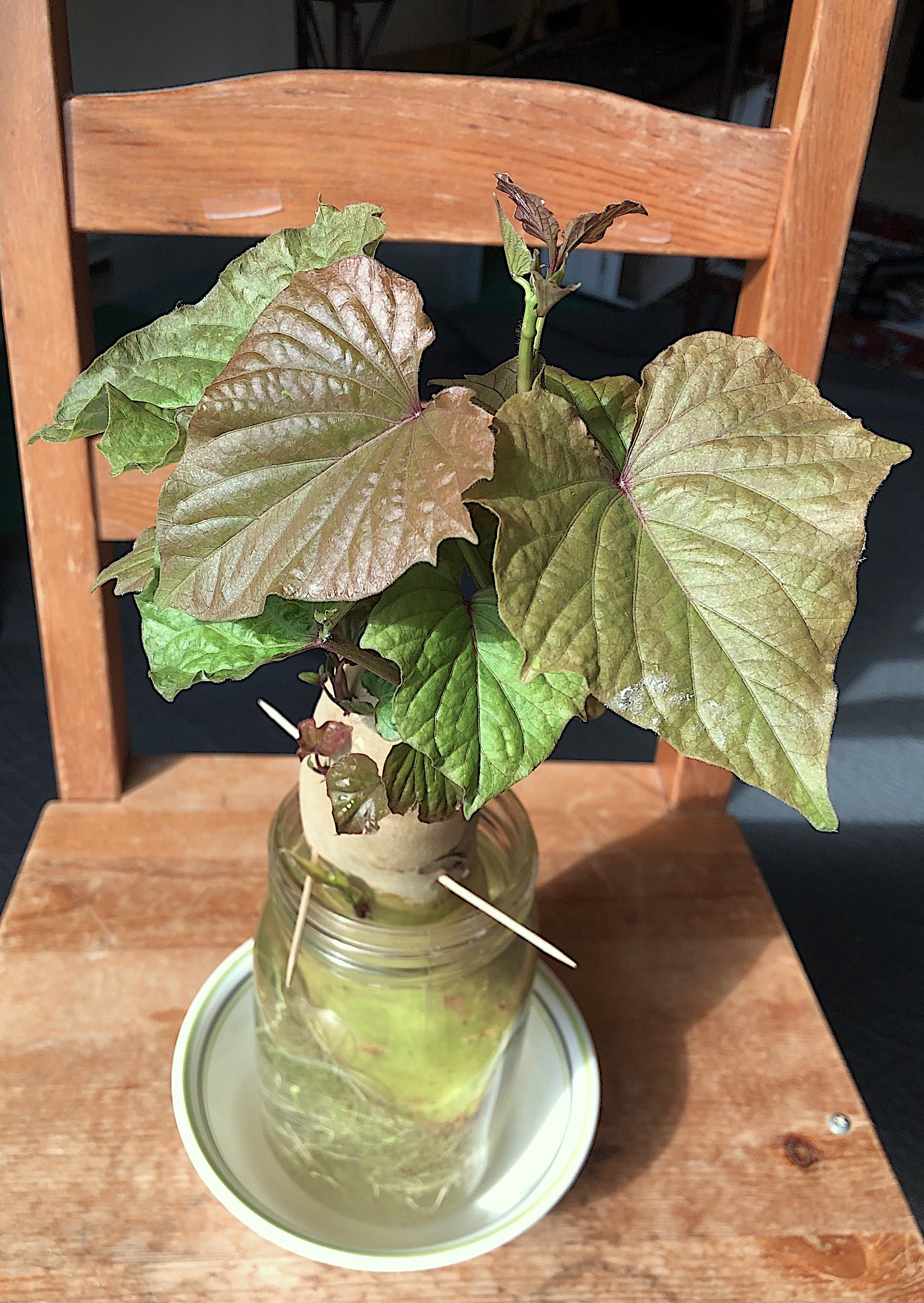
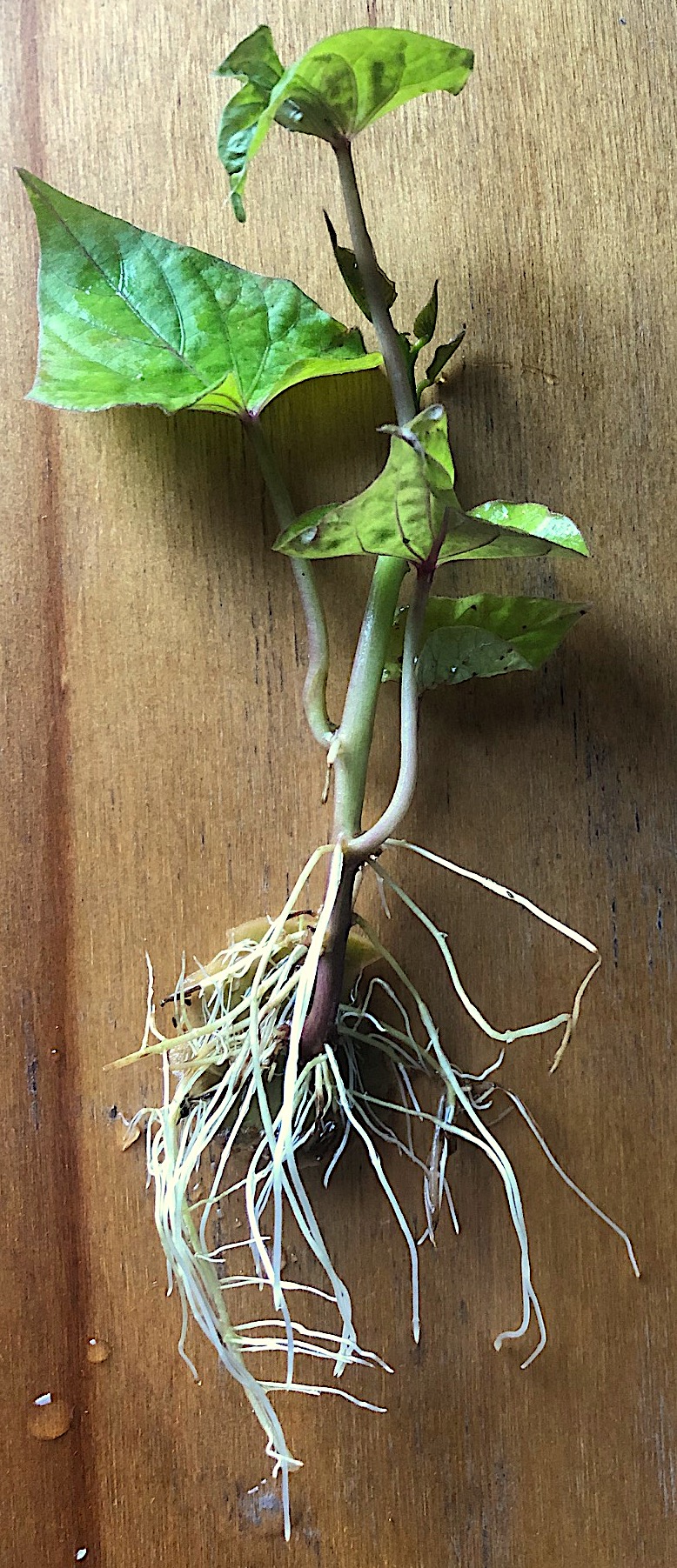
On March 17, I put a sweet potato in a jar of water. Here is the potato two months and a bit later, as of May 21.

Sweet potato on my balcony, growing roots and “slip” stems

The potato idea came from the YouTube show “Off Grid with Doug and Stacy,” the episode “Start your Potatoes Now No Matter Where You Are.” People in my life are starting to glaze over and zone out whenever I go on and on about Doug and Stacy, so maybe it’s time to stop talking and just write about them instead. Their website https://offgridwithdougandstacy.com is action packed with good ideas.

(Hey Mary, if they are off grid, how did they film their show? It’s a cell phone camera charged up with their truck battery. Doug explained the whole setup.) Ok, on with the potatoes.

When Stacy talks, I listen up.

In this video, Stacy’s instructions start at minute 10:45 or so. Here’s the libretto: While you can plant white potatoes early, around St. Patrick’s Day, the sweet potatoes are different; they don’t like cold weather, so they need to be planted later, when the soil temp is about 65 F or higher. Orange sweet potatoes take longer to sprout, and purple Molokai potatoes sprout more quickly. Use organic potatoes, because many commercial ones are sprayed to keep them from sprouting. Use wide-mouthed jars, and fill them with filtered water (tap water generally has chlorine). No need to submerge the potato; place just the bottom 2″ or so of the rounded bottom part of the tater in the jar of water. Hold it in place by driving in 3 toothpicks; the pointy end of the tater should face up. Set the jar in the sun. Change the water every week or so. Watch for tiny roots to form out the bottom, and green stems and leaves to grow out the top. Those stems are your slips. When a slip is about 6″ long, you can pinch it off right at the bottom closest to the potato. Place the slip stem in a glass of water. When the roots on the slip grow to 6″ long or so, plant the slip in a pot of dirt. Here is a happy little slip that grew in water just this week. The weather is warm now, so the slips and roots are growing much faster.

Intrepid stem, turning itself into a plant in water on the counter.

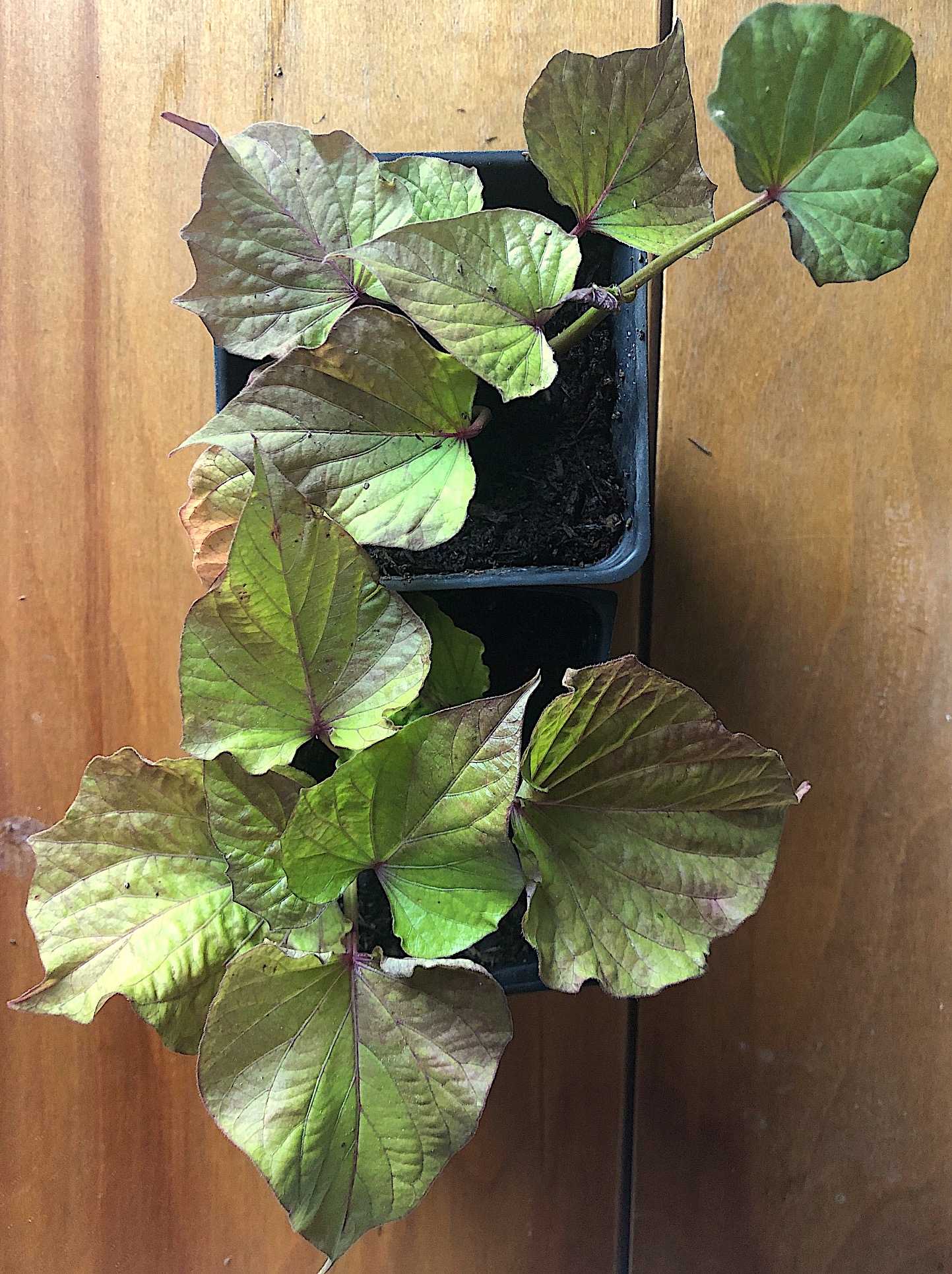
When the weather is warm enough, transplant the tater from the pot to the earth, or give it to your gardening friends as a somewhat unique present. I’ve never seen sweet potato plants for sale at a nursery, and maybe the friends haven’t either. One tater can grow even up to 15 slips, and each slip when full grown can grow up to 5 lbs. of potatoes. Not a bad return on an investment.

My original potato in water is still growing little slips. It makes a nice leafy house plant, and while it grows I’ll just keep growing and planting and giving the little ones away. Our produce market had a couple of reject-bin sweet potatoes starting to sprout, so I snapped those up and put them in water too.

When you eat your sweet potato, eat it with the peel and all. Also add a little fat — like avocado, or nut butter. Stacy says that if you do, the glycemic levels will stay steadier. Thank you Stacy!

Posted in Uncategorized | Tagged , | Leave a comment

7/4/22: ER — The Circling Night

The Big Disclaimer: Dear Ones, the takeaway for this little story is not “Jesus is really nice, and He took away my problems because of my faith.” No no. The takeaway is “I was a big sluggard fool who did not attend to her symptoms, and through sheer undeserved stupid luck stumbled across good people who did.” If the trouble passed by, that is no credit to me. Someday the outcome will not be good. That is human life. Jesus is Jesus no matter. On with the show.

___________________________________

My ankles have an extra-Soviet look.

The lower legs have a thick stocky appearance. Back in Leningrad the older Russian ladies all had it; their ankles looked stiff and heavy under their woolly leggings. Retired women in black dresses and kerchiefs kept the infrastructure going; they swept boulevards with little twig brooms, and scrubbed steps, and hauled barrels of building scrap up stairs (and if you stopped to grab a side handle they’d bash you with an elbow). The women were on their feet all day working their abacus at white marble shop counters and impaling little paper receipts on to a metal spike. They stood in packed trams, and bread lines. They stood boiling bed sheets in communal kitchens. On holy days they stood at attention for hours in churches with no pews. These were not flabby sedentary people. So over the years when my ankles got that stocky look, it brought back fond memories of those Leningrad women, who spent their teen years taking apart wrecked trams and rails in dead winter and putting them back together and operating the system themselves after a three year famine with bombs falling all over. 

Unlike the Russians, my ankle situation did not come through honest labor. It came from a lifetime of computer editing in a chair. Then a while back, a basic Jack LaLanne deep-knee bend became impossible. Then at our neighborhood hopscotch meet, the hops didn’t feel like a fun lymphatic workout; they felt jarring and wooden. Then, it was hard getting off the floor gracefully. When you visit a masjid and sit on the carpet to chat with the ladies after the service and then go to stand up — those women of all ages just float to their feet like effervescent bubbles in clear mineral water, while my double-handed inverted roll draws wide looks of concern.

That didn’t slow me down on vacation in Eagle. Those stocky ankles hiked all over town all day. But after the trip back, the 13 hours of car / plane / plane / train / bus, away from a Christian culture and all its friendliness, I felt let down and discouraged. Being home in the city itself was fine, and so was being at work. But over the next couple of weeks, every day before dawn I woke up feeling down-hearted, with a sinking sense of foreboding and fatigue. After a good night’s sleep all I wanted was a good night’s sleep. 

It felt tiresome to get off the floor and out of my blankie roll, to get down on the floor to said blankie roll at night, to get out of a chair, or to walk down stairs or jump down from the back door of the bus (exit from the rear). When ankles don’t flex or pivot or pronate fully it throws off cushioning and balance. The lower legs cramped easily, and got so restless at work that I’d go lie down and prop them up against the wall. The ankles were looking red and chafed and chapped. (Maybe there were pesticides in the grass, where I walked at the cemetery and golf course to photograph the view?) Then they grew so itchy that to feel comfortable I’d have to run them under hot water. 

One Friday at the office we had a big eventful customer service day. People needed direction and help. I ran intereference with scheduling, rooms, deliveries, visitors, and redirecting messages. By 5:00 a silent thought rose to mind: “For Christ’s SAKE, why can’t you people get it together?” That surprising attitude was a sure tip that something was wrong. It was good to take the weekend off and just get some rest.

But on Monday morning, the prospect of hauling up off the floor, let alone facing a work day, was too much. I stared at the ceiling and heard myself say “Oh God. What’s the point? I just want to die in my sleep.” 

Then, a threadbare little waltz came to mind. It sawed along over and over, refusing to go away. After a while, the lyrics floated to memory: a hymn sung by sweet Mrs. Kirkland, on an episode of “Tiny Notes from Home”:

I must tell Jesus all of my trials;
I cannot bear these burdens alone;
In my distress He kindly will help me;
He ever loves and cares for His own.

That old chestnut was not even a favorite of mine. The message seemed a forlorn last resort for people alone in little studio rooms, sleeping on the floor in a blankie. Just how did Jesus plan to bear my burden of getting up and going to work today? That thought provoked a lot of annoyance while I tried to languish in peace, forcing myself to not scratch my itching fidgety ankles while that tiresome ditty inchwormed right along:

I must tell Jesus! I must tell Jesus!
I cannot bear my burdens alone;
I must tell Jesus! I must tell Jesus!
Jesus can help me, Jesus alone.

Next an interrupting thought flashed to mind, like a news bulletin: “Cast thy burden upon the Lord, and he shall sustain thee.” A really good Christian would know the chapter and verse. A minimally better Christian would have gotten up and tracked down the quote, but I was too tired to care. Still, this verse and tune did make me wonder. What if I did tell Jesus? Which slice of this whole fatigue pie would I even talk about? 

An instant idea dawned: I could tell Jesus through a reliable proxy. I could share the burden now, by walking in to the Urgent Care Clinic and saying “My ankles itch like mad.”

“Golf Course Allergy” seemed a petty reason to trouble the providers down at Urgent Care. But I double-hand rolled off the floor, emailed the office for a sick day, and called the clinic. They booked me a 15 minute slot for 6:30 that evening. A same day appointment! That was a very meaningful stroke of luck. Feeling lighter and more hopeful, I soaked my ankles and went right back to sleep.

For medical appointments it’s a good idea to check in at least an hour early in case somebody else cancels. For a 5:15 arrival, by 4:00 I was standing on a city street packed with commuters, at a busy intersection serving several lines of buses. The scene felt too loud and glaring. It was hard to balance, to turn, to walk a straight line. It was harder to predict and to merge with the rhythm of the crowd. Before I could scramble out of the way, a jogger body-slammed right into me, stammered an apology, and sped onward.

Urgent Care runs on triage. People like me with our own reserved appointments are the privileged ones. We have symptoms stable enough for advanced planning, we speak some English or arranged for an interpreter, we have the technology and skills to make a phone call or navigate to the website for online booking. Any appointment comes with an understanding: anyone who feels worse than I do can walk right in and jump the line. That’s exactly what happened. People with complex medical issues arrived at 6:30, 6:40, 6:41, 6:50, on and on. In the waiting room, each time the name MARY crept up the list to the top of the electronic screen, with estimated wait as 0 minutes, suddenly other names would appear above mine and other patients and their families were whisked in to see the doctors. The wait crept on with a rising level of suspense. Closing time was 8:00. Sometimes patients had to be sent home to try again next day. But in another ray of good fortune, the valiant clinic staff called me in at 8:15 for a last encounter with a hard-worked but resolute vigilant physician.

The doctor scrubbed and gloved up, examining the ankles with care. He shook his head and entered a prescription for ten days of oral and topical antibiotics, and a whole panel of blood tests. “Edema; could be any of several causes. Lab’s closed for the night. Get the blood work in the morning; we’ll take the results, and plan from there.”

   “Could this be an underlying chronic venous insufficiency?” I asked him. 

   “Yes.” He looked regretful as he scrubbed up and left the room. 

Well, that could account for the downhearted sinking feeling. Something really was sinking — in this case, my blood supply. What a relief to catch the two buses home, email work for another sick day, and go to sleep. 

Bright and early in the morning, a text pinged my phone: prescriptions were ready at the grocery across the street. I picked up the order, drew up a schedule of times for doses, considered heading to the lab right away, lay down first for a little rest, and didn’t wake up until 2:00. That was an interesting sleep pattern that week or so. I would lie down for little breaks with some nice song playing as background. Invariably I’d wake up with a start when the 3 minutes was up and some strident commercial came on. That 3 minutes sounds like a pretty rapid cycle from wakefulness to deep sleep.

At this point, our Orthodox Christian readers might be wondering. Could this have been a spiritual attack? Well, who knows. It would seem that a customized attack would target someone of more spiritual stature. But for the lowest level of attack, maybe a pretty effective message would be “There’s no point in struggling. Stay in bed, and sleep all your problems away.”

Instead, at about 2:00 a very no-nonsense silent intuition demanded that I get up NOW and out to the lab for bloodwork! On the double! Somehow I got myself together, took the next dose of meds, limped off to the bus, and reached the lab for a 4:30 blood test. I limped home, took the next dose, and pitched into bed for blessed comfort and rest.

Usually in the evening I turn off and charge up my cell phone. But instead at 8:00 I was all tucked in, dozing off to a Pimsleur Ukrainian language CD. Once the CD finished, I planned to turn off the player, charge the phone, and go to sleep.

At 8:15, the cell phone (should have been plugged in, mind you, but was not) started ringing. I looked at the number. It was unfamiliar. Probably a robot call. I had no intention of answering. I answered anyway.

A cordial hearty voice wished me a good evening. It was a doctor from Urgent Care. “Someone did call you about your blood work. Right?” she asked.

(Uh… called me? How could results be done already? No, Doctor.)

   “Your D-Dimer level is elevated,” she said, with cheerful upbeat calm. “A normal reading is 0 to 0.50. Yours is 0.63. Which is your hospital? Oh — campus? Good. Go now. Report to the ER. Given your other symptoms, the lab result indicates that this might be a deep vein thrombosis. A DVT, or blood clot. People do live, if we catch it right away.” With kind cheerful firmness, she let me know in tactful fashion that if I lay here, and remained alone, I could die in my sleep.

Wasn’t that the goal? said the first thought in mind. In the next split second I looked around the studio room. There were boxes of filing and books stacked all over, because for days I didn’t have the energy or agility to keep the space clear. But I didn’t want people to find me lying here three weeks from now and say “Gee, not only that, but her place looks pretty cluttered.”

More important, here was this doctor, who was not my provider. I was not her patient. At 8:00, she was off the clock. She could be on her way home! But she stayed on anyway, reading all the lab reports. Then, she took further interest in wondering whether the handoff had happened: whether anyone picked up the phone with my results. If she thought it was worth all that trouble, the least I could do was anything she told me. I thanked her over and over, from the heart. She made me promise to get going. 

That promise to her got me upright and washed up and changed. I grabbed my insurance card, two forms of state-issued photo ID, the new antibiotics, credit card and checkbook, drinking water (no snacks; some testing needs an empty stomach), cell phone charger, notebook and pen, reading material, rain gear, fluorescent vest, and a flashlight for the trip home again. In 23 minutes flat I was at the bus stop one block away. In 20 minutes more I was checking in at the ER as a Suspected DVT.

On that Tuesday night, the ER was full. All chairs were taken. Just as well; with a DVT risk, sitting around may not be the best idea. So standing in the corner, I opened my Bible for the daily Psalm reading. The book flipped open to Psalm 55:22: “Cast thy burden upon the Lord, and he shall sustain thee.” That was an eye opener. After the Psalm reading I opened my other book, a large anthology of writings by Reverend Billy Graham. It opened to a line from I Peter 5: “Cast all your anxiety on Him, because he cares for you.”

I pondered those two Bible quotes, with Mrs. Kirkland’s hymn rolling along in mind as it had all day. Reading Mr. Graham’s anthology, I set out on a very slow walking meditation all around the back wall of the ER. With occasional breaks for testing in the back rooms with various providers, the walk became a private little Camino de Santiago, lasting for the next 10 hours.

That day, nobody triaged past me. The reception team outdid themselves being thoughtful and kind. Even the security guard was outstanding. This alert patient man monitored the waiting room, and the condition of the patients. He gave parking advice, instructions on finding other clinics, directions to the vending machines. He rounded up stray wheelchairs and offered them to new arrivals who needed them. Gently and patiently he coached a departing Somali family on how to find the rest room, repeating the instructions step by step three times, orienting himself in space and pantomiming the process until finally the family felt confident and comfortable making the trip.

   “But sir, we are completely full,” explained the valiant Reception team to a gentleman at their counter. “There simply are no beds. We will call you as soon as we possibly can.”

   “This is the kidney stones!” exclaimed the visitor in a Russian accent, pointing to an older man using a wheelchair. “Do you understand how painful he is? We came even with ambulance!” To American ears, this might seem like an overbearing behavior. But in a Russian medical facility, getting the attention of overworked staff could require an assertive and even vehement demand for special or urgent care.

   “Absolutely, Sir,” said the receptionist. “It’s written right here in the intake. They are aware of the problem. We will call you as soon as we can.”

The two men, who later turned out to be father and son, conferred in tense whispers. My old-war-horse instinct was to rush over and help. But their help was on the way, and my interpreting days were over. I was here in my new role as patient myself. Mind your business for once, I thought. Give these people some privacy. Pay attention for when the nurse calls you. And yet, me being me, after internal see-sawing pro and con, I finally approached the Russian father at a respectful distance with a contrite bow, hand over heart. “Proshú proshchénia. I beg your forgiveness. I apologize in advance, just in case they call me in first.”

The two men blinked at me. The son leaped up, trying to persuade me to take his seat. “What are you in for?”

   “It’s…” The Russian word escaped me. I showed them my angry-looking ankle. “The blood sometimes clots up in a spontaneous manner, forming a blockage in the vein.”

   “Tromb!” they exclaimed, making the sign of the cross with a reflexive prayerful whisper. “No! No, if they call us, we will demand that they take you first.” The son sprinted to the vending machine and bought me candy.

As if on cue, the triage staff whisked me right in, ahead of everybody else. Each provider that night was absolutely responsive, attentive, cheering, and gentle. They gave me lots of face to face eye contact, speaking in a clear and calming manner, keeping up pleasant conversation while they monitored my physical and cognitive status. In response to my determination to be pleasant and good-humored, they responded with great good will and humor themselves. There were lots of questions, some over and over (family history, any smoking habits, alcohol, any BREATHING PROBLEMS at the moment?) There were also extra blood draws for whatever lab tests might be called for. 

   “Sorry,” the lab tech smiled. “Taking a lot of samples.”

   “Fine,” I said. “I’ve got another 13 pints. Do I get a cute cartoon-character band-aid?”

   “Any recent plane trips?” asked a luminously kind ER resident. “Any extended time in a car?”

   “Four plane trips,” I told him. “Two 13-hour journeys, to and from vacation.”

   “Ah, I see.” He smiled a little wider, and smoothly racewalked away to consult with the ER attending physician. The ER attending physician came right in. She apologized that the vascular imaging team would not be available until 7:00 am. For a precise diagnosis we would have to wait until then, and meanwhile keep observing my symptoms through the night.

They let me back to the waiting room. By then the Russians had been called in to the back rooms. In my notebook I updated a running record of each provider’s name and title, and what they did and said. Then I kept strolling with Mr. Graham’s book.

A new receptionist came on duty. Seen from the patients’ vantage point over the counter, she wore a neat professional hospital uniform. But at one point when she crossed to the back room, one could see that she wore wonderful elaborate high-heeled cowboy boots. They were a pinto horse pattern in black and white, with lavish feathering fringe and shining buckles. 

   “In those boots, you are ready for any work emergency,” I told her. “They are simply resplendent.”

   “Helps lighten the mood,” she laughed.

At their plexiglass booth office in the corner, there was a changing of the guard. The new guard, like his predecessor, was attentive and deft and unobtrusive, guiding patients and giving instructions. He looked like an interesting young man, someone with genuine caring and presence of mind. He had the cleancut vigor one sees among the LDS missionaries, young men with classic Biblical names who stroll the campus in pairs in nice black suits in all weather. I stepped away from the plexiglass booth, not wanting to distract his vigil. But while pacing in the fresh air near the open doors at the entrance, I thought it would be nice to have some pretext for striking up a conversation with him. There wasn’t long to wait.

   “Ma’am, excuse me?” There was the guard, out of his plexiglass and right behind me. “We need to keep that entrance clear at all times. Is there anything I can do, to ask you to step away from those doors?”

   “There is everything you can do,” I answered, stepping away from the doors. Then in dismay I realized that my reply sounded very forward. And here I was, old enough to be his grandmother! “That is — no, I meant — you’ve done it all already. I will stand in this corner instead. Thank you, Sir.”

   “Thank you, Ma’am. Appreciate it.” He strode back to his post.

The team called me in every hour. Blood pressure, questions about BREATHING (checking for pulmonary embolism?), eye contact and friendly chat (checking for signs of stroke?). After midnight the team measured my height and weight, calculated a dose of short-acting anticoagulant, and administered the blood thinner with a horse-sized staple gun to a generous pinch of my abdomen. This of course led to the rueful thought that if the abdomen were less generously pinchy, I might be in better condition and not in the ER to begin with. “You can administer this injection to yourself,” they explained. “Every day for the next few weeks.”

   “Me? To MYSELF? Uh, how far does that needle have to go in?”

   “All the way. Or, do you have a partner or family member who can administer it for you? Trusted friend?”

I could just see me knocking at the Wing family next door. “Uh…”

   “We can talk about it later,” they reassured me. “The Vascular team will be here at 7:00 am to take an ultrasound. We can let you go home for a while. Get some sleep. Just be back by 7:00.”

It was now 2:10. I went out to talk to the reception staff. “Hello! I’m to report back here by 7:00 sharp later this morning for the Vascular team. Now, I’m a little scared about going home. Urgent Care told me that I must not fall asleep, or be left alone. I understand that for security and confidentiality reasons you are not running a B&B here — but is there an empty corner anywhere in this hospital where I can wait for the next five hours?”

   “You can certainly ask Security,” the reception staff volunteered. “That is entirely their decision.”

I approached the plexiglass booth. “Hello? Officer?” I explained my situation. “Is there any place in the hospital where I can stay out of everybody’s way? My check-in here at the ER will be in a little less than 5 hours.”

   “Ma’am, I regret to say that our hospitality accommodations are not of the highest order. We are lacking in the usual amenities.” He shook his head. “But you are most welcome to any chair in this waiting room.” By then the whole room was empty.

   “Oh! Thank you, Sir! I promise to not block the door.” I looked around. “Would any of you like anything from the cafeteria? I could run down and bring it back.”

   “Cafeteria’s closed,” said the team member in resplendent boots. “It opens in the morning.”

   “Oh. Vending machines then?”

   “We’re good,” said the guard. “Thank you though.”

With five hours down and five to go I sat down to raise both ankles, rotating the feet as a change of pace. Switching books I opened the Bible to the Revelation of St. John. Its surrealistic tone seemed to fit nicely for 2:00 am at an ER.

At 2:30, three new patients checked in. All of them came to tell their life story. One talked to the receptionists. One headed for the security guard for a monologue outside the plexiglass cube. One crossed the empty room to sit right next to the lady in the long dress and head scarf with the jumbo typeface Bible and the rotating ankles. From my seat I could hear the other two narratives (it would add colorful interest to relate the details here, but would not be ethical) while the senior gentleman beside me described the Slain Lamb Upon the Throne and encouraged me to receive laying on of hands with the ever-healing power of the Most Precious Blood. At no point did I feel afraid, but it came as a relief when he simply wandered out the door. The other two men were called in by the triage nurse. To restore some equanimity I got up and stood closer to the plexiglass cube.

   “Your gentleman there had an interesting story,” said the guard.

   “I had Revelation open on my lap to the Blood of the Lamb, and even was getting scared,” I admitted. “But you all have so much going on, I wanted to listen nicely and keep him talking, out of your hair and away from the receptionists.”

   “You did? I appreciate that,” he said.

Here’s the upshot. Diagnosis: Cellulitis and a lively staph leg infection, plus the chronic venous insufficiency. At 7:00 am, the Vascular Imaging team took a full top to bottom ultrasound of the blood vessels in both legs. “No sign of a clot,” they beamed. “Blood vessels clean as a whistle.” All the lab blood work turned out normal and good; they explained that the D-Dimer rate might simply indicate systemic inflammation. (That is still an important concern to work on). But for the time being the main alarm passed over. For that morning I got to go home, leave the Russians’ gracious candy bar on the giveaway shelf in our building, take my meds, and crash into bed. Later that day I took the notebook and typed out the names of all the providers and staff.

The underlying problem is still there, hobbling some on stiff ankles and a general feeling of being alone and worn down. But two days later, another Urgent Care exam found that the chafing and heat were cleared up, thanks to the antibiotics. Ten days from now, it’s back to Urgent Care for an annual physical; one of their doctors has room to be primary care provider to a new patient. There’s a referral for support stockings and physical therapy. I have to take walk breaks as much as possible, and stand up often. Maybe I’ll write to Mrs. Kirkland and thank her for posting that hymn. A lot of thanks are certainly due to the whole care team.

But, back to our story. Before my ultrasound, before dawn, the Russians came out to the waiting room and joined me near the plexiglass cube. One was treated and resting much more comfortably, both were much calmed and cheered, and they were waiting for family members to come pick them up. They were eager to give me their phone number, and invite me to their Orthodox church. (I did text them next day, but didn’t hear back. I will however attend their church one of these Sundays.) We all shared favorite stories about the Orthodox faith. When their relative appeared, we exchanged best wishes and a friendly goodbye.

I sat down to read some more of Revelation.

A courteous voice came through the plexiglass. “Izviníte. Kák Vy znáete rússkii iazyk? Excuse me. How is it that you speak Russian?” The guard spoke with meticulous pronounciation and textbook grammar.

I jumped up and stepped closer to the plexiglass. The guard and I had a very nice Russian conversation. We introduced ourselves, exchanging our classic Biblical names.

Then to give him time and space I began pacing again in slow drifting circles, memorizing Psalm 23. (Why have I not memorized it before? It’s only 6 verses!) As the night wore on I began murmuring the psalm under my breath over and over like beads in a rosary. 

   “Here come those ducks. They’re back again,” said the receptionist in the beautiful boots.

I looked up. Outside the open ER doors, in that black hour before dawn, as robins wove a thread of warbling songs in the woods on campus, a family of adult Mallards stood in a half circle. They were listening with interest to Psalm 23. And to think that only yesterday (or no, wait — it was the day before) I was too tired to stand up. Now after a whole circling night of pacing wall to wall, the lack of sleep made me so light-headed that I seemed to be floating along borne on birdsong and time melting along in an eddying steam and the kindness and fellowship and cheer everywhere in this ER.

   “THIS place is GREAT,” I exclaimed to the receptionists and guard.

They smiled.

Posted in Uncategorized | 2 Comments