This morning, Super Pup and Bingo allowed themselves to be lassoed with not even token resistance, and placed in the car by Angelina with drinking water and a bag of delicious yums made of dehydrated meats. We headed out for the dog park, where Super Pup chased the ball 1,100 times and Bingo softly slipped up to one stranger after another, peering upward with soulful dark eyes in hopes of a pet on the head.
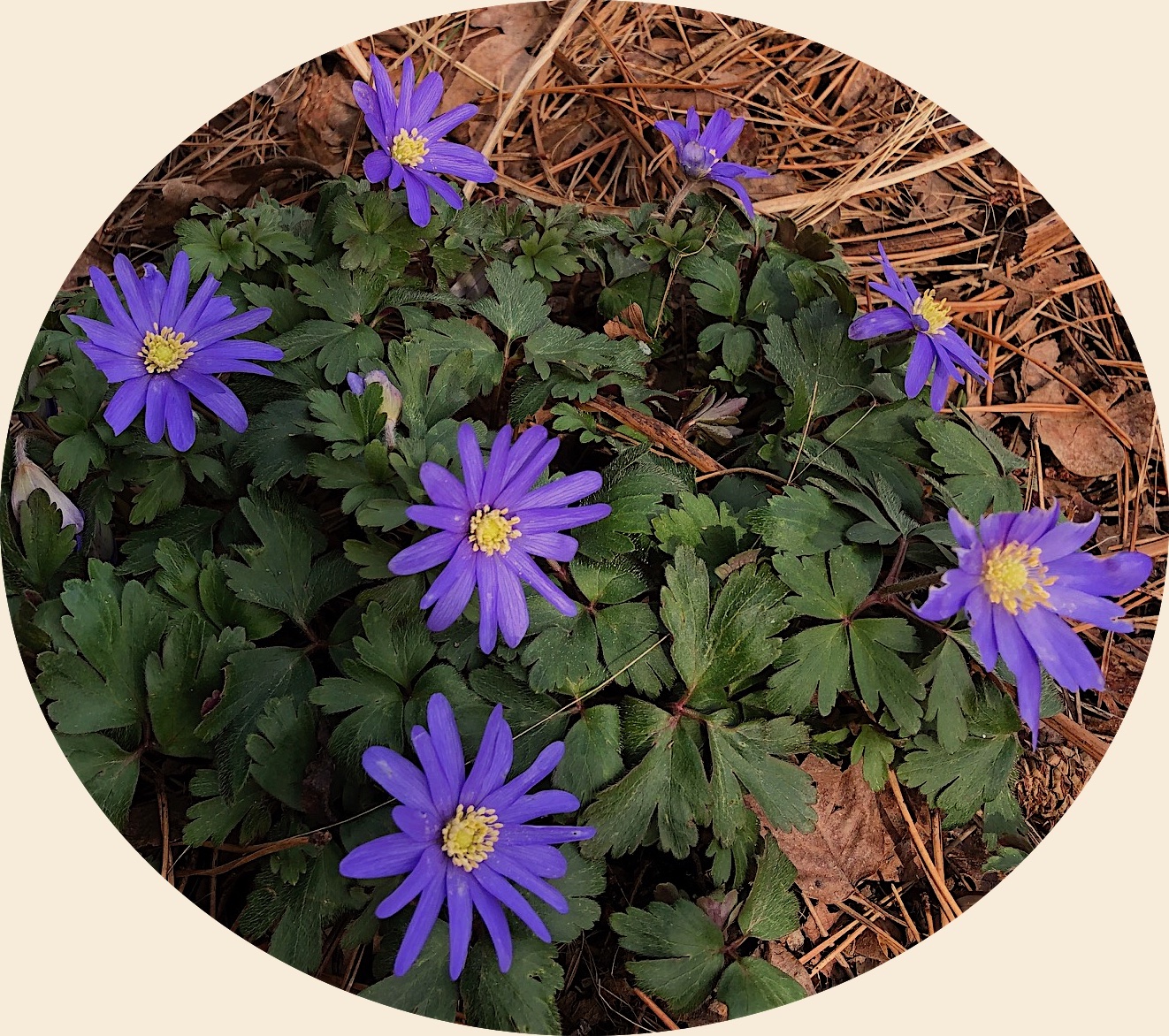
At the park we found these “Blue Shade” Anemone / Grecian Windflowers.
At the demonstration garden, some industrious grower was well rewarded by cruciferous edibles that survived the winter, then bolted out these cheery yellow blooms.
This first outing of spring was overcast but warm. A dapper Spotted Towhee, black and white with rich burnt-orange side stripes, flew up to a twig and shrilled his ratchety “Whaaat?” Frogs were out in force with their husky little sleighbell noises. “As they hear us crashing past or even crashing closer, they will keep merrily croaking along,” I told Angelina. “But as soon as you stop, they will stop too and nestle in silence under the ooze. I keep trying to sneak closer, but any amphibian is enough to outsmart me.” For her nature edification I demonstrated by stepping off the path and holding still. Sure enough — freeze and be quiet, and their songs will disappear.
Here is half a minute of their happy ruckus.
They’re louder in person. As are we all.
At the end of our power chat outing, the dogs got their yums and Angelina bought us both a slice of pizza. She and I talked the entire time about the nature of evolution, people and dogs as pack animals, cooking, gardening, parenting, stages of grief, the state of medical care, health, and everything else.
Petting the dogs goodbye I told Angelina, “You and I have exhausted every possible topic to talk about. We ran out of words. Unless we can think up something else to say, this friendship is over.”
(That lasted five hours, and then I had to go bring her my extra fluorescent vest so she can walk the dogs with safety after sundown. She offered me an avocado and a really nice extra chair made of wicker that I might take for my studio.)
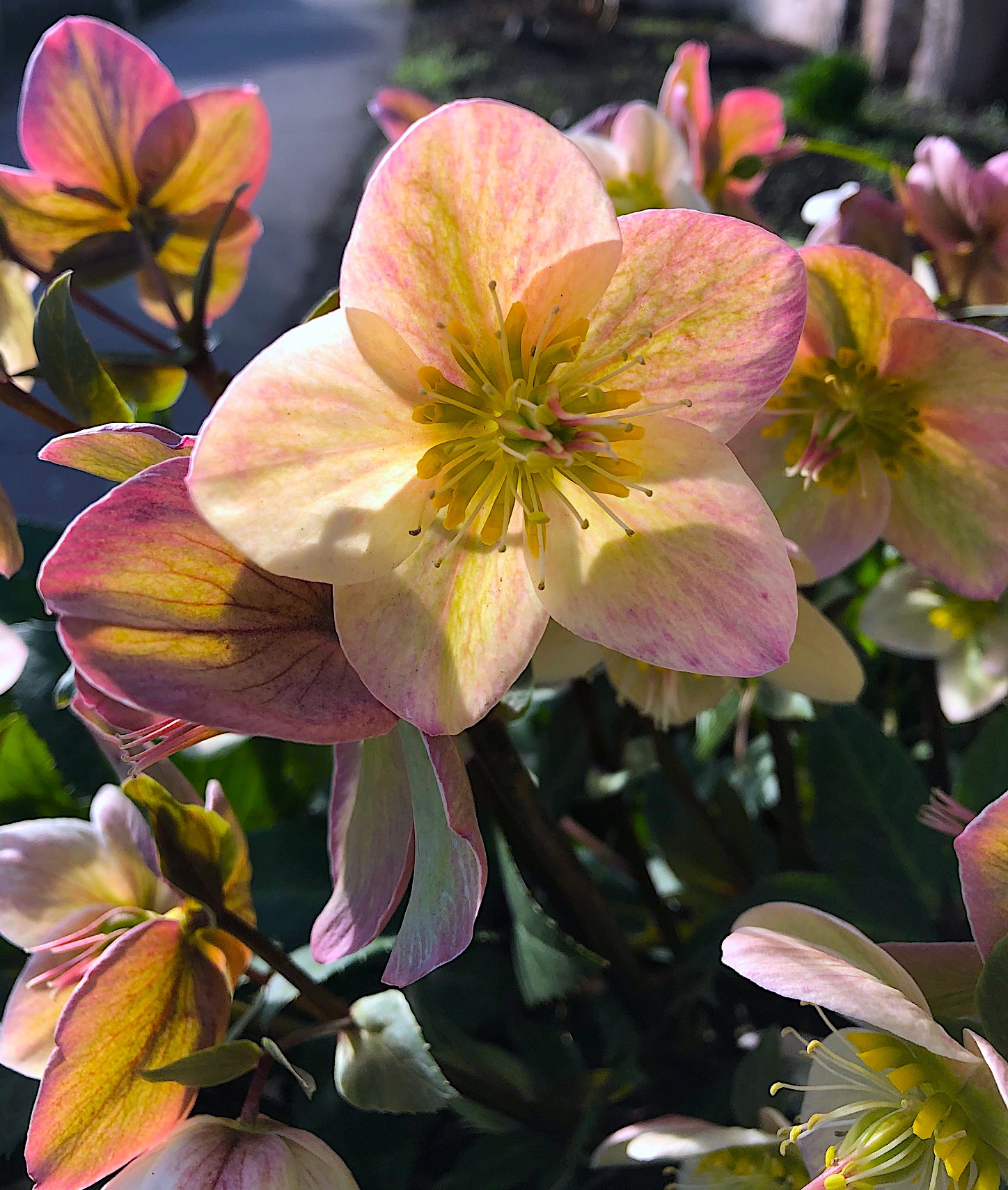
Photo: These winter-blooming Hellebore flowers have nothing to do with this subject, but they are more photogenic than my new support hose.
The Usual Huge Disclaimer: Ask your medical care team. Don’t come to a Russian language major for your health information. This is basically a journal entry about the past couple of weeks, and is not meant to apply to anybody else.
Extra Disclaimer: Here’s a show tune I wrote to lighten the mood around this topic. I don’t own the rights to the copyrighted melody or the pastoral Rodgers and Hammerstein lyrics named after The Sooner State. That said, if you want to sing along to this, go right ahead.
Lyyyyymph / Edema
Diagnosis. What to do with that???
And initial fears
when all these years
here I thought my ankles are just fat.
Tweeeeenty / Thirty
is prescribed for these new pressure hose.
They’re the right tight sort
for vein support
Iffen I can pull them past my toes.
Driiiiink / your water
ease up flour and salty snacks and sweets.
Keep up active motion
Slap on lotion
Take some break time putting up our feets.
So here I’ve been hiking around for years on stout thick stiff ankles with chapped dry flaky reddened and often-itchy skin, and thought nothing of it. Windburn made it worse, and so did sunburn, freezing air, gluten binges, and picture-taking strolls in the cemetery and golf course with, just maybe, chemicals to keep those lawns green. I just slapped on coconut oil and resolved not to scratch, and went on with life. Finally I ended up in the ER with an ankle staph infection, apparently after some trivial unnoticed skin break. Ever since then, doctors have been asking questions and referring me hither and yon.
A wonderful vascular nurse determined that it’s lymphedema. She prescribed compression knee-high stockings that apply 20-30 mm of graduated pressure, tightest around the ankles, to wear during the day but not at night. Apparently they help keep the lymph from settling down in the lower legs. She instructed me to put them on first thing in the morning, before the legs start to swell up. She explained that we’ll have to reduce the mechanical swelling in order to let the skin heal. She recommended frequent changes of position and exercise breaks. She referred me for a vein valve leg scan in April. (If there are defective valves close to the skin, they might be able to fix them. If valves are defective but deeper, we’ll stick with compression stockings.) She also referred me to an occupational therapist.
The 20-30 mm stockings from the drugstore are like a circular-knit stack of firm rubber bands, tightest at the ankle. My arthritic hands couldn’t get them up over my bent bunion toes. Uh-oh. I asked Angelina, Power Nurse at Large, to help me. “Am I gonna have to come over to your house every morning at 6:00 a.m. so you can get me dressed?” I asked her with some anxiety. “Maybe,” she said, cheerfully giving it a try. She couldn’t pull the stockings over my bent toes either. Over the next few days I kept practicing stocking techniques, all of which left me in hand pain and close to tears. I was failing as a lymphedema patient!!
Luckily for me, the outstanding occupational therapist immediately calmed me right down off the ceiling with her reassuring and cheerful solutions.
First, she defused my panic by starring me in a fashion show of wrap-around and other support garments, plus hand-held gizmos for pulling them up easily. It was really reassuring and fun trying them all on. Then she gave me a wee thin floppy square of Dycem, a wonder substance which on hard floors provides a non-skid surface. (Wash it with a drop of soap and water, and dry it on a lint-free surface to keep up the non-skid tacky qualities.) She put the Dycem on the floor, and coached me to put my toes in the stocking and slide my foot toe-to-heel. To my delight, the stocking slid right on like magic! No strain on my hands! Next, she gave me garden gloves with grippy nitrile palms. The gloves gripped and smoothed the stockings right up to the knee!
She showed me an anatomical chart of the lymphatic system with its channels and nodes. Our lymphatic system carries and cleans away dead white cells, cancer cells, and waste products. When lymph slows down and backs up into the tissues, it separates the skin more from the muscle and circulation system; then the skin breaks down, loses lubrication, and become dry and thin and fragile. Lymph pressure pushes red blood cells out of the vessels and into the tissues of the lower leg, causing iron oxidation and a brick red skin color (it’s basically rust).
She taught me lymphatic drainage massage to do for 40 minutes every day. We can use diaphragmatic breathing as well as soft gentle directional strokes (“like you’re petting a cat”) to massage and stretch bare skin along lymph channels and nodes all over the body. Stroking the lymph layer upwards and clearing it on its way (starting at the top, and working our way down) will allow the circulation to start healing the skin.
She also explained that the ankle skin needs to be kept clean and hydrated, with water-based lotion. A lotion with water as the first ingredient also helps during the massage, to gently stretch the skin. We need to avoid any activity that causes reddened skin. When the skin is reddened by topical allergens or cold or heat (overuse of hot tubs or saunas), the body will rush liquid into those tissues. (I did ask her about my Wim Hof Method daily cold water wash. She thought this short dip in cold tap water sounded okay.)
She emphasized the need to avoid cuts and scratches, because lymph is so rich in protein; any bacteria entering stagnant lymph will feast on protein and multiply rapidly. If the ankle skin shows redness and swelling or a rash, infection might reach the bloodstream and require intravenous antibiotics. At any sign of infection, it’s time to head for Urgent Care or the ER for immediate treatment.
She also emphasized the importance of hydration, drinking enough water, and cutting way down or out on flour and sugar. She suggested that I photograph the ankles so that we could measure our progress before my followup session.
I asked her, “Could this influence our emotions? I have a literal sinking feeling, a deep discouragement that is very hard to forge through.” She said “Water is heavy. If you are carrying extra water in your legs, that can definitely add to a feeling of heaviness.”
I went home wearing my stockings, and practiced the massage and skin washing and lotion that evening. But if only I had taken that starter photo before the OT session. Next morning I took a look. Whoa, thin legs! What? Are those ankle bones? Where did they come from? Since then the ankles look slender, and the skin is much softer and hasn’t had a single itch flareup. Even foot circulation looks better, with a healthy rosy color and warm feel.
That day I bought nitrile gloves and three more spare pairs of 20-33 mm stockings. (I wash each pair after taking them off, and dry them, for a supply of fresh pairs each day.) Then I shopped from store to store looking for a water-based lotion with water, not oil, as the first ingredient, and with the fewest additives. The simplest formula was Trader Joe’s “Nourish” Hydrating Hyaluronic body gel cream in a pump bottle. The pump doesn’t work, so I have to drag lotion out of the bottle with the pump stick and slop it on the skin, but oh well.
The new routine is an extra 40 minutes in the morning. It’s Wim Hof breathing exercises and lymphatic drainage massage, then a cold water wash (cold tap water feels wonderful for leg circulation and mood), then drinking plenty of warm water, then lotion, then letting the lotion soak in, then with the Dycem as an aid sliding the stockings on for the day. At work it means frequent sitting and standing changes, and breaks in the conference room holding the legs up against the wall. At night it’s all the steps backwards — stockings off & washed, massage, washing, lotion, then earlier bedtime and sleeping with the feet elevated on a cushion.
That is a whole lot of privilege and pampering. During the daily routine I think sadly about the working women back in the Soviet Union, forging around on their feet all day long. Some had massive ankles with rolls of swelling and the skin weeping fluid right through their heavy stockings. And even here, how many single moms have time to fuss with doctors and self-care like this? What about the many people I pass all day, sleeping in their tents on the streets? When do they get clean lotioned skin and the right stockings and adequate diet and rest?
Well, if I neglect this condition, that will not make me more useful to society. This is my homework for now. Lymphedema is chronic and apparently permanent. It’s painless and subtle and gradual, and I wish that someone had diagnosed it for me years ago. Like other gradual conditions, it can coast along for decades. But it can also make us vulnerable to rapid complications such as skin staph and strep infections, cellulitis, strained vein valves, and stagnant circulation leading to blood clots and embolisms. Our task is to slow down that progression in the future.
Maybe someone will read this, and start to wonder about their own ankles. Do they look swollen, or feel stiff or itchy? Does the skin look red, or have cinnamon-colored dot points? Do even soft loose low socks leave red lines on the skin? A medical provider can do the thumbprint test, where they press in a thumb (ow!) and then gauge the depth of the print and how quickly it disappears. Those are all signs to ponder.
Live and learn! This whole adventure is food for thought, and a lot to be grateful for.
Peas are jolly little troopers, happy to be planted even before the temperature warms up. According to the seed packet, they can go in the ground 4 to 6 weeks before the last frost date, especially if the soil temperature is above 40 degrees F.
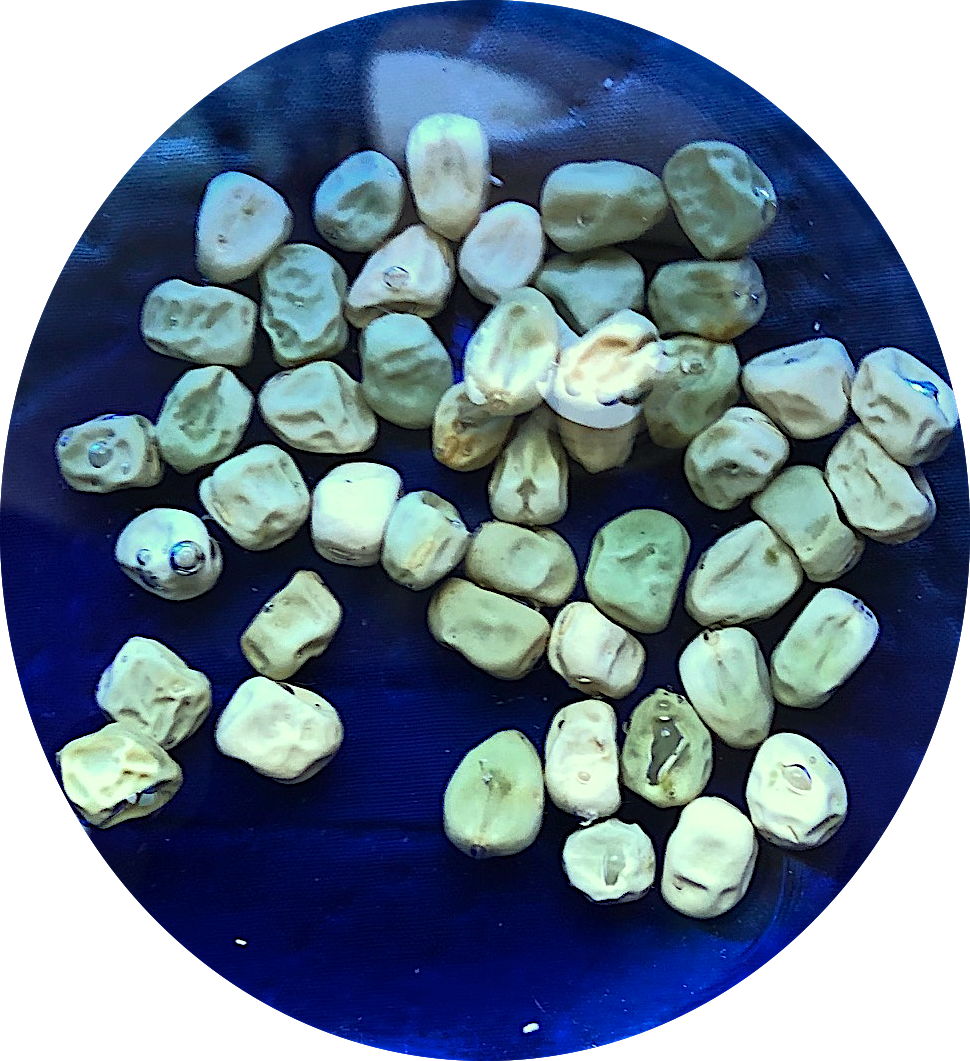
Here are the peas at bathtime Saturday morning in a blue glass bowl of water for a good 24 hour soaking.
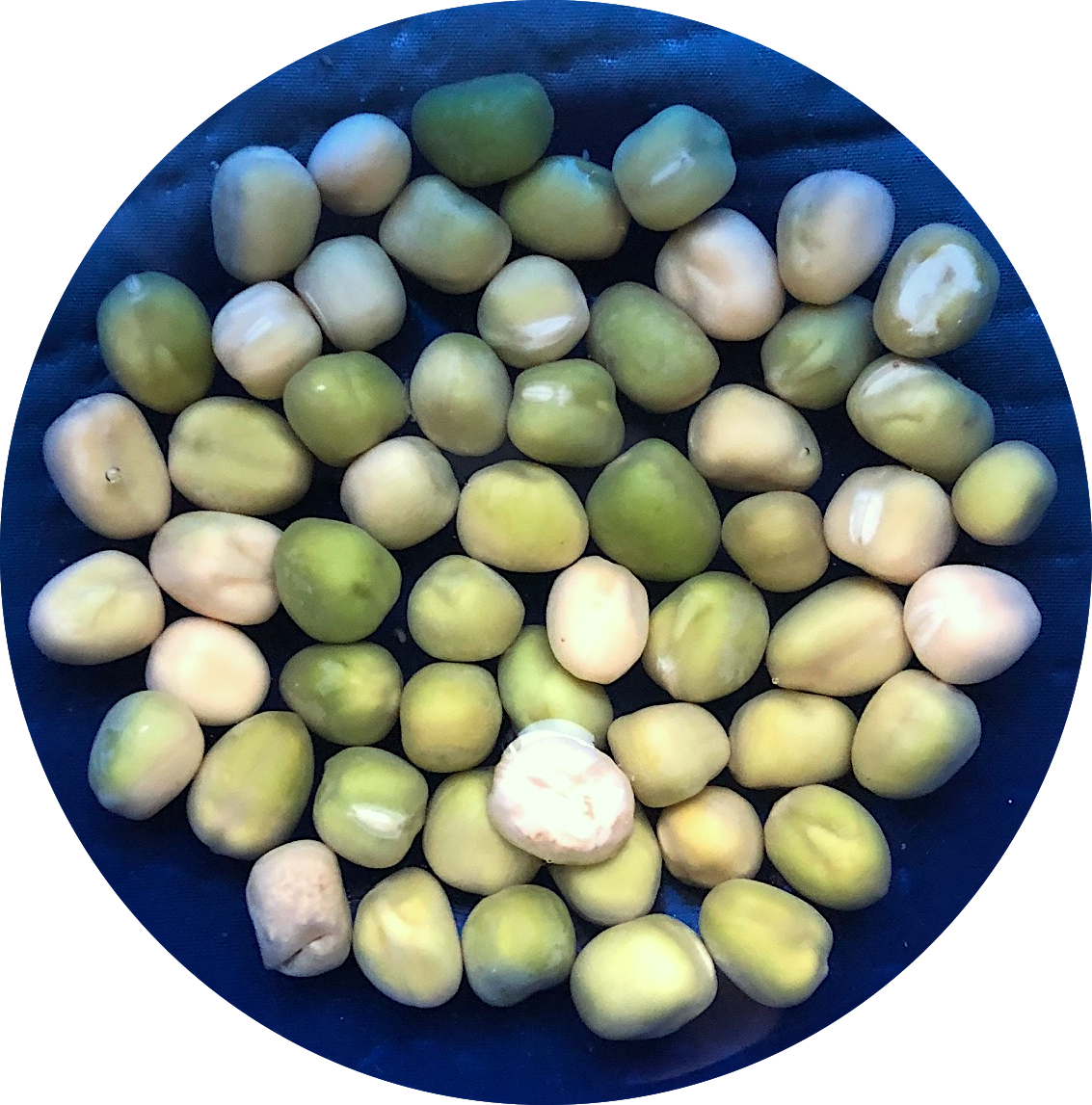
Here they are on Sunday morning, all plumped in together. The soaking is meant to give them a head start on germinating once they are in the ground.
On Sunday morning, hauling out of bed was just not my favorite idea. But those peas needed to get in the ground, so I trudged straight outdoors aiming for an optimistic mindset and humming “Why do fools fall in love?” with the peas and 25 bamboo stakes. The stakes went along the raised garden bed. Each stake got two six-inch holes dug beside them, hopefully deep enough to confuse the crows. Then the 50 or so peas went into the holes under a layer of garden soil.
It’s good luck when peas go in the ground while the weather is chilly and windy and damp. They’ll hatch along on their own and find their way up to the sun. If all works out well we could see 50 little shoots perk up through the ground on or around February 22. If all works out even better, we could have peas starting in 70 days, or early May. Peas are a very pretty sight, and they are dramatic and fast-growing enough to amuse the neighbors. Which is, after all, the whole point.
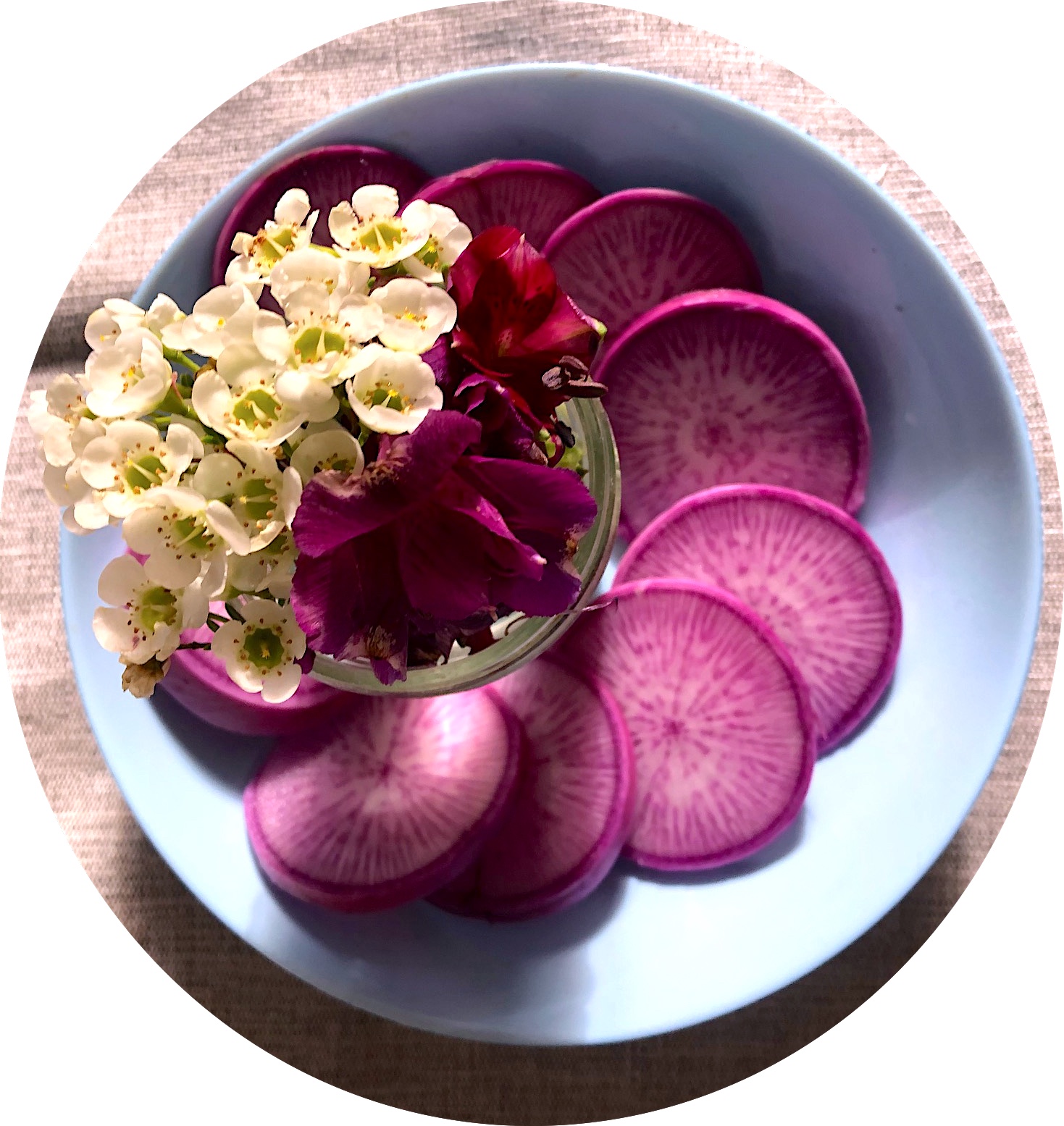
Meanwhile here’s another view of Mrs. Wing’s daikon, as pretty as… well, as a picture.
It would have been really thoughtful and considerate of me to tell the Wings that for cataract surgery #2, I was going to go ask Angelina to take me to the hospital instead.
And why? Because for cataract surgery #1, it was so wonderful to have their perfect help — doing without the family car for two mornings, and rearranging their schedule. Thanks to Captain’s winter-weather navigation and motoring skills, the surgery and the followup appointment next day were a breeze.
Me being me, my first conclusion was “That was great! Therefore, I would never venture to ask this wonderful family to help me with surgery #2. Instead I will distribute this huge imposition elsewhere so that no one set of neighbors needs to be burdened twice.”
Ya whatever. But because I didn’t dream of asking the Wings to go again, I didn’t dream that they would think they were going to be asked again. Therefore I did not talk to them of my decision. Result: they waited patiently in readiness, having noticed that cataracts come in pairs. Finally they found out by chance (with a glance at this blog) that I’d moved on and hit up someone else without ever telling them, or explaining why.
Captain called me this week with a message from Mrs. Wing, asking me to drop by the house on my way home. The call was a pleasant surprise. “It’s so nice to hear from you!” I told him. “After imposing on you for that surgery, I was afraid to contact any of you for fear you would be upset by how much work that was.”
Tactful moment of silence on the phone. “We were waiting for instructions,” he replied. “Then we read that Angelina took you to the hospital instead.”
Oh dear goodness. I am such a dork.
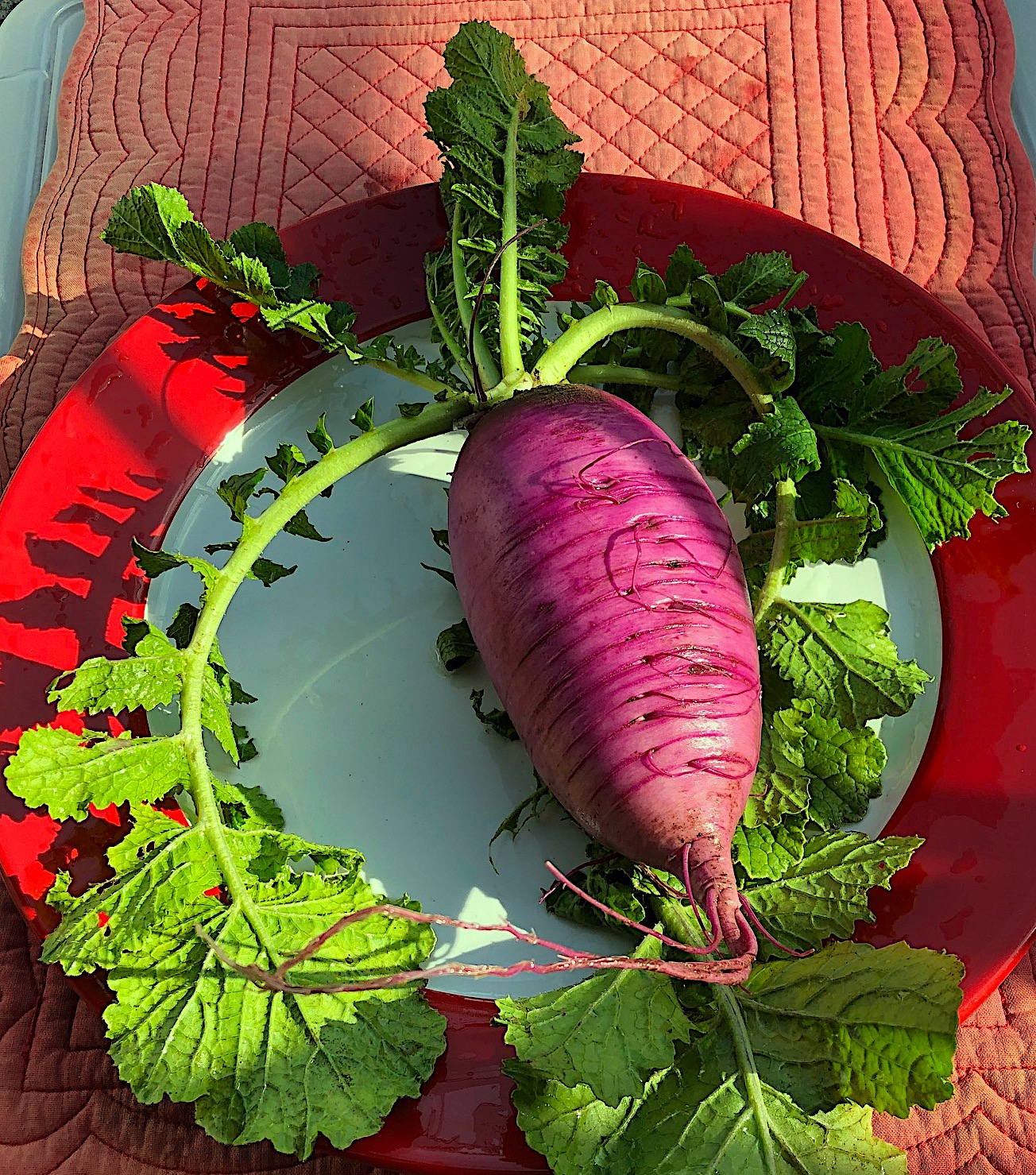
For some reason, they are still speaking to me. Mrs. Wing gave me a whole sack of fresh vegetables from their expedition to the grocery wholesale store, along with a couple of home-baked supersize macadamia cookies AND part of her harvest of winter purple daikons which grew all sturdy in the cold and snow. Here is one of them, showing only part of its lavish healthy foliage. They really are this beautiful.
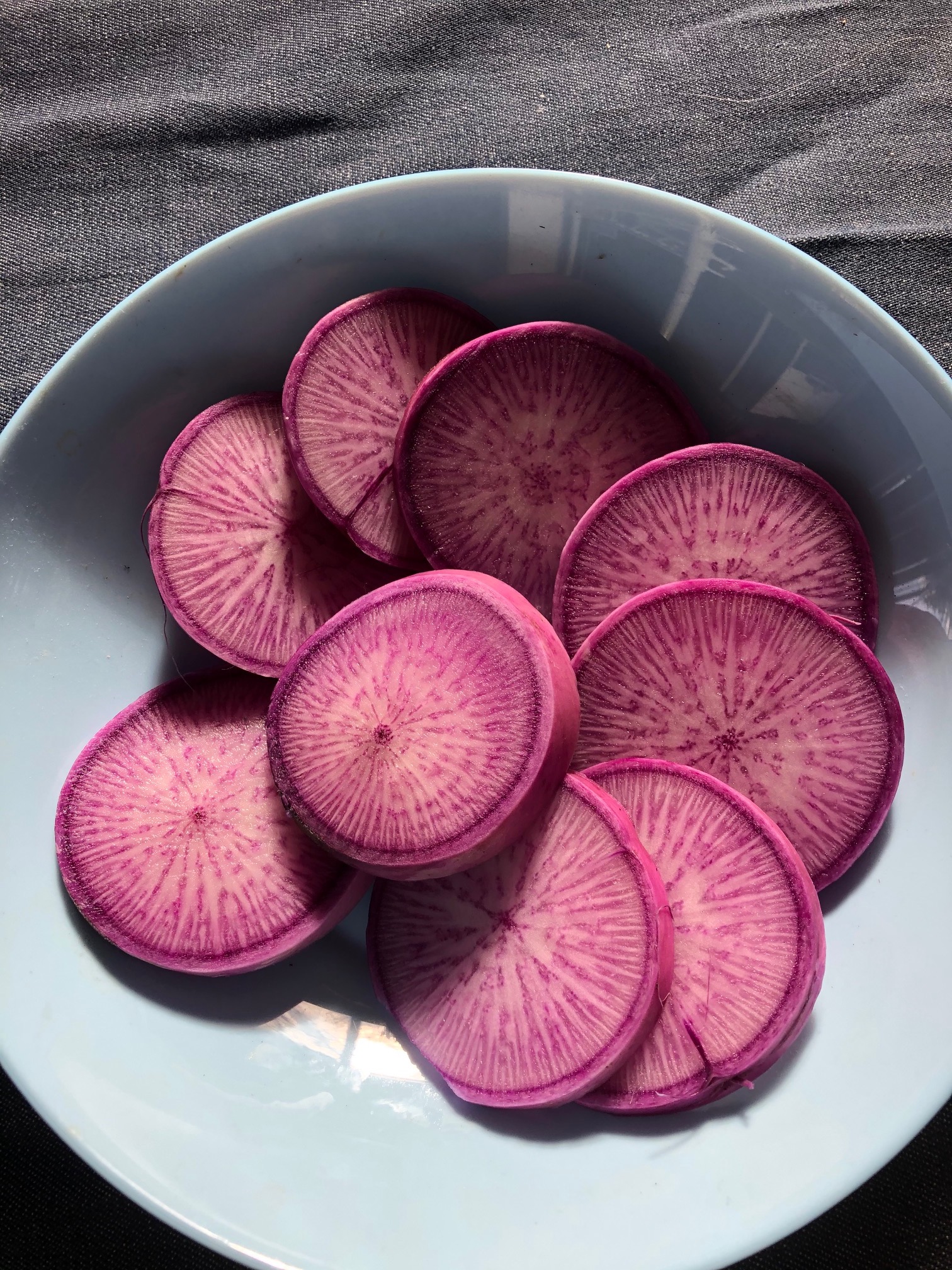
And (like the Wings), they are beautiful not only on the outside, but at heart:
Each nibble is perfectly crisp and bursting with juice, and remarkably sweet. Then the hit strikes — wow, what a spicy kick! The foliage was great too in long-cooked potassium broth with vegetables and a bit of wakame, and then the simmered leaves had a good flavor for munching. Those slices will make beautiful kimchi with some grated Asian pear, garlic, ginger, anchovy sauce, and cayenne. It’s a much appreciated home-grown super thoughtful gift.
Well, that is a life lesson for me. When God sends the best helpers, it is my job to be easy to help. That starts with updating everyone on what might be needed in future, and how best to strategize so that no one is too burdened or is left out and wondering about the plan.
Wings never wait around to be thanked or praised. But thank you all the same, dear neighbors. Maybe I can find some way to show appreciation back for all that you do for us.
Tonight we neighbors (is there a feminine plural? neighboresses?) are hurrying down to Angelina’s for Netflix and pizza. The group hasn’t picked out the movie yet. I’d like one with a Gospel message of redemption and salvation. But that may not be the case, judging by the 2023 film trailers I watched last night with the sound off, finger poised to click the mouse button to the next selection. Yike. Depending on the title I may have to leave after our supper of fellowship (is there a feminine singular? galship?).
But no matter what, I’m bringing her a salad for her weekend dinner.
It has steamed kale with grated raw carrots, red onion, boiled firm tofu, boiled eggs, chopped roasted almonds, goat cheese, yogurt, dried cherries, apple cider vinegar, olive oil, paprika, and a sprinkle of tiny fennel fronds that sprang up from an old wintering stalk out in the garden. Angelina is a grand-slam cook and comes from a background of classy restaurants, so it was necessary to think up something marginally gentrified. Besides, she was a Godsend last Saturday taking the lion’s share of weight when we wrestled four 60-pound sacks of topsoil from her car hatch to the garden in the freezing rain. Hopefully she will like the salad.
I’ll bring something to wrap around my feet and legs too, after leaving shoes at the door. The Dog Pack have decided that I am delicious, and are forever looking for an opp to wander up the couch and start nibbling my toes. That’s caused by regular foot and ankle applications of coconut oil. Apparently coconut oil must be some form of olfactory dognip. It would be interesting to see how the dogs react to alternate lubricants week by week — lard, schmalz, marrow, sardine can oil, or birdfeeder suet. As it is now, their collective greetings are all bouncy glee. “It’s Mare! Look everybody, I’m totally sticking my head up her dress! You can too!” Now I could protect my feet by sticking them in one of the tubular cages of chicken wire that we use in summer for the tomatoes. But for a visitors’ parlor Emily Post might vote for my rolled yoga mat. The yoga mat turned out to be good protection. The dogs still found great entertainment value in vaulting up on to my lap for a bite of my food. Whenever they try that, I give them a soft hiss and a firm poke, and they frolic off and pick some more hospitable lap. But it’s interesting; they are still just as pleased to see me every time. And they’ve figured out that if they edge closer in calm submissive fashion and just snuggle up next to me for a nap they know I’ll pet them, so it’s all good.
Update, morning after: We watched the first 5 episodes of a program called “Ted Lasso.” It was a pleasant surprise with interesting character development. I’m re-reading The Brain That Changes Itself by Norman Doidge, so it was interesting to watch how Coach Ted’s brain worked. The character shows hyper-developed and hyper-attuned neuroplastic connectivity skills for matching people up with their best opportunities for personal growth. For example, during various scenes Ted keeps passing by an ignored street musician busking on the street, and always stops to give him pocket change and some word of encouragement. In the finale to episode 5, when a famous celebrity doesn’t show for a benefit concert, Ted steps outside and brings in the busker (“and now, live from… outside!”), and everyone jumps up and starts dancing and has a grand time.
Angelina not only served an ample selection and portions of yummy food, but made a very good and considerate entertainment choice that pleased all of her guests. She’d make a great soccer coach herself.
The usual big disclaimer: For goodness sake, this is not medical advice. This is just one person feeling her way along, not an endorsement of cataract surgery or a prediction of anybody else’s results. This does contain an opinion about the color of my favorite breakfast bowl in my cabinet, but you could already pick out your own dishes and fix your breakfast without my say-so.
In these weeks after surgery, it is still a surprise to wake up and look outside the window. For years, the houses in this complex were turquoise blue. Now after surgery those same houses are heron slate gray. My favorite breakfast bowl was tangerine golden-pink. Now it’s pure pale rose. Those true colors, those slate houses and rose dish are new acquaintances, fresh every morning.
Of course the main dramatic change is sharp visual acuity. All day every day it’s amazing to live without prescription eyeglasses. (Of course, without eyeglass frames it’s easier to see how tired my eyes look, and how sensitive they are to light. But plain tinted safety goggles cover that pretty well.) After three years of wearing a Covid mask, it feels much safer to maneuver without the fall risk of steamed up lenses. (Stepping into a grocery store or library or clinic, I pull up my mask. Then to avoid the steaming I still reach up to take off glasses that aren’t there.) It is amazing to just type on a computer and tell the time on a wall clock and identify my books by title instead of topic order and binding color. Before, on the street corner there’d be buses materializing in the distant traffic, and I’d be there with glasses on bobbing and weaving and shading my eyes trying to figure out what the route number was, worried that if I flagged down the wrong bus and then had to wave it away the driver might be upset. The other pedestrians, the other deer in the herd, they didn’t seem to stare into the headlights at all; when a bus appeared blocks away they could just instinctively sort themselves out by stepping closer to the curb or by backing away. Now I was finally starting to catch on to the same hat trick and could blend in better with everybody else. So that’s all a marvel all day.
Next month the eye clinic team will run some tests and figure out new ideal corrective lenses. Now, the focus going forward is good care and prevention for any potential retina issues. Unfortunately, that is a risk after cataract surgery. (During recovery, resting alone in the dark, that possibility caused my melancholic mind to dredge up the “Flowers for Algernon” dilemma, and if your 8th grade curriculum didn’t make you read that then for sure don’t read it now.) One night it scared me to view what seemed to be a new internal black floater shooting across the visual field; what a happy relief to find it was a spider zipping across my monitor screen. But instead of fretting about the future, it is far better to research and learn all the symptoms of retina difficulties, to be vigilant, and to keep communicating with the care team. So, there’s an Amsler Grid taped to the bathroom wall for frequent vision tests. There’s a retina checkup in two months, and regular checkups after that from now on. This week I alerted the team to report a subtle vision glitch — an early warning? (The surgeon wrote right back, giving the phenomenon a scientific name and explaining that this was a normal short-term illusion and ought to resolve soon. He was right. It did.)
[Memory interlude: That same surgical team did a brilliant job of repairing a retina tear years ago. At the time I told my health-care colleagues in our medical department, “I need to be out of the office for emergency surgery. My retina is detached! They have to re-attach it again. Will report back in a few days.” My cubicle mates made a point of welcoming each other back from any medical time off with get-well cards, flowers, balloons, and cake. But for my return from retina surgery? Nothing. Not a soul asked how I was, or whether they could help. They even avoided looking at me. Finally, a an old-school high-level physician days from retirement stopped by my desk after hours. Looking around and clearing his throat, in gruff but obvious concern he said “So… how’s the rectum now?”]
Another rumination during rest days in dim light has been awareness of shame. It’s a lifelong tension, like chronic hyper-vigilant armoring in muscles and nerves. Some of it comes from being a failure at vision improvement exercises taught by inspiring authors like Meir Schneider. (When Mr. Schneider came to town I joined a large group for a two-hour workshop. He was an outstanding nurturing teacher. He would have been the first to say to me “Whoa, you’d better get a cataract exam.”) Mostly, shame is the memory of people’s frustration and ridicule, their assumption that near-sighted behavior shows stupidity or disrespect. It was the Sister of St. Dominic who used to comically mimic the gobsmacked look on my face when I strained to read the chalkboard. It was grownups warning “Stop squinting; you’ll get wrinkles,” or “For God’s sake come on, look alive!” or “Boys don’t make passes at girls who wear glasses!” (I didn’t know what a pass was, and didn’t even want boys to throw a football at my head.) Now even after surgery, people still say “You were crossing the street at the WALK sign, and when you stepped in front of my car I honked but you didn’t wave!” (No, I was too busy fleeing the path of some yabbo leaning on his horn.) Last week I ventured out at night, wearing wraparound black goggles against the glare. I had to scoot two blocks from bus to train in a crowded but moderately distressed neighborhood where people run about with guns, knives, and tazers. A chipper neighbor (who knew all about my surgery) charged right up behind me on the dark street. He looked forward to how happy I’d be once I realized who he was. When he lunged at my head I spun around with a skewering combative stare, recognized him, and stared even harder. He burst out laughing, backed off, and hurried away. Later he said “Hey!! Even after you saw it was me, you STILL gave me an angry look!” (This behavior must be a vestigial artifact in the deep reptilian brain: Act like an apex predator. Tamper with a woman’s friend-vs.-foe meter. Laugh uproariously at her reaction. Fortunately it’s a gag that most men set aside once they discover Play-Doh.)
On the first day after surgery #1 and the checkup next day, I left the house without my eye shield. Still feeling tired and chilled, I bundled up in a long heavy dress with trousers and high boots and sweater and black hoodie sweatshirt and head scarf and cap and black goggles. I walked very slowly, looking into the distance up ahead, to let the brain balance the new left and right visual fields. For a quiet pleasant route I walked around the block bordering the golf course, an exclusive little cul-de-sac with a security guard inside a booth who waves back when I wave at him. Taking small steps, enjoying the fresh air, I suddenly heard a sharp thwack. Oh no! A golf ball! I’d only been near the golf course at sunset or at dawn or on moonlit nights, never a weekday afternoon. That called to mind the sign posted right at the entrance:
Yike! I shielded the goggles with my hands and ducked my head. Listening hard for any more thwack activity I turned my back to the putting green and walked sideways for the next three blocks, one foot at a time, slowly fleeing for the exit. Soon a little maintenance cart came putt-putting by. The course worker peered at me, and we exchanged waves. Then another little cart came by with two workers, conversing with each other in Spanish. I hollered “Hola Señores. Qué tiempo lindo! Tengan an buen día!” [Wait, where are the upside down exclamation points on this keyboard?] The men hollered back. More handwaves. Another cart. Waving, smiling. The carts kept circling around and trailing along behind me. It looked like a Shriner parade without the fezzes. Maybe the security guard contacted them on walkie-talkies? “Slow-moving intruder. Spanish-speaking granny moves off-kilter, difficulty walking forwards on pavement. Monitor scene. Hover while she heads toward exit. Keep waving.” Finally I sidestepped to the gates, and with more waves the friendly convoy doodled off and back to work and I went back to bed.
This has all been an amazing life adventure.
And just maybe some day the Goodwill housewares shelf will have a dish in a genuine shade of my lost tangerine. I might just buy it and bring it home.
Mr. K. met me three years ago. I’d had the same hairstyle all lifelong. It was thick handfuls of curls, brown with an early streak of gray, layered in a comforting thatchy fleece falling over my eyeglasses, around my face, and in younger days down the back. It was always nice to hide under all that hair. All it needed was a weekly wash, and a good backwards brush & toss every morning.
“This is wonderful thick hair,” Mr. K. marveled, during those first few appointments, “for a woman your age.” I was going to put on a straight face and joke with him that I’m nearly thirty. But he was so sincere and congratulatory and kind that I just didn’t have the heart. His haircut technique was terrific, and I’d go my way feeling happy for Mr. K’s help.
Then, three years ago Covid lockdown came along. One day a news article mentioned a pandemic-related hair loss called telogen effluvium. That sounded curious to me. Why would lockdown be causing hair loss? I got up and went to the mirror to take a look. Holy smoke! Sure enough: receding hairline, thinning on top. Over the next few months the hair grew straight and silver and baby fine. Salons were closed for months. But that was not an immediate issue, because the hair had simply stopped growing.
Finally Mr. K. and I met again. Like a true professional he said not one single word about the change in my hair. At first I worried that he would be depressed having me as a customer, and I should switch salons. But he simply shifted gears from congratulations and enthusiasm to a tactful kind introspective approach. To his enormous credit, now he devoted even more time and thoughtfulness and painstaking ingenuity working with half as much hair.
Mr. K’s gentle respectful diplomacy makes me appreciate him very much. Not everyone in his profession shares his kind approach. Some time ago, an independent high-end haircutter made the news when he specified that he’s be cutting hair for customers under the age of 40 only. The rationale apparently was that hair eventually loses its ability to stack and bounce and spring back with the same resilience, and would not hold up properly in the sleek geometric styles for which he was famous. I guess his cuts were the equivalent of ortho-molecular gastronomy, where the top of one’s head should look as striking as plated citron whiskers set alight over caviar foam. Anyway, local codes of fair public business put a stop to his habit of turning away customers who looked to be over 40. But his sentiment is not unique. At one establishment here in town, one which did not accept appointments, I showed up three times asking for a haircut. Each time the glam young employees welcomed their peer walk-ins who were equally young and equally glam, while flatly ignoring me. Each time when I asked gently why no one was speaking to me they snapped that “we’re busy,” turning away the Boomer who believes in loyalty, courtesy, and good tips. That establishment has since gone out of business, not before slathering on another layer of shyness to the prospect of going for a haircut.
Any fashion-based scrutiny of my physical appearance feels crestfalling. A haircut might seem a pampering hour of fun to other women. For me, it’s worrying that staff might say “You are too old to look good in one of our haircuts. Your hair does not meet our high standards. We’ll just have to kill you.” To be fair, no salon employee has ever chased me with clippers and a spray bottle. But those appointments from now on will mean confronting that hair loss issue, under competent appraisal and a well-lighted mirror.
Throughout childhood, the strong message among the grownups was that to attract a prospective suitor, a girl’s most important virtue (other than, of course, virtue) was a head of good hair, preferably light in color and naturally curly. At holidays and visits the women would greet me by examining and discussing my hair, making sure that it was still curly and thick. They would lecture me on the importance of hair upkeep as a ticket to a good future and good marital treatment. While mourning the death of her own mother, Mom kindly offered me the consolation of the ultimate compliment from Grandma, who among her final words said: “Mary has NATURAL CURLS. Don’t ever let her cut them.”
All that hair talk was their way of saying “We just want you to be happy and well treated.” How dismayed those salt-of-the-earth elders would be, to see that hair fading away now. Or maybe not, from their point of view in heaven now? And as a Christian who believes in eternal life, just how much upset should I invest in such a trivial concern, and for how long a time? From the standpoint of eternal salvation, none and none. So at a beautiful local clothing boutique run by a talented sewing cooperative of Muslim women, I stocked up on knitted caps and headscarves for everyday wear and resolved to think no more of it.
It dawned on me typing this that the only person left who notices or touches my hair, or even sees it unveiled, is now Mr. K. Today I stopped by for a trim. Normally he works in conscientious silence, but today when I remarked on a song over the radio he confided that his life dream was to be a singer. He shared in a pure open-hearted way about how he practiced his craft, until war broke out at home. “In war it is hard to make your dreams come true.” His family lost everything, started here with nothing, and now he has built up his life perfecting top-level skills in several careers. It was a thrilling story. I listened in rapt admiration. Today Mr. K. must have spent 90 minutes crafting what is left of my hair. It must take great artistry and care to sculpt hair in this condition, but today he absolutely outdid himself. It’s a whole new style, blow-dried in soft sideswept silvery layers.
Leaving the salon I texted Angelina, planning to stop by and show it to her while it still looks so nice. “Omigosh, Mr. K. gave me a really nice haircut! He worked so hard! Bingo and Super Pup will not recognize me any more.” She immediately texted back “Do you think Mr. K. will cut their hair to look amazing too?” I answered that it wouldn’t hurt to try, and that she should leash them up and all come in and ask for a Three In One family special.
Then I went to the grocery store for root vegetables to make cole slaw, and daikon radish to make kimchi. A woman behind me in line said “MARY? Is that you?” It was Angelina. “Mary, your hair style! SO elegant. Turn around. Let me see. You look TEN years younger! Wanna ride home? I made you split pea soup.”
All those front-line workers and specialists who for the past three years have taken the brunt of people’s stress and have helped to keep this country from losing their collective minds? Well, Mr. K. and his team are among them.
God bless you, Mr. K. America is a better kinder country with the precious gift of your artistic talent and kind spirit. Some day I want to hear you sing.
The Usual Disclaimer: This is absolutely not medical advice. It’s not a promotion for cataract surgery, driving in winter weather, writing on one’s arm in ink, or anything else. It is a promotion of Angelina, but in her own circle she was famous before she met me.
After Surgery 1, there was a followup exam one day later, then again one week later. Then one week after that, we had Surgery 2. For round 2, I knew more of what to expect; at least my hands didn’t start shaking a whole day in advance.
Another winter weather front was on the way. Angelina and I kept in touch with frequent weather updates about the advisability of driving. Angelina made the final executive decision on the day in the dark street while innocent ordinary rain fell softly on our heads. I threw my backup gear in her car in case we got stuck under some highway overpass for the night through my own fault. There was a knapsack and duffle with bottled water, bread and cheese, fruit and nuts, chocolate, blanket, raingear, two fluorescent vests, emergency whistle, torch flashlight, and my cell phone charger so we could charge our phones at the clinic in case the power went out that day.
We were off.
Angelina is a conversation artist. She will whip the life story out of you before you know it yourself. Now I understand that she probably did that to put me at ease. In any case, the rain only spit some sleet at us once, then settled back to rain again.
In the clinic a surgery team member approached to check my identity. As for the first surgery he handed me a whole roll of adhesive labels pre-printed with my name, patient number, and date of birth, so that I could verify the information. That might be the point when they attached the same label to a bracelet on my wrist. He asked Angelina “And will you be the Getaway Driver?” He asked her for her phone number, and I showed it to him written on my own forearm in heavy ink for good measure. (“You can write my number on your arm too,” I told Angelina. “Later we’ll get matching tattoos.”)
In the prep/recovery room, the team greeted me and ran through the same solid checklist. “And which eye?” they asked at three different points, before the surgeon drew on a faint confirming arrow on my forehead. After answering three times I suggested “Let’s do the one with the cataract in it.” They asked me for the pre-printed labels, but this time I’d made the mistake of tucking them in to my waist pack, and placing that in my knapsack. “I’ll get them!” I offered. But no no, they kept me sitting still for my blood pressure check, and assured me that they’d flag down Angelina and get the labels back. Angelina as it happened had taken a stroll next door for a fortifying cup of coffee, so the team cheerfully printed a new label set.
Finally the team waited at attention, poised to zip my wheeled chair into the OR across the hall. At that moment one of them noticed that outside the window, the heavens had opened with a thick fall of enormous snowflakes. (Fortunately the huge clumped flakes suggested that we had warm temperatures, and the snow might be short duration. I certainly hoped so.) Because I was already in place with heated blanket and electrodes, a nurse darted to the window with her cell phone. She made a little video of the dramatic snowfall, then darted in beaming to play the video so I could marvel at the snow too. Her thoughtful gesture was an extra cheering touch in those moments as they zipped me across the hall and into place.
In the OR a dear team member from the first surgery said “Why hello. Thank you for visiting. Fancy seeing you here.” I assured him that there was nowhere I’d rather be. “A nice place. I love what you’ve done with it.” Even our surgeon laughed.
This time during very gentle slow deep breaths, it dawned on me lying there that I’d never felt so vulnerable or open or trusting to anyone as I was to this surgical team. That was a poignant thought, but at least the moment happened in good hands. It was a remarkable feeling. My body settled down into such deep relaxation that there seemed no need to breathe at all. I did keep breathing though, very softly and evenly, to maintain steady pressure in the eye and to keep from disrupting the monitors or the team. After 77 gentle breaths our surgeon said “We’re done.” I felt sorry to bid them all goodbye (“I guess we’re all out of cataracts now.”) but gave them a heartfelt thanks.
The original team member walked me back to Angelina. Anxious about the weather, and anxious to not keep her waiting, I zeroed over and grabbed the straps of the knapsack and duffle. “Aaaaaaah No!” Both our nurse and Angelina (a nurse herself) grabbed the straps to keep from lifting them. “That stuff must weigh thirty pounds!” Angelina said. “I hauled it with me to get my coffee. YOU can’t lift anything heavy after your surgery!” I remembered that of course they were right. While I meekly and gratefully obeyed, she carried my gear to the car herself. At least this time I was clever enough to pay for our parking. “Look at you, Girl.” She opened the car door for me. “You walked out of that surgery like it was NOTHING.”
The snow had tapered off, but the temperature was falling fast. Angelina drove home carefully, and she carried my things upstairs before I got into bed. Then the sleet set in, but thank God we made it home safely.
Up next: Recovery round 2, and helping the mind adjust to a new visual world.
Disclaimer: There is no medical expertise or advice whatsoever in this story. It’s not meant to promote cataract surgery or anything else. Your surgical needs, precautions, pre-existing conditions, life experience, impressions, medications, and everything else may vary completely. Ask your doctor, not some language major.
Dedicated to Captain Wing (designated Grownup, surgery 1), and to Angelina (designated Grownup, surgery 2).
__________________________
Before surgery, I followed a checklist.
List all pre-surgery, surgery, and followup appointments together copied to computer desktop, and printed out on the wall at home and the wall at work, with a copy for supervisor. Note them all as Away time in shared calendar, and payroll schedule. Print a binder for the office with FAQs that anyone might have. Set automatic replies to let everyone know I’d be off email for most of two weeks.
Print a “Cataract Adventure” binder with clear acetate page protectors to carry in to clinic. List date and type of surgery (and which eye to work on), Captain’s & Angelina’s contact information, parking garage and driving instructions, family contacts, primary care provider and other care team contacts, health history questionnaire sent to me by the clinic, insurance information, pharmacy information, religious affiliation, Do Not Resuscitate orders, and health summary (no, no medication allergies that I know of; no, no difficulty with anesthesia in the past; yes, neck has a full range of motion and can tip back; no, no chipped or broken teeth).
Clean house. Clear any fall hazards up off the floor. Clean off work surfaces. Take down pots and pans off their high shelf, to avoid pulling one down on my head.
Wash and iron all clothes.
Stock up all filtered water bottles.
Prepare a week of easy-heat low-inflammation fridge and freezer meals.
Print out a schedule for eye drop prescriptions (two different medications on a staggered schedule for the two eyes for the next four weeks each.)
Print an envelope wrapper for my cell phone with my alternative contact information if found.
Dedicate a workspace just for medications, eye shield, tape, and pharmacy instructions.
Schedule LOTS of time to drive to the hospital. Text meeting place, time, and plan three times in advance to designated grownup. Email them driving and parking garage directions. Emphasize the option to cancel in bad weather, or if their families need them.
Leave behind office keys and office access card and any superfluous items in a special box on desk.
Pack information binder, and lots of large and small dollar bills and quarters for pharmacy and parking garage.
Pack black glasses, orange tinted goggles to deflect blue light, and sun hat.
Day before:
Complete “e-CheckIn” function on clinic’s software.
Drink water. The team asked me to drink enough water the day before to be fully hydrated; they needed good hydration for easy access to a vein when they put in my IV.
Midnight, day of surgery: nothing by mouth; not a bite of food, and no beverages. The team emphasized NO milk, cheese, or other dairy products. (Captain Wing explained. In the OR when the team tips back the chair the patient can experience acid reflux, and dairy makes that a lot more uncomfortable.)
Morning of:
Check the weather for winter warnings. Call and email clinic in case they need to close. (When I called, the clinic let me know that they never close.)
Spread out blanket roll and pillows all ready for immediate rest time upon return.
Bring water and snack.
Meet neighbor outside at the meeting place 15 minutes early. (Both Captain and Angelina made a point of being right there 15 minutes early too, with the cars running and all warmed up. Or maybe they were parked out there all night? Who knows?)
On the way to surgery, chill out and cash in some trust in the universe.
The night before both surgeries I woke up often to check how many hours ’til alarm time, and to read bulletins from the National Weather Service. Our winters are extremely mild, with only regular soft rainfall, so scheduling them for December seemed reasonable. But our city completely shuts down in wintry weather, and all night the forecasters couldn’t tell whether we would get black ice and sleet, or six to ten inches of snow, or nothing. That left hours of time to sift through various discouraging thoughts like these.
If I were a reasonably loveable person, I’d have a family of some kind by now. They could come with me. I wouldn’t have to ask for this huge favor from wonderful neighbors who have families of their own to care for and had to take time off for this.
What if the weather gets worse? We’ll have to cancel. Then the surgery team will say “Forget it. You disobeyed our instructions. Now we’ll have to kill you.” (I don’t really think that is how surgical teams view the matter, but that inner program concerning authority figures is pretty well entrenched.)
Or, the surgery team might say “Forget it. You cancelled on the day for a 9:00 am surgery, so we’ll cross you off our Good Standing patient list and will operate only on other people. Even if we ever do let you back, when we operate on you we will not be in a good mood.”) I don’t think that’s what hospitals say either, but the OR turnover for this rapid surgery is so precise that the team won’t like just standing there with a time gap.
Or, we might drive there and the car might get stuck in bad weather or in a fender bender and it’s all my fault.
Or, somebody might snatch my knapsack with my cell phone, ID, and keys, right out of the arms of my good neighbors in the waiting room!
Maybe after two weeks off, the office won’t want me back. (Spoiler: They did. It was fine.)
It was sobering too, to ponder how much Privilege is wrapped around this surgery. It takes proximity to a good eye surgery center, a job with insurance and sick leave, a safe place to sleep and recover, washing facilities for keeping everything clean and sanitary, neighbors to drive, text and email access for the many clinic alerts, and enough mindfulness to follow all the physical restrictions during recovery and to log two medications on two staggered schedules for two eyes.
At last, it was morning for Surgery 1. We were breathtakingly lucky with the weather. The worst of it either held off for the next several days, or passed right by.
Captain Wing’s crack starship-level rush hour driving was a treat. The excellent car stereo played a fascinating mix of modern Chinese hits. All of them were strongly cheery, and lavishly orchestrated. Each note and beat sounded flawlessly produced. I even recognized a few words, such as Wo ai ni, or “I Love You.”
Then, a completely new vocalist swept in. Her voice was not only perfectly recorded, but had a naturally stellar command and tone. “Say,” I cried out. “This Chinese vocalist is really fine!” Captain Wing was uncharacteristically silent for a moment before tactfully explaining “Because she’s Sarah Brightman.” (I hope I did not hurt his feelings. With a few buttons and dials he smoothly swapped out the mixed musical menu for an all-Sarah program of opera and lighter music.)
The song was Sarah’s cover in Spanish (not Chinese) of “Tú” (Tú, sin más porqué, Tú que bésame…), by composer José María Cano. One of the striking moments of the song was Sarah hitting a clear pure high note and holding it, while the melody line fell in plaintive unusual intervals. The music is copyrighted, but here is just a morsel with the interesting key signature and that striking second measure with falling notes:
Where else had I heard falling notes in a pattern like that?? It was a real rest for an apprehensive mind, to just gaze out the window at the early morning sky and the soaring bridges and skyscrapers, and to let the memory tick back over many many songs, fitting and re-fitting that template for a good match. Finally the answer surfaced from the 1970s. It’s “Look at the Moon” by Gerry Rafferty, and those lush beautiful chords falling at the end (complete with recorded fox bark). Solved!
The cataract surgery team was absolutely wonderful. Despite all the stresses at a regional trauma center and the added workload of the pandemic, their morale was superb. After all, their OR handles only relatively fortunate patients, for elective advance-booked non-urgent surgery that is over and done in minutes, with low risk and high revenue and dramatically positive outcomes. Hopefully the financial gain to the hospital gives the team some well-deserved job appreciation. Clearly they all enjoyed working together, in synch and in touch as they maneuvered their own checklists. They completely supported their surgeon, and he in turn was clear about voicing his appreciation for them and giving them all their due credit. They caught on that I was open to good humor, and engaged in gentle delightful banter with me and each other.
“So how sedated will I be?” I asked the nurse anesthetist, as she installed my IV. The clinic had been non-committal about this question, since every patient is different.
“Not at all,” she cheerfully explained. “This IV has no needle, so you can flex your arm; we put it in only for emergencies or in case you decide that you do want sedation, and then I’ll administer it right away. I’ll be right beside you the whole time.”
(Wait, what? Really? People just sit still with a scalpel coming at them?)
“You will have plenty of local anesthetic,” she assured me. “There will be pressure at one point, but you should not feel any pain.” (She was right. There was no pain at all.)
The team administered several kinds of eye drops. They applied adhesive electrodes, and tucked me in with a heated blanket. Then they wheeled me in to the OR, and clipped on an oxygen cannula. “You will have plenty of air to breathe under the drape,” they promised. They confirmed for the last of many times who I was and my birth date and which eye they would work on and why. Then they swabbed around my eyes and applied a large upper-body adhesive drape leaving only the eye uncovered. The surgeon greeted me and gently taped open my eyelashes, then fitted on an eyelid retractor to keep the eye open. (That had seemed a disturbing prospect, but fortunately a constant wash of cold silvery anesthetic took the place of tears and numbed the eye completely.) My hands were shaking from nerves, but really all one had to do was stare into a microscope lens and keep the gaze steady through a shifting wave of colors, shadows, and lights while the surgeon talked me through the procedure. The room was full of interesting tones: vital sign monitor, the sizzling whir of the machine pulverizing the cataract and aspirating it out. In one moment of pressure the new lens was fitted in. I breathed very slowly and steadily, counting each breath with full attention, sending thankfulness and appreciation to the surgical team. At deep breath number 166 the surgeon said “Done,” and peeled off the drape. They tipped forward the chair, and wheeled me back to the recovery room to remove the IV and electrodes, tape on an eye shield, and give me a team chat about medications and physical safety.
In the waiting room Captain Wing stood at attention, holding my knapsack out for me. He was ready to calibrate my balance as I minced along to the elevator, down to the very kind and overworked pharmacy staff. (With my Ofloxacin eye drop prescription, labeled “Patient speaks ENGLISH,” the staff included paper instructions. They were for Omeprazole, a GI tract medication. The instructions were in Spanish, perhaps as a tribute to composer José María Cano.) Then Captain stepped aside for a word with the main street reception desk. By the time I stood there ogling around with one eye and caught on that he was handing in his ticket from the parking garage, he was all paid up and escorting me to the garage elevator for the car. After I arrived home and got into bed, Mrs. Wing contacted me with an offer to bring me dinner. Fortunately I was able to assure her that the fridge was stocked up.
In the Tom Hanks film Sully: Miracle on the Hudson, when everybody braces for impact the flight crew chants “Get down, Stay down!” That made a pretty good motto for that day: Rest in dim light, get up only to tip down the eye shield and take the drops, re-tape the shield, write down the time, and back to bed. Stay off the internet, and phone screens. Rest both eyes in dim light for the first couple of days.
Through the eye shield there were very strange silvery flashes of a clear brave new world. But exploring that was an adventure for the following day.
December brings annual letters with words and pictures from correspondents far and wide, showing deep warm connection with spouses and children and family and friends, shared achievements, and celebrations. Even when the year brings difficult circumstances (and that absolutely does happen), these annual letters select and offer up the best of events to uplift and cheer.
There is a genuine and wonderful art of holiday living. It’s the gift that many people have, of aligning with loved ones in special places with shared activities, greetings, gifts, and rituals to create a space of happiness and good memories to pass from generation to generation. It looks nice. It’s only right and good to share a worthy update in turn. But what?
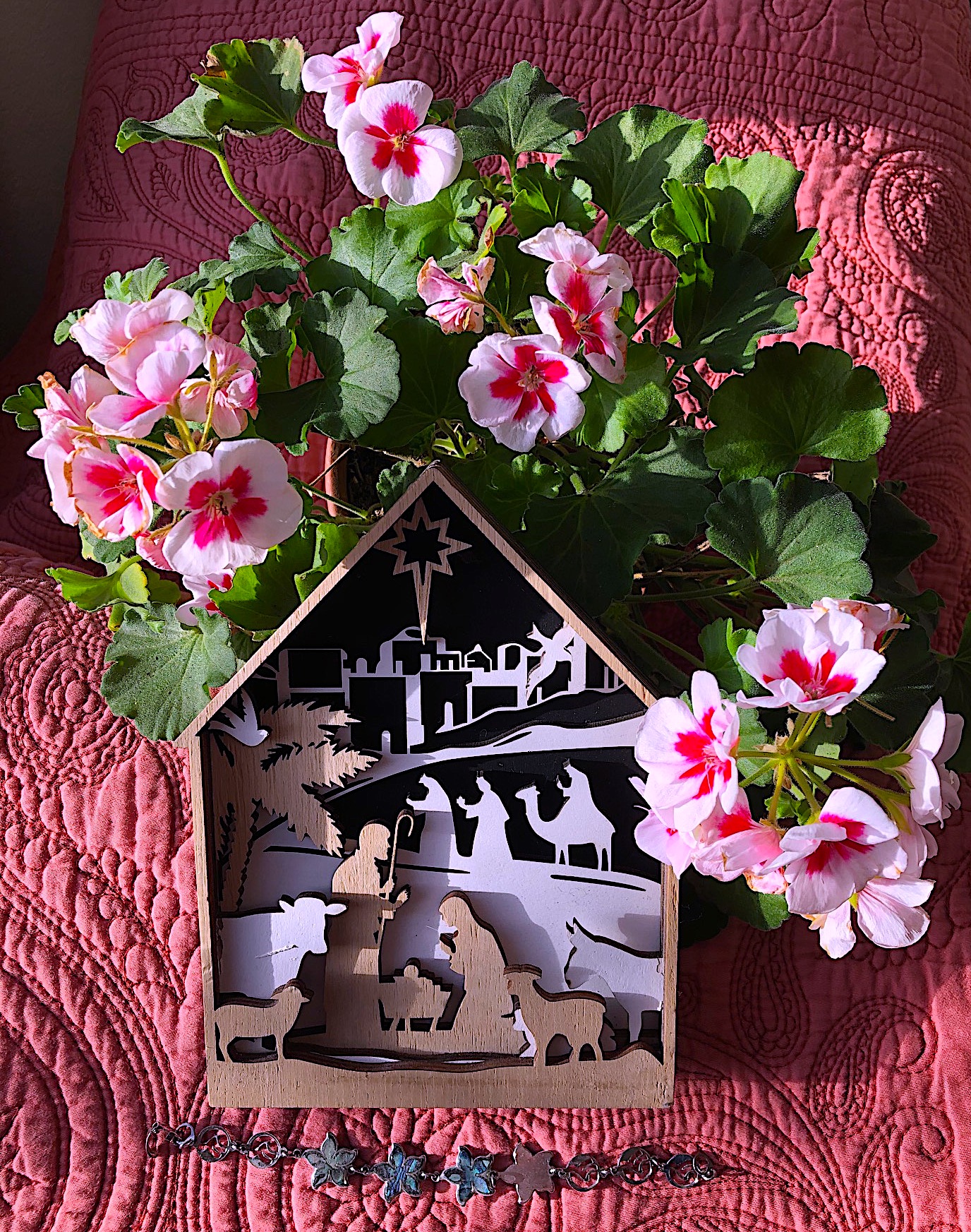
Well, here is the annual holiday photo: the flourishing rescue geranium from the urn outside our building management office; plus a gift from a dear neighbor, a Nativity scene that stands on display in the window all year long. And for an annual letter? Reading everybody’s news and looking over the family photos, I searched all month for words that are equally joyful and worth reading.
Father Seraphim Aldea at Mull Monastery posted a talk last year with the title “Don’t deny your doubts and your struggles.” His counsel is to be open and honest about the deepest of them, whether it’s loneliness or anything else, and then to walk the next steps between that reality and the faith that whatever happens “God is love, He has created the world out of love in order to save the world through love.”
Tonight the kitchen Bible fell open to Acts 20:24, to what looks like Paul’s own update message: “…neither count I my life dear unto myself, so that I might finish my course with joy, and the ministry, which I have received of the Lord Jesus, to testify the Gospel of the grace of God.”
The old year is over for us all. The next step awaits.








 consolationland