That Monday, Dear Host (DH) drove me all the way back to the airport with the cheerful alacrity that residents display toward long driving distances in all weather. There I briefly panicked, fearing that I had somehow left my keys back with Host Family. With the same cheerful alacrity, DH offered to drive back to the house to bring them for me. But thank goodness, they were with my metal items all wrapped in clear plastic for the TSA inspection. I was sad to say goodbye to him. Moving as fast as possible through the checkpoint (plastic bins, shoes, bags, then all of it in reverse), I turned back for long enthusiastic arm waves. But to my dismay I saw that people past the checkpoint are out of visual range. Perhaps the intent is that those who pass security can’t be given secret hand signals by the ones left behind? To DH my departure must have looked coldly abrupt, without even a look back.
I landed in Dallas, where the usual army of elders at volunteer posts cheerfully greeted me whenever I stopped to gaze around in bewilderment. At a CPR skills practice station, a boy 8 or so years old was chest compressing an animated model while the machine provided feedback. The boy’s father stood at his side with respectful moral support. It was a heartening scene of father-son learning, and I paused for a moment. “I hope this young man is on my plane,” I told the father. He and his son laughed as we waved in passing. And that was my last civil encounter of the day.
On the flight back to the city the other passengers in my row ignored one another in silence, communing with their blue screens. It felt dissociated to share the row for hours with not a single person asking “So where ya from? Visiting family?” We arrived at 10:00 in the evening. Other passengers dispersed to baggage claim. I was alone in an empty airport. No army of volunteers was waiting around. I hadn’t flown in years, and the airport was no longer familiar. For 45 minutes I hiked around looking for the ground transportation wing. Finally I waylaid an employee working hard to stack some ungainly bags of trash. He pointed over toward a sign for the airport terminal train; then I remembered that while ground transportation leads to Departures, from Arrivals I had to take the train.
At midnight I arrived home, dropped my clothes at the door, put them right in a punch bowl, and jumped in the shower after 13 hours by car and two planes and train and bus. I boiled the clothes on the stove, hung them to dry on the balcony, and went to bed.
Just before sunrise I half woke up from a vivid dream, believing I was still back in Eagle. Lying there I saw a black cross against the sky. That makes sense. The town of Eagle has Christian symbols everywhere. It stands to reason they’d put up a cross outside. Good. But where am I? Which Eagle neighbor let me sleep here? Maybe it doesn’t matter. It’s such a hospitable town, even a new acquaintance would let me stay on the sleeping porch for the night. Besides, we’ve got to get up now. The whole town is heading out to the fields to start the search.
Except that — was that really a cross? I sat up for a better look. No, that was my own shirt twisted by the breeze, with outstretched sleeves on a laundry rack. This was my own balcony back here in the city, hung with boiled laundry. This was not a sleeping porch in Eagle at all. The trip was over.
But what a vivid dream! Back in Eagle, I was about to join a search party after an airplane explosion. The night before, a plane went down in a fireball over the sunflower fields. There was no chance of any survivors. The fire department rushed to put out the fire, and the whole town made a plan to run there at first light and start searching in the tall sunflowers for bodies, to bring them back.
What caused a dream like that? Well, part was flying out hours ahead of a Texas storm front with lightning and chance of tornadoes. Part of it was news from Ukraine. But another piece came from joining a search party for one day 40 years ago, when I lived 80 miles from Eagle. A World War II veteran believed that the Nazis were coming to take him prisoner. In late October he ran away and covered quite a lot of ground, finding hiding places in the fields. Investigators and bloodhounds followed his trail, and volunteers from all over town showed up at dawn to help. We searched culverts and barns and woods until dark in the rain. The townspeople kept at it for many shifts until they finally found his last hiding place. Volunteers didn’t need to be asked; they simply showed up. Grandfather’s lost? Then he’s everybody’s grandfather now; we’re going.
Wide awake, looking up through laundry to the drizzling sky, it came as a great wash of relief that nobody’s plane crashed. But there was also a profound letdown. Today was just a day off work in a big city. There was no great cause to join, and no one to join with.
Next night the dream was about Eagle again, where some of my new acquaintances were restoring steps on one of the local historic old houses. One of the ladies fell and got scratched up. She wasn’t injured, but her poor forehead was bleeding. The team decided to finish the steps while one of them drove her and me to her farm. There I was going to bandage her head for her and put her to bed and fix her tea and supper and keep her company. So in the dream I teleported to my own room at home (dreamtime logic) and got my favorite head scarf out of the closet to put over her bandage, thinking it would be a nice surprise for her. I was just rushing out for the trip back to Eagle when the alarm clock rang for work.
People here back home have asked warmly “How was your week off? Go anywhere special?” And for once, yes I did. Two listeners sounded charmed hearing about Eagle as a destination. But most have a guarded or humorous reaction. “They do eye contact there? They say hello and ask where you’re from? Eek.” They also expressed kind concern for my safety in a small town, strolling in some Twilight Zone dystopia of MAGA hats, meth labs, feral dogs, guns, religious fanaticism, and malicious character-assassinating gossip and shunning. Just for the record, I didn’t see any of those features. Granted, one popular Eagleite with a grand sense of humor has a sign on the door reading “Did you not know I own a gun, or are you just stupid?” But a comparison of our police reports and theirs would indicate that the guns in their town are in more capable hands and used for saner reasons.
The dreams about Eagle lasted for weeks. In each one, everybody needed to pitch in for some important intervention, and I was one of the team. In the last dream I was working the registration table at the annual women’s retreat at Eagle Christian Church. Women flocked in, all banter and hugs. One of them brought her knitting and offered to teach me how to knit too. Then I woke up. Who’s working registration? Where did the women go? (That dream felt so real that I got out of bed and looked up the church website. Who knew: They have a women’s retreat. It’s in September.) So, every morning I’d wake up all ready to be part of the group. Then I’d remember that nobody was around. It felt discouraging to face the day knowing that if not for my job, no one would notice whether I got up or not for the next three weeks. And it wouldn’t take a skyful of October fields to hide in; this studio room would work pretty well.
In the end, the difficulty getting up in the morning had a correctable health condition, possibly brought on by all that travel. That’s the next story.
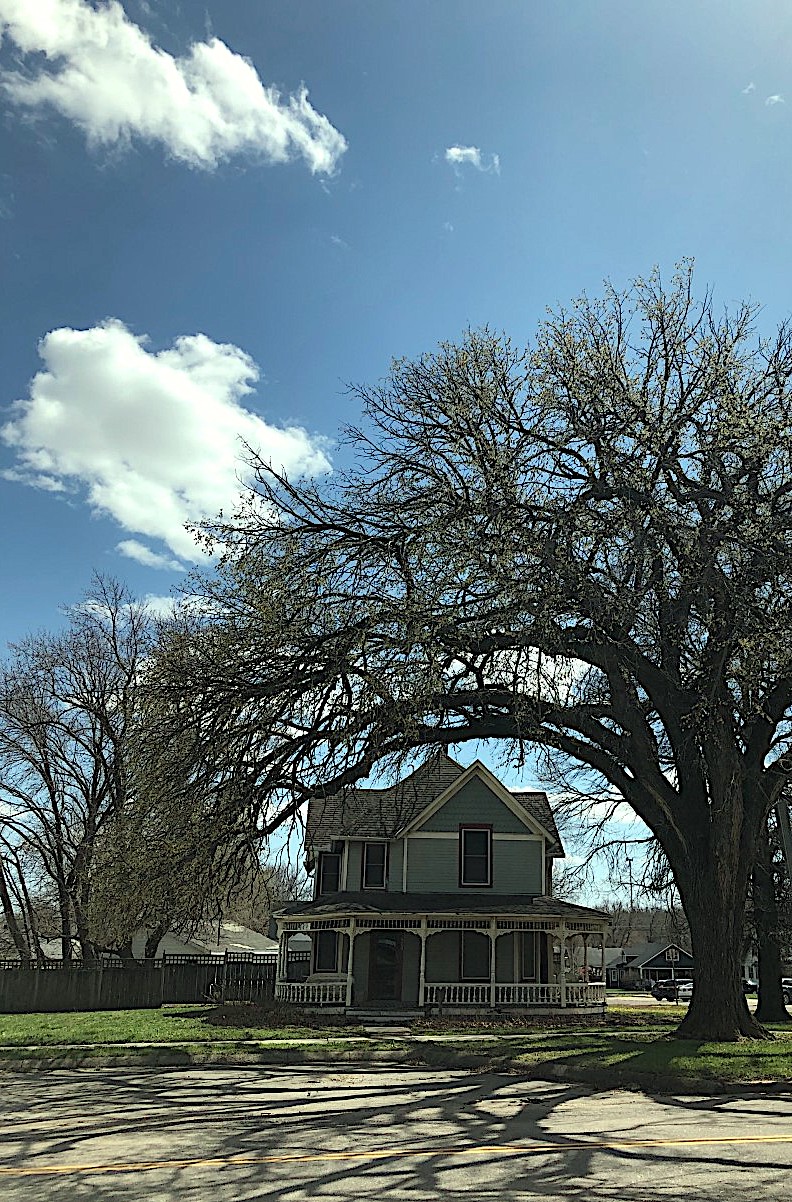
On the main street of Eagle there was a tall stately stone house with wood detail in bright clean pastel tones. Signs outside indicated that the building was a historic landmark. Hoping this was not some unsuspecting family’s private home, I ventured up the stairs under the veranda with its lacy ornate woodwork trim, gave a timid knock, and tried the door. It opened, and I peered in.
“Would you care for a TOUR?” asked a gentleman inside, greeting me right at the entrance.
“Uh… yes. Thank you, I would love a tour.” After the full noon sun I stood blinking in the soft light, looking around.
The unique room looked to be a museum, restaurant, visitors’ center, lending library, and book shop all in one. This blog is anonymous, so it did not feel respectful to take identifying pictures of the house. But they posted this picture themselves on their website:
Christmas time; just one corner of a remarkably well-appointed home
The host, Mr. M., was a trim distinguished-looking gentleman with silver hair and neat beard, keen bright eyes and expectant smile. He had the confident courtly air of a sailing vessel sea captain.
“Why, that author is Mr. S.!” I exclaimed, seeing a display of several memoirs. I recognized the author’s name as our local ornithologist, a man I’d hoped to meet personally to talk about birds. His memoirs looked full of life experiences, including his service in both the Second World War and the Korean War. “Imagine the adventures he has had since 1919. And now he is 103!”
“104,” my host volunteered with a smile. For over an hour this gentleman demonstrated a level of verbal fluency that I can not recall hearing since Tom Lehrer sang “The Elements” on TV (and even he used ready-made words, written by Dmitri Mendeleev). That command of language, as it unfolded the history of the house, had me spellbound. First, our host whipped open and spread across a table a series of laminated photographs and drawings showing phases of this remarkable building over two centuries, and its role in the history of White settlers crossing the continent. The story was in the details — 19th century engineering solutions, sections removed for one purpose, sections added on for another, transitions in uses, styles fortunate and unfortunate, owners changing hands, and finally the spiral of neglect and abandonment poised to condemn the building as obsolete and in the way.
The house owed its existence to Mr. and Mrs. M., the volunteers who saved and renovated the building. After their long illustrious careers, they deserved a shady porch and a lemonade apiece. Instead, they went to war. The couple fought for the house, inspired by its historic value and potential. What if (they asked each other) they could somehow find the funding, focus the stamina and know-how, gut the historically discordant modern “improvements,” track down the best version of the house as it was in its golden age, and build it all back again? What if they could search the countryside for authentic building details, furnishings, fabrics, handicrafts, adornment and artwork? Then, what if they could research and devise a whole menu of historically informed recipes to reflect and honor the unique diversity of ancestors from First Nation, German, Swedish, Utopian Vegans, and the other groups that settled this part of the country? What if they could then track down locally sourced sustainable livestock and fresh produce, direct from the farmers? What if they could open this place as a museum bookstore and library and cafe, and cook the meals themselves for whomever walked in through the door on their way across America? What if this labor of love could stand as a testimony to their faith in the Lord?
Over the years, they made it all come true. Now the house was a showpiece, lavished with creativity and care. The atmosphere was soft and contemplative. It was a hallowed place outside of modern mindless static and clutter, a haven for echoes from our ancestors’ lives. It brought to mind the reverent history house museums back in Leningrad, where visitors donned felt overshoes and talked in whispers to admire roped off rooms and furnishings, in a palpable vibration of the past and its historic characters and stories.
Mr. M. with deft agility sprang up and down steps and passageways on three levels, narrating stories with a crystalline recall for details. In an upstairs bedroom he pointed out some 19th century wainscoting made of beadboard — lined paneling punctuated with rows of round raised beadlike detailing. A piece of the beadboard had been lost, so Mr. M. set out in hopes of gleaning just the right match. Armed with a clear vision of the type of beadboard needed, he was able to spot the exact piece in an unlikely salvage source. The search made for a real detective story. Now he could point with pleasure to the panel, showing how the found piece matched the other panels to form a well-knit painted wall, seamless to the eye. “And that,” he concluded, “Was Miracle Number 204 in our renovation story. There have been so many miracles! This is why we keep a portrait of Jesus Christ in every room, and tell these stories as a tribute to Him.”
The house was a treasury of antique pieces. Some were elegant, like a tiny tea set and a case of little girl dolls in their colonial dresses. Some were homespun, like the little velveteen bunny peeking from the mantelpiece in that week before Easter, waiting for his new child to come find him.
Back on the ground floor across from the entrance, there was a recessed wall with steps leading down to the sunken kitchen. The kitchen passage held the rarest find of all.
Mr. M. stooped down to show me some scuffs on the wall. I looked right at and past those scratch marks; to my unaware uninformed eye, they looked like pen knife marks from a small child. But for some twenty minutes in all patience he drew my attention to every angle and side marking in the wood. It reminded me of reading Tom Brown, Jr., puzzling over some photo of a footprint in sand with a caption deciphering all the story of the person in that shoe. Mr. M. pored over those scratches with me. He told me how they discovered the markings during renovation, how Mrs. M. and her empathetic intuition sensed that the scratchwork had a story to tell, about their research, about their consulting with First Nation people in the area, about the collaboration that revealed the message: a pictograph memorial tribute to a White man who had distinguished himself by his cooperative respectful relations with the original holders of the land.
After our tour through time, I came back to the present with an even deeper appreciation for this community. Thanking Mr. M., I headed back out to the full noon sun. The only regret was the prospect of leaving town without a chance to meet Mrs. M., who was working at their home that day. Still, that evening I told Host Family all about the house, urging them to come and experience it for themselves.
Dear Host decided to take us all to the stone house the following Saturday, and treat all of us to lunch: the family, a good neighbor, and me. Mr. M. was happy to see us. He showed the family the house before heading to the kitchen to fix our meal. (I went for the toasted cheese on fresh-baked bread. It was perfect — delicious subtly sweet toast, and richly flavorful cheese, melted but crisp at the edges.)
While the family toured the house and I browsed the books, a visitor came in. She looked weary and out of sorts, and glanced around at the unique interior with a puzzled guarded look. In hopes of improving this customer’s spirits for Mr. M.’s sake, I went right over to greet her. We had to exchange the required “Are you from around here?” Then she confided that she and her husband had driven in from the countryside; he had a long tiring medical appointment here in town. As a break from waiting at the hospital, she’d decided to venture in to the stone house in hopes of a cool drink and a rest. Soon we were poring over Mr. M.’s laminated photos of the house. Taking an interest, she began talking about her own renovation projects on the farm. Mr. M. appeared with greetings and a menu. His gentle hospitality sooned cheered her mood as the two of them looked through the selections. She decided on an iced tea. Soon she was settled comfortably with her tea, admiring the room and exchanging cordial greetings with my party at the next table before she went her way looking refreshed.
Then there was a group photo session on the bright pastel porch. It’s a beautiful picture to gaze at now, those dear people on a happy day together, laughing over some friendly joke and beaming up at the big sky.
The only shadow over the outing was that once again, I had missed seeing Mrs. M. There was only more day to spend in Eagle, and I was sorry to leave without hearing her side of the shared vision of this house.
Next morning at church, after an uplifting worship service, I stood up and turned to leave the pew. The worshipper right behind me wished me a good morning. To my surprise and delight, he was a trim distinguished-looking gentleman with silver hair and neat beard, keen bright eyes and expectant smile — wishing to introduce me to his spouse!
Mrs. M. was an ethereally fair slender lady, looking lovely in turquoise jewelry and hand-sewn period clothing in lapidary colors. It was impressive to think of the construction skills she must have wielded on the house project. In photographs she stands before the house with her husband, and with keen eyes telegraphs the message “I will not step aside for your bulldozer.” But in person the impression was more of a violet aura of sensitivity and extreme fine tuning. During the conversation she mentioned her age; on hearing that number I could only shake my head in stupid wonder, unable to reconcile it with the radiant energy before me. Mrs. M. shared her own account of the inspiration and intuition that led the two of them to save the house, part and parcel of their faith in God and in one another. I offered to come help her in the kitchen on my next trip to Eagle. She offered me a volunteer job on the spot, working in and on the house; she even offered to advise me on the grants available for historic houses like this one.
That was a wonderful meeting. I came away with the fondest memory of the House of 204 (plus how many more of them?) Miracles, the gem of Eagle. Its facets are the labor of love, shared vision, and mutual devotion of Mr. and Mrs. M, and faith in their Lord Jesus Christ, portrayed with honor in every room.
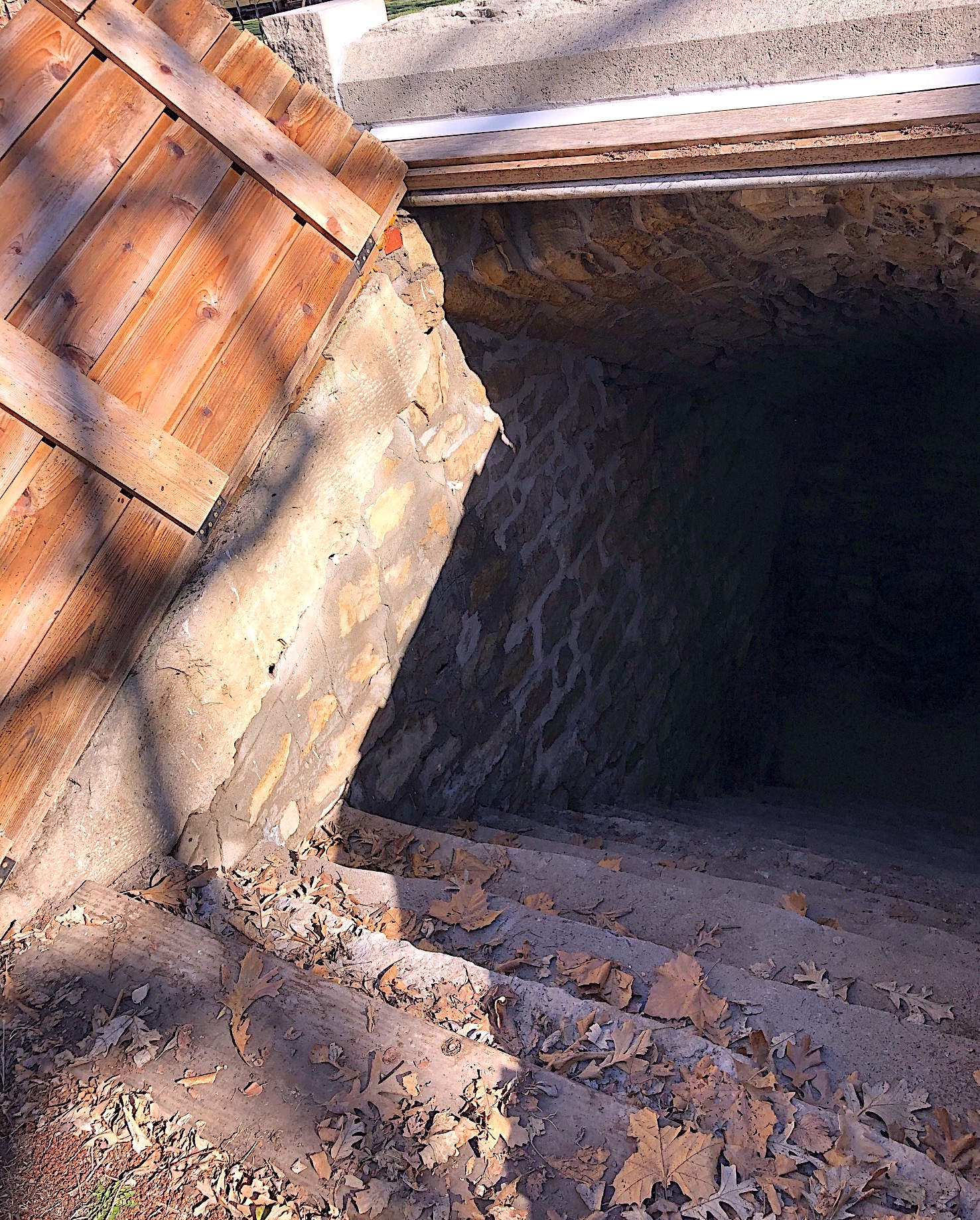
Would I? You bet! Even if it’s groping down stone stairs like these.
Historic basement. Watch your step!
In Eagle, that spontaneous invitation and a wave in the door seemed to be normal hospitality. For me it was always a pleasant surprise. (Cultural contrast: When I moved to my city here years ago, the local postmaster jokingly welcomed me with, “We might smile and make nice, but we ain’t letting you in to our houses.” These city folk are courteous, and enjoy going out to meet at a coffee shop or book reading or jogging trail. But here the residents don’t invite friends or neighbors into the home.)
In Eagle, house visits and tours are a favorite local entertainment. Upon my arrival, Host Family showed me around the house, narrating warm memories of the friends and helpers who assisted with the various features of home improvement. To them even the kitchen floor was not just a floor, but a happy souvenir of visits and good collaboration and bonding.
Another house tour was narrated by a good solid homeowner met during a walk in the center of town. (We’ll call him Augustine Johanson, a good solid homeowner name.) Next day I called a hello while passing the open door at the Johanson residence. Well! Augustine surprised me by waving me in for a tour of his immaculate house. That made an enlightening visit. He had gutted and renovated and masterminded and handcrafted that house for ultimate function in form, practical comfort, ease of use, and a clean clear trim pleasant appearance. Then Augustine revealed the story of his house renovation. After he retired from his long challenging career, life dealt him three misfortunes, any of which could have defeated any of us. He described with matter-of-fact logic how he weathered and forged through these adversities — by buying a fixer-upper as a new challenge! He showed me before and after photos of himself and the house. I stared at the pictures in awe. “Excuse me, but… is this the same house? And is this the same YOU?” Augustine’s method had worked wonders. His campaign of hard manual labor, salvaging needed parts, problem solving, and aesthetic creativity had left him looking years younger!
Listen up and remember, some instinct prompted me. When tribulations come in the future, you will look back and learn from this man’s example. I listened in rapt attention to my host with his renewed fresh appearance and eager eyes, looking happy in his comfortable welcoming home, now envisioning new projects and useful work. What a worthwhile hour and memorable story!
Visiting with Augustine tuned me in to an important theme in Eagle interactions. In the most casual conversation, passersby and business owners and neighbors would volunteer the history or construction or development of this storefront, or stone wall, or light fixture, or window treatment. This was their friendly way to orient and anchor me in a shared sense of the familiar. Town residents would greet one another with news of house or farm projects; the typical response was advice, and a decision to bring tools and to come help. (Opinion: We have many wonderful men here in my city. They are fine people whose work and rest and entertainment is sequestering up all alone with their computers day and night, with a few breaks for movie streaming services and takeout food delivered to the door in a styrofoam clamshell. In contrast, in Eagle it must be so rewarding for a guy to spend leisure time with other guys, talk shop, pick up a sledgehammer, knock stuff to smithereens in the fresh air, and then build something better shoulder to shoulder that they can point to with pride. In the UK they’ve put up shared “man sheds” stocked with tools, as outreach for mental health and wellbeing. In Eagle it’s just called Doing Life. No wonder a town 200 years old is in such good shape, and the men of all ages look so secure and content.)
A grand highlight of the trip came on Saturday — thanks to Mr. Jones, one of the pillars of the community, who had helped me earlier with the visit to the history society archive. Mr. Jones contacted Host Family with an offer to devote his Saturday free time to give us all a morning house tour! When we showed up in the center of town, Mr. Jones met us with a real treat in store: an excursion to three beautifully preserved and furnished historic houses. As a volunteer, he had the keys and a treasury of stories and facts. From cellars to garrets, we spent hours learning about the ingenious construction solutions and dedicated craftsmanship of early town residents.
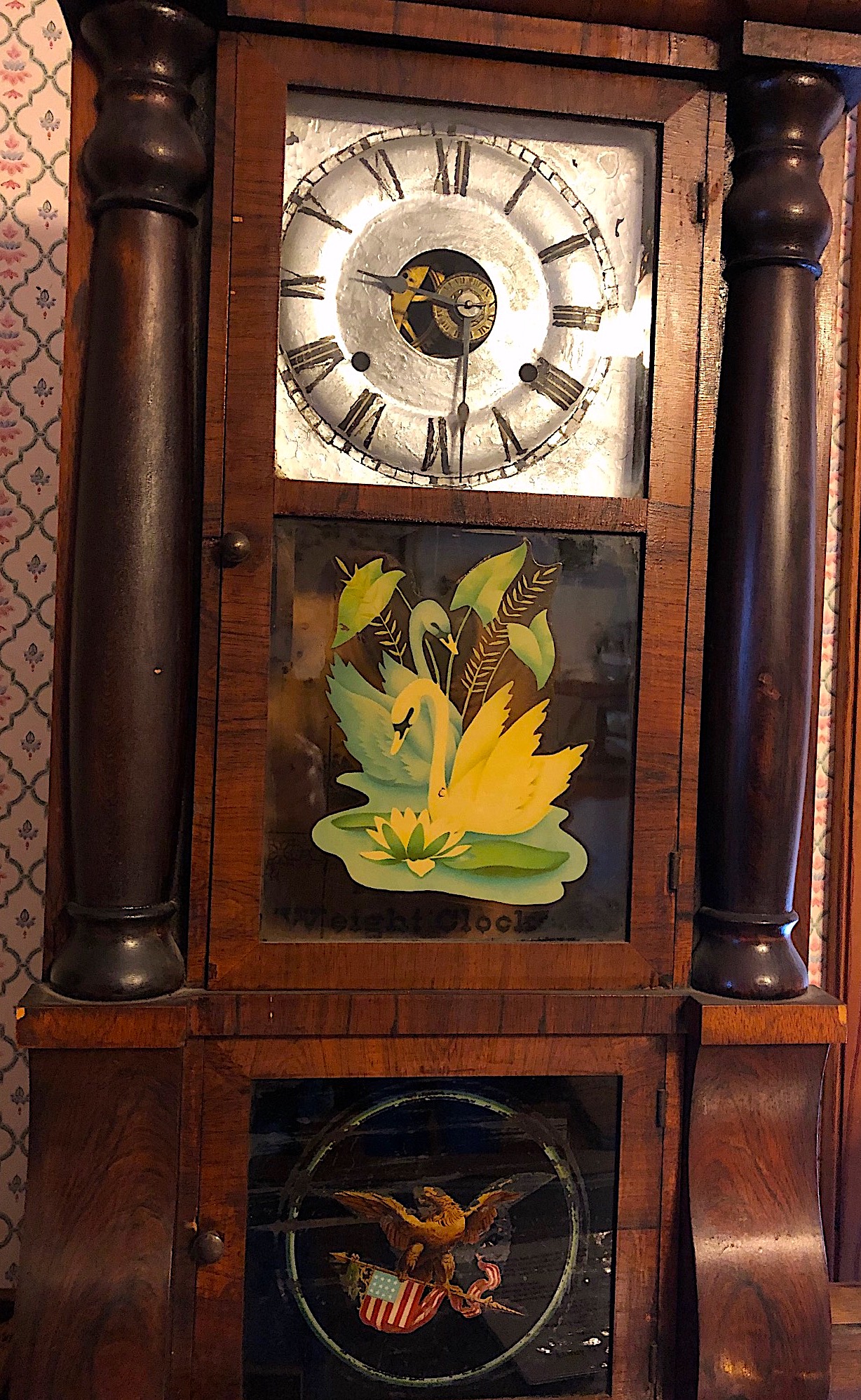
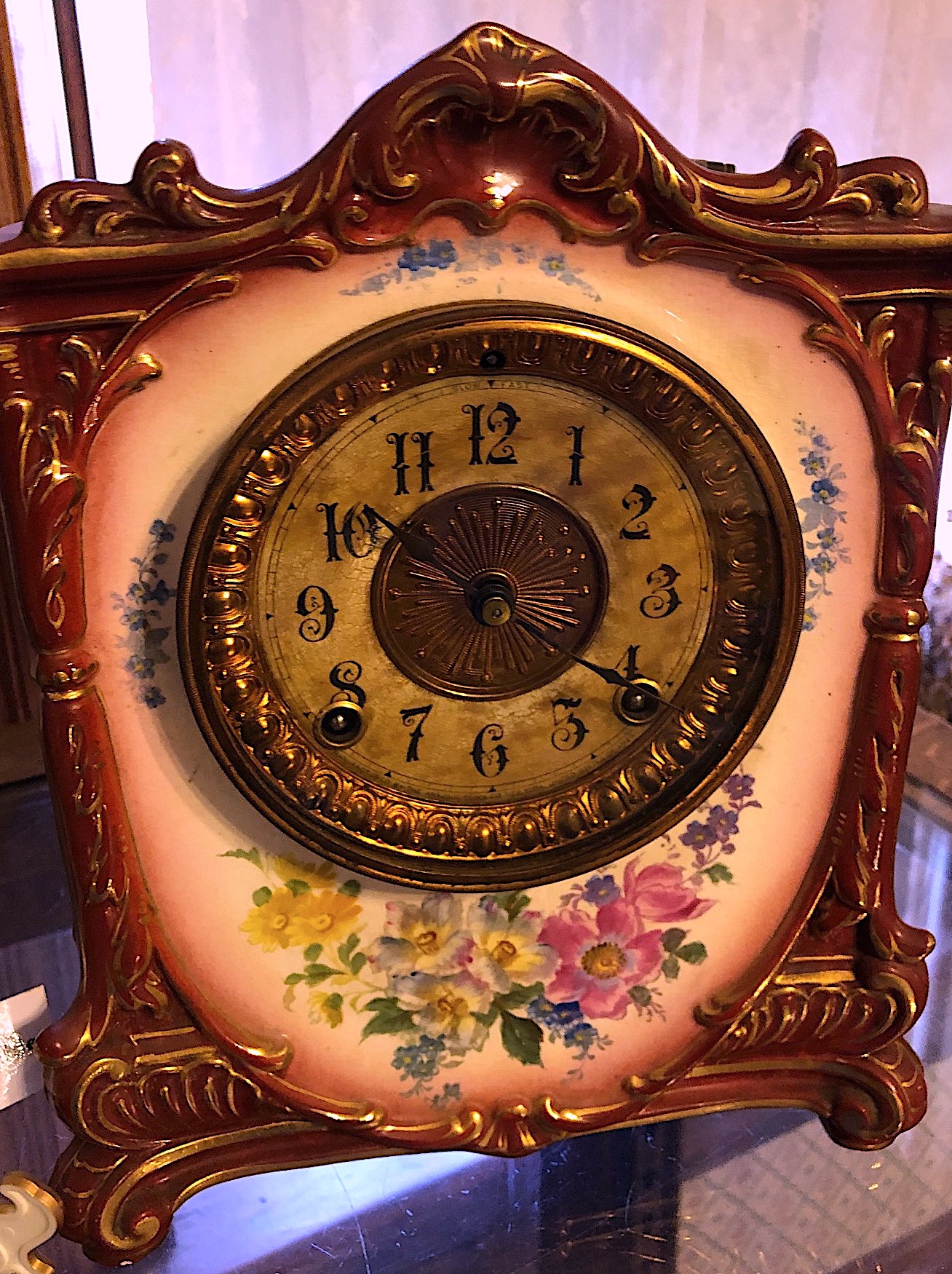
We marveled at rooms stocked with furnishings and textiles and painstaking artwork. (The photographs below, cropped off center, did not capture their real beauty. For one thing, I had to hold the phone camera at crooked angles to dodge the morning glare.) Generations of residents had used materials at hand to produce poignantly lovely pieces to record their family history, convictions, and aspirations of beauty. This image, “Gone But Not Forgotten,” is the top detail of a memorial frame. The inscription below it named the babies born to one family, and the number of months each little one had lived.
A dedicated team of town volunteers preserve these houses in order and cleanliness in a hard climate. From other houses and antique shops and auctions they have collected and gathered numerous period pieces, and arranged them in these spaces to best advantage.
From one granddaughter generations ago: pearl buttons on velvet
Clock 1
Clock 2
The tour of houses with Mr. Jones, generously sharing with us his knowledge and time, is an unforgettable memory. It was such a good way to round out the week. There was so much beauty and precious ancestral wisdom held in those buildings.
In Eagle, walls have ears and houses have a voice. They have caring guardians too, to unlock the doors and show what makes and keeps a house a home: shared community work, resourcefulness and skills, attention and care, stories in the sticks and stones.
Landmark, windbreak, and a touch of grace: a farmhouse tree outside town
The junket to the archive started with a question that seemed simple at the time.
“Where can I learn about the trees here?” I asked Dear Host (DH), when we arrived at the house from the airport. “Back at home we’ve got a tree expert; maybe Eagle has one too. And while we’re at it, who knows the names of these birds singing away?”
While I unpacked, DH sensibly whipped out his phone, and set the local grapevine humming: Who can talk to our guest here, about birds and trees? In no time, answers were rolling in. One nature enthusiast sent an actual apology! That week she was needed at home, and could not show me around. However, everyone had two suggestions: For serious birding, I should call on Mr. S. (“But we don’t know what field trips he leads these days; he’s 103.”) Then for trees, I should try for an appointment at the archives of the county historical society. Then DH decided to compose an email describing my interest in nature and in all things Eagle. With characteristic optimism he applied the old adage that to get a job done, just aim for the top and contact the busiest guy around. He sent that message to Mr. Jones, one of the most influential public figures in town, to ask how to arrange for a viewing of the local archive.
I didn’t count on an appointment to that archive. Some overworked librarian would have to set aside her tasks, hunt down the key, open the closet, and wait patiently for me to fumble around in a carton of folders for the file with the tree news clipping in it. Instead I made plans to just go out on my own and observe what I could. So early on Wednesday, after a truly refreshing sleep, I got up early in the cold clear dawn to a whole symphony of bird calls. These birds were not the shy crepuscular types like the ones back home, who fall silent by 7:00 am; this lot were out loud and proud all day long. Their happy ruckus gave me extra motivation to go explore the landscape.
Sycamore. Or is it a Sweet Gum? Either way, my phone camera could not manage to capture its height.
After a long ramble in the 19th century cemetery and the riverfront with its blue heron and carpet of purple dead-nettle flowers, I headed back toward the house. Then an email pinged my phone. Mr. Jones himself was thoughtfully letting us know that the archive had public viewing every Wednesday at 1:00. The time was 12:45, so I hurried over to the building. A cheerful librarian was just unlocking the door, and gave me a warm welcome. I masked up, and she waved me right in.
This was no closet with a banker box of folders. This was a spacious lower floor with an extensive collection, and historic artifacts on display. Two additional archivists were already at work on the digital collections. The very mention of key word “trees” lit up quite a bit of interest and discussion among them. Then the cavalcade of holdings began. The women began piling materials on my viewing table. There were vintage photograph albums of the town trees, tree maps of the area, heights and diameters, longitudinal census counts of native and imported species, calculated sprouting dates from the 1600s on, dendrochronological data, casualties of fire and storm, historic events and accounts centered on the role of trees, economic value of trees and their harvested products, arbor-themed tales and poems and festivals and social clubs and school projects. These collections were beautifully organized and well preserved. With permission, I took cell phone pictures of artifacts and displays.
And so my simple initial question was more like a Matroshka doll of many growth rings.
The tall trees (burr oak, sawtooth oak, walnut, sycamore, sweet gum, on and on) were not just standing around looking majestic; they played a central figure in history. Many of our frontier towns of the America heartland have disappeared. But trees are part of the reason for Eagle’s unique identity and economic endurance, its microclimate and handsome natural setting.
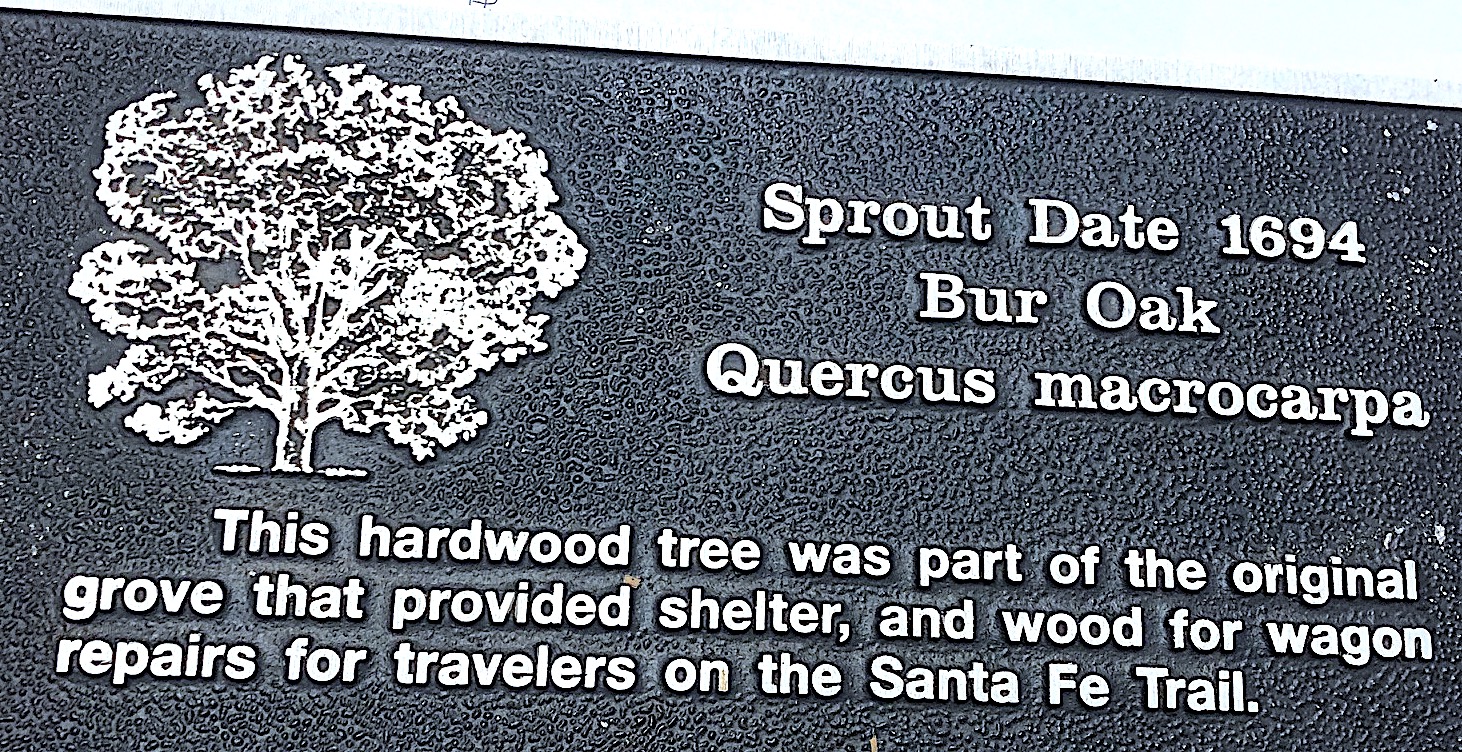
Kindred souls in the Federation of Women’s Societies had done the footwork and writing, the documentation and preservation, for many years. They had preserved portions of felled trunks here in the archive for further study, and even designed handsome engraved metal plaques to place beside the trees around town. Here is a fragment of one of them:
A town plaque
Along with the written history, there were lively reminiscences of the ladies themselves, recounting their memories of notable trees in the community life of the town. I shared with them what a pleasant surprise it was, to walk down their streets and have passing residents greet me as a stranger and volunteer to point out this or that notable tree.
Soon another caller stopped by: Mr. Jones! He was dropping in with a cordial handshake to check on the out of town guest. We all had a lively visit. At one point, our archivist asked what I do for a job. I explained that I was, well, an archivist. “Girl!’ she exclaimed, with her bright eyes and appealing smile. “How soon can you move here?” Without thinking twice I leaped over and hugged her. That was a happy hour, to feel so welcome anywhere, or so at home with a group of people. Finally to let everyone carry on with their work, I packed up and thanked them for the visit.
As I headed out, they gave me some parting advice: I should go visit with Mrs. Dorcas. (That isn’t her real name. That’s a seamstress from the Bible.) Word was, that Mrs. Dorcas is accomplished at sewing her own pioneer outfits and bonnets; she also designs menus and cooks up historically informed cuisine based on the area cultural traditions of the 1800s, and works in antique house restoration. The ladies didn’t have to work hard to persuade me; meeting a town historian like that sounded like my next worthwhile adventure.
It was heartening to learn that an eye for trees made me not an eccentric outsider, but an observer in very good company with other members of the community down through the years.
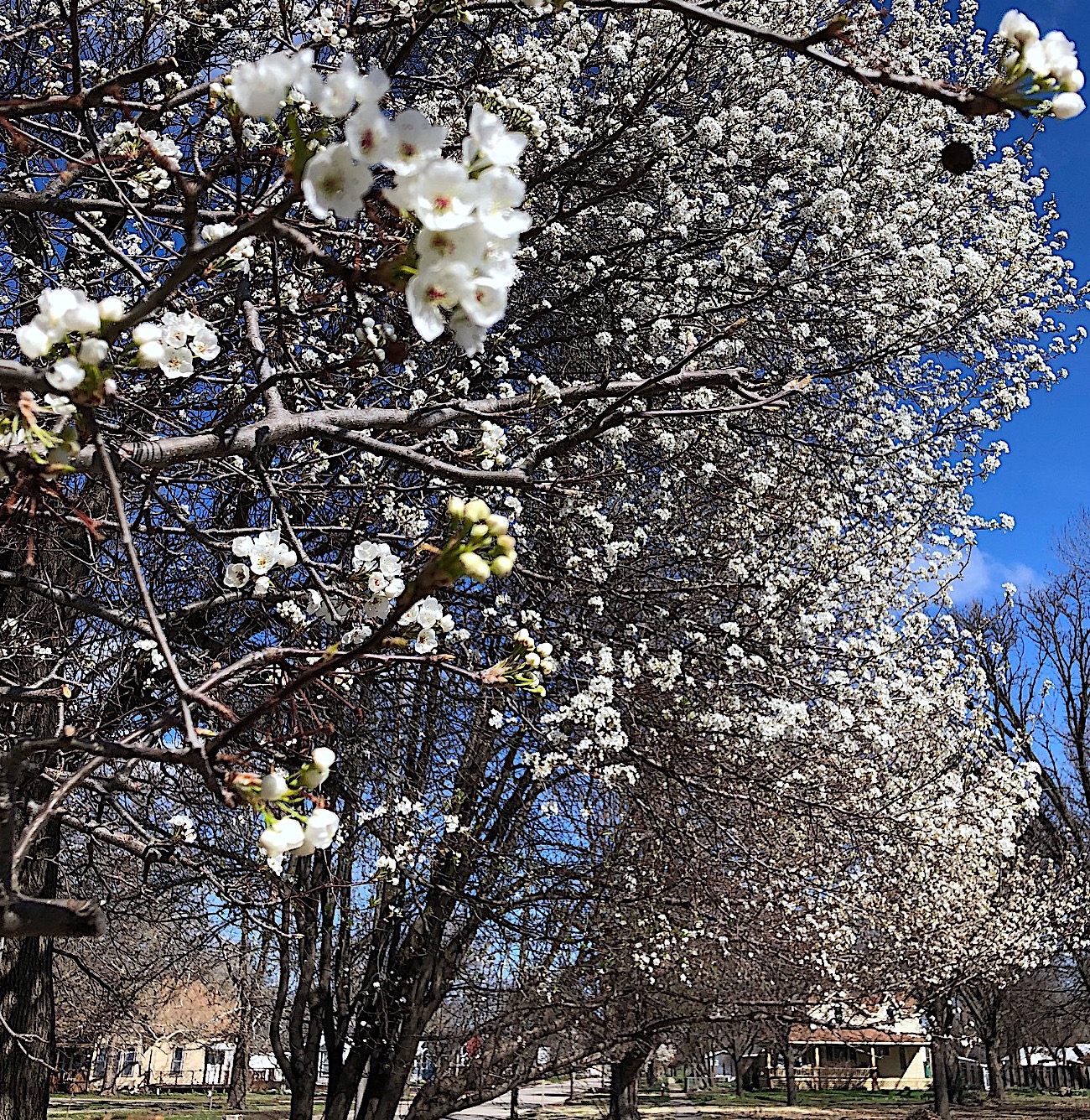
Someone with a vision for beauty lined this street with fruit trees.
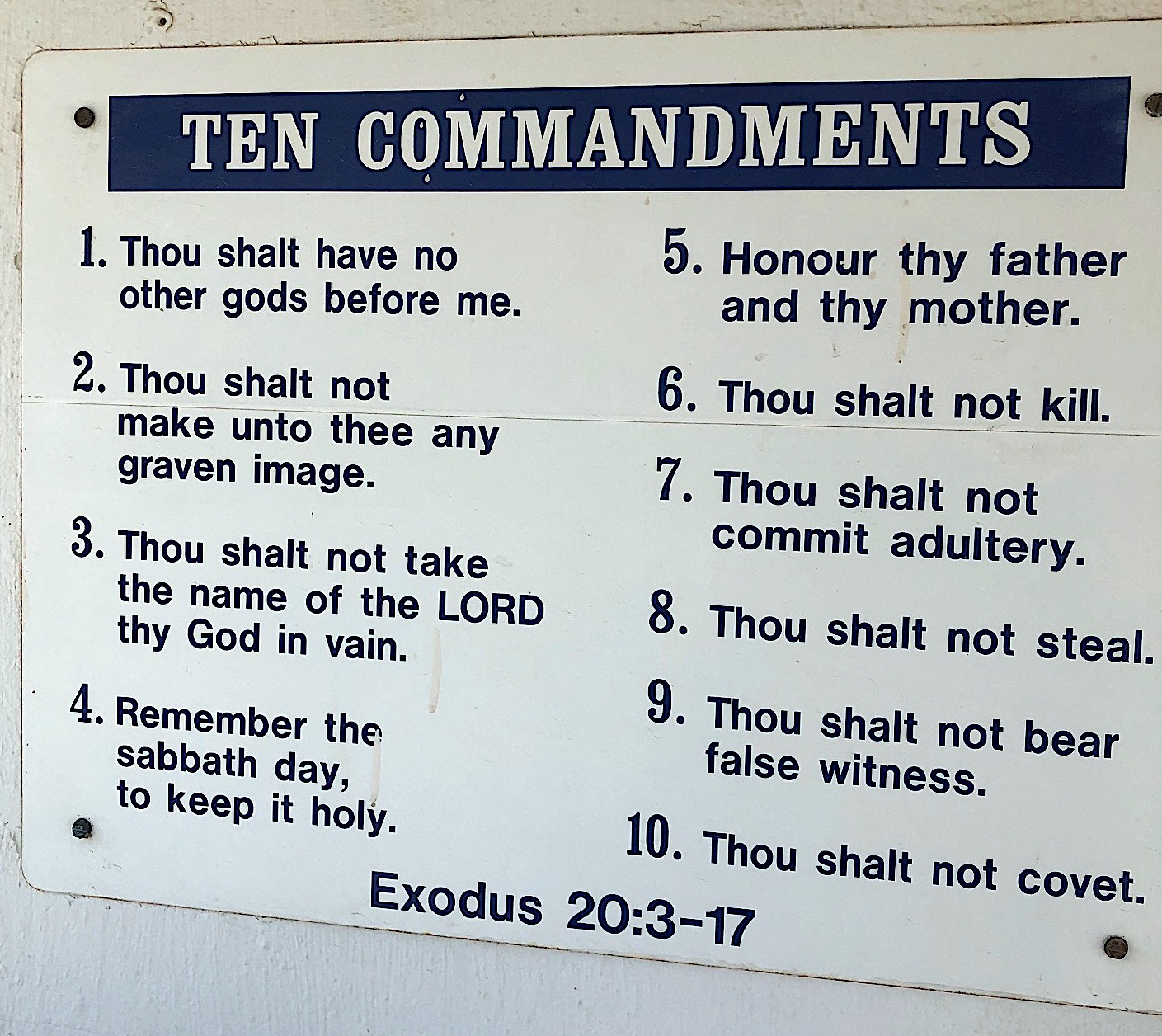
Over the weekend in Eagle, Dear Host (DH) and Our Hostess (OH) decided to buy a small furniture item at the local thrift store. The business is situated near Main Street in a trim white building with this poster at the door.
Transparency: the business statement for public view
Absorbed in jotting down some trip notes in the next room, I was only a casual listener to this plan. My expectations of the shop were modest. Based on many garage sales, and the large warehouse stores back at home, I expected harassed staff deluged with lockdown-era rejects fit for the landfill, with some poignant castoff bric-a-brac and perhaps some new cheaply manufactured imports. For me this expedition was just a part of my commitment to experience and observe as much of Eagle as possible.
Over the phone DH greeted the thrift shop owner and acknowledged that yes, he understood that the shop was closed Sundays for the Sabbath. Then he agreed that, fine, our assigned shopping reservation would be from 2:00 to 2:30. Then, in answer to an apparent question from someone at the shop, he added that his guest, Mary ____, would be coming along. Answering the next question, he agreeably spelled out my last name. Answering still another question, he volunteered “Why, she comes from ______ City. She is visiting us this week.” The call ended with sociable pleasantries. He signed off.
By now I was eavesdropping with wide eyes. A thrift shop that takes reservations? And imagine a generic “When are you open?” phone call — where the business asks the name, spelling, city of origin, and leisure plans of a household guest who is not even the customer. Even for Middle American social engagement, this seemed unusual.
DH explained. The store is of compact square footage and in great demand. During the pandemic, management began keeping a guest book to log in and distribute the traffic flow fairly among 30 minute slots. This maintains order, and safeguards the health and comfort of seniors and other shoppers who need to take special care of their health. When DH put it that way, the arrangement sounded like resourceful management. Besides, now that Eagle Thrift had included me in a time slot, and knew my name and which family in town was hosting me, the least I could do was pay the respect of showing up and summoning some genuine interest in our 2:00 visit.
We crunched up the gravel side street to the building. At sight of the Ten Commandments I flinched a bit, imagining how distressed my city friends would be at the sight. For those friends, the Commandments had been exploited by the adults in their childhood, to cause serious harm. In my city this billboard would have gotten an immediate response, perhaps with a can of spray paint. But to me they were an impressive sight; a clear transparent business statement that spoke for itself.
Opening the door, I was completely disarmed by the warm greeting of a tall strong-looking gentleman who sang out “Why hellooo, Darlin’!” and ushered me right in. He hailed each shopper wth the same greeting, making a welcoming fuss as if he had been waiting all day for the sight of our bright faces. This endearment surprised one no-nonsense man with a rancher/farmer appearance, who took a step back and asked “Why are you calling me that, Sir?” The greeter graciously replied “Young Man, at my age I don’t even try to keep track of alla your names. You are all Darlin’s to me.” Greatly mollified, with a slow smile the customer quipped, “Then ‘Let me call you Sweetheart.'”) When one young customer grew snappish over some purchase, he found the greeter’s sizable but gentle hand on his shoulder, and a word of fatherly counsel enlightening Son that in this house, we men use constructive uplifting language. The shopper calmed right down and finished his visit in peace.
And whoa, WHAT a store! If only I’d discovered this place sooner! Abundance, assortment, variety, all neatly and ingeniously displayed for best use of every inch from floor to ceiling. Sure, there was some poignant bric-a-brac peeking out. But there were plenty of good quality items in fine shape, and plenty of appealing handcrafted heirlooms. A whole wall of free Bibles took pride of place, all editions, some new and some well worn, for anyone to help themselves. I was longing to take a Bible home. It would have been a delight to spend an afternoon browsing through the versions, reading the family trees and inscriptions and margin notes, and choosing a copy to take home. (That was in my dreams just last night. The staff welcomed me back and let me look through all the Bibles for the one with the handwritten notes and events and family history that would tell me who my ancestors are, and where I come from.)
But alas, there was no time to tarry. This store was a thriving hub of activity, with customers waiting eagerly outside for their turn. Animated conversation filled the space as customers shared their stories with smiling staff and one another. Clients had driven in from miles around. Some were new military families over at the base, setting up house on new assignments. Some were farm families enjoying a trip from the countryside. Some seemed to be forging through hard times, in immediate need of goods. The wide selection, rock-bottom prices, and warm atmosphere must be a great comfort to people like moms who had to grab the kids and leave for a safer life, or families after a wildfire or flood who had to start over. Clearly, the patrons valued their store, its social connections, and its role in the community. To make way, I devoted my time slot to a quick enjoyable browse. On the way out though I did catch sight of an oversized pair of men’s New Balance walking shoes with thick padded soles. They were virtually brand-new and a perfect fit, kind and comfy to my arthritic feet. (They’ve proved to be excellent shoes, supportive and sturdy, handsome for office wear.) And what timing — on that gravel driveway approaching the store, I’d felt sharp stones slip in to worn sole spots in both sneakers. “Shoes, Ma’am? That will be 25 cents,” said a beaming young cashier. It took me a gaping moment to compute where the decimal point lay in that sales total, but I fished out a quarter and paid up.
Then I went over to visit with our greeter. “Sir, you are having too good a time for a working man.” He was delighted to banter with me, narrating his long career in useful service work, and how much he enjoyed volunteering now and greeting all of his many Darlin’s. “And with that, you’re quoting straight from Psalm 22,” I pointed out. “‘Save my Darling from the power of the dog.'” He agreed, and whispered a special tip: “The lovely girl behind the counter? She is a nursing assistant at the care home. Would you like to see a real angel? There she is!” He and I had such a hearty visit that 2:30 came all too soon. I was sad to leave, and could not help giving him a goodbye hug. “Your presence here today is a blessing,” he assured me.
Eagle Thrift called to mind the image from Matthew 13, and “a householder who brings out of his treasure things new and old.” The name says “thrift,” but the experience felt rich, and not only in the material realm where rust and moth consume.
The owner helped DH and OH with their new end table and a lovely mirror, a combined purchase of $3. I expressed to her my appreciation for the greeter and his courtesy and good spirits. She said “He is in constant prayer. He prayed for you, and for everyone who came through that door.”
So that was the secret. No wonder the staff preside over such a cheering and peaceable place, a true asset to the town.
To give dear Host Family a little peaceful time on Sunday morning, I left the house extra-early to look around for a church.
All week the weather was windy, with blue skies and sunshine by day and frost by night. On Saturday and Sunday the stiff sturdy wind had died down completely. That let the farmers charge ahead with their controlled burning plans, starting and managing very small fires on rotated parcels of land. That explained the common sight of highways bordered by a broad strip, a good 20 feet wide, of jet black ash in sharp contrast to the spring fields. It’s essential for healthy prairie, native plants, and topsoil. What’s more, it lowers the risk of wildfires. (If only it were safe to do that here; our highways are choked with highly flammable thickets of gorse, Scotch Broom, and other invasives; the city can’t possibly clear it all out. But with this population density, burning it would be too dangerous.) Anyway, on those two still windless days, the skies were lightly hazy instead of clear. At times one could catch the scent of smoke from out of town. That made the early morning weather feel soft and wistful.
The Dallas airport halfway home was expecting severe thunderstorms, large hail, and possible tornadoes (as well as wildfires around the state) on Tuesday, my departure day. That meant changing the flight to leave on Monday. I was sad to leave Eagle, but at least there was all of Sunday still left.
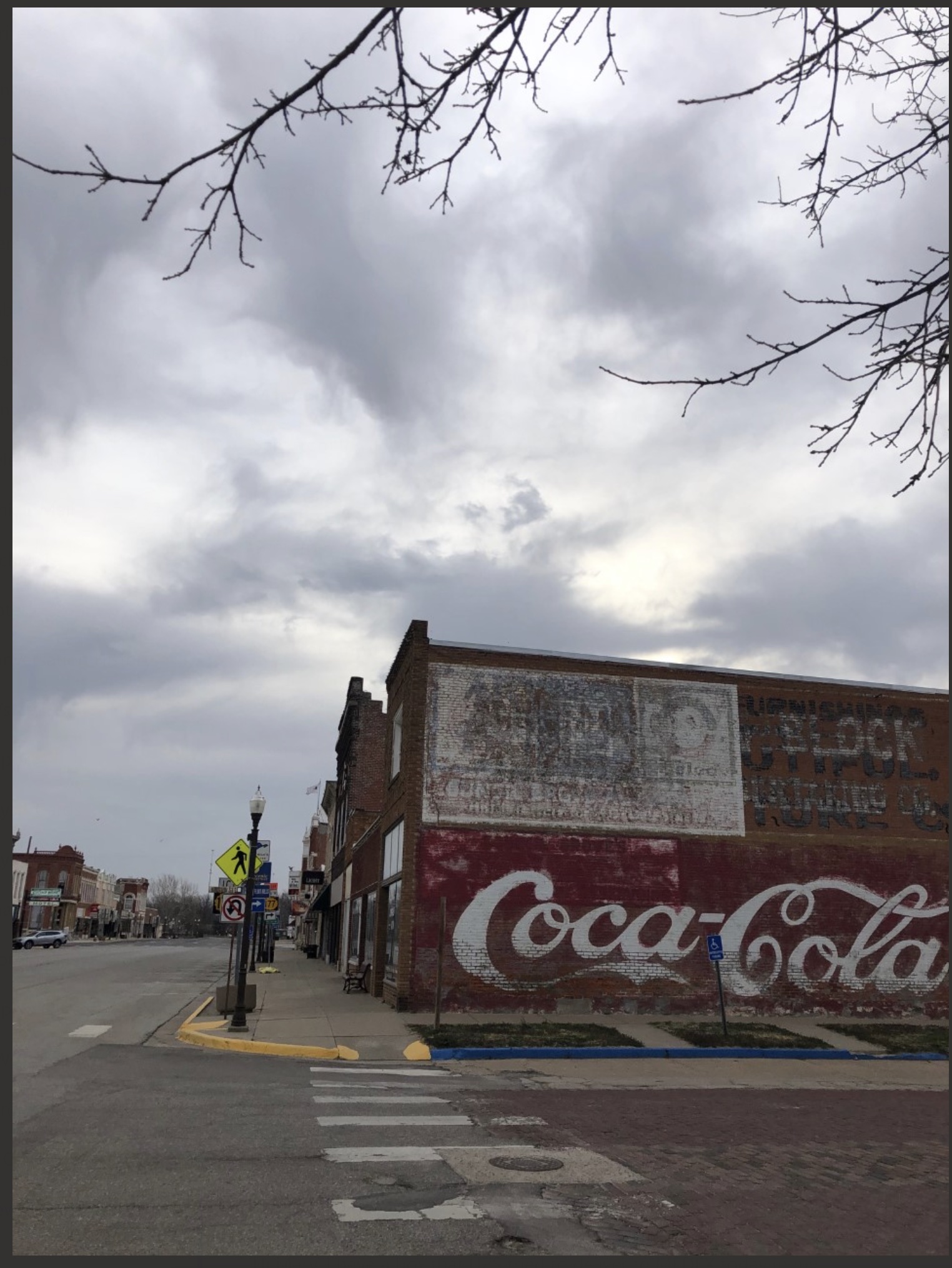
So I strolled from one end of town to the other, looking at the churches and admiring the neat clean town. Main Street is handsome but homelike with its vintage storefronts and 19th century architecture and ornamental lamp posts. There are flower containers everywhere, waiting for spring weather and planting. The street was almost perfectly quiet. A number of the independent family shops are closed on Sundays, and there are no national chain or fast food stores. (The town has a Pizza Hut down by the river, but they’ve kept out Walmart and everybody else). No one was out walking. Virtually no one was driving; perhaps many were getting ready for church.
There’s plenty of parking left.
Right by this Coca Cola sign, the silence was sweetened by some soft music lilting from a storefront, a strikingly well arranged country western song. It fit perfectly with the atmosphere. A van of horses drove by. From inside, a ringing neigh was a glorious evocative sound.
One of the larger mainstream denomination churches seemed a good choice. First, I headed back to the house for some breakfast. I hardly noticed the signboard of the smaller Eagle Christian Church. Even that one glance was just curious puzzlement. “Christian Church”? That’s like calling an eatery “Food Restaurant.” In a town of churches, why would they distinguish theirs with a name like that?
Just then, a family car pulled up to Eagle Christian. A woman stepped out and called over to me. “Good Morning! Would you like to come in, and attend our church with us today?” She and her family looked so friendly, welcoming, and even hopeful that I stopped in my tracks, completely disarmed. My conventional mind felt some chagrin; I had never heard of this denomination at all, and did not know what they preached. What if, like many perfectly good Christians, they taught the Doctrine of Total Depravity? I’m accustomed to and comfortable with sermons and books stating that if left entirely to my own devices I am bound for hell and need to repent in the Blood of the Lamb, because in my case that seems a reasonable assumption. But what if the family at home offered to come to church with me and was surprised by a message like that? But while my conventional mind hesitated, my voice spoke right out. “Yes,” it said. “Thank you, I’ll be there!” They eagerly invited me to 9:30 Sunday School, and we waved goodbye.
Well, here was a fine how-do-you-do. I didn’t have the heart to just not show up. I returned to the house and with some hesitation broke the news to the family, assuring them that they need not trouble to accompany me to a church we’d never heard of. But, surprise: Dear Host looked pleased. As it happens, “Christian Church” really has a name in this part of the country. DH’s own beloved aunt was a faithful Christian Church member in her own town. He immediately offered to meet me there after Sunday School for the service.
Back at Eagle Christian, I was instantly greeted as “Good Morning, Ma’am,” by a tall earnest young man who offered to usher me to the Sunday School. The walk to church just a little too long, and it was now 9:35. So I confided to him that perhaps I ought to skip the lesson altogether; it felt disrespectful to attend my first Sunday School several minutes late. Another greeter, quite a tall sturdy-looking gentleman, overheard me. He looked softly pained that five minutes might keep me from the benefit of Sunday School. He reached out a large strong hand, clasped my hand, then cradled my arm gently but securely in his. I was very touched by his gesture of concern. In the best and kindest sense, he seemed to be guiding a little girl through some dark and unsteady path and into safety. He walked me right over to the Sunday School in the parish hall, straight through a good crowd of attending members, right to the front and center, and seated me in the seat left behind by our speaker of the day.
Our speaker drew straight from Scripture to spell out in clear and heartfelt fashion the seven traits which are ours to claim, in a life devoted to God. (In case you were waiting for it, “total depravity” was not among them.) He made the best use of personal interactions with the group, often inviting church members to answer questions and to chime in with the relevant verses (these people really know their Bible), all with touches of humor and kind encouragement. Two of the seven traits struck home: our true identity as adopted sons and daughters of God, and life as brothers and sisters in community. For people who feel alone and lonely, these are valuable cornerstones for taking our place in the world. They called to mind a favorite chapter, Ephesians 1:3-14, and the destiny prepared for us since before time began.
Sunday School did my heart good. So did the friendliness of that table of women. One turned to me and said something that belongs in the lexicon of every church: “If you do not have someone to sit with today, please do come and sit with us. We will be in the first pew, left.” (She turned out to be the spouse of our speaker, who lost his seat when I wandered in late.)
(Editorial rant: this congregation’s social network clearly does not end after the service, and their friendliness did not hinge upon whether I had a family with me. It is absolutely normal in Catholic and other traditional Christian churches that members will speak to me provided that I have a husband on display, and preferably kids the same age as their kids. Christianity has made itself irrelevant as a shared foundation of American society. One major reason is that half the country is now single, with a wealth of older women on our own. Christian churches have no message for us from the pulpit, and no fellowship to offer. We ladies are tolerated if we volunteer our hearts out and tithe away and keep smiling. Otherwise the congregations would be more comfortable if we’d disappear to Starbucks or the yoga studio or the dog park. In my city, that’s exactly what women do.)
I went off to look for a water fountain before the service. One of the men found me wandering from pillar to post. When I asked him for a water fountain he apologized that they did not have one, but made a rapid beeline for a refrigerator and from a stockpile he brought me a generous bottle of cold water.
Dear Host found me in the vestibule. In his signature fashion he was already making friendly contacts right and left; church members were gathering around him, pleased by his reminiscences of his aunt’s branch of the Christian Church, and the role it played in her life. Before the service a radiant fair-haired small child walked up and shook my hand, introducing himself. The gracious lady who invited me from the parking lot earlier that morning turned out to be a pianist, taking her place with a small ensemble of musicians. An electronic display board showed the hymn lyrics in print so large that even I could read it, meaning I could pitch right in without getting lost in an unfamiliar hymnal or dropping it on anyone’s foot. It was reassuring to see “How Deep the Father’s Love” on the screen. I’d learned it just that week from the Sounds Like Reign channel, sung by Mrs. Kirkland, and so could join in.
This was a special Palm Sunday for the church. They were preparing for Easter in just one week. They had also lost a cherished elder quite suddenly just two days before. Clearly he had been a deeply valued member of the church. It was moving to see the church leaders step up and find words to balance mourning and tribute, with faith in the Resurrection. At different parts of the service they took turns teaching about both, backing up all of it with Scripture and the personal viewpoint of their own lives in community. One of them told a sweet family story as a parallel to the lesson of Palm Sunday; as he talked, he cradled the little fair-haired ambassador who shook my hand before the service. (This happy kiddo was so secure rocked in his father’s arms, and so delighted to find himself front and center, that to support Dad he performed fancy acrobatic tricks for the edification of all. It was a joy to see his beaming smile hanging happily upside down.) There was also an interesting slide show and talk about the church’s recent mission trip to a small mountain town in West Virginia, sharing work projects with a congregation in a small mountain town.
There was one more surprise in store. After the service, familiar faces came right over — including the very first gentleman who welcomed me to town on Day 1, the curators and restorers of the house museum café, and one gracious insurance representative who hadn’t even met me yet but came to shake hands and say “We see you all over town. You keep passing our office window!”
That was a memorable Palm Sunday. Not the Catholic service with long green palms to carry home, to keep in a safe place over the home altar and carry back to church next year (they burn the palms to make ashes for Ash Wednesday). Not the Julian Calender Greek Orthodox service that fell after my return to town, where after weeks of fasting the congregation received palms woven into intricate crosses and then shared a beautiful parish hall salmon dinner. Not the Russian Orthodox service either, where we all hold bunches lighted candles and the Russian equivalent of palms — bunches of silvery pussy willows tied with ribbon.
Christian Church was different from them all: unvarnished Bible truth, earnest sincerity, warm kindness to a random stranger, and a strong solid sense of fellowship in church and outside it during the week. Thanks to a friendly word from the church pianist to a random passerby, it was just the right way to end the week in the right place, right time, and good company.
Eagle values its historic tall trees. They’re all over town, gracing its broad streets and charming wooden houses. Even before they showed their spring leaves, they were a real crown of beauty.
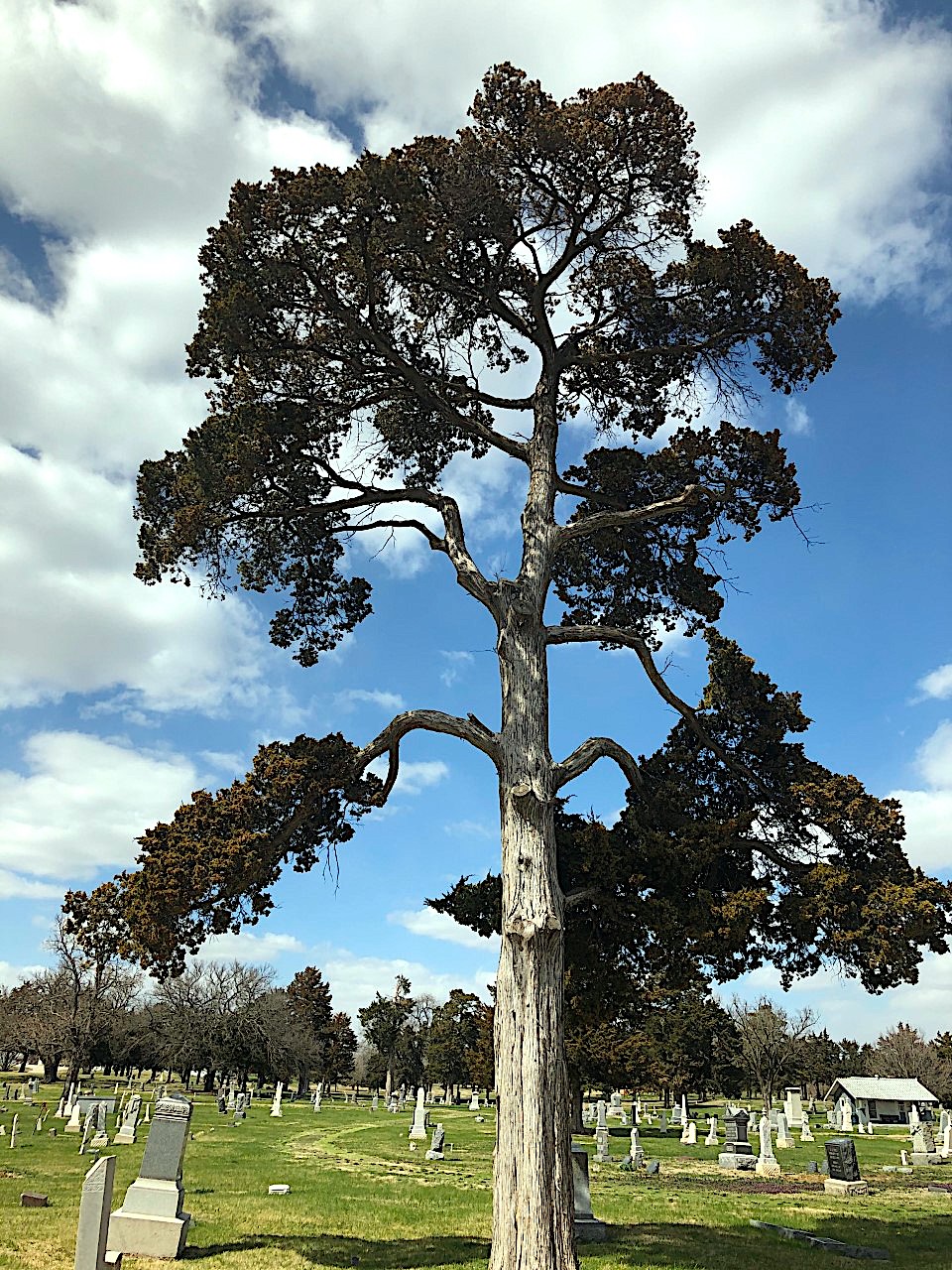
Here is the town cemetery, founded in the mid-1800s, with one of its own stately trees.
And here is a riverfront bicycle and hiking path, running right beside one of our great historic national trails. As I reached the water, a Great Blue Heron soared up from some boulders right beside me, then floated on ahead. He cleverly sidestepped all attempts to fix him in the camera, but stayed nearby all along the walk. Those purple flowers are a type of Lamium, or Dead-Nettle. During this April trip, they formed thick brilliant sweeps of color all through the fields.
For the destination airport, the newly remodeled little terminal is peaceful and clean. I was anxious to alert Host Family about the exact arrival gate, but they didn’t seem worried about finding me. I didn’t know there was only one other gate. All they’d have to do is step in the terminal door and look around.
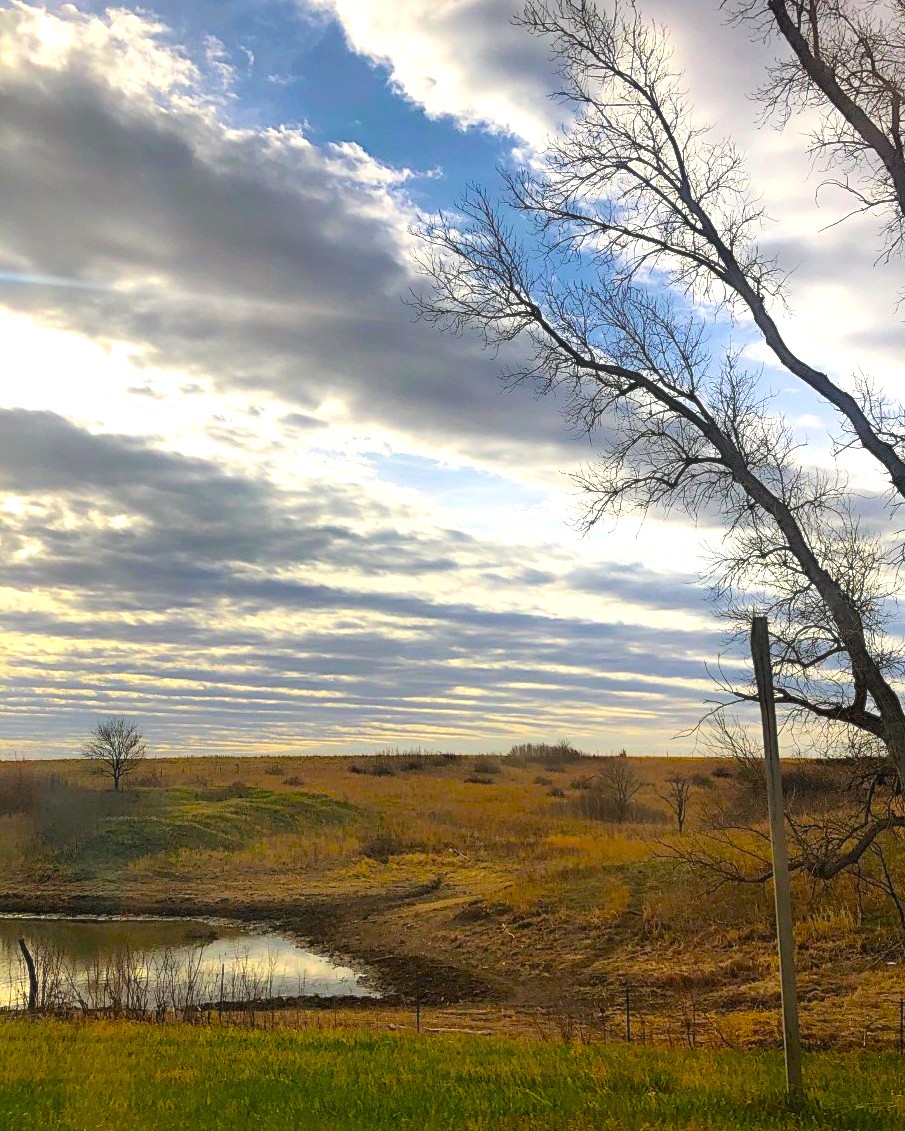
It’s a relief to step outside into fresh air and take off my mask for the first time in 12 hours, to stretch out and contemplate the free open fields and sky. We’re near the center, the heart, of the country. It feels steadying and balanced to see horizon all around.
Outside the terminal, a man on a bench calls a friendly greeting. “Morning! Ya need any help?” We get to chatting. He is here to pick up his grown son. The two are teaming up to drive all the way to the East coast. It’s their chance to catch up with a long bonding road trip. His enthusiasm is contagious. So is his neighborly sensibility. Look: a human! Let’s strike up a talk!
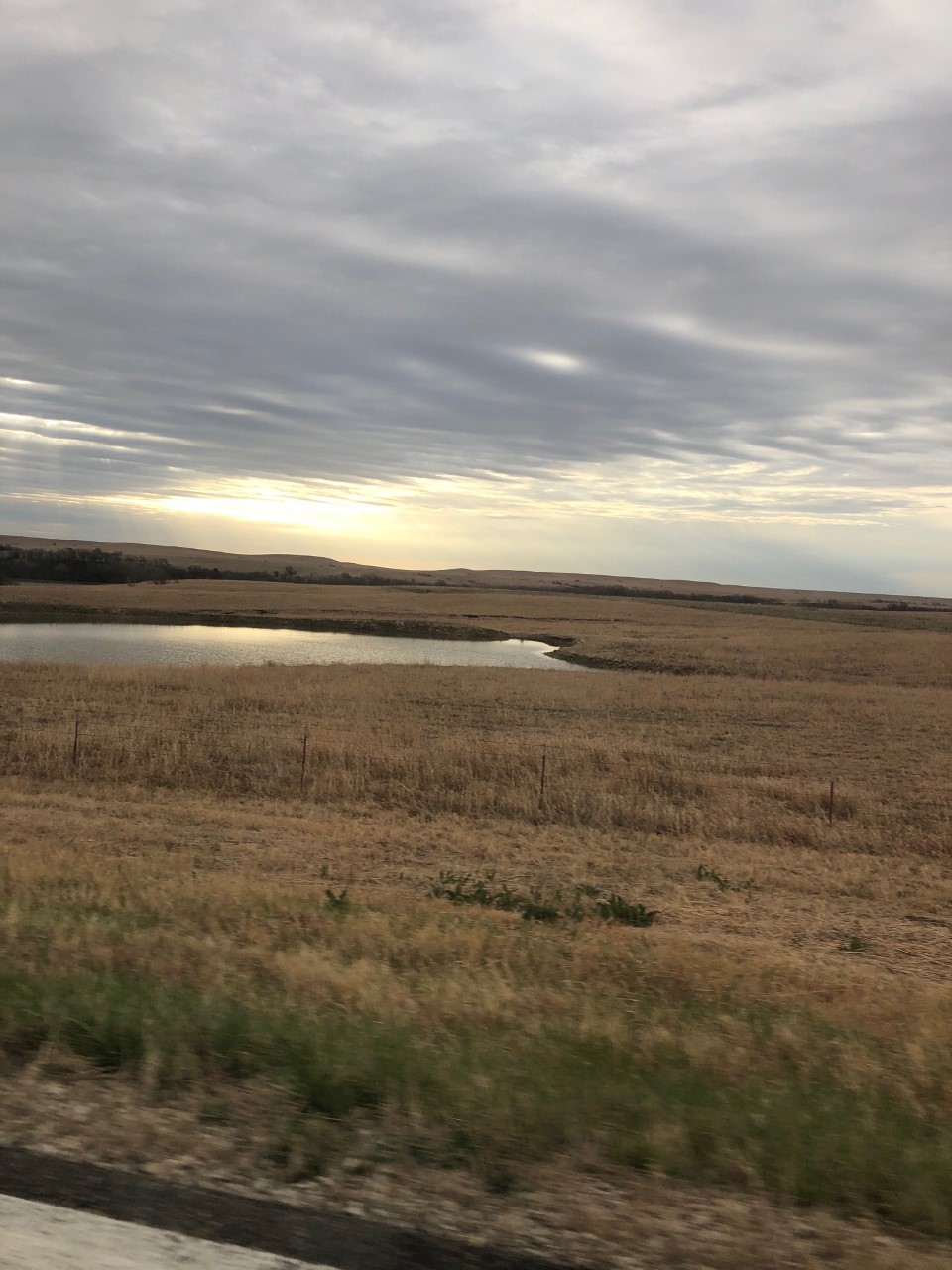
Here comes our Dear Host in his trusty Toyota Cambry, 318,000 miles young and still sailing right along. We head out through the fields, passing one poignant austere artistically composed scene after another. At one point I have to bite my hand to keep from hollering “Stop the car! Look!” After all, it’s one lane of gravel each way, with a deep culvert running along each side, probably protection against flash floods. There is no shoulder. It would not do to start an accident with some cattle van, or that lumbering truck hauling slabs of flint the size of our car. But oh, the scenery! An abandoned farmhouse with beautifully crafted windows and a torn roof is lit by a single shaft of sterling silver light through a bank of clouds; its tall stately companion tree is charred and split, perhaps by lightning, with four circling turkey vultures. It’s straight from Jane Eyre’s art portfolio! Dear Host (DH) explains that we’ll see many Gabelán, or hawks, and eagles too. He’s right; majestic birds of prey are soaring along, or striding through the fields, the size of turkeys.
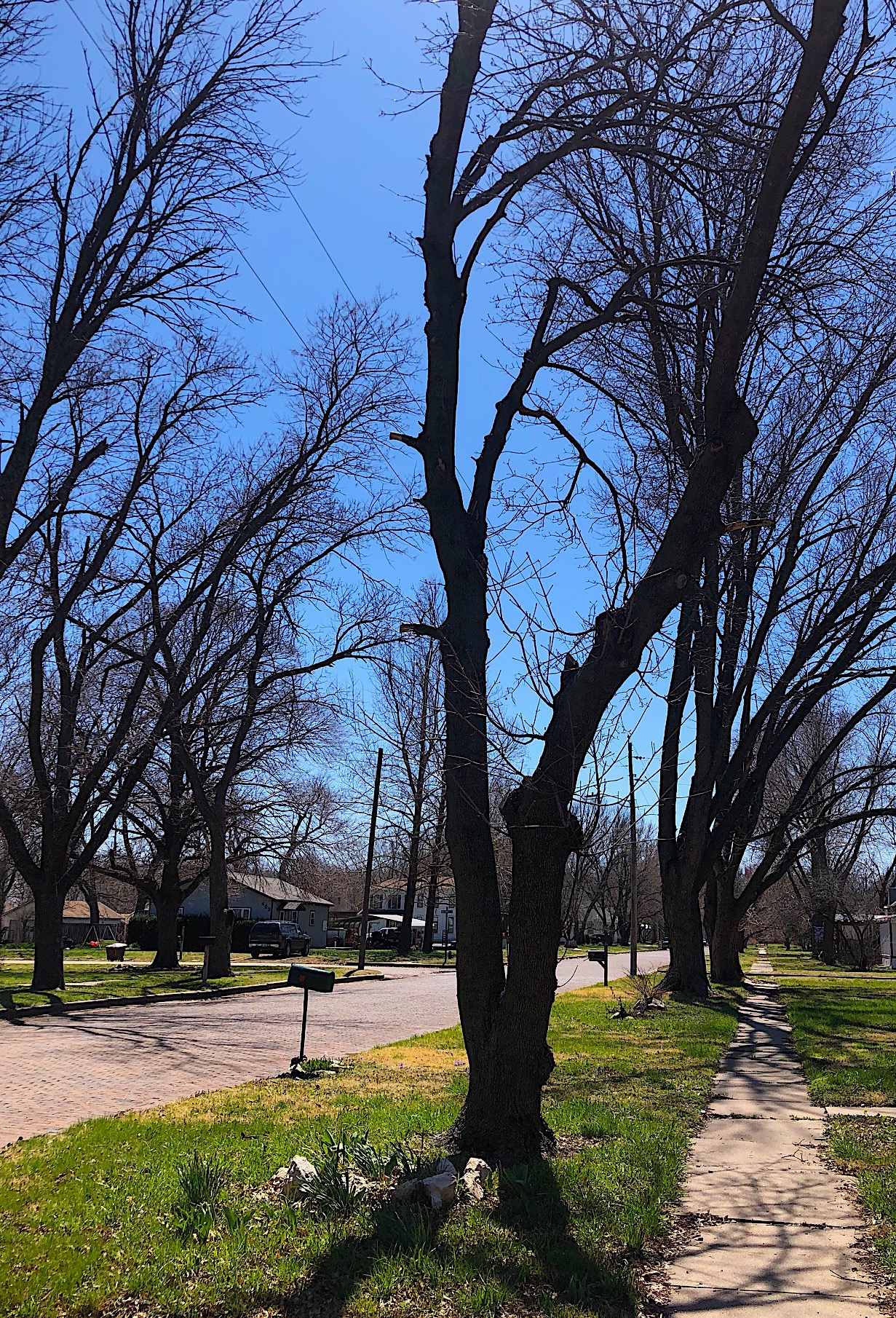
In the downtown epicenter of Eagle the side streets are spacious brickwork. Sidewalks are great slabs of uneven stone buckling from the roots of stately old trees. Bulb gardens are everywhere, with daffodils and grape hyacinths and a few tulips. Under the shade trees the houses have ornate wood and glass detailing. Some are fixer-uppers settling gently or blooming open at the roof line. Even at noon (and in fact every day all day long) there are cardinals singing away in the treetops, with songs of robins and flickers and tufted titmice, goldfinches and purple finches and ring-necked doves.
This side street picture was taken next day, when the sky cleared up.
Host Family’s newly purchased house is trim, neat, and inviting. The roof is brand new, put on right before they bought it by a roofing team who reported to the wrong address. (Oops! Sorry, you’ve got a new roof free of charge — we can’t take it with us!) It has cozy little rooms with white walls and lots of tall narrow windows; wafting in the breeze are ruffly curtains hand-sewn by Our Lady of the home (OL). There are wood floors, fine wood molding for the window and doorframes, a pristine new wood veneer for the kitchen floor and new appliances (put in by an Amish-style workbee of relatives and friends), front veranda and back screened-in porch that will be a study for him, and a cute garage with loft that they’ll turn into a study for her. There’s a front yard, and a back yard soon to be fenced off with a corner for a family chapel shrine. The handy tornado cellar doubles as a laundry room. The decor has warm housekeeping touches, like a vintage yellow porcelain cookie jar on the kitchen table; DH keeps it filled with lemon cookies and coconut macaroons for OL, so that when she comes home from work she can always help herself to a cookie. DH shows me to the snug spare bedroom with an actual writing desk, at windows overlooking the shady veranda and the sparkling birdsongs in the trees.
My two boxes are here, delivered right to the front porch. Eagerly I open them up and get my sunglasses and sun hat. Then after a bit of lunch I head out to take in the sights.
The center of town is part of the Santa Fe Trail, one short block away. Off we go. In no time, the wind fwaps the sun hat right off my face no matter how tightly it’s tied on. I just have to pin it down with one hand. This wind is only minor, but it feels like a steady shoulder shove with a soft ocean roar.
2:00. The day is young. Here’s Main Street! And there’s… tornado sirens going off. Yike. The weather looks partly cloudy; nothing’s funneling in. Still, tornadoes move fast. Maybe it’s still a quarter mile off and spinning this way. Where to run? Here’s the Eagle Grocery store. “Should we be hiding somewhere?” I ask the staff. They give me a pleasant smile and friendly greetings. “It’s first Tuesday, 2:00,” one of them calls out. “They test the sirens. Besides, Eagle has never had a tornado in our history. We’re surrounded by hills. Any tornado gets in here has no place to go; it’ll just have to spin around and drill itself right into the ground.”
I stay and browse around the store. It’s a good asset for this community of 3,000 people. Plenty of much larger towns have no food store at all. But Eagle Grocery is a lucky gem, well kept by a staff with good spirit and morale. The produce looks fresh and varied; in the cooler there are even several kinds of sturdy leafy greens. The produce aisle carries fresh jicama and yucca (cassava) with printed leaflets on how to prepare it at home. There are other unexpected discoveries, like pink Himalayan salt and Greek yogurt. (DH says that at the Bakery counter, one staff member has chef experience and a real flair for home cooking; she told him about her ceviche and other interesting recipes. I hope to meet her one day to talk food.) At the exit, the mechanical horse for the kids brings back memories of many 25-cent rides at our own grocery store, and it’s nice to come across a welcoming rack of free brand-new Bibles for customers to help themselves.
On Main Street, a tall hearty gentleman gives me a courteous hello in passing. When I sing out a good afternoon he stops short and comes right over to me with a look of good humor. “You’re not from here,” he laughs. “Visiting?”
I explain about the DH family. He introduces himself, explaining which business is his, where he lives, in which house, that his father came from Germany in 1916, and the meaning of their family name in German. Clearly he’s a key figure in the town. His friendly readiness to strike up a conversation is an ideal introduction to Eagle society. It turns out to be standard courtesy here that in a conversation of any length, people will explain their roles in the town, and the history of their arrival or that of their ancestors and origin.
As a return verbal calling card, I put together my true story; that way people can fit me in to the fabric as well. “Today I live in City N. for the climate, but have always missed the people of this state. I used to live here too, just 84 miles away from Eagle; I got a graduate degree at the University there, and my classmate from 1982 kept in touch. He just bought a house here with his family. He has talked on and on about how wonderful Eagle is. Well, he did a pretty lackluster job, because it’s so much better than I could have imagined. Your town is beautiful. You’ve done a wonderful job of preserving and restoring its historic features and cultural life.” My role as a stranger from a big city is to take the initiative, to greet every person: You have my full attention and respect. So does your town. I am here to admire and be friendly. In every interaction I point out something good about Eagle: the April weather, this view, that set of trees, a historic building. In response, the residents invariably offer to guide me over to some interesting feature, or they tell me how to find some other resident who shares my interests, or they let me know about some worthwhile resource or upcoming event. Not a single resident, all week, communes with a cell phone while walking down the street. They are alert to one another and ready to greet me, with handshakes, shoulder pats, and even “God bless you”s.
There are plenty of sights to explore here. But I already suspect that my favorite sight will be the people.
Disclaimer: Eagle is not the town name. It does have eagles though.
Day One: Monday
For the trip to Eagle, the plan was to make sure blizzard season was over in the Midwest, then travel in May via Dallas Fort Worth Airport with Alaska Airlines, my favorite carrier, to a smaller airport where Host Family very kindly offered to drive out 40 miles and pick me up and drive back to Eagle. It’s a 13 hour trip from door to door.
But say, Alaska doesn’t have connecting flights going on to my smaller destination airport. Instead, from Alaska it’s American Airlines contracting with a local carrier operating an even smaller local carrier. But that sub- sub-airline’s website schedule didn’t mesh at all with the incoming flight schedule at the destination airport. Hm. I wasn’t keen on flying with any other airline, especially after two years of pandemic-era disruptive fracas among passengers. So I kept plying the Alaska Airline layover options (Chicago? Denver?) with a transfer to sub- sub-local carrier. But the connections between airlines did not match up. May flight seats were pretty much gone. The only options left reached the smaller destination airport after 11:00 pm. (That meant Host Family driving 40 miles late at night on a one-lane highway. This for a family who needs to get up at 5:00 for everyone to commute to work.) And what if the 11:00 pm flight got in late? What’s more, available return flights had a 4:00 am check in time, meaning Host Family waking up by 2:00 am to leave with me by 3:00 and still be crunched for time driving 40 miles back again and then another 35 miles the other way to get to work.
After a day of fussing with websites I finally tried flights farther out — later in May, then June, then July into August. Connections and availability, still no soap. Amtrak and Greyhound don’t operate in that part of the state at all. Then a quick weather check determined that as of late March there were already170 wildfires burning in central Texas, and Dallas was just barely outside the red flag hazard area.
Was this whole trip just a bad idea? I went to bed feeling discouraged. Then at dawn, some flash of insight shook me awake: Travel NOW. Let go of Alaska Airlines. Fly the one airline system straight through. I jumped up and logged in. Lo! Flights right now were cheaper. American Airlines had convenient connections via Dallas, with plenty of seats. I nailed my trip in no time, to depart in a few days.
My confirmation email showed the boarding pass. But say, the boarding pass showed only the first leg to Dallas, not the connection on toward Eagle. Uh-oh. That meant a call to American Airlines customer service. That could take hours on hold, maybe with mediocre cluttery recorded music, then bothering some exhausted harried representative. But… surprise, a calm young man answered immediately. He walked me through the process for correctly viewing the entire boarding pass, which did indeed show both segments of the trip. For good measure, he emailed me a new confirmation and boarding passes — then assured me that he would wait until I could open the new email and view the whole trip. He waited patiently until I not only downloaded my passes to my desktop but could call them up with their QR codes on my cell phone (the modern boarding option that seems to be all the rage). He stayed on the line to make sure that I was comfortable viewing the whole pass both as a printable pdf, and on my phone. He was methodical, precise, clear, and completely reassuring and gracious. As always after a good customer service experience, I asked to speak with his supervisor to pass on my compliments. The supervisor was pleased. Happy ending.
Next, write and mail letters. One was to Host Family with my itinerary and emergency contact information in case of Whatever. Then a letter to my dear emergency contact, with another itinerary and Host Family’s complete contact information.
Then off to the post office for two medium-sized Flat Rate Priority Mail boxes. I packed both with items to send on ahead, then typed up a list of the contents. For the peace of mind of guards at TSA, I mailed off my favorite paring knife. Since the nearest Trader Joe is 120 miles from Eagle, each box held some 72% chocolate chips and some nuts. A change of underclothes and cloth masks and head scarf goes in each box, with safety razor and band-aids. Between the two there were rain shoes, fluorescent vest for any strolling after sunset, sunhat, and a little souvenir or two for Host Family. Each box mails for $16 or so. That’s still cheaper than a checked bag, and a lot easier than hauling stuff around an airport. I mailed the boxes and kept the tracking numbers.
My trusty green travel binder holds documents in clear acetate page protectors. The binder includes a three-page travel template checklist useful for any trip. Before going anywhere, I can customize the template for a new destination (or the same destination, next time around) and print it out for the binder. Here is a sample of the printouts in the binder.
flight confirmation
flight receipt
flight travel insurance
plan of online check-in times 24 hrs before each flight
all airport and airline phone numbers
Host Family contact info
priority mail box packing lists
Covid vaccine record
identity safety numbers (who to call for lost passport, credit card, etc.)
Medical directives (orders concerning emergency treatment options)
Packing lists for knapsack and waistpack.
This trip is more excitement than I’m built for, so it’s important to work through all of my checklists, including the final quiet walk-through at home with the list of things to review before heading out the door:
confirm flight status
check weather for 3 cities
pack cell phone AND charger
check the stove
unplug appliances
check windows
check apartment door lock
After the apartment door lockup, the keys go right in a clear plastic bag for easy viewing by the guards at TSA, along with nail clipper and spoon (= metals), toothpicks for my perio-aid (= sharps) and eye drop vials (= liquids). TSA worries about food too, so the lettuce and apple and bananas and bread (sesame loaf, brand name Ezekiel 4:9) go in a clear plastic bag on their own.
That goes in the overhead bin right in my knapsack (tied with gaudy Easter bunting, so no businessman grabs it on the way off the plane). The carry-on item is the control journal with my large-print Bible. Next trip, I’ll tie them together with an elastic cord, and slip it all in a clear plastic bag. That’s because on the flight home, the Bible flew out of the binder and whalloped the ankles of the handsome well-dressed man in front of me. When he leaned down and then realized what lay in his hands, my shoulder tap and soft apology did nothing for his look of appalled dismay.
I used to catch early bird 8:00 flights. That meant check-in at 5:00 am, meaning limousine for 3:30 but they show up whenever from 2:00 on, meaning being up & at ’em by 1:00 and trying to think straight through a three-page checklist, meaning 8:00 bedtime and waking up every 15 minutes anxious to not miss the alarm. Now I book flights at night, in this case at 1:00 am. That means leaving work, a shower and a bite of supper and a little rest at home, heading out at 8:00 for the bus and train to the airport, security check-in by 10:00, then a quiet terminal and a restful flight in soft lighting where most folks and their kiddos are asleep, then arrival bright and early in the morning for the new adventure.
Tonight the TSA checkpoint lines are a couple of blocks long. Who knew that 1:00 am flights were so popular? The guards very pleasantly request permission to have a lady colleague pat my head. That’s because my laced hand-sewn cap from the Muslim women’s art collective shop has nice reinforced seams. I offer to remove the cap for their inspection, but the TSA protocol is that everybody has to leave their clothes on and let the x-ray and pat-downs do the rest. “Is any part of your head sensitive?” asks the courteous lady guard. Then she very gently pats my head, and — all cleared and good to go. In a chair I put on my shoes, then check that every bit of everything (passport, boarding pass…) is safely back in its place.
Now to text an update to my contacts. Then check the departure schedule, head for the gate, and it’s three hours of quiet airport time to pace around and stretch. Toting the large-print Bible is a little cumbersome, and after the trip I’ll wipe down the cover with Clorox wipes. But this 13-hour journey comes with many small moments of waiting down time. Opening to the Gospels or Psalms for even a line or two is always helpful and calming.
Long around midnight people are all camped in at our gate. An extremely tiny infant is sleeping blissfully with his grandma and mom.
“That is one secure baby,” I tell them. “Sleeping away with announcements and people coming and going. Me, I’d start fussing.”
“If you do, we’ll just pick you up and pat your back,” Grandma offers.
Nearby, there is a young man 9 years old or so. His parents look exhausted. They are trying to rest their eyes while their son asks them lots of insightful questions.
“Well someone is certainly alert and energetic at this hour,” I mention in passing.
The parents open their eyes briefly and smile. So does the young man. He courteously asks me about my travel plan.
“The goal is to photograph a distant bison, a buffalo. One retreating the other way,” I tell him. “Through a window. Or sturdy fence.”
Soon the gate attendants announce boarding for active military members and for VIP and Gold and other special groups.
“You’re probably ahead of me,” I explain, stepping aside for the others. “Group 7 rides with the barnacles clinging to the wheel bay.”
Finally it’s time to board.
The flight attendant at the plane door invites our alert 9-year-old to go and take a peek at the cockpit. “Good evening,” he greets me.
“And a good morning too!” I wish him. “Dallas?”
“Michael,” he replies. “But I’m frequently mistaken for a large metropolitan area in Texas. Which is where we happen to be going. Dallas in particular.”
“Me too! And here is your wee thank you note in advance, to read later during your break.” I hand Michael an envelope with this note:
Dear Valiant Flight Crew, Greetings,I’ll be the older lady in the head scarf in seat 38-C.If for any reason a passenger wants a seat change, and you don’t know where to put them, you can ask me to move.You can seat me next to the crying baby, the emotional support peacock, the person who wants prayers, or whatever change makes people happier and makes your job any easier.I also speak Russian in case anyone needs help with that.Also slow Spanish and a wee bit of Farsi.Thank you so much for all you do to keep us safe.It is a complex and honorable mission, to keep this magnificent airplane flying along while also dealing with the American public and maneuvering a crowded aisle with a cart of tiny pretzels.God bless you, happy trails,Mary
I always pick the aisle seat way in back in front of the rest rooms.
Two very strong strapping young men pause in the aisle.
“Scuse us, Ma’am,” says one, all muscles with a tattoo or two, in a tank top. “We’re 38 A and B. This fella here likes the window.”
“Certainly.” I spring to my feet. “Let me guess: and you like the middle.”
“Not much,” says 38B beside me as the two take their seats.
“Then you’ll get the arm rest,” I assure him. “I’ll wait until you’re buckled up before reaching for my seat belt parts. Don’t want to be grabby.”
After the safety demonstration I turn to my very imposing seat mate in 38B. “I think you should put on your own oxygen mask first, before putting mine on me.”
The two of them blink and then laugh.
We are inching down the runway at a slow walking pace.
“Captain drives like that girl you were seeing. Amber?” says my seatmate to his companion. “19 miles an hour.”
Captain Mitch Siegelman gives a friendly warm welcome, and breaks the news that there will be significant turbulence en route.
“Jeez, it’s good he told us,” I observe. “Turbulence is pretty bad here on this gravel surface.”
“That’s not turbulence,” says 38B. “That’s the poor pavement quality all over the state.”
“Gonna crack this window open,” says our windowmate in 38A.
“Good thinking,” I tell him. “This is smoking section, right?”
“Hear about that guy got sucked right out of the plane?” says 38B.
“Happens,” says 38A. “Except — no, I mean… doesn’t happen to us.”
“Yeah, don’t talk scary,” says 38B. “There’s a little kid in front of us.”
“And a 65 year old next to you,” I point out.
Time for water, and complimentary tiny coffee flavored oval cookies.
“Mary?” Michael stops by my seat with the snack cart. “Mary, thank you so much for your note.”
“Thank you, Michael. I felt apprehensive about this trip. Based on the news, I expected the plane to be like the barroom brawl in the opening credits of ‘F Troop.’ But this has been great.”
Bedtime. Cabin lights are dimmed. The guys in 38A and 38B turn on a film and watch it with headphones on. It’s not polite to watch a film on somebody else’s flight tray. But this one is gripping, alternating idyllic scenery and warm lighting with affectionate family members bonding away when they’re not reacting with horror for some mysterious reason. The subtitles don’t show much dialogue; the actors use a lot of gestures and signs. The family take turn saving each other’s lives from increasingly creepy hazards. Then clearly the mom is pregnant. That is all I’ll say, but things don’t go well for her. There’s a poignant scene where the teenage girl comes across a contraption with wires and puts it over her head, pressing it closer, and dissolves into tears of despair. What?
We 38-ers alternate trips to the rest room.
“What’s your film?” I ask when the guys get back.
“‘A Quiet Place,’” he explains.
“Are some of the actors Deaf? Are all of them? Am I just really bad at figuring stuff out?”
“Only the teenage girl is Deaf. The others sign with her because aliens are listening for them to kill them. They’re like the only humans left in the world. That apparatus the girl put on is a homemade hearing aid. All through the film the dad has been trying to build one for her.”
It’s unusual to see a film nowadays about a family whose motivation is expressing love and keeping each other from getting killed and using survival skills while terrified. Still, I can’t exactly recommend this film. It doesn’t seem productive to spend two hours experiencing cortisol and elevated heart rate with a sad ending. Still, I point out, “The lighting in that movie is amazing. The moods of qualities of light are like… a character. Or a soundtrack.”
After our chat the two of them go to sleep.
Finally we’re at Dallas Fort Worth Airport. I stop and thank everyone, including the cleaning crew, and head into the terminal.
It’s a little scary to discover that the Departures board is way high up and hard to read. It is more scary to find that my connecting flight has vanished. Luckily for me, the information booths are staffed by speedy and courteous senior gentlemen watching for someone to help. Seeing my squinty neck craning, one of them comes right over and explains that this board shows only flights leaving in the next two hours.
“Your flight will appear soon. Meanwhile…” He takes my paper boarding pass, and rests it on a scanner. Beep! Like magic, all of my flight information and my confirmation number pops up on a huge board, showing the right gate. A minute later at a different station I try scanning my own pass. Beep! Now it shows that my exact same flight has been diverted to Charlotte, NC. Which is probably a grand place, but there’s no Host Family there. I flee to the nearest volunteer with my plight. He smiles and explains, “Charlotte was for the passenger who used the scanner last. Look: you gotta touch the Close button on the screen before scanning your own boarding pass.”
Time to change terminals. I consider just walking it. But here’s a Skylink shuttle departing, and a good thing, too; even with this very fast train, it takes quite a while to get there. Turns out this airport is 27 miles long. Now we’re downstairs in a quiet tucked away part of the airport waiting for the smaller airline.
A young man in a Navy uniform sits down to rest. Another young man pauses in passing. “Sir? Pardon me: thank you for your service.”
Passengers walk up to the ticket agents, and just start right in speaking Spanish. A bilingual airport. Cool. Flights are leaving for Guadalajara and Laredo and Tijuana and Texarkana.
Here’s the SUN! A dramatic tropical red ball in a hazy sky.
Life is what happens after you snap the picture, and sure enough: I just miss a wonderful dramatic moment, a white plane at liftoff shooting past the sun, sparkling with fire-colored sunflashes.
Now the next flight is boarding. Night is over. Trip day one is over. On to Eagle for our excellent adventure!
Here are four sunflower seedlings in the kitchen this morning
This early morning dream came along about the Los Angeles River. How did that image come to mind, when this isn’t Los Angeles? Well, years ago there was a video about a dog rescue on the LA River. Now that might sound like throwing a net into some rapids, or wetsuiting up and swimming out for the dog. But no, this wasn’t a river with a slippery shore or swampy reeds or currents. It was concrete walls several stories high over a dry sun-baked concrete canyon that goes along apparently for miles. At that time and location the river was all out of water, so volunteers climbed down some dubious slap-up of laddering and ropes. They persuaded a panicked injured German Shepherd to not attack while being caged and hauled up to safety. It looked dangerous at every step. At the time it must have impressed its way into my subconscious as an Inauspicious Environment archetypal image.
So right, the dream. It was all about running through the LA River like a panicked animal looking for a way to climb out and escape. The only chance was to reach some safety flood gates up ahead and try to climb up one of them. But just as I got closer, each of the gates slammed shut one by one, and sirens started going off. Why were flood gates slamming in a dry riverbed? Because from around the bend here’s a high tsunami of burning radioactive slag rushing along the canal. After fleeing for as long and far as possible, I finally reach a glass control booth. It’s a laboratory full of men and women, scientists who manage natural disasters for the city. Behind the glass they’re completely rapt in their instruments and screens, running from station to station, snapping out commands. They have no spare time to notice that I’m pounding on the door trying to get indoors or trying to warn them. Then it dawns on me: this isn’t Los Angeles. This is Chernobyl. This the Ukrainian team keeping the reactor from blowing up even with all the other hell breaking loose this past month. Screaming at the glass wall won’t help. For one thing, I don’t know Ukrainian, let alone a term like “tsunami of radioactive slag.” I could scream in Russian; that would be comprehensible to them but not a sensitive thing to do. Then the intensity of their work makes it clear that they knew when they volunteered for this assignment what could happen out here, and they’re sparing no thought to whether they make it out of here or not. Distracting them for even a second is the wrong thing. They have something honorable to accomplish together, shoulder to shoulder, in lives full of meaning. Me, I was just bumbling around getting lost; in that much bigger picture of world importance, what happens out here in the canal really doesn’t matter. So I drop my hands and turn from the door and walk away.
Well, a dream like that was good for an early hour or two of lying paralyzed staring at the ceiling. It was really hard to get up and get going with the tasks of the day.
At that point, the most constructive recourse seemed to be tending the new sunflower seedlings. One week ago I planted 40 sprouting sunflower seeds in the garden. Not a single one has cracked the ground. That is probably because our crows are so interested and smart that they must have have fluttered down and dug them all up. It’s a good thing that as backup plan B there was another set of seeds planted indoors in a flat of dirt away from them rascally crows.
Plot review: March 17, put seeds in water. March 18, put seeds in a strainer with frequent rinsing. Then on March 20, when the seeds sprouted little roots, I planted them in seedling flats with potting soil and frequent water misting until March 27.
Note to self: From now on, when the pointy seed tips crack open and show a tiny white shoot, plant the seed with pointy seed tip DOWN and the rounder flatter side on top. That white shoot is a root — not future leaves! (Oops. I planted them all upside down at first. Next day I was puzzled to see no sprouts peeking out. Instead, each sunflower seed hull had somehow risen up out of the soil. Then gradually little leaves unfolded inside the seed hull and finally shed the hull.) Fortunately the seeds knew which end was up. Every one of the sprout roots turned itself top down, digging in and pushing the hull backwards out of the dirt.
Experience also shows that on Day 10 these guys belong in the ground. By then they are two inches tall and ravenous for light. Despite frequent rotation they will twist around to follow the sun and will get gangly stems. Plus they already have a tap root and side roots the same size as the seedling or more. So today I took the dozen largest, and planted them outdoors. Then to let the neighbors know that these are plants and not weeds, I picked out lighter-colored stones from the rock bed, and made little crop circles around each seedling. (It was nice that the sun lit up the inside of that little scallop shell.)
Sunflower seedling in the ground with protective circle of rocks and one shell.
In other neighborhood news, last night neighbor D. and I decided to draw a hopscotch board outside the garbage cage because why not? So we swept the space really well and swiped the big floor mat from the front of our building as a template, and got to work. Here it is, cropped here and there to slice out views of the garbage cage and other peripheral clutter.
Hopscotch Board
Other adults, some of them total strangers walking by, grabbed chalk and helped. Then for the hopscotch game we got some flat rocks to toss on the board, and tried to remember and figure out how to play while making up any rules as needed. My contribution was remembering that the flat rock is called a potsy, and on the way back to square one when we land on the potsy square we have to bend over on one foot to pick it up, calling out “Butterfingers!” Of course, those are New York rules, and the honorable opponent from Mexico had a different set of rules, which was different from Vancouver and Ohio rules. Then as more total strangers walked by we asked them to referee rules for us. Then as various unsuspecting grownups came to take out their garbage, Neighbor D. explained to them that from now on, the rule is that to access the garbage cage, you have to at least walk over the board. The surprise was that nobody turned us down; everybody tried at least walking or hopping, and some even threw in fancy backwards hopping and other tricks. Even when suppertime came and it started raining we big people stayed out for 90 minutes throwing potsies and making up rules and taking turns with the chalk. Between turns, on the far side of the hopscotch board people added big chalk flowers and hearts and smiles and frills and Peace and Love and Understanding. Finally it was getting dark and chilly, and we put the floor mat back where it belonged and headed indoors.
“Gee,” said one of our reigning champions, “and I just came out for a smoke.”