12/24/2022: Christmas Eve

The cold snap warmed up today. Instead of snow or sleet or frozen pavement, all day there was dark cloud cover and hard rain flooding the icy streets and yards.

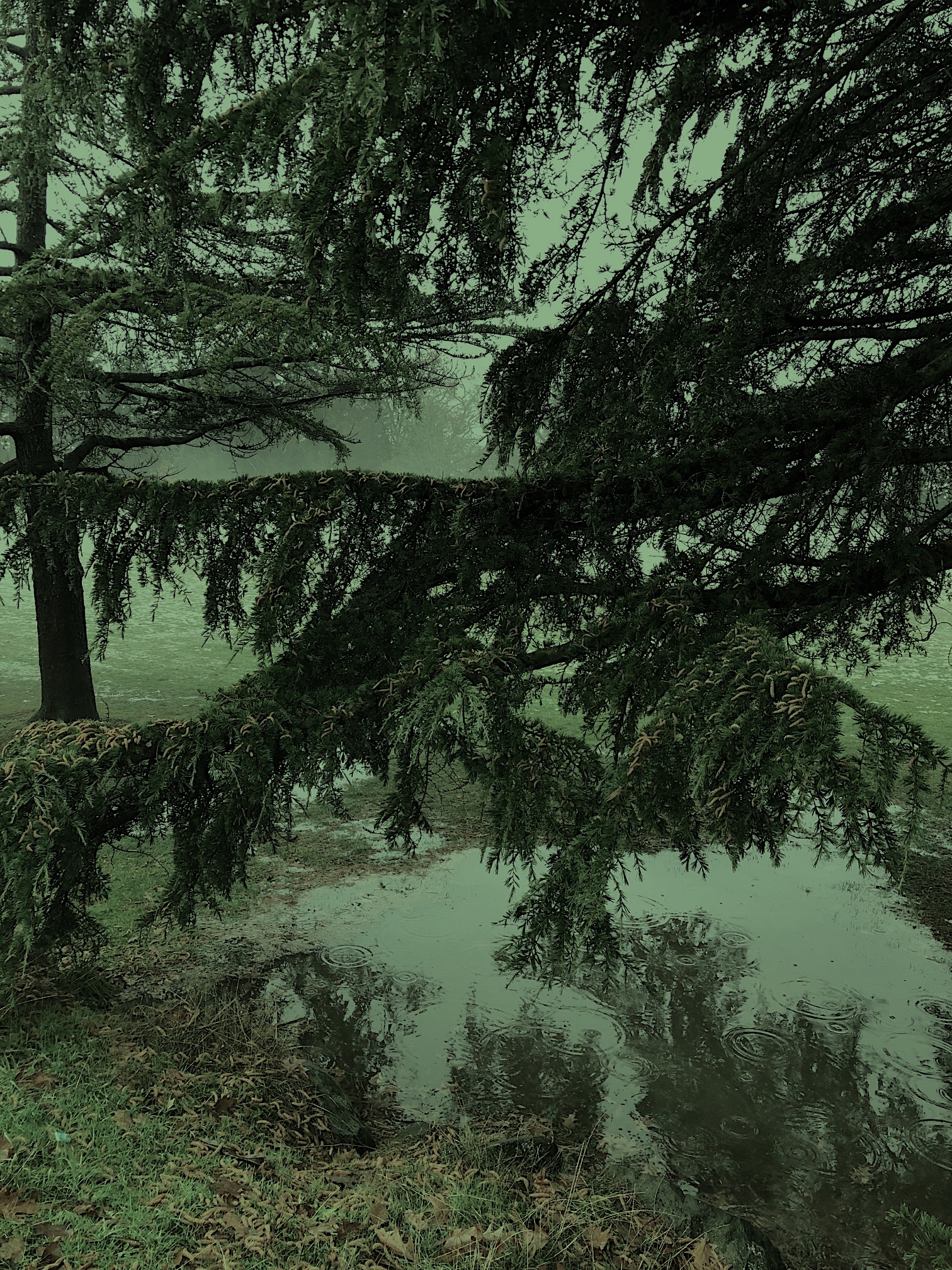
In that steady deluge, there was not a soul or passing car on the streets. For once, the park was empty of sports events and joggers and dogs. From the road it’s a sharp slope down, much too slippery to navigate today, on a trail descending straight through tall conifers and oaks, to a broad field covered with snow. Under heavy rain the snow was melting fast, steaming up in a blanket of thick drifting mist. This scene could be a backdrop by Ivan Bilibin, awaiting knights in armor on horseback.

In my dreams during the cold snap, Angelina showed up in a cameo role to help me be a better Catholic. (Later I sent a text to thank her. She texted back “Oh my gosh that is hilarious. Since that’s the last thing I want you to be.”) Anyway, Dream Angelina knew that in our icy weather, it would be hard for me to get myself out to evening Mass. She told me “Mary. Don’t even try walking over to church in this weather. You stay home. I will drive there, stand in the Communion line, and bring you back a little wafer whatever it means to you. You’ve been to Confession first, right?” Well, no; I haven’t been to Confession in over a year, and had to confess that to her. “A year!” said Dream Angelina. “Then you certainly are not spiritually prepared to receive Communion if you have not been to Confession. Well, I’ll go stand in that line too. Here: write down all of your sins on this piece of paper. I’ll carry it into the voting booth with me and add it on to my sins to tell the priest. Father can absolve us both, like a two for one special.”

To reward her piety, her offer to present all of my sins as her own, and her faith that they would all fit on one sheet of paper, I stopped by her house tonight to share an annual splurge holiday confection: four ounces of organic milk chocolate drops with a crunchy colorful candy coating. They’re an imitation of a familiar childhood candy, but made with different ingredients (the pigments come from turmeric, radish, red cabbage, spirulina, and beets). Real-Life Angelina and I tucked in to the jar and started munching the chocolate drops. They were an ideal festive backdrop to chatting and watching “Angels We Have Heard on High” by the Piano Guys.

When I unscrewed the jar lid, Super Pup snapped to attention on her dog bed. She’d just had a relaxing walk topped off with delicious pup-healthy treats. But even after I tightly resealed the jar, she zeroed in on that unfamiliar substance under glass, a food which canines are not at all evolved to digest. “Chocolate is toxic for dogs,” I informed her. She was not deterred. She rested a tiny paw on my shoe. She whimpered in a plaintive manner. She crept on to my knee. She nudged the sealed jar, staring at vivid colors that a dog (they’re pretty well colorblind) couldn’t even see. I put the jar away out of sight in my duffle bag, thinking she would forget about it. Instead she crept closer to track and sniff my mouth and hands. She tried a protest yip. She even tried flashing her teeth. I nudged her away with a fingertap. Nothing daunted, she vaulted off the sofa to rummage among some toys. She vaulted right back at me with a little slice of bone. Cuddling right up, she nestled the bone slice in my palm, then tipped her head and gazed sweetly in my eyes. “That’s a trade,” Angelina explained. “Fork over that chocolate, and you can gnaw my favorite bone.” For the rest of the visit Super Pup plied me with ploys to get at that candy. Finally we leashed her and Bingo so Angelina could walk me home. Only then did the standoff end.

None of this even mentions Our Lord and Christmas. That story comes tomorrow. Silent Night!!

Posted in Uncategorized | 2 Comments

12/18/22-12/20/22: Joy?

This pond image looks fuzzy with TV static. But the white dots are a sunshower of Rimed Graupel, raindrops cooled down to round soft snow puffs. As precipitation types go (and from what I saw of Kansas weather, some are pretty scary) a minute of graupel shower is benign and cute, like standing under confetti when you’ve won a spelling bee.

Among today’s duck flock there were a matched pair with large pompadour crests, one in gray and one in black and white. Their showy look inspired me to search the internet for “ducks with black and white heads.” The remarkable “All About Birds” website at CornellLabs showed just the right portrait to match this endearing bird, calling it a male Hooded Merganser. To respect the copyright and the hard work of the photographer, here is a link instead of a picture.

https://www.allaboutbirds.org/guide/Hooded_Merganser/photo-gallery/302071781

In other news, on Sunday nights at church there is a series of sermons about the spirit of Christmas — to be exact, the role of the Holy Spirit as the creative power behind the many incidents and connections which culminated in the Christmas story. Now those Gospel accounts have been familiar over a lifetime of repetition and fond cultural associations, and that can lead to a default habit of imagining ahead to the finale of the story. But this month, when popular culture is flinging holiday-themed distractions at us, the church up the street is a welcome sensible oasis to ponder the holy day at the heart of it all. Pastor takes this very familiar story, walks us through the verses, and then thin-slices the moments and discusses the details for a fresh deeper look.

One point involved First Thessalonians 5:16, “Rejoice evermore.” The idea is that joy is not the same as being happy about every life condition. Instead, joy is something that we can affirm in every circumstance. (Famous Christian example: Corrie and Betsy ten Boom in The Hiding Place were not happy about the blanket of fleas in their bunk in the labor camp. But they thanked God in the circumstance of even those fleas. Later they discovered that they were able to pray, preach, and sing hymns in peace with their fellow prisoners without punishment, only because the prison guards refused to enter the cell block because of the fleas.)

Anyway, Pastor made the point that “Rejoice evermore” sheds light on the point three verses after in 5:19, “Quench not the Spirit.” So one way to align our lives with the Holy Spirit, at Christmas and every day, is by rejoicing. Joy is after all one of the nine fruits of the Holy Spirit. It would stand to reason that we can work more closely with the Spirit by affirming joy.

Christianity has a custom of describing spiritual experiences using the vocabulary of worldly experiences. That’s a fine start, but it assumes that listeners have had the worldly experiences to begin with, and are bringing that to the table. Describing God as an unconditionally loving Father may not help a person with no background experience of love from a human father. What does Psalm 23 mean to people who have no idea what it is to see and feel the calming effect of a green pasture and running water, or natural beauty at all? What did “Peace be with you!” mean to my college roommate’s devout father? He was afflicted with hysterically violent outbursts of temper until the family appealed to his doctor. The care team conducted a thorough physical with lab tests, and then the doctor (as a reluctant ethically controversial last resort) prescribed “blood pressure” pills that were really an anti-depressant. After a few weeks on medication, Dad woke up in tears, exclaiming “Peace!! I’m finally at peace! I’ve never felt it before in my life. Now I know what people are talking about.” He healed his relationship with his family, and might well have found more comfort in his King James Bible, where “Peace” is used 420 times (thank you Google search).

The idea of rejoicing in the Spirit was in mind all week. In fact, day and night, it wouldn’t go away. Focusing on joy over happiness, and centering that joy on God, is a good solid idea. The only issue is that I don’t know how joy feels to begin with. I simply don’t know what people are talking about. Unable to puzzle out the sermon from last week, I grew so discouraged that I didn’t even try going to church for Sunday evening service.

Part of the issue is that popular culture seems to kick these words around without much agreement or deep thought about what they mean. In the news today, a sincere reverent reader responded to an online article with the comment, “It is only through suffering that we can know what the opposite, true joy, really is.” (So “joy” equals the absence of suffering? Here I thought joy was a lot more rugged and deep somehow.) One error is to label “joy” to what is really just natural (or artificially induced) elation, implied in, say, ads on our city buses showing paid models screaming over their good times at some casino. Yesterday’s winter reading at the library was a Marie Kondo picture book with gorgeously arranged photographs of her home, advising on how to choose objects and arrangements which spark our inner joy. For example, she described her daily uplifting ritual of wiping and polishing her entryway to her home, and also cleaning the soles of her shoes before arranging them neatly, each in its place all ready for use. Ms. Kondo’s focus and dedication have given me some practical tips and enjoyable images. Inanimate household items matter; I’m grateful for kimchi rice, a nap in soft bedding, my new Water-Pik flosser, and the new toilet seat from building management that doesn’t wobble and threaten to tip me onto the floor. But an inanimate belonging doesn’t spark anything joyward unless it’s a symbol of a personal relationship.

Instead of church, I went over to Angelina’s to hear her ideas about joy. She was just finishing a batch of chicken cacciatore and fresh pizzelle anise waffle Christmas cookies hot from the pizzelle press. She shared with me a lot of good examples of the joyful moments in her life, including the company of her wonderful children, play with her dogs, and the privilege of cooking and sharing delicious foods. (Then again, is that kind of uplift and harmony what we would call “happiness”? See, I wouldn’t even know.) After our visit, Angelina packed up goodies for me to take home. “Why don’t you think of some step that will bring you closer to what looks like joy. Then we can go out in my car and explore that together.” That sounded like a generous and sensible idea from a caring warm-hearted person.

People have suggested that maybe I’m expecting “Joy” to be something very dramatic? But my problem seems to be that I simply don’t have an emotion set, to match what other people mean. (I don’t have an emotion set for a whole range of other feelings either. The idea of “insatiable lust” or “avarice” or “relentless athletic competitiveness to the point of physical self-damage” are far over my head too.) A friend of mine is red-green color blind. People have dangled really really bright reds and greens at him saying “You must be able to see that. It’s really bright!” Like, maybe you were expecting red and green to be dramatic, but in fact they are in the little everyday details around us and you’re just not paying attention or appreciating them.

Talking with Angelina I looked far back over the years to think of times in life when I felt joy. For me, the closest approximation must be warm human connections. That’s why I take walks in the cemetery; the engravings are a reminder, carved in stone, that people love one another. That’s why the Russian TV show Zhdi meniá (Wait for Me) is a favorite Friday tradition for my mirror neurons; the show tracks down and matches up long-lost relatives and friends, and brings them together in the studio to share life stories and hugs and kisses and expressions of clearly recognizable joy. “Maybe the closest thing,” I told Angelina, “was times in life when things were difficult or impossible for people that I love, but then there was an opportunity to do what God would want, or that person had a truly remarkable change of heart, and that created an even better connection.” Closer connection with God and other people — to me that looks like spiritual consolation and grace, something which sustains and guides and inspires us through any circumstance, like the many wonderful stories of Corrie ten Boom. For now, that is my best definition of joy.

Just today, Angelina took us on our first adventure: to the doctor for a followup check for me, through rain with warnings of a winter storm front. Rushing to meet Angelina, waiting downstairs with the car, I hopped around in one snow boot, tugged and struggled with the sliding doors of my dark closet, rummaged wildly through footwear for my other snow boot, and exclaimed “This NEVER happens to Marie Kondo!” The medical checkup all turned out just fine, and Angelina’s good company and humor and skill at navigating in very cold rain turning to snow fills me with gratitude. Afterwards we brainstormed ideas for future adventures: Kashmir? Machu Picchu? Then it was off to rest in thankfulness with the great privilege of some kimchi rice and soft bedding.

In conclusion, a picture of ornate lacelike pizzelle belongs here. But on Sunday night I ate them all in the 5 minute walk home.

Posted in Uncategorized | Tagged , , | 1 Comment

12/3/2022: Dressing for the weather

Autumn trailed away with some nice parting views.

This house had a dainty planter at the front gate, holding miniature succulents.

Here are some implausibly tall cottonwood trees (the picture can’t do justice to their towering height or the glorious sunshine), losing their leaves in a high ray of light from the setting sun.

Some implausibly tall cottonwood trees are shaking off their leaves for the year, lit up by the last ray of high sun.

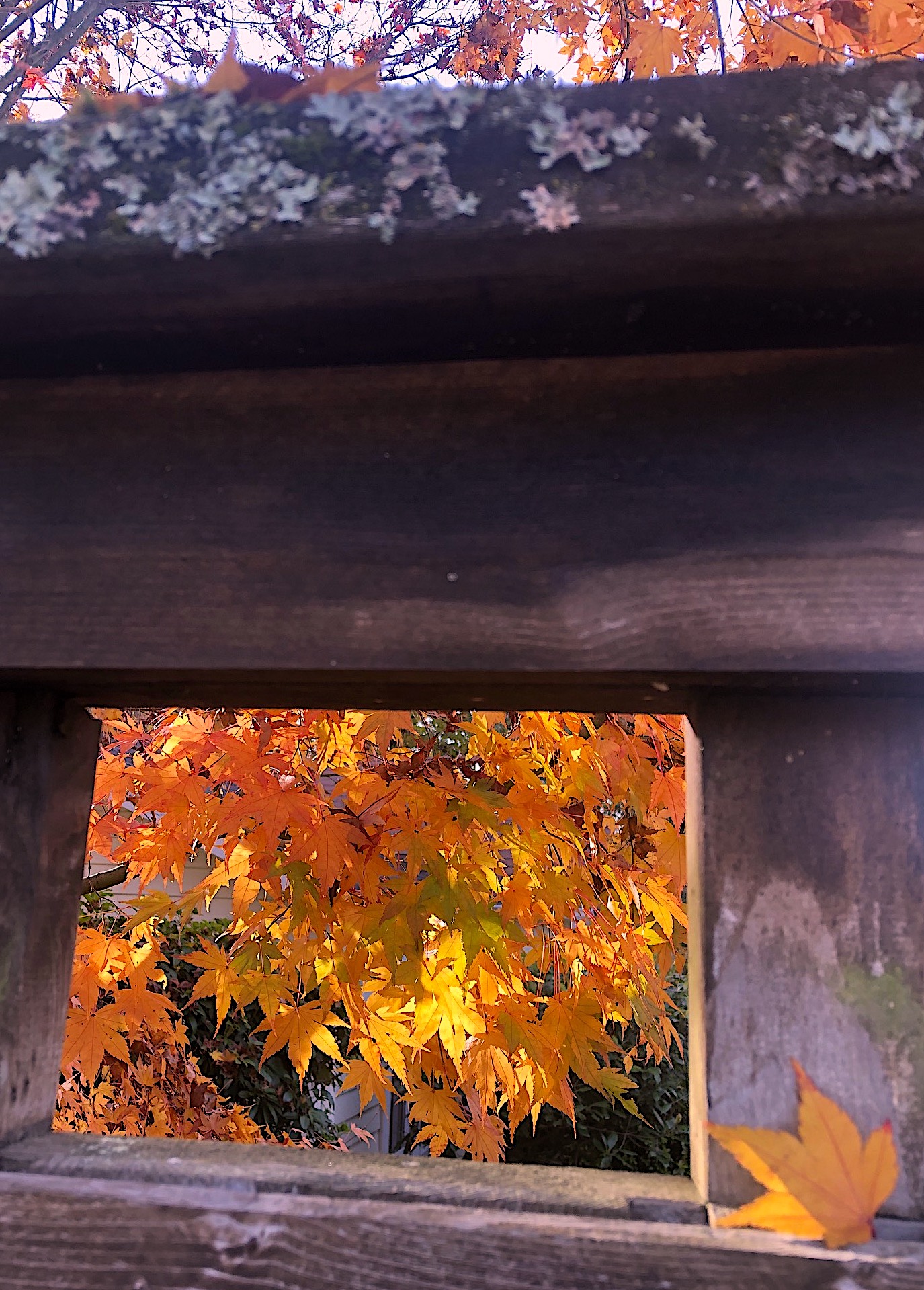
Here below is a sturdy wooden fence with a genteel tempering of lichen. A random side glance through a space in the frame revealed this glimpse of the garden inside.

On a cold morning of intermittent freezing rain I was nested in perfect comfort on the bus to work, eyes closed, head bowed, arms folded, breath long and gentle. In that profoundly restorative interlude, thoughts of worry and regret drifted past and misted away, leaving only a clear inner mirror of calm and interested sensations: feet on ridged non-skid floor feeling the surfaces of the road, balance gently shifting as the bus changed directions and speeds, supportive plastic-leather seat, soft surrounding cell-phone chat in nearby seats, alternating heated and chilled drafts of air. Thoughts and impressions passed by that clear mirror in peace, leaving only good wishes and warmth for this group of strangers heading into their day.

“Would you LIKE A PAIR OF GLOVES?”

My head and spine snapped upright; the words seemed to be right inside my sweatshirt hood, but were in fact about six inches from my face. A genteel and sweet looking lady had bowed right in close and raised her voice a bit. She was holding out a pair of nice little gloves. “I have an extra pair at home. Please, it’s fine.”

I gave her a smile and showed her my hands. “Thank you so much! My joints are too bent for gloves. That is why they are folded into this kangaroo pocket, all snug. But that is very kind of you.”

“Is that rheumatoid arthritis? I am so sorry. Well all right then. See you next time!” We waved goodbye as she got off the bus.

It was very kind of her to just offer that way. It’s not too rare for people see me hiking around in freezing rain and assume that I’m very poor. But in fact for rheumatoid hand circulation, nothing beats a lined sweatshirt with hood and a kangaroo pocket for comfort and warmth. Nothing beats a jumbo rain tarp either, or clownie men’s shoes with cleats and a high toe box (the feet are rheumatoid too) or a fluorescent vest for safety, or a sturdy beat-up shoulder bag with broken zipper bought ten years ago for a dollar at the Lutheran church charity sale, the perfect size for my triple-filtered water green tea and the best organic produce money can buy cooked up fresh into neat glass jars and some Pimsleur language learning tapes and a library book and eye drops and tissues and a flashlight. This caring lovely lady wouldn’t know that I’d just invested $366 for the incredible luxury of a followup CT scan of last year’s gum abscess. (Rheumatism comes with gum disease. But it’s all fine; there is even new bone growth, which was wonderful news.) That’s putting my money where my mouth is, not wearing it on my sleeve.

That calls to mind our Greek Orthodox church, where the youth group assembled bags with bottled water and protein bars and hygiene toiletries and clean socks for distribution to community members experiencing homelessness. On bag assembly day I was standing in the purchase line at the church bookstore waiting my turn with other customers. A congregation member spotted me with the clown shoes and rain tarp slung over one arm and the Lutheran duffle with provisions for my post-Liturgy prayer hike. She hurried into the bookstore singling me out with a raised voice. At first glance, her eyes, tone, and assertive approach looked as if she thought I was shoplifting. It took a dim gaping moment to figure out what she meant by “You NEED a BAG?!” But in fact I was just lost in enchantment, surrounded by beautiful devotional items, eagerly waiting to purchase two books on monasticism and an icon and cross. I was also happy that day to be dressed not to tote file boxes at work, but for church in my nicest dusky-rose blouse and long rose dress with matching rose & silver Pashmina shawl. Well, that’s what humility is for, and it’s good to know that we have generous people afoot.

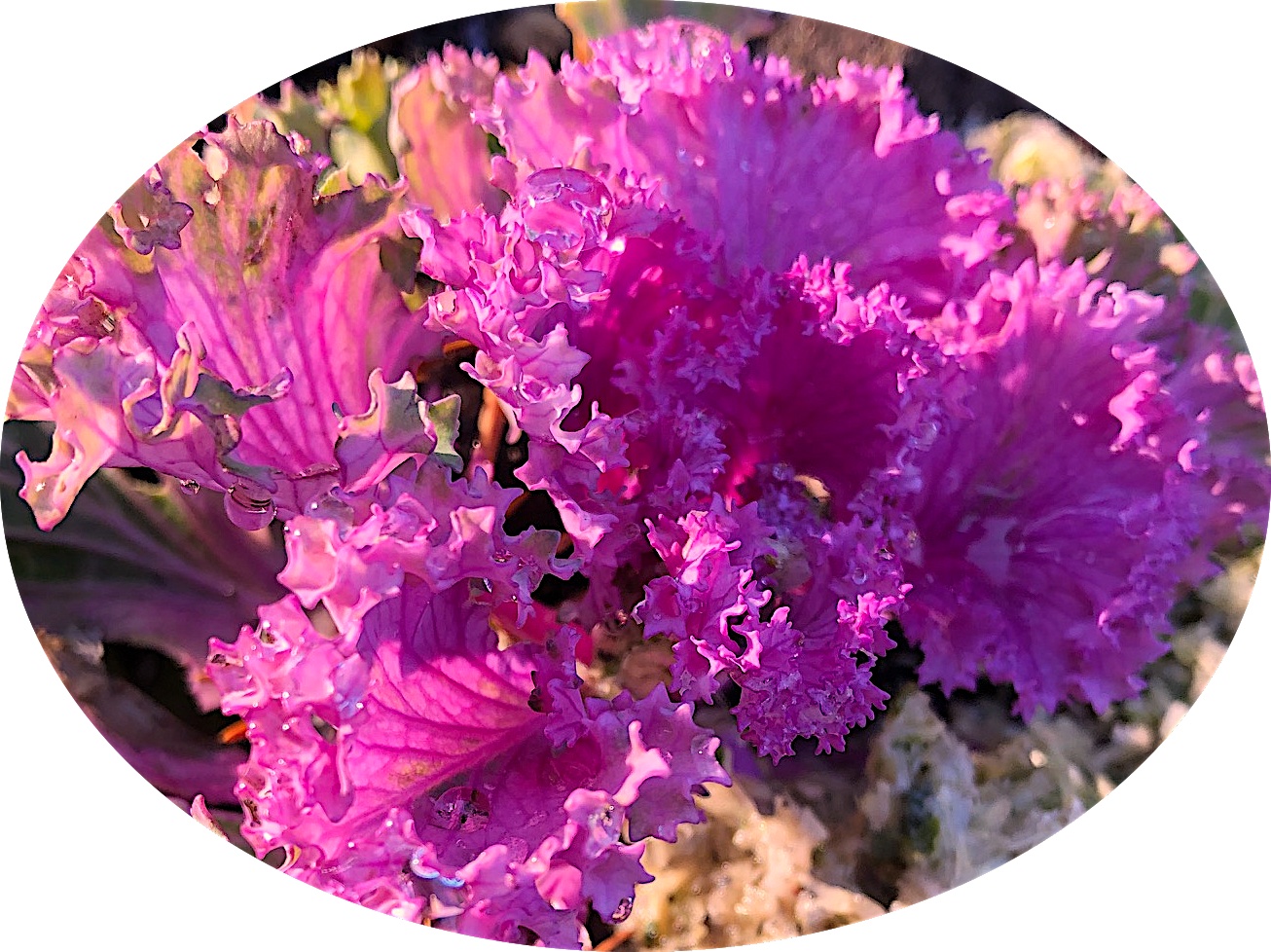
This week saw the start of a new winter season. Last night at bedtime there was soft steady rain. But before dawn, there was a wake-up surprise: at eye level right outside through the screen at the open balcony door, a foot away from the bedroll and pillow, there were inches of snow! It all melted with sunrise, and the day turned clear and brisk with an early moon (84.7% full, waxing gibbous). In the garden, here was some of my frozen flowering kale in the early sunshine.

And here is a new winter crop. On an afternoon of sleet and freezing rain with gusts of wind, the Wing Family harvested their bumper crop of sunchokes (the first three quarts of chokes are now in my fridge) and brought in fresh black topsoil and giant turnip plants. They planted a row of white turnips, and a row of Chinese Red turnips. The plants thrive in snow, and will grow all winter as a source of edible roots and leaves. Mrs. Wing explained that she will also use them as one ingredient to compound her herbal medicine cough syrup elixir. It does the heart good to see this hard-working family constantly tending every available bit of space and improving our quality of life and garden enjoyment.

Well, the sprouted chickpeas are all cooked up, and this week’s batch of kimchi is mixed and seasoned and in the weighted press. Time to go soak some rice and cook greens for tomorrow. Maybe we will have a thaw for that hike in the woods….

Posted in Uncategorized | 5 Comments

11/20/2022: Stolen Tree

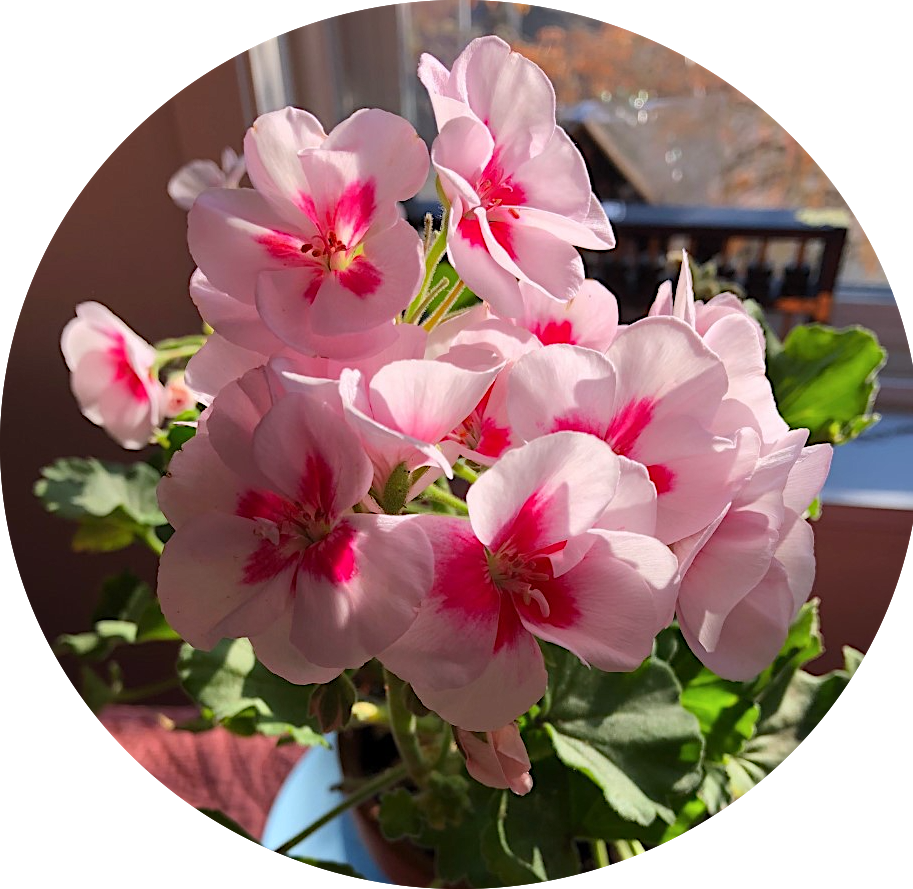
Just for the record: this plant is not stolen. Our building management said I could dig up a geranium from their planter and take it indoors out of the frost. Here is how it looks now.

That night I was last and late leaving work in the basement stock room. I locked up the office and stepped outside into six inches of water. The wind took my breath away and threw me back against the door. My rain slicker somersaulted up and off; I yanked it back on and pinned it down with one arm, shielding my head with the other from the horizontal rain.

The main street was empty; not a soul or car in sight.

A shopping cart raced over the curb and spun out in the road. Metal trash cans flipped end to end, spilling and splitting their bags of garbage. Some window behind me broke in a shower of glass. Up on a half-finished building, Tyvek wrap was all booming shreds. Streetlights jolted like hanging effigies with their lights spelling empty black.

Taking off my steamed and streaming glasses I peered through my fingers to slide along a drug store wall and cower in the doorway for the next hour, waiting for a bus that came an hour later. I’d always been afraid of bad weather, and ashamed for feeling that way. But even for me, all this blowing debris seemed extra scary. There were no pay phones in the area to call the house. Maybe I should go sleep in the stock room at work? But that would mean walking all the way back through those dark streets to the empty building. Some sense told me to just stand right there in my little nook at the drug store, and shelter in place.

Next I was hit in the chest by a potted plant. It was a hefty armful of leafy tree in a planter, bounding down the street. On some impulse I picked it up, and then saw the bus headlights. Wait, how would the driver see me in the dark? I ran out to the stop, hopping up and down and waving the tree. The driver swerved and pulled in. I fell breathless up the bus steps.

   “Gwan gwan move IN,” the driver ordered as I fumbled for the fare. “Get back.”

The bus was jammed with delayed commuters. I wedged in, holding the tree sideways out of their way. Potting mulch and rain streamed down me and on to the floor, already a trampled sludge of fallen leaves and newsprint. A young man in a good suit and London Fog coat gave me an indignant glare. “That is a stolen tree. That tree and planter were stolen right out of my house.”

Passengers turned and stared at me. I thought fast. “And now, here it is! I didn’t know where the tree came from. I was getting on the bus and it flew right at me. Here you are, Sir.”

He waved me away. “Whoa no. I don’t want it back. That was all my tenant’s idea. The plant was all dried out at the curb on trash day, and he dragged it home. He got it all blooming again. White flowers and little oranges.”

An orange tree! The passengers and I took a more appreciative look at the five gallon bronze colored planter with scalloped edges. The tree was about four feet tall, covered with jet black leathery leaves. “It’s frost-bit some is all,” I said. “I can re-pot it and care for it a while. Then your tenant can have it back as a surprise.”

   “No,” he said. “That is… no but thanks. He died last year.” The passengers turned and stared at him. “He named it Clara.”

   “Clara it is, then. She can stay with me, and be his memory tree. He must have cared about plants. Did he work in a plant nursery?”

   “He worked in two restaurants. But he moved here from Delaware to stage ‘The Nutcracker.’ That was his whole big dream. He rented my ground floor. Every spare minute he was building sets and models in his rooms downstairs, like a whole little stage world. Playing the music, learning the score, walking through choreography, drawing costumes and decorations, moving panels and curtains around. He was all excited over this dead plant. He always said if the tree makes it then he’ll make it too. Like, ‘It’s you and me, Clara. All the way. Together.’ And when the tree grew back, he was so happy.”

   “And ‘The Nutcracker’? Did anybody see his stage set?” I asked.

   “Couple of guys came over and looked at the plans and talked with him. Then he caught a cold and didn’t get better. In and out of the hospital. At home he lay in bed looking around at his stage and playing the music, making little Christmas ornaments to hang on the tree. When he died his parents came and picked up all his things.”

   “They took the stage set to Delaware?”

   “They took it to the dumpster in pieces. I found it there that night after they left.”

   “The tree too?”

   “They didn’t get the tree. After he died…” He stopped and cleared his throat, looking around. We all waited for him to go on. “I had this dream about a group of men. They were whispering this little song, like chanting. They joined hands and walked in a circle all around the tree. And I woke up and jumped out of bed thinking ‘My God, those men are inside the house!’ And I ran downstairs. But no, the place was all quiet and locked. Then I saw an orange blossom by the front door. I opened up his room. Everything there was right the way he left it, but the tree was gone.”

Passengers took a long collective breath. Then they stirred, looking around.

   “Where are we?” A couple sitting nearby wiped the steam off the windows and bobbed their heads to see past the rain. “We missed Washington Street. Six blocks ago.”

   “We missed Maple before that,” said another.

   “I just missed Rutherford,” said the young man.

The driver stopped the bus. “Jeez, you coulda rang the bell. Folks, this is bad out there. I’ll have to circle back to Maple, let ya’s all off at your stops. And you, Miss. Young lady with the tree. Where ya headed?”

   “Center Square, Sir. Last stop.”

   “Stay put while I loop around.”

The bus emptied out. At Rutherford the young man left the bus. “Good luck with that.”

Clara and I took a seat near the driver. I dropped my coins in the fare box. Center Square was the last stop. I stood up to leave.

   “How far you going, Miss?” The driver turned around. “Top of the hill? No, you can’t lug that thing. Sit down and point out the way I’ll drive you.” That night our residential neighborhood, all soaring sycamores and pines and three-story family houses built in 1900, had an off-duty Metro bus ease along the flooded street and right to my door. “Get in safe, Hon. Take care of yourself. And your little tree there.” I thanked him and waved goodbye, and rushed for the house.

The rain roared down on roofs and tall rocking trees. I groped my way over fallen sycamore limbs and up the porch steps. Unlocking the front door and sliding along the wall I eased sideways up to our apartment on the second floor. I carried the pot down the hall to the bathroom off the kitchen, and set it down in the bathtub along with my shoes and socks. Then I sat down on the edge of the tub and realized that I’d forgotten for a while to be scared of the storm, because now there was something important to care for, a tree with a story and a name. What if it really did start to grow again? It would look so pretty in my room, and make a nice story for our guests. Best of all, maybe that young man’s spirit would feel pleased that Clara was doing well and in good hands.

On the first floor, all the lights were out; our neighbors were away for the weekend. In our household upstairs the four other guys and gals were all at home, but not for long. The gal headed over to her boyfriend’s for the night. The guys were heading to the pub with their friend Trigg to shoot pool and play darts. The fellows urged me to join them. “It’s a gloomy evening for sitting home alone,” Jared pointed out, tuning his guitar on the sofa; “They’ve got a Trivia Night. Maybe the bonus topic will be Russian Grammar, and you’ll win.” But I was too wary of heading out again for a late night in rough weather. I wanted to tend to the orange tree, then warm up and get to sleep.

First I grabbed my rain tarp and rubber sandals, and ran down to the garden. I emptied an extra five-gallon clay pot, rinsing it well under the rain spout. Then I picked up and threw in a quart of rocks, and hauled it all back upstairs. I was cooking the rocks over the stove in my laundry-boiling pot when Trigg strolled in to the kitchen for a hello and a hug, and took a look in the pot. “Short ’til payday, Love?”

   “Hi, Trigg! I’m sterilizing these stones to transplant an orange tree. It flew along and hit me at the bus stop.”

   “Full-blown gale, trash flying all over hell. This one has to drag it into the house.”

   “Can you have a look and tell me what it needs? It’s right there in the bathroom.”

   “Sure… Wait, that sorry ragmop in the tub?”

   “What’s it mean when the leaves turn black?”

   “Means ‘plant death.’ Let it go, Dear. Could have mites or who knows what. I can walk it to the bin for you.”

   “Oh, it used to be dead to begin with. But a young man from Delaware was staging ‘The Nutcracker,’ and he nursed it back to health and named it Clara. I’m at least the third owner.”

   “You’re likely the last. You got all that from what, the note in the foundling basket?”

   “Owner’s landlord was on my very bus. Somebody stole the tree from his house, but he didn’t want it back. Let’s see if it perks up in a few days. I think these rocks are done.”

   “Why not give it up and come with us.” Trigg ruffled my hair. “I’ll have the van at the door in ten. And look, I’ve got a houseful of plants and trees, Pet. I’ll bring you something healthy with a fightin’ chance.”

Jared on the sofa left off practicing his guitar and put his boots on, and the men got ready to go. “I enjoy watching Mary do her life,” said Trigg to the fellows as he left to bring the van. “She’s all hero’s journey. Like a kitten fighting its way out of a sandwich bag.” The sound of their voices trailed off, and their bootsteps creaked through the ceiling as I grabbed the clay pot of rocks and headed down to the basement.

There was a van horn and the flash of Trigg’s headlights. “Is that the downstairs lights you’ve left on?” he yelled up to the house. “Aw Jaysus, no — that’s your girl down cellar coddling that roadkill in a planter. What’s wrong with you lot, letting her catch her death of damp and mold! She’ll be haunting the house next. Go get her out of that and into the van and I’ll buy her a pint.” After some calling back and forth and slamming doors, the men drove off.

The project took a chill drafty hour or more. There was a trip four flights up to the kitchen bin for newspapers to spread on the floor, a trowel, scissors to cut open some construction sand to spread over the hot rocks, then a wrestle with the large bag of potting soil, then another trip to the kitchen for an old platter to put underneath, then later another trip for a jug of distilled water and fertilizer liquid and paper towels. Finally the planting and sweeping and cleanup were done. I locked up the cellar, turned out all the lights, hoisted up the pot, and began to struggled up the four flights of back steps. The wet clay pot and rocks and watered earth and mulch were so heavy that halfway up I nearly fell, and had to half-drop it on the stairs.

And with that final jolt, all but one black leather leaf fell off the tree in a heap. I sank down to the steps, head in hands. Maybe this whole Saving Orange Clara fantasy was all about me wanting to reach out and connect and do something helpful and feel all special. Huddled on the steps I just felt crestfallen and chagrined. The emotion felt familiar. Where had that feeling come from before? Then, the memory came to mind:

It was a hospital room, with a young friend on a lot of monitors and machines sitting up in bed and me perched in the doorway being quiet, just to keep him company. He’d been there for weeks, and for some reason that day it felt important to go get on the bus and visit him. When I tapped on the door frame with a soft hello he didn’t look at or speak to me. But he seemed acutely sensitive and aware of everything around him. He knew exactly who I was; it’s just that now his energy was fixed on a smaller more focused circle of rapt attention. He was staring hard at the wall, working to keep his head upright while watching some vast epic that I couldn’t see, playing out all across the white painted surface. His vigilance was so tense that at one point I stood up with some murmur of reassurance, and slowly reached over to touch his hair. His head snapped back. He flashed his eyes at me like some captive bird of prey. Clearly my intervention had disrupted his epic, and possibly its entire outcome. I backed away on tiptoe to sit down again. Two nurses rushed in to the room and hurried me out. He died the next day.

   “Clara? I was wrong this time too.” I picked up a black leaf. “I rushed in and intervened in your epic. I wanted you to get well and to stay with me! But you just want to be an orange tree in heaven, don’t you? You just want to see your young man again.” I took a deep breath. “Here you go then, just like he said: ‘All the way, together.’ Goodbye.” I wrenched the tree roots out of the pot.

When I did that, an immense wave of grief and despair, something more than any wind or weather, swept from basement upwards, straight up and out of the house. I cowered down as the cloud passed over. Then, to my immense relief, loud men’s voices rang out loudly upstairs. The fellows! They must have turned back to spend the evening at home! I leaped up to call out to the four of them and join their good company. But then I realized that the voices were strange men, in our house. At first I froze. Was it the police with news of an accident? Were they people breaking in? Should I run upstairs two flights, and out the back door? What if there were more men outside?

It took a long moment of fear and a musical commercial break to tell me that the voices came from the television. Creeping up the stairs, I peered into the living room. Sure enough, the television showed a basketball game, with commentators hollering about the score. But why hadn’t I heard it, trudging up and down to the kitchen for the past hour? And why would the guys turn it on before going out? We housemates almost never watched TV at all. That black and white set was left from some long past generation of tenants. It was a large wooden console with sound panels of scratchy gold fabric, and an old-fashioned on/off button — push in hard to turn on, push in hard again to turn off. I pushed the button.

And at that, the set turned on.

It wasn’t basketball. It was white snow static and no reception at all. I crawled behind the console and yanked the plug out of the wall outlet, using both wrists because my hands were shaking so hard. Then for some reason that I can not explain, I ran down the back stairs and grabbed the clay pot, ran right up two flights, and put the orange tree right out of our home. The 1900 house had a closed pantry porch at the back. It led to a closed yard with a tall chain link fence. The porch floor boards were so warped and loose that we never used that door ourselves, so I settled the tree there. Then I slammed and bolted the porch door and house door, charged up the two flights to our back kitchen, and locked the stair door and the kitchen door. Still shaking hard I changed into dry clothes.

My bedroom was all windows, and the wind and rain were pounding on the house. So I settled on the living room sofa in a Jared-shaped space in the cushions, and fell asleep next to his guitar with my rosary. At least it was a comfort to think about the unexpected fellow-feeling on that city bus, and the kindness of that driver. By looping around and driving us home, he might have kept us safe from walking around with flying branches or downed wires. Here it seemed like I was out saving an orange tree, when maybe the tree saved us.

That was the weekend of All Saints/All Souls, 1991. Later on we found out that those wind gusts reached 75 miles an hour. The nameless hurricane that people in the city still call The Perfect Storm passed over us. Thirteen people lost their lives. The Andrea Gail sank off the coast.

In the morning I woke up and ran downstairs to place the tree in our compost. I searched the porch, the chain-link yard, the steps, the basement, and even asked my housemates whether they had moved it. But the tree had vanished, pot and all, leaving one black leaf by the door.

We were fortunate that night. Everyone got home safely. At 2:00 am Jared woke me up and marched me back to my room. I was mainly walking in my sleep, but happy to see him. “How was Trivia Night? Was it Russian Grammar?”

“That’s right. We all lost. What were you doing sleeping with my guitar, Mare? I think this rosary is yours, not mine.”

“Is the TV off?” I worried, getting into bed right in my street clothes and too sleepy to care.

“TV? What?” He just smiled, sitting down at the foot of my bed. “Sure it’s off. We weren’t watching it, and neither were you.” He tucked me in, then stopped in the doorway on his way out. “Mare? I won’t quote his exact words, but Trigg says your orange tree isn’t gonna make it. Tomorrow he’s bringing you a Peace Lily from his sun room. Sweet dreams.”
Posted in Uncategorized | 4 Comments

11/17/22: Family Notion

This week a friendly enthusiastic kind and caring young woman asked, “So do you have big plans for Thanksgiving?” I said “Well, Thanksgiving is for families at home, and I don’t have family at mine.”

She lit up with a radiant smile, and said “Then WE will be your Thanksgiving family!!” It was very dear of her to volunteer herself and all her associates on their behalf, so I thanked her. Here all I’d expected her to do was ring up my dental floss on the pharmacy cash register and then say “Next customer, hello.”

When people say that to me, and they do, what picture are they carrying in their dear heads? Are they really thinking “We’ll be closed for the holiday, so sure she can totally spend it here in the Dental Care aisle”? Somewhere over the years, did the term “family” wander off its little dictionary page and take a tumble right into the Sunday funny papers?

Or, maybe my view of kindred connection was wrong to begin with, some cotton-candy notion about coming home at the end of any ordinary day, and people there say “There’s chicken soup. It’s on the stove.” And they share the sofa, and the kitchen, and the real stories about their life. They stay around, maybe for years, maybe a lifetime, maybe generations, saying “Let’s pray about this,” or “Let’s move to the same town,” or “Let’s buy a house,” or “Let’s raise my kid / restore some land and grow potatoes / take a road trip through 10 endless states / start a band and play music on the street.”

Pondering all this on the commute home last night, I reached for my bus reading (Pema Chödrön, How We Live is How We Die), but the book had slipped under my groceries. To keep from rummaging and fussing I just sat back and worked with deep long breaths for the 40 minutes home. Soon on an out breath the thought occurred, “This breath now is the most at-home that you Mary can ever be. For you, that’s all there is.” There was really nowhere else than to be in this breath now, on this bus now, and my home group was this random assortment of phone-swiping strangers. It was not my favorite choice of possible thoughts. But I just kept floating down into it and kept breathing out and out in this one way to live and die.

In pleasant contrast, at church there is the most beautiful lovable couple, married for lots of years. They reflect a steady state of deft thoughtfulness and sweetness and uplift and understated humor, generated by their deft thoughtfulness toward one another. Well, this week out of the blue they had a distressing misfortune. But they teamed up and got right through it and for Wednesday mid-week service they even managed to bake and bring us pumpkin pie with whipped cream. Of course with a glorious dessert like that, the bananas that I brought for the refreshment table didn’t vanish, and there were plenty left after. So our dear Mrs. asked me “Mary, may I possibly take two of your bananas home?” She explained that dear Mr. is fond of a banana every morning with his breakfast, but with their circumstances this week, they’d had no time to go shop for produce. I said “Please take them all! And I have another bunch right here.” But oh no, just two was fine thank you very much. They offered me a ride home, and left the church hall marveling in pleased voices about my astounding generosity. “The Lord has provided,” dear Mr. proclaimed in wonder. “Through Mary,” dear Mrs. pointed out to him, with a thoughtfully procured banana in each hand. Their distressing mishap week was drawing to a close — and now he could look forward to his favorite breakfast tomorrow and the day after. But she sounded happier still, at the chance to serve it and then sit with him while he ate it. They kindly dropped me at my door. Then they headed home together.

Posted in Uncategorized | Leave a comment

11/14/22: Holiday Thought

There’s an ideal that I’ve been pondering for years about “holiday spirit” and all its associations.

This is all just an anthropologist on or from Mars talking, who has never set up a holiday for a houseful of people or put up a tree full of lights or cooked a turkey or plum pudding with brandied hard sauce. But here on the outside looking in, it appears that everyone could save a little stress if they spread out the festivities and socials over time, rather than herding it all into one day here and there to fit the Gregorian Calendar and the store sales.

That can work in a more interdependent society where people check in with one another more often. “Who has time for that?” Well, people who share their cares and chores in everyday ways.

On Sunday at our small church up the road, one of the women brought delicious chickpea hummus. She and I were swapping hummus recipes and methods, and she talked about her sourdough baking, which led to a talk about pickling and fermenting, and then she mentioned kimchi. Kimchi? I never would have bet the ranch that the demographic of this church would be chatting with me about shopping at H Mart for gochugaru versus gochujang. (Then again, those Baptist folks are so energetic and enterprising that they do get up and out and living around the world.) “Me too!” I hollered at her, flapping my hands and jumping up and down. “There’s always a weighted crock in progress on the counter.” Then we talked about our favorite kimchi styles. (Later on her spouse remarked “It’s interesting to sit across a room and observe the conversations, and to see which people in the room light up at the word ‘kimchi.'”)

Well, wouldn’t it be a better world if we routinely swapped the weekly sourdough or pickling or what have you? Then everybody would have more friendly bacteria and more leisure.

Sometimes people shoehorn a whole bunch of celebrating into just a day here and there because, they explain, cleaning a full size family house with kids and a dog is such an exhausting hat trick that they can only carry it off every so often. That’s absolutely understandable to me, someone living in one room with nothing to tend but a salvaged geranium in a pot. So I tell them “Let’s set a timer for 30 minutes, and I’ll walk across the street and help you declutter until the timer goes off. Then you come over and we’ll set a timer for another 30, and you keep me company while I file paperwork. If we do that every week for an hour we’ll get way ahead and have fun.” But so far that idea has fizzled the conversation pretty quickly. “I can’t do that,” people say. “I’m too ashamed.” (Ashamed of what? You’re a paramedic who works crazy hours rescuing people and also raising three kiddos! And standing in the way of our quality time is a dust bunny trying to stare us down?)

What I’d like in my stocking this year, along with my foot, is a life where people are engaged with each other more often, sharing more holiday spirit (= generosity, engagement, and appreciation for our blessings) all year round. This holiday season I’ll practice more of that in my interactions day by day, and talk up the idea on how we can carry that over right into January.

Ok, got to stir the kimchi. Added some Nappa cabbage last night, so the mix might need more anchovy sauce.

Posted in Uncategorized | Leave a comment

11/3/22: ASL Slipped Through My Fingers

American Sign Language (ASL) is not a language of mine, and I have no background or proficiency in Deaf communities or cultures. This account is sure to contain mistakes in terminology and perceptions. I apologize and will correct this account if anyone adds a comment telling me that an error is disrespectful. It is certainly not meant to be.

As a little kiddo I had a children’s book about Helen Keller. The book had a fingerspelling alphabet, so I walked around the house and school and neighborhood spelling things to myself until the grownups were scared that I was losing my hearing or common sense or both. As it happens, New York was a loud place with loud speech. Noise and voices (and the words in those voices) sometimes startled me so much that it was restful to think of people just signaling instead, in Morse code light flashes or Boy Scout flag wigwagging or smoke signals. That manual alphabet just seemed a really appealing way to share ideas.

Back then the WNET educational television Channel 13 had a show called “What’s New?” One regular feature was “The Quiet Man,” where Mr. Bernard Bragg acted out pantomime scenes with piano music, like a silent movie. The pantomime costumes and facial expressions seemed a little scary at the time. But years later at the library there were health books on the shelf by Paul Bragg, and I took a few to the checkout desk. At home it turned out that one book was by Bernard Bragg. The Quiet Man! It was his memoir, Lessons in Laughter. The Quiet Man had a lot to say, and I started reading and couldn’t put the book down. Mr. Bragg’s had a whole lifetime of achievements, as a famous actor of Deaf theater. What? Deaf theater? It was amazing to learn about ASL — not at all just English spelled one letter at a time, but a historic language of communities and cultures. [Wee editorial break, 11/21/22: just yesterday I noticed a note about Koko the Gorilla, mentioning that dear Koko was “fluent in ASL.” What? Koko and her human associates accomplished something unprecedented and wonderful, but… ASL as language and culture? Another realm. End of editorial. -mg]

In 1978 I started teaching Russian as a graduate teaching assistant. The course required every student to come to the front of the room, and recite a memorized Russian dialogue. One quiet student was too shy to speak in front of a group. Finally I had to advise her that if she didn’t drop my course, she’d get an F in her grade point average. At that news she sat with her head down in silent tears, with her fingers in her lap making shape after shape. Through some higher grace of inspiration I asked her “Your hands — is that Sign?” She explained that she was a hearing student attending Gallaudet, living in the Deaf community and using ASL everywhere except in my class. “How about this?” I asked her. “What if the whole class recites the dialogue together to YOU — and you Sign it back to them? This week you can look up the vocabulary, and teach it to them.” That was the best teaching idea I ever had. She was a natural star! Signing away, teaching at the head of the class! Soon the students were signing right back (Lenin! Komsomol! Borscht!) and waving jazz hands in the air in applause. After that class she felt comfortable Signing while also reciting in Russian, impressing the daylights out of her peers. (Yes, it would have been more appropriate to ask her to use Russian Sign, but at least ASL was just the bridge we needed.) Years later I saw the student again, a radiant young woman leading a whole group of Deaf friends. She pointed me out to them, then told them some story about me. The group watched her story, beamed at me, and applauded. As they ran away she looked back at me, crossing her fists over her heart.

In work at a publishing company, it was a thrill to hear a phone operator introduce my very first teletypewriter phone call. I hollered into the receiver like a telegraph operator in an old war movie. “OPENING QUOTATION MARK HELLO COMMA CAPITAL MISTER CAPITAL ENGELS E-N-G-E-L-S PERIOD CAPITAL THIS IS CAPITAL MARY M-A-R-Y PERIOD CAPITAL WHAT BOOK WOULD YOU LIKE TODAY QUESTION MARK CLOSING QUOTATION MARK OVER!! OPERATOR GO AHEAD PLEASE.” The operator sweetly clued me in that that I could calm down and just speak like a human.

In the 1980s at a hospital interpreter job, there was always a hopeless shortage of in-person ASL interpreters. Deaf patients would show up for even urgent and complex appointments and procedures — and were routinely turned away entirely, or were given a shrug and a prescription pad and pen to write on. (One of our hospital bureaucrats decided to cut costs by hiring a friend of his to fill in for ASL interpreters. She interpreted many appointments, saving the department the fee of $35 an hour. Then one day, a Deaf patient stormed out of the hospital and stormed right in to the Massachusetts Commission Against Discrimination. They determined that the volunteer was using homemade hand signs devised by her family 50 years earlier to communicate with a relative institutionalized as a child — back in Greece.) Given the drastic shortage of ASL interpreters, it dawned on me: Could I ever study and advance well enough to be at all helpful to our patients?

I did get to serve exactly one patient. Our interpreting dispatcher got a desperate call for an interpreter as stenographer. All our interpreters spoke English as a second language, and were self-conscious about their QWERTY typing. The only native English speaker on site was me. The patient was hard of hearing, and doctors had grave news; for over two hours the providers and a social worker walked him through choices of interventional, palliative, and end of life care. The patient sat close to me, asking many questions and intently reading the computer monitor while I speed-typed every word of the doctors’ instructions in 20 point font. One doctor entered and raised his voice: “Mr. X: LOOK at me when I speak to you!” The patient did not turn around. I pointed to the monitor and said “Doctor? Mr. X__ is paying full attention to every word you say, right here.” The doctor came over to watch, fascinated by our transcription workaround — especially when I printed up the entire session for Mr. X. to take home, with the answers to all his questions. (After my contracting job with that hospital ended, that same doctor called the dispatcher to insist that they send The English-English Girl.)

One night at the Boston Public Library I passed a conference room filled with patrons happily Signing with their snack plates and cups on the floor. (One beautiful young woman walked in with a little red foxlike dog. The dog looked around, lit up with joy at the sight of a floor covered with treats, and glanced up at his owner for cues. She snapped three fingers together, letter N for “No!” The dog lowered his head and sighed, and carefully skirted around the plates at heel.) One young man was both speaking and Signing with what appeared to be effortless bilingual fluency. I slipped in to the room and introduced myself, confiding to him my concern: that by learning ASL with no background in Deaf culture, I would only be offending members of those communities. This friendly welcoming man raised a hand for attention, and interpreted my misgivings to the group so that they could answer for themselves. The whole group laughed. After a rapid spirited discussion, they gave him their consensus to pass on to me: “It would help if more people would learn ASL. At the grocery store I could ask where the eggs are!” They also agreed that of course the Deaf communities encompass a full spectrum of opinions and sensibilities about the use of ASL, and that much depends on an outsider’s attitude, motive, and manners.

There was so much to learn! A wonderful book was Deaf Like Me by Thomas Spradley, about his little daughter Lynn and her maddening struggle with the “Oral Method” exercises required by her well-meaning teachers; finally the parents discovered the power of ASL to set free an extraordinarily bright little girl who was raring to connect with others. There was Joanne Greenberg’s novel Of Such Small Differences, and the narrator’s acute awareness and resilience as he coped with oblivious Seeing / Hearing characters and their reactions from infantilizing to predatory. There was In Silence: Growing Up Hearing in a Deaf World, a heartbreakingly beautiful memoir by the late Ruth Sidransky about her warm-hearted Deaf parents and the rich East European Jewish Deaf community of New York in the early 20th century. (At her father Benny’s deathbed, the family walked in during his last moments and found his arms placed in full restraints as a fall prevention — keeping this passionately loving man from expressing his farewell to his beloved wife and daughter. At the burial, Benny’s widow watched his coffin lowered into the ground, and signed “Benny? Can you hear now?”)

In 1997 the Adult Ed school downtown announced a class in ASL. Who wouldn’t jump at a chance like that? I bucked into that room like a rodeo steer out of a starting gate, and all through class stared hard at our teacher’s every gesture. Within a few lessons he began Signing “Hey LADY! Back off. You make me nervous.” Our Deaf instructor was hilarious, gifted at Signing humor, irony, mimicry, innuendo, allusion, sarcasm, regional dialect, social register, and his interpreted scenes of classic Hollywood movies where he would play all the characters himself. One night, still afire after an all-absorbing session, I stepped out to the street still gesturing to myself — and was startled by the passersby trying to communicate by pushing their mouth parts at one another, using inefficient clicking and buzzing noises like insects.

One year later on Christmas morning, friends invited me to play them some holiday carols on the Irish whistle. To my bewilderment I hit several sloppy wrong notes. We chalked it up to the cold weather. That was the first symptom of rheumatoid arthritis, a condition that took away Irish whistle, calligraphy, and of course ASL. For example, to finger-spell the letter “R” (= cross your index finger and middle finger and hold them up, as if to wish someone good luck) I have to reach over with the other hand and nudge the middle finger in a suggestion of a front crossover, a 10% approximation.

With vicarious wistfulness I keep up with the ever-flourishing talents and achievements of people like Marlee Matlin and Mandy Harvey. Tonight I was in tears all over again watching a favorite Steve Hartman clip on YouTube, CBS Evening News “On the Road.” (You can search for title “Community learns sign language to engage with 2-year-old girl.”)

Letter by letter, this language and yet another life dream have slipped through my hands. What’s lost is more than cartilage and bone; it’s a world of insights and relationships and wonder.

In 2000 or so, late one bitter cold night on the Boston Red Line T, a young teenager sat hunched over and alone, staring at the floor. As each person boarded the train, the young man glanced up, searching in vain for eye contact, and each time flipped a furtive signal with his hand. I watched him several times to make sure, and sure enough: as each passenger passed he fingerspelled “H + I.” My stop was coming up next. I’d have to sprint out of the car, change trains, change trains again, then walk two miles at midnight through harbor wetlands by the airport to get home. There was no time to even grab a piece of paper and start a note to him. But I leaned across the aisle and with a hand sweep Signed “Hello!” He sat bolt upright with an electrified stare of attention, and signed “You Deaf?” From that night class I remembered just enough for my swollen joints to Sign back in hurting painful fashion “Deaf, No. Hearing. Took school class. Long ago. Don’t know ASL.” He launched into my seat right up against me and signed “You Deaf?” I signed one phrase I’d gone and studied, for just this occasion: “Hands arthritis hurt ouch! My Sign no good finished very sad.” He tapped my chest, then my ear and jaw: “YOU! DEAF??” We were pulling in to my stop. He Signed me some urgent message, Signed it again, shook me by the shoulders, and finally with his fingers tapped on my teeth. And all I could say to him was “Sorry late house go bye Sorry” before sprinting for the next train.

He was only a kid. He didn’t know what to do on a late night subway except launch himself at a strange woman and tap on her teeth. He had something to say. It was important. It mattered, and so did he. What was it?

I will never know.

Posted in Uncategorized | Tagged , | 1 Comment

10/28/2022: She Moved Through the Fair

Note: As always, any character details have to be pastiched around with great care for everybody’s sake. A white Spitz might be borrowed from Chekhov, and might really be a red Pomeranian. Who knows? That sort of thing. If any beautiful woman of distinction in her seventies or eighties should read this now — please rest assured. There’s good reason why it’s not about you.

She was one more face in the crowd at the publishers’ media show.

The expo center was acres of jostle and hubbub, wares and swag, raised voices and microphone feedback, motorcarts beeping around. Warren and Jancie and Glimm and I staffed our booth with publications, posters and banners, sign-up sheets, cash box and coin rolls, receipt pads and pens, catalogues, business cards, logo fridge magnets and pins, first aid kit, and hot Schlegel’s Bagels with cream cheeses and lox. For Friday’s display I brought autumn leaves, toffee in gem-tone wrappers, and appealing stuffed animals (wolf, hedgehog, bunny, hawk). At first, the men put up a fuss over those plush huggies. But they were impressed when time and again some customer or other with evasive manners and a cat-got tongue would step up to pet the animals, jiggle them around to make it look like they’re walking, and then sign up for our mailing list and take a catalogue. Seeing that would attract more people to come ask for a band-aid or tissues or a toffee or change for the pay phone, or for the rest rooms, water fountain, elevator, parking garage; then they’d sign up too.

Plenty of convention visitors just needed to talk. Hearing their stories in a welcoming way was my job, while minding the inventory and receipts. That way the men could work in peace. Warren consulted with business owners who wanted our services: tape and dictaphone transcription, proofreading, typesetting, advertising layout, list fulfillment, mass mailing, book packaging and binding. Glimm and Jancie toted merchandise, moved the van, made bank and coffee runs, assembled the display and broke it down, and caught a smoke break now and then. On Friday an hour before closing, we were working away when something new made us stop and look around.

In the house of merchandise, a shadowed hush came rippling in our direction. The hush materialized as deferential space around one young woman in motion. Everywhere she set foot, people looked twice and turned away, silent as she floated past booth after booth. Their riveted attention did not extend to giving her a single neighborly word or nod of acknowledgment.

I was all smiles at sight of her. She was altogether lovely. She was years older than I was, perhaps thirty or so, or even more; but I couldn’t tell. What other image of timeless beauty might compare? Possibly heroine Elise McKenna from “Somewhere In Time,” strolling Mackinac Island with pompadoured hair and a parasol. Here in this venue with no animals allowed, the lady had two snowy Spitz dogs, perfectly matched and groomed, in step at her heels and gazing up for orders. Her style was flowing and modest from high collar to cuffs to hem. She wore a long creme dress with a wide shawl in tints from lavender to sea green, and turquoise jewelry. She had long fair hair piled high, pale cameo features, languid eyes lashing off into some middle distance. They looked remote or weary, or perhaps weighed down by the press of the crowd. 

But her expression flickered with a hint of animation at sight of our plush menagerie. Pausing at our table she arced a turquoised hand at the catalogues in her reach. She asked me for one in a cultured whisper, beckoning with palm up and grasping the shawl high as if to warm her throat and protect her voice. Eager to assist, I pounced on a catalogue and offered it with both hands. She took the copy and skimmed right past the men as if they were nobody and nothing. Her silence trailed after with the two white shadows gliding at her heels. The men just stood there, looking uncharacteristically subdued and at a loss for words.

“Isn’t she beautiful,” I said with a sigh. Any appearance of fresh wholesome old-fashioned purity always earned my respect and admiration. I sighed again, looking down at my layers of sturdy denim and sneakers for a day of loading cartons in rough weather. “I hope that she’s all right. She looks delicate and shy.”

Glimm spluttered into a coughing fit. Warren gave him an amiable pounding on the back.

   “What is She doing? Here in town?” Jancie burst out, then backed off and examined the floor.

   “Bank run.” Warren announced. He counted the cash, filled out a deposit slip, and handed the envelope to Glimm. “And load up these three boxes. We’ll make do with the rest for an hour.”

   “It’s only an hour. We could all just go then,” Jancie reasoned.

   “Or you could just go now.” Warren handed Jancie another twenty. “Put some gas in the van. Have a cigarette. Have two. Freight dock at five.”

Glimm pocketed the envelope, hanging his head. “I kinda figured she’d be taller,” he said softly.

   “It’s in the contract,” Warren explained. “No men over five foot six.”

   “Whoa. What?” Jancie looked from one of them to the other. “What else is in the contract?” 

Warren threw the van keys at his chest.

The crowd was thinning out. I packed up the plush animals and toffee, and in the relative quiet heard a rush and drumming up on the glass roof. “Gee, it’s pouring! The fellas will get soaked!”

   “It’ll do them good,” Warren handed me the thermos of tea. “We’ll let ’em have their guy talk.”

   “Do you think she’ll be back tomorrow?” Her regal poignant fragile look haunted my sympathy and spirits.

   “I don’t.” He swallowed some cold thermos coffee. “Pumpernickel, sesame, onion, or raisin?”

   “Sesame. Oh Warren. She’s everything I’m not. I’m just one of the guys, huh? Men don’t notice me like that. Like ever.”

Warren put down his pumpernickel bagel and lox, and took a deep breath. Then he quietly explained that our guest was a movie star.

“Wow! In anything I’ve –?”

Warren shook his head and started over. He explained in brief tasteful terms about films in a parallel universe. Listening to him called to mind our video store, and a dim awareness of seeing a back alcove where customers could step in, like a confessional, and browse a rack of videos displayed behind a curtain. I listened in awe, about our guest’s formidable acting charisma, but also her astute knack for finance and negotiation and promotion and self-maintenance. In fact, that might explain her appearance at the media fair. Like the rest of us she’d probably heard about modem communications from one mainframe computer to another. Not many of us pictured ourselves accessing these capabilities, on small computers right in the home. It’s possible that she saw far ahead of the curve how this might have implications for her own industry.

I sat there with my sesame bagel, looking at the wilting autumn leaves on the table, trying dimly to imagine being so attractive, and also having all that awareness and influence over one’s profession and career (and in an industry by and for men! That had to be difficult.). So she really was everything that I was not, after all. Still, what was it like for her, that day, to walk among so many fans and see no sign of outright welcome from anybody? That sounded a little lonesome. And though she was older, it made me want to do something friendly and motherly and comforting for her. I should have given her my hedgehog, toffees, magnets for her fridge. I still wish it now when she walks through my memory; I always ask God to please protect and keep her safe and well.

   “Warren?” We were folding up the chairs. “She didn’t have an umbrella or little coats for the dogs. I sure hope somebody was planning to pick her up at the freight dock.”

Outside my apartment, Glimm and Jancie gave me grippy shoulder pats while I hopped out of the van. Warren saluted goodbye. “Rest up, Mare. And in the morning, we’ll be right here for you.”

Posted in Uncategorized | Leave a comment

10/23/22: Best Intentions, Best-Laid Plans

This weekend a major self-cheering campaign was in order. Where to start?? Well, there is always some task worth doing, and always some person worth reaching out to for company.

Well, there’s our good senior neighbor who makes her careful way home every evening from the bus. She crosses two busy multi-lane intersections and comes down a dark street. There to avoid a broken sidewalk she steps off the curb, walks into the road around the parked cars against the traffic, and then back up on the curb. Whenever I catch sight of her I run to walk her home, and we stroll together chatting in a comic hash from three languages. It’s really been a nice ritual, women sticking together like a couple of wise pilgrims sharing the path and the lights to get home safe. Days are getting shorter fast and rain season is here, so a couple of weeks ago I had fun going to the work gear store and buying her a flashy reflective vest. It’s a copy of the one I always wear outdoors after sunset. I set up my new carry lantern too, with fresh batteries, to be ready for our dark evenings. Then for Friday night’s rain storm I surprised her at the bus stop, holding out the new vest so she could put it on. “Now we’ll match,” I joked with her. “We can start our own railroad crew.” The plan was, at her door I was going to give her a hug and say “Merry Early Christmas! It’s yours!” But she waved away the vest firmly. She also let me know that Honestly, it was really not necessary for me to walk with her this way. “I can walk it my Self.” And she means it, too. Maybe she felt beholden, or I was only in her way with my fussy safety ideas. I can certainly stay out of it. But I’ll miss our little walks.

Seemed like a pretty good idea at the time

On Saturday morning I stopped by the farmers’ market, to my favorite most informative entertaining display of all. The vendor is Ace at explaining his crops and his harvest, and how to grow and cook the roots and greens. He’s a few years older than I am, a super-fit handsome wholesome dynamo of energy and good nature. For about twelve years I’ve stopped to listen with avid admiration while he tosses advice and banter at passersby (with jokes to the ladies that he is single and earnestly looking). Between shoppers he and I have good talks about diet and health and social wellbeing. I photograph the vegetables, and one time printed up the best pictures and dropped them off with a thank you note (he hung them at the cash box). I read and keep all the bulletins that he sends to his customer list, about seasonal produce and recipes. A couple of times I’ve made up my own recipes with his produce, and dropped them off at the stall for him and the customers. Our neighborhood is right on his way home, so this time I loitered around until he had some down time with no one stopping by. Then after all these years I worked up the moxie to suggest that he stop by and see our raised bed before it’s tucked away for the winter. I was ready to bring a bite of lunch down to our picnic table. Then he could meet the Wings, people who truly know their stuff when it comes to plants, and we could all have a little visit.

Wellsir. In few words he indicated that I was not, shall we say, a going concern. He arrowed off into his produce truck and out of sight. He sounded upset and frustrated. Perhaps he wished that one of the younger customers had asked him instead. After a dumb gaping moment I backed away and left. At home I sat for a long time, pondering an email message to apologize and explain and to make sure that he was okay. (Luckily I did not write or send anything. There’s no need. He didn’t ask what I thought or felt. If he wanted to know he’d get in touch.) It’s a huge market, vendors everywhere with good turnip tops and beets. Now I would rather go shop with any of them instead. It’s sad though. Over the years, that was such a nice little sunbreak in the social fabric of a weekend.

This morning there was a pre-Hallowe’en community event for children over at the park. A Russian-speaking family from Canada was in town for the weekend, for some medical followup. A neighbor invited them to the event, and asked me to come interpret for the family so they would feel more comfortable. I had other things to do, and was shy of going to watch young couples with little ones interact with other young couples with little ones. But here’s the thing: when I go to a strange town, what’s the best most important memory? It’s not the architecture or the public events or scenery; it’s always when someone in that town goes out of their way to be friendly. Wouldn’t I enjoy meeting someone who speaks my language? Sure. So I dressed up and hauled on over to the park. There were the Russians, who smiled cordially when I said hello. But they absolutely froze when I kept talking, about sights worth seeing in our neighborhood when traveling with kiddos, and the logistics of getting around. Mom and Dad nodded politely and took the children away to mingle with the real Americans. I lingered around, looking pleasant, but the families talked to families and the Russians stayed out of my way. Finally I backed off and headed home. By the way, their behavior was perfectly appropriate for them. (I will get the same reception if I walk into a Russian Orthodox church anywhere and try chatting people up in their own language.) In a perfect world, our mutual acquaintance would have alerted them that I was coming, explained who I was, and introduced us. This statement goes out on a limb a bit, but in my experience Russian culture has a strong precedent for respecting privacy, leaving the neighbors in peace, and being careful of strangers. They’re not Midwest Americans, who have their own precedent of saying hello to everybody and bringing hot pie to their door.

Well, what to try next? There’s a nice recipe from “Off Grid with Doug and Stacy” for crispy homemade baked potato chips and beet chips. That would be something good to bring to church. So I thin-sliced some baking potatoes and beets, mixed a big batch with a little coconut oil and Redmond salt and and ginger (with black pepper for the taters, and cinnamon for the beets), spread them in baking pans on parchment paper, and baked them at 350 degrees. Those chips baked the whole afternoon. The centers stayed soft and didn’t crisp up no matter what, though with the first test bite a hard baked potato skin cut my gums. A teething Malamute would have fun tossing them around, but I can’t serve these to anybody.

Okay, next plan. Maybe clear out the garden? The sweet potatoes didn’t get enough sun this summer to produce any roots (well, two potatoes turned up today; they look like “pinkies” — the hairless newborn mice you buy frozen at the pet store to feed your snake). We had our first chilly morning, and frost will kill off sweet potatoes. So I pulled up half the vines and cooked a batch of leaves for lunch. (Safety alert: Don’t eat leaves from real potatoes. Those are toxic nightshade leaves, not fit for human consumption.) I’ve munched on sweet potato leaves all summer, but it’s easy to see why they are not a commercial commodity. They wilt the minute they are picked, shrink down instantly to nothing when dropped into simmering water, and have a mucilaginous mouth feel and blander-than-spinach taste. This time I added some goat cheese and garlic oil, and resolutely munched them down.

That still left several long thriving vines. In jars of water on all the windowsills, the vines can grow indefinitely for use over several meals.

In the afternoon we had a fleeting sunny break, so I decided to pull up the whole bed. From now on, it will be dark and raining after work. More important, bedding the garden now will save Mrs. Wing the work of clearing my stray sweet potatoes vines out of her own patch. So I pulled them all, brought a much bigger pile of leaves upstairs, and washed them thoroughly. When gathered in such a large quantity, they gave off a very bitter fragrance. A careful inspection of the leaves showed that yes, all the leaves were heart-shaped with a rich green color. All in order there. Still, was something wrong with the vines, to give them that sharp creosote smell? As an extreme plant amateur, my rule is “When in doubt, throw it out.” To be safe and cautious I stuffed the leaves in batches into the Cuisinart, ground them up for the compost bucket, then scrubbed the Cuisinart three times with soap and baking soda. Downstairs, I spread the summer’s worth of ground leaf pulp over the patch.

Mrs. Wing, who sees all, rushed right outside with a pleasant smile and wave. With a little trowel she quickly but gently began turning over the newly cleared soil. “Looking for roots,” she cheerfully explained. With tender care she combed through each spoonful of soil, extracting fine white fibers about six inches long, and laid each one aside. When she had a handful of them and found no more roots, she showed them to me. “These are our medicine.” She waved goodbye and went inside.

Then, it dawned on me. Whoa dearness. Last spring, Mrs. Wing brought home a tiny plant. She set it in their patch, and kept a fond watchful daily eye on its welfare and growth. She was so happy when her plant put out its delicate white blossoms. Captain Wing explained that this plant is prized in the Chinese materia medica for its roots, a valuable wintertime cough medicine. Mrs. Wing cared for this rare little plant all summer as an investment in her family’s good health.

By summer’s end, the lovely white blossoms had died, leaving only greenery. Meanwhile my happy sweet potato vines spread everywhere, a ground cover of root suckers and vines all along our raised bed. Now while clearing those vines, in one stroke I had disturbed the precious white roots growing under the plant’s leaves — which just happen to be heart-shaped and rich green. The beautiful website “China South of the Clouds” at this link

http://chinasouthoftheclouds.com/articles/in-the-yunnan-kitchen-fish-mint-root/

calls it Fish Mint, or “fish-smell herb”(鱼腥草; “yúxīng cǎo”). In Yunnan cuisine, the heart-shaped leaves are a salad green, and the roots are a prized delicacy for their piercing saponin-bitter taste. So that astringent flavor would have done me good. It posed no health hazard in my kitchen. The only hazard today was me, ransacking the wrong plant.

(Update, 10/29: that sharp bitter smell was really nasturtium leaves. I’d thrown in a handful, because the round leaves are edible, and taste milder than the flowers. Still, a bit goes a long way or longer.)

Mrs. Wing’s treasured plant, until today

Here’s a little fan video of film scenes with a song. Is it viewable here? Let’s find out. If not, the YT title is “Scott Krippayne (While the days are young).” The film is “Old Fashioned” with Rik Swartzwelder. Among the critics on the Rotten Tomatoes movie site this film earned a remarkable 17% out of 100 on charges of being sexist and saccharine, but I’m fond of it and even fond of the lighting. Finding this little clip cheered me up. I’ve been playing it on repeat, singing my heart out for the past hour while typing all this up.

Okay, time to give up and let this whole weekend go. Clean the roots out of the sink. Take out the compost. Do the dishes. Pack some sweet potato leaves and root jerky for work tomorrow. Monday’s a new day. Night.


Posted in Uncategorized | Leave a comment

10/19/22: AQI 251

That was Wednesday’s alert on airnow.gov for the atmospheric presence of Fine Particulate Matter.

For the day, the local news said we had the worst air quality of any city in the world.

To be fair, it’s not yet winter. That’s when the balance shifts, when we have soft rain while folks in some other countries have to burn coal to keep themselves warm. We were terribly lucky here. Our smoke lasted only a few days. The towns closer to the wildfires had it worse, and for much longer. Compare that to Ukraine or Haiti or half the world, and this is nothing.

Still. AQI 100 and up means nausea and indigestion and eyestrain and fitful sleep and ominous dreams and a creeping sense of dread. It meant no Wednesday church with its 14 minute walk there and back. Early that morning it meant hopping the bus to work, because a great big building has more air than a little studio, right? Except their HVAC detected smoke in the system and went into overdrive like a wind tunnel in the elevators and halls, to blast the smoke out. That of course blasted more smoke back in. So then it made sense to just give up and leave early.

On the bus commute home, it was broad daylight with over an hour to go until sunset. Here was the sky where the sun was supposed to be.

It’s up there someplace

Outside the bus window the sun is even more not there when eyeglasses steam up from the safety mask (fine particulate matter model PM2.5) worn under my cloth mask and over my knitted cap from the Muslim women’s shop all tucked under a long wrapped head scarf to hold everything together. The bus reading is Доктор Живаго (Dóktor Zhivágo) from the Little Free Library. It flips right open to some apocalyptic Russian wartime winter where characters are trying to cobble a chimney and stove so the smoke doesn’t kill everybody before the cold does.

At home everything is silent. It’s like late evening on a snow day, but not fun and without the sledding. The library up the road has to close on smoke days and in hot weather because they don’t have AC and it isn’t safe for the staff. No pedestrians or neighbors or dogs or birds or cars. Any other day at sunset there’d be whole flocks of mouthy crows rivering over in a racket. Today there’s only a few of them, sitting on the lawn with their beaks open. Crows are not somebody to mess with, so I always back up and nod to them and point away to show them where I’m going, and I walk the long way around them. Then there’s a chammering little squeak that I’ve never heard before. It’s squirrels, creeping close and staring at me like they’re in a trance. Some tenants hand feed them, but I think that’s not a good idea. “Hi guys,” I tell them, backing away. “I don’t have any food.” But they chammer at me and close in like they’re going to climb my pants leg. Finally I pull out my rain slicker and let it float open like a curtain, and that makes them uneasy enough to stop and let me walk away. Late that night I wake up in a sweat in the closed room and realize: oh gosh, they must have been thirsty. I should have run and got them some water.

This smoke drill is new to us. It’s only happened the past five years or so, and absolutely never this late in the year. But we know enough to batten the hatches and seal the doors and windows and leave off the kitchen and bathroom vents and fans. Whatever air you start with is the air you will have until the alert is over. That means fast cool dipper baths, and no hand laundry; clothes on the rack outside will smell like burned tires and need another washing. If clothing dries indoors, that is more condensation and humid air, and that’s not ideal. (Some other units have mold, and one had mushrooms turn up in the bedroom closet.) Same goes for cooking. The Brussels sprouts and collards and onions in the fridge need to stay there, not to bother the neighbors up and down the hall. No point in setting up a crock of kimchi either. Even cooking potatoes just leaves more steam. So it’s defrosted beans and salads and pre-soaked flash-boiled oatmeal and fruit and nuts and Ezekiel bread and goat cheese. Which is fine really. Except at one point when I masked up and went to the supermarket just to see people and breathe a while, and bought some pudding and chips. Taking walks and gardening and returning library books are all off limits. So is toting water from the triple-filter machine down the street. By yesterday the water supply on the counter tasted like what might be pond scum. 

But late last night, Thursday, I could pour those bottles out and scrub them with salt water and then suit up in fluorescent gear and go bring home a couple of days’ worth. That’s because all of a sudden the wind shifted around and brought in a breath of fresh air and real honest mist. This morning Friday brought this whole new AQI score too. Cause to leap up and throw the windows open again, and fix some collards and eggs.

And with the morning I stepped out for a look at the garden and found this bouquet. The Wings could tell the smoke was getting to me. So they went out and gathered my tomatoes and cleared away the bushes. And then Mrs. Wing worried that I’d come back out and miss my tomato patch. So out there in the AQI 251 she went outside and cut down some of her very last dahlias of the year and left this.

Captain Wing was out early with the garden hose.

“If Mrs. Wing left these flowers last night — and no other candidate comes to mind — then it’s a good thing I was not around to see it.”

“How come?” he asked. “What’s up?”

“Because I was told at a culture seminar that it is not polite to run up and hug Chinese people. Is that true?”

“No.”

“Really?”

“Depends.”

“Oh, okay. What did I do in my past life that your family is so kind to me?”

“Your “past life”??? WHAT are you talking about! It’s for this life here now. Go get that bag: she left you some cucumbers and avocadoes for your breakfast.”

Posted in Uncategorized | Leave a comment