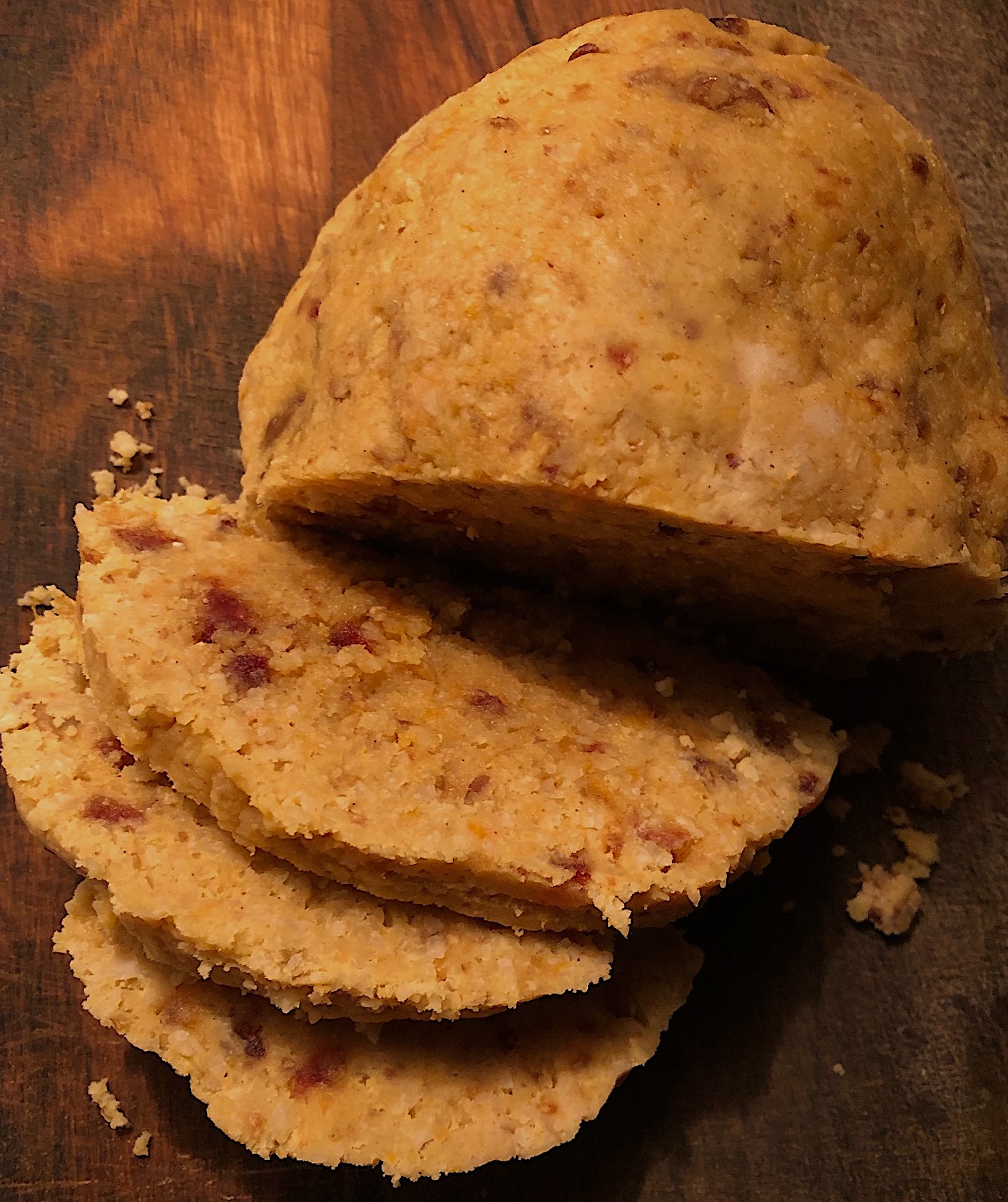
11/23/23: Thanksgiving Confection, No Sugar

Dates, 6 large, pits removed, soaked in a bit of water for half an hour, then diced up.

Oranges, 4, tiny mandarinees or tangeritas or whatever the word is, peeled and chopped.

Flavoring mix: bitter cocoa powder, 1/2 tsp or so. Cinnamon. Vanilla, alcohol-free. Teaspoon of coconut cream (optional, for softer fluffier texture).

Coconut, unsweetened flaked. The package is 8 ounces, but this was more like 7 ounces because I put some on my oatmeal last week.

Spin coconut in Cuisinart until it’s all powdered down and just starting to stick together. Add flavoring and spin some more. Add orange and date pieces. Spin until mixture sticks together in a clump.

On a sheet of wax paper, pat dough into a firm ball. Wrap it in the wax paper. Press down into a small bowl. Pop into the freezer for an hour. Then unroll and slice it, or roll into little balls. Put it back in the freezer, and serve at dessert time. It’s handy that for upcoming social events you can freeze this in advance.

This is for anyone at the party who is cutting out refined sugar. The coconut is the central ingredient. (But spinning raw almonds, soaked and peeled, should work too.) Overall, a very versatile recipe. Substitute anything for anything. This doesn’t give the usual spike hit of sugar because there isn’t any. But when it’s chewed a while it tastes sweet, and the healthy fat and fiber give it a satisfying feel. I brought this to Angelina’s tonight, and the guests were fine with it.

Posted in Uncategorized | 2 Comments

11/23/23: Walking and Strawberry Trees

For colleague Gunnar, holidays are a time to get up before the sun and hit the HIKING TRAIL for a fast light 5 miles before his coffee, if he even drinks coffee which is doubtful, and not only on holidays but any old morning before a full day of work. This time I ventured to join him. For a slow-moving organism, that meant planning the day before by laying out clothes and going to bed early, then hopping up before 6:00 for a cold bath and lymphatic massage and foot bandages and compression hose, getting dressed and having shoes and carry bag ready at the door.

Yay, all ready — half an hour early! So I curled up on the carpet with a Pimsleur language CD and learned some Italian until hike time.

We hit the trail for that fast light 5 miles. (Fast and light for him, clumping along for me.) Through the trees there were views like this one. Cropped out the family’s house. Kept the scenery.

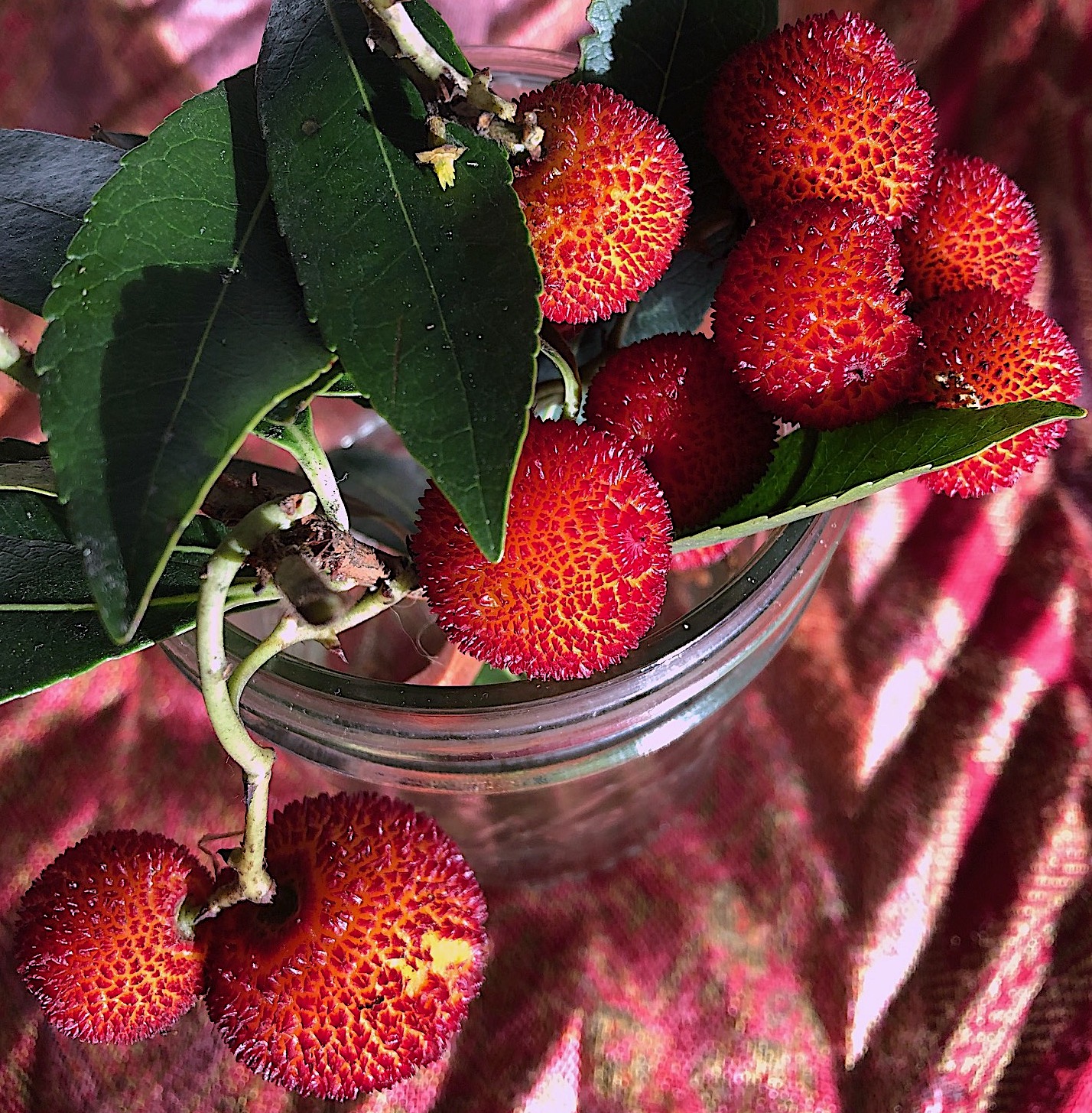
Along the way we passed a strawberry tree, Arbutus unedo, national tree of Italy. There are impressive online descriptions of its many uses in Mediterranean cooking. (Usual disclaimer: For goodness sake do your own research. Don’t take nutritional advice from some language major.)

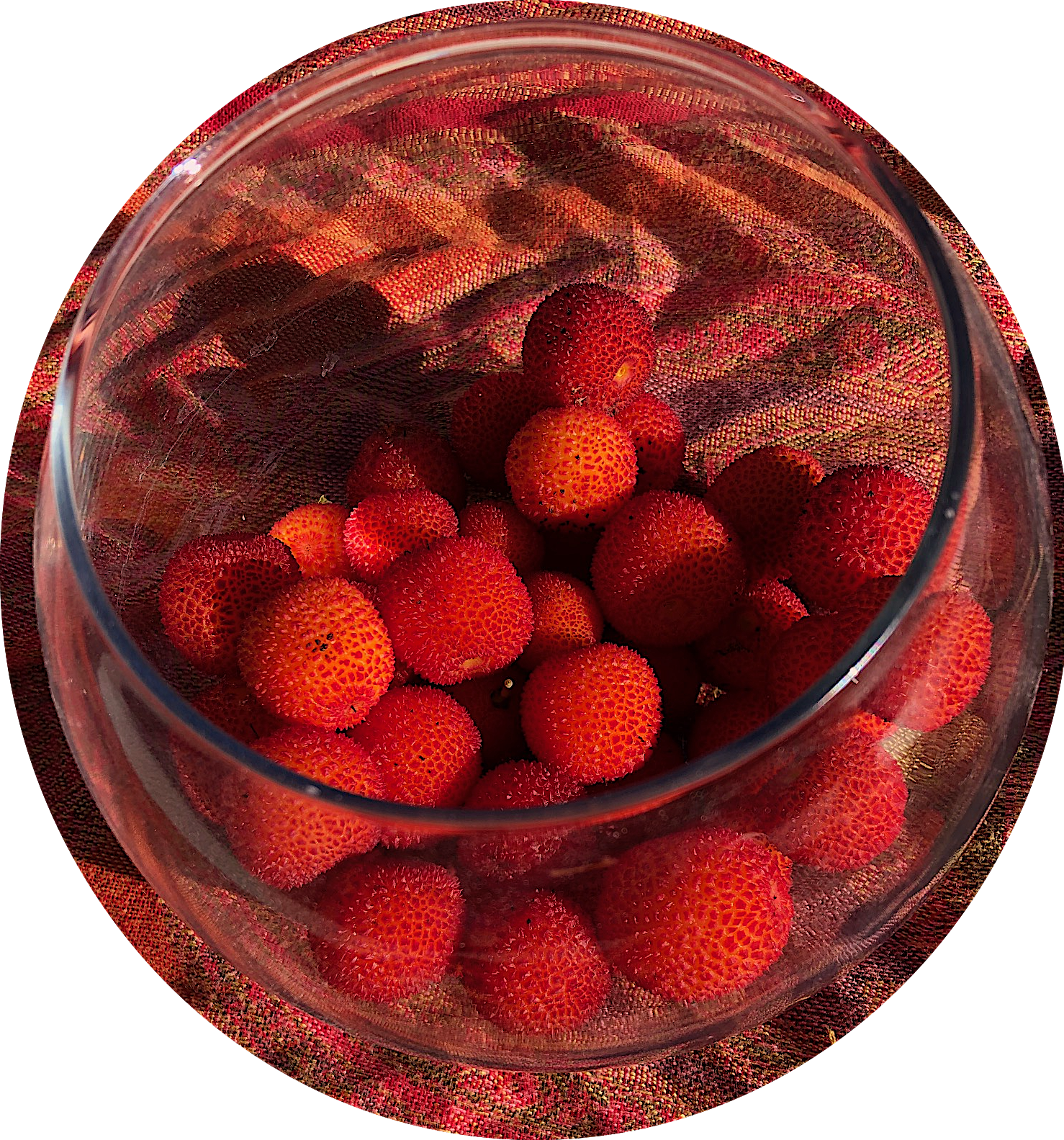
The fruits were ripe and falling all over the trail anyway, getting trampled. Soon they’ll be gone. So naturally I picked some for my carry bag and brought them home.

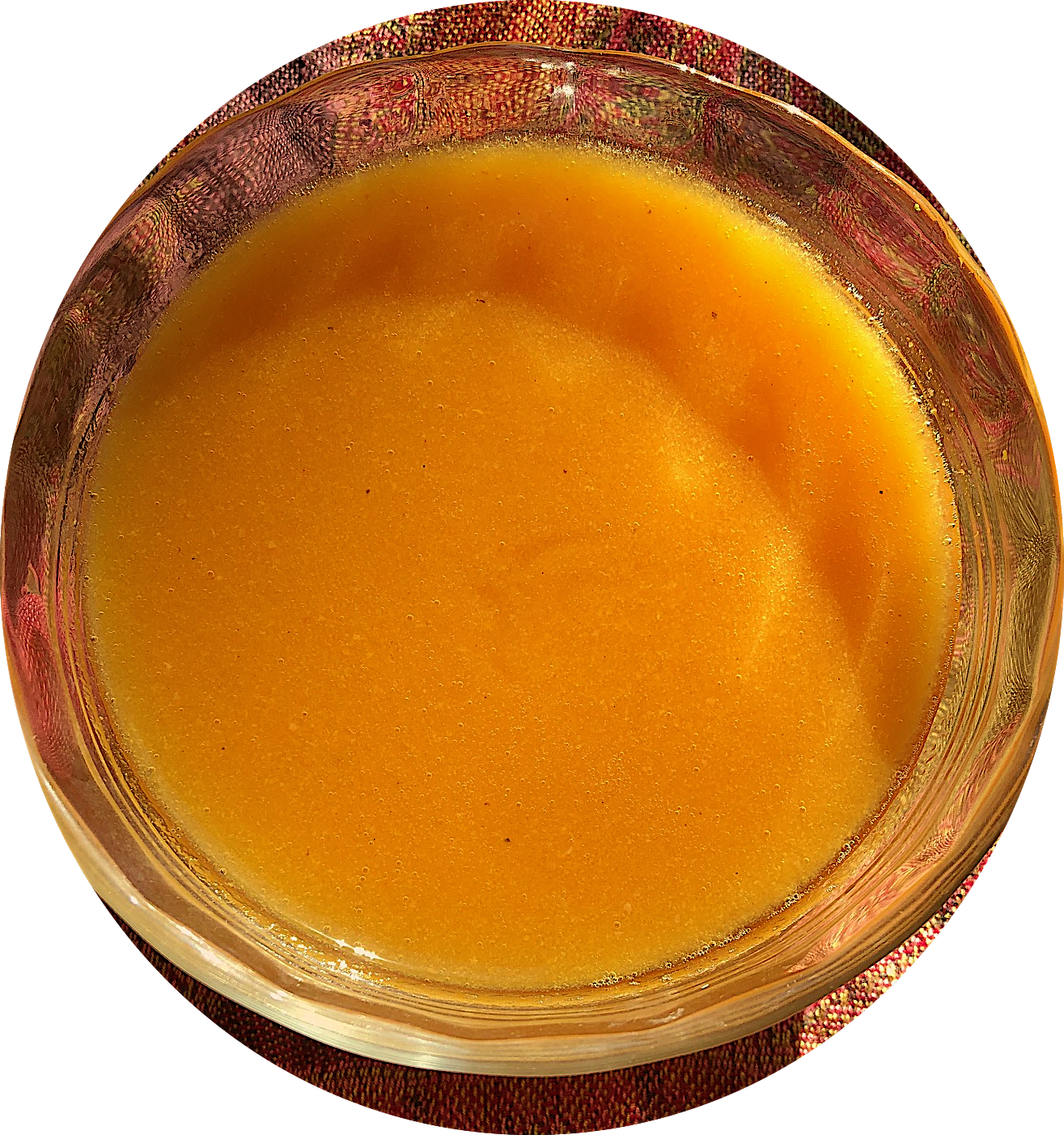
There I simmered them over lowest heat, mashing and cooking them down in their own juice. Here’s the cooked whole fruit mash. The light fruity fragrance was wonderful.

Tricky part: the fruits are sand balls. They’re sandpaper puffs of very fine grit seeds. So I added a little water, stirred them in a sieve, and strained them. Then I rinsed the strainer and bowl, and strained the fruits again, repeating that about a dozen times. I don’t know the effect of superfine grit on our digestion or plumbing, and don’t need to find out today. So I strained them very well and collected the rinsewater with the pulp to pour on the garden. That fruit cooked down to about four ounces of puree.

The slogan for truth in advertising would be “A pleasant subtle peachy-mango nectar if you are fine with rinsing residual superfine grit from your teeth and tongue and spitting in a garden bucket.”

I texted Angelina to let her know that for her Thanksgiving dinner tonight, I’m bringing her some “REAL Italian food.” She texted back a thumbs’ up. Whatever she’s expecting, it’s likely not this.

As you would expect from a guy named Gunnar, he’s a long distance type who can outpace me twice over. But today he was kind enough to interrupt his workout and stand around on the trail helping me pick fuzzy balls off a tree. Thanks, Gunnar!

Posted in Uncategorized | Leave a comment

10/29/23: Pumpkins

Pumpkins didn’t cross my mind much as a useful vegetable. Winter squash and sweet potatoes and parsnips have a more pleasant taste, and it didn’t make sense to replace them with something that for most of the year just comes in a can. But then this BBC article was interesting food for thought.

https://www.bbc.com/future/article/20231026-are-halloween-pumpkins-a-future-superfood

Apparently they’re a sustainable highly nutritious crop which thrives in even dry land and poor soil. In Bangladesh, they’re a food source thriving in the mini-deserts caused by flash flooding. They don’t require refrigeration for transport. The flesh is full of nutrients, and so are the seeds. In some heirloom varieties, even the leaves are edible. That inspired me to think about planting pumpkins next year; perhaps on the steep inclined poor runoff soil behind our property? Maybe the vines would anchor and improve the ground.

Meanwhile, I went out comparing pumpkin prices. At the bargain bin down at Fruit & Folks, my favorite produce open-air stand, there were a couple of sugar-pie pumpkins that were slightly dented but perfectly good. Trader Joe had a sale on canned pumpkin pulp, so I bought some for the winter pantry. After Halloween I’ll check the half-price shelf at the grocery too.

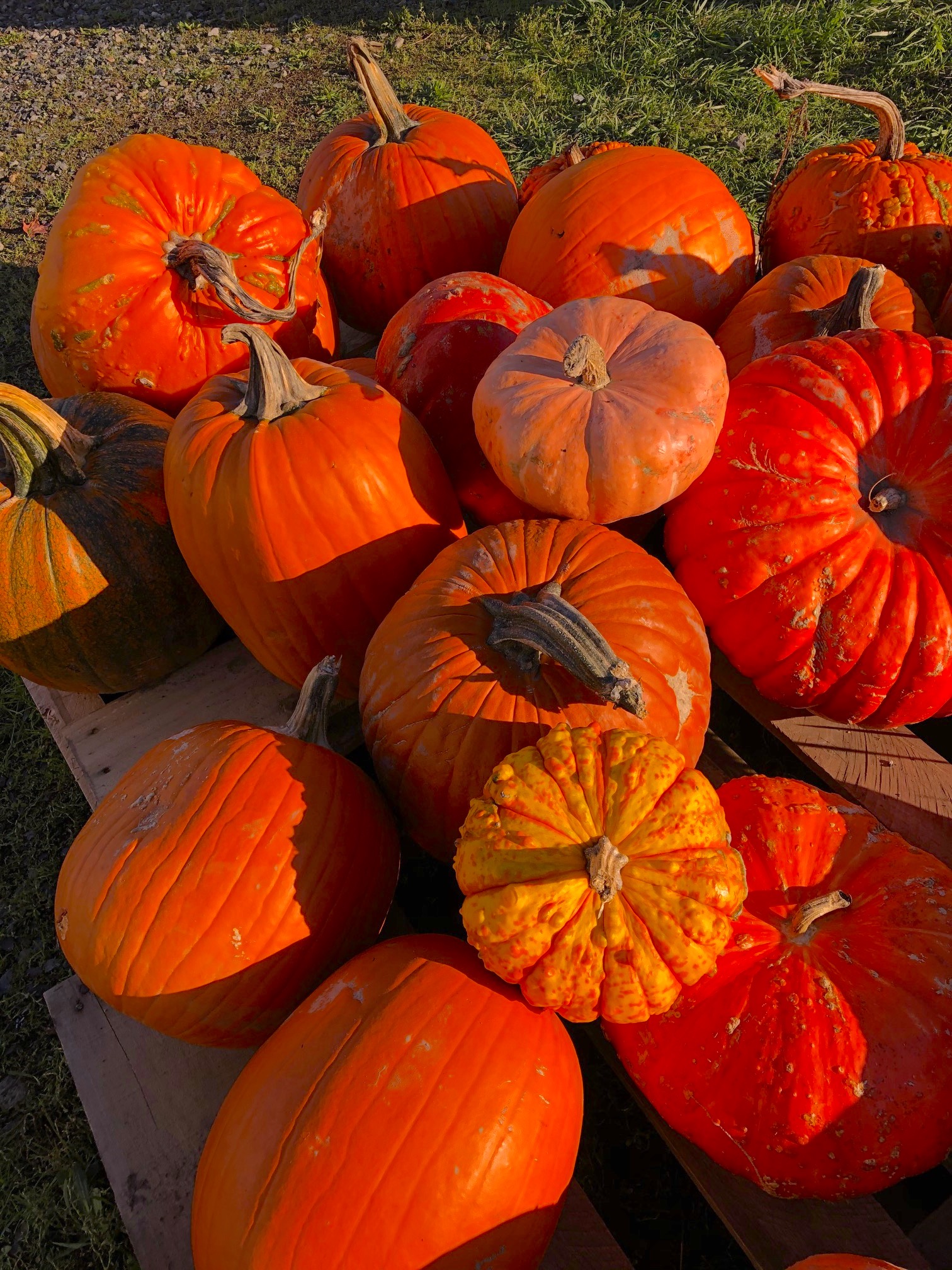
Yesterday I bought a small pie pumpkin to support our local Boy Scout troop. The Scouts and their families were just closing the gates for the season, but still had a few pumpkins left looking wholesome and nostalgic in the sunset.

Which of the pumpkins were best for cooking? I asked the farm manager. “We don’t know; we always sort the varieties and box them up with labels, but customers spend all day carrying and moving them around. They end up all mixed together, so we don’t want to guarantee. Your safest bet is a smaller round one; that is the most likely to be a pie pumpkin. All pumpkins are edible; but these big ones, for decorations and carving? Those don’t have a good flavor, and might be bitter. The largest ones are cheapest per pound. They are bought out by [A supersize nationwide food distributor], to bake into pies. How do they fix the flavor? By adding lots of CORN SYRUP. That is not your Grandma’s pie. But the customers buy it right up.”

It was troubling to think that after the stand closed for the year, these pumpkins might go to waste. But no, the staff explained that they will drive those pumpkins home and feed them to their cows. “On the farm when we pick the pumpkins to drive them here and some are too damaged to sell, we drop those in the cow pasture. Those cows come running! Pigs love them too. Pumpkin makes great feed.” It was heartening to hear about livestock in America who receive wholesome food.

But for sustainable dry weather planting, it’s time to learn more about this underrated vegetable before garden season next year.

Posted in Uncategorized | Leave a comment

Review of Feeling Good: The New Mood Therapy

Feeling Good: The New Mood Therapy, by David D. Burns, MD, 1980

Huge Disclaimer: This little essay has nothing to do with the millions of people experiencing world disasters and life-and-death emergencies; and there are certainly times when severe depression requires immediate medical help, and/or an immediate change in circumstances. This is only a reflection about chronic depression affecting even people in the most comfortable and peaceful surroundings.  

Another Disclaimer: Loved ones in my acquaintance report their strong conclusions that anti-depressant medications have saved and transformed their lives. Dr. Burns devotes pages 474-681, plus copious references, to these medications and their efficacy as an option, so that patients can be more informed consumers.

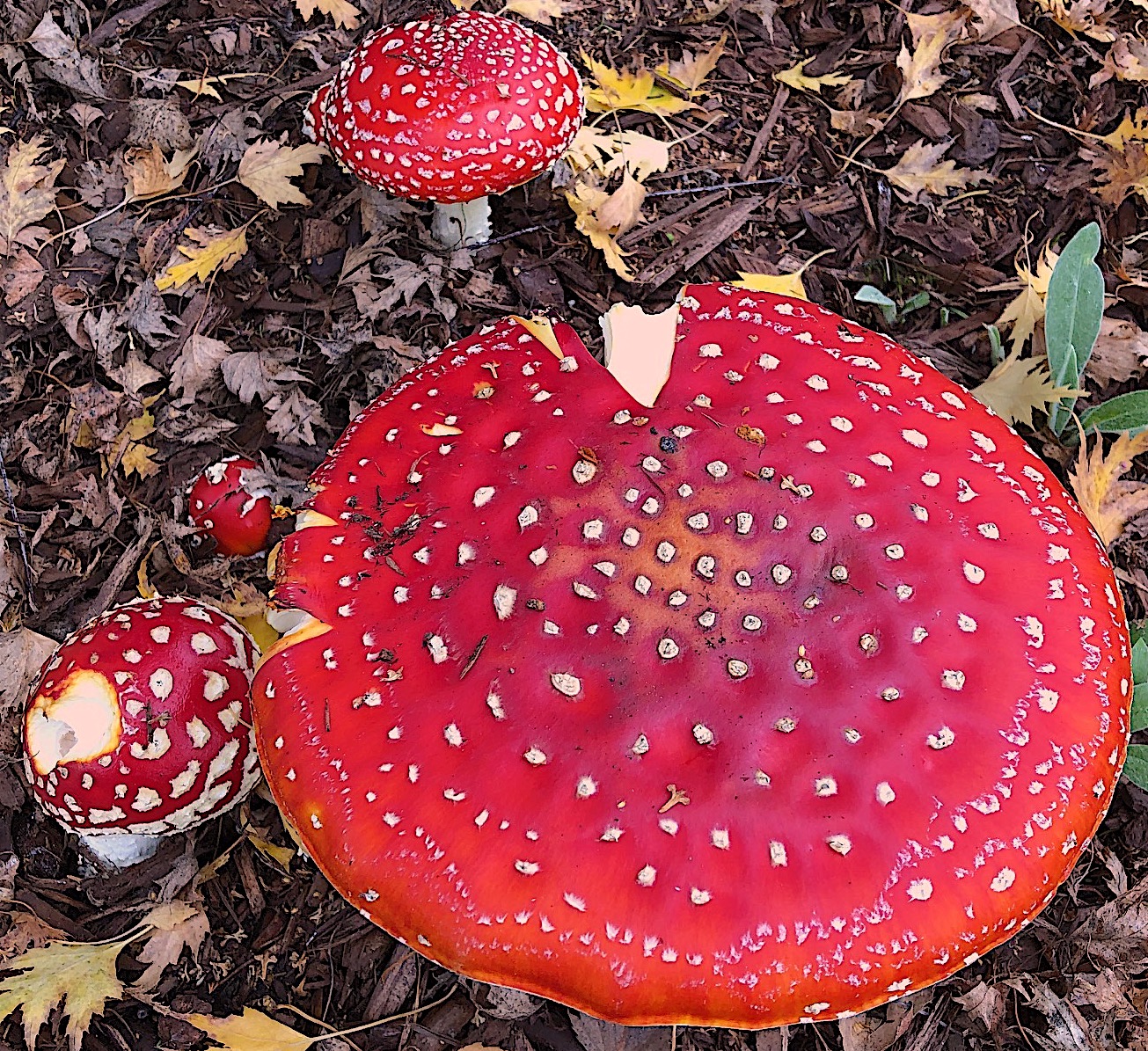
(This is not a psychiatric medication. It’s just some Amanita muscaria growing outside on the curb.)

Every year as hours of daylight wane, I treat myself to a re-reading of this classic text. On a dark and stormy night, especially around the holidays, there’s nothing like curling up and finding hearty laughter in a book about depression. The author’s humility, his honest admission of his mistakes, the lively dialogues that talk back to depression, and his cornball humor make this a pleasant heartening read.

The book’s message is that thinking patterns can play a role in triggering depression. In Chapter 3, in Table 3-1, there is a list of ten standard Cognitive Distortions (such as All-or-Nothing Thinking, Overgeneralization, or Disqualifying the Positive). These hurtful thoughts can loom across the sky like immense dragon floats in a parade. When people are living with depression, these thought glitches may well be the snares in the quicksand that weigh down their mood. If we recognize the common distortion thoughts and then learn simple techniques to defuse them, this can lighten our spirits.

This sizable book is packed with explanations, exercises, true stories, and encouragement for defusing the ten cognitive dragons. There is practice with reality checks, manageable little action steps, and self-compassion throughout. The author’s presentation of these tools is respectful, personable, simple, and clear, with a light warm tone.

In Chapter 5, the author deconstructs the old assumption that people shut down and freeze because they enjoy suffering. He suggests a homespun diagnostic called The Paper-Clip Test: pressing the end of a paper clip under one’s fingernail, while asking “Is this really enjoyable? Do I really like to suffer?” If you’ve been lectured enough times that you enjoy being depressed, this is good for a healthy guffaw right away. In the same chapter, he addresses patients overwhelmed by the prospect of the many life tasks waiting to be done. He reassures them that at dinner, they need not plan ahead for the oceans of food and liquid that will need to be swallowed in the course of a life; they need not lose hope and say “There’s just no point in eating one pitiful hamburger tonight.” The same chapter offers the hourly Daily Activity Schedule technique of planning a day with small worthwhile tasks, and with plans for pleasure and fun. He proposes this in particular for the “weekend/holiday blues” experienced by us single people — the cognitive distortion that being alone will mean a dull discouraging day. This quote is my personal funny-bone favorite.

You stare at the walls and mope, or lie in bed all day Saturday and Sunday; or, for good times, you watch a boring TV show and eat a meager dinner of a peanut-butter sandwich and a cup of instant coffee…. Would you treat someone else in such a sadistic manner?

Another real knee-slapper comes up in Chapter 8. There Dr. Burns applies self-compassion to successfully lose excess weight. His greatest calorie temptation was ice cream at night. To deflect this thought, he would promise himself that if he refrained from ice cream, “I could reward myself with a big, fresh, glazed doughnut in the morning and a box of Mason Dots [gum candy] in the evening.” As an extra compassion benefit, even on nights when he succumbed and ate the ice cream he would still eat the doughnut-and-Dots reward! Thanks to the extra ration of comforting self reassurance, this wacky diet resulted in a weight loss of 50 pounds, and an annual holler of mirth for me.

For the author’s TEDx Talk, you can search YouTube for this title:

Feeling good | David Burns | TEDxReno

It’s a worthwhile use of 18 minutes. Here he describes his early dedication to tracking down and prescribing the right antidepressants for his patients, then the revelation of learning cognitive-behavioral therapy as an additional technique. This inspired him to write the manual of straightforward steps that patients can use themselves. I love the moment in the talk when he talks about his patient Martha from Latvia, and he becomes choked up when he expresses his admiration for her courage. As a bonus, the talk contains an open-hearted personal story and a lovely surprise ending with his son Erik.

Tomorrow the book goes back to the library, but the good exercises and zany sweet jokes will be a good influence all year.

Posted in Uncategorized | Tagged , , | 4 Comments

10/15: A Dostoevsky Film

I’ve been pondering a 1990 Russian film directed by Andrei Eshpai. Here is the copy-&-pasteable title of the link in YouTube. For movie buffs who like atmosphere and scene composition, it’s worth a look.

Униженные и оскорбленные (1990) драма

Google Translate renders this as “Humiliated and Insulted.” At first glance this looked like a translation of “Les Miserables,” but it turned out to be a dramatization of a Dostoevsky novel. Based on the Russian roots (Lowered + Offended/Hurt) it could also be “The Downtrodden and Aggrieved.” By any name, the whole plot is compressed like a bullion cube down into 90 minutes. Therefore it drifted right over my head despite the somewhat phonetically fractured Russian subtitles. It took me half a dozen plot summaries and film reviews to sort out which of the characters are downtrodden, which ones are aggrieved, and why in the world these people are so unhappy.

(Ivan at vigilant rest, between errands, chores, and imploring people to calm the heck down.)

Nikita Mikhalkov (not shown here) plays the wealthy socially dominant prince, all labile moods and polished insinuating monologues. He pops up uninvited in everybody’s personal living space, abjectly humble yet ignoring all boundaries, causing fracas right and left. Under his unctuous silliness he is clearly roaming for chances to cast down other people and then make off with their money and/or virtue. But since he feeds off the reactions of those around him, it could be prudent if his listeners could downpedal their reactions instead of falling into hysterics at his malicious sallies. The prince wants his indecisive hapless rich son to go marry a rich girl instead of the indecisive hapless poor heroine; if the two lovers would listen to him and break up, they would do themselves a lifelong favor and make the whole plot easier to follow. Nastassja Kinski as poor heroine Natasha looks beautiful and poignant; in all her scenes any available illumination in the room centers on her lovely features and fair hair.

The Russian film reviews, at least the half dozen that I checked, didn’t mention my two favorite characters.

The first character is St. Petersburg at the end of a long winter, cast as its astonishing evocative brooding self — the courtyards and gables and winding stairs and ironwork on the bridges and canals and thawing ice. A truly gifted team worked with the scene composition and props and interior lighting, scrimping and saving every candlepower in rich shades of shadow and gloom. Privileged characters (such as the prince, at a restaurant) are shown with facets of color and light, with brighter fabrics and extra candles and crystal glassware. The poorer people spend their lives frosted in to alley garrets with virtually no light at all, making one wonder how anyone could face the day and how the geranium on the heroine’s freezing windowsill stays all leafy and green.

Actor Sergey Perelygin makes the film with his beautiful portrayal of Ivan Petrovich (shown above and below). Ivan, also called by his diminutive name Vanya, is a poor honest writer. As a country orphan he was raised by Natasha’s family and keeps unswerving devotion to them. He occupies the darkest garret of all, illuminated at times only by his fine expressive eyes. Ivan and his eyes are the backdrop presence in every scene. His tastes are restrained and thrifty (he is mocked for abstaining from liquor, and for ordering the cheapest thing on the menu when the prince treats him to dinner.) He is also the only member of his social set who actually works for a living. His mercantile trade of selling written pieces for publication, and his lack of a noble name, cause the others to overlook him as a marriage prospect. (The prince though gleefully sneers at Ivan’s spartan lodgings and socio-economic celibacy, and offers Ivan a bribe to marry heroine Natasha and so get her away from his son.)

But usually Ivan is relegated to the farthest corner of the dim wallpaper while the other self-absorbed characters and their speeches drive each other to distraction. He is the one soul with a lick of sense, biding his time as an expert witness and keeping his own emotions in hand, then springing into action whenever anyone needs help or comfort. Heroine Natasha spends the film languishing from divan to bed to window lamenting to Ivan her passion for her vacillating suitor. Natasha also sends Ivan from pillar to post over ice and snow at all hours delivering messages and notes or arranging or chaperoning her meetings with her sweetheart or blaming him for her ill-starred love life. All the while, Ivan expresses his love for her by protecting Natasha while she tries to capture her intermittent swain. Once in a while Ivan gets to talk back (as, to the prince: “And what about your conscience, before God?”) or to offer ignored advice and kind gentle words.

But mostly, Ivan is busy. He’s comforting an old man and his old dog dying on the street or arranging an inter-generational reconciliation or rescuing an orphan from trafficking and nursing her until her death or sprinting to the apothecary or salvaging scraps of someone’s reputation-saving documents or handing over his only coat or lighting a candle for the deceased at church or blowing out a candle at home to save on wax or calling in the doctor or serving as a tireless confidant and probably watering that geranium. He manages a bite of apple before hand-feeding the rest of it to others, but he’s not about to get a second puff of that cigarette or a first sip of tea.

At the end of the story the characters, with no word of thanks or glimmer of appreciation for Ivan, have all moved away to greener pastures or died of tuberculosis or heart trouble or existential angst. He is left alone with his dark garret and quill pens, murmuring “If only I can capture this whole story, and write it all down.” He proceeds to do just that.

Maybe it’s not unheard of, for families in general to have an Ivan somewhere under the radar. Some kid who watches from the corner and keeps trying to fix and remember things. Maybe?

Posted in Uncategorized | Tagged , | 2 Comments

10/8/23: Book: The Great Dechurching

The Great Dechurching: Who’s Leaving, Why Are They Going, and What Will It Take to Bring Them Back? by Jim Davis and Michael Graham with Ryan P. Burge

These authors get full credit for best intentions, sincerity, and for researching their topic. They turned to social scientists and the International Review Board (IRB) for an “academic-review-board-approved, nationwide, quantitative study” (xxi) of thousands of congregation members who have left their churches. The book reports the stated reasons given by the research subjects. It provides ideas on encouraging former church-goers to return. It offers extensive footnotes and bar graphs. It even compiles the data to form composite portraits as fictional characters talking about their faith walk.

“[I]n 2020 church membership in the United States fell below 50 percent in America.” (11) Some 40 million Americans in the past 25 years have stopped attending church. The loss in potential tithes and donations from these individuals could run to some $24.7 billion dollars per year. (13) Among evangelicals in particular, the data show four main dechurched groups: mainstream evangelicals, cultural Christians, exvangelicals, and BIPoC adults.

One reported reason for leaving church membership was polarization, as publicized and fueled in social media. As the authors sensibly conclude, “To maintain friendship in real life or online, it feels like people must agree with you on whole new lists of things that we didn’t have in the past…. [M]aybe it isn’t the best idea to end relationships over viewpoints on climate change, gun control, or a whole host of other matters.” (17)

One reason was changes within the family. The church-going influence of parents on their children is not as strong as in past generations. In fact, some respondents cited parental religion as a factor in leaving. They felt that parents were unwilling to listen to alternative ideas about a range of life issues, or that parental religion led to differences in political views.

One reason was logistics. Geographic mobility displaces churchgoers into unfamiliar communities; economic mobility comes with extra job pressures and less time; marriage and children require more time investments, with less leisure left for Sundays. The popularity of the internet and virtual services has lessened appreciation and experience of in-person shared worship.

One reason was social stress, including racism and abuse experienced both within and outside of church, discouraging members from the emotional risk of reconnecting. The authors emphasize the importance of empathy, open listening, and kindness to those who have experienced harm in their church experience.

One reason is breakdown in social cohesion. The authors point out that “If you belong to a nuclear family, graduate from college, and have children after marriage, America’s institutions tend to work better for you.” (26) “The American church… is largely built for the nuclear family or those on that track,” while “The young, single parent working multiple jobs… [is] more likely to experience depression and even shame in a church culture [aiming] to elevate the nuclear family.”

Just yesterday, my little free library furnished a second source on this same topic; I flipped through it for additional context. The book is Surprising Insights from the Unchurched and Proven Ways to Reach Them by Mr. Thom Rainer, Dean of the Billy Graham School of Missions, Evangelism, and Church Growth, 2001. This data-packed book includes two interesting pie charts. One shows time management skills of Comparison (=Ordinary) Church Leaders. The other chart shows time allocation by Effective Church Leaders, those with flourishing congregations. How do they compare? The book points out that ordinary leaders get 8 hours of sleep, while Effective Leaders save time by limiting themselves to 6 hours. (The pie charts included no time slice for “helping wife at home,” although all home life, including family life, was 22% for Effective leaders and 18% for Ordinary leaders.) Ordinary leaders lost time on personal ministry such as guidance and consolation with members requesting spiritual insight and comfort. The more sleep-deprived Effective Leaders handed off these tasks to church staff, and instead prioritized sermon preparation and personal evangelization — with goals such as winning one soul to Christ every week. The book urges Effective Leaders to write sermons which include expository, topical, thematic, narrative, and doctrinal elements, perhaps for visitors who check up on hermeneutic quality. As another winning factor, the book named infrastructure — including attractive grounds: “What surprised me was how many churches let their facilities and their landscaping… advertise ‘We don’t care.’ I sure didn’t go back to those places.” (227) It is fortunate that early Christianity arose in a geoclimate that did not call for “Lawn-Boy mower duty” as a pastoral concern.

But, back to The Great Dechurching. “There is strong scientific evidence that supports the correlation between church attendance and improved physical and mental health.” (29) (Does correlation always mean that A causes B? Could it be that B causes A, and that physical and mental wellbeing and an appropriate wardrobe allow for structured Sunday activity?) The authors add that the path of members who depart can be marked by “addiction, destructive behaviors, gender and sexual confusion, and even suicide.” (9) Can they also be marked by productive charitable connected lives? The dechurched people among my acquaintances would not be counted in these results because it wouldn’t occur to them to fill out a church survey. But not one person I know left their religion and then fell apart. Every one of them have lives marked by solid intimate relationships, mental health, philanthropy, and Sundays running at the park with their dog or building cold frames in the garden or fostering kids.

One wee downside with the book is the imaginative storytelling. The authors aimed to go beyond their own anecdotal evidence of actual people. But the narrative and dialogue style didn’t quite resonate as deep human truth. In this paragraph, a character thinks back to faith-based college days with his Christian roommate, and his subsequent dark night of the soul:

Things had gone well for [fictional dechurched] Tom in those first couple of years at USC. It was the best time of his life. His sophomore season, they were conference champs, with [fictional still-churched] Rex as their starting pitcher and team captain. Miraculously, they won both the regional and super regional tournaments. Going to the College World Series in Omaha was a literal dream come true, even though they ended up losing…. The week after that College World Series loss was when his life had started going downhill…. Senior year was basically a blur of alcohol, baseball, and differential equations.

(Did everybody follow all that?)

Another scenario mentions the Boston Globe coverage by the Spotlight team, about sexual abuse in the Catholic Church. Says [fictional dechurched] Conor,

I got a phone call from my ma that just… let’s just say it changed the rest of my life…. Ma started talking about how she was worried because some of the stories coming out were really bad…. She went on and on… and finally blurted out, ‘One of those priests touched Tommy.’

(Sad to say, this actually made me laugh. Who talks like that? No Catholic parent in my childhood ever fathomed or verbalized the concept that their children were being abused inside or outside the home.) Ma phones in Tommy’s story instead of allowing her adult son some confidentiality and space to tell the story in his own time. Conor not only leaves the church; he also stops speaking to Tommy.

The authors caution against making the Christian walk all alone or through virtual church services, and they praise the unique value of group worship. “…[W]e can taste the home we long for. Our Sunday gathering has a centering effect on us, and to the degree we make the gathering a priority in our lives, we will taste our true home and flourish as citizens of heaven on earth….. [W]e are part of a spiritual family that will never be broken.” That sounds like a wonderful feeling. Maybe church leaders can look around and see whether some members are missing out on this experience of belonging.

Despite the described advantages of group worship, “Tens of millions of regular Christian worshipers have decided to stop attending church, leaving little explanation as to why” (back cover). Little explanation? Maybe some of us just wore ourselves out crying in the wilderness, trying to tell leaders what church is like for us and how some of us feel just plain left out.

One group left out of the discussion in both books is single people, even though we’re half of America. The survey and stories don’t include any sign of “Sitting surrounded by families makes it hard to not have a family.” In traditional Christian churches, the core topic of coffee hour conversation (and often sermons) is marriage and children and household concerns. The whole social structure is built not from atoms, but from tight molecules of nuclear families matching up with nuclear families — couples with kids matching up with other couples with kids. (One kindly Catholic leader actually urged us single people to sit exclusively in the first pew, and face forward. That way we wouldn’t see the Catholic couples and families with their remarkable knack for constant mutual grooming and stroking, prolonged private whispers, and exchanges of crinkly snacks.)

The authors freely acknowledge that congregational life, like any human institution, can fail us. They offer kind words for people who have been hurt. Then, they hasten onward to assure us that the Gospel is such overwhelmingly good news that it bountifully compensates for any past hurt. They eagerly counsel leaders on attractive assertive strategies: the four-chapter vs. two-chapter presentation of the Gospel, balance of mission and confession, and much more.

If I could fill in one of those surveys, my advice would be to stop finding bigger more assertive ways of broadcasting the Gospel. Instead, when people fade into the woodwork and stop attending, try reaching out just to ask “Are you okay?” and “If you’re coming back, how can we be there for you? If you’re not, how could we do a better job?” Then, listen to the answer. Does any church do that?

Can’t be harder than operating that Lawn-Boy.

Posted in Uncategorized | Tagged | 2 Comments

10/6: Flu Shot

Disclaimer: This pond scene is not a close approximation of today’s flu shot clinic.

In our fancy patient online portal, I clicked through the decision tree to book me a flu shot appointment. Sure, the local pharmacy offers them, but if I schedule through the portal then the shot can go in my permanent record, and my providers will see and won’t fret about me this flu season. Trick is, the portal lists all the local clinics in our agency except the real convenient one across the street from work. There was no evident way of adding that clinic to my list of provider sites. So, after typing a tech support question (how do I add this member of your franchise to the viewing page?) the team sent me a nice lengthy explanation sounding like a prepared chat reply, about how to open the portal and click through the decision tree to book me a flu shot.

Sigh. So at 3:10 pm I got out of my chair and walked across the street to the clinic registration desk and got in line. During the little wait, 15 minutes or so, all of us in the building could hear ear-wincing roars of distress from some small child in a back room. All we could do, clinic staff and patients, was abide there going about our business while the little gipper just roared to the ceiling. My heart went out to this poor baby being subjected to some scary procedure back there.

Then it was my turn at the Registration desk. We had to raise our voices to be heard above the screaming, but it was still a pleasant exchange. “Hello!! Say, here’s my ID and insurance. I’d like a flu shot. I’m a patient in the system, but can’t figure out how to add this clinic to the list in my portal.” The friendly staff member said “Well, then howbout you just step through that door and ask the nurse? Maybe she’ll take a walk-in.” Really? Wow! Sometimes there is no substitute for levitating out of your chair, logging out, and walking across the street to ask questions and find out stuff on your own.

So ok, at 3:25 I peeked around the corner. There were two nurses in a little office with, sure enough, a kind of popup flu season vaccine site. But the 3:15 slot had already been reserved for the howling baby, who was flatly refusing his flu shot. It was surprising to see that he wasn’t a baby at all. He was a strapping kid of five or so, sitting back on a chair and kicking his Dad’s stomach with both legs while demanding that Dad take him home without a shot. “Would you rather sit in Daddy’s lap for this? I’ll hold you,” said his father. But, no dice. Well, no one could restrain this unhappy patient from fighting. His anxious father tried to soothe, comfort, and apologize to his frantic son as the minutes ticked by. Finally Dad peeled his son out of the chair and hauled him out to the hallway for a gentle cuddle.

Now. This was not the common everyday occurrence of, say, a child with autism at the grocery store who is understandably overwhelmed by the fluorescent lighting, the random announcements and chimes shooting out of the overhead sound system, people with carts trying to navigate around crowded aisles. When one of these little fellas has an implosive incoherent meltdown, that’s different. My standard response is to catch the parent’s eye, and say “I wish I had a cool person to shop with!” Sometimes that’s enough to improve things. There is also the ploy of crouching on the floor at a safe distance and talking out loud about these fascinating barcode stripes on the shelf. What can they all mean? It must be a special language! Those stripes there mean tomatoes at 99 cents a can. How much is that an ounce? Is it cheaper than the tomato cans over here?

But that’s a child who is neurologically drowning and screaming for help. That seems different from a child issuing commands that he doesn’t want to get wet, and therefore everybody must get out of the pool (all while aiming full frontal blows at his parent).

The two nurses glanced over at me. It dawned on the three of us that maybe that 3:15 slot wasn’t going to be a wash after all. They opened the portal to my patient record immunization screen, and asked me a few questions about allergies and such. “Just so you know,” I told them softly, “When I get flu shots, I sound just like him.” One nurse gave me a long patient look. “You go for it,” she invited me, entering my data. “Ma’am, you’re going to heaven,” I predicted. “Don’t know about that,” she reasoned, preparing the hypodermic.

I unfastened a couple of buttons, pulled my shirt off the shoulder, stepped out into the hall and spoke to the kiddo. “HEY, look at this: I’m getting a flu shot. Come watch me! This is gonna be AWESOME!” Dad looked hopeful. “Would you like to go watch the flu shot and see what it’s like?” At this the boy just roared even more. “Oh… you’re afraid to watch,” the Dad said, giving him a sympathetic squeeze.

I went back in and sat down. “I’m being pretty good, you know. There better be a lollipop in store for me.” The nurse gave me my shot and applied a band-aid. “Well, you can help yourself to this bowl of stickers. I think you should take two.”

I took a colorful sticker at random, thanked them, went back to the hall, and announced to no one “THAT ONLY TOOK A SECOND. IT DIDN’T HURT AT ALL. AND, I GOT A FREE STICKER.” The boy paid no mind to me. The clinic closed at 4:00, so it’s not certain that he ever got his shot. But his mom gave me a grateful look: “You are very brave.” I buttoned my shirt, gave her a smile, and said “Well, I’m 67. That’s almost grown up.” Back at the office across the street I logged right back in, looked up the nurse in our hospital system directory, and sent her an email hailing her with praise and appreciation. We’re not allowed to mention religion in our email communications, though it is still evident that she’s going to heaven.

At home, one of my favorite smokers was out on the bench, enjoying the evening. I told him about the clinic. “It seems to me,” I said, “that by shielding and lulling that child for 5, 10, 15, 20 minutes and more, it was only prolonging his ordeal and holding him in his place of panic. When I offered to let him watch, I wanted to portion the task into manageable pieces and include him in cheerful community support. Maybe the parents could have asked for a saline injection for themselves too, to model the experience. Make it all a victorious rite of passage, complete with stickers. One time when I was little, Mom brought me to the doctor for a shot, and I locked myself in the doctor’s office bathroom. Mom told me in a very quiet Company Voice to open that door this second and get out here and SIT. Then she gave me That Look. From a Mom, The Look was worse than any shot. We were taught to respect doctors and do what we’re told. What about your childhood?” No need to ask. I knew perfectly well what he’d say next. “Would your mother put up with fuss?”

“Would mine?” He sat back with a delighted laugh. “A Mexican mom? Whoooa.”

The sticker in day-glo colors spells the word EXTROVERT. That gives me an image to live up to.

The band-aid is extra bright and very sparkly.

Posted in Uncategorized | 2 Comments

9/30: They’re Back!

Our summer was dry and warm, 90 days with no precipitation. Then The First Big Storm was predicted for last Monday with heavy wind and rainfall. That means that the dry ground, full of air pockets, can be drenched so fast that tree roots grow loose and the taller trees, still full of leaves, can fall and take power lines down with them. We did in fact get a thorough deluge, two power outages, and a very wet week.

Before the weather blew in, the neighbors and I were in serious deliberation: What about Captain Wing and Mrs. Wing and their prized stand of Sunchokes? We didn’t know what day of the week the family would be back from their little vacation. Would the storm wipe out the whole patch of these thick top-heavy plants? Were we supposed to dig up the whole bumper crop in the family’s absence? Would the tender chokelets be ruined by flooding? Would the family be upset to return and see their prized armament of stalks beaten down, and the chokes rotted from the wet? I was all motivated to run out and start digging as the storm front grew closer. It was hard to hold off and do nothing. But some instinct whispered that perhaps I’d better leave it to the family. If there’s one thing we knew, Captain would have a plan A, plan B, and plan C. If his executive decision-making included reaching out to us for help, he would.

We’ve all been eagerly anticipating their return. What a happy moment it was a couple of days ago, when Mrs. Wing’s soft friendly voice called from their kitchen door. I started jumping up and down and hollering greetings, wishing it were appropriate to rush over and give her a bear hug. She had gifts all ready: a large bag of sweet ripe plums, and a gorgeous gift-wrapped tin of Moon Festival cake made with salted duck eggs and lotus seed paste. She also asked me to please wait a moment for what she was pleased to call “a slice of squash.” Then she disappeared for several mysterious minutes, while inside the kitchen there were sounds as if she were breaking cinder blocks with the side of her hand. While waiting I imagined that “a slice” meant a teacup portion. In Mrs. Wing’s view, it was this:

The egg (hen, not duck) is there for size perspective. This gold ingot of squash “slice” must weigh five pounds. A Clydesdale could wear it as a collar; I tried it on, and my entire leg fit inside all the way up.

Doubles as an attractive planter, too.

I can’t wait to cook it up. “Very sweet,” Mrs. Wing assured me. “Like chestnuts.”

Captain looked pleased to be back. He called me over to the raised garden bed four feet high, and on top of that the sunchoke row of plants six feet tall. “Look, all the way up at the top.” He pointed ten feet up to the sturdy saplings waving proudly all down the raised bed. The rain brought out a real surprise: yellow buds, all over the tops of the plants! “When those yellow flowers finish blooming, it means the sunchokes have grown and are ready to harvest.”

Well, that is the difference between an uninformed pessimist and an enterprising optimist. Here I was, afraid that the dry summer had left the chokes with no flowers and no crop, expecting that the family would be disappointed. But all this time they weren’t worried at all! They had faith that summer would be summer, and that Nature was right on schedule. Meanwhile we neighbors have been greeting each other with the words “Wings are back!” We are just happy they are safe home again.

Posted in Uncategorized | Leave a comment

9/1/2023: Blue Moon; House & Garden Update

August brought two full moons instead of one. Here is a picture of the second, or “blue” moon, seen over a water glass of fennel from the garden.

CatCub’s owner reports that now when CatCub watches out the window and sees me walking on the street, CatCub rushes to the front door and waits patiently for me to come in and visit her. This week she has me visiting three times a day while her owner is away. CatCub has started a new object permanence game to play with me. She waits for me to sit down with her cat brush. Then she stares at me from the floor. Then with a yip she leaps up and starts kneading my lap and purring, lashing her tail directly toward my eyes from pure exuberance. While I hold up the brush she decides how much of a brushing she wants, and for long, then leaps off my lap and hides. That way she’s in complete control, and that seems to make her feel safe. After hiding out of my sight for one minute, she pops out all ready for the next round. She can keep that up all day.

This morning, Melina was feeling some woe. Mom and Dad and Bernard, her baby brother, were all ready for fun at the playground. Everybody was waiting for Melina to hurry up and put on her socks. To their credit, they were going to give her all the time she needed to put the socks on by herself. But socks are tricky to put on, and the morning was getting hot. One sock was half inside out. The other sock had the heel upside down, facing up instead of down. Finally she sat down in the building lobby and had to start over; not only that, but she couldn’t find her water bottle. “Here it is,” I pointed out, finding it in the outdoor stroller. But no, that’s not the special bottle! Fortunately, Mom appeared with Melina’s special bottle; Mom had filled it full of ice as a surprise. Now after playtime Melina and Bernard could have nice cold water in their bottles. The sock battle was a victory, and the family headed out.

Later, Melina ran over to tell me about the playground. She found me sweeping the garden walk. “Whatcha doing?” she asked. “I’m on Rock Patrol,” I told her. “And now YOU can be a Rock Ranger too.” Naturally, she came closer to investigate this special offer. I pointed out some little rocks that were sneaking out of the rock bed and on to the sidewalk. “When Mrs. D. walks this way after supper, sometimes she steps on a pebble or rock. It feels shaky, and she’s afraid that she might fall down. We don’t want that! When I see a rock that got lost, I put it back home in the rock bed. You can too.”

Last week I arrived home from work, and in front of our building found an ambulance with emergency personnel just slamming the doors. Oh no! Which neighbor? I sprinted across the parking lot, and was 2 seconds too late just as the back doors of the ambulance closed. It felt sad to miss the chance to wish them well. And what if they had pets or plants to care for? Were they ever coming back? I know that curious interested ambulance-chasing neighbors are a real distraction and delay for paramedics and EMTs. So I only gave them an appreciative wave and got out of their way.

Fortunately, I already had two phone texts letting me know which neighbor it was, and we had a fast-moving group text consult on the spot. Who’s got apartment keys? Who’s driving to the ER right now to sit and be company? Who will pick out personal care comfortries and deliver them tomorrow? Who will watch for and take in the Amazon deliveries? In no time we had a good strategy. As one of them said “It takes a village!”

On the street outside the grocery store, Seth from Produce called to me with interesting news. He showed me a real treasure in the photos on his phone: a serendipitous forage discovery of a particular beautiful mushroom. It’s a delicacy in spectacular demand; I’ve never tasted one. Local chefs who take pride in signature local gourmet foods have assured Seth that they will welcome all he can find, at top prices. Through years of study and exploration, Seth has worked out a sense for the precise habitat and annual climate of these showy creatures. He was kind enough to divulge the whole list of conducive conditions, none of which I will mention here or anywhere. And now, as innovative people do, Seth is taking smaller specimens and painstakingly culturing the spores so he can add them to his home mushroom ventures. It was a real spirit lifter to share his enthusiasm for nature, and to see how industrious he is about raising and prizing good produce.

This afternoon I lugged and hauled the hose around and gave the Wing Family garden a good soaking. A passing neighbor, one famed for his hearty and antic sense of humor, said “Why Mary — that’s very kind! I didn’t know you had it in you. I think I’ll text and let Wing know that his garden is baked toast and everything is dead. You were fed up with all this field labor, and two weeks ago you went on strike. I’ll remind him too, that if ya make a Catholic woman angry, ya better watch your back!” He and Captain are friends from way back, so I invited him to send off tidings as he sees fit; far be it from me, to get in the way of male bonding. Meanwhile, their butterscotch dahlias are just flourishing:

In Mrs. Wing’s herb patch there is some kind of mystery bulb, putting up small flowers in delicate tones. It will be interesting to see her again, and find out the name of this little visitor.

We look forward to seeing them soon. Happy trails, Friends!

Posted in Uncategorized | Leave a comment

8/30/23: Wing Family Chronicle: Garden Update

Dear Captain and Mrs. Wing,

You have way better things to do on the road than be reading this, but if you ever wondered “What is happening to our garden? Will it be there when we get home?” the answer is “Copacetically, sort of.”

Fish Mint is a real natural, merrily creeping all over and staying healthy.

Your little pots of herbs are fine too. Here is a delicate little onion cousin. Garlic leek?

But the important crop is your two beds of Sunchokes. (Readers a little younger might know them as Jerusalem Artichokes. Readers my age didn’t call them anything, because in the 50s they hadn’t been invented yet. We had just peas and carrots in little frozen cubes.)

Your chokes are tall and full of leafy growth on top, as seen here in Exhibit A:

However, I have not seen them put out any of their signature yellow flowers. What’s more, the ones in the raised bed look okay, but the row planted directly in the ground outside your kitchen? I hope you are not too disappointed. They are looking stalky, and the middle leaves are losing color. Their lower leaves dried up, so I crunched them into flutters and scattered them on the ground as mulch.

Why’s that? Probably because of our heat wave dome. That set in right after you folks left, followed by a weekend of wildfire smoke. Four of us neighbors took turns watering every day, but the ground would dry right up again. That soil outside the kitchen is baked down pretty hard. I dug it up some and scratched a kind of moat around the plants, and Angelina drove me to the nursery for some topsoil to spread around, so that holds the water a little better. Yesterday cloudy weather set in with actual soft rain, so that should help. You might look at these pictures and think “Gah! Why can’t you lot have the sense to just add some [potash / potassium / nitrogen / lead shavings / brown sugar].” Or whatever they need.

Scarlet Runner beans in pots: Same deal. During the heat wave their lower leaves fell off, and the lower pods didn’t mature at all. Some really large pods are still there near the top, but as you can see they are looking a little peaky.

I brought some large pods in the house for fear the sun would burn them up. Those large pods were mostly empty. Two beans started to sprout, so now they are in a dish of water. The other beans are drying here indoors out of the sun, and I turn them every day. Most are too small to grow or eat. There are only a few mature beans, but they are certainly pretty.

Fuchsia: looking good.

Tomatoes: are those plum, Roma, San Marzano, or what? By any name, they’re growing in clumps.

The gladiolas are gone now, but they were the hit of the year, and people on the street still stop me to give me all the misplaced credit for how lovely they were. There are still some giant dahlias in different colors, and those are a hit too:

In conclusion, here is hoping that you are not unhappy with us. After all your hard work in the spring and early summer, you trusted me to take care of things. Maybe you will come home and feel that the crop will not be your dreams come true. If that is true, I am really sorry. We sure slugged around a lot of water. The texts and calls were flying as folks sent bulletins back and forth on what-all they managed to water when, so it really brought people together and gave them something to talk about.

Maybe your important crop this year was neighbors, and how we look at your plants and think of you. We miss you. Have a lovely time, and hurry home.

Posted in Uncategorized | Leave a comment