In the park at the edge of the woods, blue flowers in light rain. (Update 4/25: a few more blue flowers bloomed and snuck in when we weren’t looking.)
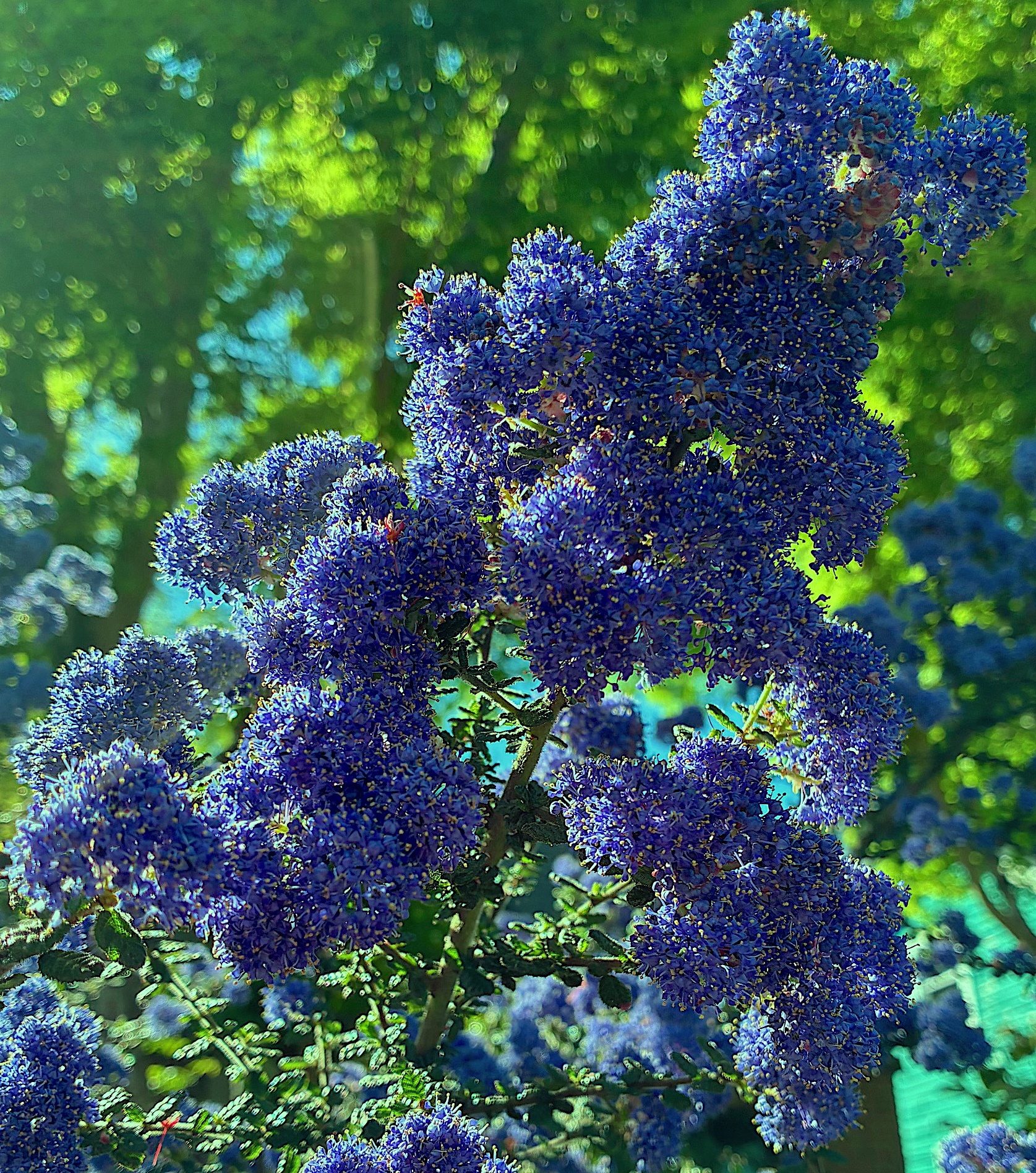
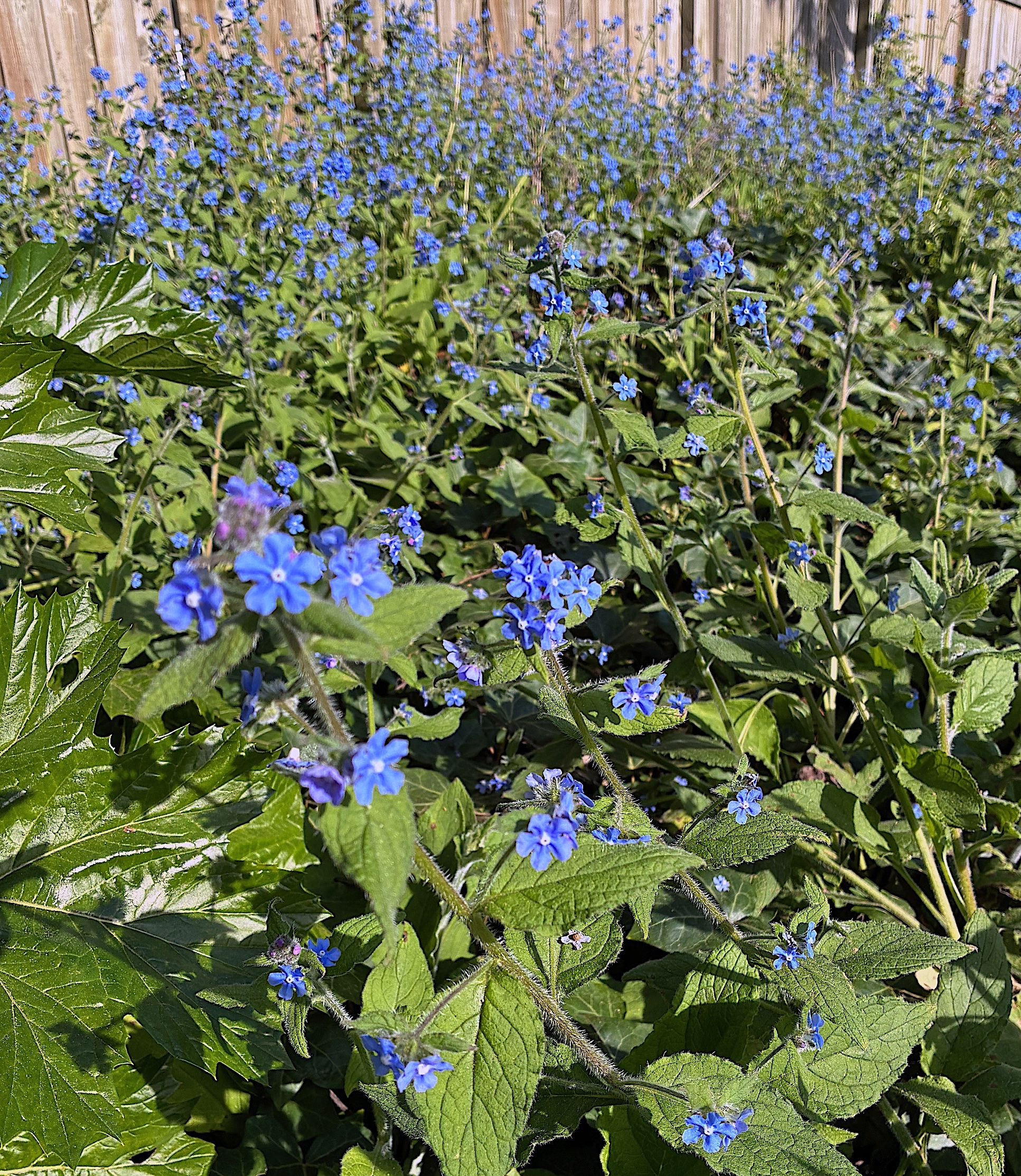
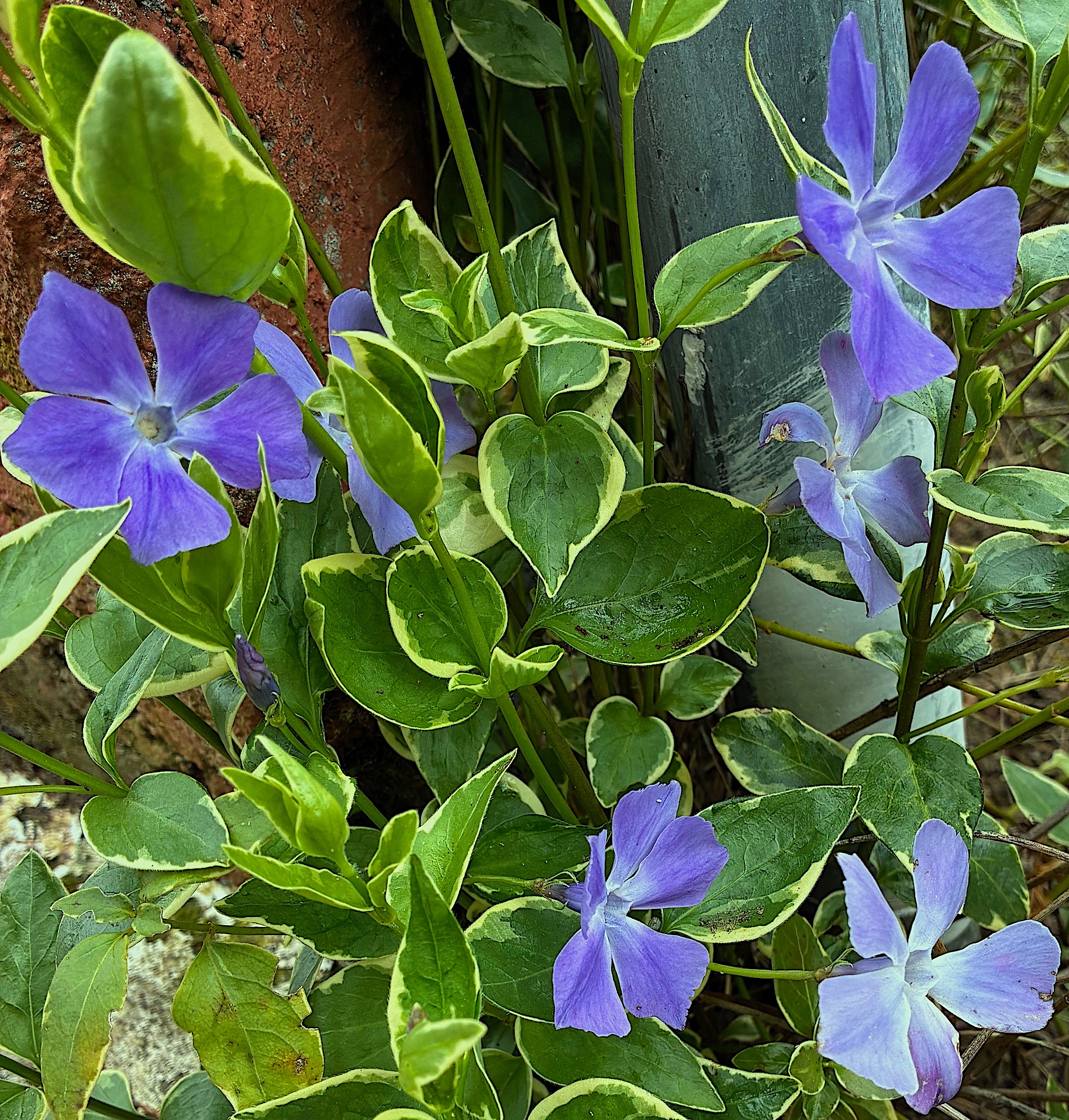
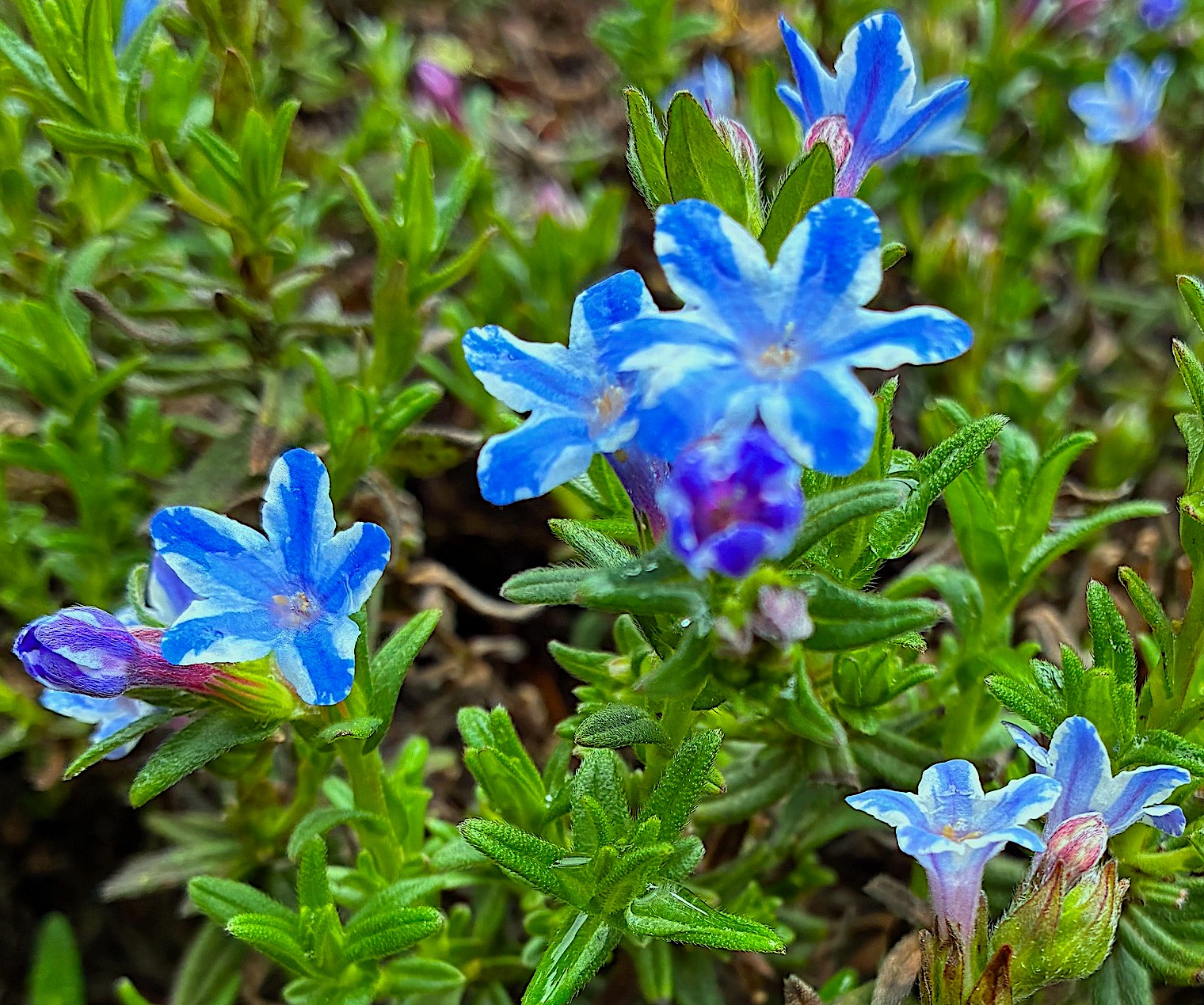
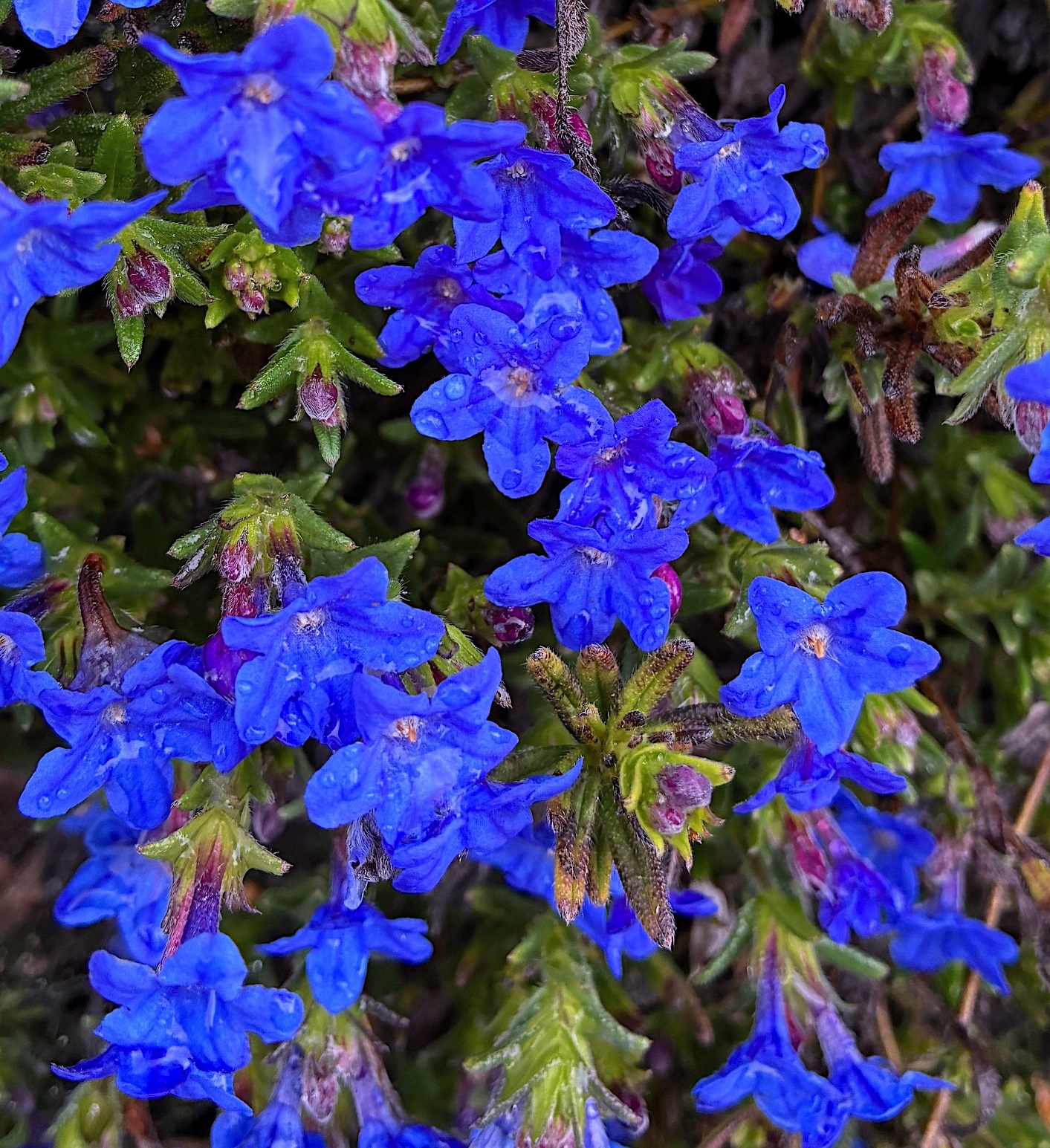
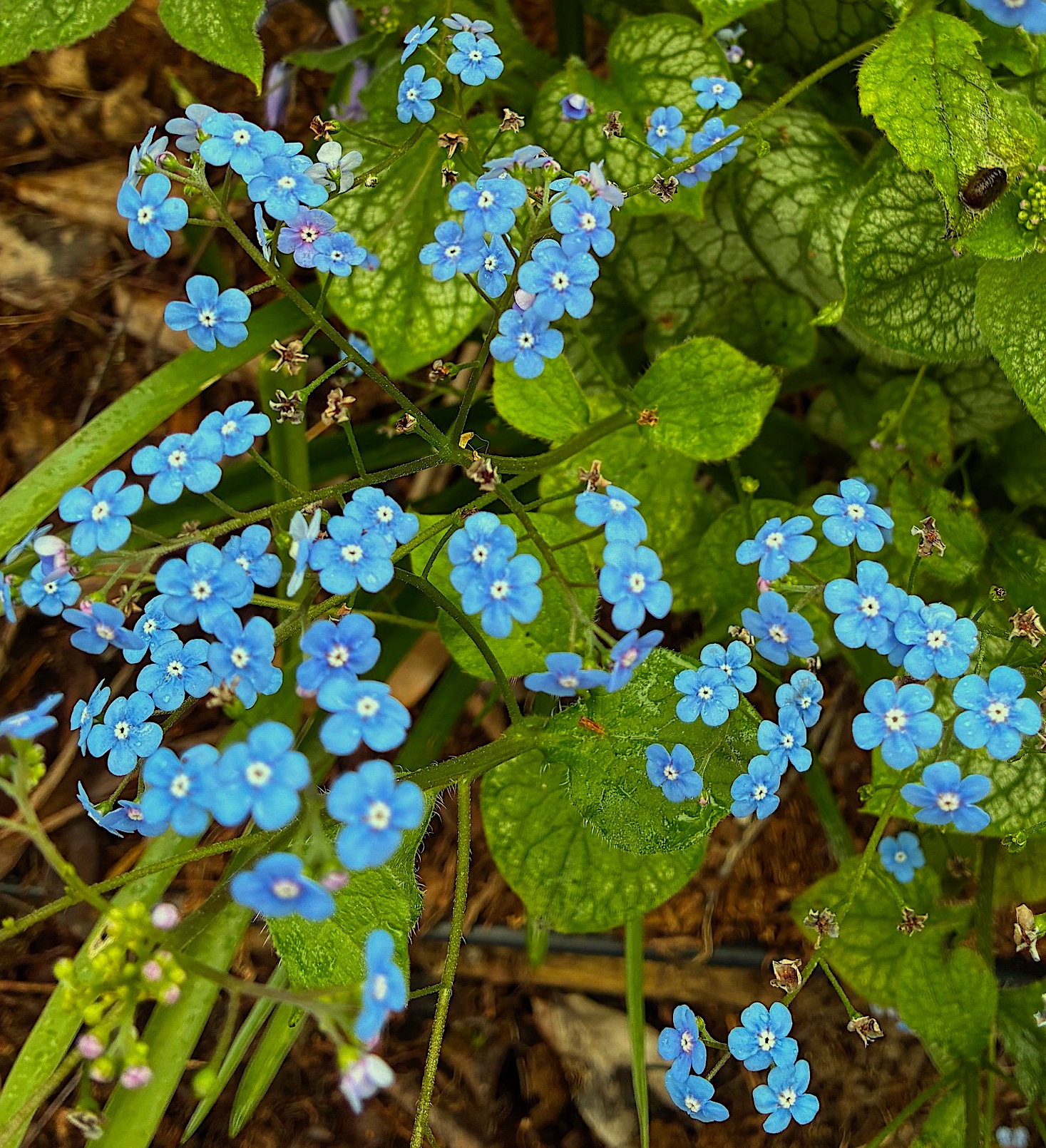
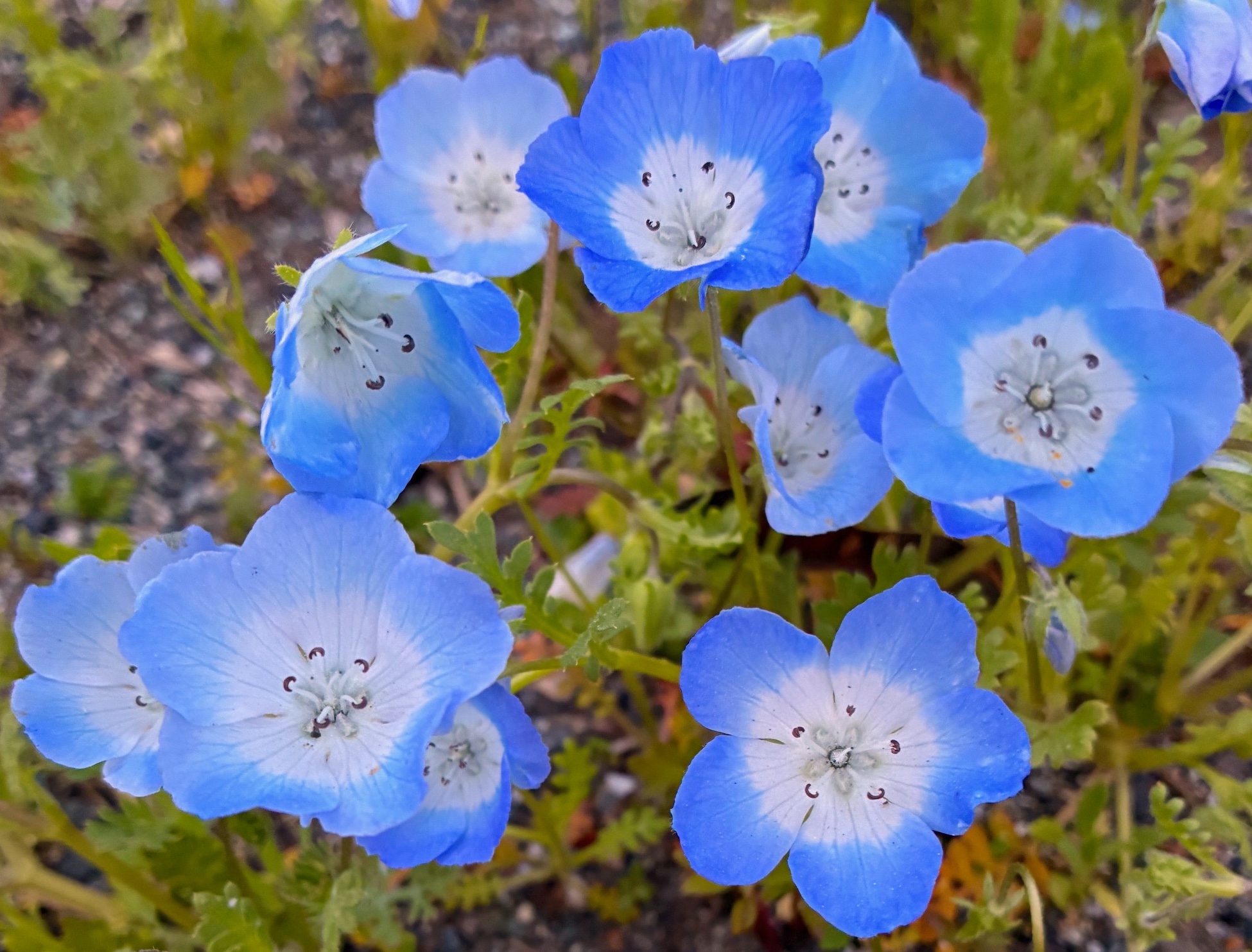
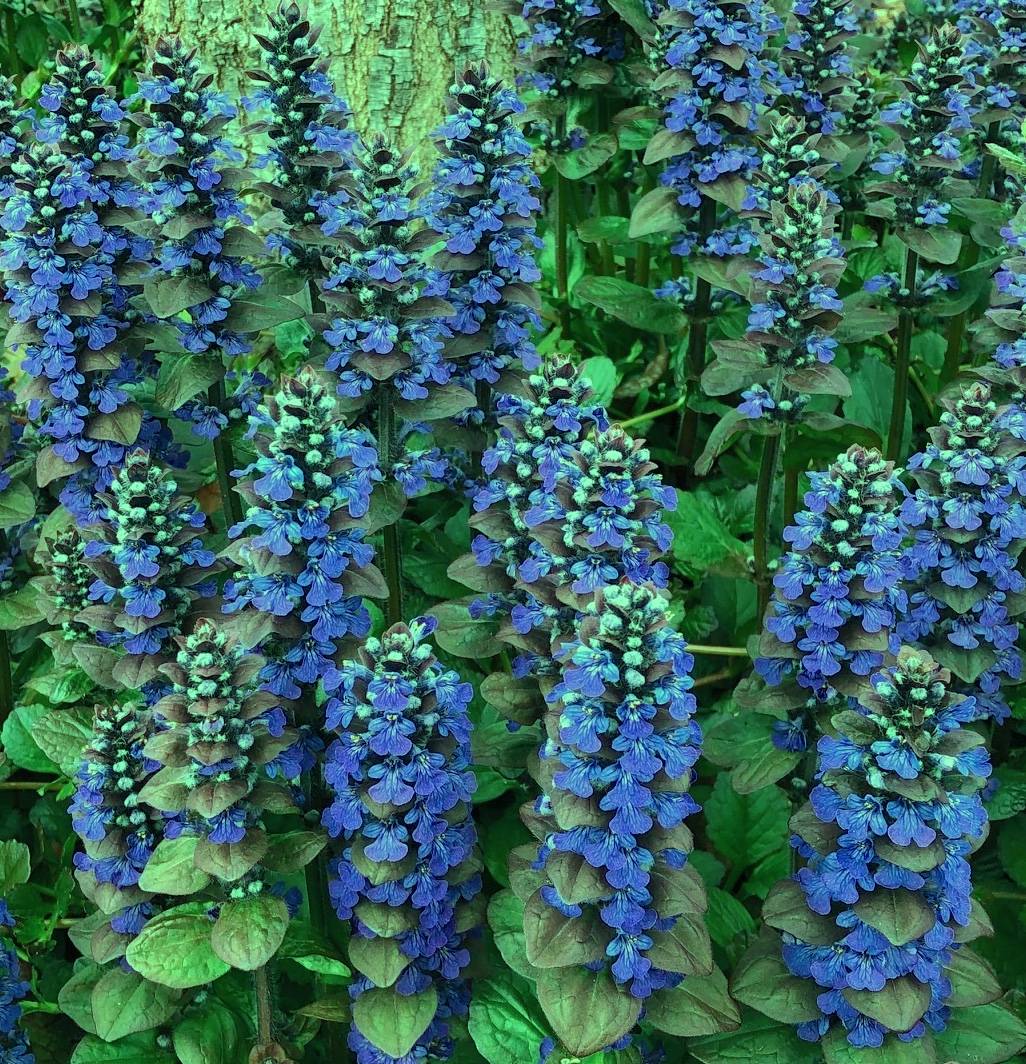
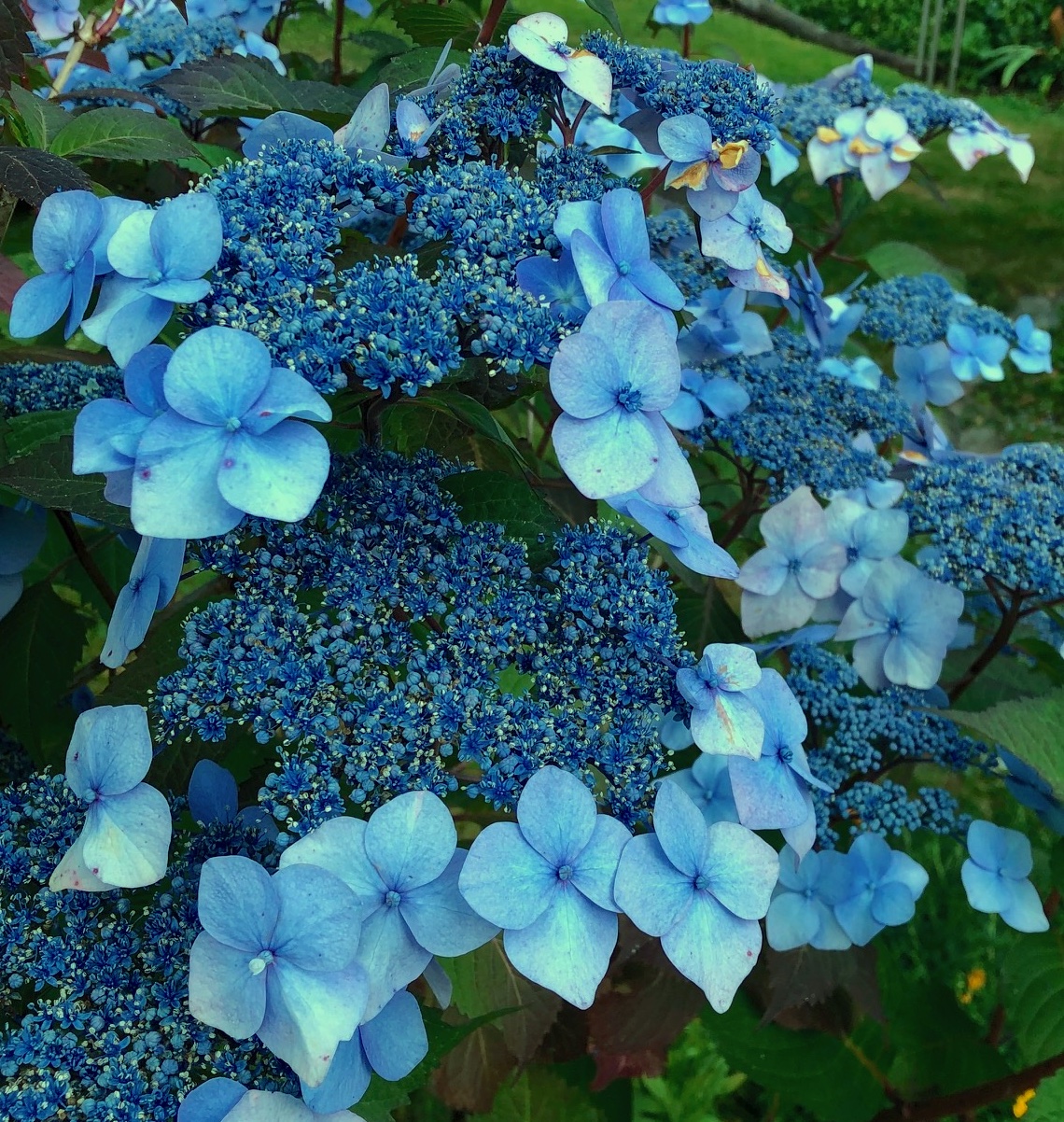
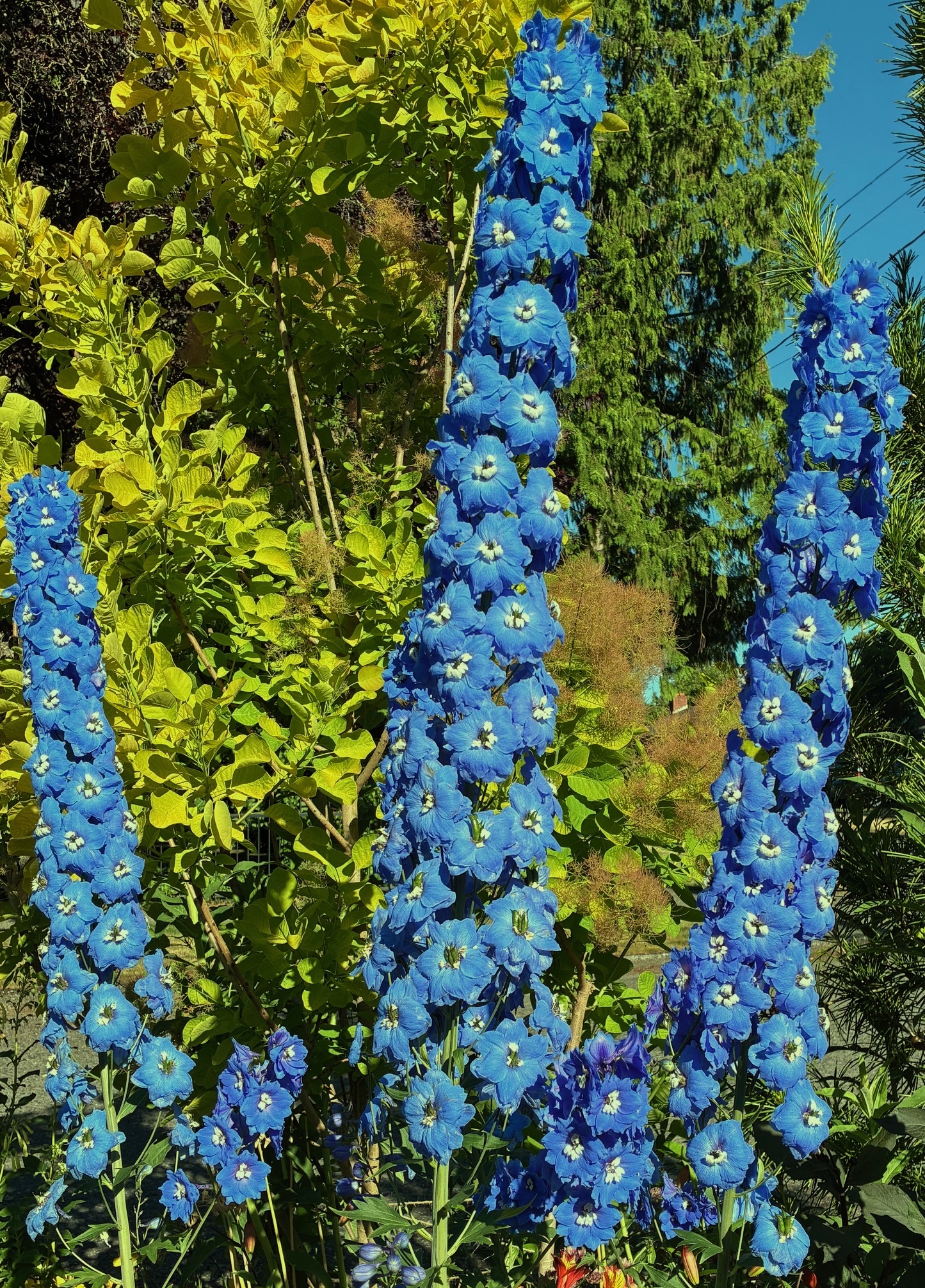
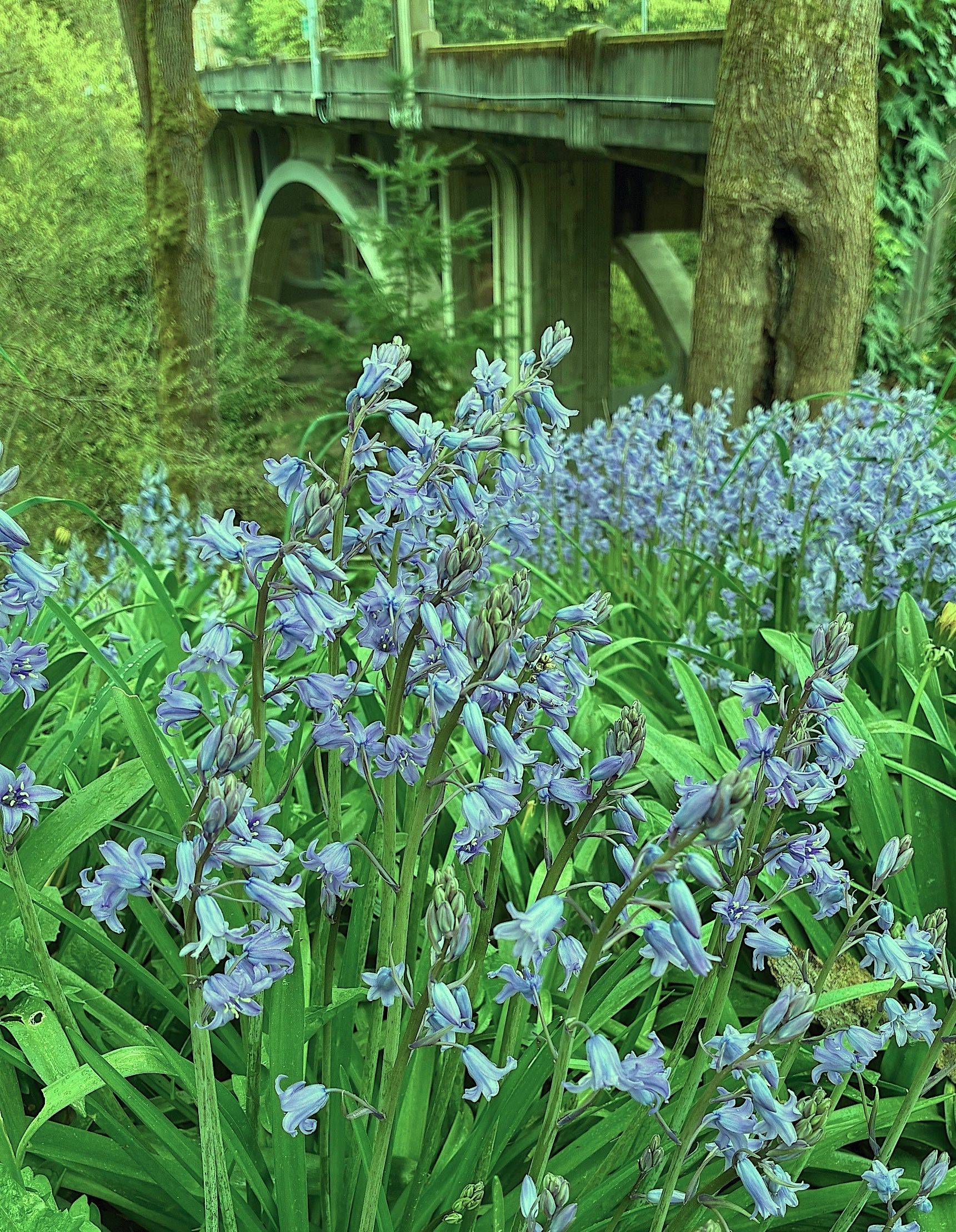
In the park at the edge of the woods, blue flowers in light rain. (Update 4/25: a few more blue flowers bloomed and snuck in when we weren’t looking.)
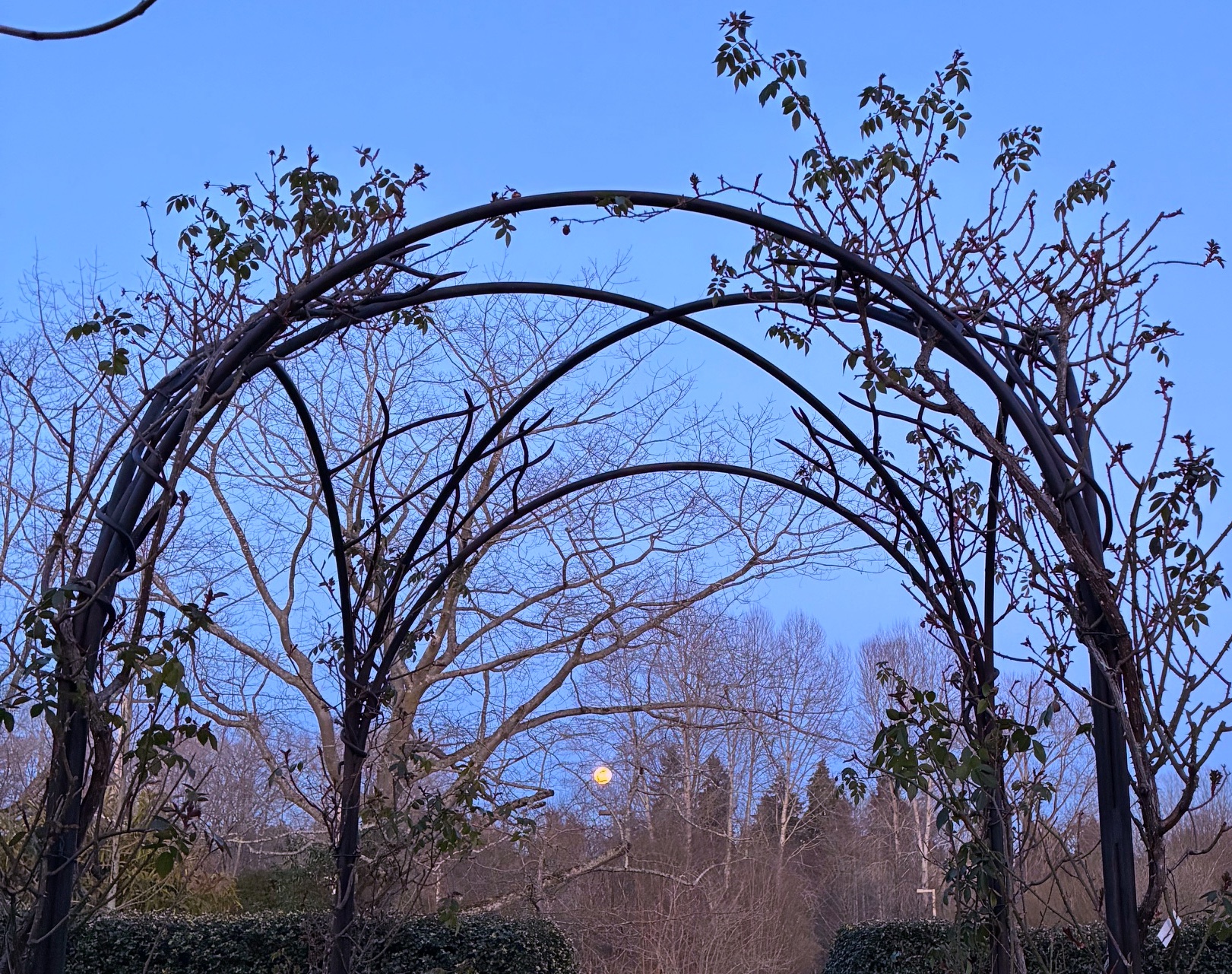
The moon was in the news for sure — nearly full, waxing gibbous at 97+ percent, in “Blood Moon” color phase, and expected to rise at 5:22 pm with a full lunar eclipse later in the wee hours. Commuting homeward from work I glanced outside and on the horizon caught sight of the moon’s rosy edgemost edge. Yanking the overhead bell cord for the next stop, I scrambled for the exit and hopped off the bus.
It was a foot race then with the usual bag & baggage, about a mile to the park on the water, hoping to get there in time for a nice view. The phone camera isn’t set for grand events in the firmament, and in my pictures the brightest moon appears to be a paper dot cut from a hole punch if it shows up at all. But the prospect was worth a try.
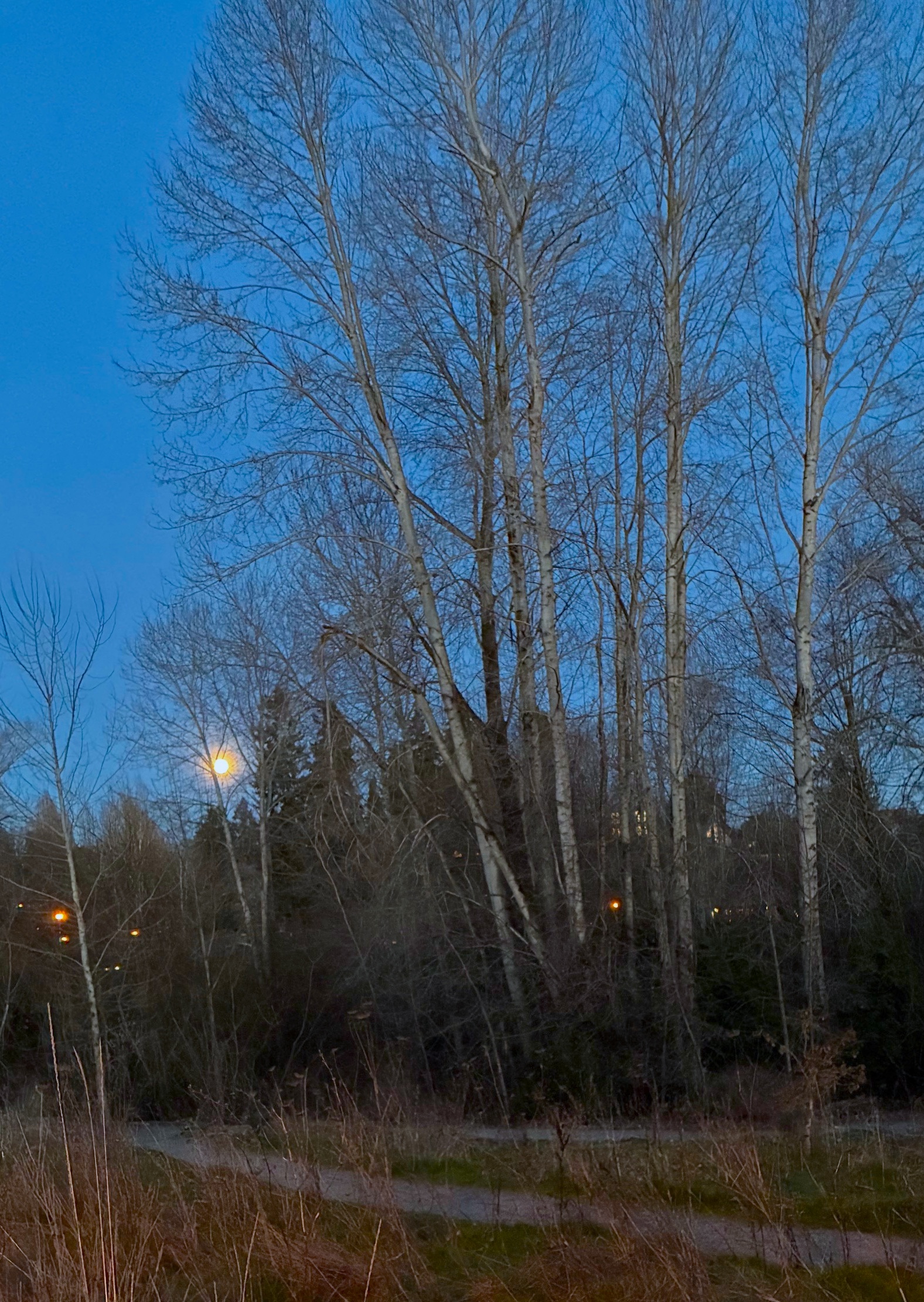
What an enticing idea, to follow this nature trail deep into the birch woods and downhill to the waterfront! But with regrets I passed up the solitary walk through this fairytale prettiness, and stayed in the populated parking lot. Other nature fans had gathered there, parents with baby strollers and carriages. Now if I had children, or so it seems to me, I would point out the moon and explain why this is a special night, and would invite them to watch for the first star constellations and listen to the flying killdeer and geese and other nature sounds. But these kidlets left to their own devices showed their nature appreciation in their own way — shrieking in high spirits, chasing one another, and stampeding round and round these garden paths:
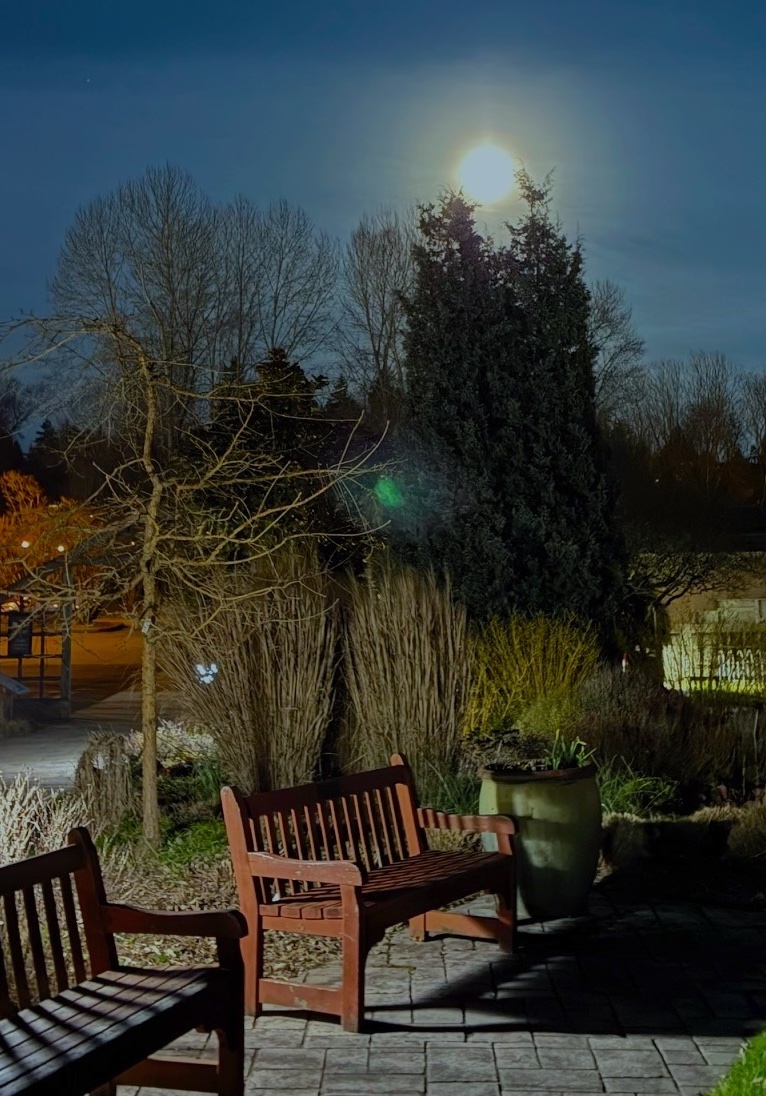
The mile walk back to the bus stop is dark with abrupt and unexpected changes of pavement and footing, so it was high time to leave and pick a cautious path to the main road. Here was the last glimpse of splendor over that same living arch of vines:

There was nothing to wish for then but a companion to share the walk with me. A pretty evening, all the same.
Sure, it’s a milder winter than it ought to be, and maybe we’re running out of snowpack, and maybe we’ll pay for that this summer. Meanwhile, we can just look around and notice little moments day by day, attend to what’s happening in the sky and on the ground and in other people as they come along.
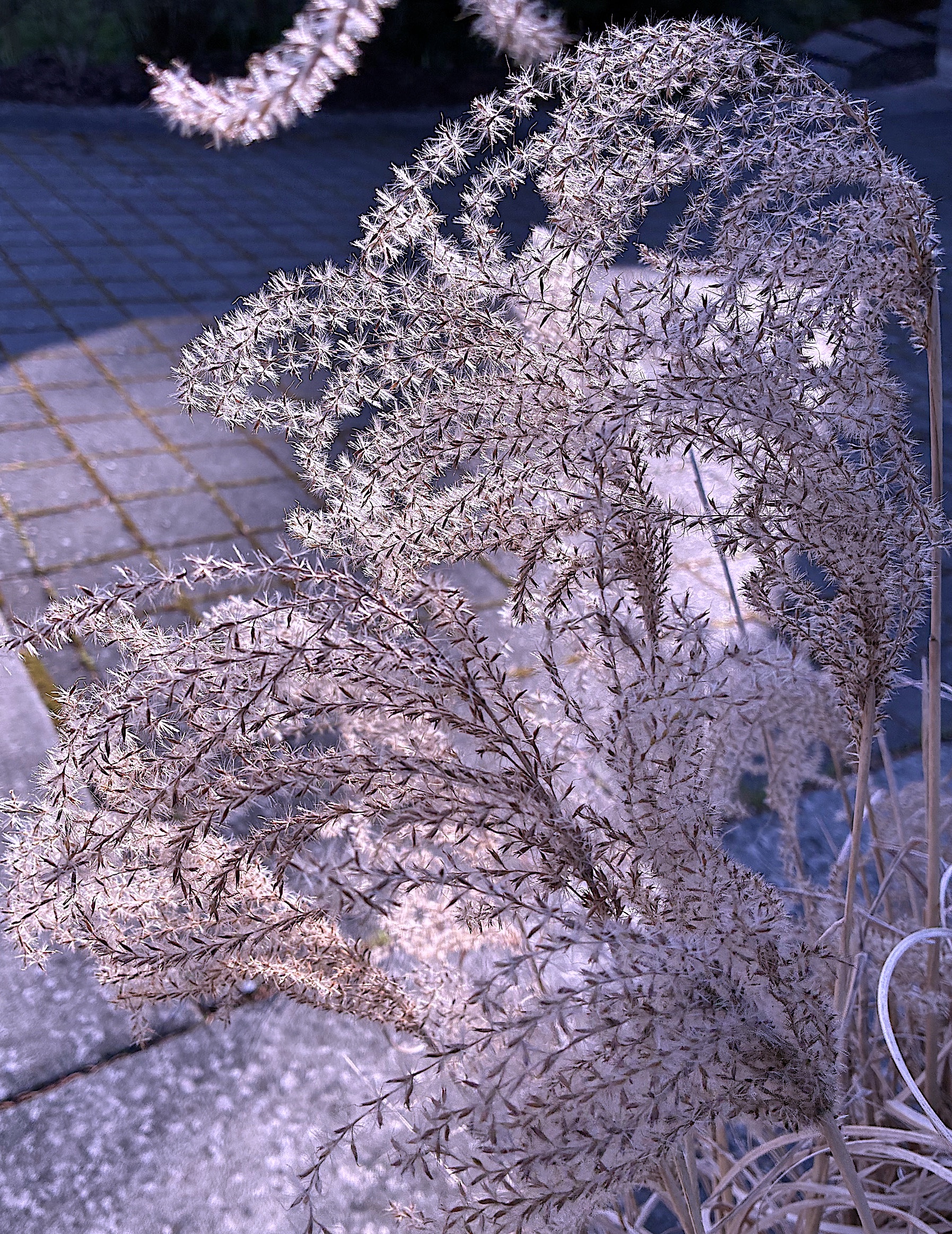
So first here’s an ordinary winter winter sight, some lace-like tall grass looking like frost flowers on a window pane:
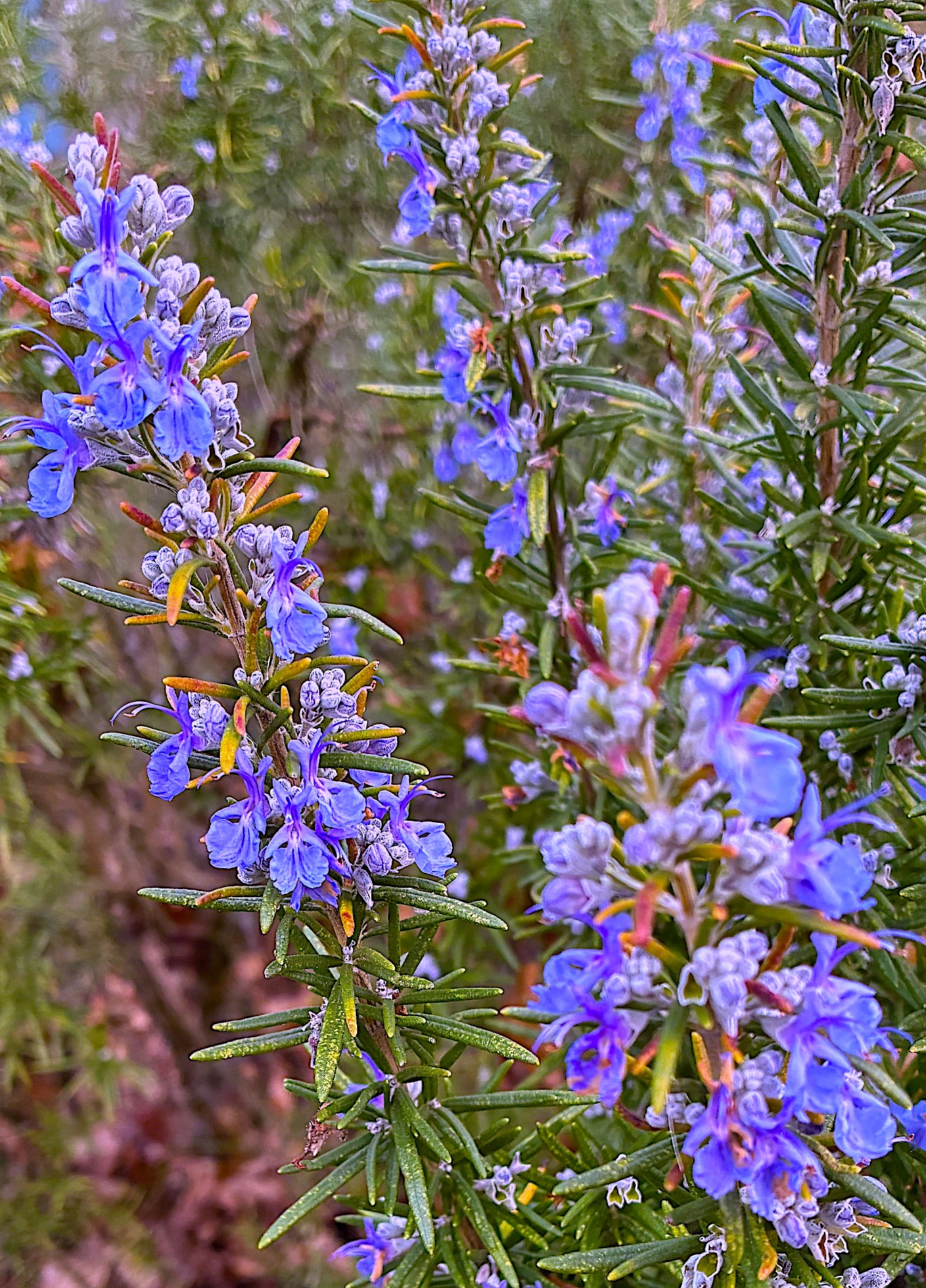
Here’s another winter winter flower, some cheery rosemary growing out of the sidewalk.
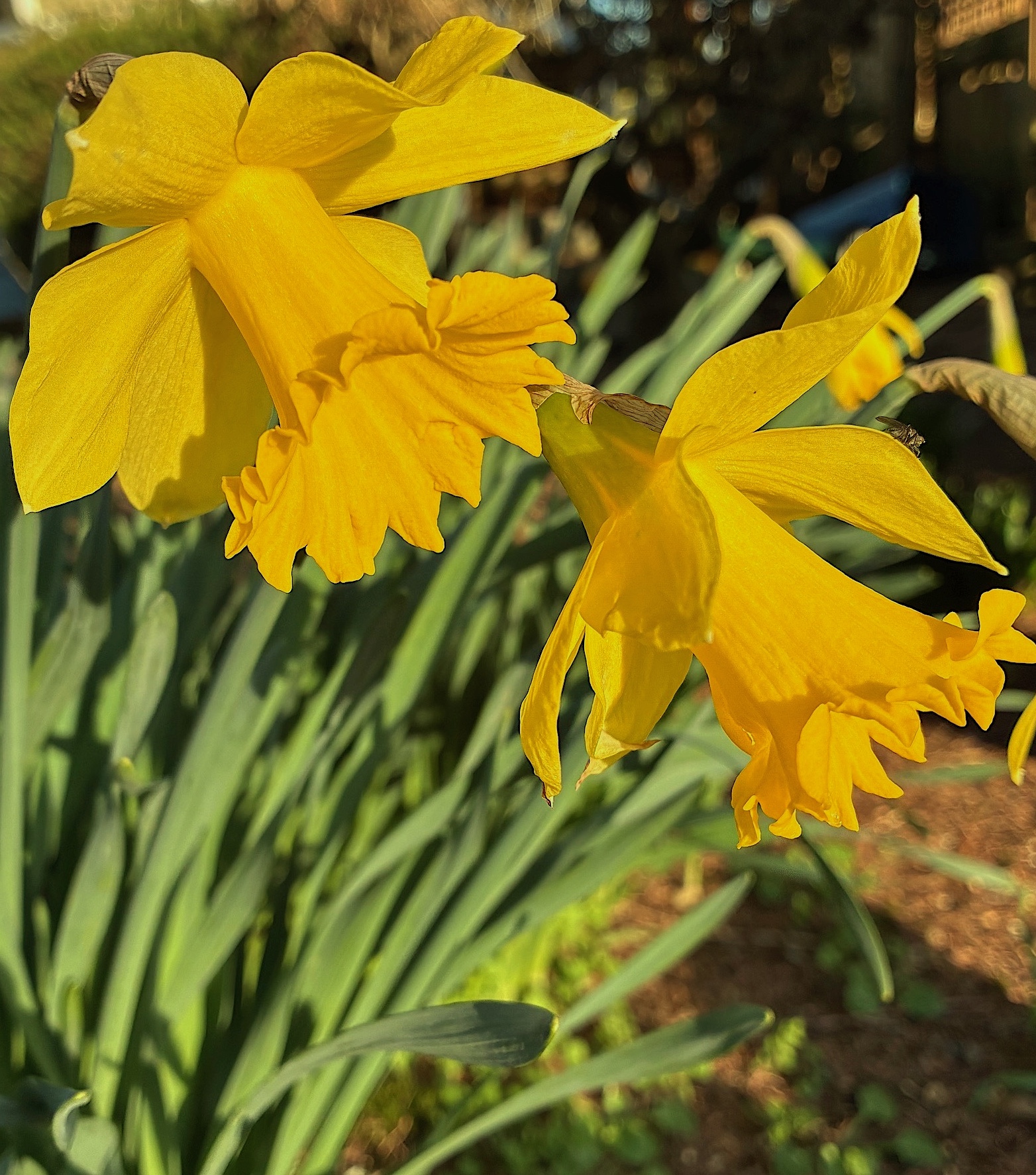
But here’s an unexpected flower: daffodils in February?
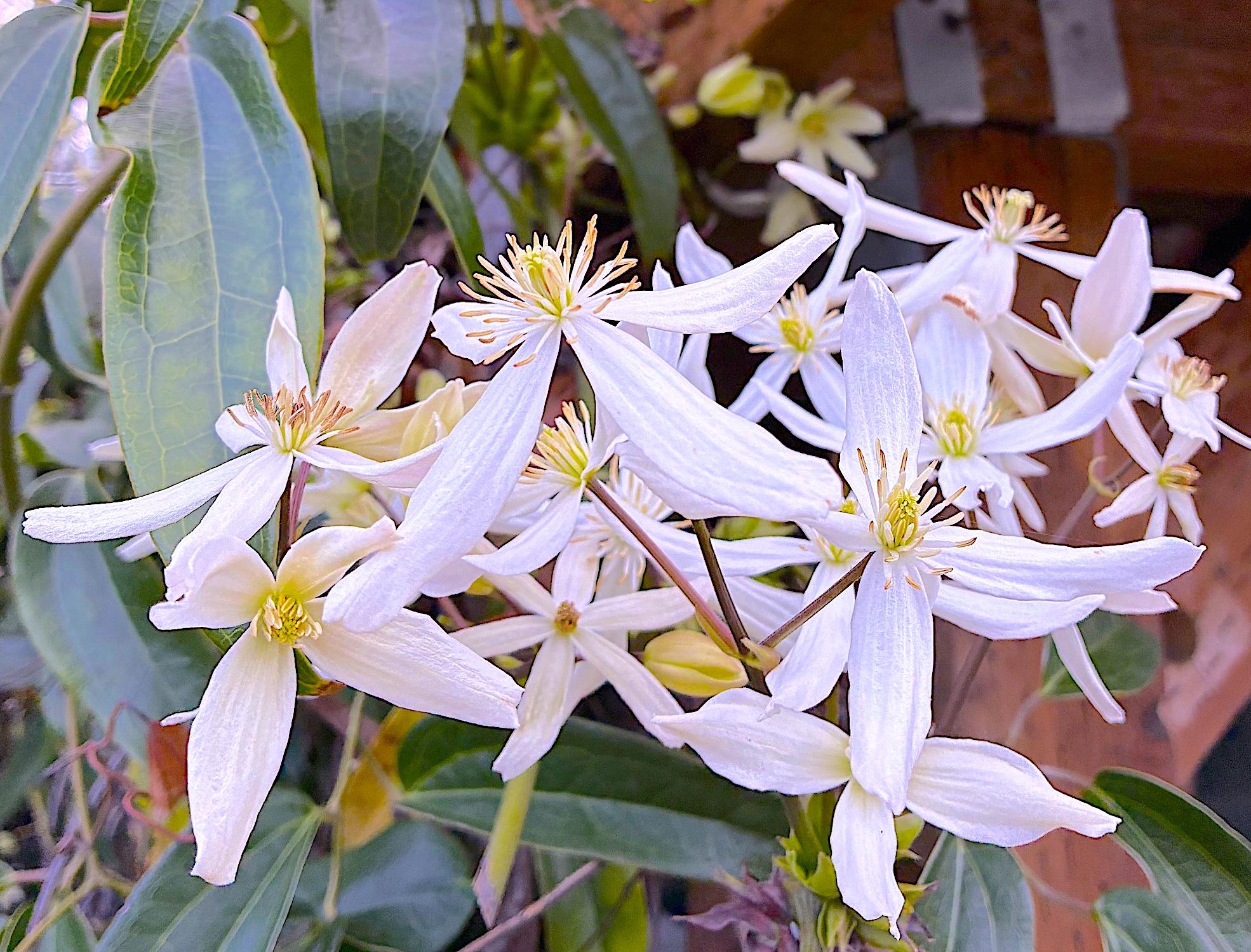
And here’s another surprise, early in the season: some poisonous climbing vine Clematis armandii. It grows and takes over fences and walls all over town. I wouldn’t want toxic ornamentals on big messy vines in my own garden, but for one week a year it’s a nice elegant scent.
Lately the news, some of it sensational and distressingly scandalous, has gotten me down enough to bother my sleep and spirits. There’s not a thing I can do to solve any of it, and these scandals only call to mind frightening situations from my own past. Finally I resolved to turn off these sensational updates, and to shift focus on two other things instead.
The first was revisiting a sermon from last year by Father Seraphim Aldea. On YouTube it’s called “Bad thoughts and people? Don’t take the bait.” As usual, the sermon draws on the writings of the early Desert Fathers, to encourage the listener to “Keep engaged in your relationship with Christ and with prayer…. Try to discern if something good or bad serves your prayer, serves you in your journey towards Christ; if it nourishes prayer, if it nourishes love, if it nourishes a non-judgmental and forgiving and penitential repentant heart in you.” (It’s good to remember the Orthodox evening prayer asking God to protect us during the night from “vain thoughts, and from evil memories.”) Any ruminations waking or sleeping are better spent getting to know about Christ instead.
The second action was deciding here and now to open the garden patch for the year, as a little note of encouragement for the neighbors and our tiny world. This year the garden will be a memorial in particular for my own parents and the blessing and peace of their souls.
Well, it would be good to start with green peas. Why peas? They can be planted in the cold, and will even germinate if it’s snowy. They grow noticeably day by day; it’s entertaining for the passersby to watch them grow. They are good for the soil, they have nice white flowers, and we can eat not only the peas but the new tendrils as well. As a pleasant surprise, this year ‘s 2026 season pea seeds showed up at (of all places) Grocery Outlet. As time allows I can plant those perhaps even this week.
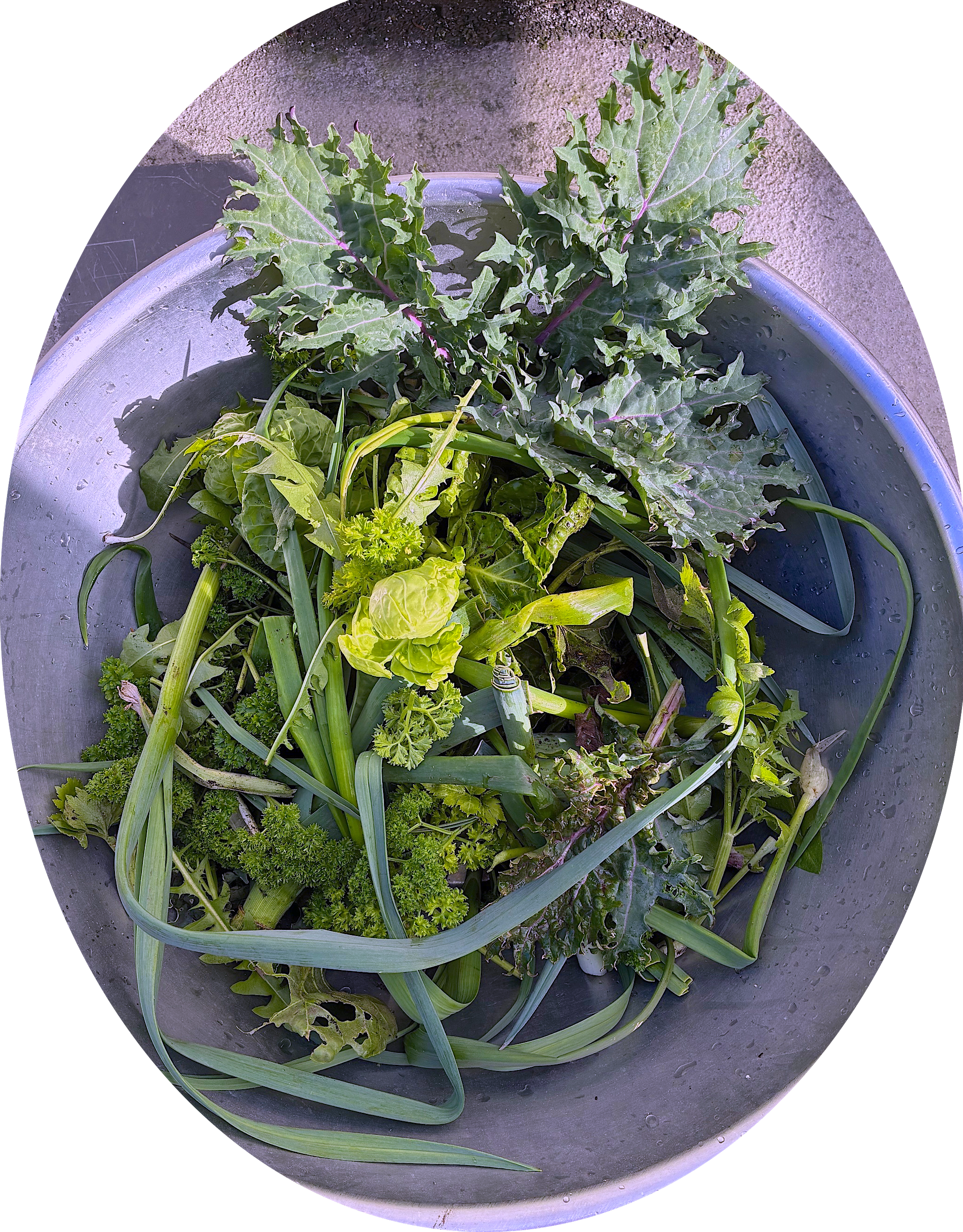
Then yesterday I hauled my clumsy self up on to the raised bed, both patches, and dug up several bowlfuls of the hardy greens still soldiering on from last season: kale, onion greens, kale, leeks, scallions, celery leaves, curly parsley, brussels sprouts. And yes, I can just leave them be; but I’d like to start fresh and create a new canvas for the new year. These greens made a strong nutritious broth for drinking, and also several meals of cooked mixed greens.
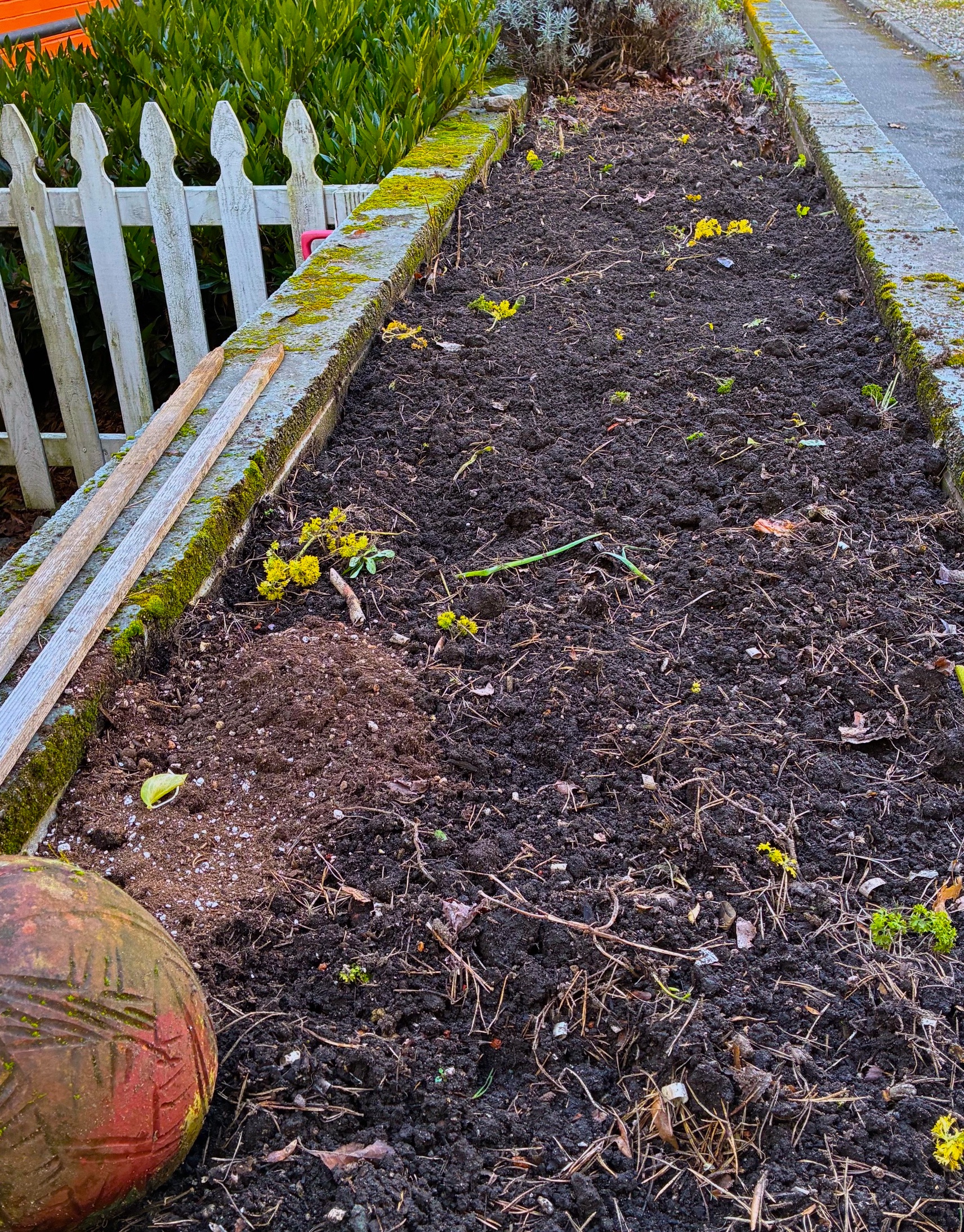
Then for the south patch I hacked at the top six inches of soil to loosen it up.
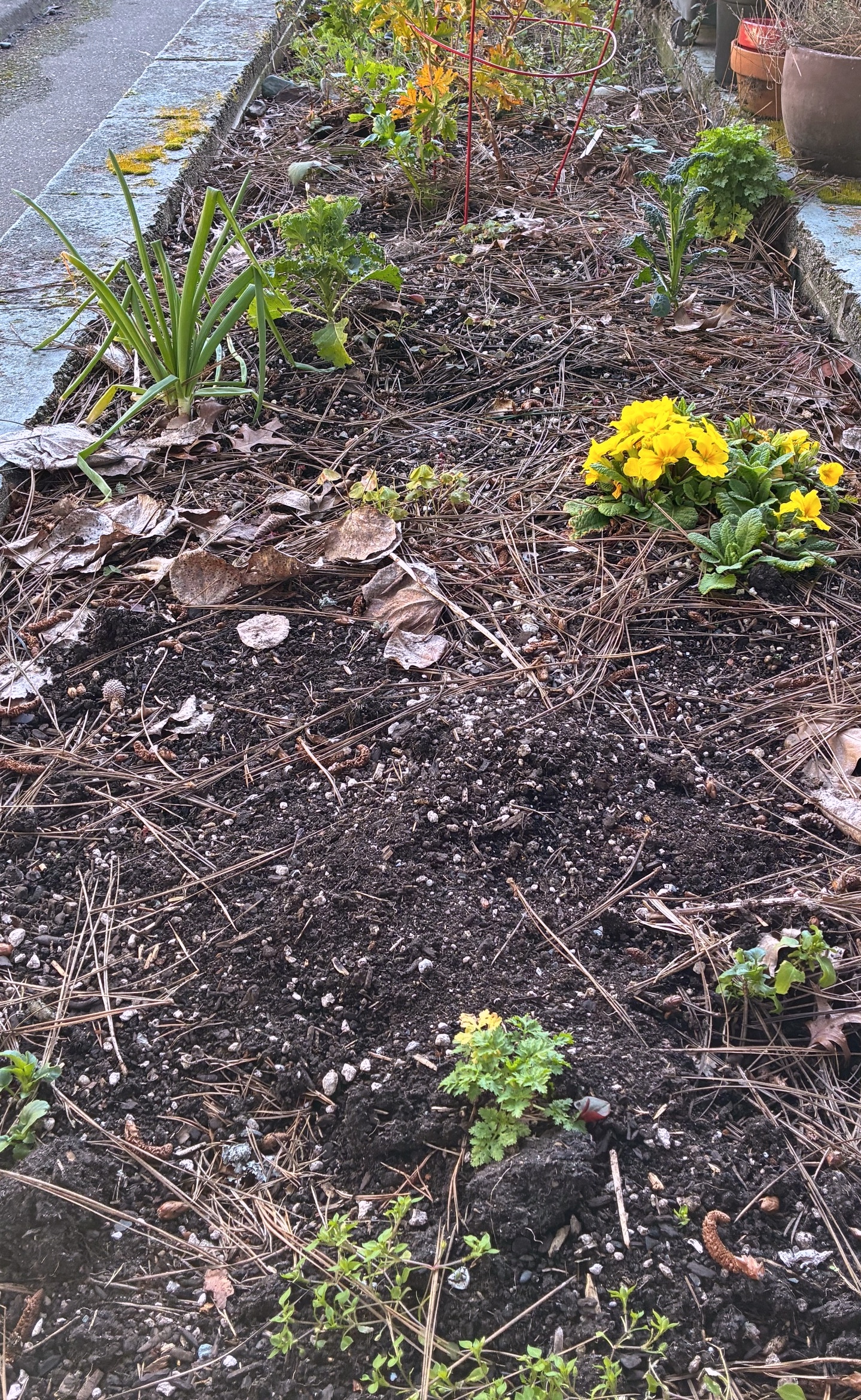
The north patch needed clearing and chopping too.
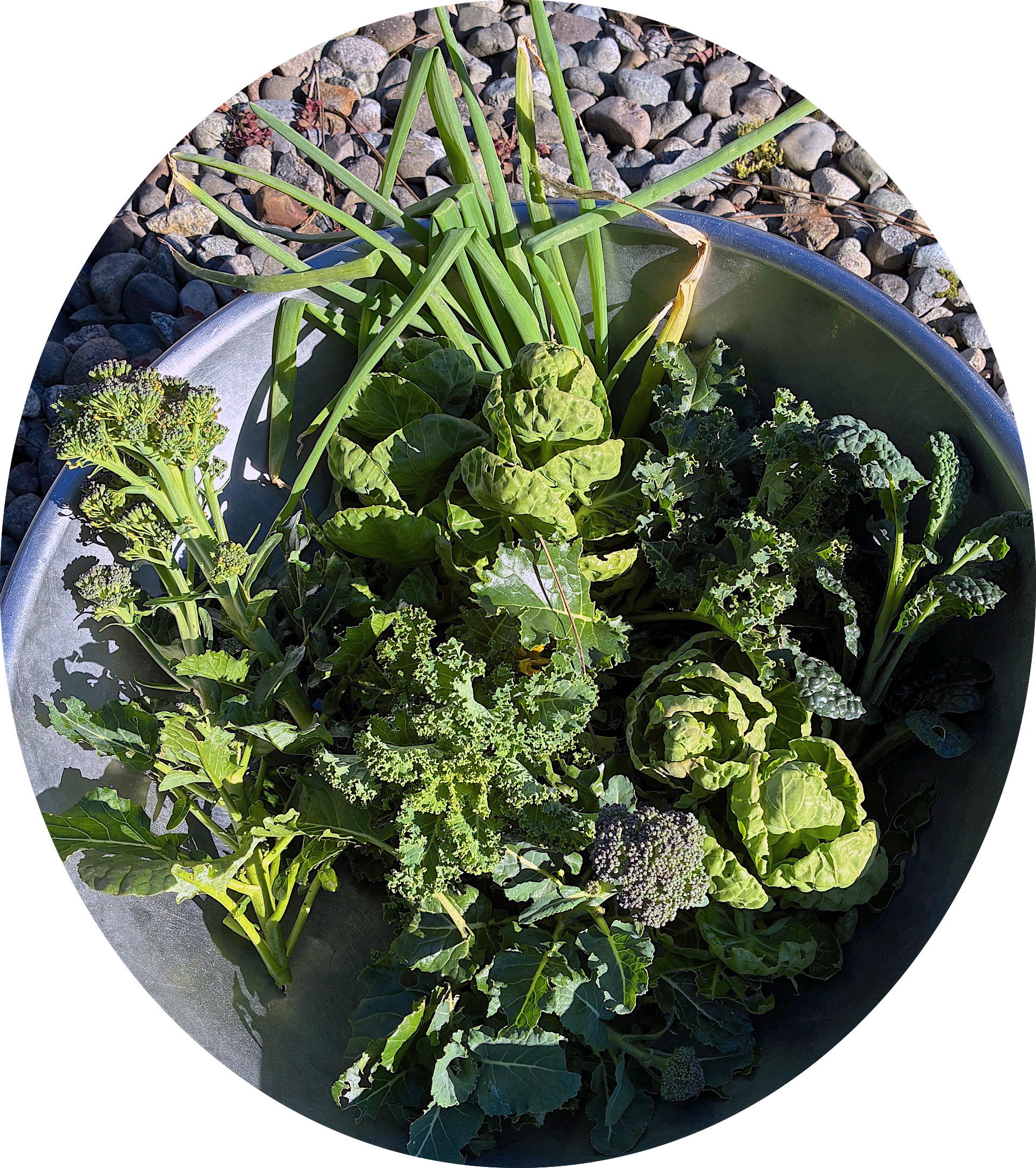
That yielded a new bowl of edible trimmings.
Next I called out for help to my former co-worker, trusty resourceful Sandrine. I asked her to drive me to the hardware store for dirt — specifically, organic soil mix for raised bed gardens. She very kindly showed up and drove me out for four bags, 30 pounds apiece. What’s more, she brought some spare stakes for my envisioned pea patch.
Today Sandrine and I tipped the soil bags out of her car to the ground near the raised bed. It’s an annual ritual: I cut open the bags, load handfuls of fluffy dirt into my bucket, and walk it around to spread across the garden beds. It takes about 40 trips to walk the soil around and spread it out.
Well, two neighbors (one girl in first grade, one boy just in nursery school) came running outside in great enthusiasm, all eager to help. They asked all about the bowl of edible trimmings, and what each plant was. After learning the names, the little guy bit right in to a bud tip of baby kale and happily chewed it up. (Next time I’ll tell him to wash his greens first, but he seemed happy with his kale foray.) The siblings asked permission to bring a sample of each vegetable to their mother. They scooped up handfuls of greens, and hollering with excitement went storming into the house to give the bounty to their mom, who is nursing a newborn and is likely to have little leisure to wash and sort these items. Still, it gave the kiddos a thrill to be symbolically bringing home the bacon.
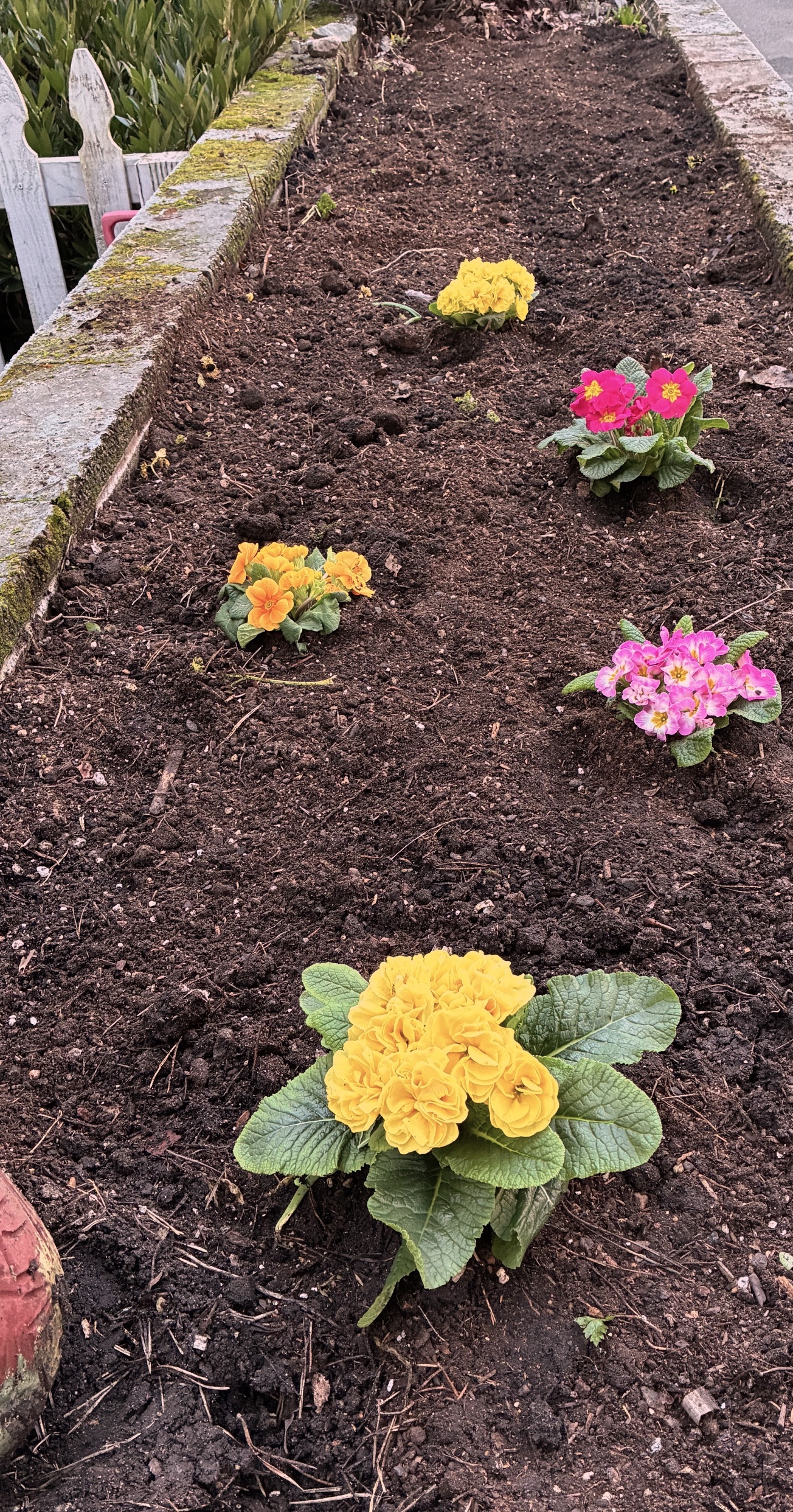
In past years when they were smaller, they were pleased to ask oodles of questions, then would run off to explore further wonders of the world. But to my surprise, this time until their mom and dad called them in to go to the store, these energetic kiddos took buckets and trowels and worked on and on for one and a half hours! In 90 minutes we moved 90 pounds of dirt, scooping it all by hand and toting it in pots and pails. With their help, I had time to plant the primroses just in time before the sun set.
Here’s the south patch now, and the north patch.
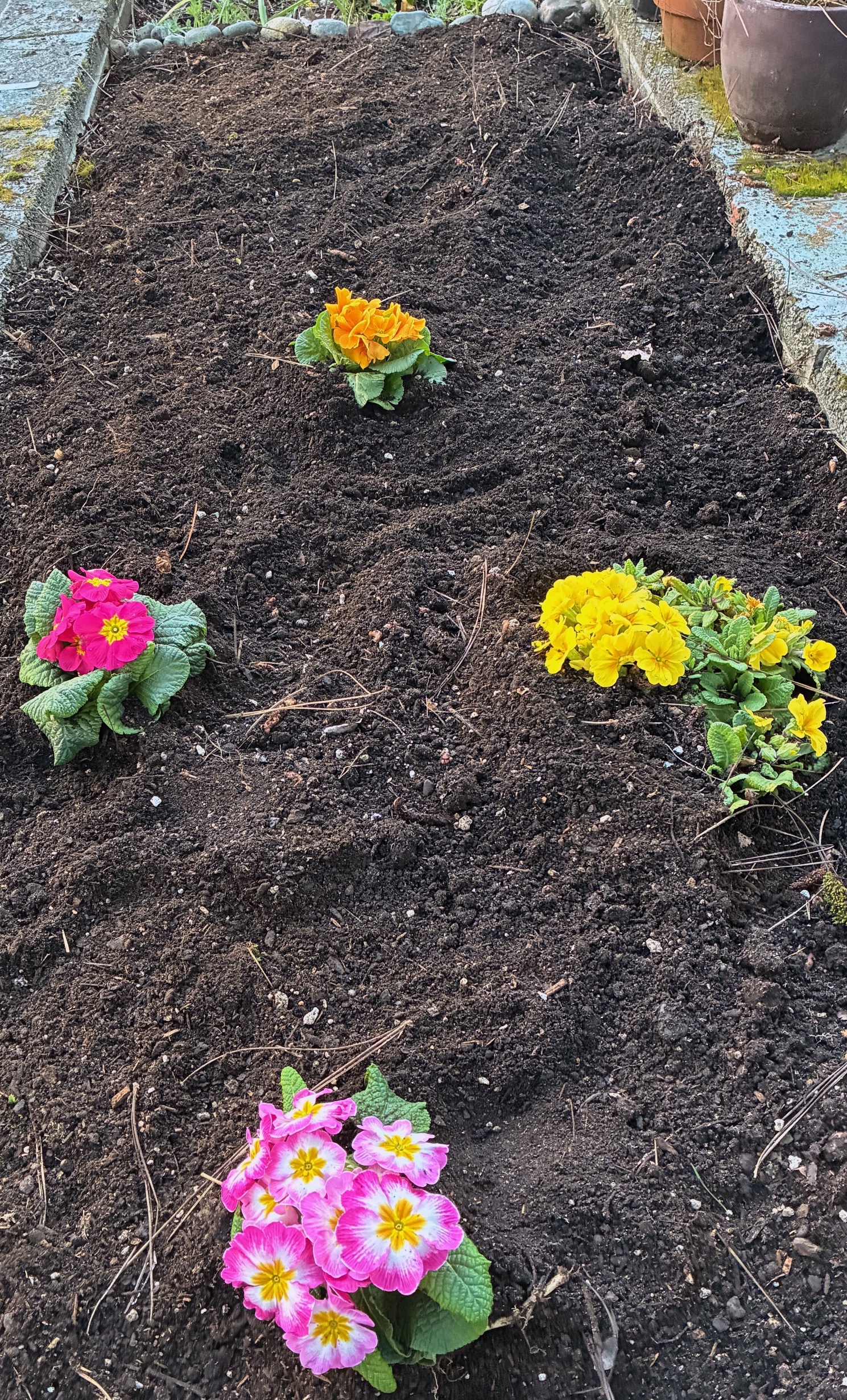
It is an immense privilege to do this: to have money to buy the materials, to have a place to live and a little patch outside, to be able bodied enough to haul a clumsy toehold up on the raised bed, to have at least enough know-how and leisure to put these plants in the ground.
The forecast is rain on the way, and a chance of lowland snow. But outside there’s one extra bag of soil left. It would be nice to scoop some into pots and start a few seeds indoors. And meanwhile, even with strange news tugging at our attention every day, maybe God willing these flowers can stand for something cheerful.
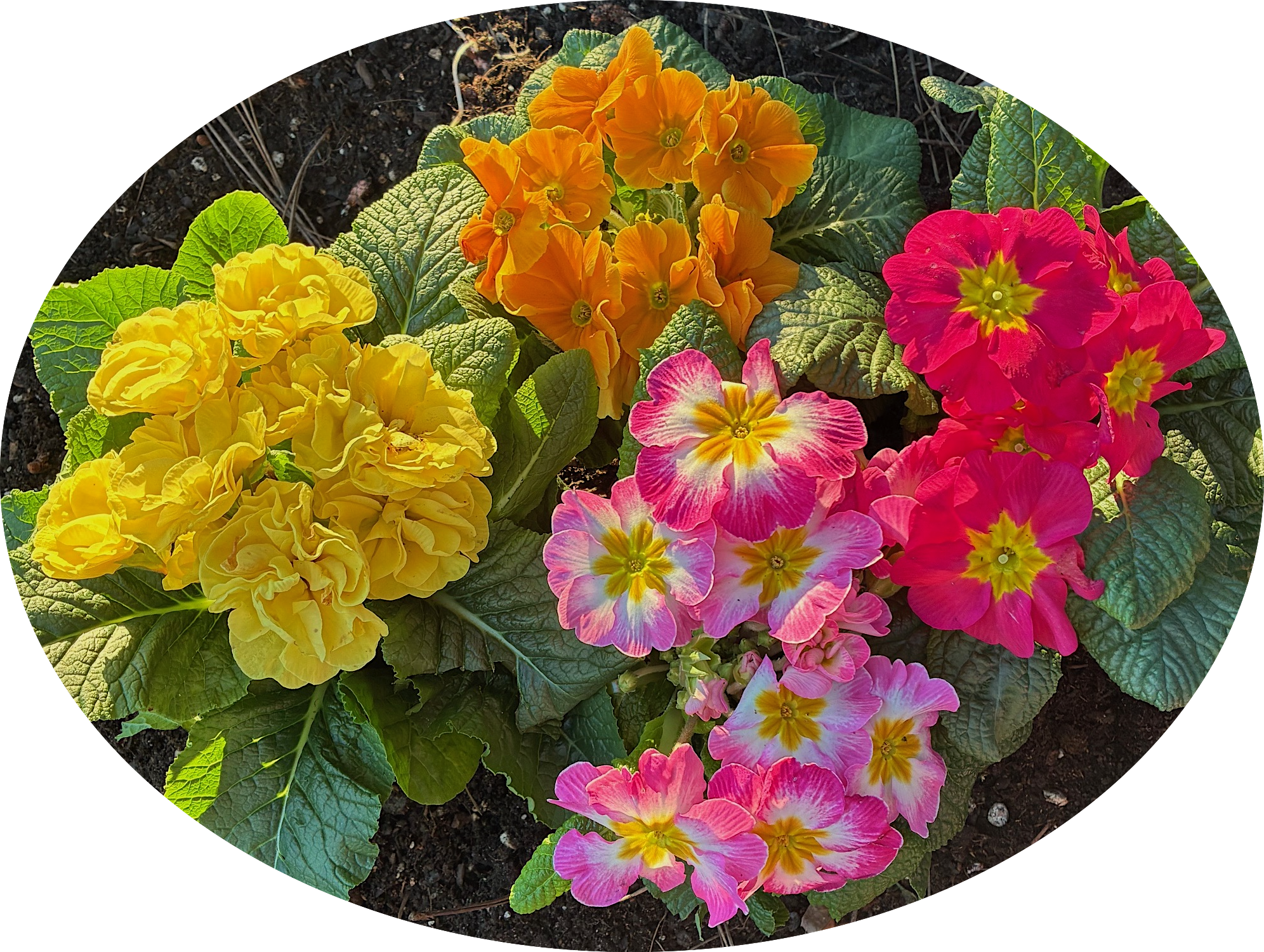
The Village to Village Network nationwide has a chapter right up the street. They are quite the bunch of go-getters who have gone-got in life already, and are still at it now and full of new ideas.
The VVN has a new walking club. Last week our leader coordinated a hike. It was a perfect day, clear with pleasant sunshine and a bracing breeze. So a group of folks carpooled to the trail, and we set out.
The weather and the trail were on our side. The path is level, broad, and clear, about three miles through thick woods with towering trees but right along the lakeshore with its wonderful sky views of the downtown miles away.
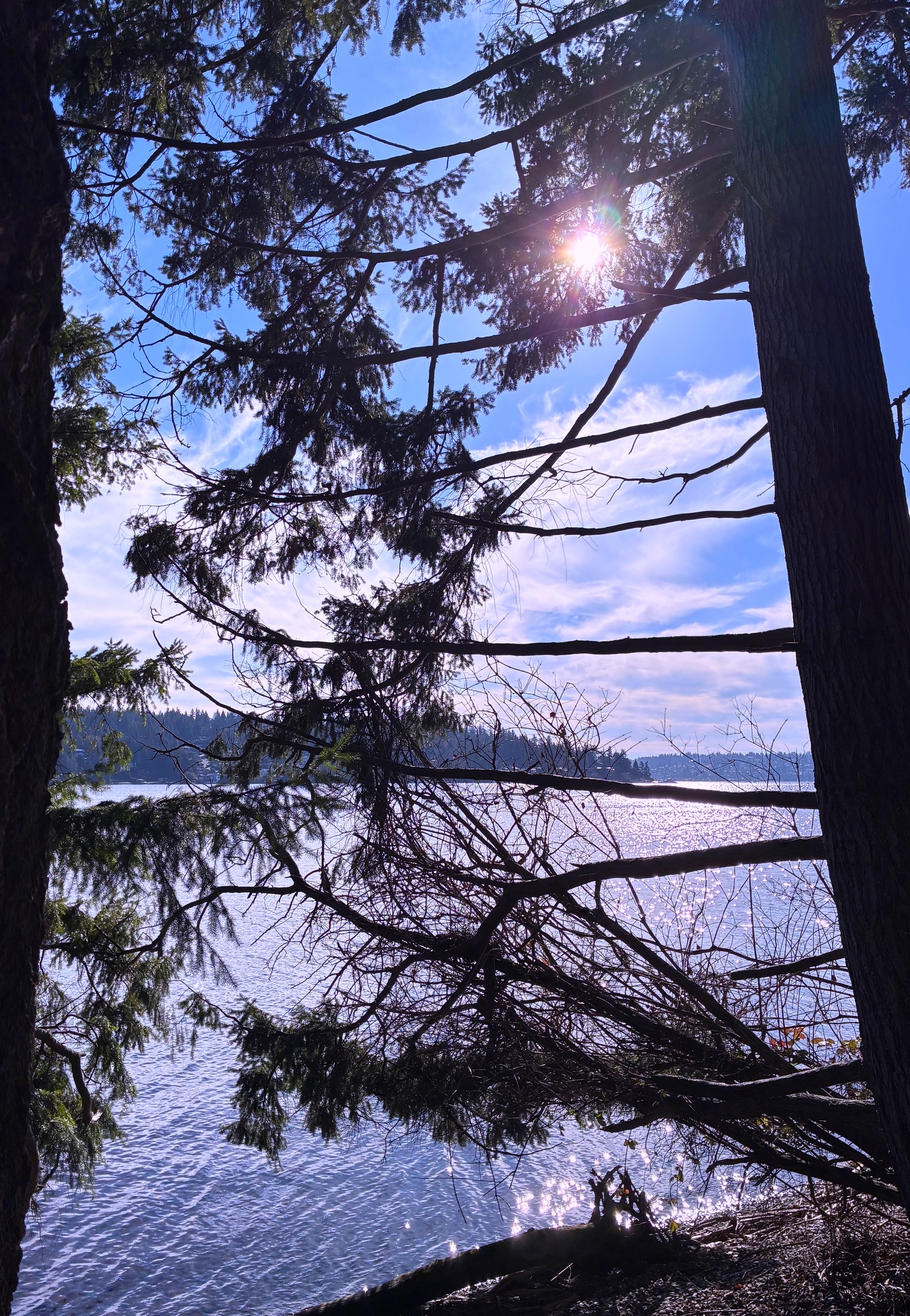
We even heard a tuneful twittering deep in the conifer cover overhead. The others immediately recognized this as the calls of bald eagles. In great anticipation I unzipped my waist pack, grabbed my cell phone, punched in my pass code, chose Photo, and leaned way back just as the eagle family soared on out of sight. Yes, Nature’s grandeur is what happens before and after I turn on my phone.

The conversation was lively with a pace of its own, sometimes with everybody chiming in together and other times with people pairing off and dropping back to delve into special topics and stories. It’s a pattern that reaches right back to shared traditions worldwide: people on the move, in groups, sharing their thoughts as they go. It was especially good to share it with folks who are so well prepared to be pleased.
It was a nourishing time to be treasured on a winter’s day.
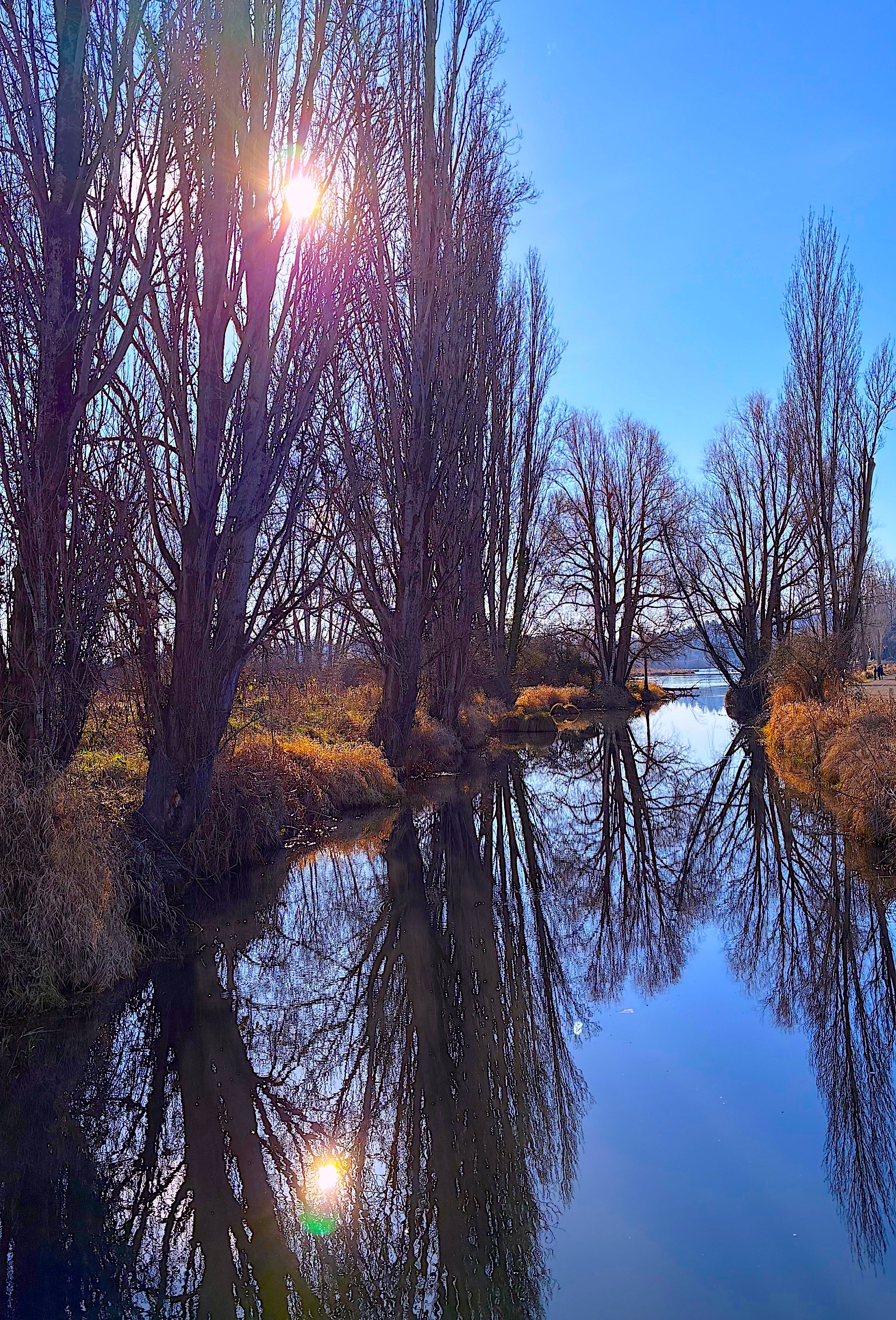
Yesterday’s winter stroll along the water.
Millions of people nationwide are facing dangerous weather, with low temperatures and heavy snow and sleet. And here we are, basking in the sun as our snowpack dwindles away. Here are more unexpected sights from this week, from a person who figures “Why not start worrying six months in advance of wildfire season?” Here’s the prettiness update for now.
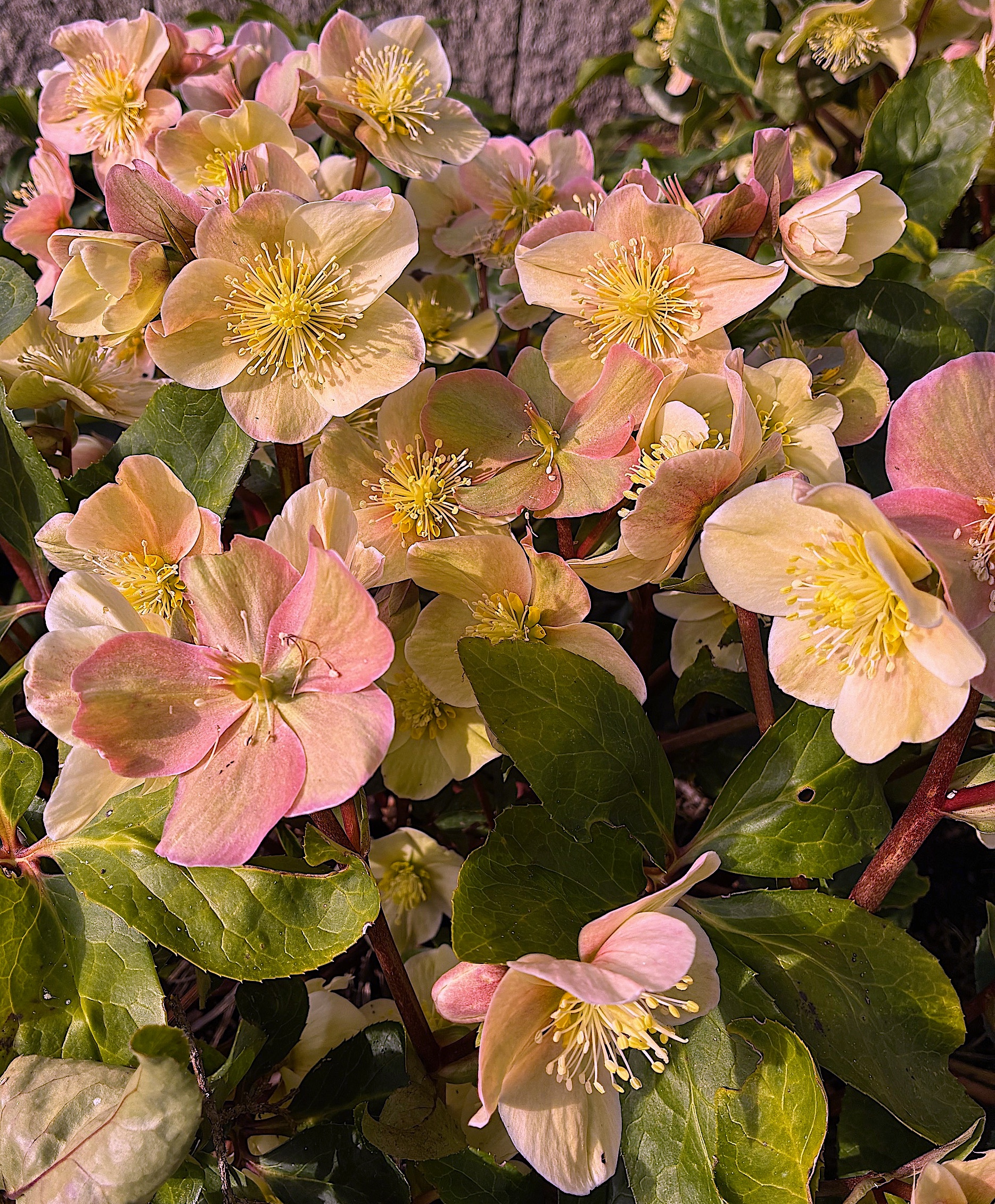
At least the Hellebores are in season.
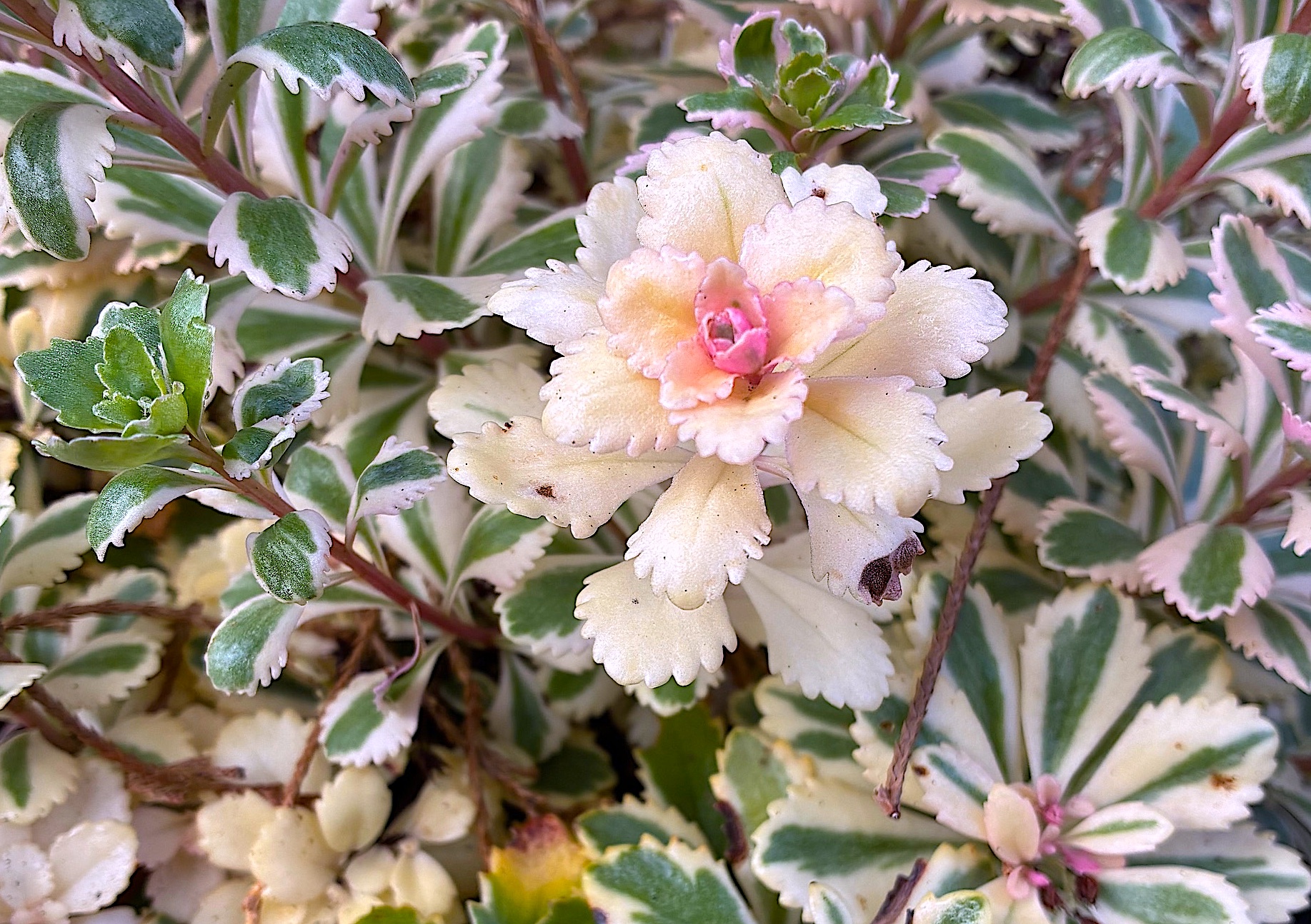
One of our many types of Sedum.
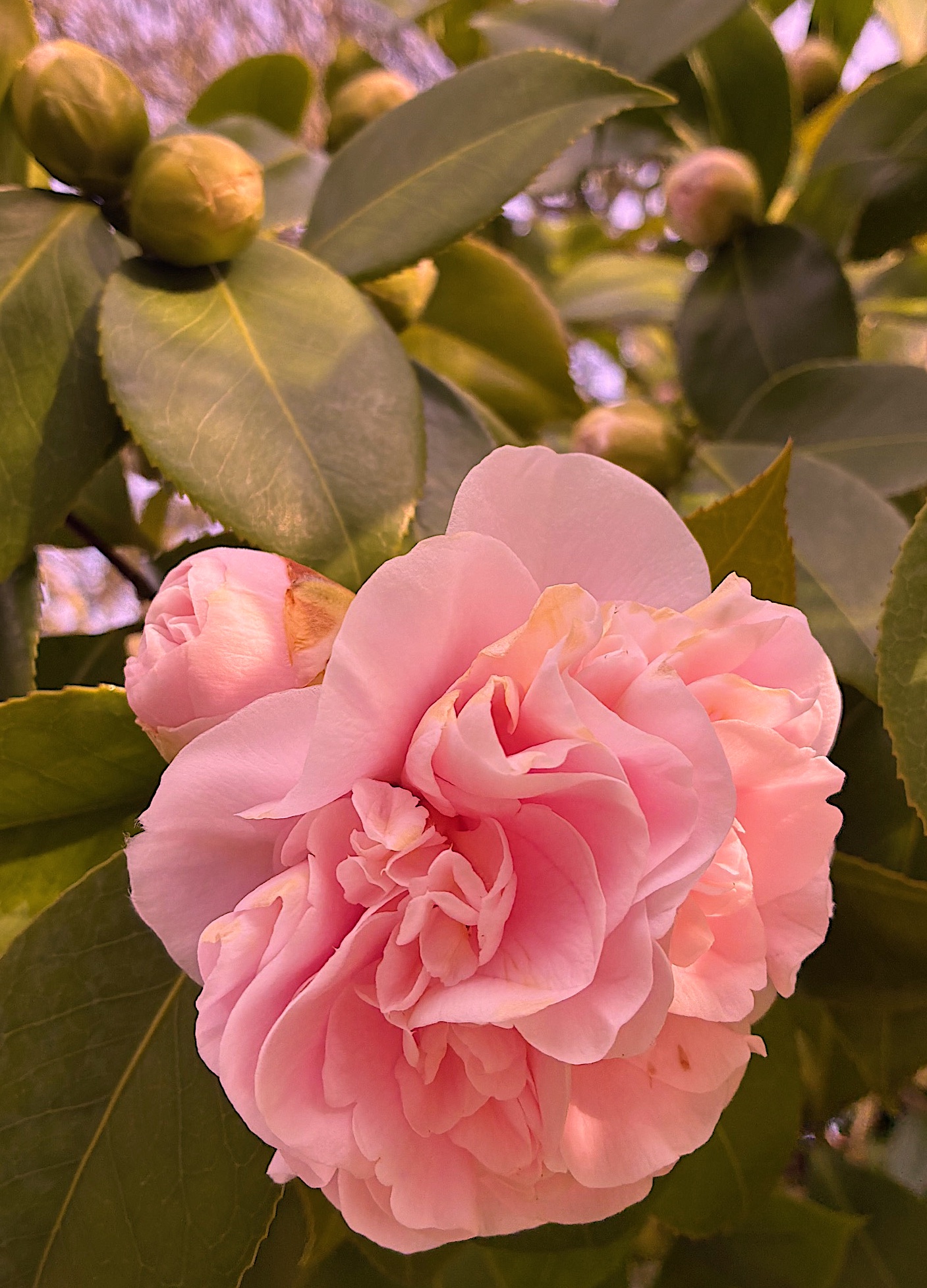
A little early for Camellias though.
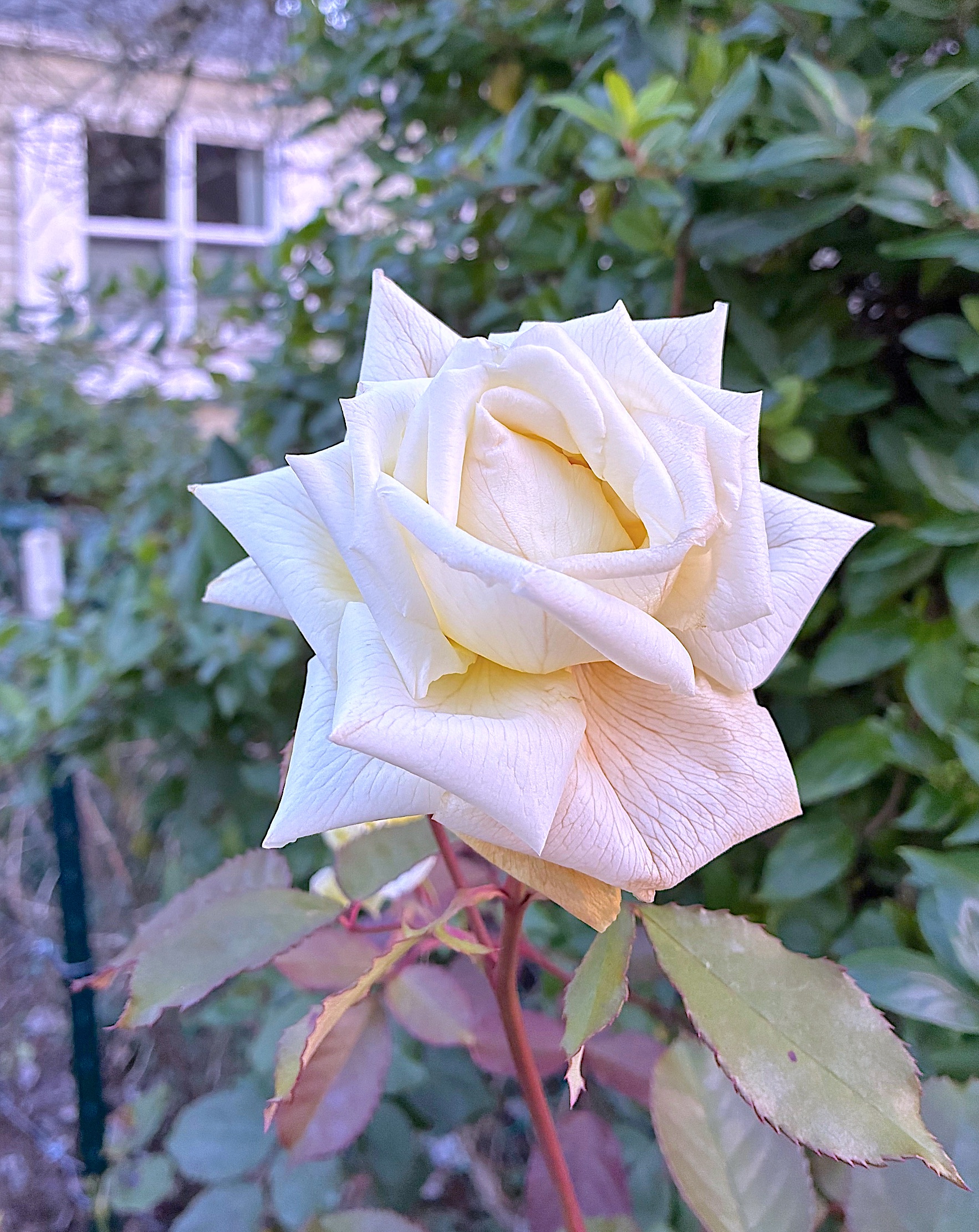
White rose??
The plum trees are out, full of spring birds with happy courting songs. Oh dear.
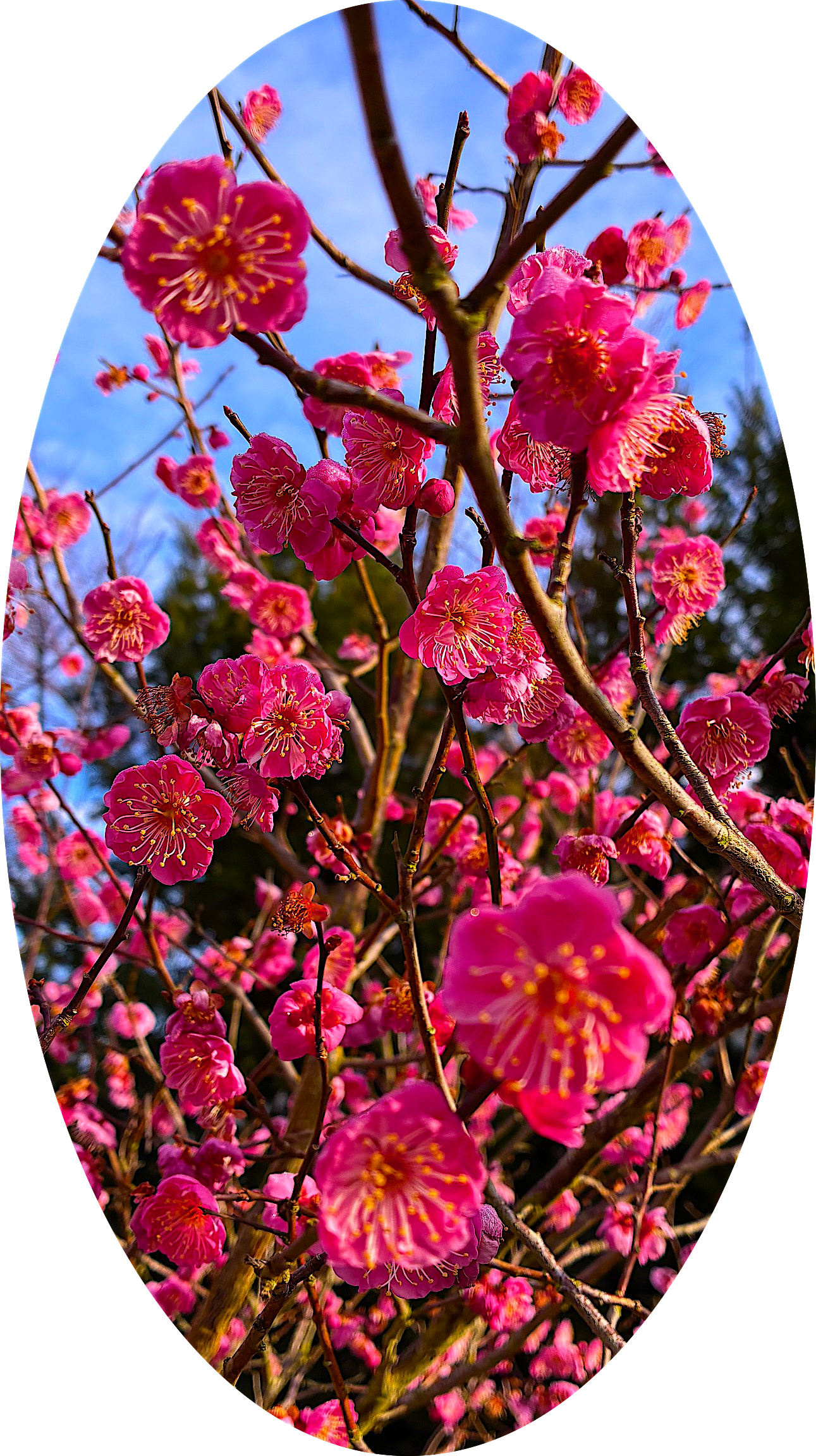
Well, nothing to do but go look over the garden and hope for the best this year.
It’s a curiously mild winter this year; not a flake of snow, no frost yet really, and temperatures in the 50s all week. We had a couple of weeks of hard rain washing through, come and gone. If only that were snow, and falling 30 miles away in the mountains; the snowpack level is only 42% of normal. That could mean wildfire trouble this summer.
But anxiety does better with a walk to just look and explore the way things are right now.
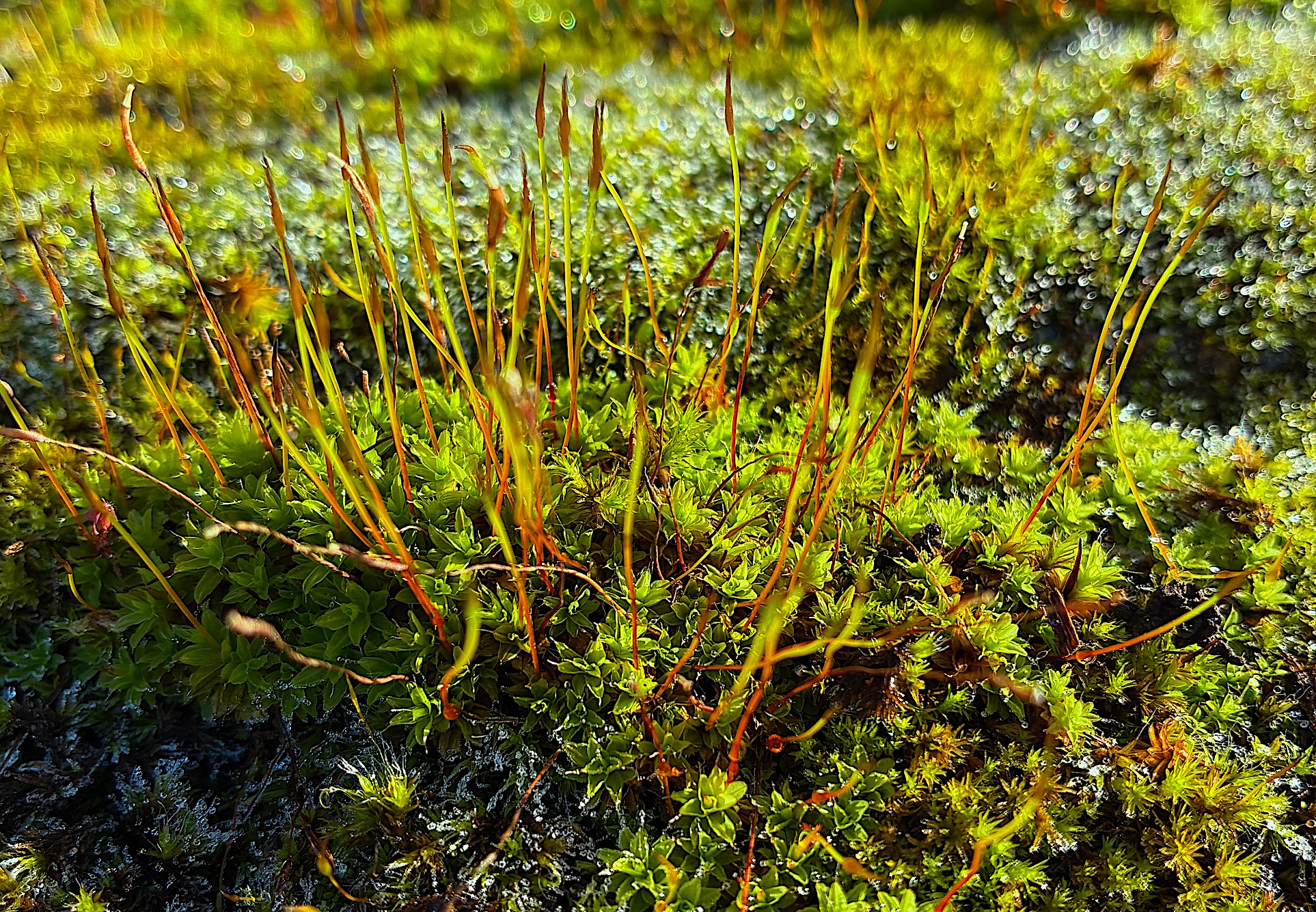
Here’s a very close-up peek at some tiny moss, all different kinds, in early sun and dew.
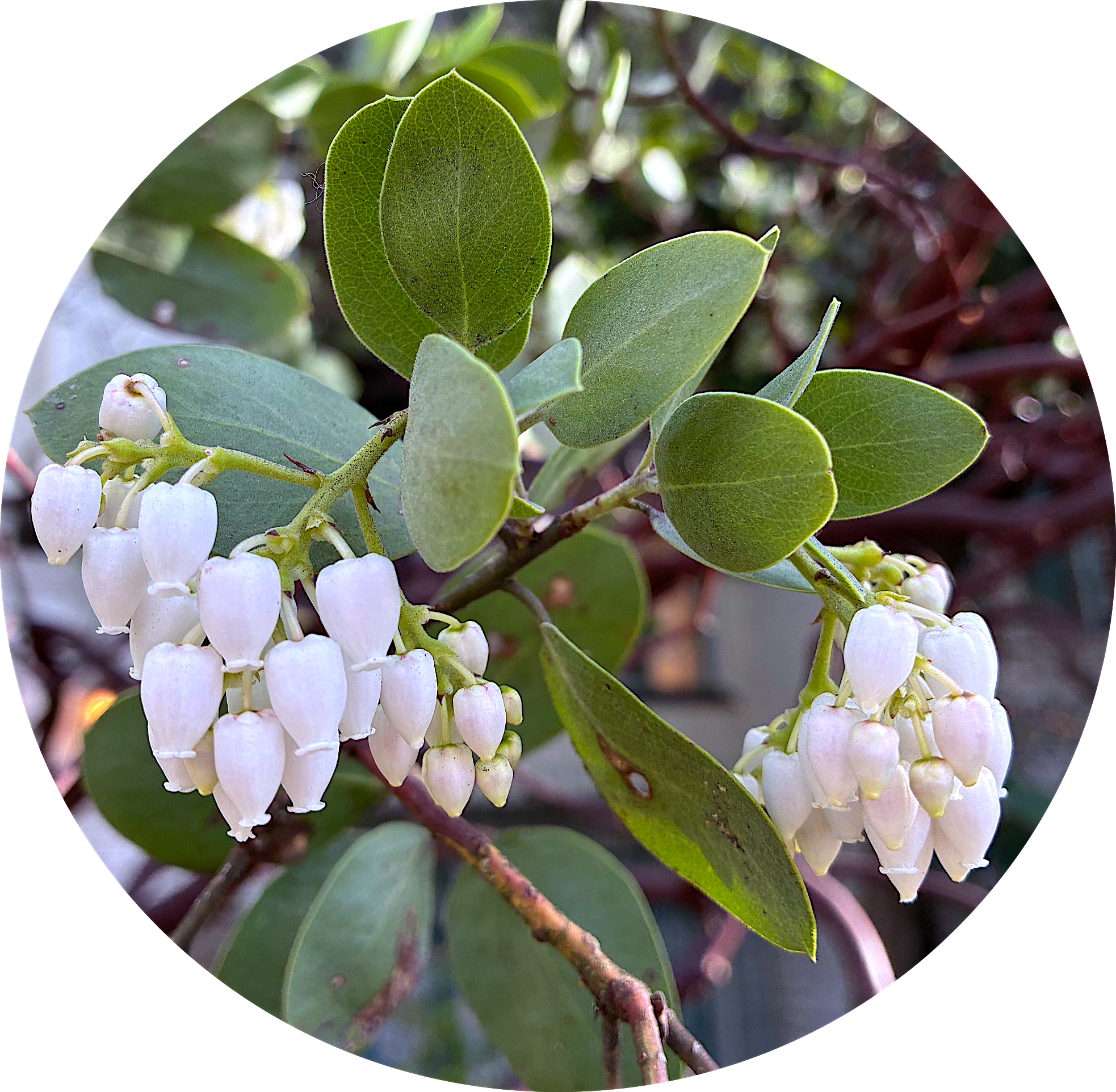
Manzanita flowers:
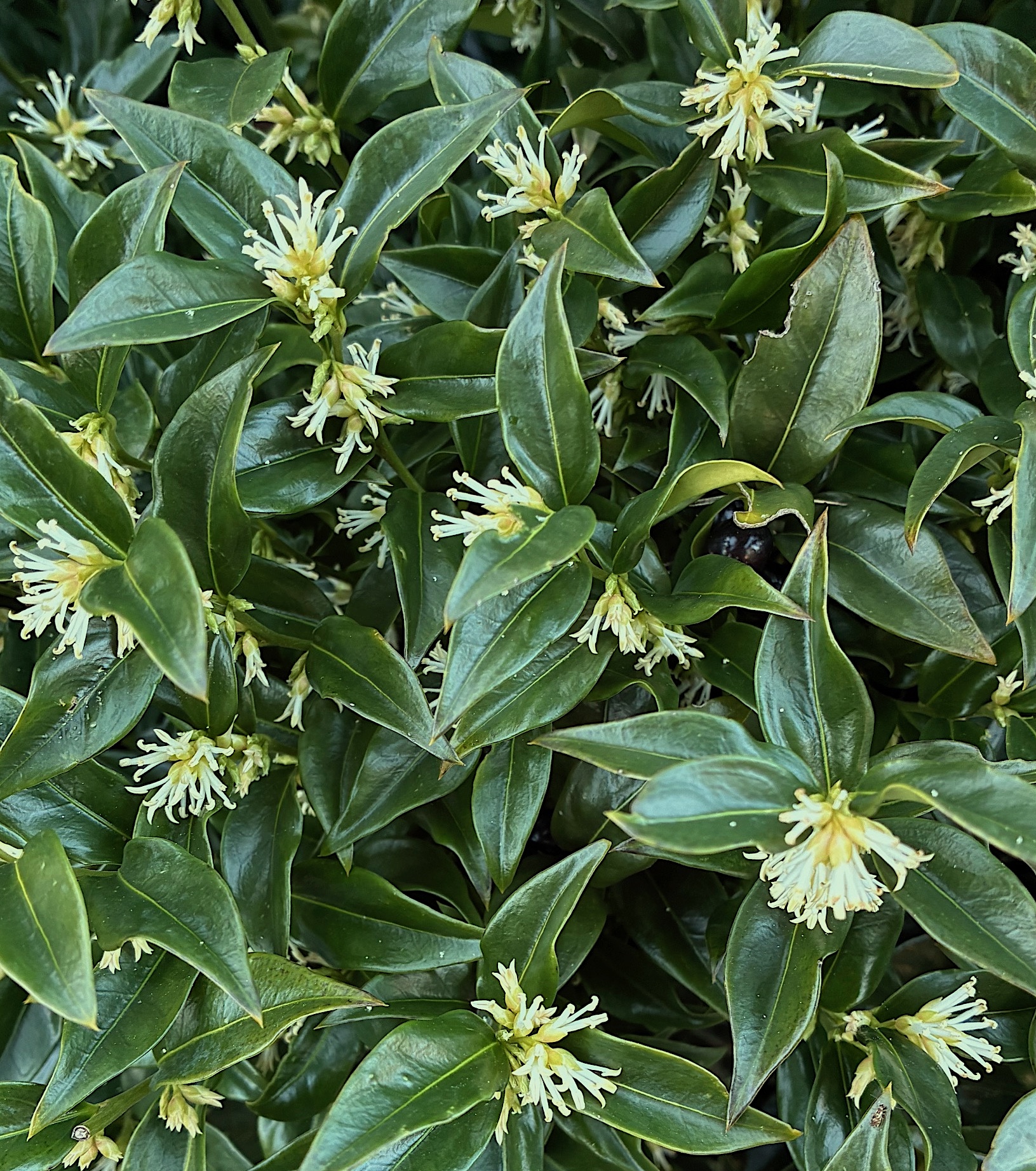
Here is a small hedge of Sarcococca, “Christmas Box.” Earlier in the year it had shiny black berries; now it has little white flowers with a wonderful sweet fragrance. It’s really nice to walk through the winter dark, and step in to a zone of this lovely scent:
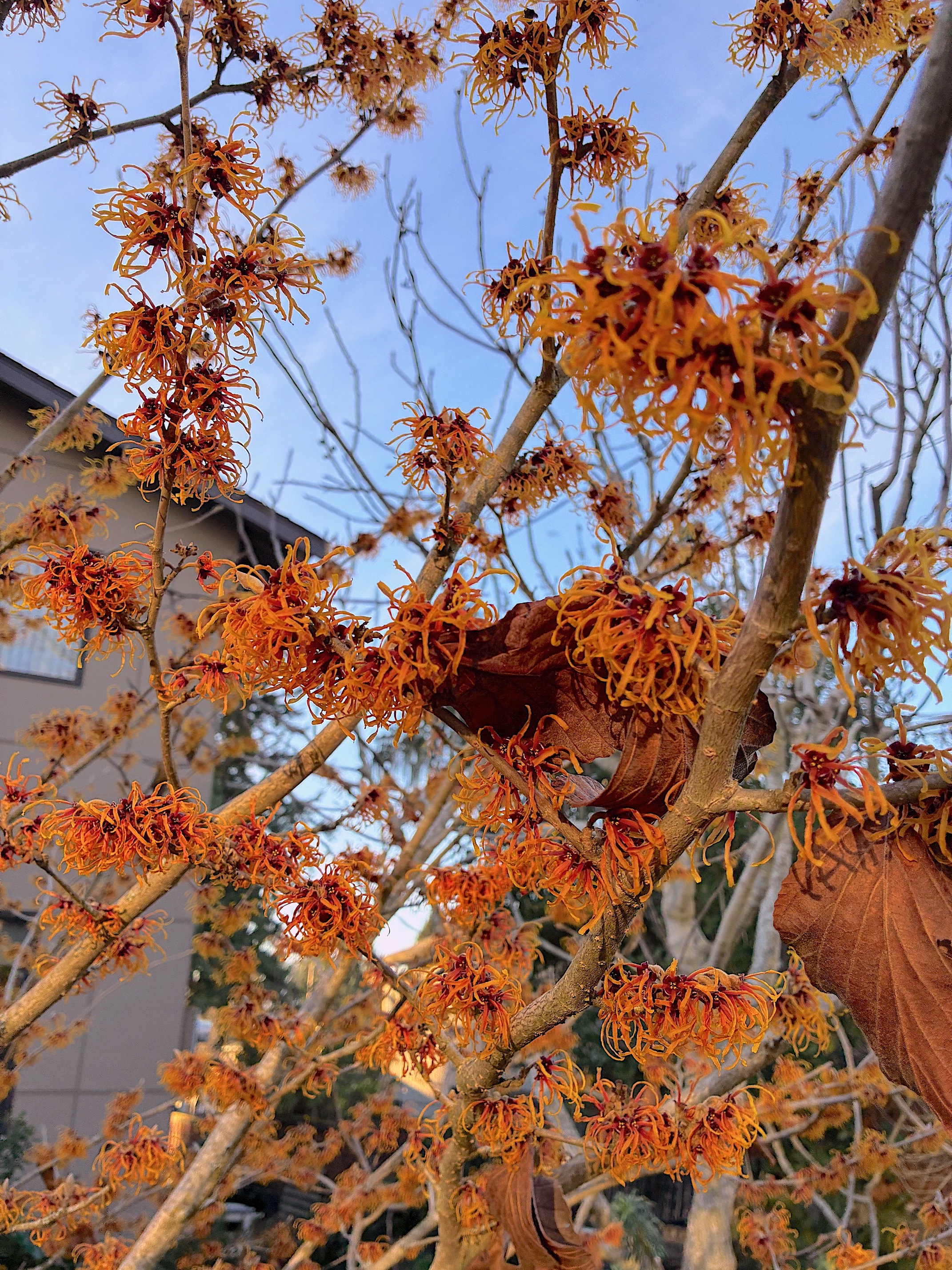
Here is Witch Hazel, another sweet scent that blooms in the cold; the flowers come in a whole range of shades from pale yellow to rich reddish amber:
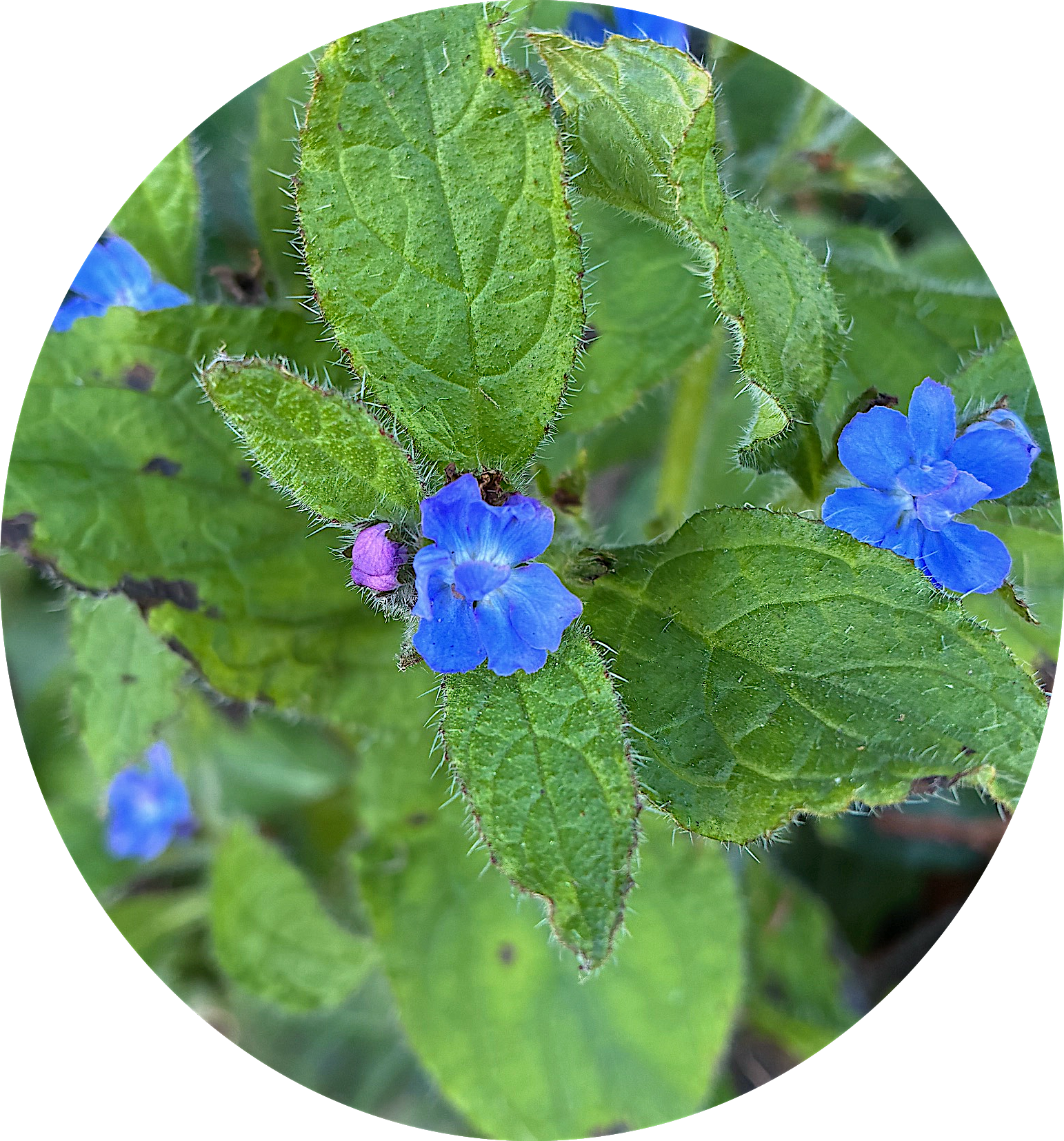
This could be a type of Alkanet — blooming in January for some reason.
Elephant-Ear Saxifrage:

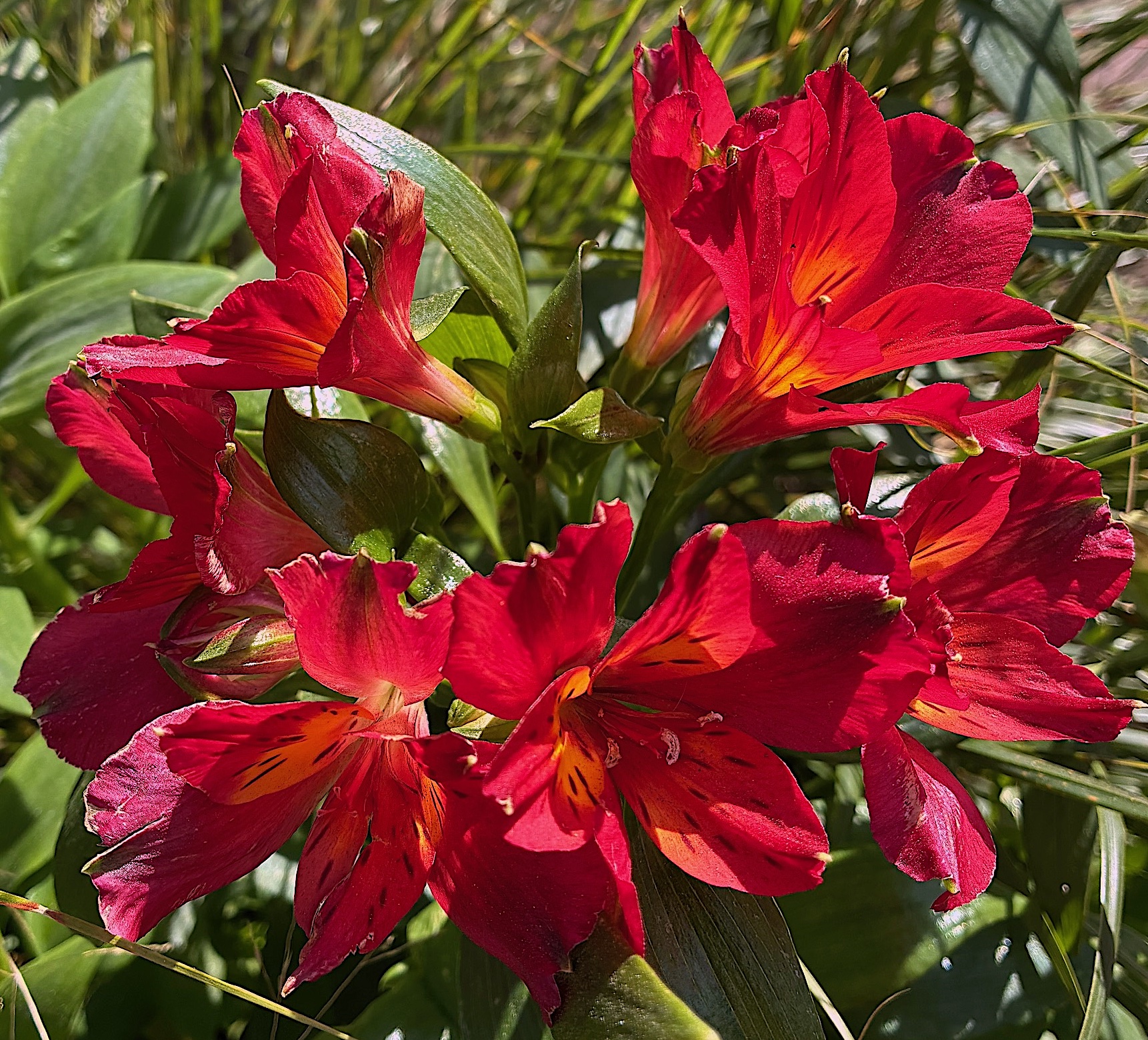
And Alstroemeria:
This little show-stopper bloomed during Christmas Week. It’s new to me, but according to my iPhone this is called “Kiss-Me-Over-The-Garden-Gate.”
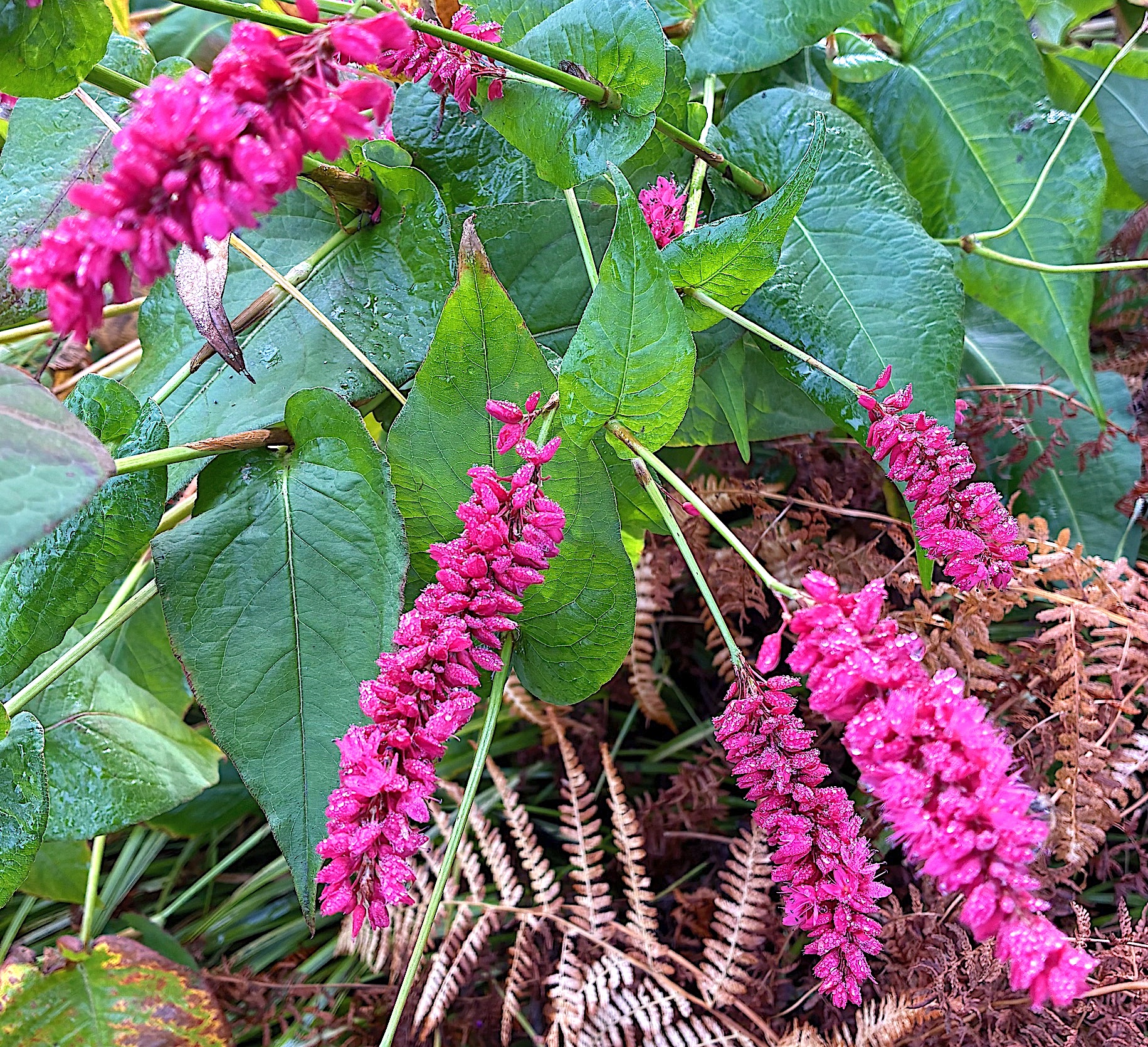
At least the Where’s Winter? worries can still find something beautiful to appreciate while we keep an eye on the sky.
The Big Disclaimer: This reflection can come across as self-serving and whine-ridden, and of course despondency is a foundational sin to take to the Sacrament of Reconciliation on a regular basis. There’s always a keen appreciation that being able to walk in to a store and buy (or receive) a kraut cabbage is a modern miracle of our society, and so is having a long weekend in a dry kitchen to cook and eat it in. The point is that maybe someone out there reading this might feel a little less alone in their experience of what holidays can be like. -M
A holiday is like a rushing river cutting crosswise to the main path. The idea is to carry the gear, lay out plans and backup plans and more backup plans as little sticks and twigs, lay them out in a bridge, and then very softly step by step inch out across the river and reach solid ground on the other side and then climb up and away from the river bank. It’s a rope trick. And if the sticks and twigs hold up, then there might be some nice scenery along the climb over and some nice people on the way.
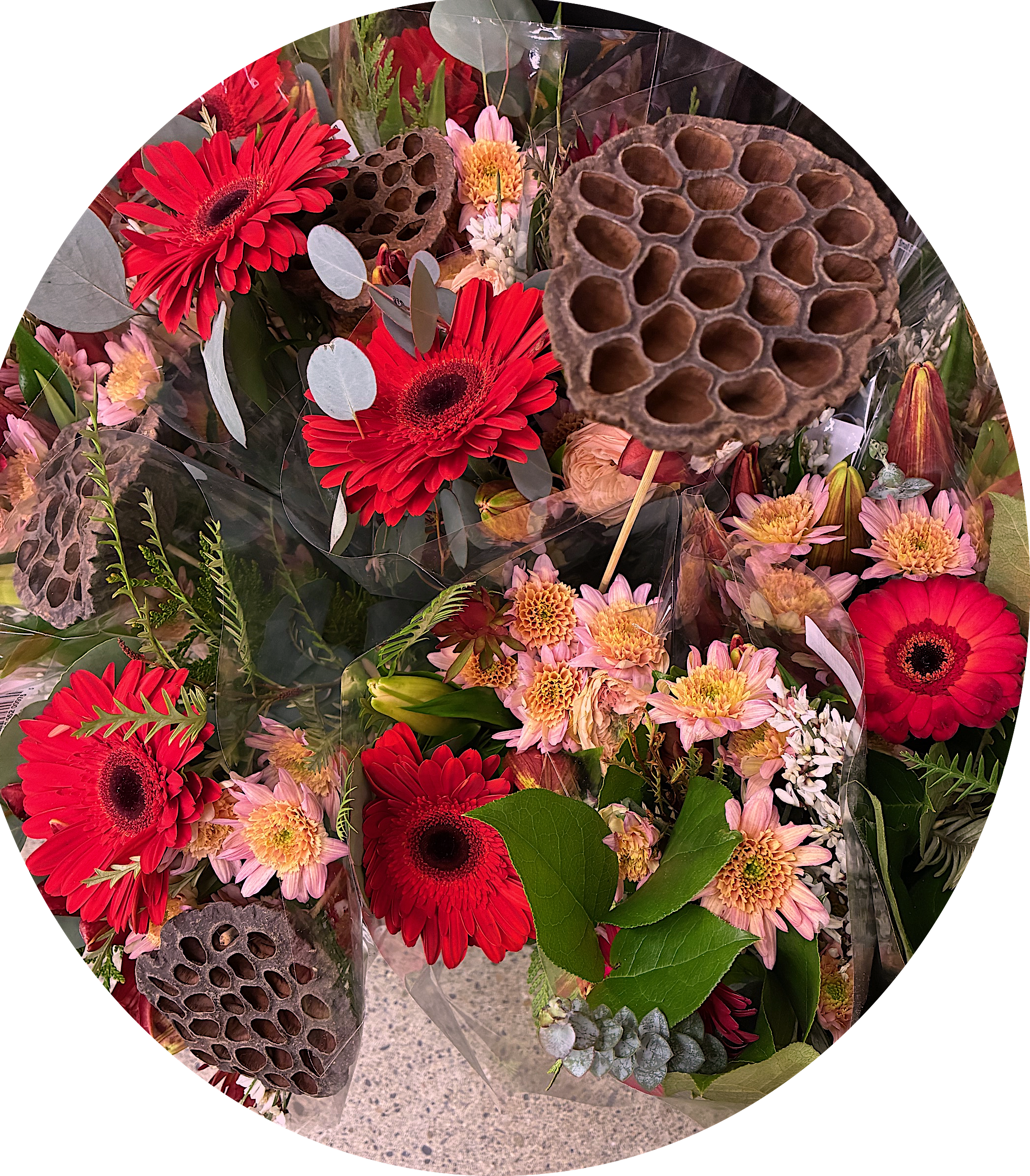
One tool in the kit is to mark the date three days after the holiday. Once the celebration is over, that is when someone can skid and fall backwards off the bank and be really downcast. This year that bottom-out happened three days after on the 28th. That day was dedicated to Little Wins, something to work on every hour of the day. The 24 short prayers of St. John Chrysostom gives us one prayer per hour around the clock to work with, so I made a chart of hours and copied in the prayers in Slavonic and put that in a clear page protector to carry everywhere, and set a timer as a signal to move on to the next prayer in an hour. Anyone can choose their own prayer set though; there are heartfelt little one-sentence prayers all over the Psalms, for example. These are a real benefit, as meditation on the Stair Master at the gym to feeling stressed by the noise level on the bus to waking up worried at night.
Before the holiday there was research to track down the exact schedule of church services and events and things to do, and the bus schedules to get there. That way, on an unsceduled day it’s clear where to be when, and how to travel.
One perennial favorite is a live music event with demonstration instruments to test out and play. This year the live music was fine, but for once absolutely no one was in the classrooms and that part of the building felt empty, as if we weren’t really supposed to be back there. Out front during the performances it was all young couples and happy kids running around. After about 10 minutes my spirits fell so far so fast that I had to leave.
Earlier that day was the office party, folks who brought their families and introduced new boyfriends and girlfriends, and announced their engagements and baby due dates. One colleague stood up with a toast to say “Nothing matters as much as family. Nothing! Why, you hear about these people who don’t have children; they just go off and live for themselves and die all alone — it’s just inhuman.” She and I are on a very friendly basis, so I gave her a little nudge and smile and said “Are you describing me?” She waved me off and said “You have all of us. For you, family is this whole department.” She repeated her toast for everyone at the table, and as they applauded warmly I slipped away and went home.
At one church, the friendliest member in the whole congregation greeted me to ask me how I was spending Christmas. “Praying a lot,” I told her, and showed her my chart of 24 hourly prayers. She described how her family all travel to be together, and how wonderful that was every year. I gave her warm congratulations on her large family event and how much the relatives all enjoy each other’s company. “There is nothing like it,” she said. “John and I and the kids look forward to visiting them too. There is no feeling in the world like relaxing on the sofa, watching your parents and aunties and uncles and cousins, and we can just all bask in one another’s company.” I kept congratulating her, agreeing on the importance of family, and my eyes picked that moment to start pouring tears. It soon became obvious enough that she stopped at a loss for words, and asked “So… is your… do you have any… are you from this state?” I explained No to all of the above, and she very courteously went and started a conversation with someone else. Now here’s the thing: she has had this same exchange with me for five Christmases in five years now, and every time she’s trying to grasp that some people are on their own, and she can’t picture that at all and has no idea how to react. For those five years I’ve been making myself come back here and talk to people. This time I went off to wash my face and go sit outside for a bit, and had a heart to heart talk with, well, my heart, saying “You know, it’s ok. You don’t even have to come to this church any more. We can just go home now.”
Christmas Eve is my most holy night of the year, so I picked out a 5:00 pm Vigil service and got all dressed up to go and was feeling happy about it. Then on my phone I found a series of voicemail messages and texts. Please call us! It’s urgent! It was a dear family with wee kidlets, and they had lost a valuable item. They were out of town visiting their folks for the holiday, and really needed help. It was raining hard by then and the streets were completely deserted, but with a flashlight I retraced their path including a creepy alley, looking everywhere for their lost item. After an hour I just didn’t know where else to search, so I had to text them that their item was gone. Well, it turns out that they had called another family, who found the item right away, and now everyone was off at church with their relatives! By then it was too late for Vigil, and I had to go home and change and get dry and warm up. So that was Christmas Eve.
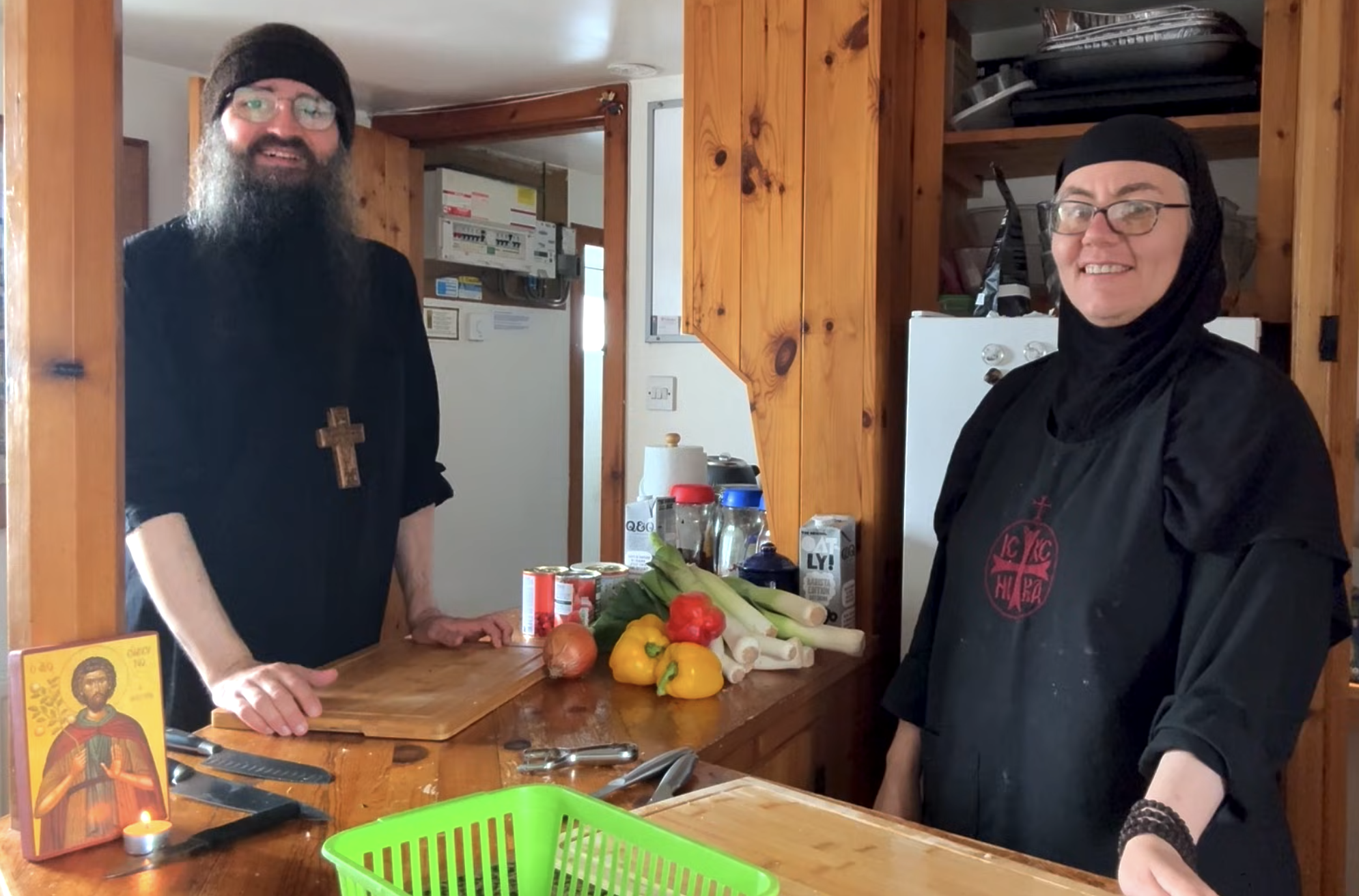
But one nice thing was a trip to Fruit & Folks on December 22. Before their holiday break I picked up as many super-sized sturdy vegetables as I could carry home — including the indulgence of a Kraut Cabbage, 39 cents a pound. I brought home the very smallest one, about the size of a basketball. At the cash register the staff just laughed at my purchase. Apparently they were under orders to watch out for Mary, and to give her all her Christmas food for free! Insisting that my money was no good here, they helped me load up and I headed for the bus stop while they waved goodbye.
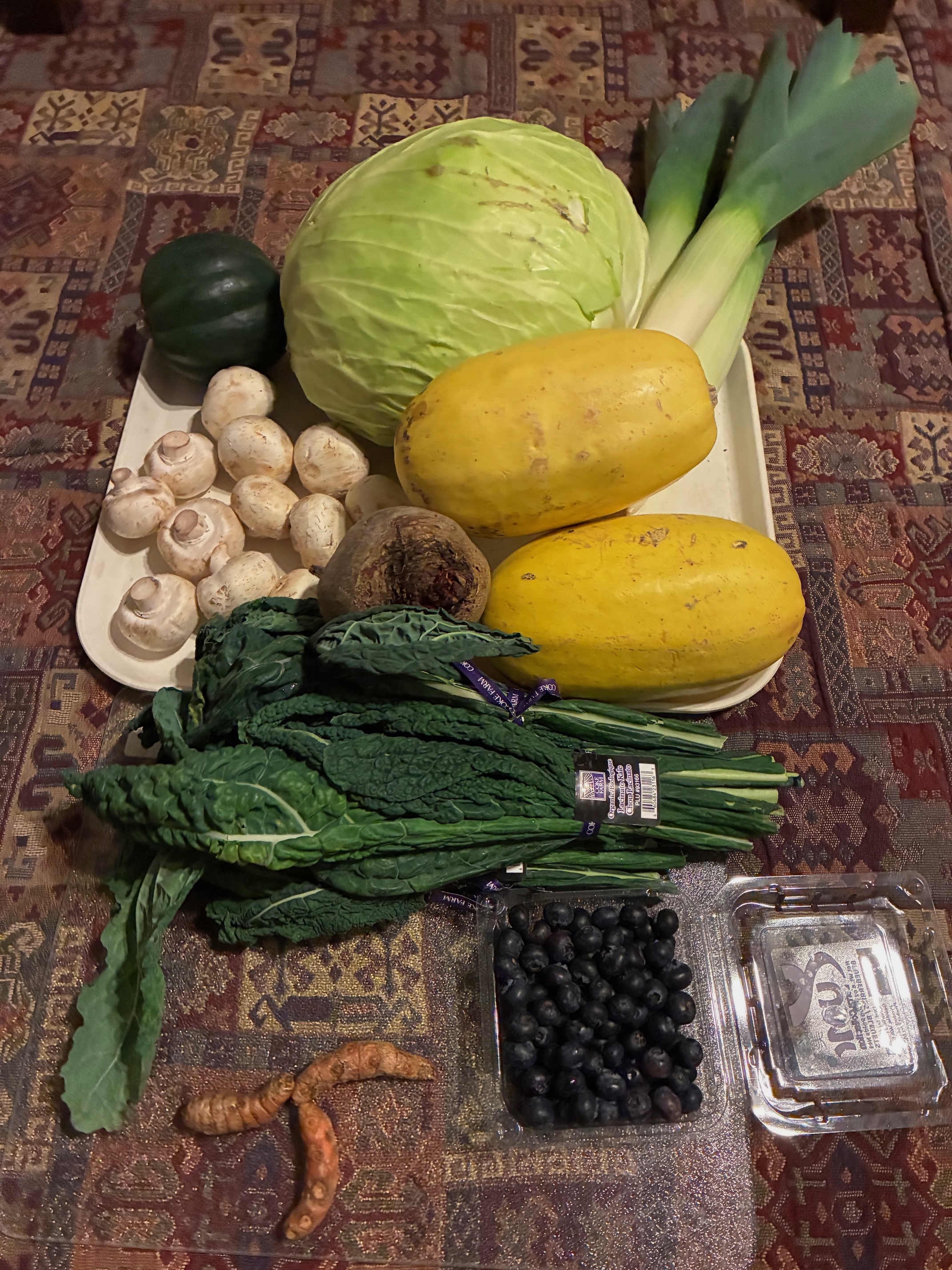
After toting the food home, as a rest break I watched a Mull Monastery cooking video on YouTube, with Father Seraphim Aldea and Mother Abbess Ita. If you would like to watch two lovable monastics in the kitchen, you can search their channel for “When I was a kid in Communist Romania: cooking stew and remembering our childhood.” This hearty chunky stew is meant to fill in wintertime comfort and flavor chimes in their usual monastic diet, which includes little meat and quite possibly no meat at all.
https://www.youtube.com/watch?v=fMLR8a3mNmchttps://www.youtube.com/watch?v=fMLR8a3mNmc
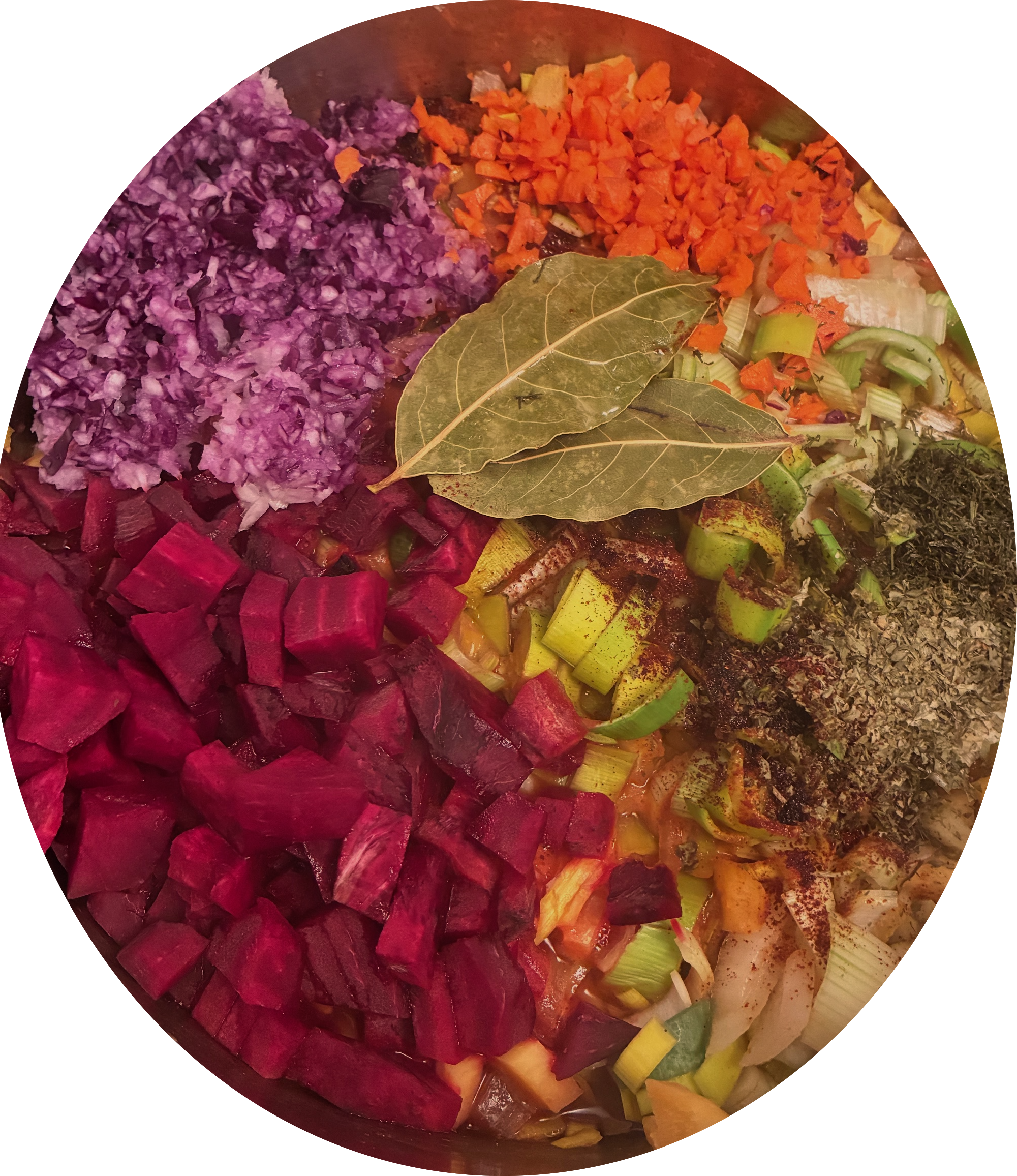
With their inspiration, I cooked up the whole gift bounty for the fridge and freezer. Here’s the start of some soup.
So instead I started rewriting an old story about what it was like, to work in a Produce department 40 years ago at a food coop on Christmas Eve, and all the adventures going on with the business and customers, and how the team members pulled together to get through the evening. At our own food coop now, the Produce staff and I got talking about how produce departments were so different back then, and when they asked to read it I promised them a printed copy. They were really happy about it! The Produce manager offered to post it in the break room. I told them he could tell folks it was written by the Mary who walks there every night to buy a refill gallon of filtered water from their machine. “Mary?” he said. “Everybody here knows exactly who you are.”
Meanwhile I go around practicing an underrated Russian Christmas carol of the Blessed Mother singing her baby Jesus to sleep. On YouTube the search title is
“Берег Запредельного. NARTANA DESHE. Колыбельная Богородицы.”
https://www.youtube.com/watch?v=wiAYJxyNCVM&list=RDwiAYJxyNCVM&start_radio=1
The guest soloist (and ticket seller for the show) is Valeriia Psiukalova, and the folk ensemble is called Azure-Golden Shore of the Beyond. Apparently they are followers of Sri Chinmoy and that tradition of chanting, but they also interpret Russian spiritual songs.
Then for last thing at night as bedtime reading there’s a secondhand bookstore discovery: St. Thérèse of Lisieux, The Last Conversations before her death in 1897. It’s normal to think of Thérèse as a sentimental girl tossing flower petals at statues and writing poetry dismissed as saccharine rhymes, but the real medical story shows a 24 year old with a titanium character submitting to 19th-century interventions that enormously magnified her suffering. (She was also prescribed morphine injections throughout her illness, but died without receiving a single one; the Mother Superior at that time didn’t believe in pain remedies for nuns, and Thérèse was adamant about obedience to monastic rules.) Her sweetness and humor and determination to cheer her companions shine all through the book.
Christmas is hard for many many people. Like a sailor with the sea or a farmer with the sky, we know to not turn our back on it and to regard it as a formidable adversary that takes planning and work. It’s a relief that this one is over for another year, with help from God and good people.
Quince fruit (Cydonia oblonga) was a welcome new discovery, one that to more knowledgeable cooks is not new at all. This month two co-workers and one neighbor all shared their harvest supplies of quince, so it was time to study up and go test it out in the kitchen.
Apparently quince used to be common as a source of pectin in fruit canning, but with the rise of pectin powder people relied on the fruit less over time.
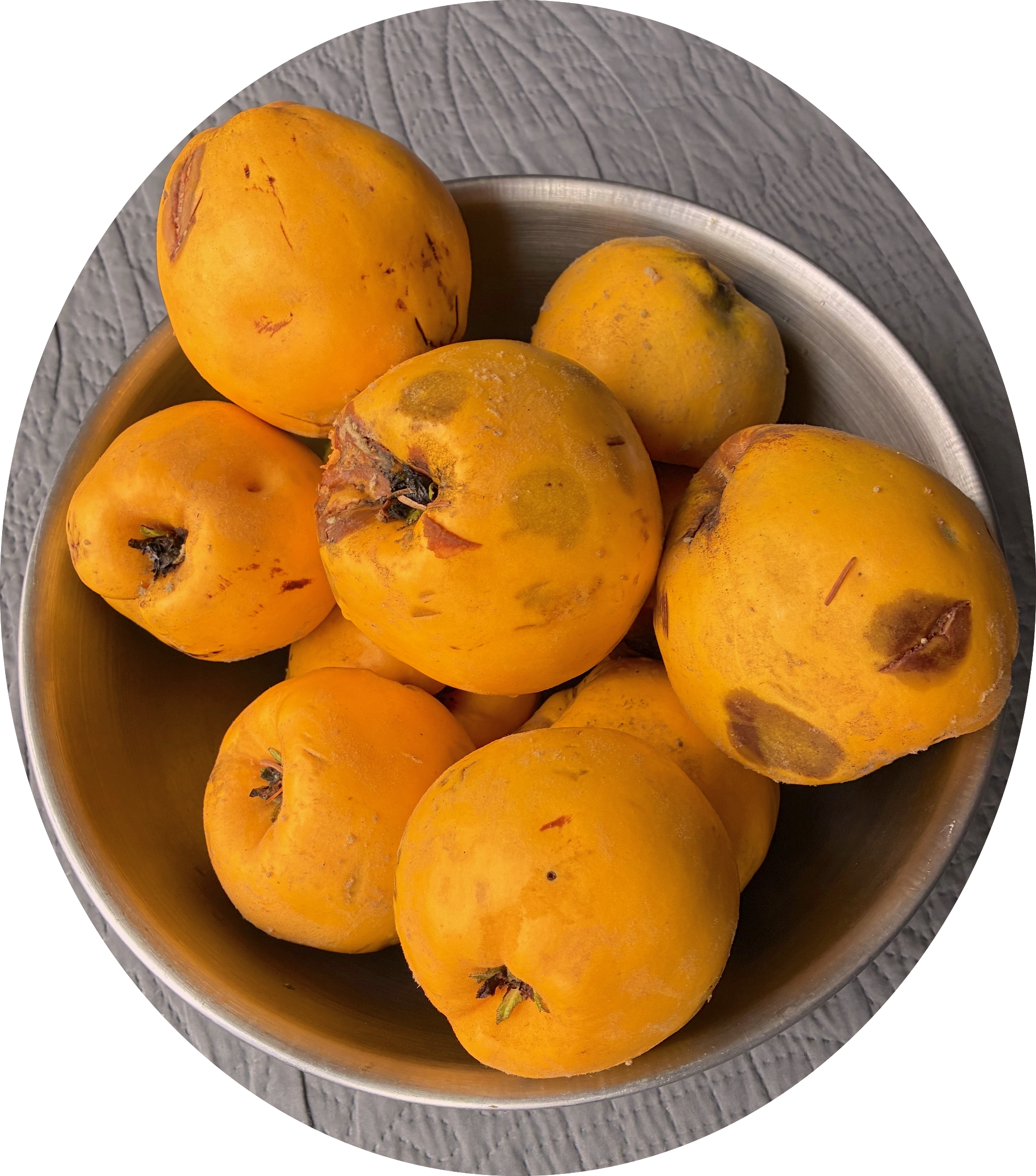
A quince fruit is like a giant heavy pear with a nice fragrance, tough skin, and woody flesh. They are not sweet as is. To peel and cut them takes some extra muscle and determination. Here are a few, staring me down:
Finally peeled, cored (don’t eat the seeds!), and chopped:

Quince simmered in water, then blended to a puree:

Quince pureed, simmered on low heat with regular stirring, for eight hours to half its volume:
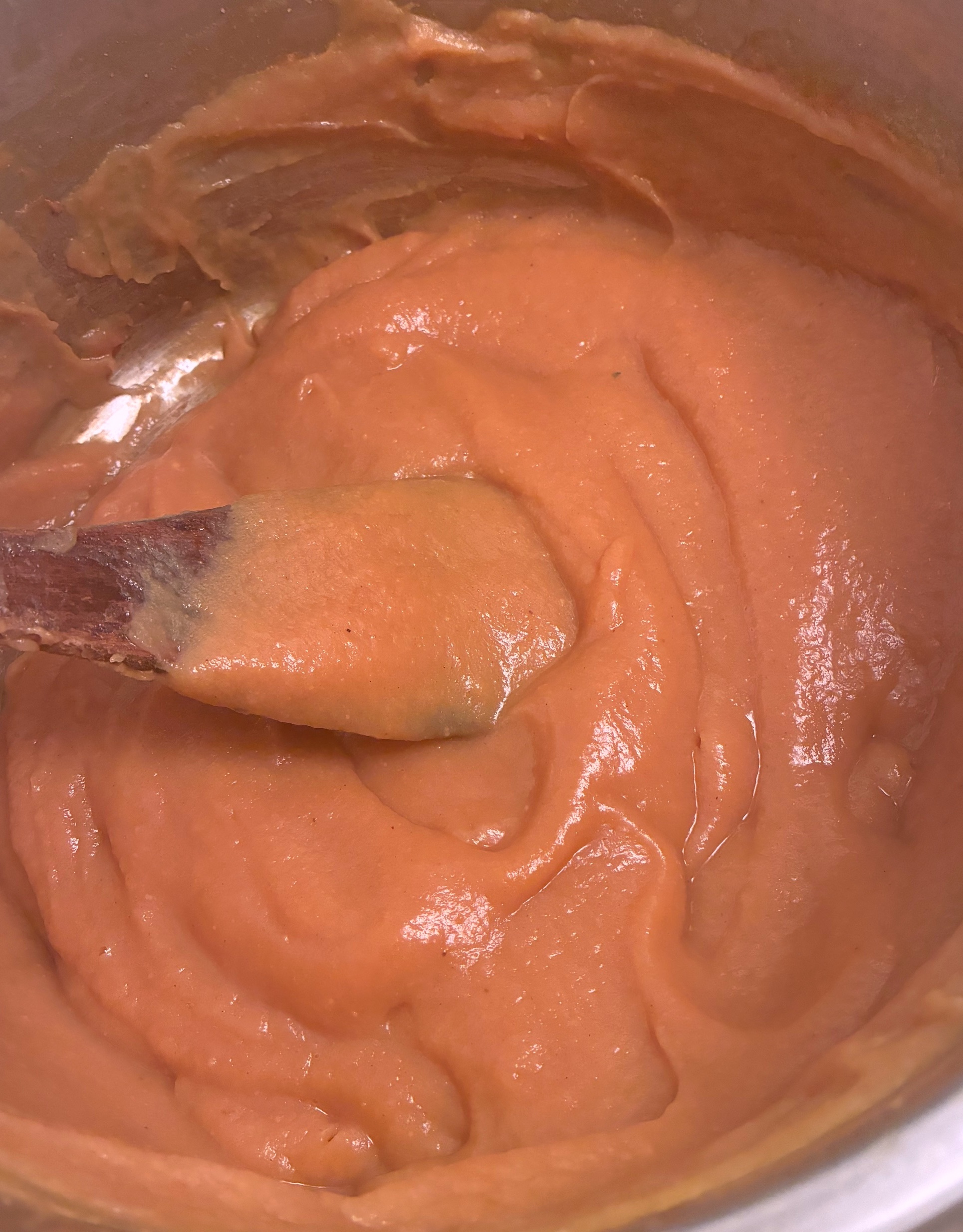
A popular recipe for quince is membrillo, a sliced gel eaten with Manchego sheep-milk cheese in Spain. The idea is to cook down the puree, add an equal volume of sugar and heat again to blend, then season with lemon and lemon zest and vanilla. The pantry is fresh out of lemon and vanilla. So I melted in some fair-trade crystal sugar (less than the 50% called for), and a dash of pumpkin pie spice.
The purees goes in to a baking pan lined with parchment paper, and into the oven on low heat until the pectin forms a gel.
It’s been baking for several hours and Lo, it’s developing a fruit-leather skin on top.
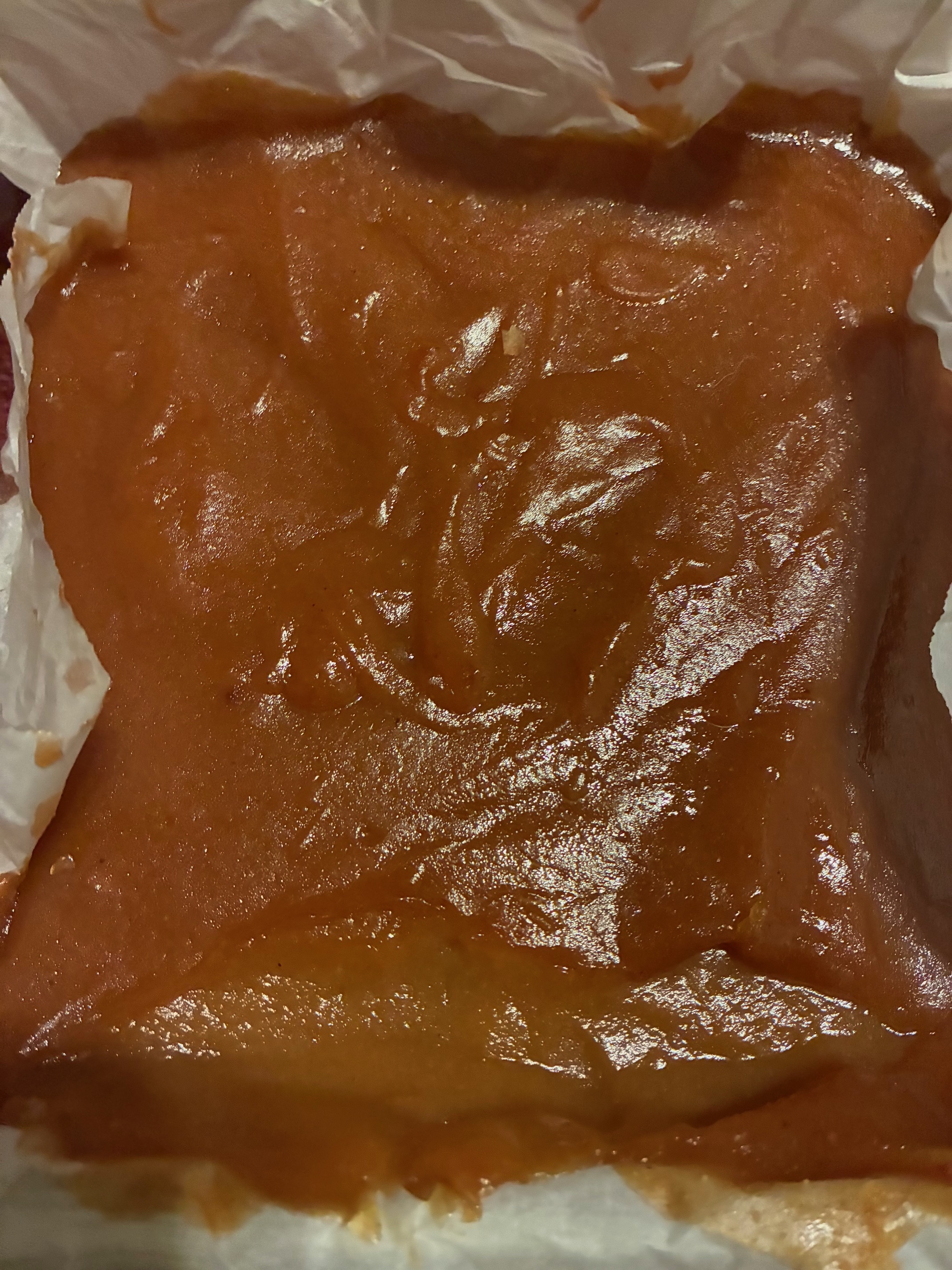
Whether it sets and gels or not, at least it has a rich intense fruit flavor.
Here it is, after hours in the oven at 250 F. All those quince yielded 3 cups or so of halfway-gelled candied spread with fruit leather on top. Maybe it will thicken as it cools?

Would I ever try the membrillo venture again? Well, no. Last week’s set of quinces made an excellent stewed sauce blended half and half with pureed pears, and that’s plenty good enough. Still, this will make a novel holiday confection for the three people who shared their fruit with me, and at least this venture saved them 12 hours of kitchen fuss.
It was nice to experience a whole new legacy fruit, as a symbol of harvest generosity among our neighbors.
The neighbors have a medlar tree. It’s not my tree, the neighbors don’t know me, and it’s too early in the year for harvest. But after days of hard wind and rain, some medlar fruits fell off the tree and were beaten into the mud. That made it feel ethically okay to pick up three weatherbeaten fruits and bring them home.

This would be the place to pile on details about how to “blet” and prepare the fruits. But looking up medlar history and recipes will be so enjoyable (well, for the people out there who enjoy looking up food history and recipes) that it’s only fair to let everyone have their own heritage plant fun.
These fruits have a long respectable colorful history that is worth learning. In colder climates the tree has been prized for its ability to lighten the winter by bearing us something sweet. Maybe our apartment complex will let me plant one here?
The Big Disclaimer: Knowing me, I’ll be polishing this post over and over for days. You might want to turn in a week from now for best results. Meanwhile, here it is.
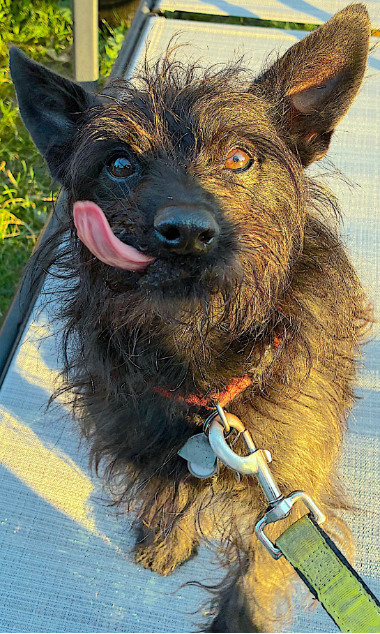
Here’s a friendly doodlecrumpet from our apartment complex.
He was wiggling right off his chair while offering me his left paw and licking his lips for the yum looking is that a protein bar? that is really my cell phone camera. An all-round good little egg.
Our neighborhood has lots of who’s-a-good boys and who’s-a-good girls. For example, Angelina’s beautifully cared-for dogs Super-Pup and Bingo have popped up in this blog. They’ve always been fun, friendly, sweet companions. Most dogs are amiable folk. They give me a passing sniff and wag; then they move on in search of stuff to chew, chase, or roll in. Every dog deserves safety, security, knowledgeable care, purpose, community, respect, affection, and a daily walk that actually goes out somewhere instead of roughhousing around and around. So this not to put down dogs, or the owners and their playtime right now outside this window.
What else is going on outside this window? A city with a lot of lonely people. Our Anglo-American tech-money culture keeps promising to fill in that loneliness with concocted substitutes. It seizes good healthy natural things and tampers with them, then markets and sells them to us.
About 60 years ago that image machine latched on to domestic animals who have been at our fireside for many centuries, and pitched their role as anthropomorphic action avatars promoted to be just as good as human companions, or maybe better. Social media and marketing have ascribed to dogs a whole range of human motives and emotions, handing down interpretations of canine behavior and inventing new social rituals to indulge our created tastes. Then it sells us products and services to maintain the avatar and keep it enshrined.
There are recipes for dog print cookies, made by pressing a dog’s paw into each circle of dough. There are keychains of dog figurines depicting a choice of breeds asleep wrapped in heavenly angel wings; in the photos it was unclear whether the dogs were sleeping angels, or were wrapped in wings while ascending to heaven. For those ascended pets, one zoo is organizing a new attraction for Día de los Muertos: an ofrenda, a commemoration altar, where visitors can come offer keepsakes and photos of deceased animal friends. A local school of psychic studies has classes in contacting deceased pets and channeling their messages to bereaved owners. A particular bank now has dog ATMs. While the owner withdraws cash, the dog can withdraw treats from a dispenser bowl. (That way he can share a food dish with who knows how many other dogs, and also learns that it’s fine to pick up food with undetermined ingredients from random sources on the street.) One clinic aims to tackle vaccine resistance by providing dogs to comfort little patients, cheerfully ignoring normal sanitary standard precautions, and the fact that some children are allergic to and terrified of dogs.
One news feature described a very successful new advertising strategy. Instead of visiting a shelter and sitting down with an actual dog, potential owners can browse AI-generated cartoons of adoptable pets. Each cartoon comes with a voice feature letting the character tell you all about its life and personality. The article explains that the animation advert brings joy by facilitating adoption, enables us to see into the dog’s soul (what?) humanizes the dog (they’re human now?), and lets it come alive (weren’t they alive to start with?). Where are we going as a culture now? Where are we dragging these dogs along with?
If we let this avatar idol take over our relationship to dogs as dogs, it can 1. block out nourishing social elements and customs that would do us humans a lot of good, 2. introduce non-nourishing elements that are not good for us humans at all, and 3. cause stress, anxiety, and ailments for the dogs themselves.
It wasn’t always like this. Back in our 1950s blue-collar neighborhood there were a lot of goldfish, turtles, two baby alligators, hamsters, canaries, parakeets, one Mynah bird, one cardinal (illegal, but he fell out of the nest and settled in on the family piano), one Dutch rabbit living in a truck bed, sea monkeys, and Mexican jumping beans. But very few families owned dogs. The Catholic housewives with eight kiddos were too busy boiling & ironing diapers and getting everyone out to Mass, with no time to fuss over some pet with fur. (And if people had suggested that she make plans to put the dog in the car and drive him out to a play date, she’d have chased them with a dust mop.) Back then, caring for a dog was seen as a pleasant laid-back juvenile pastime, like delivering newspapers or joining Girl Scouts or building orange crates into a go-cart. Breed selection was very limited, in modest sizes that were cheap to feed and easygoing in temper: cocker spaniels, fox terriers, mini-schnauzers, beagles, dachsunds, small poodles, and mixes in between. Nobody went for a Komondor or Kuvash or cattle dog. (I never saw a pit bull until graduate school. We only heard of them as a literary device in fight scenes by Jack London or Albert Payson Terhune.) People got a dog when some other family’s dog had muttlets. Then the other neighbors would notice and spread the word, maybe share an ad in the paper. Then we kids would go visit that family a bunch of times, meet the mother dog, play with the puppies for a few weeks, discuss their personalities, probably make a complete nuisance of ourselves. Then the new family would pick out the pup who clearly liked them and was nice to the kids. And nobody foisted off a sick or unstable dog, because that dog would get returned fast and the whole parish would hear about it. A dog’s job was to announce visitors, and mostly to follow the family’s kids all day long all over town. By night, they got a dinner plate of leftovers and slept in a little house in the yard or in the laundry room. They all wore a collar with name, phone number, and a rabies tag. (If that rabies tag was missing, Neighbor Vigilante down the street, our one-man Irish homeowners’ association, would threaten to call the dog catcher.) None of the dogs could tap out arithmetic answers or dial 911 or dance freestyle on stage. But they were amiable and chill, ready to be friendly with just whomever. As a wee one I used to knock on various doors asking for the dog to come out and play, and the lady of the house would just hand him over on a leash with a handful of biscuits. My best pal was the cocker spaniel across the street; he and I took naps together, and when he ate I would be on all fours next to his bowl fishing out kibble to munch on. To this day I can still remember and name every one of those playmates.
Nowadays, puppies don’t often come from friends of friends. We don’t often meet the mother dog or the original owners, or play with the puppy before it’s weaned. It’s easy to search idealized descriptions online of impressive-looking breeds, and decide before actually gaining experience with just what-all is entailed in owning one. Or, you can hear owners narrating their dogs’ backstory of mystery and drama, especially as a universal excuse if their dog has just acted out at someone. There is real social value placed on choosing an animal airlifted from this natural disaster or that hoarding misfortune. We even import dogs as novelties, even though this country already has far more strays than we can catch or care for. (One can only hope to heaven that Americans have more sense than to bring in the yellow Hwanggu / Nureongi Spitz dogs of South Korea; these powerful creatures were not bred to be pets, and they have zero reason to ever like or trust humans.)
Our local news website offers powerful breeds for adoption dressed in cute outfits with cute names, with discreet euphemistic code laying down the dog’s rules for the household: I will be happy with a woman only, a man only, no kids, no cats, no other dogs; my food dish and my toys belong to me. There are plenty of adoption videos where the new owner picks a dog on the internet or at a shelter because he has one floppy ear and looks cute, or has a brown eye patch over one eye like a pirate, or has a snaggle fang and “looks like he’s grinning.” (Sharks can do that for you too.) The ASPCA website explains that more rescue dogs nowadays have significant medical and behavioral problems. Their stated mission is to provide behavioral training, and to overcome adoption barriers by favoring more amenable municipal laws, and pet-friendly policies in housing. The stated ASPCA goal is to give these challenged / challenging dogs a better chance of finding a loving home. And here I figured shelters would prioritize responsibility to owners and their children first, their safety, and their right to the most adjusted emotionally stable pet!
And yes, there are good knowledgeable programs for people after military service or trauma or incarceration, to rehabilitate rescue dogs and forge strong therapeutic connections. But wouldn’t survivors do better with animals who were good-natured and healthy to start with? Millions of dogs are put down in this country every year. How about giving the first preference to dogs from gentler breeds, dogs who are reliable and friendly and have a lick of sense? All too often, well-meaning amateur pet “parents” are drawn to a dog with profound behavioral issues. Then they believe that hugging and treats and indulgence from the neighbors will impart the social skills that should have come from the dog’s real mother back in the nest.
For years that was my dream too. I was very touched by books and videos about rescued pit bulls, and the plight and resilience of these resourceful animals. It’s a brave meaningful dream overall: that in our broken fallen world we can venture out and rescue at least one hurt creature, and recreate Eden in our own home. So I did years of research on what these dogs need from us, how they should be socialized, how they should be put to hard work and mental stimulation for their fulfillment, and especially the lifelong safety precautions that they need for their wellbeing and harmony with other people and dogs.
And what’s the conclusion? Nope. We’re not in Eden any more.
These are not “nanny dogs” bred to protect babies in England. (See dogsbite.org for the origin of that legend; and do type the .org correctly, or you’ll get a mirror website with a different stance. And don’t view it before going to sleep.) Granted, like all animals pit bulls are innocent creatures of God. For centuries now, they do exactly what humans have bred, programmed, forced, and even tortured them to do. Gripping-breed dogs are crystal prisms magnifying and reflecting the bravest, the boldest, and also the most selfish hurtful facets of our humanity. They don’t belong with new or casual owners, or families with children.
That said, these dogs can put their personalities to work with experts like Joseph Carter the Mink Man, who provides meticulous care and training, full flat-out exertion, mental work, and warm encouragement for his dogs. Mr. Carter credits Bindi, his little American Pit Bull Terrier, for her unusually pleasant obedient temperament. Bindi dispatches rats all day, climbing and diving and running and digging and cooperating with other dogs and following complex commands.
One of Mr. Carter’s videos showed men in Florida night hunting feral hogs to donate the pork and save their farm crops. The hogs are described by the FDA as our most dangerous invasive animal, causing some 2.5 billion dollars of agricultural damage a year. First, valuable Blackmouth Curs with GPS collars tracked and held the hog in a solid cane brake, baying to cue the men. Then the men took a pit bull built like a cinder block, and strapped him in to padded armor. His mission was to grip the hog’s ear and hold the hog’s head still no matter what, and he did; that dog struck his prey like lightning. Clearly that was the moment he lived for, his closest view of heaven with his closest idea of a god. If they sent in that catch dog half a minute too soon, he could be slashed at by the hog. If they sent in the dog half minute too late, the one slashed at could be the knife man. It sounds like hunting a golf cart with razor bumpers, one that is agile and smart and ready to destroy anything in reach. It moved me to tears to see the extreme logistical thought and care of the men, and the absolute dedication of those dogs. We’re going in tonight, Partner. Let’s roll.
But vigorous exercise all day in all weather, breed-appropriate purpose, problem-solving, tangible accomplishment, and close companion teamwork — how many owners provide that? What happens when a powerful dog becomes his own pack leader, and chooses his own job?
And, what brought on this whole line of thought?
On two mornings last July, two different pit bulls on two days spotted me at different bus stops and launched a silent full attack at my head. My breathing and muscles locked in, and my mind and even my vision went completely blank, as if there were a blinding white wall in front of me. Both owners apparently yanked their dogs back just in time, leaning back on the harness like water skiiers, while shouting at me for triggering their animals. Both owners seemed to think that my frozen shock response showed a lack of respect, so both showed me who was boss by giving their dogs a second try at me, yanking back just in time before finally strolling off, satisfied that they had taught me a good lesson. That’s a total of five close calls from five pit bulls over the years who picked out my face on the street and thought “Today, Satan.” I didn’t even see them coming.
I’ve only told a couple of neighbors, and they didn’t, did not, believe for a second that these things can happen with no provocation or warning. And yes, pit bulls can be clowny keg-party funsters when they get what they want and get their own way, complete with the softest sofa and the food. But their primal need is to work off their immense physical energy every single day; that energy is a serious source of frustration and tension when it isn’t drained off, and a frustrated dog is an unstable dog. When a pit bull is staring or charging at me, is it really because he wants to play? Assessing that in the moment is just not my skill set or my job. Just last week at our apartment complex there were two new large pit bulls being walked about a hundred paces away from me. I monitored them out of the corner of my eye as I strolled smoothly around the corner and in the building door. Maybe there was no cause for concern. But pretty much any dog on grass will get busy sniffing around and rolling in dirt and marking shrubbery. In contrast, these dogs displayed dominance by carrying head and ears and tail high, both were dragging their owners around, both were leading with intense eyes instead of nose. Both owners had improper connection with the leash and were obliviously checking their phones. Owners were unaware that both dogs stopped on a dime at sight of me and stared me down for the couple of minutes that it took me to amble along out of sight. That’s the same casual default evasion I’d use when stared at by a bison at a national park.
I don’t go to national parks.
“Predatory drift” is a normal natural phenomenon, an orderly series of small links forming a chain reaction which activates a hunting reflex in a predatory animal. The trigger can be hearing a high-pitched or excited voice, or seeing erratic or unsteady motion. In a Cavalier King Charles Spaniel, the predatory drift has been pretty well damped down through breed selection. In other breeds, the reflex is a lot closer to the surface. Sometimes, all it takes to light the fuse is the sight of someone at a distance minding their business, heading the other way.
After the most recent near miss at the bus stop I came straight home, and opened my building door. Right inside, another dog on a leash leaped right at me. This dog has been trying to get at me for years, and I just ignore and block him, but this time my first reflex was a swift kick. Instead of that, to calm down I fled back out the door to my garden to lean down and look at the flowers. Right away, still another dog jumped up against my back. My hyper-startle reflex dismayed his owner, who said “But I thought you liked my dog! He’s such a lover, isn’t he?”
Then I gave up. For the rest of that Dog Day Afternoon I hid indoors, waiting for my stress hormones to settle down. Those nerves haven’t calmed down yet. (It’s interesting now to read accounts of women who were dog fans, but had a change of attitude after becoming pregnant, or experiencing some other hormonal event that re-set their reflexes and defenses. For one woman, it was retiring to a secluded area of a park to breastfeed her infant, and being charged by a dog who wanted the breast for himself.) All of a sudden this body just doesn’t sense random dogs the same way any more. Memories of past dog attacks and threats and dominance have been crawling out of the woodwork, even in my sleep.
When our trust is shaken up, part of the aftershock is difficulty trusting ourselves. Dr. John Delony makes that point on his podcasts. For that first pit bull attack, I didn’t see the approach because I was happily reading Dr. Delony’s book Building a Non-Anxious Life. In my now more anxious life, the first question was How was this my fault? What did I do, to trigger these dogs?
Because that is how female victims are programmed to think.
Until July I relied on Cesar Millan’s rule: “No touch, no talk, no eye contact” for safety around dogs. It hit pretty hard to find that Cesar’s rule doesn’t stop a dog who’s already left the ground. It would be nice to take a walk with Cesar at his ranch with his pack, and it’s good watching him work with aggressive dogs and patiently trying to demonstrate how to hold a leash short but not tense. So it helps to keep in mind that Cesar knows that he’s going to meet a dog that day. The owners are self-selected and willing to change their tactics, and they are grateful for his presence and they don’t say “I know, let’s really scare somebody with our dog.” They are screened in advance. Sometimes they are instructed to muzzle their animal. And Cesar gets to go in there with his crew standing behind the cameras, and he gets to hold up a tennis racket or wastebasket or whatever prop is at hand. And he can say “Red zone case. This calls for the power of my stable dog pack to back me up. Bring me Daddy and Junior.” Besides, what is the safety disclaimer on the show? Do not try these techniques at home by yourself without a professional!
I also trusted (and dream of living up to) the Orthodox Christian teaching that animals respond wonderfully to a person with a quiet demeanor and good intentions. In the 19th Century Russian memoir Way of a Pilgrim, an attacking wolf retreats at sight of the pilgrim’s knotted woolen rosary. In his book Our Thoughts Determine Our Lives, Elder Thaddeus of Vitovnica (1914-2003) tells of a priest who charmed an attacking German Shepherd just by opening his arms and saying “Let’s wrestle!” Elder Thaddeus taught that peaceful, well-meaning intentions will calm animals and plants around us, as they sense in us the grace of God; and that everything happening in our lives is either by God’s plan, or God’s permission. In The Scent of Holiness, the Greek monastery sisters reassure author Constantina Palmer that when she sees a poisonous snake in the garden or fields, “Just make the sign of the cross over it.” It was sad to realize that when faced with these dogs I was too frozen to pray, and there was no instant of time to make a sign of the cross. Well, faith is not a magic talisman anyway; as written out in the Morning Prayer of the Last Elders of Optina Pustyn,’ who knew they could be arrested any day and actually were, faith is a way to brace up no matter what harm the day may bring. It’s helpful to think of that, and to pray for those dog owners now whenever they come to mind.
Update: I just confided the incidents to an old friend, and he went right to work analyzing better strategies and precautions so I could stop acting like such a target. “Now, is there a way to avoid those two bus stops and just take a different stop?” (Those are closest on either side of my house. Dogs are faster than I am, and they can change bus stops too.) Are the stops in a deserted area? (No. They are on major thoroughfares.) What time of day was it? (Late morning.) Is there a way to go outside at a time when other people are on the street? (There were other people on the street.) Didn’t other people step in and help you? (No. They didn’t care, or were afraid of the dog themselves.) Then why exactly did the dogs single you out? There must have been some reason. Let’s go over these incidents again, moment by moment. What exactly were you doing? (Reading a library book.) How did you engage with the dogs before that? (Didn’t.) Are you saying that these dogs came at you out of nowhere? (Yes.) By then my adrenalin was spiking so much that I had to end the conversation.
Another thoughtful listener said “Do you think these dogs are aggressive because they sense that you just don’t like dogs?” Well, 1. I liked them just fine until July; 2. I couldn’t have been radiating much animosity by happily reading a library book not knowing that a dog was on its way; and 3. I’ve more often been blamed by owners for the opposite fault, liking dogs too much — that is, of owning one at home, and thereby triggering their own dog.
I actually get pretty far with animals just by giving them space, quiet, and respect. There are some nice examples of this. While it’s normal for dogs to alert their owner when I knock on a door, it’s pretty funny that when owners are away and I’m pet-sitting, the same dogs will sleep right through my arrival and departure until I clip on the leash and talk them awake. One summer evening a tenant’s guest brought his German Shepherd to a barbecue, and let him prowl the property unsupervised; the dog zoomed out of the shrubbery toward me, and I was somehow inspired to point behind him, whispering “Pst: Look! Squirrel!” The big guy stopped in his tracks and spun around, and we watched the squirrel; then he zoomed off again. One young couple had a big ol’ hound dog, a lanky manic adolescent, who adored playing fetch and would make the owners swing him off his feet snarling to wrestle the ball away. One day the hound brought the ball to me, and I tapped on a bench and said “Here.” Then I kept tapping the bench to show him where to put the ball. It took five minutes of repetition, but then all I had to do was tap gently on the bench, and he would just as gently put the ball down and sit down and wait; each time I made a big fuss praising him and threw the ball. The owners were surprised. “He’s being so sweet with you!” Another couple had a runaway Golden Retriever, an adorable bambino eight weeks old, and after they chased him around anxiously for a while he came frisking along and jumped up on me. I caught his gaze, pointed at him, then traced a path in the air pointing back toward his owners. He backed up, turned around, and trotted back to the couple. One night I stepped out of a brightly lit drugstore, and from the dark shrubbery outside a German Shepherd charged at me growling and lunging. In that scary moment I realized that in the shrubbery there were several people sitting on the ground. “Part Chow,” I called over to them. “Yes! That’s right, he is!” said a teenage girl. At the sound of her voice, the dog about-faced and lay down beside her. “That auburn touch in the fur, extra thick ruff, solid shoulders,” I said. “Handsome dog. Look how secure he is, taking his cues from you. He calmed right down.” She said politely “Yes he did, Ma’am. You didn’t come on like a total ass.”
To look on the bright side, only one dog has ever succeeded in biting me, and that was minor although sitting in the ER was not my plan for spending that Sunday. That was a Golden Retriever in a crosswalk. I’d already greeted the owner and passed by, when the dog spun around and got me in the back of the thigh. (The owner saw the bite, sprinted off into the traffic, and ran away.) But there have been many many incidents of snapping and lunging and unruly dominant behavior. So far, the standby has been to stand still and quiet, picturing a state of equanimity while blocking the dog with a duffle bag carried around for that specific purpose. But the more aggressive an incident is, the more strongly the owners reprimand me, to train me on how to not upset their dog.
1. “My dog is barking because you must have high blood pressure / high blood sugar / some undiagnosed disease, like cancer. My dog can sense it, and is warning you. He’s like a therapy dog.” This is the Mantacore Principle, inspired by the late Mr. Roy Horn of Siegfried & Roy, when his white tiger bit and dragged him across the stage during a show. Mr. Horn explained that Mantacore sensed an imminent medical issue in his owner, and was dragging him to safety. During recovery from the accident, this positive compassionate view seemed to bring meaning and comfort. Mr. Horn’s lifetime of devotion to these big cats gave him the hard-earned right to apply this theory to himself. It is less convincing when a dog owner applies it to me.
2. “You scared my dog by wearing a hat. You scared my dog by wearing a raincoat. You scared my dog by wearing a knapsack. You scared my dog by wearing a Covid mask. You scared my dog because you probably own a dog / cat at home, and he could smell it on you. (I don’t.) You scared my dog because you must have petted another dog. (I didn’t.) You scared my dog because you must have been traumatized by a dog as a child. (I wasn’t.) You scared my dog because you talk in a low voice like a man. (Maybe.) You scared my dog because you started to lean over, and he was kidnapped as a little baby. You scared my dog because you walk fast / you are tall / you are wearing all black / you are wearing green just like a camouflaged soldier.” (Dogs are red-green colorblind. They love working with soldiers.)
3. “Awww. Did you want her to play with you?” Spoken by a dentist to a shelter German Shepherd who charged me as I stepped into the waiting room. This foster dog was too destructive to be left alone at home. I found another dental office.
4. “Dogs bring JOY to the office.” Spoken by a former boss, when a shelter German Shepherd charged me as I stepped into the file room. This foster dog was too destructive to be left alone at home. (The boss didn’t remember to tell me she had locked him in there.) At another workplace a dog left a large deposit under my desk, discovered when I crawled under there to take a nap. That building and department had a no-dog rule, and as an asthmatic I asked my colleagues for years to not bring their pets. One day we had four of them at once; one dog lunged at me with aggressive barking when I stood up to present a talk in our auditorium, one lunged at me when I entered a conference room for a meeting, one kept dumping out my wastebasket looking for food, and one leaped on my desk trying to grab and eat an Orthodox icon.
5. “Is that your new GIRLfriend? Is that your new GIRLfriend?” Spoken in falsetto baby voice by a man to his dog who lunged at my shopping bag.
6. “Leave it! Leave it! Leave it! Leave it! Leave it!” This is how men greet women on our city streets. The “it” being our bodies.
7. “He has never reacted like this toward anyone, ever. YOU must be around other dogs.” Spoken by a man with a pleasant Polish accent as his Labrador Retriever lunged foaming on two legs. I responded cheerfully in Polish, at which the dog did a classic double take and lay down at my feet.
8. “My dog is a rescue. He was traumatized as a puppy.” Spoken by a frail little lady when her Rottweiler came at me. I was photographing flowers in a cul-de-sac alleyway, and could only stand there and wait for them to let me pass. She hugged the dog with treats and began to cry, saying “It’s okay, Baby. It’s okay. I’m right here.” I pointed out “Well, he’s not traumatized now. You raised a fine strappin’ dog. Look at that gleaming coat!” At those words the lady dried her eyes and smiled. The dog dropped me a play bow, leading with his nose and happy to come visit. Then he showed firm intentions of coming home with me.
9. “Just let him sit on your lap! He’ll learn to trust you.” Spoken by women in a book club when a dog leaped up to grab a pastry off my plate. When I blocked him with a cushion he leaped on the sofa behind my head. When his teeth closed in my hair I blocked him again onto the floor, explaining calmly to the guests that my lap is by invitation only. The hostess got the dog his own pastry, then tucked him in to her bed for a comforting nap. I was not invited back.
10. “She’s a great judge of character.” Said by a man behind me, entering the commuter train while I was reading a Bible while his Doberman Pinscher in a “Service Dog” harness leaped up with paws in my lap ready to romp. Flash: Your dog is a crap judge of character. There were plenty of spirited adoring dogs working for the Gestapo.
11. “Well, that is HIS car seat.” Spoken by a dear college friend who came through my town and picked me up for an outing. As we pulled away from the curb his new Siberian Husky began howling murder to a dog in the car ahead, then slammed over into the front seat so hard I figured he’d set off the air bags or yank the steering wheel and get us all killed. I got out and gave the dog back his seat. We said a cordial farewell to our friendship. I spent the next hour peeling fur off my pants with packing tape.
12. “But he’s friendly.” This is meant as universal currency, reassurance as solid as the Rock of Gibraltar. When unleashed dogs run up to my neighbor, she calls out “Please! Would you call back your dog? My little granddaughter is terribly allergic. Dog hair on my clothes could put her into anaphylactic shock!” Owners are uniformly oblivious to this line of logic. (It’s like the college acquaintance who used to ask restaurant waitstaff, “Is there ANY bell pepper in this food? If so, I will die.” The universal answer is “Pepper? No, that dish is not spicy.”) One Muslim family, from a country where dogs are not socialized as indoor pets, lived in my building for a semester. On Fridays I would walk them to prayer services at their másjid. Each week we crossed paths with a poodle off leash who ran around barking and jumping up on people. The poor dog’s wool was littered with debris and was badly stained; he needed a soap and water wash. My neighbors were all freshly bathed and all dressed up for worship, and would murmur “Nice doggie, nice doggie,” while ducking behind cars and trees to steer out of his way. Finally one week I explained gently to the owner that we had no personal grudge against dogs; it’s just that if the poodle jumped up with its wet paws on my neighbors’ clothes, then they would have to go home and wash over again and change their clothes before entering the worship space. “But my dog is friendly!” the owner seethed at me. “How can you hate a dog? Sick sick sick religion for sick people!” Each week from then on I encouraged the dog to jump all over me while the neighbors tiptoed away.
How about a #MeToo movement for this kind of violation of women? Does this society grant a woman enough bodily autonomy to go about her own business, free of unexpected nonconsensual physical encounters with dogs? Is she allowed to ask owners to restrain their animal? Can she do it without increasing risk, incurring their anger, or destroying a relationship? Maybe not.
The flip side of course is that my female acquaintances over the years were equally scrupulous about putting up with the behavior of their own dogs, sacrificing for them in a willing loving spirit. One couple buys ex-fight dogs considered too high-risk for any other home or shelter; the dogs live out their lives on separate floors and separate rooms to keep them safely apart, and they enjoy carefully scheduled exercise and affection, but the couple do not have guests, a dog sitter, or vacations. One dear friend paid for her shelter dog’s surgeries by placing a second mortgage on her house. Another had to return her large protection dog to a shelter after she gave him a good morning hug in bed, and he bit her face and sent her to the emergency room. One colleague spent her weekends driving to dog shows, groomers, veterinarians, and photo studios with her champion companions, and recorded tapes of her dogs’ snoring as a comfort soundtrack during time at her office. One customer had several 150 pound dogs who would jump up against her shoulders when greeting her at night; every day she took pride in showing the scars and ongoing grooved abrasions on her neck and arms, as tokens of “how much my babies love me.” I suggested that she head over to the urgent care clinic for topical antibiotics and bandaging. I also suggested that at night for her safety she should sidle in the door and refuse to acknowledge the quarter ton of babies piling on her until they calmed down. But she became tearful and said “I can’t do that. It would hurt me.”
These beautiful women deserved better for all their troubles and cares. It also concerns me that the social skills we girls were taught back in those 1950s (placating and appeasing boys and men, accepting needy disrespectful dominant dangerous behavior) transfer all too easily later on to indulgence with dominant pets.
And heavens yes, everyone has every right and plenty of reason to say enough of people and their hurtful relationships, and to retire to the wonderful company of an endearing dog. But the dog should not bring yet more trouble and care, or financial hardship, or medical harm, or damaged friendships.
Aren’t there many cases of companion dogs stepping in and providing crucial protection and help? Absolutely. For example, I know two women who were sexually abused as girls by multiple members of the family, and in both cases the family dog immediately stepped in and blocked the first incident of abuse. (Afterwards both dogs vanished from the home with no explanation offered from the parents.) One client lived in a remote area miles from town; her husband had threatened her and then went out to buy more liquor. As soon as the husband drove away, instantly the wife’s dog fetched the leash and with forcefulness and speed herded the wife out the door. The two of them ran away, the police brought them to the women’s shelter despite the no-pet rule, and that dog proved an outstanding source of calm and comfort with the children there that night. And what’s the common origin of stories when an animal was scrambling to help? The common origin was a history of human beings who failed these women in devastating ways, plus the human beings around them who didn’t know enough to intervene a lot sooner.
No wonder there are so many popular media views that our safety, emotional health, social adjustment, and even immunity and internal microbiome can be improved by dogs. There’s a socially cherished view that bringing dogs home has (quoting dear Cesar again) “made many packs complete” with the potential for “better humans, better planet.” For example, I’ve read that being raised with a dog can help a child to develop immunity to allergies and asthma; but I handled dogs at every chance, and was still basically grounded and home-schooled with my allergies and asthma.
What’s the rest of the health picture? In the US it’s not much on the radar any more, but those rabies inoculation tags are not a universal now, especially with harnesses replacing collars, and neither are rabies shots; some owners who oppose vaccines for themselves are starting to oppose shots for their dogs too. And with private equity medical specialty firms buying out primary-care vet practices, dogs no longer have the same vet for a lifetime; could that make it harder to keep track of preventive measures like rabies shots? (According to one news interview, an animal doesn’t even need to bite to carry the virus; rabies virus on the skin can infect us when we touch our eyes, nose, or mouth.) According to the US Centers for Disease Control and Prevention (CDC.gov) human alveolar echinococcus has been detected in rescue dogs imported from Europe. The CDC also notes that “in the United States alone, an estimated 4.5 million dog bites occur each year.” New owners now suffer from “puppy depression,” reporting significant stress from unexpected interrupted sleep, noise, cleanup, expenses, training responsibilities, and less social mobility; rehoming the dog can cause stress and guilt as well. Wikipedia quotes a 2009 citation from the Injury Prevention Bulletin that in the US, dogs and cats together “are a factor in more than 86,000 falls each year.” That’s pretty serious, considering our rate of osteoporosis. There are leash dragging and shoulder injuries, partly from the popular habit of juggling a leash with a full waste baggie, a cup of coffee, and a cell phone at the same time. There’s the carbon footprint of the factory-farm livestock slaughtered to make all that dog food. Dog waste is an increasing public health issue for people, plants, and ground water. Even when it is picked up, where are all those plastic twist-tie baggies going for the next thousand years? According to a hiker friend, baggies are piling up even on remote mountain trails hours away from the city, waiting for our defunded park rangers to come and clean them up.
How are the dogs doing? In daily observation around our building complex and on our streets, especially since pandemic lockdown, it seems as if dogs have plenty of snuggling and fun but more anxiety, more uncertainty, more scattered behavior, and more startle reflex. They are simply not using their noses quite as much, and so are easily freaked out by changes in their visual field. Almost no owners are attuned and actually guiding the dog with the leash. (In her 1877 novel Black Beauty, Anna Sewell described how crucial and calming it is for a horse to feel an owner’s sensitive steady hand on the reins guiding his head and balance. That doesn’t just apply to horses.) Many dogs have no idea how to greet even a calm stranger who wouldn’t mind being friendly. Nowadays when a dog is yanking its owner around and looking spaced out I just step off the curb and walk around them; with my lymphedema there’s no leeway for even the smallest bite or scratch.
Dogs look to us for stability and calm, not hyper elated baby talk. Cesar teaches that every dog wants a pack leader who will snap on a leash and say “1. Follow me. 2. Let’s go.” But our modern rituals don’t seem to be doing them much good. Hauling dogs into church on October 4th for the annual blessing on the Feast of St. Francis doesn’t sound meaningful or calming for the dogs. Besides, Francis was strenuously opposed to keeping pets. He respected wild animals exactly as they were, living their natural lives. It’s nice to laugh with dogs when they are in a happy-go-lucky mood and clearly want to obey a task or cheer us up to please us. But it doesn’t seem to fair to set them up in comical situations that they don’t understand. Jokes about their body parts and functions just seems jarring and disrespectful. Memes of breeds with extreme facial features that we’ve inbred into them, “ugliest dog” contests, Halloween costumes (I once lost a friend by not laughing when she dressed her dog as a Catholic priest) — we’re just displaying to the dog our own clueless incompetence at tuning in to them.
There’s a genre of dramatic videos of dogs put in extremely emotional reunions, with high-pitched cries like “Here comes Daddy!” Naturally the dog picks up on all this emotion and starts leaping and spinning. Humans think it’s from transports of happiness. In large part it’s because 1. the setting might be full of stimuli, such as an airport; 2. the narrator’s voice is over the top; and 3. there’s an intense encounter with everybody piling on to the new arrival. That’s about like filming a child on his first birthday as his eyes roll back at the very first taste of refined sugar frosting while everybody laughs at him. Goodness knows, people greeting a loved one deserve the happiness of whatever reunion they like. But if they want to include the dog in a harmonious way that the animal can comprehend, then here’s my fantasy: first, the dog is dropped off at a friend’s house to play, and then it’s off to the airport where the new arrival can have a reunion, come home with the family, shower off after the trip to get back their familiar smell, get a meal and a rest, then go over to the friend’s house and clip a leash on the dog and walk it home. That would establish a good attuned orderly bond again as a real kindness to the relationship.
In refreshing contrast, I knew an athletic outdoorsy couple who established their own new ritual. Each of them wanted a large powerful strong-willed dog — a German Shepherd, and an Akita. The two men chose puppies in advance by working with reputable breeders. They picked up their puppies on the same day. Instead of bringing the pups home for a bombardment of kisses and cuddles, they took them right out on a ten-day hike. The puppies had to scramble behind their leaders all day, anxious to keep up on rugged mountain trails, and they all ate and slept together at night. After ten days those dogs were walking close at heel as a stable bonded pack.
For all our obsession with dogs, owners seem to be missing vital cues in their dogs’ behavior. A dog whining and begging for food all through a holiday meal isn’t a deprived infant; he’s asserting dominance by insisting on his right to eat before everyone else. A dog dragging his poor rear end across the carpet with hind paws in air is not performing a circus trick for our amusement; he needs a vet. A dog wagging his tail has a whole range of reasons; it doesn’t guarantee that he’s happy to see us. When two Staffordshire terriers attacked a child stroller, trying to rip the wheels apart while their owner’s toddler was inside, that looked like possessive aggression to me. But to the trainer featured on the BBC, it was a cue that the dogs needed a reward of tasty treats to divert them. It’s a good way to teach dogs that attacking a carriage with child earns a treat reward, but what does it do for the toddler’s sense of security and trust in Mom? A compilation video of dogs with babies was supposed to show heartwarming evidence that “pitties” protect their baby “brother” or “sister.” It was an alarming display of resource guarding, where each dog warned the parents away as if the child were its food dish. (Cesar Millan has emphasized that dogs MUST be taught that the baby is not a littermate or toy, but the new pack leader of the entire house. At the sight and sound of that baby, at even the smell of a diaper in the garbage, the dog must be taught to back off and calm down. Later on he can be invited closer, but he must not be allowed to show a shred of excitement around an infant.) At the same time, it would be nice to teach children that dogs are not primates, and they don’t understand hugs; the family pet might put up with it, but any dog might see it in canine terms as a pose that dominates and pins him down. There are “puppy interview” shows where celebrities talk while squealing, howling, barking, and scooping up puppies as a cute photo opp, with no regard for a small animal’s body language, mood, or need to check out the human and to scope out its surroundings first. (One celebrity even egged on some pudgy wrestling pit bulls calling “Fight Fight!”) This trains the dog too, that humans expect him to enter a room with excitement and chaos, and to dominate the human’s lap and personal space. One new pit bull owner assured me that her dog was perfectly safe, because he keeps trying to suckle a cat who keeps whacking him out of her way. To humans this infantile neediness might seem cute, but it sounds like an adult male without proper weaning or age-appropriate socialization, one who can’t read boundaries and cues.
Learning those cues and interacting accordingly ought to be common knowledge by now; we’ve had enough millennia to practice getting along with these animals. Their potential is worth more attention and thoughtfulness. Dogs can be not only fine companions; they can be irreplaceable, whether going with Shackleton to the Antarctic or running the diphtheria serum to Nome in 1925 (and that wasn’t just Balto; it was a relay of 150 or so other dogs pitching in) or sniffing out bedbugs or smuggled narcotics or cancerous cells. There’s the Arizona ranch dog who guided a two year old home over seven miles of mountain-lion wilderness one night. There’s the loyal Great Pyrenees dog in Georgia who fought off 11 coyotes to defend his assigned flock of sheep. (I think they should put a pair of Great Pyrenees on our bridges, to buy time for anyone who thinks of jumping off. They’re bred to walk a patrol in all weather and keep watch, and to be good-natured pals who can also stand up for themselves. A person in crisis wandering a bridge at night, whether they like dogs or not, would certainly be distracted if a pair of Pyrenees loomed out of the dark to say hello.) It’s impressive to watch trainers like Joseph Carter patiently training his pit bull and hunting dogs to be versatile rat catchers. We all know about service dogs and personal companion dogs who have transformed lives. Just tonight I read a good news story about a small gentle dog whose warm comforting presence helped an owner recovering from a concussion. For another delightful example, check out Eric O’Grey’s seven-minute YouTube story “Eric & Peety, A Mutual Rescue Film.”
Still, I’ve been wondering what it could be like, to explore interactive spaces and relationships without The Social Avatar and its distractions and demands. Maybe then we humans can have a little more space and peace to interact with one another. How would that even look?
Well, maybe our gym. That’s a great place to not impose on a dog, full of canine triggers and overwhelm. It has crowding, sweat on exposed skin and minimal clothing, sudden boisterous movement, people staring at cell phones as they dart around and pop out of dressing rooms. There’s excited cheering and booing, bouncing balls, jump ropes, loud machines and equipment and loose weights falling, workout music, and a lively all-gender locker room with strong smells of chlorine and disinfectant as the staff work to keep surfaces cleaned and dried. Just the other day I was thinking with a sigh of relief how freeing it felt to walk the halls without being vigilant, without my duffle bag protection, without having to moderate my gestures or gait. Just then my elevator arrived at the weight room, where the doors opened on a good-sized dog. He’s probably a service dog, and yes, that’s absolutely understandable. Now what if there’s ever two dogs, and they don’t get along? What if the owner would like to use the pool, the shower room, the sauna? (Dogs don’t sweat. Don’t put them in a sauna.)
The closest I ever came to an avatar-free social structure was Leningrad in the 1970s. That summer I saw exactly one dog in town, a docile old English Mastiff wearing a muzzle on long daily walks. For companionship, Leningraders had one another. After supper the city went promenading on the long summer evenings. People of all ages strolled arm in arm with friends, singing and playing musical instruments in the parks, then sitting up at home over cups of tea and conversation.
I’ve seen Catholics and Episcopalians bringing in their companion pet to hug and share the pew. But at every másjid I’ve ever attended, the Muslim worshippers are fine praying without a dog around. Orthodox Christian churches are human-only spaces as well; in Russia even a home blessing requires that the dog be removed from the premises during the ceremony. Writers like St. Silouan of Mount Athos, a monastic with immense sensitivity to and compassion for the suffering of animals, warned against turning animals into playmates and possessions. In a Russian survey of priests in pravmir.ru, every one explained that at Liturgy, even guide dogs must remain leashed in the parish hall while the congregation pitches in to support and serve their fellow worshipper. That stands to reason; the churches have no pews that a dog could lie under. The congregation is half elderly people who could easily trip and fall. Worshippers are in constant motion to venerate icons or fill holy water bottles or receive Eucharist or go up for antidoron bread and a blessing or to ring bells. Churches are always packed. There are banks of candles everywhere and lighted candles in hand during processions. Yet, for many long hours of services and activities, these people seem to manage perfectly well just with the company of other people.
Single women like me hear plenty of say-so that without a dog our lives are just not as fulfilled in health and maturity and empathy. Just last month a very kind therapist in an introductory session advised that I really (really) need a dog. Long-term girlfriends going back many years still joke that my wrapping myself around a large furry male dog in bed at night would be better than any husband. My insistence on safe well-trained pets, and belief in dog-free beds and linens, really cut down the dating pool of some good eligible men who made it clear that their dog came with the nuptial package. To personal questions about why I don’t have a dog, my most tactful response is to defend the hypothetical pet, explaining that it’s not good for him or her to be alone all day in a studio room with white wall to wall carpet. It does no good at all to confide that for me, building a family starts with humans first.
This week a co-worker shared that when she gets home at night, “I just HAVE to have my dog there, waiting at the door to say ‘Where is my dinner?'” My own rose-cloud ideal would be getting home at night to the words “Dinner’s in the oven. How was your day?” It would be interesting to meet and observe owners who work with real working dogs. On the other hand, first and foremost my aspiration is close relationships with consensual humans who chose me as much as I chose them.
Here is one quiet vote to say that loneliness is healed first by communion with other people and connections with nature. For our closest and best inner-circle companions, we humans deserve the very best: the kindest and closest connections with other people. My dream is holding space, especially for single women, to share more of that kindness and peace for ourselves and one another.


