A holiday theme story is in progress, almost ready to post here. And meanwhile,
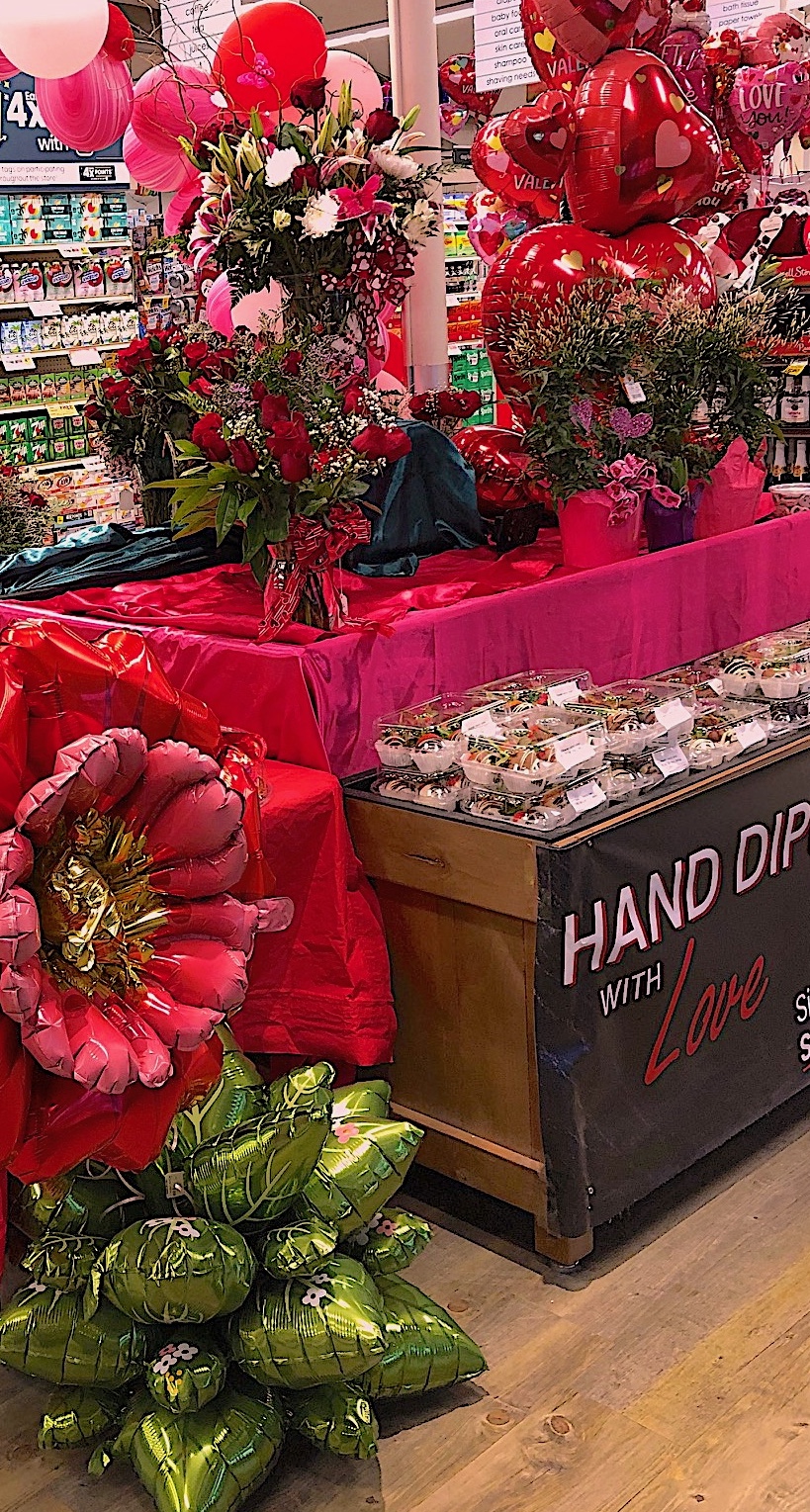
Here is a wee corner of the Valentine’s Day display at our corner Big Chain Grocery. This is only 25% of the fanfare; I cropped out the background of customers, juice coolers, carts, and other sundries. But even this small slice shows that the staff have outdone themselves. They set out flowers, giant balloons, cookies and cakes from the bakery in back, even strawberries hand-dipped by the Produce team in stripes of dark chocolate and white chocolate. Yesterday before 8:00 am the store had a rush of young men hurrying to buy bouquets! That seemed a hopeful sign. And so many bouquets to choose from! (In the center of these bouquets, the sharp spiky blue flower below is Sea Holly. It’s an interesting touch, and one more sign that the staff really care about their handiwork.)
Down at the pond, we had a rare calm sunny day of winter.
On today’s visit there was a new kind of waterfowl. My phone camera doesn’t capture bird pictures. But of course the Cornell Bird Lab comes through instead. Here is their page with video and photos of Ring-Necked Ducks ready to be admired.
Today there were several Ring-Necked males, striking and glam in their sharp dark & white suits, blue and white striped bills, and rich violet plumage tones.
A gentleman with a large old-fashioned camera was patiently standing and angling about for just the right shot of this or that bird. He identified the species, and could see that these ducks were a new wonder for me. So he surprised me by bringing them up close! He made a clear chirping call, and swung his forearm up and down. In a flash every duck in the pond headed straight toward him as if they knew who he was. They all assembled at the base of our footbridge, looking up with interest.
“My goodness!” I exclaimed. “Do they think that we are going to feed them?”
“No,” he said. “They have their own food. They are only curious and bored.”
Then I asked him “Is that a blue heron up in that nest already? How wonderful!” In this picture above, in the very tippy-top left corner, there is a tousled heron nest with tousled heron, and a crow sitting just to the left.
“Yes, that is a heron.” He tactfully let me know that the heron family didn’t stand a chance. “In a successful rookery you’ll have a hundred nests, not only one; then the whole flock will stand watch and defend the others. See that crow just to the left? He’ll get any eggs as soon as the parents leave the nests. Every year that same pair nest right there, but there’s no next generation to build beside them next year. They haven’t figured out that safety comes in numbers.”
1/5/25, wee update: Our same Catholic church-which-does-all-things-brilliantly emailed me a month ago about a welcome social brunch scheduled for today. It was their first social since pandemic lockdown. They wanted to welcome all the people who had registered with the church since 2020. The brunch followed the largest Sunday Mass, so that the most people could walk right over after the service to the large hall across the street. The program sounded really nice! Something hopeful and shy in me responded right away to the email. Then every day for weeks I gazed at the event on my calendar and looked forward to going.
So good, the brunch was today at 10:30. At 10:33 I was just walking down the steps to the hall, and crossed paths with a woman who was already leaving. She was very attractive and well dressed with a pleasant manner, younger than me, in her 40s or so. We greeted each other. We introduced ourselves as Catherine, and Mary. Catherine very graciously welcomed me to the event and pointed out the exact entrance. I thanked her, confiding that I’d never been to one of these parish welcomes before. She confided right back that she hadn’t either. In fact she’d stepped in, took one look around, and headed right back out the exit.
“I guess I am just not any good at being sociable,” she confessed.
“I’m plenty sociable,” I told her, “and really want close people in my life. I’m just not any good at finding them at church socials.”
“Oh, I want close people too,” she hastened to add. “But at this event I lasted about three minutes.” She wished me a good time, and went her way.
It turns out that in the last four years, some 425 people plus their kids had registered with this church. The tables were packed with young couples and proportionally way more babies and kidlets than one would see anywhere else in town. I floated around nodding and smiling at everyone, looking for a place to sit. Finally I perched on the edge of the stage and pulled out my lentil soup and spoon, tuning in to the atmosphere and listening to the conversations all around while the children ran shrieking with joy around and around and around me and the hall. The couples looked on happily, cuddling babies and pointing out their kids and sharing conversations about parenting.
Now, I should have gone to the kitchen at the back and volunteered. I should have asked “Is this seat free?” and plunked myself down to meet some young families. I should have invited Catherine out for tea. But this grip of sadness came over me, as if my heart were bleeding light. The light turned to tears pouring out of my eyes, so I put the soup away and left for the bus home.
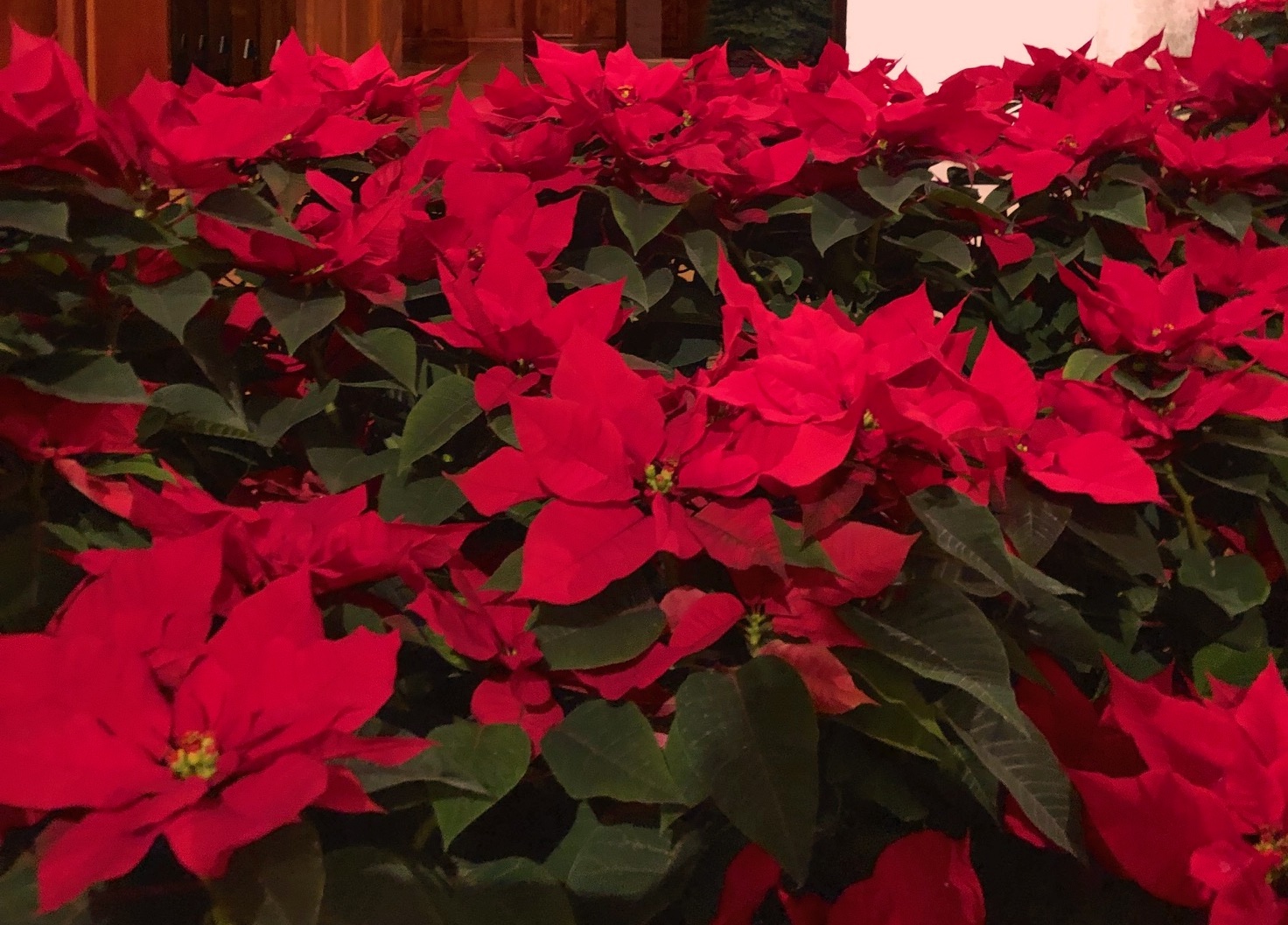
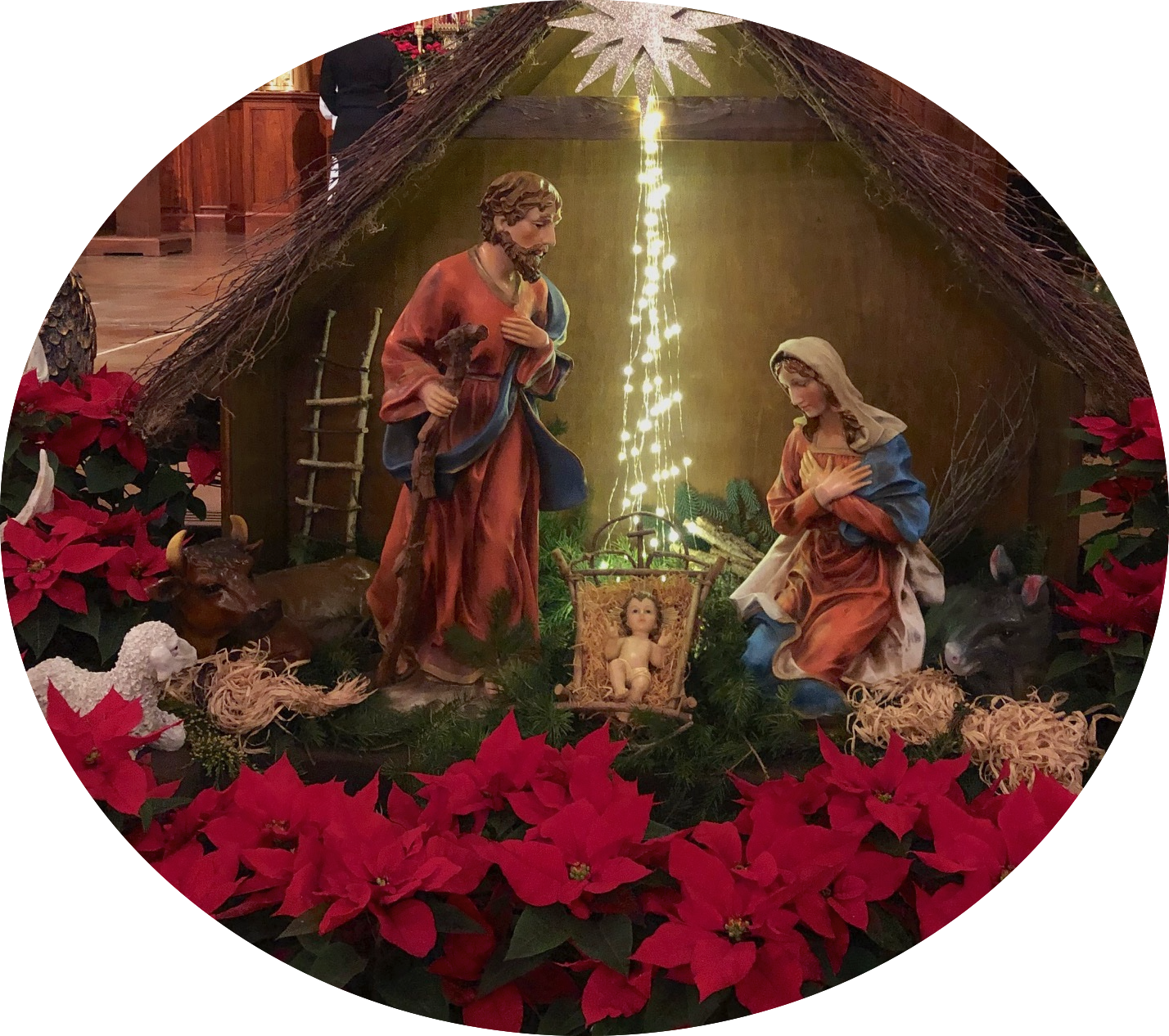
(Christmas at our Catholic church: Poinsettias at the altar rail.)
There’s a human experience out there called building a Faith Community. According to wise and spiritually attuned people, we can not be saved for eternity except within the safe ark of the Church. According to these wise people, faith community leads to the deepest most powerful intimacy possible: being members of the literal Body of Christ, the mystical transformative union of people who share in sacraments and ritual week after week for life.
The formula is that this begins with showing up at the services and becoming a member, so people can see us as familiar and dependable. Next it means titheing and teaming up to administer the church and also serve those less fortunate. Next it means carrying each other’s burdens and interacting with vulnerability to know and be known in our deepest selves. Next we open ourselves up and bathe in the love of the Holy Spirit shed abroad in the hearts of the faithful around us. We become true brothers and sisters in Christ in unconditional love and honesty and trust and sterling accountability, forged into true stable lasting family who show up for one another no matter what, and that’s the true solution to the loneliness of being human. As a kindly Orthodox priest said to me, “This congregation is here so that YOU won’t ever be alone.”
And according to the wise people, that starts with coffee hour. As one Catholic wife & mom urged me, “If you are single, then show up after Mass, take a seat with us, share a beverage and doughnut. And then this coffee hour will become the true family life that you are longing for.” Even Dr. John Delony on his podcast made the point that statistically, people who make it a point to join in a worship community do much much better in every area of their lives. Certainly people in churches look infinitely happier and more socially integrated than I am. So I keep going back.
The initial step in belonging is that all-important first conversation, where the community forms an impression of who you are, and your place in the congregation. It’s vital to put one’s best foot forward, and to say the right things. That starts with giving good answers to friendly get-acquainted questions. For some of us, that’s a delicate art.
At an Orthodox church some 20 years ago I sat down at coffee hour and was greeted by Olga and Irina, two Russian ladies born before the First World War. “You are not Orthodox, are you my dear? What is your background?” Olga asked.
“I’m an Irish Catholic who loves the Orthodox faith as well,” I told her.
The two exchanged looks. “What you are?” they asked again.
“I’m Irish,” I said.
“What?”
I switched to Russian. “Ia irlándka.”
“Chtó oná govorít? What is she saying?” the two of them asked one another.
I tried the country name. “Irrr-LAN-di-a.”
“Ah!” They beamed and nodded. “Wonderful. Welcome.”
The next week, the ladies had an amazing surprise for me. First, they tracked down the right parishioners, who tracked down the right relatives, who tracked down the right care home staff, who arranged the right access van, and synchronized a whole successful operation to bring a special guest to church. That Sunday after Liturgy, in the parish hall, the ladies eagerly introduced me to a very frail looking but dapperly dressed gentleman. The Russians all around us gathered to watch the excitement as he and I were introduced. Our venerable guest kissed my hand and greeted me. My smile froze; his Russian was incomprehensible to me. As onlookers watched for my delighted reaction, I struggled to figure out what dialect this was, but to no avail. Well, he was probably saying something along the lines of “Hyvää huomenta. Miten voit? Mikä sinun nimesi on?“
“See?” the ladies beamed. “Like you: he is from Finlándia!” But soon my dumb look and inability to respond sensibly to this dear man made for a great disappointment to everyone at the table.
It took a week or two for everyone to establish that my heritage was Irish. Then Olga said “This then you will know: V Amérike, Któ sámy velíkii irlándets? In America, who is the very greatest Irishman? We admire him very much.”
I looked around at the group. “Uh. John Fitzgerald Kennedy?”
“What? No no no no no,” Olga said. “AH re li. AH re li.”
Hm. Well, that li was the Russian past plural ending. The word sounded rather like the Russian verb “they howled.” But… Who? “Któ?” I asked them. Who was doing the howling??
Olga prodded my arm, giving me a triumphant knowing hint. “Bil!”
“Bil?” Well, that was easy: bil is the singular masculine past tense of “to beat.” So some man beat people until they howled. That was their idea of the greatest Irishman?
Olga repeated everything again. “Bil! Bil! AH re li. AH re li.“
Finally Irina turned to Olga. “I think Americans call him Bill O’Reilly.”
Olga just shook her head, waving away the whole sorry conversation. After that day, after their two attempts to make me feel at home, the two women gave up and stopped speaking to me altogether. “Imagine,” Olga said to Irina as they stood up and put on their coats. “An Irish, and does not know Bil Areli!”
_________________________________________
My latest foray at finding community was this year on Christmas Eve, at our Catholic church of some 1,000 households. There was an absolutely beautiful holiday reception in the decorated parish hall. Here is only one of four tables loaded with homemade treats. (Those two round pastries in the front are baked Brie cheese pies, one with apple and one with fig.)
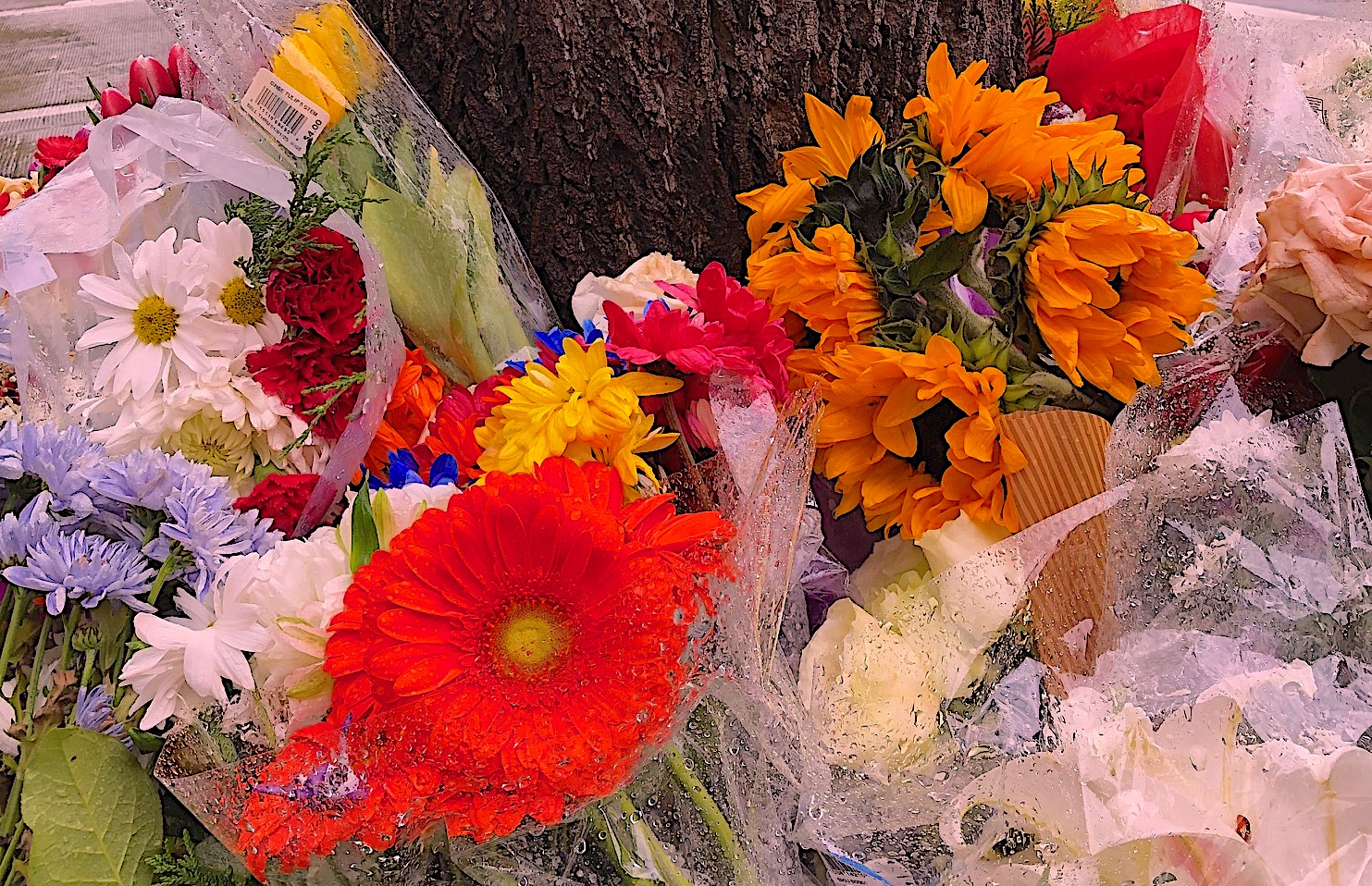
This 6:30 event had to be a short visit for me; I planned to leave the building at 7:00. The church neighborhood experiences armed robberies and attacks every single week, at all hours. Last week, one bus stop away from this very church, a city worker minding his own business carrying out his city job was murdered by a random stranger. It made all the local headlines, and people left flowers and candles on that corner:
(Leaving early turned out to be a good idea on that Christmas Eve. At 7:00 pm every single business was closed, and my bus home was completely empty. So were the dark foggy streets, with not a car or pedestrian anywhere the whole way. It was a great relief to get back home and in the door again.)
Meanwhile, the church greeters welcomed me right in. “You’re joining us for Midnight Mass, right?”
“I would love to,” I told them. “But I only stopped by for a prayer upstairs and to meet you all down here and thank you for creating this beautiful event. Then I need to get back on the bus home for safety’s sake.”
Their faces fell. “But can’t you stay with us for Mass and the reception?” Judging by the full parking lot, it’s likely that these early arrivals had cars right outside the door, and families to ride home with.
“Well, I’d better go earlier,” I said. Then I felt anxious to explain that this was not a reflection on their beautiful event. “What with the murder up the street this past week.”
The friendly folks around me were left at a total loss for words.
That cast a pensive shadow over the greeting committee. So I thanked them all again and moved on in to the reception, and took an empty seat next to a friendly married couple. They invited me to help myself to the festive treats, and eagerly asked me the standard Catholic question: “What is your usual Mass?” Orthodox people don’t ask this. Their churches have one Liturgy on Sunday, and with the readings before and after that’s over two hours. Their churches are smaller and there are no pews, so everyone is in full view as they file up to venerate the icons; you were there and they all know that, or you weren’t and they know that too. But Catholics ask you this to glimpse which parish social set you run with, and who at the church will know you. It’s a friendly interest question. The deep true answer is, “Mass attendance depends upon my level of existential anguish on any given day.” Instead I say “Oh, depends. The Masses all have their own appeal, and I really like those different experiences. I visit other Catholic churches too. And Orthodox churches as well.” I handed them my Orthodox daily prayer book. The husband looked at the book cover, written in liturgical Greek letters. He turned away from me and began murmuring at his wife about a work project he was planning at their home. I waited a few minutes, and then got up and tiptoed away.
Upstairs at the church I knelt down for a quiet prayer. Early Mass was just ending. The manger crèche had been put up that very evening.
Apparently, in this parish the manger scene is the setting for a joyful tradition: Dozens of families were lining up to exclaim over the Baby Jesus and to have their pictures taken on their small pilgrimage to the stable. During my half hour visit, wave after wave of excited little ones took turns rushing up to the altar rail to stand for pictures, and young couples posed with infants in arms. The church rafters echoed with laughter and excitement and greetings. It was nice to watch these family portraits in the making, keepsakes to share in future years. I caught my breath trying to envision how wonderful it would be, to have a person of my own alongside me for pictures and Mass.
Finally one woman pointed me out and whispered “I think we’re disturbing that lady there.” Her family turned to look at me.
I gave her my warmest smile, standing up to greet them all. “YOU are re-creating the true spirit of Christmas. The Holy Family has been here just waiting for your visit.”
They beamed back at me, and started arranging each other in rows for their Christmas portrait.
Usual Big Disclaimer: These notes mention a couple of potentially edible plants. But as always, don’t put anything in your mouth on my say-so. Why would you go to a foreign-language major for your foraging or nutritional advice?
After the usual morning cold-water bathe and some lymphatic drainage massage and foot bandaging, and a big bowl of kale with tomato & onion, it was time to hit the road with rosary in hand for a holiday walk in a whole new different residential neighborhood.
One all-winter neighbor is our wealth of mosses and lichens, taking over any wooden surface they can find. Here below was a branching twig all grown over with little passengers.
On the upper right, that flat lichen of soft sea/sage green curling at the edges might be Cetrelia cetrarioides. On the very lower right, the branching sea-green tendrils could be Evernia prunastri. And on the left, those two puffy-soft tumbleweedy blobs might be Sphaerophorus tukermanii.
At least, that is a best initial guess based on pictures from the handy lichen fan site https://lichens.twinferntech.net/pnw/ , where photographer B. McCune has clearly been hard at work. And, these name guesses may be totally wrong, because even the lichenologists are busy trying to keep track of our “580 species of macrolichens and over 1400 species of microlichens.” Here below was an irresistible sample from Photographer McCune, who for size comparison thoughtfully put in a 1997 coin (“Bank of Russia. One Ruble”).
This could be stinging nettle.
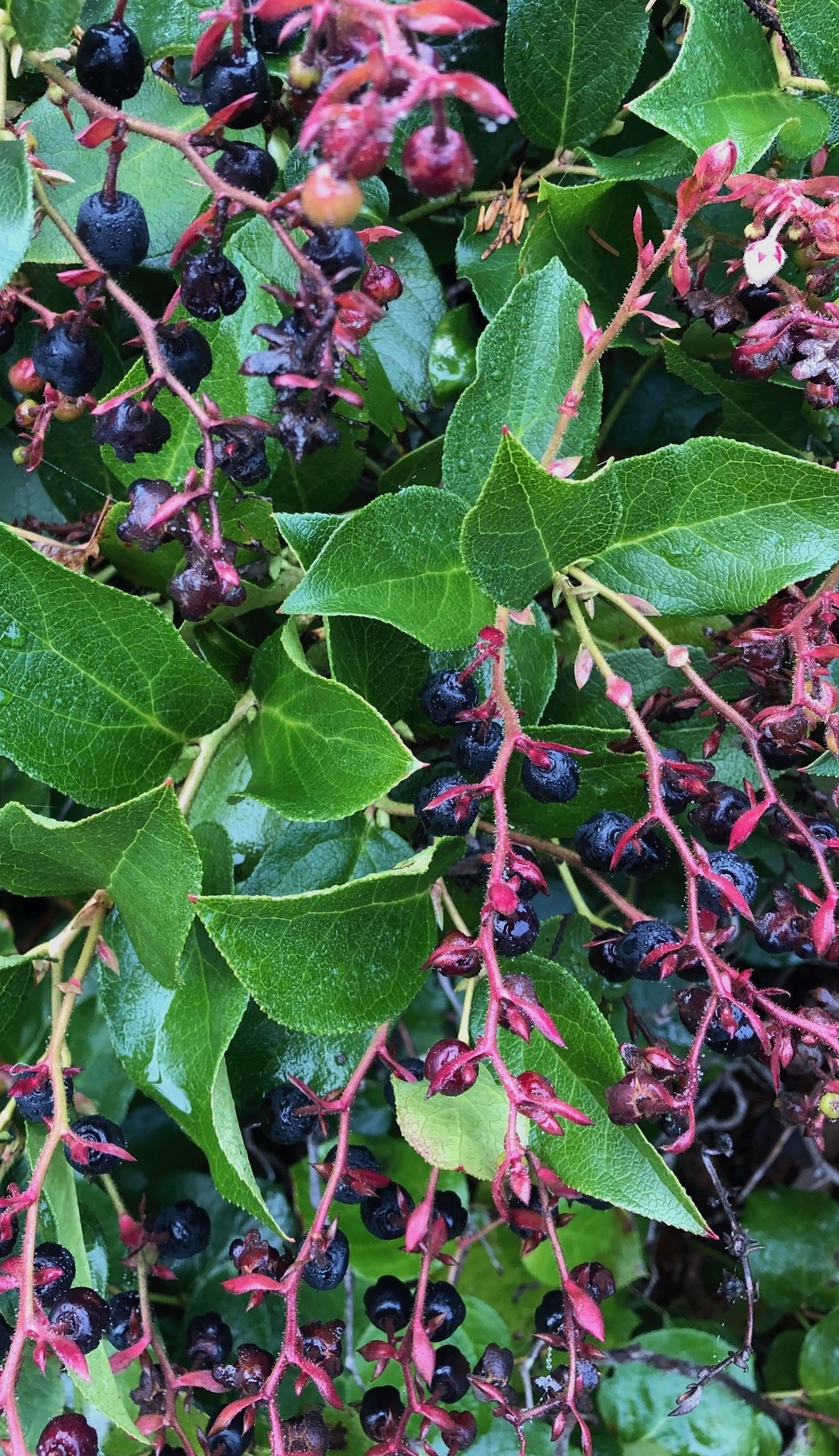
At one of our public libraries, the bushes had a second harvest of salal berries.
This homeowner put up a choice of birdhouses, and even made sure that bird dwellers could pay social calls on one another using little walkways. The angle is awkward, and it included just one birdhouse. That was to avoid aiming directly at the human house in the background.
In the nearby woods, this small birdhouse fell in the underbrush. The open plan was a puzzle. Who lived in here? (Not bats; for a bat house the bats hang in upside down, and there’s no floor.)
At this point in the walk the morning fog lifted, and the sun came out for a beautiful clear day.
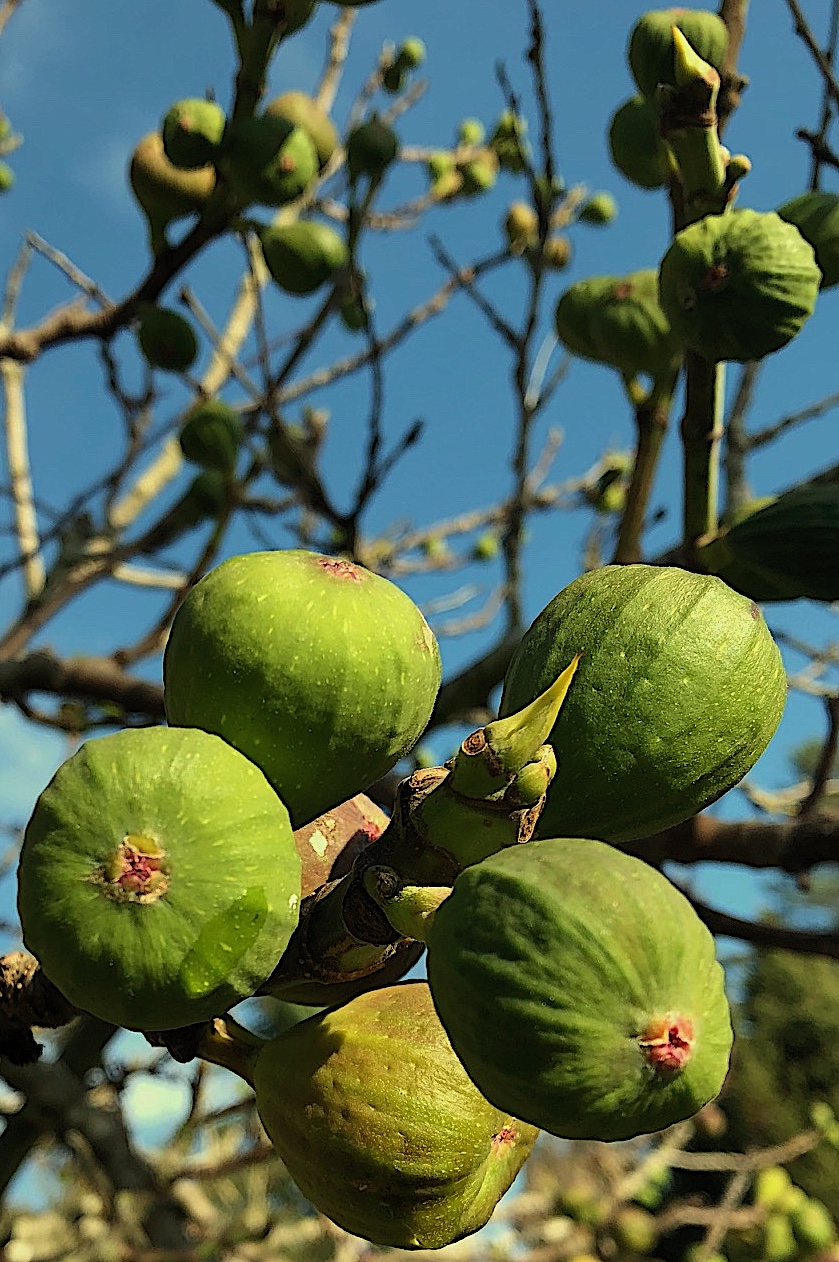
The leaves are fallen from this fig tree, but it seems to be sprouting for next spring and is still bursting with fruit. I’ve heard that the figs have a chance to ripen, if the tree is planted in a sheltered black plastic pot directly against a south-facing brick wall.
One harvest that hasn’t made an appearance is from our Strawberry Trees. Other years the fruits are everywhere, and go to waste falling all over the streets. Last Thanksgiving on our jogging trail I gathered quarts of fruit and made boiled strained nectar, but this year hadn’t seen the fruits at all. On this walk though there was finally a very small tree with just a few fruits. The tree was right in someone’s private yard, so I gathered nothing but this picture.
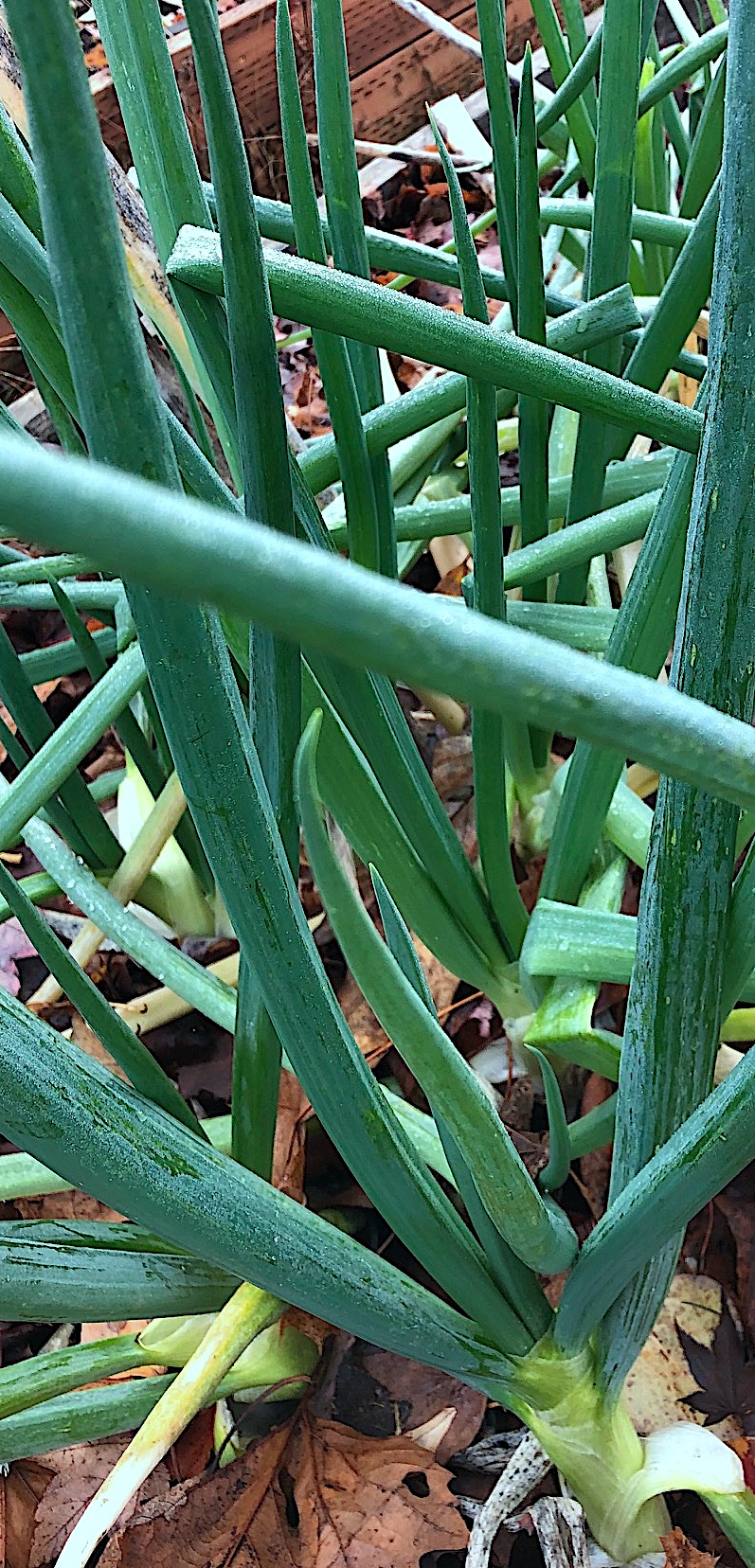
It’s heartening that even in affluent neighborhoods, residents resist the urge to put in flat green lawns. Instead they plant tall trees or rock gardens with succulents, and many have vegetables right in the front yard and even a chicken house. Sometimes they are in no hurry to harvest the vegetables, especially the cold-sturdy items like this curb strip of leeks.
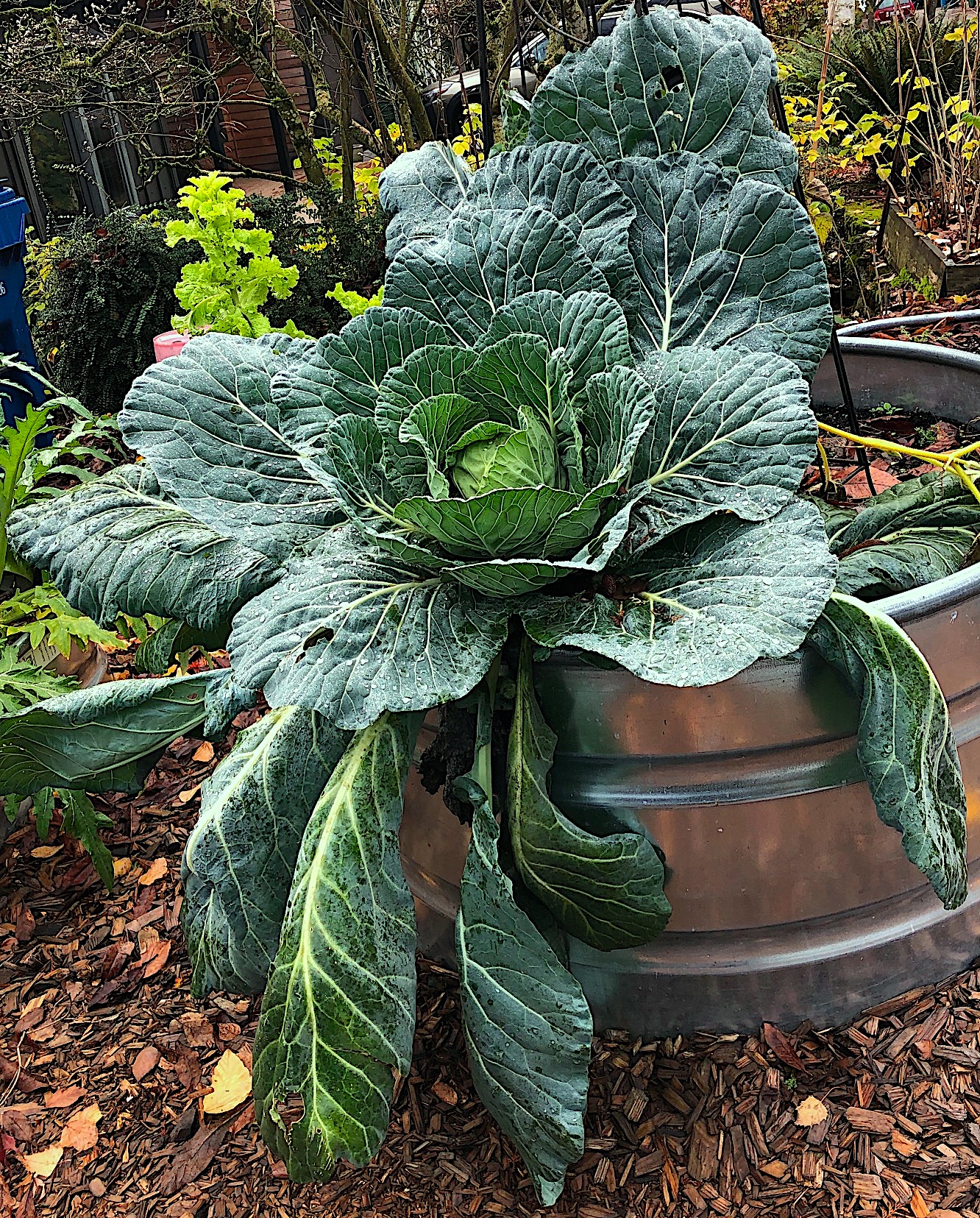
And this triumphant cabbage, easily four feet wide.
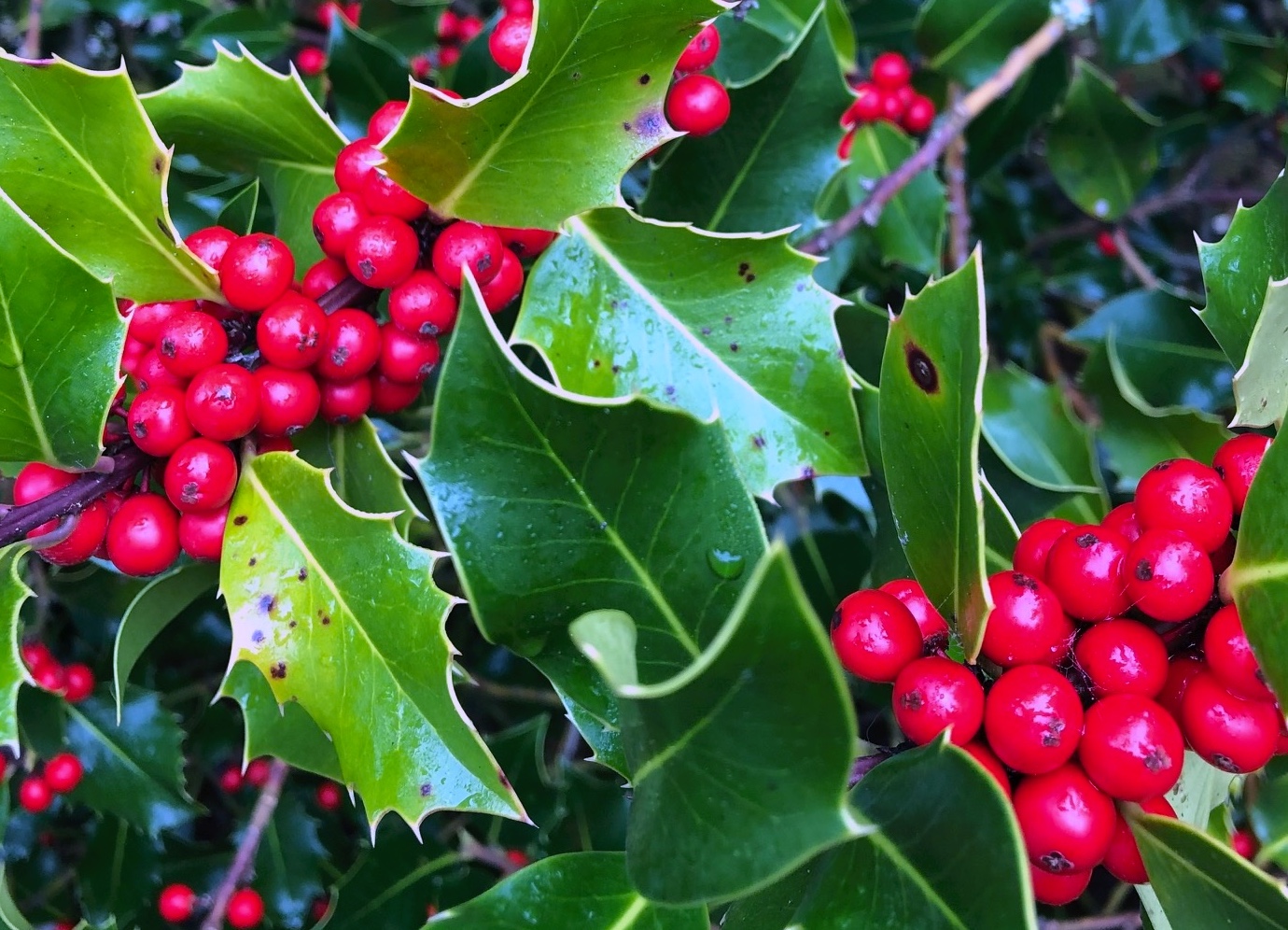
The holly trees have their showy berries ready for Christmas.
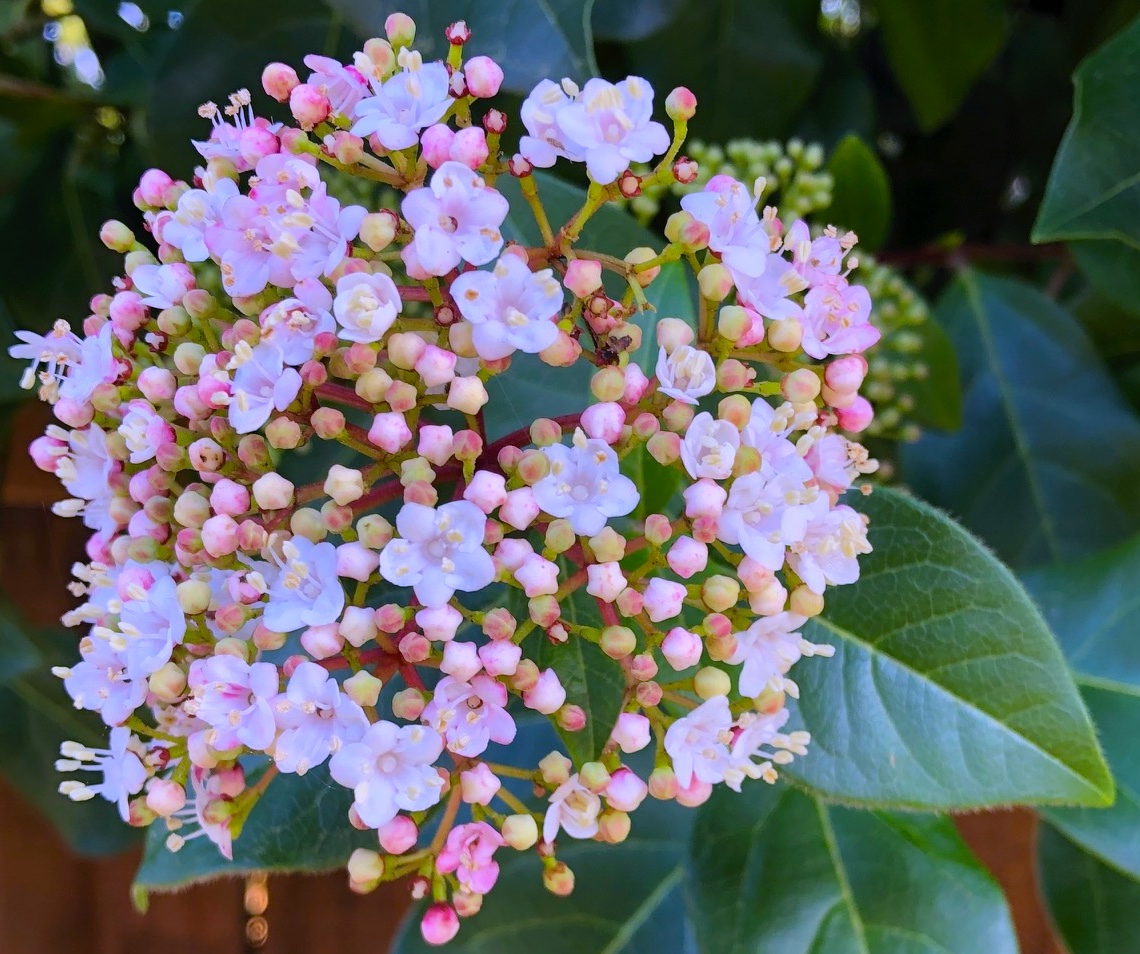
These delicate blossoms invite pollinators with the vigorous smell of rotting meat.
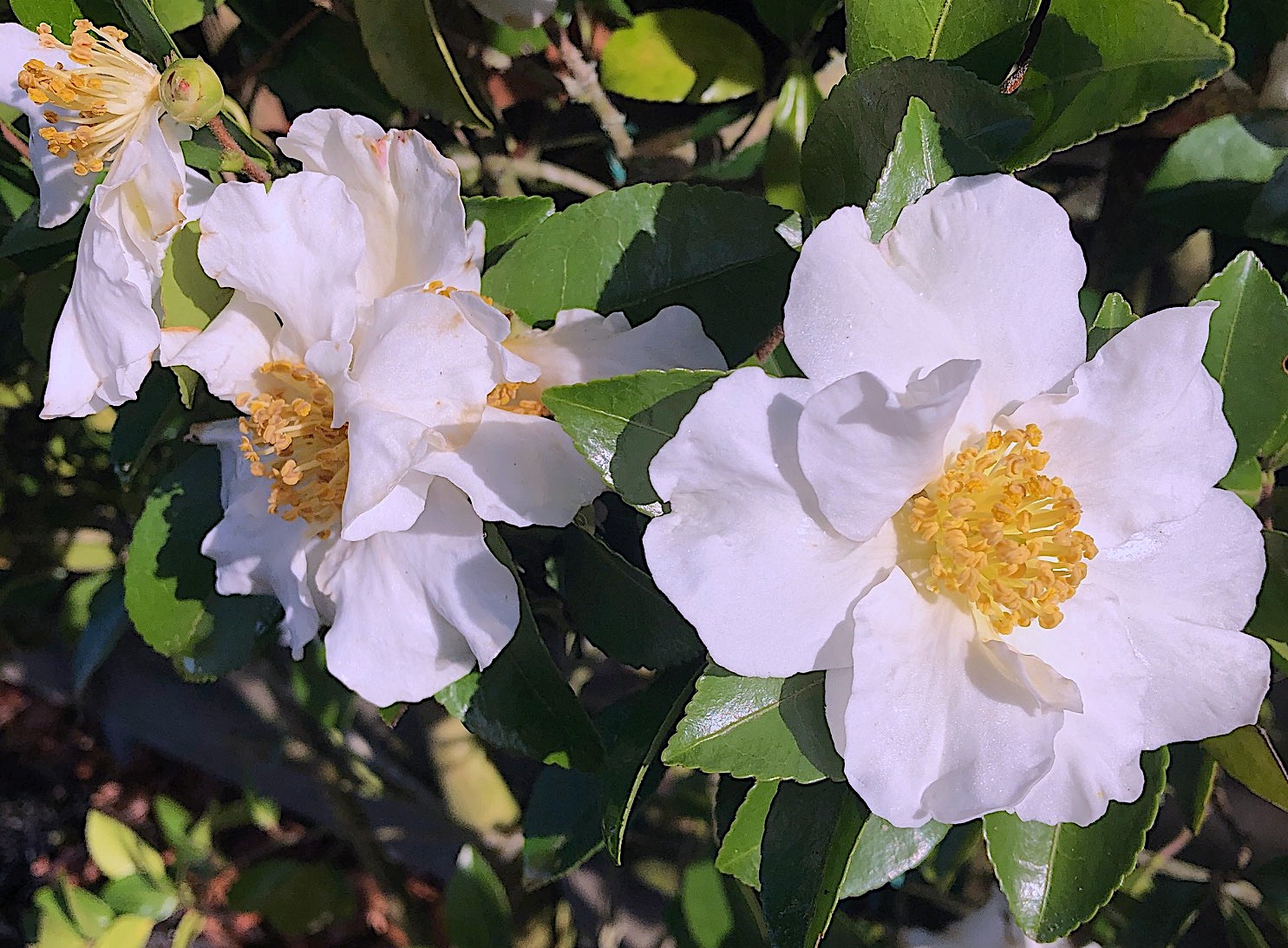
These winter-blooming Camellias flourished high up on a trellis in full sun.
That brought the walk back to familiar ground, six miles in all. After all that exploring it was a real relief to sit down with some lentil soup and think about the many reasons to be grateful, before making holiday visits and calls.
On our street at National Grocery Chain, a cashier is leaving.
His presence has been one more important seamless stitch holding together the social fabric of our everyday lives. When the stitches of presence work together, the fabric runs like silk and it’s too easy to overlook the fine job done by the staff.
National Grocery Chain is selling our store. The new mega-corporation might keep the store going, or might shut it down to consolidate sites. We don’t know. Meanwhile, that grocery is the heart of the neighborhood, not only for shopping but as a gathering place and for safety. Unlike most Americans, we have the great comfort of knowing there is food and a pharmacy right across the street, open 20 hours every day. After work, especially now on our dark rainy evenings, it’s a Godsend just to hop off the bus and to pass by those lighted windows with shoppers coming and going on the street and vigilant staff patrolling and maintaining the premises. Stopping by there for an item or two nearly every day, greeting the regular staff and hearing the news on the street, is always a source of uplift and cheer.
Our cashier is working night shift right now for the entire front end — a half dozen checkout aisles, and another dozen self-serve checkout machines that are constantly beeping and flashing for his immediate help. It’s managing machines, stocking the checkout areas, coordinating the customer service desk and locked cabinets of batteries and liquor, monitoring customers who sometimes behave in distraught or impaired or hostile ways and even run out the door with their coats stuffed with merchandise. On my shopping trip there tonight, our cashier was holding down the fort alone with no backup in sight. When I first walked in, busy as he was he gave me an enthusiastic hello wave from the other side of the store. It’s like I was the Cavalry showing up, when in fact it was the same older lady who comes in every night to buy kale and refill a gallon jug from the filtered water machine.
It was especially special to be recognized that way because he and I have never had an actual conversation. All this time I’ve just cruised through the self check, punching in item numbers for leafy foliage, and on the way out always gave him a smile. Until today I didn’t know his name. On the street I wouldn’t know him because at work he is always dutifully masked up. All this time I’ve kept my distance because he is busy and young and quiet and ultra-sensitive and fine-tuned in some higher indigo chakra manner. Our total interaction time was my noticing his lunch snack — some 100% sugar-free baking chocolate — and saying “Whoa. 100%. You’re the Man!”
Well tonight I punched in the numbers for my mustard greens and two potatoes and was heading out. He flagged me down and said “I just wanted you to know. Today is my last day. I’m only here until 10:00.” He is going to a nearby town, where National Grocery Chain is promoting him to management at a much larger busier store.
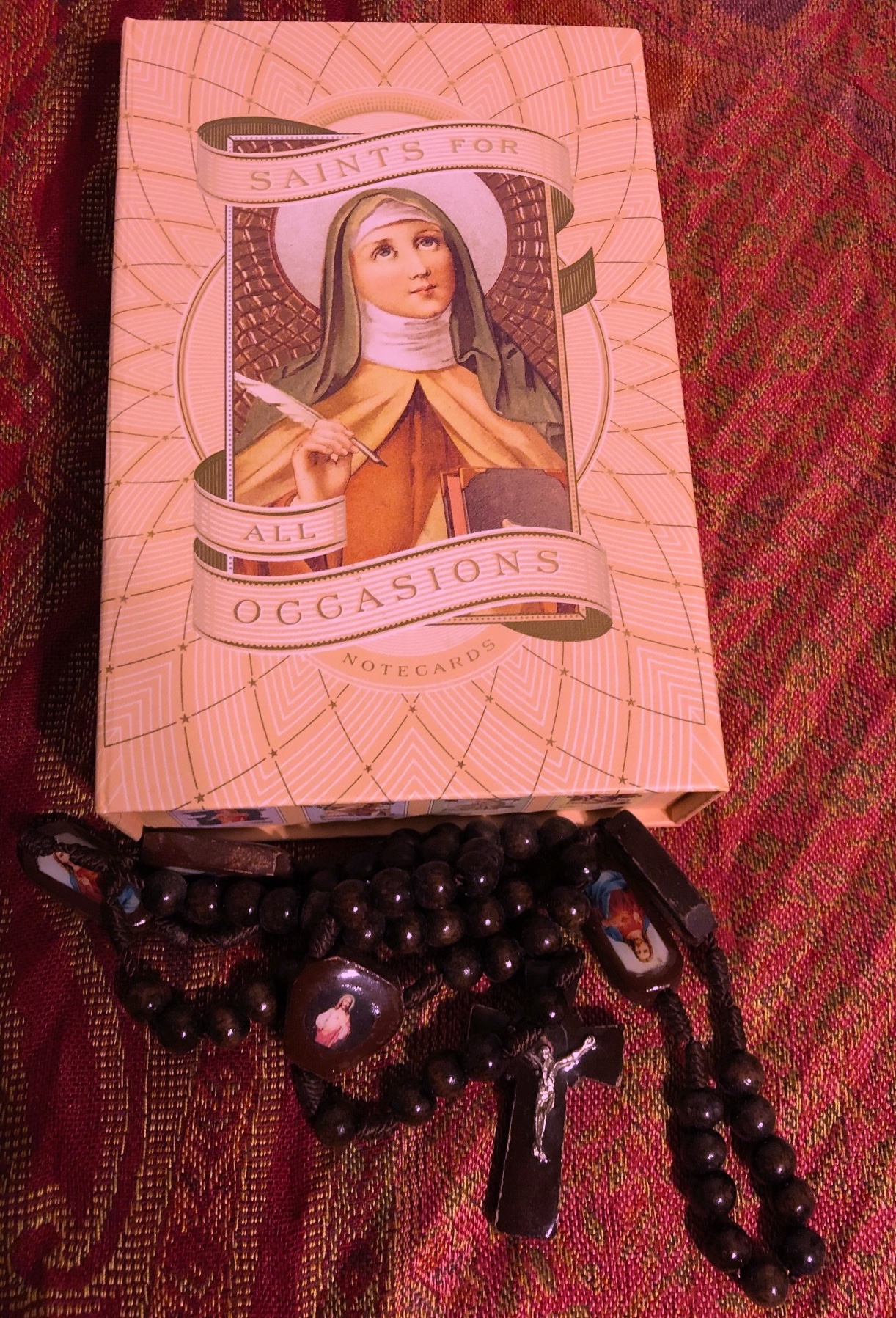
So I ran home and rummaged in the pantry and wrapped up all of my 100% sugar-free chocolate chips. Then I emptied all the cards out of my special card box of Catholic Saints for All Occasions, chose a saint card, and wrote him a little message. I put the card back in the box with the chocolate and ran back to the store. During a fleeting break in the customer action I handed him the card box. When I did he asked: Would I come and see his new store? He gave me directions on how to drive there. He clearly meant it. Think of that. Dealing with hundreds of people every day, and here he sounded serious about having one more person buying her kale at his new place. What an honor! Just then, some customers needed his help at their flashing blinking self-check stands, so we waved goodbye and I beelined out to the parking lot. That was just as well. I was getting too choked up to speak, just thinking about the staff at our store.
See, that card box was a treasured keepsake from a young cashier who worked the same shift at the same register a few years ago. She had a rapid-fire straight-faced sense of dry humor, and worked like lightning to get us through the line and out the door. She wasn’t one for chat, and never mentioned her personal life to me, except one brief detail before moving on to the next customer: “I’m your downstairs neighbor.”
She never told me her medical history, or how she was soldiering on just to stand at that register all day. Only later did we shoppers compare notes and piece together parts of her story — at her memorial service, held outside our apartment complex. National Grocery donated and delivered all the beverages and food. Over 60 neighbors got together and shared stories about her. Two of the women with a beautiful garden put in tribute ornaments and plants that still grow in her honor.
I should have done more to get to know her. She led a quiet life; it didn’t seem right to interrupt her leisure time off work. But one time she walked upstairs and knocked on my door, all busy and brisk on errands. Dropping a wrapped bundle in my arms she said “Here ya go. You should have these,” and off she went. I never saw her again. In that bundle there was the box of Catholic cards, and an armful of beautiful long jumper dresses, and an icon of the Virgin Theotokos. As it turned out, her beloved Orthodox Christian Grandma had left her that icon, and she left it to me. In fact, she went all around the building and neighborhood with arms full of gifts. She was one of many fine cashiers, one who for her end of life planning gave away all her nice things to the customers.
There’s a city bus to the nearby town of the new store of our cashier, now a manager; I just looked up the route. It’s a trip worth taking whether they have kale or not.
People who serve are simply everywhere, all the time. Cashiers, truck drivers, librarians, the phone operator who helped me today with a medical insurance question — there is no way to show enough appreciation, for all they do to hold together the lives that bless us.
Well, not really in the rain. It was tucked back under the eaves out of the path of the rain, on a bench under the call box of our building, where clearly someone didn’t pick up the phone in time to buzz in the pizza delivery driver.
Halloween Night. The wind blasted squalls of rain, leaves, and costumed folk of all ages darting through the traffic all in stylish black. At the front door, the two hot boxed mystery pizzas smell wonderful. A bevy of neighbors from the building, coming and going with their candy bags and baby strollers, gather around the pizzas. Is there a name on the box? Sales slip? We text various usual suspects from various apartments. Finally we all vote to move the boxes indoors to the donation table, where at least they’ll be safe from the raccoons and cold wind. I’m just adding a note to the boxes when another tenant pops out of the elevator and claims his nearly hot prize. Everybody laughs and heads out for their festivities. I walk upstairs humming, while my brain happily rewrites Jimmy Webb’s “MacArthur Park.”*
Here’s a bill for $35 from the dental clinic. Fine. Take health account payment card, call clinic, pay by phone. Of course, there’s a pretty healthy wait time. Then the kind patient rep has to take down my data and pore through their records for my account. Then their computer freezes and has to reboot. Then the bill isn’t showing as due? For some reason? Is it ok if she puts me on hold? “Take your time,” I tell her. “I needed a Muzak break.” La la la, la la la. Okay, she’s back. What’s the card number? Oh wait, it’s a health payment card? Yes indeedy! (The card is issued by the state with pre-tax dollars that we state employees can use at this state-sponsored clinic, but I refrain from pointing that out.) Hm. She is not able to process that kind of card in that program just now. Is it ok if she transfers me to another desk? “Sure thing!” I tell her. She transfers me to another number. There’s an extended silence without the Muzak. La la la, la la la. She’s back again. That line does not seem to be answering. Would I like her to text me when that line is free? Would I prefer to call them back? “Sure, whatever. That’s fine. So long as the clinic knows I tried to pay my $35. Sounds like you are WAY busy there.” She explains that yes, they are way busy. “I get it,” I say. “I used to work there at the hospital too.” She sounds more cheerful. I did? At the hospital? What was my job? “Russian interpreter. Lively times.” We wish each other a good day, and somehow it turns into a very heartening call.
At same dental clinic I’ve been trying to reschedule a cancelled checkup, and tried calling for a few days now but just got the voicemail. So I hop on the bus, show up at the dental billing office, and hand them my insurance card. Their scanner can’t read it (?). Luckily as Plan B I also brought my checkbook, so I write them a $35 check. Now everybody is happy, and we all wave goodbye. I head upstairs to my clinic, and reschedule the appointment. The receptionist is happy to help. I happen to know that this clinic’s mission is not only training new specialty dental residents, but also helping patients with grave dental-related illnesses including procedures in the OR under general anesthesia with a code cart team at the ready. These people are high above all my admiration for their amazing work. But “Say, you’re minding the store by yourself?” I tell the receptionist, fielding patient arrivals and phone calls. “Sure am,” she says, “for the past three weeks my partner’s been out. There’s 300 voicemails waiting for me.” I hand her my annual treat for their break room: Trader Joe 100% sugar-free all-cocoa chips. “Recommended by 11 out of 10 dentists,” I tell her. “Trick or Treat!! Your leopard costume is adorable.” We exchange lavish goodbyes, and I head out the door. Suddenly there are footsteps behind me. She’s left the phone desk for a minute to give me a huge leopard-plushy hug. I hug her back.
At work I get a mystery text. “Mary, I have to ask a humble errand. Please don’t think badly of us 🙂 !” Who is this? Is this yet another unsolicited election donation request? I don’t keep any names in my phone, and I know the familiar numbers by heart, but don’t recognize this one. My address book indicates that Aha, it’s the Dad from a young couple in the next apartment building. Here’s another text. “Could you please get the kids’ clothes out of the end dryer at the laundry room near Captain Wing’s place? We have a net bag on the machine. We can’t get back home in time.” I text back. “Sure, leaving office at 5:00. Will head right over there.” At 6:00 I’m at the cottage-garden building laundry room. Oops: Of course! I’m not a tenant at this building, and don’t have a key. I’ll have to go to my place, write a note, then tape it to the door explaining whose laundry is in the end dryer. Wait, what’s happening in the window? The dryers are all stopped, and all the dryer doors are open. In the closest one, there’s a load of children’s clothes safely tucked in a tall net bag hamper on top of the machine. Good deal. I text Papa the update: some good Samaritan beat us both to it.
Back at my place, there’s a gift on the mat: a downstairs neighbor left me a 5 pound bag of organic rolled sprouted oats, and let me know that she doesn’t want payment for it. She and I have a tradition that on the weekends when I sprout and boil lentils or chickpeas, she gets a share too; why should two of us bother cooking the same thing? Then I pack up some Trader Joe pumpkin biscotti and carry them over to leave at Angelina’s door. Her downstairs neighbor pops out to flag me down: “Would you like my queen size mattress? It’s practically new.” I explain to her that in my studio room I just sleep on a yoga mat. That’s about all I have room for, but it’s really kind of her to offer.
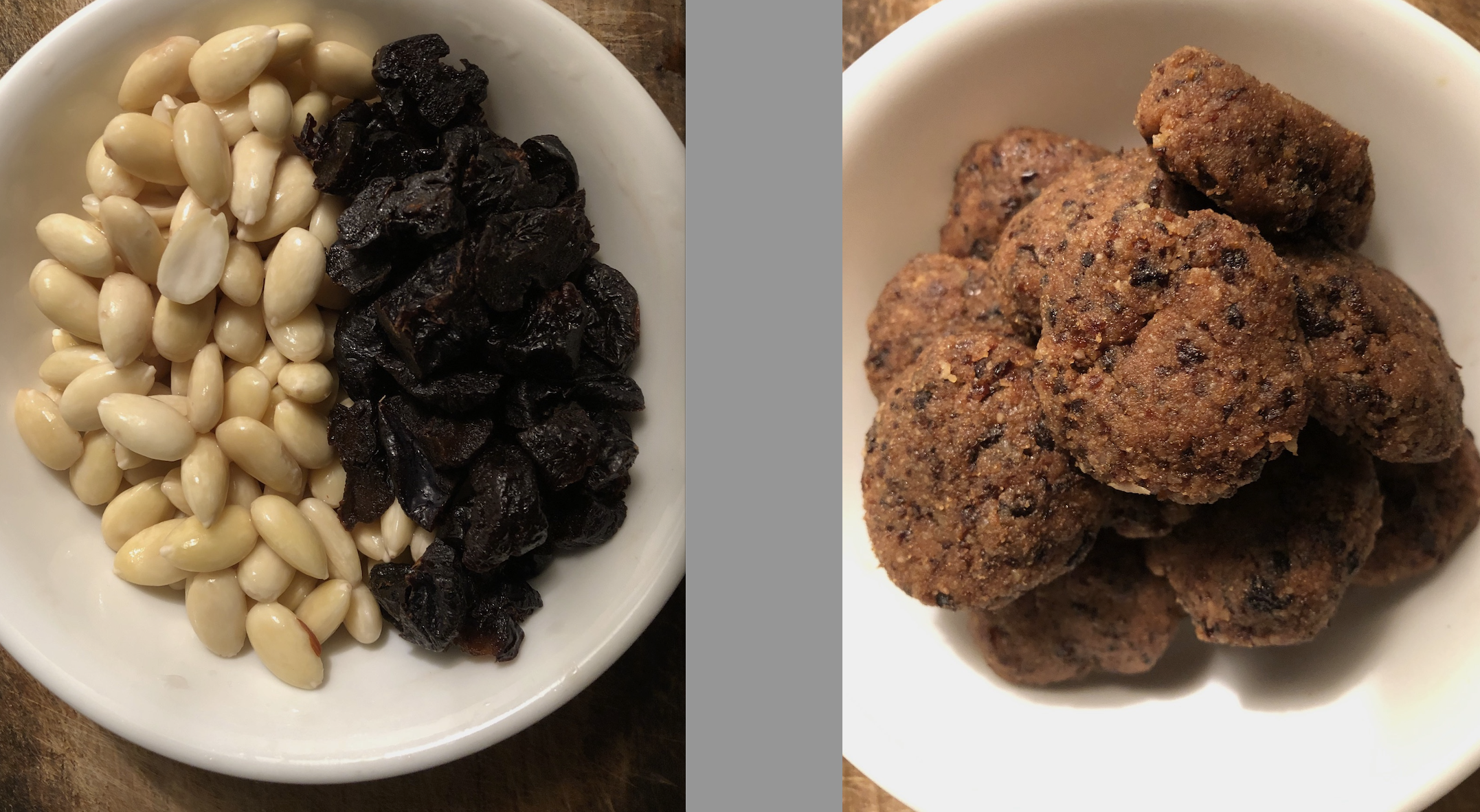
Almond-Prune Bites: Two ingredients, pretty much
Raw almonds, soaked in cold water overnight and then peeled. (The skins slip right off. No blanching needed.)
Prunes with no additives, pitted. I still slice each one in quarters to make super sure there are no pit fragments. These can go in the Cuisinart with the almonds for a good spin with unsweetened powdered cocoa, vanilla, cinnamon, and lemon oil. When the mix clumps up, roll into balls and keep in the fridge. These don’t have the dopamine hit of regular candy, but they are plenty sweet if chewed well, and have a nice steady quality.
* Just listened to “MacArthur Park” again for the first time since, like, 1968. Then to shake off the sensation of melting auditory cake icing I recalibrate my ears by turning on “Moonlight and Gold” by Gerry Rafferty.
It’s a bright sunny afternoon. High school is letting out, and teenagers are everywhere. Outside our building the local bus stops to swap some students off and on. Then in a flash, something goes haywire — and not with the teens. One woman is screaming at another outside the bus. They’re on the ground grappling so hard that one falls right under the bus while the other screams Get the !@#$%^ back up. I sprint toward the bus to tell the driver not to pull out, and so does every adult within a block around along with some of the teens. But the driver isn’t going anywhere. He’s already on his phone relaying information, and in a couple of minutes the bus company inspector drives up and speaks to the women, or tries to over the screaming. I’m not a witness to what happened, and qualified help has arrived. So I cross the street on my way to the grocery store, up a steep driveway making a natural lookout point at the top. The sheriff arrives and tries to intervene. Then a police car shows up with two officers. But a woman’s voice goes right on roaring obscenities. At last in the milling crowd we see a young woman sitting in the very middle of the sidewalk wrapped in her arms, slumped over quiet with a police office on either side of her. Up in the parking lot lookout with me, there’s a family gathered and still watching. They’re a mom with an infant and a flock of small children all about kindergarten age or younger. Their family is often out walking on our block single file, all modest signature clothing and earnest manners, but they’ve always respectfully kept to themselves. Today though the mom speaks to me for the first time. “What do they do in a case like this? Will they arrest her?” My vote is that it depends on what the police find out as they patiently sort through what on earth is going on. The small children take an interest in me, and several ask questions about the various law enforcement cars, the role of the driver and the officials. I make the point to the kids that it is impressive to see a family like theirs, such young people who can use such good situational awareness, keep a level head, stay gathered together, tune in to Mom for cues, and ask insightful questions. “This is why emotional self-regulation is so important,” I tell them, indicating the altercation. “Knowing how to calm ourselves down.” Mom makes a good-humored joke. “I’m not feeling very self-regulated at the moment.” I counter with the possibility that at the moment she is regulating the balance of not only the family, but the woman across the street. We all say goodbye; she gathers the troops and heads on home.
At my clinic I was down at heart and discouraged, waiting to discuss the low bone mineral density results in my DEXA scan, and didn’t notice a button-cute little girl chatting eagerly with her Dad. After a while her Mom came out and the parents switched places, Dad heading in to the doctor’s office while Mom sat in the waiting room with their little girl. In an effortless way the little girl switched from English with Dad to Spanish with Mom, eagerly whispering something with a cupped hand to Mom’s ear and pointing at me. As I glanced up at them, Mom apologized. “She was just saying that you look like a Grandmother.” The little girl gave me a shy friendly look. “Es verdad,” I told her. “Yo soy la abuela de todo el mundo.” She sprang up with a look of joy, and rushed to bring me a little rock from a decorative planter, and drop it in my hand. In English and Spanish I admired the rock, pointing out its good points. She took the rock back, then rushed to bring me another. I pointed out the excellent qualities of that rock too, so she hurried to exchange it for another to see my reaction. What is more fun than to cue the behavior of an adult, and to test the same reaction dozens of times? When Dad came out and the family prepared to leave, the parents got a smile out of watching their daughter, a busy bee still choosing and swapping rocks with everybody’s grandma.
Across the street at the grocery store, Jordan in Produce always has something new to tell me about vegetables, how to grow and cook them. So when my horseradish plant put out its last leaves of summer, I wrapped them up to carry over to Jordan. Along the way there’s a house with raised bed boxes right on the curb, planted with good dirt and double-sized thriving vegetables and flowers. I stopped to admire the dahlias. The neighbor opened the front door and called to me. “Take some cucumbers! We have too many.” As she stepped outside to pick me some I said “Would you like some horseradish leaves? They’re a tender salad green with a bit of a wasabi bite.” She took the packet with a curious look, and said “Just now? I was in the kitchen blending our tomatoes. They all ripened at once, so I was making a Bloody Mary mix. The recipe called for horseradish. I thought ‘What is that? Where do I even get any?’ and there you were.”
The Wing Family took a “vacation.” This is their name for a cross-planetary trip with kiddoes to spend an intensive month or two working hard and caring for older relatives in rural areas. It’s tiring just to type all that, let alone imagine it. But then they came back. They brought me a package of beautiful historic church postcards, and they brought me fresh green kû guā, or Bitter Melons. Somewhere along the way, with all their packing, toting, caring, and travel, they remembered those are Things That Mary Likes. I don’t know how they do that.
Tonight at the food coop I paid for my oats, quinoa, and emmer faro, and headed for the door. There a young teenager flagged me down, bouncing on her toes in eagerness to talk to me. She was an instantly appealing little soul with her expansive hands and excited voice and studious eyeglasses. “Are those YOUR three dogs in the parking lot?” I said “Well, I have no dogs. Are they in trouble?” But no, she only wanted to show me three splendid white husky dogs seated in a row in the pouring rain, watching the door with laser focused attention. “You LOOK like their owner! You look like a person with three dogs! They should be yours!” Well, that made sense. “Sure, I’m dressed like a dog walker, in all this raingear and fluorescent vest.” She said “No no, I mean you look like a Witch. In a good way.” I thanked her for the compliment, and confided that yes, I would love to have three dogs. “You NEED them! Three dogs!” she cried. “Some day. Maybe four,” I called back, as we waved goodbye.
Grocery manager Morrison often has a philosophical question about the meaning of life. While I was buying collard greens he asked “When you were in your twenties, what was the most trouble you ever got into?” I said “Being pulled over by the Moscow police for writing a postcard with my left instead of right hand. That wasn’t done in those days.” He threw his hands up. “Never mind. Can’t top that.”
Today Maizie my old office mate from 1989-1993 rang me up to ask “Where can I find a weasel for my summer house? Not for a pet, but to go after the chipmunks and mice. They’re in the basement. My friend has a weasel who like weaseled his way into her farm cellar, and she leaves him alone and he clears out all the varmints.” I said “That would be Joseph Carter the Mink Man. He has trained minks, and he makes house calls. Here, let me look him up… Oh. No sorry, he’s in Utah. Maybe there’s a franchise near you?” She said “You just pulled ‘Call Joseph Carter’ at random right out of a hat. That’s impressive, in an unsettling way.” I said “I’m just the random person that you thought to call.”
So much of everybody else’s business to mind, so little time.
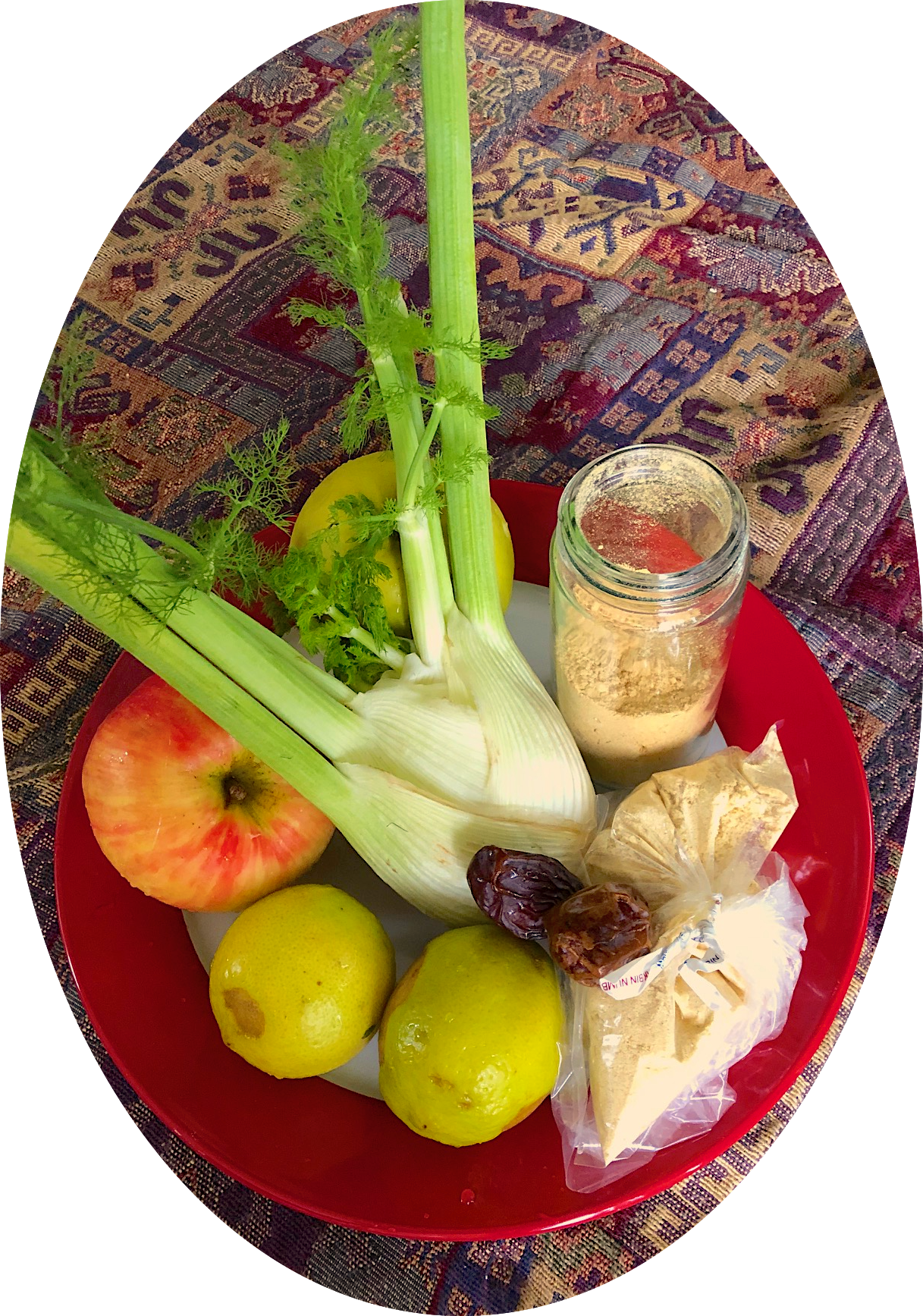
Chop up this stuff and drop it in the Cuisinart, in proportions to taste.
Apples
Fennel bulb & fronds
Lime juice
Dates
Ginger powder
Mustard powder
It’s one option if you’re cooking for folks who want to cut out oil & salt. This sweet sour spicy raw relish is good on just about whatever. I’m eating some now on hot Yukon potatoes & cabbage.
“Why would you say a crazy thing like that to me?” My host flashed his lovely sweet smile.
“I’m sorry!” I apologized. “Nat King Cole –“
“I have no idea who that is.”
“Oh. Right.” My mistake. How could I expect him to know Nat King Cole??
He put down his cigarette and picked up the wine bottle, still smiling. “What an insane thing to say.”
I smiled back. Truce! “I just thought –“
“Well don’t.” He poured our wine. “I made that dish just for you!”
“Yes, it’s very good.” I got back to work with my steak knife, and finally resorted to my fingernails. With my ham-handed cutlery skills, dinner might as well have been a plate of bite-sized Rubik’s cubes.
“Look at you. Acting like a child.” He couldn’t help laughing.
I laughed at myself too. Laughter seemed like a good sign for a first dinner date. Right?
My host was not to blame, that when anyone watched and pointed out my dining manners, I always wanted to shrink under the table. Even now, restaurants don’t feel like a happy place. For companionable eating I just want to buy my own hand-held food at a counter. Then we can find a quiet place to listen and talk and stroll side by side, and watch seagulls or squirrels instead of one another.
He filled my wine glass. “So you don’t like my cooking. Here I really looked forward to your visit tonight. I wanted it to be a nice evening. To make you feel welcome.”
“Yes yes, I appreciate that.” I wrestled a bite and started chewing.
“So I served your own food from YOUR tradition, not mine. But that comment you made to me just now? Don’t tell that to anyone. Everybody in the world will think you’re nuts.”
I crunched and chewed some more, and managed to swallow. Everybody in the world? Well, he knew better than I did. He’d seen a lot of that world, speaking five languages including mine, and I spoke not a word of his. He’d sampled fine food and wine all over the planet. And in most cultures, including his, refusing to eat a home-prepared meal was a hurtful insult.
He looked hurt now, but tried to laugh it off. “Look, never mind. Let’s forget the whole thing. What you don’t finish tonight, you can finish next time you come over.”
“Oh, good,” I agreed. He was inviting me back for another date. “That will be very nice, thank you.” Next time I was going to figure this out and do a better job.
He put after-dinner mints on the table, took my plate to the kitchen, and drove me home.
Here is what I didn’t get to tell him. Instead I’ll say it here to you.
Nat King Cole sang “Chestnuts Roasting on an Open Fire.” His song was on the radio and in shops and on record players all over the neighborhood between Thanksgiving and Christmas when I was small. All of us knew it (well, we knew the first 12 words). The song was always right where it belonged, as the winter backdrop for festivities to share and remember.
We even heard the song right on the streets in The City, when Dad took the whole carful of us for the big holiday trip each year. There we could walk through FAO Schwarz and look at plush stuffed animals, a whole Noah’s Ark, lifesize and lifelike enough to breathe. We could go to the Museum of Natural History to stare up at the great blue whale soaring along under the roof. We could go to Hayden Planetarium and hear a talk and watch a little green arrow trace out animal pictures out of twinkling lights on the ceiling, and tell us all about the Star of Bethlehem. We could go to the Christmas floor show at Radio City Music Hall. We could peek in at the German decorations and violinists at Lüchow’s. We could look in at the jewelry window at Tiffany’s. We could see skaters at Lincoln Center. We could see Central Park, and the carriage horses with bells on, and they let me reach up and pet their noses.
The weather was cold for those hours of walking on short solstice days, all wind tunnel around buildings so tall they cut out the sun. We could get warm standing on the street grates when the subway went rushing underfoot. We could stand near the warm pushcarts in the street too, with their hot charcoal fires baking up great big soft pretzels with kosher salt, and honey-roasted peanuts, and buttery popcorn tumbling inside a window.
But the best warmth was the little bags of chestnuts. Dad was a hero for being our tour guide and for buying a bag for us before the car ride home. In the bag there was heat and smoke and scorched shells to warm our hands. The shells cracked right off along with the fuzzy inside skin. The wrinkly pale little nut brain inside had a creamy soft mouth feel, and a heavenly taste between the best cashews and the best baked sweet potato ever.
At home for the couple of weeks when chestnuts were in the market, it was something special when Mom & Dad brought home a bagful for the kitchen. They looked pretty on the table as a centerpiece, in a pewter bowl with gourds and autumn leaves and chrysanthemum flowers.
A raw chestnut has a hard tough leather hull. If you hack and wrestle off the hull and try to eat a raw one it’s just fuzzy and astringent and bitter skin, and crunchy starch. If you put them in the oven as is, the steam will burst the kernels. Then you’ll just get an oven with shell bits and fluff.
So Mom taught me how to cut a deep cross in the dome-shaped side. That was my girl homemaker job. I loved blessing the chestnuts by carving the sign of the cross in every one. Then when they came hot from the gas stove we had a platter of chewy sugary comfort. We ate our chestnuts with buttered popcorn and hot apple cider and homemade Toll House cookies and Mom’s blended cream & egg & sugar & vanilla & nutmeg nog, and all of us piled in on the sofa watching Nat King Cole.
Then I went off to college, and had an invitation to a real dinner date, and got all dressed up, and found myself facing off with a whole plate of chestnuts served raw. I just figured this was the cosmopolitan sophisticated way to eat them, like sushi-grade raw tuna instead of tuna from a can. Maybe it hurt his feelings and his pride when I apologized for my table manners by confessing that I was only familiar with chestnuts in roasted form. Now, what if I were clever and brave? What if I said “Say, let’s try something fun. I can roast some of these for you right now, and we can have a taste test, and you can see what you think.” But instead, during that short relationship, every time I came to visit, that same plateful was served with no sign of the cross in any of them. I chipped away at several more nuts each time.
In my new town the mature chestnut trees were killed off long ago by The Great Blight. But in older neighborhoods and back alleys maybe there are ancient stumps underground, because you still find little saplings springing up to make a brave fresh start for a short doomed life. Their green burrs are falling on the ground this very week. Sometimes the burrs are crushed open by cars, and then in gingerly fashion (those spines are sharp) I ease them apart to get the nuts inside. So far the nuts are just empty shells. But I always stop and admire them anyway as an American treasure, and think about winters long ago, back when gaslight was a noun and a power that stayed in the oven making itself useful, when Mom & Dad were alive and just wanted the family to be happy.
That night my host put out his cigarette and poured himself a second glass, still laughing. “You’re positively mad. Chestnuts roasted? Who does that? Nobody.” He headed down the hall to get our coats and his car keys.
I helped myself to a couple of dinner mints, eased open his door, poured my wine out under some shrubs, and to cheer up hummed to myself a catchy little holiday song from years ago.
That was a sleepless night, wondering how another date with another suitor went off the rails. Maybe I got it all wrong about Nat King Cole after all? Maybe that song was a deeper allegory about something else entirely that went right over my head? Only years later, typing these words, did a dawning realization make me smile: The Host didn’t have to be attend to my words, not when a whole battalion could have backed me up and set him straight: the no-nonsense pushcart vendors who rule the holiday streets of a city that does not mistake its recipes or mince its words.
On the first Tuesday in August, Americans have permission to turn off the telly and go step outside and see who lives on their street and wave at them. It’s a chance too, to stop and be very thankful for a street where one can step outside for a stroll even at night.
In school neighborhoods, or for families with kiddos, people take it serious. They register their street in July with the local police, and the city puts that street on a map of goings-on, and then those neighbors can block off their street and put up sawhorse tables and signs and food and music and games and amusements.
Here at our apartment complex, we villagers figure any summer evening is a good reason for a night out. But things here were uncommonly peaceful tonight, so I headed out to the main street to see what-all the action was.
Action was only three blocks away. A circle of people were out in lawn chairs, looking cultured and wholesome. They sure have a nice garden too.
I crossed the street and strolled closer, tuning in to the energetic bubble around them. Fortunately there was a conversation piece right on the sidewalk — a stepladder, dressed in a frilly folk-dancey skirt. “Giant chrysanthemum?” I called over to them. “And does all this constitute a Night Out?”
For an under-imaginative intrusion like that, a default unmarked response could be a flick of handwave, if that. But not this bunch. No, they hollered at me to come right on over and get some refreshments, calling out the various menu options. Then we settled in and got all acquainted. They were quite a crack team at sociability, in both sharing and eliciting interesting questions and answers. In no time we worked out who lived where, who belonged with whom. We swapped household shopping tips about my fluorescent getup (state surplus warehouse $1 on clearance), and our hostess’s party lamp (a luminAID solar lantern. There is supposed to be a tiny superscript R in a circle after the brand name, but I couldn’t get the symbol to transfer in to WordPress).
Here’s a picture of another uninvited guest who came crashing in. “He’s clearly heading straight over to my garden to eat flowers, though he is moving real slow,” one neighbor observed. “Actually for a snail, he’s in a vast hurry,” I had to tell her. “Word is out, you’re growing tasty stuff.”
Pictured here for Angelina’s son Jaeger, who is all about nature denizens of this sort and might have taken the little guy home.
We settled in to a good talk about neighborhoods and community. I marveled at everyone’s very thoughtful planning and shopping for their social; they’d even printed up invitations and delivered them to houses all up and down our main road!
Then it was time to start packing up goodies for everyone to take home.
Wee sampler from a groaning board of tasties. I didn’t have the audacity to accept more.
Not pictured: ice chest of refreshments, hummus, a watermelon cubed in big tempting chunks, and more luscious vittles that people offered to hand over.
These are good neighbors to keep in touch with. They gave me thanks and hugs, just for being there! I promised to not write any personal details about them “except for the snail,” I called as they waved goodbye.












 consolationland