
(Blanket Flowers down the street, a random picture irrelevant to this whole junket.)
Concluding idea: Maybe that scope procedure showed my doctor some things about part of me. But writing down this experience was like a different scope into my own thought process start to finish, and that’s a journey too.
The Big Disclaimer: My day at the clinic was a sea breeze compared to the medical experiences of other patients. In my own case the procedure carried the lowest level of risk. Preparations and results will vary widely depending on a person’s own circumstances (diabetes? anti-coagulant medications? sleep apnea? on and on). For someone else there may be lots of other safety instructions, so this is not medical advice for anybody else.
The Second Big Disclaimer: A colonoscopy, like a flight on a commercial airplane, feels like an insane amount of privilege. Both experiences are carried by the intelligence and dedication and skill of an army of people behind the scenes. To write about it here, when the option isn’t available to the people who may need it most, feels like taking unearned good luck and flaunting it around. At the same time, what if someone needs the same procedure but is worried and wonders what it’s like? Well, maybe these thoughts will help.
A friendly patient representative called in March. Their hospital clinic had re-opened their calendar for new appointments, and they could book me in for June. This is a routine scheduled preventive diagnostic for people of senior age. The last colonoscopy was in mid-winter, and that is not a comfy time for a water fast and cleanse. June sounded ideal. Over the phone there was a long list of questions about medical conditions and history and lifestyle, assessing my risk level for the patient chart. Right after the call, my phone and email lit up with notifications: the update to my patient chart showing the phone interview, prep prescription, instructions, driving directions and maps to the parking lots.
Step 1. Booked three days off work, to include a day for the prep, then the day after. (Another extreme privilege: a job with leave time, and a studio room to rest in.) My grab-&-go hospital binder got some updates for the occasion: the clinic’s assessment of my risk (low), medically relevant history including a POLST / DNR forms, and contact info for me, my doctor, my responsible adult driving me home after, and my relatives.
Step 2. Called my friend Sandy, to be my friendly grownup to drive with me to the clinic, check in with me at the front desk, give them her phone number, and promise to wait and drive me home and see me safely in the door. Luckily Sandy did all of that. I also called a second friend as backup standby, because on the day what if something came up for Sandy, or her car didn’t start? (It started up fine. Sandy had just bought it.)
Step 3. Ten days beforehand, cleared out any food that might linger in the digestive system and clutter up the doctor’s view through that scope. The chia seeds, flax, hemp, nuts, raisins went in the closet with the air-pop popcorn maker. I finished off any groceries with seeds like tomatoes, zucchini, cucumbers, even bananas (they have seeds too). For the last few days before the prep, directions say to cut out beans, and items with vivid colors, especially red ones — so no beets, no red cabbage, no pomegranates, no dulse, no dark chocolate. To be on the super safe side I cut out vivid greens and high fiber too.
Step 4. One week in advance, picked up the prescription. The supermarket pharmacy texted when it was ready. At the counter a young pharm tech handed me a gallon-plus sized jug with just some white powder at the bottom. Before handing it over, he had me electronically sign a release form stating that I had received complete counseling on how to take the prescription. I signed, then asked “What counseling would you like to give me?” He said “The counseling is ‘Talk to your doctor.'” But the empty jug with powder puzzled me. In the last two procedures in years past I seem to remember receiving pre-mixed prep, and some additional flavor packets. “Is there anything else I’m supposed to pick up?” I asked him. “Anything else to do while I’m here?” The young man gave me a stricken look. “No no — the prep is at home. You do it at home!”
As opposed to, say, prepping in Aisle 4. That was adorable. And so was the scene a minute later at the cash register, for Step 5.
Step 5. Stocked up on white low-texture food for the three days before the prep: light-colored low-sodium broth, tofu, rice milk, pasta, white baking potatoes (to eat without the peel), plain puffed cereal, a bar of white chocolate, distilled water, and a 12-pack of toilet paper. Our young Christian cashier rang up the items and said “Nice to see you, Mary. Have an amazing blessed day! Any big plans for the weekend?” I said “Yes!” and held up the jug. To the cashier’s bewilderment, on that checkout line everyone over the age of 50 started laughing, saying “Yup, we’ve had those weekends.” One super-fit trim young man with a radiant laugh said “Me too. Go proud! Go proud!”
Step 6: White Food. The standard meal around here is leafy greens with beans, stewed tomatoes, seeds, and red Berbere spice. So a couple days of bland white food was a novel change, like being a little kid in the 1950s again. But even one meal of refined stuff can really tank one’s blood sugar and wellbeing. A person can fill up and still stay hungry. It became harder to concentrate, to prioritize projects, to make sequential-step decisions. One night I felt so gnawing and anxious after supper that I bought a jumbo box of Life cereal and wolfed down the whole thing. That’s a good reminder of how most people feel every day the world over! That includes the millions with little or no food, and some fellow Americans with a higher budget. It gave me more understanding too of the many attention-deficit issues that people can face, for a whole range of reasons.
Step 7: Fasting. After two days of plain carbs, the next two days of fasting on just water was much more comfortable. The trick was remembering to not eat — another good reason to keep those cabinets cleared out. While batch cooking for the week ahead I had to remember not to taste-test anything, and not to lick the spatula.
Step 8, a day in advance: Parking. I took the maps and instructions for both hospital parking lots, tiptoed down the ramps, and interviewed staff at the ticket booths on their procedures. Which ramp was likely to fill up first at 2:00 pm? Did they take cash? The staff were all very nice. I walked through the garages to explore the location of elevators and exits and emergency call boxes, then went home.
Step 9, the night before: Doses and Flavorings
Surprise: YouTube had a prep video, filmed by my own medical team at my own clinic! The presenter insisted that every patient has to ask the pharmacist for the flavor packets that go with the prescription; the tech is supposed to tape them to the jug. Hm. I called the pharmacy. “That formula doesn’t come with flavoring, Hon,” said a strong good-humored reassuring bass voice, clearly someone who had helped many patients through this same rodeo. “Just go buy ya some lemonade powder; you’ll be better off. Or, save ya money: I been there myself. After the first quart of that stuff I don’t taste nothin. Could be gasoline for all I care. Just get it down and over with.” That sounded reasonable at the time.
The prescription called for 4 liters of formula mixed with plain water, 12 cups taken the evening before and 4 cups or so taken early on the day, drunk as 8 oz. every quarter hour. I drew up a spreadsheet with ruled lines and clock times, to checkmark each dose taken. I took some sticky labels, numbered them 1 to 16, and on each one I wrote the clock time for each dose. That night I set my phone alarm to signal every 15 minutes for the 12 evening doses. I applied the labels to the lids of 16 Mason pint jars, and measured out the doses in each jar. There was a stressful moment when the measurements didn’t quite add up. But that makes sense; the doses are in metric, and my kitchen measuring cup and the markings on the jars are in English measurements. That tracking system was a real help for accuracy and peace of mind.
One video suggested drinking this stuff ice cold to dull the taste, but I never drink cold things and was afraid it would upset my stomach. So I just set the doses in a row on the counter. Thinking How hard can this be? Here goes! I slugged down a cup of bitter salty water. But looking ahead to the next 15 doses gave me pause. At some point the body is going to react, as it’s designed to do, and say “Don’t be an idiot. Stop drinking salty water.” Drinking formula is one thing. Keeping it down is another; some folks can’t, and then they have to cancel the whole procedure.
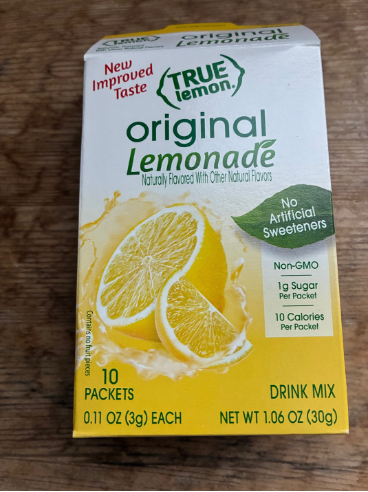
Back to the supermarket. There were many powdered drink brands on the shelf, but they contained daunting innovative sweeteners. Finally, here was this one exception — TRUE lemon original Lemonade Naturally Flavored drink mix, shown below. This 1.06 oz. box came with 10 little packets. Each packet is sweetened with 1 gram of plain cane sugar, with some stevia. Friends, this lemonade powder was a great investment. It helped me drink all those doses in comfort.
Side note: for this experience, it helped to wear comfy surgical scrub trousers with an easy to unfasten drawstring, and to stock the bathroom with edifying and inspirational books.
After all the doses, and in between, we’re instructed to drink water and clear liquids. Gatorade is recommended, but at our supermarket it comes only in large shrink-wrapped plastic lots in vivid blue and green colors. Luckily I was able to find a bottle of untinted no-flavor unsweetened Gatorade sold as individual bottles. (Thank you, dear Mom & Pop Korean grocery!) Unflavored Gatorade is a little odd, with a faint quality like the scent of fabric softener at a laundromat, but my body found it very heartening. The white grape juice and coconut water were a real help too.
For the next procedure, a few years from now, as soon as it’s scheduled I’ll run right out and buy all of these right away.

Step 10: The Big Day
Early in the morning I drank the final doses and lots of water. I shined up the kitchen and bathroom. I prepared a small simple light supper for after the procedure, to avoid knives and stoves while recovering from anesthesia. I made up my bed roll, and laid out sleepwear ready for immediate bedtime. I put away my cell phone and wallet and office keys. I showered and dressed in comfortable clothes.
I took my apartment keys, the empty prep jug, the bin of empty containers from all the clear liquids, an exact food journal from the pre-prep days, and the dosage schedule with all the times checkmarked. That’s in case the medical team asked anything like “So what have you been eating? What is your idea of a ‘clear liquid’? Did you drink your formula?” I added a printout of the parking instructions, plenty of cash and a quarter roll, my hospital binder of medical history, and a heavy blanket.
Dear Sandy showed up early, right as rain. “Blanket??” she asked. I folded up the blanket as a seat cushion, explaining that even when a person is all wrung out by this process, they don’t want to risk an old friendship and a new car. Sandy raised her hands in surrender. She is familiar with my mode of operations by now. She eyed all my gear and data without comment, and listened respectfully to my reassurance that I had interviewed the parking attendants in advance. As we pulled away I said “Oh no! I was going to give you a book by Timothy Snyder at Yale University. Please remind me after the procedure, and I’ll give it to you then.”
Parking was easy, and I was proud of knowing the exact location of the elevator to the clinic. We checked in at the reception desk. As always, I’d stored up maximum anxiety in advance, prepared and fretted at every stage, then was astonished and overjoyed when the day didn’t leave me sitting in hell in a handbasket. That made it a special pleasure to meet the team.
The colonoscopy team is a very high-morale outfit. Unlike the ER, this is not a place where anyone is rushed in with a crisis. Patients are vetted and instructed and scheduled well in advance, and this is not in general an emergency high-risk procedure. (It probably also earns the hospital a fair income; according to the chart notes, from start to finish my colonoscopy took 18 minutes.) The medical team whisked me in, saw no need to inspect my empty juice containers or checklists, and settled me in bed. One kindly medical assistant helped me stow my stuff and to robe up, one started an IV for the fentanyl and midazolam, and the doctor came in for a final final check. (I showed her my hospital binder, and pointed out my POLST form.) The team seemed to sense that this patient appreciates good humor, and they were ready to comply.
A truly wonderful anesthesia nurse came in to explain the program for the day, and they wheeled me to the procedure room. There, the sound system played a 1983 hit by Sting and the Police. “Oh, so is that the Anesthesia Nurse theme song?” I asked her. “‘Every breath you take, I’ll be watching you.’?” She laughed “Yes it is, and yes I will! And what is your favorite music?” I figured she was asking out of courtesy to put at me at ease, so I said “Russian Orthodox chant.” She said “Great! So… like Fleetwood Mac?” I said “Yes, exactly.”
So while they adjusted the equipment and my IV and draping, in the half minute of down time waiting for the doctor, they team broke into an impromptu happy dance while we all sang along with Fleetwood Mac’s “Seven Wonders,” which given the context was a pretty amusing song choice.
The doctor came in all enthusiastic about getting started, and said “Now first I’ll make an initial exam before we insert the camera.” Sure. I was about to give her consent to do just that. But then somehow this was the parking garage again, and there was only a warm instant of memory of the doctor saying with a cheering smile that everything looked normal and fine, and we were done.
“It’ll be ten dollars,” said Sandy, replying to something I must have said.
I handed her the money and thanked the attendant for our parking experience. “Sandy?” I asked. “Am I stoned right now?”
“Yes,” she assured me, and we headed home.
Back at home I snipped off my patient ID bracelet, and set the prescription jug in the pantry. (In the event of an adverse reaction the batch number on the jug has to be reported to the pharmacy. There was no reaction, so three days later I peeled off my medical ID label and threw the jug in the recycling.) I settled into bed with my sweet potato and miso soup, and slept deeply for four hours. Waking up, I packed my wallet and office keys and then remembered the Timothy Snyder book that was supposed to go to Sandy. Oh no! I looked at the shelf. The book was gone, leaving a little gap in its place. I must have given it to her, meaning that she must have walked me upstairs, which was very thoughtful of her.
A couple of lessons remain.
One, the days of refined foods and fasting (and then a day or two of medications wearing off) made it more difficult to plan and execute the sequencing of steps in a task. For example, I set up hot soapy water and my scrubbing board in the kitchen, but really should have fetched the handwashing first to save steps. Sequence makes meaning and carries consequences for the result of a project. Well, at times in my life there have been people making choices without thinking ahead to the results, eliciting the question “What were they thinking?” Sometimes people caught those moments in time and/or noticed and repaired the result to do it differently next time, but not always. Well, it was humbling to realize how little it takes for my own sense of sequence and consequence to be thrown off track.
Two, remembrance can be a tremendous gift. We have the potential to commit events to memory, to store and retrieve the memory, then to articulate and create meaning with it and share that meaning with others as part of deep human connection. When people remember important events in my life, it makes me feel connected. When life-altering events are forgotten or unnoticed by people who matter to me, it can feel as if my life either didn’t matter, or just didn’t happen. Well, perhaps there are moments when that knack is out of their hands. After leaving the clinic I didn’t even remember putting my pants back on. But the someone doing it must have been me, because when I got home my lymphedema bandages were all perfectly wrapped and fastened in place. I did thank Sandy later for her company that day, but did I ever say “Thank you” when she dropped me off? No idea. (I did text her that night feeling anxious about the parking. What did I owe her? How much was it? “Ten dollars,” she texted back. “You paid the attendant.”) Remembering is a high-level ability, and is more fragile than it seems. I feel committed now to preserving that ability as much as possible.
There was a lot to be thankful for too, to Sandy and everybody on the team. Later that week I typed up thank you notes for the doctor and the anesthesia nurse, telling them what was especially helpful about their care. I taped the notes to cards, and dropped them at the clinic in observance of our day of Seven Wonders.
 consolationland