- A young man with long hair had staked out a busy corner. He had many layers of clothing and luggage and a sleeping bag, trying with eager anxiety to catch the eye of people walking by. Making the snap assumption that he was selling our street empowerment newspaper, I took out a couple of dollars. But at closer range it turned out that he was holding up not a sample issue and ID badge, but a cardboard sign that he needed to raise $20 to buy lunch. I gave him the $2 anyway. As is often the case, what he wanted was not just lunch but a conversation. He had a bright-eyed avid look, ready to ask advice and counsel from anyone who decided to stop.
“Thank you!” he greeted me joyfully. “Say, I’m from Florida. I just arrived in town. Tell me — how come people in this city are so unfriendly to the homeless?”
“They probably don’t mean to be,” I told him. “They are just concerned with their obligations and tasks. Head down, powering through the day the best they can. So, Florida? Are folks more friendly there?”
“For living on the street? Whoa!” He raised his hands in a protective gesture. “Florida’s downright dangerous. But say, why is the food here so expensive? Can you guess how much I just paid for a bottle of Kombucha?”
“Ah, no. Can’t afford Kombucha.”
“Oh. I’m sorry! I have to. I can eat only certified organic foods — dairy-free, gluten-free, soy-free.”
“Gosh. That makes it complicated for you, for sure.”
“It does. How do you get by, living here? What do you eat?”
“Well, at Christmas the store had a sale shelf of mixed dry beans, 99 cents a pound. I made a couple trips and bought 20 pounds for $19.80. Still eating on them, a big potful every week. And bargain shelf from the B-Grade produce stand, whatever is left on Saturday nights and needs cooking right away; they always have organic greens. And grain from bulk bins.”
“I’d love to buy rice,” he said. “But I can only buy those little instant plastic rice packages from [Local Zen Spendy Store], because they let me use the microwave. See other stores don’t let you do that.”
At that point other older neighbors saw his sign and stopped to chat with him and share dollar bills, so I headed off to mail a birthday card. It made me think. The absolutely harrowing difficulty of living on the street is well beyond my ability to imagine anyway, but it dawned as a new idea that buying food for life outdoors without a kitchen has to be way more costly. One more way that our food supply is all cattywampus.
He was such an eager young man, really hanging on every word that anybody said to him; clearly he wanted lots of company. Five years ago he could have gone to our public kitchen for young people like him, ages 18 to 25. They could come indoors for a hot breakfast and a hot supper and socializing with the staff. Whenever our workplace had catered events, I’d call their kitchen and then we’d drop off trays of food. I volunteered for their kitchen one time, putting supper together and eating with the guests. That night I woke up good & sick with Covid, and then the whole city locked down. That kitchen valiantly stayed in operation, but since the pandemic they have to refuse all fresh or cooked food (at our last visit the kitchen staff apologized profusely, and helped me take our trays of wrapped assorted sandwiches and pitch them in the compost). Now they’re only authorized to hand out sealed packaged snacks and beverage bottles with no more in-house hot meals or shared community. It’s one more thread of social fabric that has unraveled and disappeared.
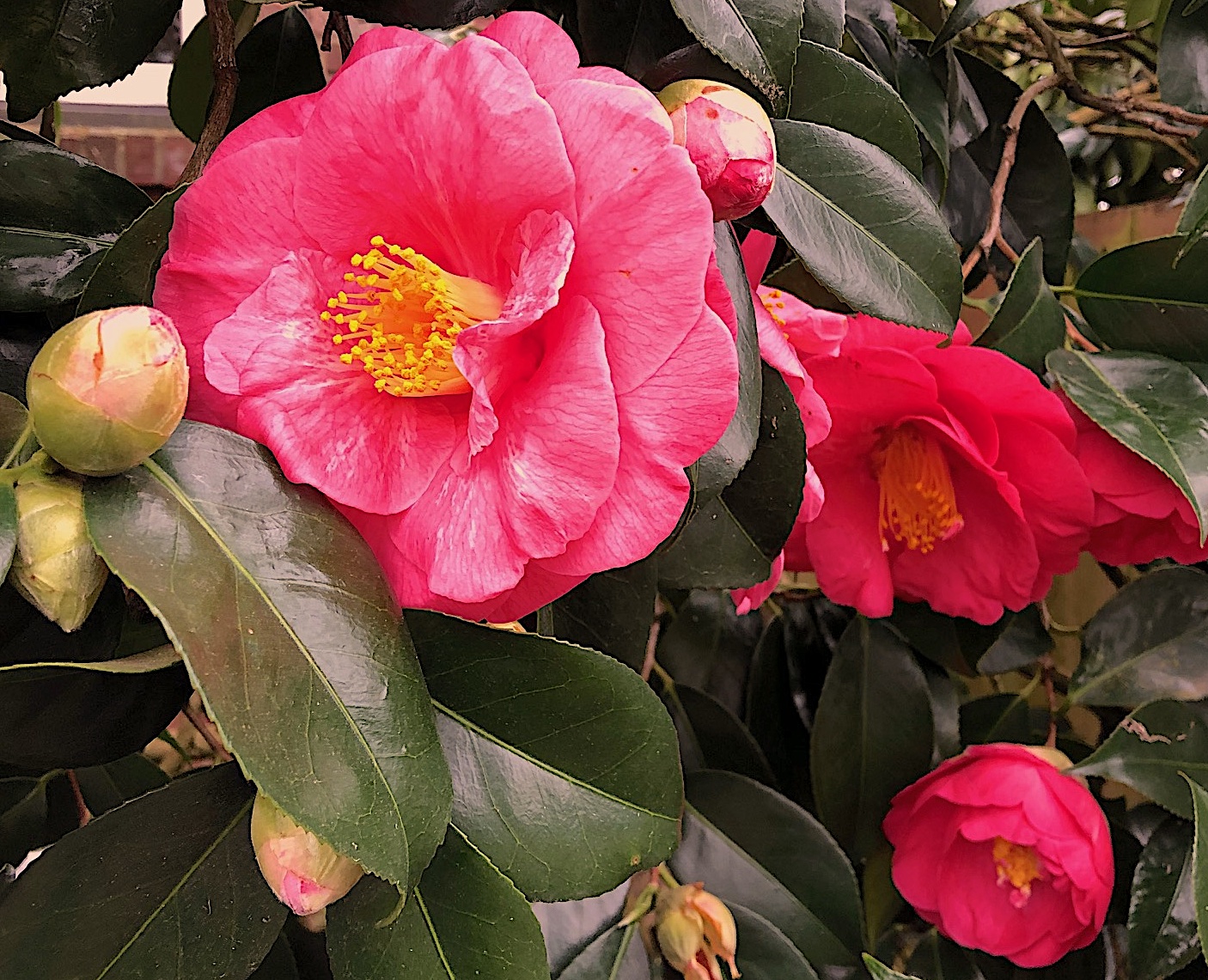
2. I was kneeling on the ground looking for just the right angle to photograph a glorious rose-red camellia tree growing right through a wooden picket fence, against a pleasantly weathered little house in the old style — high pitched roof, deep set windows and doors, wraparound porch, little gables peering out from dormers and eaves.
To my chagrin, the door popped open. A man strolled out to light a cigarette, looking serene and composed, pondering the sunlight. I jumped up from the other side of the shrubbery and hastily complimented the tree, then asked his permission to take its picture. He gave me a friendly nod and a shrug of assent. Then he told me the history of this century-old house. His family had lived here and worked in the grand old theater downtown, producing musicals, operas, and ballets. He grew up backstage, learning the business from taking tickets and coats to working the popcorn machine, and kept up the whole family legacy — handmade costumes, lighting, backdrops, sound, musicians, staging.
For the next hour it was like a show right there, standing on a carpet of camellia petals in that dooryard, listening to him weave a whole spell of those grand theatrical productions.
I burst out with a lot of ideas to throw at him, things I’ve always wondered or marveled over, the backstories of movies and plays and their technical effects. Like, at one point I said “Now that backdrop you described sounds like…” I named an Orthodox church that I’d seen once, and told him all about its magnificent interior.
He laughed. “When the pandemic cancelled our whole season, for the subscribers we picked that church. I did the staging for the company to film a short feature film there.”
Unlike so many experts, he didn’t just roll his eyes and brush off my ideas. Naturally he’d heard all the stories, lived with those special effects, created many of them himself, made it all happen. But he just smiled in recognition, and added details I’d never dreamed of about just how much work goes in to the kind of production that true fans will remember for the rest of their lives. “For [classical world-famous epic] we had 220 stage hands and 78 tractor trailers of props for the scene changes, all made for that production. And at the end, where do you store 78 trailers? There’s no warehouse here large enough. We had to destroy it all.” He thought it over. “I’ve been very very fortunate. Raised in a career that I truly love, with the chance to work in it for a lifetime. By the way, that necklace you’re wearing is gorgeous.”
“This?” It’s beads on a little leatherette string. “Got it yesterday for a dollar. Church thrift shop.”
He shook his head. “Every bead of that is worth more than a dollar.”
“Oh. Are they glass?”
“Stones. Semi-precious, some of them.”
We wrapped it up when it occurred to me that “With all you have to keep in mind, you must have things to do. And here you just stepped outside for a quiet cigarette! Thank you for talking to me about the bigger plot unfolding back behind the curtain. I’ll bet the hardest part is working with all those personalities — performers, orchestra members, cast and crew, audience. So much. No wonder for his crew’s backstage snacks, David Lee Roth specified the color of the M&Ms.”
“Right,” he laughed.
“Creating those 78 tractor trailers, and letting it all go? That’s like a mandala.”
“Exactly.” We waved goodbye.

3. The Cable Guy was due at 2:00. The day before I moved my bookshelves and everything else well out of the way of the entire cable wire, dusted the baseboard radiator, worked the carpet sweeper, cleared off the computer table and the entry hall, had the new gateway router ready for him and a plastic bag so he could carry off the old router conveniently. I made sure everything was ready an hour early, at 1:00.
He called me at 1:07, a young man with an Arabic name. He’d reached my street, and was it okay to show up early for this call to the fourth floor?
Sure. I met him downstairs. He was just jumping out of his truck with the company name all over it and a tall ladder folded on top.
“Oh, you don’t need to use the ladder,” I assured him. “Let’s just take the stairs.”
He gave me a concerned look, and then had a good laugh.
We exchanged the usual pleasantries on the way upstairs. Taking a guess that he was Muslim I left my door propped open for his comfort. He immediately took off his shoes and left them outside. In about two minutes flat he swapped out the routers. Then he stood in silence at my side for twenty minutes, tapping a whole series of functions on his phone. “Diagnostics. Testing the connection,” he said. “Sorry. Takes a few minutes. So, are you from here?”
“No, New York.”
“What is your heart for New York?”
“My heart?”
“Yes! Like, think ‘New York,’ and what is your childhood thought that your heart is for New York life?”
“My heart remembers people being very religious. Every day at noon it was time for the Angelus prayer, to think about Angel Gabriel appearing to Hezrat Miriam. You’re driving in your car? Pull over and say the prayer. You’re a man wearing a hat? Take it off and say the prayer. The church bells ring for noon? Stop on the street and say the prayer.”
“Really? Unbelievable.” Tactful hesitation. “You know… New York? Not like that any more. Ok, your connection is all good.” He picked up the old router.
“It’s 1:28 now. Well that was fast. And what is your nice accent?”
“My what? Oh! It’s uh…” Pause. “Well, it’s… well, I’m from Africa. North Africa that is.”
“Oh, sure. Okay.”
Pause. “Country called ‘Libya.'”
“So you know Mohamed Bzeek?”
“I do. Do you???”
“Only through the news. I looked him up this morning to check on his health, since he’s had cancer. And no family to care for him.”
“No! Cancer? He brought home and cared for so many of the dying children! So many.”
“Yes, like 80. He takes babies in hospice care. At one point, people started a fund for him and sent him money. What did he do with it? He bought an air conditioner for the babies, so they can rest in comfort. That man will enter Paradise ahead of us all. Our favorite Libyan.”
Downstairs at the front door, we exchanged a handshake.
“Shúkran djídan, thank you for your call. Ma’a salaam.“
“Ma’a salaam. You know… Mohamed Bzeek. It’s kindness like him,” he concluded. “It is our only hope for the life.”
 consolationland
Beautiful! Thank you for sharing your experiences. I love what the cable man said as he was leaving, “It’s kindness like him…It is our only hope for the life.” And the flower photo is beautiful, too.
Namaste and blessings,
Wendy
Wendy, hello! For me that is where the little sacramental moments are; just welcoming the cable guy. And then we string the moments all together and knit some social fabric. As always, thank you for this sacramental moment of seeing your message! Night night, m