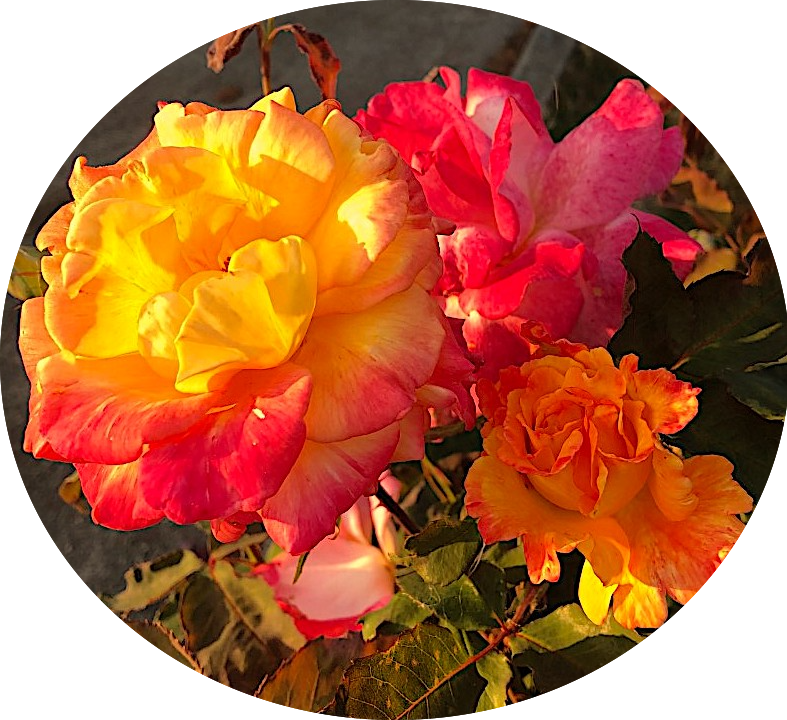
Father Jerome’s roses are all in bloom right now. They’re a lovely memorial to Father’s many years of toil and care for his garden in honor of the Blessed Virgin. Even more important, to me they’re an annual reminder of how those roses brought us together after our big fight.

Some 18 years ago I slipped in to a Catholic church in my new city for a first visit. There in the vestibule was a stack of handsome little ornate cards as ceremony souvenirs, announcing the ordination of a certain Father Ambrose, with what might be his life verse: Paul’s Letter to the Romans, 10:14
How then shall they call on Him in whom they have not believed? and how shall they believe in Him of whom they have not heard? and how shall they hear without a preacher?
The cards are a nice custom, a keepsake for the family and friends at an ordination, and an invitation to us parishioners to pray for the new priest. I smiled, took a card, and stepped into a pew.
At that early weekday Mass, attended by only a few parishioners, the celebrant was the stately venerable semi-retired Father Jerome, then 77 years old. In his brief sermon he offered an observation that flattened me right back in my pew. It was an artifact of an old Catholic conventional notion dating right back to Pope Pius XII. What was it doing in a sermon, in this day and age? Smothering the urge to leap and up say “Wait! That’s not a Catholic teaching!” I walked out of the service.
Outside, there was a garden of thriving well-tended roses in shades from black to silver-blue to all kinds of extraordinarily vivid colors and shadings; some even had buds in one bright color, then bloomed showing other contrasting nuances of tone. When Father Jerome finally came out of the building I approached with some trepidation to ask about his sermon comment.
“I don’t have time for this,” he informed me with curt formality, adjusting the sprinkler. “I’m going back in to pray the rosary with the people.” He walked up the steps to the side door, and let it close behind him. I stood there feeling even more troubled, ready to quit the premises in discouragement.
Then, an inner guidance intervened, commanding me “Do NOT set foot from this church. If you do, you will never come back. Walk right back in there now and find Father Ambrose.”
Father Ambrose, newly ordained? But he was nowhere in sight at Mass that day. The young priests didn’t spend peaceful weekday mornings with the retired faithful, lingering to pray the Rosary. The young priests were sent off to the four winds at a run all day, to serve and assist at multiple Masses, to give theology and philosophy lectures on campus, to visit hospitals, to hear confessions, and much more.
But out of obedience to that inner intuition I walked around to the far side of the church, away from Father Jerome, and pulled open a door to the back dark corner under the old choir loft. There was a young priest, waiting with folded hands. “Hello, good morning,” he greeted me. “I am Father Ambrose. Can I help you?” He held the door for me, we stepped outside, and we took a turn along the rose garden.
First, Father Ambrose sympathized warmly with my dismay. After I was all done venting, he set out for me in broad generous terms the history of Father Jerome’s post-war seminary training, the European influence of his elders, the language in which they couched certain sincere yet obsolete world views. He confirmed with care that this particular viewpoint artifact was never Church dogma. Finally he hinted at Father Jerome’s hidden virtues and good works, inviting and encouraging me to take a closer look at the life of his elder priest. As my next step, Father Ambrose urged me to call up Father Pastor right away for a chat, and to return to Mass on Sunday.
In some fear and trembling I called Father Pastor and left voicemail, expressing appreciation for Father N. and also confiding some hurt over the sermon. After signing off from the call, I regretted making it at all. I dreaded the return call from Father Pastor, who might well give me a good scold-out for questioning his priest.
Just then, an old friend from back home called with happy news: he was in my new town on a layover, and was taking me to lunch. On that afternoon we had a sudden record-breaking heat wave, so I changed to a light summer dress before heading out to meet him. I had just acquired my first cell phone, and was afraid that by placing the phone in my knapsack I would miss any return phone call. Where to put it? There was no time for a satisfactory solution; my friend had arrived.
During our lunch, my friend noticed that I seemed anxious and downcast. I told him about the sermon. Then I blurted out, within earshot of other patrons and waitstaff, “If my bra starts buzzing, I have to answer it. It’s my new pastor.”
My friend and I said our goodbyes. Then the call came. Father Pastor introduced himself, and said “Is this Mary? I’ve just left the hospital from visiting a patient. Pulling out of my parking space I checked your voicemail and nearly ran the car off the road. I am beyond sorry that you heard that sermon in our church. It will, believe me, not happen again. Please come back — and next time, come to Sunday Mass at 9:00. I will deliver that homily myself. Come up after the service and introduce yourself. I hope to see you in church soon.”
For the next two years, Father Jerome could be seen working hard, being greeted by staunch-looking long-term parishioners, or working in his garden. And at sight of me, he would level a glare in my general direction, and march away. During that time, I got to hear testimonials about the petals of vivid virtues that grew from his thorny façade. Years before, he had noticed that a number of men lived nearby at a highway overpass; over time he began striking up conversations and getting to know them, and when men knocked on the door in hopes of a chat and perhaps a snack, Father would hurry to fix a sandwich and coffee and then share the time of day with his visitor. Once I was walking through the snow to early Mass; struggling up the hill there were several elderly men with clearly difficult lives and precarious health, and one of them began cheering on his companions by chanting out “I smell FOOD. I smell FOOD.” Another petal of virtue was his legendary courage in military medical service, then his years nursing wounded veterans, and his many years of work as a hospital chaplain — especially to patients with no tolerance for priests, but who had no other visitors than this old salt who kept stopping by to keep them company. Yes, Father Jerome’s crusty exterior hid a soft sweet heart for the poor, the elderly, old soldiers, young children — everyone, apparently, but me.
One day, an inspiration came to mind. I sat down in the rose garden one day after work with paper and colored pencils. It took six weeks of visits and several false starts and failures, then more weeks of finishing touches at home. But finally when the roses were all gone for the year, their images were blooming again in my picture just in time for the Feast of the Immaculate Conception of Our Lady. I made a dozen color copies, put them in an envelope, and waited after Sunday Mass. When Father Jerome stepped outside in a whole group of parishioners I darted up and handed him the envelope before he had a chance to realize who I was.
“What is this?” he demanded sternly. Then he saw his own name on the envelope. He gave a cautious look inside, and pulled out an image of his rose garden. “Oh! Beautiful, beautiful,” he marveled softly. Then he walked me around, pointing out the different bushes all neatly trimmed and mulched for winter, telling me all about what each one needed, and how he planned to care for and expand the garden come spring. During our talk, Father Pastor stepped out of church. Seeing Father Jerome and I joined in earnest companionable discussion side by side, Pastor did a classic double take. “HI Guys,” he exclaimed in astonishment. “And Girl.”
Father Jerome lived to be 91 years of age. He had more productive years to befriend the men who so enjoyed his soup kitchen, years to visit the sick who didn’t know how much they wanted a visit, years to nurture the roses that to this day form a riot of color all along the church grounds.
Toward the end of his life, one day I stopped by the church to take some flower photographs. At first I didn’t notice Father Jerome, stooped behind some shrubbery in his plain black work clothes. Intent on clearing some weeds, he didn’t recognize me. But he did take notice of my interest. “Do you like flowers?” he asked me. Then he gave me a thorough tour of the entire grounds, introducing the roses by name like old friends. We had a peaceful stroll that day, sharing our wonder at these beautiful blooms.
“It’s hard to choose a favorite,” I told him. “The colors are beautiful on their own, but even more beautiful as they highlight the contrasting colors all around them. Each color shows the beauty of all the others.”
“All of these roses grow in honor of Our Lady,” he assured me. “Their beauty is from her, and for her.”
He headed for the faucet, to start watering them all.
 consolationland