Every day, walking down the street or waiting at the bus stop or passing a weedy lot that at first glance seems unattractive and dull, I feel so fortunate that they all feature some kind of plant right nearby. Whenever there is a moment or a bit of ground, it’s good to look at plants and to learn them one face and name at a time, and to marvel at them all.
A special interest is, how do people recognize or decide which plants are welcome? Which ones belong where they bloom?
Nature and plant devotees have a social image of being peaceable folks. One might think that fondness for plants would always draw people together. It came as a surprise, to read and hear that plant people can differ about which plants belong in our local habitat, and which ones do not. There are good collegial and neighborly relationships which have frayed apart over this issue. One native plant advocacy group were called “purist Nazis” because they wanted to preserve a restoration site for only those plants which flourished before the city was founded. Another example of the complexity of these debates came from a bulletin courtesy of our dedicated and sincere local extension service. They advised that from now on, the Syrian Bean Caper Zygophyllum fabago should be called just Bean Caper; it reasoned that former names like that one had a nationalist and exclusionary origin, and could stoke xenophobia. But it gave me a chuckle to see that the same extension service cautions about the invasive nature of Russian thistle, Canada thistle, and those pesky English holly and English ivy.
Our food coop, an upscale place with very conscientious product sourcing and social awareness, has a lovely display of Chameleon plant for shoppers to take home for their gardens. They probably don’t know that the dear little thing happens to be classified as an “extreme invasive”:

Chameleon plant is a variegated cultivar of plain green fish mint (Houttuynia cordata), which has cheerfully spread all through our little vegetable patch. (Our fish mint makes a sturdy ground cover, and Mrs. Wing will harvest the roots in the fall for traditional Chinese medicine remedies, so for us it’s all good.) But both have a habit of taking up all the space they can.
That’s a complication in deciding which plants belong here: our nurseries can make a good profit stocking plants which easily jump the garden wall and take over whole landscapes, because many are attractive and reasonably priced and easy to grow.
It’s surprising to discover that some plants which strike delight and awe should be grubbed out and dumped in a garbage can. A neighbor’s yard holds this treasure, with its hooded flowers and showy stalks. Until today I thought it was some rare woodland Jack-in-the-Pulpit. But yikes! no, it’s poisonous toxic Italian Arum (Arum italicum) or orange candleflower, classified as a noxious weed. Don’t even touch without gloves! Keep the kids and dog away!

Adding to more confusion, some other invasives were introduced deliberately as food plants which then got out of hand. There is one local that I’d like to find but will not name or picture here; apparently it’s a healthy cruciferous with good flavor. It would be nice if we could just harvest it into extinction. But I won’t forage any until I can go with an expert. It’s not safe to pick stuff and taste it without solid knowledge.
This morning for the last day of spring, I took an early walk at a favorite small pond. It used to be a weekly year-round destination to a neat clean little body of water. But today I didn’t recognize the place. It was so choked with brown algae and green scum that the herons and usual water birds were nowhere; a few Mallards hung around, but instead of swimming they were huddled on a bit of mud flat. Along much of the walkway, the water wasn’t even visible; there was a massive amount of invasive thorny Himalayan Blackberry about fifteen feet high, along with invasive hedge bindweed, spotted jewelweed, butterfly bush, knotweed, and unfamiliar new plants like the ones below.
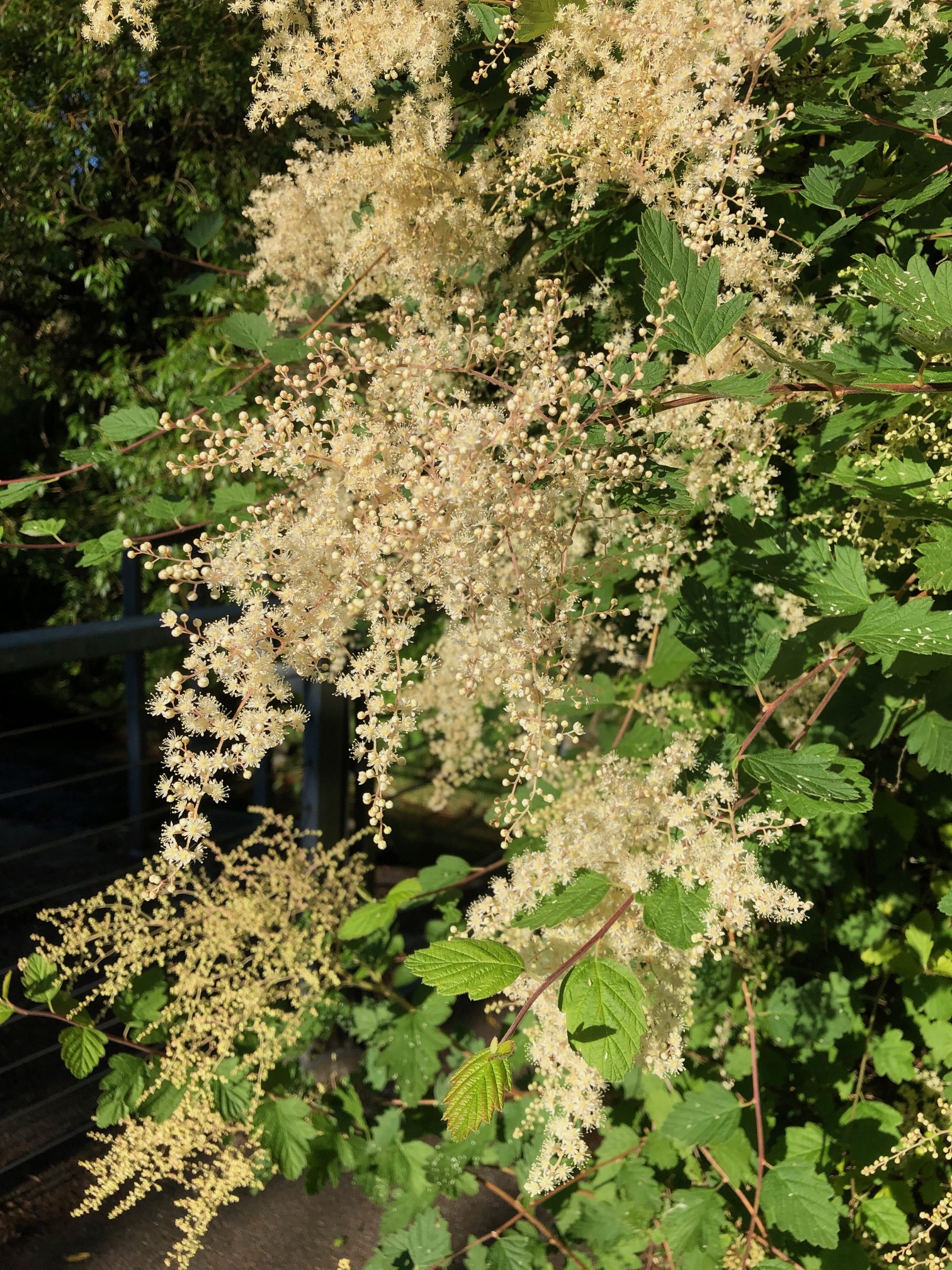
The hardwood forest side of the pond is muffled up with masses of this white-flowered overgrowth. Silver lace vine? Goat beard? Old man’s beard (wild clematis)? Some kind of knotweed? None of the on-line images quite fit. There certainly is a lot of it.
Update: This might be Ocean Spray (Holodiscus discolor), a native shrub. The wood has been put to many uses, carved into utensils and tools.
Scruffy little yellow-flowering trees have taken over one bank. It looks like a member of the legume family, some of which are poisonous, so I didn’t touch it.

My guess on this is Hardhack or Spiraea douglasii, in its fluffy cotton candy season. It’s crowding around on the shore. The county extension calls it “aggressive” when grown under moist conditions.

What could have happened? At our local pond, there was an army of retired folks who really knew their animals and plants. Their houses adjoined the pond, and one of them even donated the land. They were out there every day at all hours with their cameras and dogs, checking on the system; I once saw a group of them with butterfly nets, patiently scooping up algae and bagging it up for the trash. But those neighbors were in their eighties and nineties; perhaps they don’t have opportunities to cut down these out-of-balance plants any more? Now I’d like to find out whether anybody is still keeping an eye on the property, and whether there are cleanout days planned.
A lot of nature seems off kilter at the moment: cropland coping with feral hogs, songbirds coping with pet cats, the Everglades coping with pythons dumped out of aquariums, on and on. One python hunter made an excellent point: “The pythons didn’t ask to be here.” And when it comes to invasives, a compassionate co-worker reasoned that when a plant is thriving in its very own habitat, then it co-exists peacefully with a whole range of other plant types, and the necessary insects and animal predators that keep the whole ecosystem in check. When the plant is part of a supportive network, everyone can thrive. But when a plant is torn up and dragged in to unfamiliar turf, it has lost its original connections. Then its survival is more precarious; to grow at all, it has to grab up all the space it can.
Her view is very compassionate. I don’t feel that compassion yet for the Poison Hemlock taking over our main walking trail, but she has a good point. It also makes me wish for some picture of what our lovely landscape looked like in former times, in all its lush variety and balance, before just a small handful of species were dumped here and started rampaging around.
Here is the delicate social balancing act: in order to honor and protect our unique indigenous native plants, perhaps we really do have to make some firm decisions about which plants belong in one defined area, and which do not? After all, we know that for good health our inner microbiome needs a rich assortment of bacteria so that disease-causing strains don’t take over. I used to be delighted at the sight of a uniform carpet of Yellow Archangel or Herb Robert or Shiny Geranium blooming in a whole colorful patch. But now I know: that kind of uniform thriving prettiness probably means that some other plants got crowded out.
That pond walk was food for thought. It inspires me to learn more about our changing ecosystem. Hopefully I can help with good plant stewardship to cultivate balance, for the sake of the plants themselves and the creatures around us.
 consolationland