
Feeling Good: The New Mood Therapy, by David D. Burns, MD, 1980
Huge Disclaimer: This little essay has nothing to do with the millions of people experiencing world disasters and life-and-death emergencies; and there are certainly times when severe depression requires immediate medical help, and/or an immediate change in circumstances. This is only a reflection about chronic depression affecting even people in the most comfortable and peaceful surroundings.
Another Disclaimer: Loved ones in my acquaintance report their strong conclusions that anti-depressant medications have saved and transformed their lives. Dr. Burns devotes pages 474-681, plus copious references, to these medications and their efficacy as an option, so that patients can be more informed consumers.
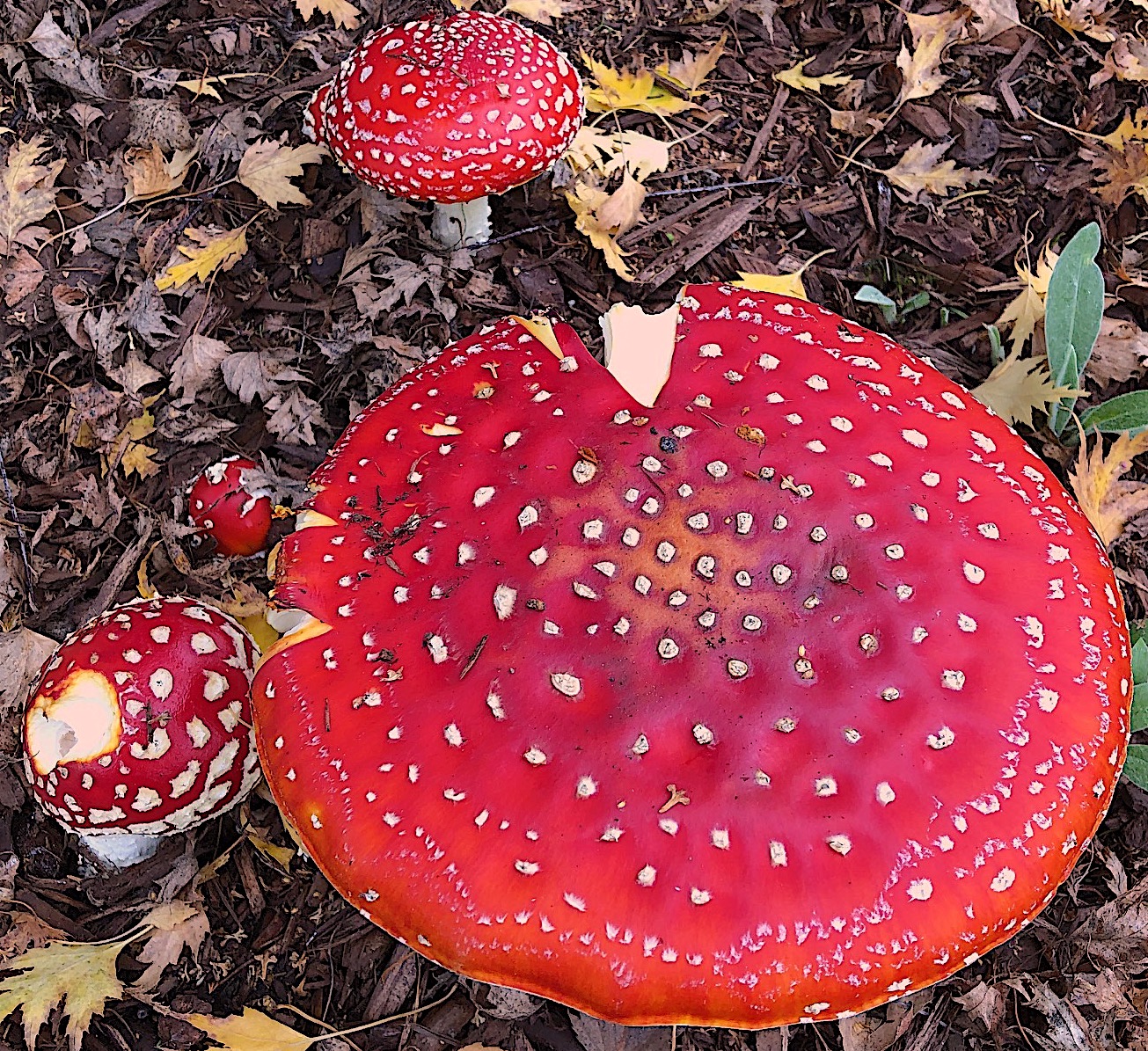
(This is not a psychiatric medication. It’s just some Amanita muscaria growing outside on the curb.)
Every year as hours of daylight wane, I treat myself to a re-reading of this classic text. On a dark and stormy night, especially around the holidays, there’s nothing like curling up and finding hearty laughter in a book about depression. The author’s humility, his honest admission of his mistakes, the lively dialogues that talk back to depression, and his cornball humor make this a pleasant heartening read.
The book’s message is that thinking patterns can play a role in triggering depression. In Chapter 3, in Table 3-1, there is a list of ten standard Cognitive Distortions (such as All-or-Nothing Thinking, Overgeneralization, or Disqualifying the Positive). These hurtful thoughts can loom across the sky like immense dragon floats in a parade. When people are living with depression, these thought glitches may well be the snares in the quicksand that weigh down their mood. If we recognize the common distortion thoughts and then learn simple techniques to defuse them, this can lighten our spirits.
This sizable book is packed with explanations, exercises, true stories, and encouragement for defusing the ten cognitive dragons. There is practice with reality checks, manageable little action steps, and self-compassion throughout. The author’s presentation of these tools is respectful, personable, simple, and clear, with a light warm tone.
In Chapter 5, the author deconstructs the old assumption that people shut down and freeze because they enjoy suffering. He suggests a homespun diagnostic called The Paper-Clip Test: pressing the end of a paper clip under one’s fingernail, while asking “Is this really enjoyable? Do I really like to suffer?” If you’ve been lectured enough times that you enjoy being depressed, this is good for a healthy guffaw right away. In the same chapter, he addresses patients overwhelmed by the prospect of the many life tasks waiting to be done. He reassures them that at dinner, they need not plan ahead for the oceans of food and liquid that will need to be swallowed in the course of a life; they need not lose hope and say “There’s just no point in eating one pitiful hamburger tonight.” The same chapter offers the hourly Daily Activity Schedule technique of planning a day with small worthwhile tasks, and with plans for pleasure and fun. He proposes this in particular for the “weekend/holiday blues” experienced by us single people — the cognitive distortion that being alone will mean a dull discouraging day. This quote is my personal funny-bone favorite.
You stare at the walls and mope, or lie in bed all day Saturday and Sunday; or, for good times, you watch a boring TV show and eat a meager dinner of a peanut-butter sandwich and a cup of instant coffee…. Would you treat someone else in such a sadistic manner?
Another real knee-slapper comes up in Chapter 8. There Dr. Burns applies self-compassion to successfully lose excess weight. His greatest calorie temptation was ice cream at night. To deflect this thought, he would promise himself that if he refrained from ice cream, “I could reward myself with a big, fresh, glazed doughnut in the morning and a box of Mason Dots [gum candy] in the evening.” As an extra compassion benefit, even on nights when he succumbed and ate the ice cream he would still eat the doughnut-and-Dots reward! Thanks to the extra ration of comforting self reassurance, this wacky diet resulted in a weight loss of 50 pounds, and an annual holler of mirth for me.
For the author’s TEDx Talk, you can search YouTube for this title:
Feeling good | David Burns | TEDxReno
It’s a worthwhile use of 18 minutes. Here he describes his early dedication to tracking down and prescribing the right antidepressants for his patients, then the revelation of learning cognitive-behavioral therapy as an additional technique. This inspired him to write the manual of straightforward steps that patients can use themselves. I love the moment in the talk when he talks about his patient Martha from Latvia, and he becomes choked up when he expresses his admiration for her courage. As a bonus, the talk contains an open-hearted personal story and a lovely surprise ending with his son Erik.
Tomorrow the book goes back to the library, but the good exercises and zany sweet jokes will be a good influence all year.
 consolationland
Hi Mary,
I’m in my 70s and have been doing recovery for trauma for many years This was one of my early “bibliotherapy” books, the first of many. Thank God (Loving Higher Power), books, therapy, ACA, Al-Anon, supportive friends and family (minus family of origin) and the “Oldest, Wisest part of me” I’m emotionally and spiritually healthier than I was back then.
I’m so old I remember Transactional Analysis—parent, adult and child! I came back to ACA fairly recently and have been very pleasantly surprised by the new literature that has incorporated the best of everything I’ve done in my years of recovery and study. They even have new groups for c-ptsd in which many of the attendees have been in recovery for years.
Namaste and blessings,
Wendy
Dear Wendy, All of those methods you mention are old friends — including Al-Anon with two fierce but loyal lady sponsors. And yes, your long-term recovery wisdom really comes through when I read your posts. Since the book is from 1980, are people hearing about it in therapy any more? Hopefully so. It’s nice to share the journey with you. Blessings, Mary
Thank you for writing this.
Dear Anonymous, Thank you for being here! It was really a nice experience to flip through this book again and review the ideas, and write up some appreciation for Dr. Burns. Welcome to the blog, it’s very nice to see your message today. – Mary